

Cesarean Delivery Recovery Week by Week: Walking, Incision Healing and Lifting Limits

Key Takeaways
- Hospital stays after a cesarean typically run two to four days, and the first assisted walk usually happens within hours of surgery (NHS; Mayo Clinic).
- The skin along the incision generally seals within about two weeks, but the load-bearing fascia and the uterus keep healing for six weeks and beyond, which is why lifting limits outlast how you feel (Mayo Clinic).
- Non-dissolvable stitches or staples are usually removed around five to seven days after surgery; dissolvable stitches and glue need nothing done (NHS).
- Vaginal bleeding after a cesarean is lochia from the uterine lining, not the incision, and can continue in changing colors for up to six weeks (Mayo Clinic).
- Numbness in a band around the scar is common and can take months to improve as small skin nerves regrow (NHS).
- Driving is generally considered once you can brake sharply without pain and are off medicines that cause drowsiness: a functional test, not a fixed week (NHS).
Most people spend two to four days in the hospital after a cesarean, walk short distances within the first day, and feel steadier by week two. Incision skin usually closes within two weeks, while deeper layers keep healing for weeks. Lifting is typically limited to the baby's weight until the six-week postpartum check, and full recovery is often quoted as around six weeks, though it varies.
Day four. You are standing at the kitchen counter for the first time since the birth, one hand pressed flat against a dressing you have not yet dared to look at properly, the other holding a phone open on a search bar. The baby is asleep. The house is quiet. And the question is not really “what happened to me” but “what is supposed to happen next.”
That is what a c section recovery week by week guide should answer, and most do not. They list weeks like a syllabus. They rarely explain why day three can feel worse than day one, why the skin looks healed long before the body is ready to lift a car seat, or how anyone is meant to know what “gentle walking” means at ten days.
This explainer follows the layers of healing as much as the calendar, because the two do not move at the same speed, and understanding the gap is what keeps people out of trouble.
What a cesarean actually does to your body, layer by layer
A cesarean: the surgical delivery of a baby through cuts in the abdomen and the uterus, the muscular organ that holds the pregnancy, is major abdominal surgery even when it is planned and calm. Roughly one in five births worldwide now happens this way (WHO), which makes this one of the most common surgical recoveries anywhere.
Understanding why it takes time starts with the layers. The surgeon opens the skin, usually with a horizontal cut low on the abdomen near the pubic hairline (Mayo Clinic), then passes through a thin layer of fat and the fascia, a tough connective-tissue sheet that works like the body’s internal corset. The two long vertical abdominal muscles beneath are parted along their midline rather than cut. Behind them sits the peritoneum, the membrane lining the abdominal cavity, and then the uterus itself, which is opened, emptied of baby and placenta, and closed with dissolvable stitches.
Closing happens in reverse. The uterine wall is stitched, the fascia is stitched, this is the layer that carries load when you stand, cough or lift, and the skin is closed with stitches, staples or surgical glue. Most cesareans are done under a spinal or epidural, an injection near the spinal cord that numbs the body from the chest down while you stay awake (Cleveland Clinic).
Each layer heals on its own clock. Skin is quick, the uterus steady, the fascia slow. That mismatch is the single most useful idea in this whole explainer: feeling better on the outside arrives well before strength returns underneath, and nearly every lifting and exercise rule exists to protect the layer you cannot see.
Why C-section recovery week by week rarely runs in a straight line
Ask a room of parents about the toughest stretch and most point to days two and three. The spinal has worn off, the uterus is cramping back toward its pre-pregnancy size in what are often called afterpains, trapped gas is pressing on a fresh incision, and, for those breastfeeding, milk is arriving on almost no sleep. Nobody mentions that the second night can feel harder than the first.

Then something shifts. By the end of week one many people move around the house with less of a shuffle, and by week two the incision is no longer the loudest thing in the room (NHS). But recovery is a staircase with landings, not a ramp. A day of visitors or a long car ride can drop you back a step, and that is not a sign something has gone wrong.
Three separate processes run at once, and they do not finish together:
- Surgical healing of the incision, uterus and fascia, which drives the early pain and the lifting limits.
- Postpartum change that follows any birth, bleeding called lochia (the shedding of the uterine lining), hormone swings and breast changes (Mayo Clinic).
- Life logistics: a newborn, broken sleep and sometimes a birth that did not go to plan.
The NHS describes feeling sore and tired for several weeks as ordinary, with full recovery often taking around six weeks (NHS). The word “around” matters. Six weeks is a checkpoint clinicians use to review you, not a finish line every body crosses on the same day. Some people feel largely themselves sooner; others, particularly after an emergency cesarean at the end of a long labor, need longer. Neither is a failing, and neither predicts how the next pregnancy would go.
Days 1 to 3: the hospital stretch and the first walk
The first walk comes sooner than most people expect. Within hours of surgery, once the spinal has faded enough to feel your legs, a nurse helps you sit, dangle, stand and take a few steps (Mayo Clinic). It feels absurd, you have just had abdominal surgery, but early movement is one of the strongest tools on the ward. It lowers the risk of a deep vein thrombosis, a blood clot forming in a leg vein, keeps the lungs expanding after anesthesia and coaxes a sluggish bowel back to work.
The urinary catheter, a thin tube draining the bladder, is usually removed once you can walk to the bathroom, often within the first day (NHS). Passing urine may sting briefly afterward. Gas pain is the other surprise; it can lodge under the ribs or even in the shoulder, and tends to ease with walking and warm drinks rather than more painkillers.
Hospital pain relief typically layers medicines by class: acetaminophen, which acts on pain signaling in the nervous system; nonsteroidal anti-inflammatories, which dampen the inflammation driving soreness at the incision; and, when needed, short courses of opioids for breakthrough pain. The combination and timing are set by the anesthesia and obstetric team. The goal is comfort sufficient to walk, cough and feed, not zero pain.
The dressing is often left in place for about 24 hours before the wound is checked (NHS). Stays after cesarean commonly run two to four days (NHS; Mayo Clinic), shorter after an uncomplicated planned surgery, longer if there was heavy blood loss, an infection concern or the baby needs extra care. Going home is a decision the team makes with you, based on pain control, walking, eating and the wound, not on the day of the week.
Week 1 at home: the incision, the bleeding and the pain plan
Home changes the questions. Nobody is walking in every few hours to check the wound, so you become the first observer of your own incision.
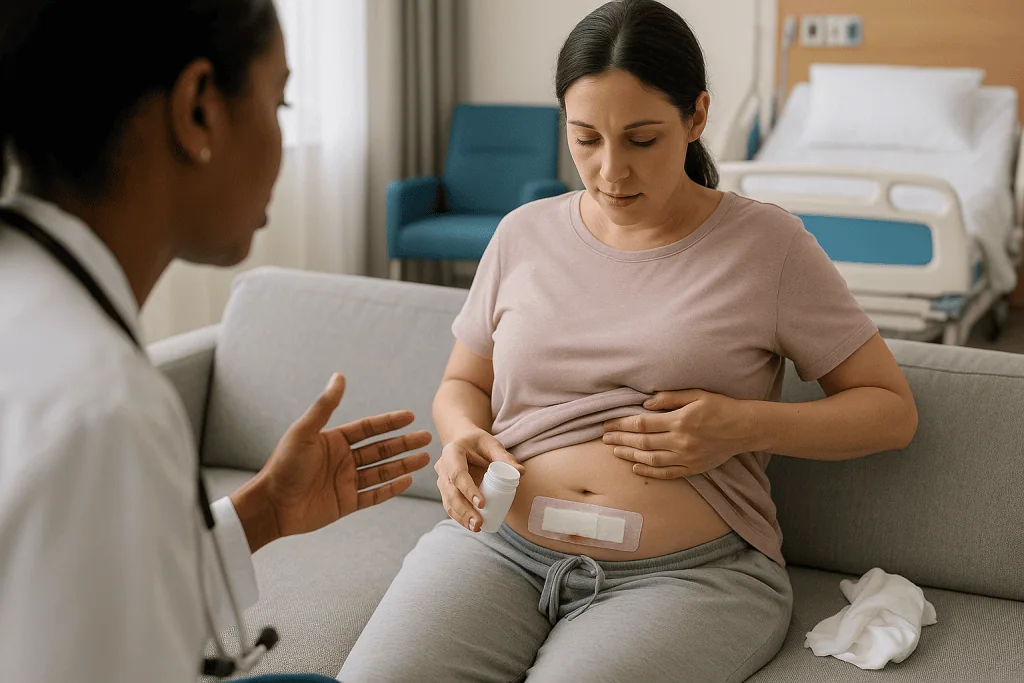
Care is unglamorous: let water run over it in the shower, pat dry with a clean towel and leave it open to the air when you can (NHS). Loose, high-waisted cotton underwear that sits above the scar line avoids rubbing. If non-dissolvable stitches or staples were used, they are usually removed around five to seven days after surgery, at home by a visiting nurse or at a clinic visit (NHS). Dissolvable stitches and glue need nothing done.
Bleeding this week comes from the uterus, not the incision: a distinction worth repeating. Lochia starts bright red and fairly heavy, then over the following weeks turns pinkish-brown and finally yellow-white; the whole process can last up to six weeks (Mayo Clinic). Small clots in the first days, especially on standing after lying down, are common.
Coughing, laughing and sneezing pull on the wound. Pressing a folded pillow against the lower belly beforehand splints the incision and makes a surprising difference. Stairs are fine, slowly, with a hand on the rail; most people find going up easier than coming down.
The home pain plan is usually scheduled rather than “as needed” for the first days, then stepped down as soreness fades, on the prescriber’s guidance. Some people also go home with a course of anticoagulant injections, medicines that reduce the blood’s tendency to clot, when the team judges clot risk to be higher. If that applies to you, the prescribing clinician sets the duration; the useful questions are how long and what to watch for.
Sleep will be broken. Accept every offered meal and every load of laundry; the hands you save are hands for the baby.
Week 2: what to avoid and why the plateau is normal
Week two is where over-confidence creeps in. The skin along the incision has typically sealed, walking to the kitchen no longer needs planning and the sharp pain has dulled to a pulling sensation. It is tempting to conclude the job is done.
Underneath, it is not. Skin closes in the first couple of weeks; the fascia and uterus keep remodeling for six weeks and beyond (Mayo Clinic). The gap between how you feel and how strong you are is widest right now, which is why the second week produces so many versions of “I did too much on day ten and paid for it on day eleven.”
What people are commonly asked to avoid at this stage:
- Lifting anything heavier than the baby, including a loaded car seat or a wet basket of laundry (NHS).
- Vacuuming, mopping and other chores that twist and push through the abdomen (NHS).
- Driving, until braking hard causes no pain and you are off medicines that cause drowsiness (NHS).
- Sex, until bleeding has stopped and you feel ready, which for many people is nearer six weeks (NHS).
- Soaking the scar in a bath, hot tub or pool until the wound has fully closed and the care team agrees.
The plateau itself is ordinary. Energy tends to dip around days ten to fourteen as adrenaline fades, night feeds accumulate and the reality of a newborn settles in. Pain that had been easing can seem to stall. What matters is the direction of travel over several days, not any single one. Improvement that reverses, new pain, more bleeding, a wound that looks different, is a call to your care team, not a challenge to push through.
If your plan includes an early postpartum check around this point, mood, the wound and contraception are all ordinary topics to raise.
Weeks 3 to 6: stairs, driving, the postpartum check and lifting limits
By the third week the itch arrives. Healing skin itches, and the scar may look redder and more raised than it did at week one; that is the middle stage of healing doing its work, not a sign of trouble. Numbness in a band around and below the incision is common and can persist for months as small skin nerves regrow (NHS).
Walking distances lengthen naturally now: a slow lap of the block, then two. Stairs stop being an event. Most people can manage a store trip if someone else lifts the bags.
Driving usually returns in this window. The practical test many clinicians use is whether you can twist to check mirrors and brake sharply without pain, and whether you have stopped any medicine that slows reaction time (NHS). There is no fixed week; the test is the answer.
The postpartum visit typically falls by the end of six weeks, sometimes earlier (Mayo Clinic). It covers the scar, bleeding, blood pressure, mood, contraception and any bladder or bowel changes. It is also the usual gateway to more demanding exercise. Gentle low-impact movement and pelvic floor exercises, squeezing the muscles that support the bladder, uterus and bowel, are generally encouraged well before this, because pregnancy itself stretches the pelvic floor no matter how the baby was born (NHS). Running, abdominal work and lifting above the baby’s weight are usually held until the team confirms the deeper layers have caught up.
Six weeks does not mean six weeks for everyone. Fatigue, a tender scar and a soft, unfamiliar belly often outlast the checkup by months. That is a normal timeline, not a slow one, and it is worth saying out loud at the visit if it worries you.
C section incision healing stages: what you should see outside, and how healing inside is judged
Clinicians describe wound healing in three overlapping stages, and each has a look you can learn to recognize.
Inflammation, roughly days one to four. The edges are pink, slightly swollen and warm. A small amount of clear or straw-colored fluid on the dressing is ordinary. Bruising near the corners of the cut is common.
Proliferation, roughly weeks one to three. New tissue fills the gap. The scar line turns pink-red or purplish and may feel like a firm ridge under the skin; that ridge is scar tissue knitting the layers, and it softens over months. Skin edges are sealed by now, and itching is typical.
Maturation, months one to twelve and beyond. The scar flattens and fades toward a pale, silvery line. Some people develop a thicker, raised scar; this tends to run in families and can be discussed at the postpartum visit.
Inside, the timeline is slower. The uterine incision heals over weeks. The fascia, the load-bearing layer, regains its strength gradually over months, which is the real basis for lifting limits long after the skin looks finished.
Because nobody can see the deep layers at home, healing inside is judged indirectly: pain that lessens week on week, bleeding that lightens and changes color on schedule, no fever, and a scar that stays flat and dry. Pulling or twinges when you stretch are expected. A spreading area of redness, a wound that opens, or a new swelling that feels tense, a possible hematoma, meaning a collection of blood under the skin, is not, and warrants a same-day call (Cleveland Clinic).
A soft overhang of skin above the scar is not poor healing; it is loose abdominal skin settling over a new fold, and it changes over the following year.
Walking after C section: how far and how fast
No guideline sets a distance for walking after c section, and that is deliberate. The NHS and Mayo Clinic both advise gentle walking from the first day, building gradually and letting comfort set the pace (NHS; Mayo Clinic). What follows is a common pattern, not a target.
Days one to three: to the bathroom and back, a corridor length with a nurse, a slow lap of the ward. Stopping to breathe is part of the exercise.
Days four to seven: laps of the house, standing at the sink, out to the mailbox or the end of the driveway. Short and frequent beats one long effort.
Around day ten: many people manage ten to fifteen minutes of easy walking on level ground, around the block with the baby in a carrier, or beside a stroller someone else is pushing. If that leaves you no more sore afterward, it was the right amount. If bleeding picks up or the incision aches for the rest of the day, tomorrow’s walk should be shorter.
Weeks three to six: distances stretch toward twenty or thirty minutes, hills and uneven paths return, and pushing a stroller, a lean forward that loads the abdominal wall, becomes comfortable.
Walking does more than pass time. It keeps blood moving through the legs, which matters because the postpartum weeks carry a raised clot risk; it stimulates the bowel; and regular gentle activity is linked with better mood after birth (Mayo Clinic). The signals to slow down are consistent: a rush of bleeding after activity, a pulling or tearing feeling at the scar, or dizziness and breathlessness out of proportion to the effort. The first two mean rest. The last two mean a phone call.
Lifting limits after a cesarean: what “nothing heavier than your baby” means
“Nothing heavier than your baby” is the phrase almost every discharge conversation includes (NHS), and it is more precise than it sounds. A newborn weighs a few kilograms and is lifted with bent arms close to the body. A car seat with a baby in it can easily double that load and is carried at arm’s length, which multiplies the strain on the abdominal wall. A toddler who launches at your knees is another category again.
The reason is the fascia. When you lift, you brace, and bracing raises pressure inside the abdomen against a stitched sheet of connective tissue that regains strength over months rather than days. Skin does not tear from lifting; the concern is that deep layer, along with pelvic floor muscles already stretched by pregnancy.
Practical translations people find useful:
- Let others carry the car seat, the stroller frame and the groceries for roughly the first six weeks, or until your team says otherwise.
- With an older child, sit down first and let them climb into your lap rather than lifting them.
- Keep frequently used items, diapers, water, phone, at waist height so the day is not a string of bends and lifts.
- When you do lift, exhale as you rise and avoid holding your breath.
Many people notice a soft bulge or “doming” down the middle of the belly when they sit up. This is often diastasis recti, a widening of the gap between the two vertical abdominal muscles that pregnancy stretches apart. It usually narrows over months; guided exercises from a pelvic health physical therapist can help, and hard crunches early on are generally discouraged (NHS).
Lifting limits are lifted by your care team, not by the calendar. If your job or home life makes them impossible to follow, say so at the postpartum visit so the plan can be adapted.
C section recovery timeline at a glance
The table below gathers the typical pattern described by the NHS, Mayo Clinic and Cleveland Clinic into one view. Treat every row as a range that your own team may shift in either direction, not a schedule to be met.
| Phase | Walking | Incision | Lifting | Body |
|---|---|---|---|---|
| Days 1–3 (hospital) | First steps within hours; ward laps with help | Dressing on ~24 hours, then checked | Baby only, with help positioning | Afterpains, gas, catheter out once walking |
| Days 4–7 (home) | Around the house; to the mailbox | Stitches or staples out ~days 5–7 if used | Baby only | Lochia red to pink-brown; scheduled pain plan |
| Week 2 | 10–15 minutes on flat ground for many | Skin sealed; pink-red ridge forming | Baby only; no car seat, vacuum or laundry baskets | Energy dip common; bleeding lightening |
| Weeks 3–4 | Laps of the block; stairs routine | Itchy, red, raised; numbness common | Still baby-weight; light chores if pain-free | Driving when brake test is pain-free |
| Weeks 5–6 | 20–30 minutes; hills and stroller pushing | Fading; softening ridge | Reviewed at postpartum visit | Bleeding usually ending; sex when ready |
| Beyond 6 weeks | Progress toward previous activity as advised | Fades to pale line over months | Gradual increase per team | Fatigue and scar tenderness can linger |
Two cautions. First, the walking figures are patterns people commonly report, not clinical thresholds; the guidance behind them is simply “gently, and build up” (NHS). Second, the six-week column marks a review point, not a certificate of completion: the scar keeps maturing for up to a year, and the fascia keeps strengthening for months (Mayo Clinic). If you are ahead of this table, that is fine. If you are behind it, that is very often fine too, and the postpartum visit is where to check.
Who usually heals on the typical schedule, and who is asked to go slower
Two people can have the same operation and very different weeks. The surgery is only half the story; the other half is what the body brings to it.
Recovery more often follows the typical pattern after a planned cesarean under a spinal, in someone who was well during pregnancy, lost an average amount of blood and walked early.
Care teams commonly anticipate a slower or more closely watched course when:
- The cesarean was unplanned after a long labor, so exhaustion and swelling start the recovery in deficit.
- General anesthesia was needed, more nausea, more grogginess, a later first walk.
- Blood loss was heavy, leaving anemia, a shortage of red blood cells that shows up as breathlessness and fatigue.
- Diabetes, smoking or a higher body weight is present; each is associated with slower wound healing and a higher infection risk after surgery (Cleveland Clinic).
- There is a personal or family history of blood clots, when anticoagulant injections may continue at home for longer.
- It is a repeat cesarean or a twin pregnancy, meaning more scar tissue or a more stretched abdominal wall.
Who is usually asked to wait before advancing activity? Anyone with a wound that has opened, drained pus or developed a hematoma; anyone treated for endometritis, an infection of the uterine lining; and anyone whose blood pressure ran high after birth, since exertion is reviewed alongside that treatment.
None of these mean recovery will go badly. They mean the timeline above should be read as a range, and the checkpoints, dressing check, stitch removal, postpartum visit, as chances to recalibrate. If your circumstances fit this list, ask the team which milestones they want you to reach before moving to the next step, rather than following the standard week numbers on your own.
What people often get wrong about C-section recovery week by week
“If I feel fine at two weeks, I am healed.” The skin is. The fascia and uterus are weeks from finished (Mayo Clinic). This single misunderstanding explains most of the overexertion stories.
“Bleeding means the incision has opened inside.” Vaginal bleeding after a cesarean is lochia from the uterine lining, which happens after every birth. Bleeding or fluid from the scar itself is a different matter and should be reported (NHS).
“A cesarean is the easy way out.” It is major abdominal surgery layered on top of postpartum recovery. Anyone who has done both usually retires the phrase.
“The numb patch means permanent nerve damage.” Small skin nerves are cut with any incision. Sensation often returns gradually over months, though a small area may stay altered (NHS). It does not affect the deeper repair.
“Crunches will fix the belly.” The soft midline is usually stretched muscle and skin, sometimes with diastasis recti. Early crunches load exactly the tissue that needs time; graded, guided core work later is the approach most clinicians favor (NHS).
“A belly binder heals the wound faster.” Some people find a supportive band comfortable when walking or coughing. Evidence that it speeds healing or narrows muscle separation is limited and mixed; treat it as a comfort measure, not a treatment, and check with your team before using one over a fresh wound.
“Six weeks and you are back to normal.” Six weeks is when a clinician reviews you. Many people describe feeling like themselves closer to three to six months, and the scar keeps changing for a year (Mayo Clinic).
“You cannot hold your toddler for six weeks.” Holding while seated is different from lifting. The limit is about load through the abdominal wall, not about contact.
Questions to ask your care team
A short list, written down before discharge or the first check, turns a rushed conversation into a useful one. These are the questions that tend to matter most in the weeks ahead.
- How was my skin closed, stitches, staples or glue, and does anything need removing? If so, when and where?
- What should this incision look like at one week and at three weeks, and what change would you want to hear about the same day?
- Was anything unusual during the surgery, heavy blood loss, an extended uterine incision, adhesions, that changes my timeline or matters for a future pregnancy?
- What is my pain plan, how should I step it down, and which medicines make it unsafe to drive?
- Am I going home with anticoagulant injections? For how long, and what signs of bleeding or clotting should I watch for?
- What is my lifting limit, in plain terms, and who decides when it changes?
- When is my postpartum visit, and is there an earlier check for blood pressure, the wound or mood?
- When may I drive, bathe, swim, have sex and start exercise beyond walking?
- Can I be referred to pelvic health physical therapy, especially if I notice leaking, heaviness or a midline bulge?
- Who do I call out of hours, and what number is the right one for a wound concern versus a bleeding concern?
- Do I need any contraception discussion now, given that fertility can return before periods do?
One more, often skipped: “What would make you want me to slow down?” Teams usually have a clear answer, a wound change, a fever, a rise in bleeding, and hearing it in their words is more reassuring than guessing.
Everything above sits with your treating team. Guidance from the NHS, Mayo Clinic and others describes the usual shape of recovery; your obstetrician, midwife or nurse knows the shape of yours.
When to call your doctor
Most bumps in recovery are ordinary and can wait for a routine visit. A short list should not wait. The CDC’s postpartum warning-signs guidance is the backbone of this section, and the message is the same everywhere: if something feels wrong, say so, and say that you recently gave birth (CDC).
Call your care team the same day for:
- A fever, or chills and shivering.
- Redness spreading from the incision, pus or foul-smelling discharge, a wound edge opening, or a new tense, painful swelling under the scar.
- Bleeding that soaks a maternity pad within an hour, clots larger than an egg, or bleeding that turns bright red and heavy again after lightening.
- Foul-smelling vaginal discharge, or belly pain that is worsening rather than easing.
- Pain, swelling or warmth in one calf: a possible blood clot.
- Burning when passing urine, an inability to pass urine, or leaking that does not settle.
- A severe headache, blurred vision, or swelling of the face and hands, which can signal high blood pressure after birth.
Call emergency services or go to the emergency department for chest pain, sudden shortness of breath, coughing up blood, fainting, a seizure, or bleeding that will not slow.
Mood belongs on this list too. Feeling weepy in the first days is common; feeling hopeless, unable to sleep even when the baby sleeps, or having thoughts of harming yourself or the baby is a reason to call today, and clinicians expect and want that call (CDC; Mayo Clinic).
You know your body’s direction of travel better than any table. Steady improvement with the occasional bad day is recovery. A reversal, a new symptom or a persistent sense that something is not right is a phone call, and no one on the other end will think you called too soon.
Frequently asked questions
What are the hardest days of C-section recovery?
For most people, days two and three are the hardest. The spinal anesthetic has worn off, the uterus is cramping back toward its normal size, trapped gas presses on the incision and, for those breastfeeding, milk is coming in on very little sleep. Soreness typically eases through the first week and is noticeably better by week two, though fatigue and a tender scar can linger for weeks (NHS).
How do I know my C-section is healing inside?
You judge it indirectly, because the deep layers cannot be seen. Pain that lessens week on week, bleeding that lightens and shifts from red to brown to yellow-white, no fever, and a scar that stays flat and dry all point the right way. Spreading redness, a wound that opens, a new tense swelling, worsening belly pain or a fever are reasons to call your care team the same day (Cleveland Clinic).
What should I avoid 2 weeks after a C-section?
At two weeks, people are commonly asked to avoid lifting anything heavier than the baby, including a loaded car seat, along with vacuuming, driving until braking is pain-free, sex until bleeding stops and you feel ready, and soaking the scar in baths or pools until it has fully closed (NHS). The skin looks healed at this point but the deeper layers are still weeks from full strength.
How far can I walk 10 days after a C-section?
There is no set distance; the NHS and Mayo Clinic advise gentle walking that builds gradually. Around day ten, many people manage ten to fifteen minutes on flat ground, such as a slow loop of the block. If you are no more sore afterward, it was the right amount. If bleeding increases or the incision aches for the rest of the day, shorten the next walk.
How long does C section recovery take?
Full recovery is often quoted as around six weeks, which is when the routine postpartum visit usually falls (NHS; Mayo Clinic). That figure is a review point rather than a finish line. Skin heals within about two weeks, the uterus over several weeks, and the fascia, the deep connective-tissue layer, regains strength over months. Many people describe feeling fully themselves closer to three to six months.
Why is my C-section scar numb or itchy?
Both are ordinary parts of healing. Itching comes as new tissue fills the wound in the second and third weeks. Numbness happens because small skin nerves are cut with any incision; sensation often returns gradually over months, though a small patch may stay altered (NHS). Neither affects the deeper repair. Itching with spreading redness, warmth or discharge is different and should be reported.
When can I drive after a cesarean?
Most clinicians use a functional test rather than a fixed week: you should be able to twist to check mirrors and perform an emergency stop without pain, and you should have stopped any pain medicine that causes drowsiness or slows reaction time (NHS). For many people that falls somewhere between two and six weeks. Ask your care team to confirm before your first drive.
Is it normal to bleed for weeks after a cesarean?
Yes. Vaginal bleeding after a cesarean is lochia, the shedding of the uterine lining, and it happens after every birth regardless of delivery method. It starts bright red and fairly heavy, then turns pinkish-brown and finally yellow-white, and can last up to six weeks (Mayo Clinic). Soaking a pad within an hour, very large clots, or a return to heavy red bleeding after it has lightened should prompt a call.
Can I pick up my toddler after a C-section?
Lifting is usually limited to the baby’s weight for roughly the first six weeks or until your team advises otherwise (NHS), and a toddler exceeds that. Holding is different from lifting: sit down first and let your child climb into your lap. The concern is pressure through the stitched fascia, the deep abdominal layer that regains strength slowly, not closeness or contact.
When can I start exercising or swimming again after a C-section?
Gentle walking and pelvic floor exercises are generally encouraged from the first days. Higher-impact exercise, abdominal work and lifting beyond the baby’s weight are usually held until the postpartum visit, typically by six weeks, and cleared by your team (NHS; Mayo Clinic). Swimming is generally deferred until the wound has fully closed and bleeding has stopped, so ask before the first dip.
References
- NHS: Caesarean section: Recovery
- Cleveland Clinic: Cesarean Birth (C-Section)
- MedlinePlus: Going home after a C-section
- CDC: Urgent Maternal Warning Signs (Hear Her)
This article is for general information only and is not a substitute for professional medical advice. Please consult a qualified doctor about your individual situation.

More from the Blog

Putting Water Birth in Your Birth Plan: What to Ask the Maternity Unit Early in Pregnancy
A water birth birth plan records that you would like to labor, and possibly give birth, in a warm pool, and what you prefer…

The Days Before Fetal Surgery: Confirming the Diagnosis, Fasting and Arranging a Longer Stay
Preparing for fetal surgery usually means a compressed week or two of repeat imaging to confirm the diagnosis, counseling about risks and alternatives, written…

Questions to Ask a Fetal Surgery Team: Alternatives, Timing and What Follows the Operation
Before fetal surgery, ask the team to confirm how certain the diagnosis is and how the condition is expected to progress, to explain every…

Pregnancy Monitoring Trimester by Trimester: Which Visits, Scans and Blood Tests Come When
A typical prenatal care schedule begins with a booking visit before about 10 to 12 weeks, then visits roughly every four weeks until 28…

Recovering After a Water Birth: Perineal Care, Rest and the First Six Weeks at a Gentle Pace
Recovery after a water birth follows the same path as any vaginal birth: the perineum heals over roughly the first month, bleeding tapers over…

Before an Epidural Delivery: The Bleeding, Spine and Anesthesia History Your Team Asks About
Before a labor epidural, tell the anesthesiologist about any bleeding tendency, low platelet count, blood thinners or aspirin, spine problems such as scoliosis, fusion,…