

What Is Normal After Urodynamic Testing? Burning, Frequency and the Signs That Need a Call

Key Takeaways
- Burning after urodynamic testing comes from catheters rubbing the urethral lining and from stretching the bladder muscle, not from damage, and the NIDDK describes it as mild discomfort lasting a few hours.
- The most reliable sign that symptoms are ordinary is direction: irritation is worst at the first void and eases with each one, while infection builds over a day or two.
- A faint pink tinge in the first one or two voids is expected; red or dark urine, clots, or bleeding that begins a day later is not.
- The NIDDK suggests drinking an eight-ounce glass of water every half hour for about two hours after the test, because dilute urine stings less and flushes bacteria before they settle.
- A fever of 38°C (100.4°F) or above, chills, flank pain, or an inability to pass urine despite a full bladder are the red flags that warrant a same-day call.
- Leftover antibiotics should never be used to treat post-test symptoms, because they can mask a developing infection and make the urine culture your team relies on harder to interpret.
Mild burning when you pass urine, needing to go more often than usual, and a faint pink tinge in the first one or two voids are common for about a day after urodynamic testing, because thin catheters were passed into the bladder and it was filled with fluid. Symptoms that worsen after 24 hours, a fever or chills, being unable to pass urine, or heavy bleeding are not expected and need a same-day call to your care team.
The appointment is over. You have dressed, thanked the nurse, and walked back to the parking lot with a plastic cup of water still in your hand. Then, standing at the first restroom on the way home, it happens: a hot little sting as the stream starts, and a bladder that seems to have forgotten it was emptied ten minutes ago.
That moment sends a lot of people straight to their phones. Is burning after urodynamic testing a sign that something went wrong? Was the catheter dirty? Did the test itself cause damage? Most of the time the honest answer is reassuring, and it has a clear physical explanation involving a delicate tube lining, a bladder that was deliberately overfilled, and nerves that take a few hours to calm down.
What matters is knowing the difference between ordinary irritation that fades with each visit to the bathroom and the small set of signs that mean you should stop waiting and pick up the phone. This guide walks through both, without drama and without guesswork.
What actually happens during urodynamic testing
Urodynamic testing is a group of measurements that show how your bladder, the tube that drains it, and the muscles around them store and release urine. Think of it as a plumbing inspection with pressure gauges, done while you are awake and talking.
Most sessions begin with uroflowmetry, which simply means peeing into a funnel-shaped device that records how fast and how much you empty. Next comes a check of post-void residual, the amount of urine left behind after you finish, measured either with a small ultrasound probe on the lower belly or with a catheter, a thin flexible tube passed through the urethra (the channel urine leaves through).
The core of the test is cystometry. A slender catheter carrying a pressure sensor stays in the bladder, and a second one is placed in the rectum or vagina to measure pressure from the abdomen. Sterile fluid is then run slowly into the bladder while you report the first sensation of filling, the point you would normally look for a bathroom, and the point you could not hold on. You may be asked to cough or bear down so the team can see whether leakage happens under strain. In a pressure-flow study, you then empty with the catheter still in place. Some centers add electromyography, which uses small skin patches or fine sensors to record pelvic floor muscle activity, and some use X-ray contrast so the bladder can be filmed as it fills and empties.
Every one of those steps involves either passing a tube along a sensitive lining or stretching the bladder further than daily life usually asks of it. That is the root of nearly every symptom described in the sections that follow, and the National Institute of Diabetes and Digestive and Kidney Diseases (NIDDK) notes that mild discomfort afterward is an expected part of the experience rather than a complication.
Why burning after urodynamic testing happens: the mechanism
The urethra is lined with a thin, moist tissue called mucosa, the same kind of surface you have inside your mouth. It is designed to let urine pass over it, not to have objects slide along it. Even a well-lubricated catheter thinner than a drinking straw rubs that surface, and a second catheter, or a repositioned one, rubs it again.
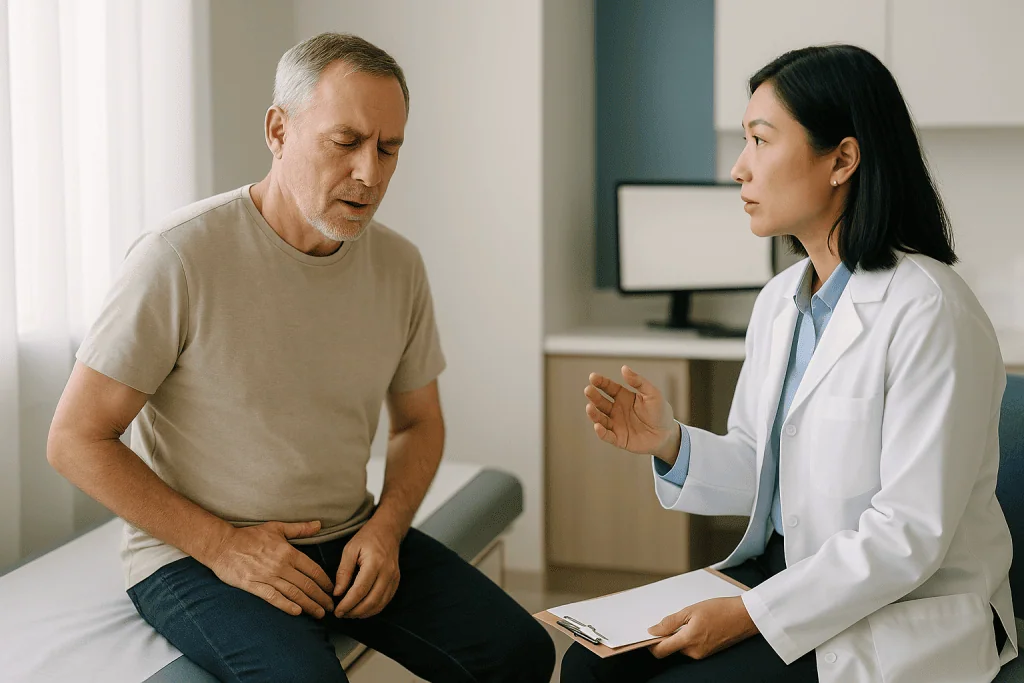
The result is not a wound in any meaningful sense. Picture the feeling of a paper cut on your tongue: nothing you can see, but the next sip of orange juice announces itself. Urine is mildly acidic and carries dissolved salts, so when it flows across a freshly irritated lining, the nerve endings there fire, and the brain registers a sting. This burning sensation is known medically as dysuria.
A second contributor sits higher up. During cystometry the bladder is filled with room-temperature fluid until you report you could not hold any more. The bladder wall contains a smooth muscle called the detrusor, and stretching it to that degree leaves it twitchy for a while. Each contraction pushes a little urine across the irritated urethra, so the two effects reinforce each other: the muscle wants to go, and going stings.
Lubricating gel, contrast dye if it was used, and the simple act of clenching against the sensation all add to the picture. None of these things damages the bladder. They irritate it, and irritation has a predictable course: strongest at the first void, easing at the second and third, and largely gone by the following day. The NIDDK describes this as mild discomfort lasting a few hours, and that matches what most people report when asked the next morning.
How long does burning last after urodynamics?
The clock is less useful here than the trend. The NIDDK says mild discomfort can last a few hours after the test; the Cleveland Clinic describes stinging and urgency that settle over roughly a day. Both are typical ranges, not promises, and your own experience will depend on how many catheters were placed, how long the session ran, whether you already had bladder sensitivity before you arrived, and how well you drink afterward.
A more reliable way to judge things is to compare one bathroom trip with the one before it. Ordinary post-procedure irritation follows a downward slope. The first void after leaving the clinic is usually the worst. By the third or fourth, most people notice the sting has softened from sharp to dull. By bedtime it is often an afterthought, and by the next morning many people have forgotten about it entirely.
Infection, by contrast, follows an upward slope. It does not usually declare itself immediately after the test, because bacteria need time to multiply. Burning that eases through the evening and then returns stronger the next day, especially with cloudy or strong-smelling urine or a feeling of being hot and shivery, is a different pattern and deserves a call, as the later section on urinary tract infection explains.
Two practical notes. First, if you have a condition that already causes bladder pain, such as interstitial cystitis or painful bladder syndrome, your baseline symptoms may flare for longer than a day; tell the team beforehand so they can plan for it. Second, plateau is not the same as improvement. Burning that is still at the same intensity at the 48-hour mark has not followed the expected course, even if it has not worsened, and that too is worth reporting.
Is needing to pee constantly normal the first day?
Yes, and it is one of the most disconcerting parts of the aftermath, because you may have just spent an hour proving your bladder can hold quite a lot. Frequency (going more often than usual) and urgency (a sudden strong need that is hard to postpone) are both common for the rest of the day.

Three things drive this. The detrusor muscle was stretched further than it is on an average afternoon, sometimes more than once if the bladder was filled twice, and stretched smooth muscle tends to overreact for several hours afterward. The irritated urethra sends constant low-level signals that the brain has learned to interpret as “something is in the channel, empty now.” And you are probably drinking more water than usual on your care team’s advice, which genuinely does produce more urine.
For people who already live with overactive bladder, the test can briefly amplify a familiar problem. That is not a sign that the condition has worsened; it reflects a temporary spike in a system that was already sensitive. People who came in for the opposite problem, difficulty emptying, may notice something different: a bladder that feels full but is slow to start, because the pelvic muscles are guarding against the anticipated sting. Relaxed breathing and sitting rather than hovering can help that first stream begin.
Urgency that fades through the evening is expected. Urgency that pairs with the inability to pass more than a trickle over several hours, particularly with a hard or painful lower belly, is not, because it can signal urinary retention. That combination belongs in the red-flag list at the end of this article, and it is one of the few reasons to seek care the same evening rather than waiting for the office to open.
Blood in urine after urodynamic test: what to expect
Seeing pink in the toilet is alarming in a way that stinging is not, so it helps to know what the team expects. A small amount of blood, called hematuria, is common after catheters have been passed. The NIDDK lists it among the ordinary short-term effects. Typically it appears as a faint pink tinge in the first one or two voids, or a thin streak on the toilet tissue, and then clears.
The source is the same irritated mucosal lining responsible for the burning. A few surface capillaries have been disturbed, they seep briefly, and they seal themselves, in the same way a scraped knee stops weeping within a short time. Because urine dilutes blood dramatically, a few drops can tint an entire bowl, which makes it look like far more than it is.
What does not fit that picture: urine the color of cranberry juice or darker, visible clots, bleeding that appears for the first time a day or more after the test, or pink that persists past the first day rather than clearing. Any of those should prompt a call. So should any bleeding at all if you take a blood-thinning medicine, since your team may want to check you more closely. Never adjust a blood thinner on your own; if the test team asked you to change anything before the appointment, ask them exactly when and how to return to your usual routine.
People with a history of bladder tumors, kidney stones, or an enlarged prostate sometimes bleed a little more readily after instrumentation. That is expected by the clinicians who know your history, but it is still worth mentioning if the amount surprises you. The rule of thumb is simple: a tinge that fades is ordinary; a color that deepens is not.
Urodynamic test side effects at a glance
The table below sets the commonly expected effects beside the signs that fall outside that range. It summarizes guidance from the NIDDK and the Cleveland Clinic on what usually follows the test. Use it as a quick reference, not as a substitute for the advice you were given at discharge, which reflects your own history.
| Symptom | Commonly expected | Needs a same-day call |
|---|---|---|
| Burning or stinging when urinating | Mild, worst at the first void, easing over hours to about a day | Worsening after 24 hours, or unchanged at 48 hours |
| Frequency and urgency | Frequent trips through the first evening, settling by the next day | Strong urge with little or no urine passed over several hours |
| Blood in urine | Faint pink tinge in the first one or two voids | Red or dark urine, clots, or bleeding that starts or continues after the first day |
| Lower belly or pelvic ache | Dull, mild, eased by warmth and emptying the bladder | Severe pain, a hard swollen abdomen, or pain in the side or back |
| Temperature | Normal | Fever of 38°C (100.4°F) or above, or chills and shivering |
| Urine appearance and smell | Clear, possibly slightly pink at first | Cloudy, strong-smelling, or foul urine, especially with pain |
Two patterns underlie every row. Expected effects begin immediately and improve. Concerning effects either escalate, appear late, or arrive with whole-body signs such as fever, nausea, or feeling generally unwell. The NHS uses that same fever threshold when describing when a urinary infection may have spread beyond the bladder, which is why it appears here as a hard line rather than a judgment call.
If a symptom sits in the middle, neither clearly ordinary nor clearly alarming, the safe default is to call the number you were given. Nurses who work in urology hear these questions every day, and a two-minute conversation is a far better use of everyone’s time than an anxious night.
Who is usually offered urodynamic testing, and who is asked to wait
Urodynamics is rarely a first step. The NHS and the Mayo Clinic both describe an initial pathway built on a conversation about symptoms, a physical examination, a urine test, and often a bladder diary, in which you note what you drink and when you pass urine over a few days. Many bladder problems can be managed on the strength of that information alone.
The test earns its place when the picture is unclear or the stakes of getting it wrong are high. Common reasons include incontinence where it is not obvious whether leakage comes from a weak outlet, an overactive bladder muscle, or both; symptoms that have not responded to initial treatment; planned surgery for incontinence, where the team wants objective pressure measurements first; difficulty emptying that is not fully explained by prostate enlargement; and neurological conditions such as spinal cord injury, multiple sclerosis, or spina bifida, where the bladder can behave unpredictably and silently strain the kidneys. Children with complex bladder or bowel problems are sometimes tested too, with extra attention to comfort and preparation.
There are also reasons to postpone. An active urinary tract infection is the most common: passing catheters through infected urine can push bacteria upward, and inflammation makes the pressure readings unreliable. Teams typically test the urine beforehand and reschedule if infection is found. Heavy menstrual bleeding sometimes leads to rescheduling for practical reasons. Certain medicines that act on the bladder can mask the very behavior the test is looking for, so you may be asked whether you take them; any change to a prescription is the clinician’s call, never something to do on your own initiative before the appointment.
People who feel they cannot tolerate catheters, whether because of past trauma or severe anxiety, should say so early. Adjustments to positioning, pacing, and who is in the room are routinely possible.
What the next few days usually look like
The rest of the test day is usually the only part that feels different from an ordinary day. Most people are able to drive themselves home, return to work or normal activities, and eat and drink as usual, unless sedation was used, which is uncommon for standard urodynamics. Expect to visit the bathroom more than normal that afternoon and evening, partly from irritation and partly from deliberate extra drinking.
The first evening is when stinging is most noticeable. Warmth, fluids, and emptying the bladder when you feel the urge rather than holding on all tend to help; the next section covers what the evidence says about each. A faint pink tinge in early voids is unremarkable. Sleep may be interrupted by one or two extra trips.
By the next morning, the NIDDK’s description of discomfort lasting a few hours means most people wake feeling close to their usual selves. Frequency has typically settled, and the sting is gone or nearly so. The second and third days are where the two possible stories diverge: continued improvement to baseline, or the return of symptoms with cloudy urine or fever that points toward infection.
Results follow their own timeline. The NIDDK notes that findings from simpler components such as uroflowmetry and cystometry are often discussed at the end of the appointment, while results that need detailed interpretation or imaging review can take several days. If you left without a clear plan for how you will hear back, a quick call to the office to ask is entirely reasonable.
Sexual activity, exercise, and travel do not usually need to be restricted beyond personal comfort, though it is sensible to wait until any burning and bleeding have resolved. If your team gave you specific instructions, those take precedence over any general guidance here.
Comfort measures with some evidence behind them
The single most useful thing you can do after urodynamic testing is drink water. The NIDDK suggests an eight-ounce glass every half hour for about two hours after the test. The logic is straightforward: dilute urine is less acidic and less concentrated, so it stings less as it passes over the irritated lining, and frequent flushing gives any bacteria introduced during catheterization less chance to settle and multiply. This is not a dose in any medical sense; it is roughly the amount many people already drink with a meal.
Warmth is the second well-supported measure. The NIDDK mentions a warm bath or a warm, damp washcloth held over the urethral opening. Heat relaxes pelvic floor muscles that tend to clench against discomfort and eases the dull pelvic ache some people feel after the bladder has been stretched.
Emptying when you feel the urge, rather than holding on to avoid the sting, tends to shorten the whole episode. Holding concentrated urine against an irritated lining prolongs the irritation.
Some advice circulates with weaker support. Cutting out caffeine and alcohol for a day is a reasonable comfort measure because both are bladder irritants in many people, but there is no good trial evidence that it changes recovery after this specific test. Cranberry products are marketed for urinary health, and the evidence for preventing recurrent infection in some groups is modest at best; there is no evidence they relieve post-procedure irritation. Over-the-counter urinary pain relievers and simple analgesics exist, and a pharmacist or your clinician can tell you whether one is appropriate for you given your other medicines and conditions; that decision belongs to them, not to a magazine article.
What you should not do is take leftover antibiotics from a previous illness “just in case.” That decision is covered in its own section below.
UTI after urodynamic testing: telling irritation from infection
A urinary tract infection (UTI) is the most talked-about complication of urodynamics, and it is worth being clear about both its likelihood and its signature. Any procedure that passes an object through the urethra can carry skin or bowel bacteria into the bladder. Sterile technique, single-use catheters, and pre-test urine checks keep that risk low, but the NIDDK acknowledges it remains possible, and it is the reason your team asked you to drink afterward and, in some cases, gave preventive treatment.
The difficulty is that irritation and early infection share symptoms: burning, frequency, urgency. What separates them is timing, direction, and company.
Timing: irritation is at its worst immediately and improves; infection usually needs a day or two to build, so symptoms that fade and then return are more suspicious than symptoms that were bad from the start.
Direction: irritation trends downward with each void; infection trends upward.
Company: infection tends to bring companions that irritation does not. The NHS lists cloudy urine, urine that smells unusually strong, pain in the lower belly, and, when infection has reached the kidneys, a high temperature or feeling hot and shivery, pain in the side or lower back, and nausea. Older adults sometimes show infection as new confusion or unsteadiness rather than urinary symptoms at all, which families should know.
None of this is a checklist for diagnosing yourself. It is a guide to when the conversation with your care team should happen. If infection is suspected, the usual approach is a urine sample tested first with a dipstick and then sent for culture, which identifies the organism and what will treat it. Starting treatment before that sample is taken can make the culture harder to interpret, another reason to call rather than reach for something in the medicine cabinet.
What about preventive antibiotics after the test?
Practice varies. Some teams give a short course of an antibiotic around the time of urodynamic testing to reduce the chance of a UTI; others do not, reserving treatment for people who develop symptoms. Both approaches are used by reputable services, and the difference reflects genuinely mixed evidence rather than carelessness on either side.
The mechanism is simple. Antibiotics either kill bacteria or stop them multiplying, so a dose given close to the moment bacteria might be introduced can prevent a small number of organisms from becoming an established infection. Against that benefit sit the usual costs: side effects such as stomach upset or rash, disruption of the body’s own helpful bacteria, and the broader problem of antibiotic resistance, which grows every time these medicines are used when they are not needed.
The NIDDK notes that a clinician may prescribe an antibiotic to prevent infection after urodynamics, and the decision usually turns on individual risk. People with a history of frequent UTIs, those who use catheters day to day, people with neurological bladder conditions, people with diabetes, and those with a weakened immune system are more likely to be offered prevention. Someone with a healthy bladder and no infection history may not be.
If you were prescribed a course, take it exactly as directed and finish it unless the prescriber tells you otherwise. If you were not, that is a considered decision, and it is reasonable to ask what the reasoning was. What is not reasonable is to fill the gap with antibiotics left over from another illness. The organism, the medicine, and the timing may all be wrong, and self-treatment can mask an infection long enough for it to reach the kidneys. Any question about whether you should be taking something is a question for the team that ran the test.
What people often get wrong
Misunderstandings about the aftermath of urodynamics are common enough to deserve their own section. Here are the ones that cause the most needless worry, and one that causes needless risk.
“Burning means they gave me an infection.” Immediate stinging is mechanical irritation from the catheter and the filling. Infection takes time to develop and usually announces itself a day or more later with worsening, not improving, symptoms.
“If I drink less, I’ll pee less and it will hurt less.” The opposite is true. Concentrated urine stings more, and fewer voids give bacteria a better chance. The NIDDK’s advice to drink steadily for the first couple of hours exists for good reason.
“The test damaged my bladder.” Filling a bladder to capacity under monitored conditions does not injure it. The detrusor muscle is designed to stretch and recover, which is exactly what it does over the following hours.
“Pink urine means internal bleeding.” Urine dilutes blood enormously. A few drops from a scuffed lining can tint an entire bowl. The concern is color that deepens or clots, not a tinge that fades.
“If the test felt normal, my results must be normal.” Comfort during the test and the pressure readings on the chart are unrelated. Many people with significant findings felt fine throughout, and some with entirely normal readings found the process unpleasant.
“Leftover antibiotics will sort it out.” This is the myth that carries real risk. The wrong medicine at the wrong time can mask a growing infection and confuse the culture your team needs. Call instead.
“Cranberry juice fixes post-test irritation.” There is no evidence that it does, and the sugar in many juices can worsen urgency for some people. Water does the job it is credited with.
Questions to ask your care team
The best time to ask these is before you leave the appointment, but a phone call afterward is a perfectly good second choice. Nobody minds a patient who wants to understand the plan.
- Roughly how long should I expect burning or frequency to last in my case, given my history and what was done today?
- Was my urine checked for infection before the test, and what was the result?
- Have you prescribed anything to prevent infection, and if not, what was the reasoning for me specifically?
- If I take a blood thinner or a bladder medicine and was asked to change anything beforehand, exactly when and how should I return to my usual routine?
- How much pink in the urine is within the range you would expect, and at what point would you want to hear from me?
- What symptoms should prompt a call during office hours, and which ones mean I should not wait until morning?
- Who do I contact after hours, and what number should I use?
- When and how will I receive the results, and who will explain them to me?
- Do the findings change the options we discussed before the test, or do they confirm the plan?
- Is there anything about my bladder behavior during the test that I should watch for at home?
Write the answers down or ask permission to record them. Post-procedure discussions happen when people are tired and mildly uncomfortable, which is not the ideal state for remembering detail. If you have a partner, family member, or friend with you, having them listen too is worthwhile.
One more question is worth asking of yourself rather than the team: is there anything I did not mention beforehand that they should know now? Past infections, difficulty with catheters, a history of bladder pain, or a medicine you forgot to list are all relevant to how the coming days are likely to go, and it is never too late to share them.
When to call your doctor after urodynamic testing
Most people never need this section. For the few who do, acting promptly makes a real difference, because urinary infections that reach the kidneys and bladders that cannot empty are both far easier to manage early than late.
Call your care team the same day if you notice any of the following:
- A fever of 38°C (100.4°F) or higher, or chills and shivering, which the NHS identifies as signs that a urinary infection may have spread beyond the bladder.
- Burning or pelvic pain that is getting worse after the first 24 hours, or that has not eased at all by 48 hours.
- Urine that is red or dark rather than faintly pink, contains clots, or starts bleeding for the first time a day or more after the test.
- Cloudy, strong-smelling, or foul urine, especially alongside pain or feeling generally unwell.
- Pain in your side or lower back, nausea, or vomiting.
- New confusion, drowsiness, or unsteadiness, particularly in an older adult, which can be how infection shows itself without obvious urinary symptoms.
Seek urgent care without waiting for office hours if you have a strong urge to urinate but cannot pass more than a trickle over several hours and your lower belly feels full, hard, or painful; this can indicate urinary retention. Do the same for a high fever with shaking chills, heavy bleeding, or if you feel faint or very unwell.
When you call, have a few facts ready: when the test was, what symptoms you have and how they have changed, your temperature if you have taken it, and any medicines you take, including blood thinners and anything given at the appointment. If you were given a direct line by the urology service, use it; the people who ran your test know your case and can judge fastest.
Every decision about testing, treatment, or reassurance rests with the clinicians caring for you. This guide exists to help you recognize when that conversation should happen, not to replace it.
Frequently asked questions
How long does burning last after urodynamics?
For most people, burning eases over a few hours and is largely gone by the next day, which matches the NIDDK’s description of mild, short-lived discomfort. The pattern matters more than the clock: each void should sting a little less than the one before. Burning that plateaus for two days, or that improves and then returns with cloudy urine or fever, falls outside the expected course and should be reported to your care team.
What are the common urodynamic test side effects?
The usual effects are mild stinging when you pass urine, going more often than normal for the rest of the day, a sense of urgency, a dull pelvic ache, and a faint pink tinge in the first one or two voids. All of these stem from catheters passing along the urethra and the bladder being filled to capacity. Less common effects include urinary tract infection and, rarely, temporary difficulty emptying. Serious complications are unusual.
Can I get a UTI after urodynamic testing?
It is possible, because any procedure that passes a tube through the urethra can carry bacteria into the bladder, though sterile technique and pre-test urine checks keep the risk low. Infection typically shows itself a day or more after the test as worsening burning, cloudy or strong-smelling urine, lower belly pain, or fever and chills. If those appear, call your care team so a urine sample can be tested before any treatment decision is made.
Is blood in urine after a urodynamic test normal?
A small amount is common. A pink tinge in the first one or two voids, or a streak on the tissue, comes from surface capillaries in the urethral lining that were disturbed by the catheter and seal quickly. Urine dilutes blood so much that a few drops can color the whole bowl. Red or dark urine, clots, or bleeding that starts or continues after the first day are not expected and need a same-day call.
Why do I feel like I constantly need to pee after the test?
The bladder muscle was stretched further than usual during filling and stays twitchy for several hours afterward, while the irritated urethra sends signals the brain reads as a need to empty. Drinking extra water on your team’s advice adds real volume too. This urgency and frequency usually settle by the next morning. A strong urge with little or no urine passed over several hours is different and should be treated as urgent.
Can I drive home and go back to work the same day?
Usually yes. Standard urodynamic testing is done without sedation, so most people drive themselves home and return to ordinary activities straight away. Plan for more frequent bathroom visits during the afternoon and evening, and keep water with you. If your appointment involved sedation, or your team gave you specific instructions about rest or activity, follow their guidance rather than general advice.
Should I take leftover antibiotics if it burns?
No. Immediate burning is almost always irritation, not infection, and leftover antibiotics may be the wrong medicine, at the wrong time, for an organism that has not been identified. Taking them can hide a developing infection and confuse the urine culture your clinicians would rely on. If you suspect infection, contact your care team; they may ask for a sample first. Any decision to start an antibiotic belongs to the prescriber.
When will I get my urodynamic test results?
The NIDDK notes that results from simpler components such as uroflowmetry and cystometry are often discussed at the end of the appointment, while findings that need detailed interpretation or review of imaging can take several days. If you left without a clear plan for hearing back, call the office and ask who will explain the results and when. Comfort or discomfort during the test does not predict what the readings show.
Does drinking more water really help after urodynamics?
Yes, and it is the single best-supported comfort measure. The NIDDK suggests an eight-ounce glass every half hour for about two hours afterward. Dilute urine is less acidic and less concentrated, so it stings less as it passes the irritated lining, and frequent flushing gives any introduced bacteria less opportunity to settle. Cutting fluids to avoid the sting has the opposite effect and can prolong the irritation.
What signs after urodynamic testing mean I should not wait until morning?
Seek urgent care if you cannot pass more than a trickle over several hours despite a strong urge and a full, hard, or painful lower belly, which can signal urinary retention. Do the same for a fever of 38°C (100.4°F) or above with shaking chills, heavy bleeding or clots, pain in the side or back with vomiting, or feeling faint or very unwell. These are uncommon, but they are the situations where prompt assessment matters most.
References
- Urodynamic Testing, National Institute of Diabetes and Digestive and Kidney Diseases (NIH)
- Urinary incontinence: Diagnosis, NHS
- Urinary tract infections (UTIs), NHS
- Urinary tract infection – adults, MedlinePlus Medical Encyclopedia
This article is for general information only and is not a substitute for professional medical advice. Please consult a qualified doctor about your individual situation.

More from the Blog

When Can You Lift, Drive and Exercise Again After Robotic Prostate Surgery?
Most people walk the day of robotic prostate surgery, drive again once the catheter is out and they are no longer taking opioid painkillers,…
How Peritoneal Dialysis Exchanges Work: Fill, Dwell and Drain Explained in Plain Words
A peritoneal dialysis exchange uses the lining of your own abdomen as a filter. Cleansing fluid flows through a soft catheter into the belly…

Reading a Bladder Disease Treatment Plan: Questions to Ask Your Urologist Before You Decide
Before agreeing to a bladder disease treatment plan, ask your urologist which specific condition is being treated, what test results support that diagnosis, why…

Is Tiredness After Hemodialysis Normal? Cramps, Low Blood Pressure and What to Report
Yes, feeling tired after hemodialysis is common and expected for many people, because a session removes fluid and waste quickly and shifts salts and…

Shockwave Therapy or Endoscopic Removal: Which Kidney Stone Treatment Fits Your Stone?
Shock wave lithotripsy breaks a kidney stone from outside the body using focused sound waves, while ureteroscopy passes a thin scope up the urinary…

Orchiopexy Recovery for Children: Swelling, Incision Care and When Rough Play Can Resume
Most children recover from orchiopexy, the operation that moves an undescended testicle into the scrotum, over roughly two to four weeks. Expect scrotal swelling…