

What Pulmonary Rehabilitation Can Realistically Change for Someone With Emphysema

Key Takeaways
- Pulmonary rehabilitation does not change FEV1, the standard lung function measure, yet the Cochrane review found participants walked about 44 meters farther in six minutes than those receiving usual care.
- Much of the breathlessness in emphysema comes from deconditioned leg muscles demanding more oxygen than they should, which is why training muscles eases breathing even though the lungs are unchanged.
- Standard programs run six to twelve weeks with two or three supervised sessions a week, combining endurance and resistance exercise with education on inhalers, breathing techniques and flare-up plans.
- Referral is appropriate as soon as breathlessness limits daily life, regardless of disease stage, and is routinely recommended within weeks of a hospital admission for a flare-up.
- Gains fade over roughly twelve to eighteen months without continued activity, so a maintenance plan arranged before graduation predicts how much benefit you keep.
- Completing pulmonary rehabilitation is a standard prerequisite for lung volume reduction procedures, endobronchial valves and transplant evaluation, not an alternative to them.
Pulmonary rehabilitation for emphysema does not repair damaged air sacs or raise lung function test scores. What it reliably changes, according to systematic reviews, is how far a person can walk, how breathless everyday tasks feel, how confident they are managing flare-ups, and how often those flare-ups lead back to hospital. Gains build over six to twelve weeks and fade without continued activity.
The kitchen is fourteen steps from the bedroom. Ray knows this because he has started counting. He stops twice now, once at the hallway and once with a hand on the counter, waiting for the tightness in his chest to loosen before he can pour coffee. His pulmonologist has just suggested pulmonary rehabilitation for emphysema, and Ray’s first reaction was blunt: how is exercise supposed to help lungs that are already damaged?
It is the right question, and the honest answer is more interesting than either the skeptics or the cheerleaders suggest. Emphysema destroys tissue that does not grow back. Rehab cannot touch that. Yet people who complete a program routinely walk farther, climb stairs with less panic, and spend fewer nights in hospital beds.
How both things can be true at once is the story of this article.
What pulmonary rehabilitation for emphysema actually involves
Emphysema is a form of chronic obstructive pulmonary disease, or COPD, in which the tiny air sacs at the end of the airways lose their elastic walls, trap air, and stop exchanging oxygen efficiently. Pulmonary rehabilitation is a structured, supervised program that combines exercise training with education and support for people living with chronic lung disease. It is a medical treatment, prescribed and delivered by a team, not a gym membership with a health label attached.
A typical program, as described by the NHS and the National Heart, Lung, and Blood Institute, runs for six to twelve weeks with two or three sessions a week, each lasting roughly one to two hours. The people in the room are usually a respiratory physiotherapist or exercise physiologist, a nurse, and often a dietitian or occupational therapist. Before anything else happens, you are assessed: a walking test, a questionnaire about breathlessness and mood, a check of oxygen levels at rest and during effort, and a review of your inhalers and other medicines.
The exercise portion is deliberately unglamorous. Stationary bikes, treadmills or simple corridor walking build endurance. Light weights or resistance bands work the legs and arms. Everything is dosed to your own limits and adjusted session by session. Around the exercise sits the education: how the lungs work, why breathlessness happens, how to use inhalers so the medicine reaches the airways, how to recognize a flare-up early, and how to pace a day so energy is spent where it matters.
The point is not to push you through discomfort. It is to teach your body, and your nervous system, that effort is safe again.
Why the target is your muscles, not your lungs
Here is the paradox at the heart of emphysema. The lungs cannot empty properly, so air becomes trapped and the chest stays partly inflated even at rest. Doctors call this hyperinflation: the lungs are stuck in a half-full position, which flattens the diaphragm and makes every breath more work. Breathing feels frightening, so people move less. Moving less weakens the leg muscles. Weak muscles need more oxygen for the same task and produce more carbon dioxide, which drives faster breathing, which feels worse still.
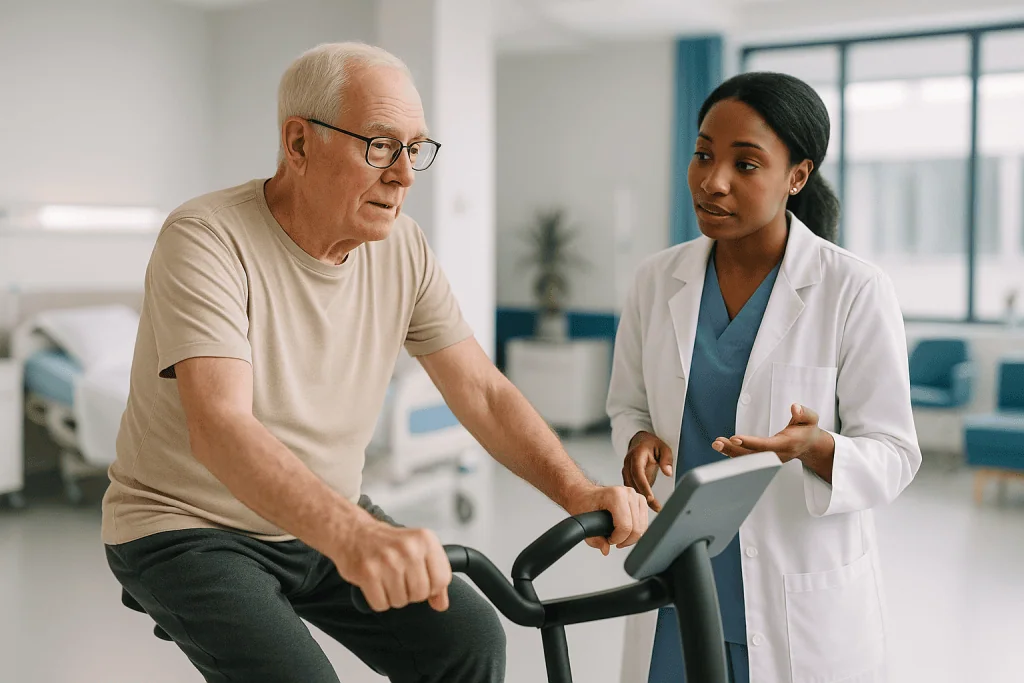
Within a year or two of this cycle, many people with emphysema are limited less by their lungs than by deconditioned thigh muscles. The muscles fatigue before the lungs reach their ceiling. That is the opening rehab exploits.
Trained muscle extracts oxygen more efficiently and produces less lactic acid at a given workload. In practical terms, walking to the mailbox demands a smaller share of your total breathing capacity than it did before, so the sensation of air hunger arrives later or not at all. Research summarized by the National Heart, Lung, and Blood Institute describes this as improving exercise tolerance rather than lung function: the engine is unchanged, but the rest of the vehicle is lighter and more efficient.
There is a second mechanism, quieter but real. Breathlessness is partly a learned alarm. When you become short of breath dozens of times in a supervised room and nothing terrible happens, the brain recalibrates. The threshold at which discomfort tips into fear moves. People describe this as feeling less afraid of their own breathing, and it may be why quality-of-life scores improve even more consistently than walking distance does.
Can your lungs get better after pulmonary rehab?
The measurement doctors use to stage emphysema is FEV1, the volume of air you can force out in the first second of a hard exhale. It tracks how narrowed and floppy the airways have become. After a full course of pulmonary rehabilitation, FEV1 typically does not change. Studies that measure it before and after find essentially the same number. If someone tells you rehab will raise your lung function, they are describing something the evidence does not show.
So in the narrow sense, no, your lungs do not get better. What gets better is everything the lungs are asked to serve.
The Cochrane systematic review of pulmonary rehabilitation in COPD, which pooled dozens of randomized trials, found that participants walked on average about 44 meters farther in a six-minute walk test than people who received usual care. The six-minute walk test is exactly what it sounds like: how far you can cover on a flat corridor in six minutes at your own pace. Forty-four meters is roughly half a city block, and it exceeds the threshold researchers consider meaningful to patients. The same review found improvements in breathlessness, fatigue, emotional wellbeing and sense of control that were large enough to matter in daily life, not just on paper.
Think of it this way. Emphysema fixes the size of the room you live in. Rehab rearranges the furniture so you can move through it. The walls have not moved, yet you bump into them far less often.
That distinction matters for expectations. People who enter rehab hoping to see their spirometry numbers climb often leave disappointed. People who enter hoping to carry groceries without stopping usually do not.
Who is usually referred, and who is usually asked to wait
Referral criteria are broader than many people assume. Guidance from the NHS and the National Heart, Lung, and Blood Institute supports pulmonary rehabilitation for anyone with COPD whose breathlessness limits daily activities, regardless of how severe their spirometry looks. Someone with moderate emphysema who cannot keep up with grandchildren qualifies just as clearly as someone on home oxygen. Being referred is also standard after a hospital admission for a flare-up, ideally within a few weeks of discharge, because that is when the risk of readmission is highest and the deconditioning from bed rest is freshest.
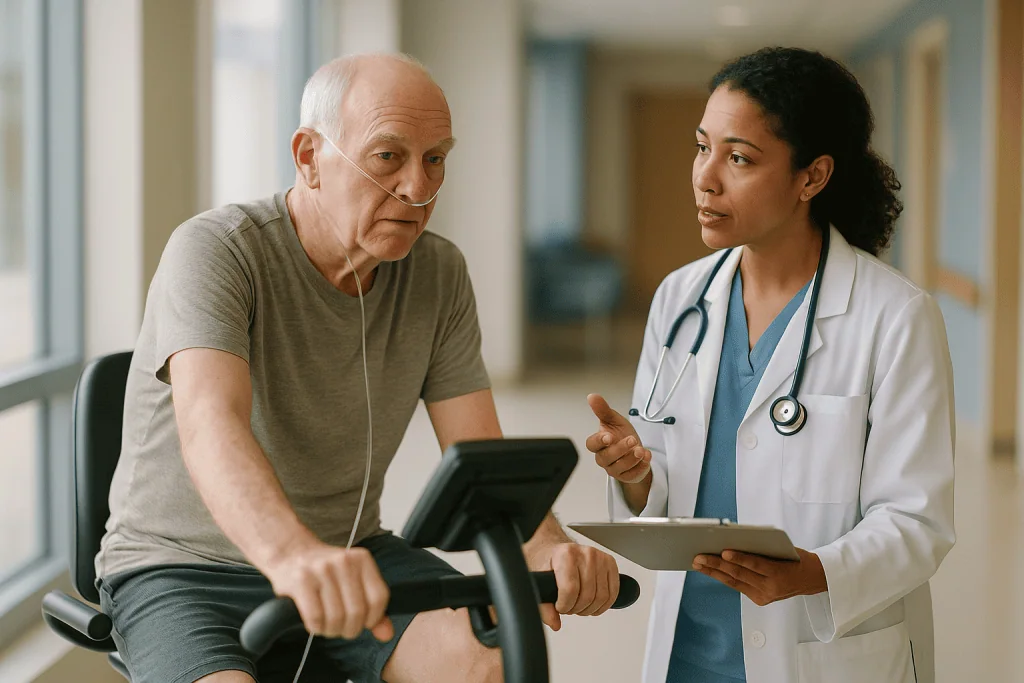
Age alone is not a barrier. Neither is needing oxygen; programs routinely titrate supplemental oxygen during sessions. Neither is walking with a cane or frame. Programs adapt.
Some people are asked to wait, and the reasons are about safety rather than worthiness. Unstable heart disease, such as chest pain that comes on at rest or a recent heart attack still under evaluation, needs to be settled first, because exercise stress on an unstable heart is risky. Uncontrolled high blood pressure, a very recent flare-up still on treatment, or an acute infection usually mean a short postponement. Severe cognitive impairment or a joint problem that makes any walking impossible can make a standard group program impractical, though modified or home-based alternatives may exist.
Current smoking is not, in most guidance, a reason to exclude someone. Programs typically weave in support for quitting because stopping smoking is the single intervention that slows the loss of lung tissue. If you smoke and worry that this disqualifies you, ask directly; the answer is often the opposite.
The final call sits with your respiratory team, who weigh your heart, joints, oxygen needs and recent history together.
How long is pulmonary rehab, and what do the weeks look like?
The NHS describes a standard course as around six weeks with two sessions a week, while programs in the United States commonly run eight to twelve weeks, sometimes longer when insurance and capacity allow. The National Heart, Lung, and Blood Institute notes that duration varies by program. What follows is a typical arc rather than a schedule to expect.
The first week is mostly measurement and reassurance. You do a baseline walk test, answer questionnaires, and learn what the monitors on your finger and chest are reading. Exercise is light, often shorter than people expect, and its main purpose is to find your starting point.
Weeks two through four are where most people hit a wall of doubt. Muscles ache in unfamiliar places. Breathlessness during sessions is deliberately provoked, within safe limits, and that can feel like going backward. Staff are watching for this and will explain that the soreness is the training effect, not the disease advancing.
Somewhere around week four to six, something shifts. The same bike resistance that felt impossible now feels merely hard. Stairs at home take one pause instead of three. Many people report that the mental change arrives before the physical one: they stop bracing for every exertion.
The final weeks focus on carrying the program home. You repeat the walk test and questionnaires, and the team helps you build a plan for continuing on your own, whether through a maintenance class, a home routine, or a community walking group.
Missing occasional sessions is common and usually manageable. Missing several in a row, especially in the first month, tends to reset progress, so most programs ask you to tell them early if life is getting in the way.
What realistically changes, and what does not
Expectations shape whether people finish. This table summarizes what the evidence, chiefly the Cochrane review and guidance from the NHS and National Heart, Lung, and Blood Institute, supports.
| Outcome | What the evidence shows | What that means day to day |
|---|---|---|
| Lung function (FEV1) | Essentially unchanged | Spirometry numbers stay the same |
| Walking distance | Improves by a clinically meaningful amount, roughly 44 meters in six minutes on average | Farther between rests; errands become feasible |
| Breathlessness during activity | Consistently reduced in quality-of-life measures | Same task, less air hunger |
| Anxiety and low mood | Improved in most trials | Less dread before exertion |
| Hospital readmission after a flare-up | Reduced when rehab starts soon after discharge | Fewer emergency visits |
| Oxygen requirement | Usually unchanged | Prescribed oxygen continues as before |
| Survival | Evidence uncertain; not established | No promise can honestly be made |
Two entries deserve emphasis. Oxygen need does not typically fall; people who arrive on home oxygen usually leave on it, though they may use it more confidently. And survival remains an open question. Some observational studies hint at benefit, but the randomized evidence does not settle it, and a responsible program will not claim otherwise.
The middle rows are where the real story lives. A person who can walk 44 meters farther and feels less frightened doing it has a different life, even with identical lungs. That is the realistic promise, and it is a substantial one.
Beyond the treadmill: breathing techniques, inhalers and action plans
Half of a rehab session happens off the equipment, and this half is easy to undervalue.
Breathing techniques come first. Pursed-lip breathing means inhaling through the nose and exhaling slowly through lips shaped as if cooling soup. The gentle back-pressure helps hold floppy airways open a fraction longer so more trapped air escapes. It is one of the few maneuvers that directly addresses hyperinflation, and the NHS lists it among core self-management skills. Forward-leaning positions, hands braced on knees or a table, let the shoulder and neck muscles assist breathing when you are caught out. Neither replaces medication; both buy time and calm.
Inhaler technique is the second pillar. Studies repeatedly find that a large share of people with COPD use their inhalers incorrectly, which means medicine lands in the mouth rather than the lungs. Rehab staff watch you use your own device and correct the timing, the breath-hold, and the coordination. This is not about changing what you are prescribed; it is about making what you are prescribed actually arrive.
Medicines are discussed by class and mechanism. Bronchodilators relax the muscle around the airways so they open wider, which is why they are the mainstay for emphysema. Inhaled corticosteroids reduce inflammation and are added for some people with frequent flare-ups. Any question about starting, stopping or adjusting these belongs to your prescriber, and good programs say so plainly.
Finally, the action plan. A flare-up, or exacerbation, is a period when symptoms worsen beyond the usual daily variation. Rehab teaches you to recognize the early signs in your own pattern and tells you exactly whom to call and when. That single sheet of paper may be the most powerful thing you take home.
What are the disadvantages of pulmonary rehabilitation?
Any honest explainer has to sit with the downsides, because they explain why so many eligible people never start and why a meaningful share drop out.
Time is the first cost. Two or three sessions a week for two or three months is a real commitment, and for someone already exhausted by breathing, the travel to and from a center can consume the energy the session was meant to build. Rural residents may face long drives. People who are still working, or caring for someone else, often cannot fit it in.
Discomfort is the second. Effective training requires provoking breathlessness in a controlled way, and that feels alarming even when monitors confirm oxygen levels are fine. Muscle soreness in the first weeks is expected. Some people find the group setting exposing; being the most breathless person in a room is not pleasant.
Medical risks exist but are uncommon in supervised settings. Oxygen levels can dip during exertion, which is why they are monitored and supplemental oxygen is on hand. Exercise can unmask heart rhythm problems or angina, which is one reason cardiac screening happens first. Falls are possible on equipment. Programs are designed around these risks, and serious adverse events in trials are rare, but rare is not zero.
The third disadvantage is impermanence. The Cochrane review and other studies note that gains decline over the twelve to eighteen months after a program ends unless activity continues. Rehab is not a course you complete once; it is the start of a habit, and that can feel like a burden rather than a gift.
Weighing these against the benefits is a personal calculation, and it is legitimate to conclude that a home-based or modified program fits your life better than the standard one.
Does pulmonary rehab work in the long run, or do the benefits fade?
The evidence on durability is sobering but not discouraging. Trials that follow participants after graduation find that walking distance and quality-of-life scores drift back toward baseline over roughly a year to eighteen months if nothing replaces the supervised sessions. The National Heart, Lung, and Blood Institute frames this simply: pulmonary rehabilitation helps as long as you keep doing the exercises and applying what you learned.
This is not a failure of the treatment. Muscle adapts to what it is asked to do and de-adapts when the asking stops. The same is true of a marathon runner who takes a year off.
Maintenance therefore matters as much as the initial course. Options vary widely. Some centers run ongoing weekly maintenance classes at lower intensity. Community groups for people with lung disease, often organized around gentle walking or seated exercise, exist in many areas. Home programs built during the final rehab weeks typically combine a daily walk of a length you set with the staff, a short set of resistance exercises two or three times a week, and continued use of breathing techniques during exertion.
Repeat courses are also possible. Guidance from the NHS supports re-referral after a hospital admission or when function declines noticeably, and there is no evidence that a second program is less effective than the first.
The realistic framing is this: rehab works for as long as its habits are alive in your week. A program that ends with a graduation certificate and no plan has done half its job. Ask, before you begin, what maintenance the program helps arrange, because the answer predicts how much of your gain you keep.
How rehab fits with the newer lung treatments for emphysema
People searching for the newest emphysema treatments will find two procedures aimed at the same problem rehab addresses from the outside: trapped air. Understanding them clarifies where rehab sits.
Lung volume reduction surgery removes the most damaged, over-inflated portions of lung so the remaining, healthier tissue and the diaphragm have room to work. Bronchoscopic lung volume reduction achieves a similar goal without surgery: an endobronchial valve is a tiny one-way device placed through a flexible scope into an airway feeding a diseased section, letting air out but not in, so that section gradually deflates. The Mayo Clinic describes both as options for a carefully selected minority whose emphysema is concentrated in particular regions and who meet strict criteria.
Here is the connection most people miss. Completing pulmonary rehabilitation is a standard prerequisite for both procedures. There are two reasons. First, some people improve enough with rehab that the procedure is no longer worth its risks, which include air leaks, pneumonia and, for surgery, the hazards of a major operation. Second, being as fit as possible beforehand improves how people tolerate the intervention and recover afterward. Rehab is not the alternative to these treatments; it is the gate to them.
Lung transplantation, for a small number of people with very advanced disease, also requires demonstrated participation in rehabilitation, both to prepare for the operation and as evidence of the capacity to follow a demanding regimen afterward.
Whether any of these procedures is appropriate for you depends on imaging patterns, lung function, heart health and other factors that only a specialist team can weigh. Rehab is the one step nearly everyone in that pathway shares.
Can lungs regenerate from emphysema?
The short answer, based on current mainstream evidence, is no. The walls between alveoli, the microscopic air sacs, are destroyed by inflammation driven mostly by smoke and other inhaled irritants. Once those walls are gone, the lung does not rebuild them. Adults do not regrow lung tissue the way skin heals or bone knits. Laboratory research into regeneration continues, but nothing has reached routine clinical use, and any product or clinic promising to regrow lung tissue is making a claim the evidence does not support.
What the lungs can do is stop getting worse faster than they must. Everyone loses a little lung function with age; in someone who keeps smoking, that loss runs several times faster. Stopping smoking returns the rate of decline toward the normal aging curve. The CDC identifies quitting as the most important step for anyone with COPD, and it remains true at every stage, including advanced disease.
Other measures protect what is left. Vaccination against influenza, pneumococcal disease and other respiratory infections matters because each severe infection can leave a permanent step down in function. Avoiding indoor smoke, occupational dust and outdoor pollution on high-alert days reduces the irritant load. Treating flare-ups promptly limits their damage.
Where does rehab fit? It does none of this at the tissue level. It changes what the surviving tissue is asked to deliver by making the rest of the body more efficient. That is why the walking gains are real while the lung function numbers are flat.
Grief about permanence is reasonable. Many people find it easier to commit to rehab once they stop waiting for the lungs to heal and start working with what they have.
What people often get wrong about pulmonary rehab for emphysema
Some misunderstandings surface so often in clinic that they are worth addressing directly.
“Exercise will damage my lungs further.” There is no evidence that supervised exercise accelerates emphysema. The tissue loss is driven by inflammation from irritants, not by effort. Breathlessness during exertion is uncomfortable, not harmful, when oxygen levels are monitored.
“I’m too far gone for it to help.” Trials include people with severe disease and those on oxygen, and they benefit. Improvements in breathlessness and confidence do not depend on starting lung function.
“I’m not bad enough yet.” The reverse error. Guidance supports referral as soon as breathlessness limits daily life. Earlier entry means less deconditioning to reverse.
“Rehab is just a class about inhalers.” Education matters, but the exercise component is what drives the measured gains. A program without supervised training is not pulmonary rehabilitation in the sense the evidence describes.
“Once I’ve done it, I’m done.” Benefits fade over a year or so without maintenance. The program is the beginning of a habit.
“I can get the same result walking on my own.” Unsupervised walking is valuable and better than nothing, but the structured, progressively harder, monitored training in a program produces larger and more reliable gains, partly because most people stop well short of their true limits when alone.
“If my numbers don’t improve, it didn’t work.” The right numbers are the walk test and the questionnaires, not spirometry. Judging rehab by FEV1 is like judging a new pair of glasses by whether your eyes changed shape.
Correcting these ideas early tends to be the difference between finishing and quitting in week three.
Questions to ask your care team before you start
A good program welcomes questions, and the answers reveal a great deal about how it will fit your life. Consider bringing these to your referral appointment or the first assessment.
- How long is the program, how many sessions a week, and how long is each session?
- Who supervises the exercise, and what monitoring is used during sessions?
- Do I need any heart tests or other checks before I begin?
- Will my oxygen be adjusted during exercise, and who decides that?
- What happens if I have a flare-up partway through? Do I pause, restart, or continue?
- Is there a home-based or virtual option if travel is difficult for me?
- How will you measure whether it is working for me specifically, and when will we review that?
- What maintenance options exist after the program ends, and will you help me set them up?
- Can a family member or caregiver attend the education sessions with me?
- How does this program connect with my other emphysema treatments, and will you communicate with my prescribing doctor?
Two additional questions are worth asking yourself rather than the team. What specific task do I want to be able to do at the end? Naming it, whether it is walking to a particular shop or getting through a shower without stopping, gives you a personal outcome to track that matters more than any average. And what has stopped me from exercising before? Knowing your own obstacles, whether fear, fatigue, or logistics, lets the staff plan around them from day one rather than discover them in week four.
Write the answers down. The first session involves a lot of information, and the details about maintenance in particular tend to be forgotten by the time they are needed.
When to call your doctor
Pulmonary rehabilitation is safe under supervision, but emphysema itself can change quickly, and some signs mean the program is not the right place to be that day.
Call your doctor or the program promptly if, over a day or two, you notice your usual breathlessness worsening, your cough producing more phlegm or phlegm that has changed color, a new need to use your reliever inhaler far more often, unusual swelling in your ankles, or a fever. These are the typical early signs of a flare-up, and starting treatment early tends to limit its severity. Your action plan should already tell you the specific steps and contacts.
Seek emergency care immediately, by calling your local emergency number, if you experience any of the following:
- Severe breathlessness that does not ease with rest or your usual inhaler
- Chest pain or pressure, especially with sweating, nausea or pain spreading to the arm or jaw
- Blue or gray color of the lips or fingertips
- Confusion, extreme drowsiness or difficulty staying awake
- Coughing up blood
- A pulse oximeter reading well below your usual range, if you have been told what that range is
During a rehab session, tell staff at once about dizziness, chest discomfort, a racing or irregular heartbeat, or breathlessness that feels different from your usual exertional pattern. They would far rather stop a session than miss a warning sign.
None of this should discourage participation. Most people complete programs without incident. Knowing the signs simply means the rare exception is caught early, and that knowledge is itself one of the things rehab is designed to teach.
Frequently asked questions
What is the new lung treatment for emphysema?
The newest widely used approach is bronchoscopic lung volume reduction, in which tiny one-way endobronchial valves are placed through a scope to deflate the most damaged lung regions. It suits only a minority whose emphysema is concentrated in specific areas, carries risks such as air leak and pneumonia, and requires completing pulmonary rehabilitation first. Your specialist team decides eligibility based on imaging and lung function.
Can lungs regenerate from emphysema?
No. The destroyed walls between air sacs do not grow back, and no clinical treatment currently rebuilds them. What you can do is slow further loss, most powerfully by stopping smoking, and protect remaining tissue through vaccination, avoiding irritants and treating flare-ups early. Rehabilitation improves function by making the rest of your body more efficient, not by repairing lung tissue.
Can your lungs get better after pulmonary rehab?
Lung function tests typically do not improve after rehab. What improves is walking distance, breathlessness during activity, confidence and mood, and the likelihood of avoiding hospital readmission. The Cochrane review found these gains were large enough to matter in daily life. Judging rehab by spirometry misses its actual benefit, which lies in how far and how comfortably you can move.
What are the disadvantages of pulmonary rehabilitation?
The main drawbacks are time and travel for two or three sessions weekly over several weeks, discomfort from deliberately provoked breathlessness and muscle soreness early on, and the fact that gains fade within a year or so without maintenance. Medical risks such as oxygen dips or heart rhythm problems are uncommon in supervised settings but are why screening and monitoring are built in.
Does pulmonary rehab work for severe emphysema or people on oxygen?
Yes. Trials included people with severe disease and those using supplemental oxygen, and they showed improvements in walking distance and quality of life comparable to people with milder disease. Programs adjust oxygen flow during exercise and adapt intensity to each person. Severity of spirometry is not a reason to be excluded; unstable heart disease or an active flare-up are the usual reasons to postpone.
How long is pulmonary rehab, and how often do you go?
The NHS describes a typical course as about six weeks with two sessions a week, while many programs in the United States run eight to twelve weeks at two or three sessions weekly. Each session usually lasts one to two hours, split between supervised exercise and education. Duration varies by program, and a maintenance phase afterward is strongly encouraged to preserve the gains.
What are the pulmonary rehab exercises for COPD and emphysema?
Core exercises are endurance training on a stationary bike, treadmill or walking track, plus resistance work for legs and arms using light weights or bands. Intensity is set from your baseline walk test and increased gradually. Breathing techniques such as pursed-lip breathing are practiced during exertion. Everything is tailored and monitored, so the exact mix differs from person to person.
What are the main pulmonary rehabilitation benefits people actually notice?
Most people notice they can walk farther before stopping, climb stairs with fewer pauses, and feel less frightened when breathless. Measured benefits in trials include a meaningful increase in six-minute walk distance, better quality-of-life scores, reduced anxiety and depression, and fewer hospital readmissions when rehab follows a flare-up. Oxygen requirement and lung function numbers usually stay the same.
Is it safe to exercise with emphysema outside of a program?
For most people, yes, and regular walking at home is encouraged as maintenance. Supervised programs add value because they push safely past the point where people stop on their own and catch problems such as oxygen dips or heart symptoms. Ask your care team about your personal limits, what oxygen reading should prompt you to stop, and which symptoms mean you should call.
Can I repeat pulmonary rehabilitation if my breathing gets worse again?
Yes. Guidance supports re-referral after a hospital admission for a flare-up or when function has clearly declined since a previous course. There is no evidence that a repeat program is less effective than the first. Between courses, maintenance activity, whether a community class or a home routine, helps preserve gains and shortens the ground to recover the next time.
References
- NHS: Chronic obstructive pulmonary disease (COPD): Treatment
- NIH National Heart, Lung, and Blood Institute: Pulmonary Rehabilitation
- MedlinePlus: Pulmonary Rehabilitation
- CDC: Chronic Obstructive Pulmonary Disease (COPD)
This article is for general information only and is not a substitute for professional medical advice. Please consult a qualified doctor about your individual situation.

More from the Blog

Who Benefits Most From a Structured Smoking Cessation Program? What Doctors Consider
A structured smoking cessation program tends to help most when nicotine dependence is strong, earlier quit attempts have not lasted, or a health condition…

The First 24 Hours After a Bronchoscopy: Sore Throat, Swallowing Checks and Driving Rules
After a bronchoscopy, most people spend one to several hours in a recovery area while sedation wears off, then go home the same day…
Pneumonia Treatment Warning Signs: When Breathing Changes Mean Urgent Care
During pneumonia treatment, most people begin to feel better within a few days. Warning signs that need urgent medical review include breathing that becomes…

What Does Withdrawal Feel Like Week by Week in a Smoking Cessation Program?
Nicotine withdrawal usually begins within hours of the last cigarette, peaks during the first three days, and eases steadily over two to four weeks.…
When Pleural Effusion Keeps Coming Back: Pleurodesis, Indwelling Catheters and Next Steps
Recurrent pleural effusion treatment depends on why the fluid keeps returning. When the underlying cause, most often heart failure, cancer, or infection, can be…
Single-Port VATS vs Multi-Port Thoracoscopy: What One Incision Changes for Recovery
Single-port VATS uses one small incision for the camera and instruments; multi-port VATS uses two to four. Both are keyhole lung operations that do…