

What Robotic Hair Surgery Results Depend On: The Robot, the Team and Time
Key Takeaways
- Robotic hair surgery is a form of follicular unit extraction in which a camera-guided arm cores out grafts; hairline design, graft handling and placement remain human tasks.
- No high-quality randomized trials show robotic FUE produces better final appearance than skilled manual FUE; published evidence is mostly single-center technique reports.
- Transplanted hairs typically shed between roughly two and six weeks after surgery, then regrow from month three or four, per NHS and MedlinePlus guidance.
- MedlinePlus reports that most people see about 60 percent of their new growth by six to nine months, with the fuller result judged at around 12 to 18 months.
- Robotic systems rely on visual contrast and straight follicle paths, so very curly, very fine or pale hair on pale skin may be better served by other methods.
- A transplant redistributes existing hair and does not stop native hair from thinning, which is why medical management is usually discussed alongside surgery.
Robotic hair surgery results depend far more on the donor hair supply, the surgical team's planning and graft handling, and the pattern of underlying hair loss than on the robot itself. The robot assists with follicle extraction; people design the hairline, place the grafts and manage aftercare. Transplanted hair sheds within weeks, regrows over months, and the fuller result is usually judged at around 12 to 18 months.
The photo that finally did it was not a selfie. It was a snapshot from a family barbecue, taken from behind, the crown catching the afternoon sun in a way the bathroom mirror never showed. Two weeks later he was sitting across from a consultant with a folder of questions, the top one written in capital letters: does the robot make it better?
It is a fair question, and the honest answer is more interesting than a yes or no. Robotic hair surgery results are shaped by a chain of decisions and biological limits, most of which have nothing to do with a machine. A robot can core out follicles with steady precision for hours without tiring. It cannot decide whether you are a good candidate, sketch a hairline that will still look right at sixty, or keep a graft alive on the bench.
This explainer walks through that chain, link by link: what the robot does, what the team does, and what only time can do. The evidence is graded plainly, and every decision about your care stays with the clinicians who examine your scalp.
What actually happens during a robotic hair transplant?
A hair transplant moves your own hair from a place where it grows reliably, usually the back and sides of the head, to a place where it has thinned. The unit being moved is a follicular unit: a natural cluster of one to four hairs that share a small patch of skin, oil gland and nerve supply. Once lifted out, that cluster is called a graft.
There are two established ways to harvest grafts. Follicular unit transplantation (FUT) removes a strip of scalp and dissects it into grafts under magnification, leaving a linear scar. Follicular unit extraction (FUE) uses a tiny circular punch to core out one unit at a time, leaving scattered dot scars. The NHS describes both as the standard approaches offered in cosmetic surgery settings.
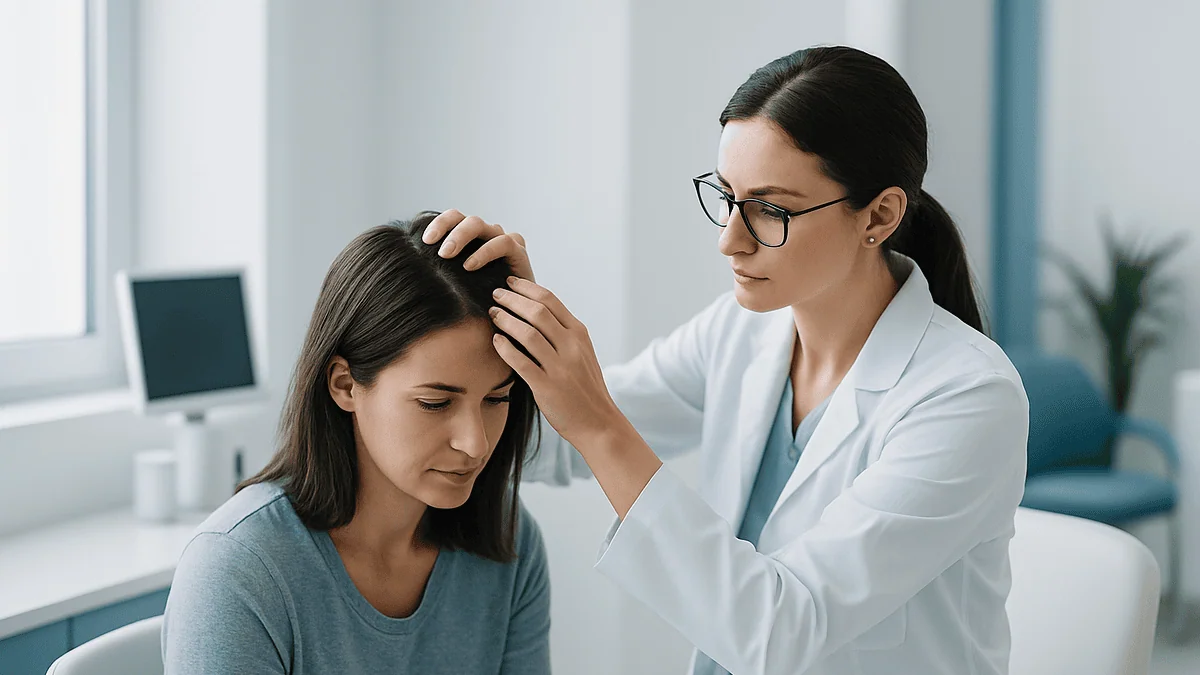
Robotic hair surgery is a form of FUE. The patient sits with the donor area trimmed short and a small tensioning frame placed on the skin. A camera system maps the follicles, and software selects units based on angle, spacing and hair count. A robotic arm then positions a punch and scores the skin around each unit, guided by that image analysis. A technician or surgeon lifts the loosened grafts with forceps, checks them, and stores them in a chilled solution until implantation.
Some systems can also make the recipient-site incisions according to a plan the surgeon draws on a digital model of the scalp. The final placement of grafts into those sites is still done by hand in the large majority of practices. Sessions typically run 4 to 8 hours according to Cleveland Clinic, done under local anesthetic, with breaks. In other words, the robot is a harvesting tool with excellent stamina, embedded in a procedure that remains thoroughly human.
What robotic hair surgery results actually depend on
Think of the outcome as three stacked layers. The bottom layer is biology: how much stable donor hair you have, how thick each hair shaft is, how fast the rest of your hair is thinning, and how your skin heals. No instrument changes those facts, which is why a careful assessment matters more than the technology list on a brochure.
The middle layer is the team. Someone decides how many grafts to take without depleting the donor zone, where the hairline should sit, which direction each hair should point, and how to distribute density so the result reads as natural rather than uniform. Someone trims and sorts grafts, keeps them cool and hydrated, and places them at the correct depth. Each of these steps involves judgment and dexterity; each can help or harm the final appearance.
The top layer is time. Transplanted follicles go through a predictable shock, shed their hair shafts, rest, then restart growth. Hair lengthens at roughly half an inch a month per Cleveland Clinic, so a short, fine early regrowth takes many months to thicken and blend. Meanwhile the untransplanted hair around the grafts continues to follow its own genetic program, which may mean further thinning unless that process is managed medically.
Where does the robot fit? Squarely in the middle layer, as one tool for one step. It can standardize punch angle and reduce operator fatigue during long extraction sessions. It cannot compensate for a weak donor area, an over-ambitious graft count, a hairline drawn too low, or a plan that ignores future loss. When people ask whether robotic hair surgery results are better, the truthful reply is that they depend on the same things every transplant depends on, with the robot changing only how one of those steps is performed.
Robot vs manual FUE: what the evidence actually shows
Here is the part many people find surprising. High-quality head-to-head trials comparing robotic FUE with an experienced surgeon performing manual or motorized FUE are scarce. Most published reports are case series or single-center descriptions of technique, which sit low on the evidence ladder. Such studies can show that robotic extraction is feasible and that graft damage rates during harvesting can be low, but they cannot prove that final density or appearance is superior.
What can be said with reasonable confidence, drawn from consumer guidance such as MedlinePlus, the NHS and Cleveland Clinic, is that the biological milestones are identical regardless of harvesting method: temporary shedding, regrowth beginning after a few months, and a fuller appearance over the following year. Nothing in the robot’s operation accelerates the hair cycle.
Potential practical advantages that are often described include consistency of punch alignment across thousands of extractions, less reliance on the extractor’s endurance in a long case, and image-based selection that may favor higher-hair-count units. Potential limitations are also real. Robotic systems generally require the donor hair to be trimmed very short across a broad area, work best on straight to wavy dark hair against lighter skin because the camera relies on contrast, and can be less suited to very curly hair or to fine, light hair. They cannot be used for FUT, and some scalps or body-hair donor sites are not accessible to the arm.
The candid summary: robotic assistance is one credible method of FUE among several. Whether it improves robotic hair surgery results for a specific person depends on their hair characteristics and, above all, on the team operating it. An excellent manual surgeon and an excellent robotic team are both far more consequential than the choice between them.
Who is robotic hair surgery usually for, and who is asked to wait?
The typical candidate has androgenetic alopecia, the hereditary, hormone-sensitive pattern that Mayo Clinic identifies as the most common cause of hair loss in both men and women. The pattern is stable or progressing slowly, the person is in good general health, and the donor area is dense enough to supply grafts without becoming visibly thin itself.
Hair characteristics matter for the robotic approach specifically. Straight or wavy hair that contrasts with the scalp gives the camera the clearest map. Very curly follicles bend beneath the skin in a way a straight punch may transect, so many teams reserve those cases for manual techniques or decline them. Fine, pale hair on pale skin can also challenge image recognition.
Several groups are routinely asked to wait or to consider other paths first:
- People in their late teens or early twenties whose final pattern is unknown; a hairline suitable at 22 can look unnatural at 45 as the surrounding hair recedes.
- Anyone with active, unexplained shedding, until a diagnosis is made; transplanting into an inflamed or scarring scalp can fail and can waste donor hair.
- People with diffuse thinning across the whole scalp, including the back, because the donor supply is itself affected.
- Those with bleeding disorders, poorly controlled chronic conditions, or unrealistic expectations about density.
Women present a particular case. Harvard Health notes that female pattern hair loss is common but often diffuse, and that medical therapy is usually the first step, with surgery suitable only when a stable donor area exists. A dermatologist or hair restoration surgeon, not a marketing consultation, should make the call, and it is reasonable to ask why you are or are not being offered a particular technique.
Why the donor area sets the ceiling on any transplant
Every transplant is a redistribution, not a multiplication. You finish with the same number of hairs you started with, arranged differently. That single fact explains most disappointments and most of the surgeon’s difficult decisions.
The hair at the back and sides is genetically resistant to the hormone that miniaturizes hair on the top of the head. Dihydrotestosterone (DHT) is a form of testosterone that, in genetically susceptible follicles, shortens the growth phase and shrinks the follicle over successive cycles until the hair is fine and short. Occipital follicles largely ignore it, which is why they keep growing after being moved. That resistance is the whole premise of the procedure.
Yet the safe donor zone is finite. Taking too many follicular units from too small an area leaves a moth-eaten look that is difficult to correct, and it removes hair you may want for a second procedure years later as thinning progresses. Robotic systems can compute spacing precisely, which helps, but the target number of grafts is a human decision that must weigh today’s request against tomorrow’s needs.
Hair caliber counts as much as hair count. Thick shafts cover more scalp per graft than fine ones; a person with coarse hair may look fuller with fewer grafts than someone with fine hair and more grafts. Curl adds apparent volume too. Good planning therefore involves measuring density and shaft diameter rather than quoting a round number.
Practical takeaway: when you are told how many grafts are proposed, ask how that figure relates to your total safe donor supply and what will be left for later. A team confident in its planning will welcome the question.
Hairline design and hair angle: the part no machine decides
If the donor area sets the ceiling, artistry sets the impression. Natural hairlines are not lines. They are irregular zones with single-hair units at the front, gradual increases in density behind, and slight asymmetries that the eye reads as organic. A hairline that is too straight, too low, or too dense at the edge is the most common visual giveaway of a transplant, and it is entirely a planning error rather than a harvesting one.
Angle and direction are the second craft element. Scalp hair exits the skin at shallow angles that change across the head: forward at the front, swirling at the crown, downward at the temples. Each recipient site must be made at an angle matching the surrounding pattern so the new hair lies the same way. Sites made too perpendicular produce hair that stands up like bristles; sites made against the natural flow create cowlicks in the wrong places.
Robotic systems that create recipient sites do so from a plan the surgeon draws on a digital model, and in most practices the surgeon reviews or hand-makes sites in the critical frontal zone. Graft placement itself, the delicate act of sliding each unit into its site without crushing the root, is done by trained assistants and the surgeon under magnification. This is where experience shows: the same grafts placed well or placed hurriedly can yield very different coverage.
Age-appropriateness is the final judgment. A mature hairline sits a little higher than an adolescent one and looks right for decades. Surgeons who consistently plan for the person at 60 rather than the person in the chair tend to produce results that age gracefully. None of this appears in a device specification sheet.
Robotic FUE graft survival: what happens to a follicle out of the body
A follicular unit is living tissue. From the moment it leaves the scalp until blood flow reconnects in its new site, it is on a clock. Several factors along that path influence whether it grows.
Transection is the first risk: cutting through the follicle during extraction so the growth cells are damaged. Robotic image guidance aims to align the punch with the follicle’s angle beneath the skin, and published technique reports describe low transection rates in suitable hair types, though these are single-center findings rather than randomized comparisons. Curly hair and very fine hair raise the risk with any method.
Time out of body comes next. Grafts are kept in chilled holding solution, and teams work to limit the interval between extraction and implantation. Dehydration is a well-recognized hazard; a graft allowed to dry on gauze even briefly may not survive. Handling matters too. Grasping the follicle bulb rather than the surrounding tissue can crush the very cells that regenerate the hair.
Implantation depth and site fit complete the picture. A graft placed too deep can form an ingrown cyst; one placed too shallow may dry out or pop out during early healing. Sites that are too tight compress the graft; too loose and it lacks blood contact.
Robotic hair surgery results therefore hinge on a chain of small, careful actions performed by people during and after the robot’s part is complete. When you read about survival percentages, remember that most originate from small series with varying methods and definitions, so a specific figure should not be quoted to you as a promise for your case. What you can reasonably ask is how the team minimizes each of these known risks.
Robotic hair transplant recovery time: the first two weeks
The first evening is usually more strange than painful. The donor area feels tight and tender under a light dressing; the recipient area is dotted with tiny crusts around each graft. Local anesthetic wears off over hours, and the team will have discussed pain relief options appropriate for you; follow their written instructions rather than general advice.
Days one to three bring swelling, sometimes migrating down to the forehead and around the eyes. The NHS describes this swelling and the small scabs as expected and temporary. Sleeping slightly propped up is commonly suggested. Gentle, specific washing routines begin within the first days, designed to soften crusts without dislodging grafts; hair washing should follow the team’s exact method, not a shampoo bottle’s.
Days four to ten are about protection. Grafts are increasingly anchored but still vulnerable to rubbing, sweat and direct sun. Most teams advise avoiding strenuous exercise, swimming, saunas and hats that press on the recipient area for a period they will define. Returning to a desk job is often possible within a few days to about a week, and the NHS notes you may need to plan time off depending on your work and how visible you are comfortable being; those with physical jobs may need longer.
By around day ten to fourteen, crusts have typically flaked away and the transplanted hairs are still standing, short and stubbly. Then comes the moment that unnerves almost everyone: shedding. Between roughly two and six weeks after surgery, the NHS explains, most transplanted hairs fall out. The follicle beneath remains and is entering a rest phase. Losing those hairs is expected, not a sign of failure, and knowing this in advance spares a great deal of worry.
How long do robotic hair surgery results take to show?
Hair grows in cycles, and a transplanted follicle restarts its cycle from the beginning. That is why the honest answer to “when will I see it” is measured in months, not weeks, whatever method was used to harvest the grafts.
| Time after surgery | What is typical | Source |
|---|---|---|
| 0 to 2 weeks | Swelling, small crusts, tenderness; grafts anchoring | NHS |
| 2 to 6 weeks | Transplanted hairs shed; follicles enter rest phase | NHS, MedlinePlus |
| 3 to 4 months | Fine, short new hairs begin to appear unevenly | MedlinePlus, Cleveland Clinic |
| 6 to 9 months | Many people see a substantial share of expected new growth | MedlinePlus |
| 12 to 18 months | Hair thickens, lengthens and blends; usual point for final assessment | Cleveland Clinic |
MedlinePlus notes that most people see around 60 percent of their new hair growth by six to nine months, with the remainder maturing afterward. Cleveland Clinic describes full results as taking roughly a year to eighteen months. Both figures are population descriptions, not guarantees for any individual.
Why so slow? Two reasons. Follicles emerging from the rest phase produce a fine, sometimes lighter hair that thickens over several cycles. And hair simply takes time to reach a length that covers scalp; at about half an inch a month, a hair that starts growing at month four is only around four inches long at month twelve.
There is also a psychological pattern worth naming. Months two to four are often the low point: the shed hairs are gone, new ones are barely visible, and the person looks much as before. Teams who prepare patients for this dip see fewer panicked calls. Photographs under consistent lighting at set intervals are a more reliable judge of progress than the bathroom mirror at 6 a.m.
Medicines and other alternatives that protect the result
A transplant relocates resistant hair; it does nothing to protect the native hair that remains on top. If that hair keeps thinning, a good result can look sparser over the years as the surroundings recede around it. This is why hair restoration specialists so often discuss medical management alongside surgery. Decisions about any medicine rest with your prescribing clinician; what follows describes mechanism and typical timelines only.
Minoxidil is a topical treatment, thought to prolong the growth phase and increase blood flow around follicles. Mayo Clinic notes that it takes at least six months of use to judge whether it is helping, and that benefit fades if it is stopped. Finasteride, an oral medicine used in men, lowers the conversion of testosterone to DHT, the hormone that miniaturizes susceptible follicles. Mayo Clinic describes it as slowing loss and sometimes producing regrowth over several months of use, and lists potential side effects that a clinician should review with you. It is not used in women who are or may become pregnant.
Other options exist and are graded differently. Low-level laser devices have some supportive studies but inconsistent quality. Platelet-rich plasma injections, in which a person’s own concentrated platelets are injected into the scalp, are offered widely, yet Mayo Clinic and Harvard Health describe the evidence as early and mixed rather than established. Microneedling is similarly under study. None of these should be presented to you as proven adjuncts to surgery.
For some people, a transplant is not the right first step at all. Medical therapy alone, camouflage products, scalp micropigmentation or simply choosing a shorter style are legitimate paths. A neutral consultation will lay these out before discussing grafts.
Risks and complications, in plain clinical language
Hair transplantation is considered a low-risk elective procedure when performed by trained teams in appropriate settings, but low risk is not no risk. Knowing the range in advance makes it easier to spot the unusual.
Common and usually temporary effects include swelling of the forehead, bruising, crusting, itching, numbness or altered sensation in the donor and recipient areas, and small pimple-like bumps (folliculitis) as new hairs push through. The NHS lists these among expected experiences. Shock loss, a temporary shedding of native hair near the recipient area caused by surgical trauma, can occur and usually regrows over months.
Less common problems include infection, bleeding, wide or visible scarring, small cysts from grafts placed too deep, and poor growth of some or all grafts. FUE, including robotic FUE, leaves hundreds or thousands of tiny dot scars that are generally hidden by surrounding hair unless it is cut very short or the donor area was over-harvested. Rarely, persistent numbness or a patchy donor area can be permanent.
Cosmetic dissatisfaction deserves its own mention because it is the most frequent reason people seek revision: a hairline that looks too low or too straight, grafts pointing the wrong way, or density that reads as unnatural. These are planning and placement issues, not device failures, and correcting them consumes donor hair.
Robotic systems introduce a few method-specific considerations: the need to trim a broad donor area very short, pressure marks from the tensioning frame, and reduced suitability for some hair types. Cleveland Clinic and MedlinePlus both stress that choosing a properly qualified surgeon and disclosing your full medical history are the most reliable ways to lower overall risk. Your team should explain how they would handle each of these outcomes if they arose.
What people often get wrong about robotic hair surgery
Myths cluster around new technology, and the robot has attracted its share. Correcting them is one of the kindest things a consultation can do.
“The robot does the whole operation.” It performs, or assists with, extraction and sometimes site creation. Candidate selection, hairline design, graft sorting, placement and aftercare are done by people. The team’s skill is the largest variable you can influence.
“Robotic means scarless.” FUE of any kind leaves tiny dot scars. They are usually inconspicuous under hair of ordinary length, but they exist, and very short haircuts may reveal them.
“My hair fell out, so it failed.” Shedding between roughly two and six weeks is the normal cycle restarting, per NHS and MedlinePlus. Failure is judged at a year or more, not at week three.
“More grafts always means better.” Beyond a point, extra grafts deplete the donor zone and compromise future options while adding little visible density. Distribution and angle matter more than raw numbers.
“A transplant stops hair loss.” It moves resistant hair; the native hair keeps following its genetic program. That is why medical management is so often discussed alongside surgery.
“Results are permanent and complete after one session.” Transplanted follicles generally keep growing for life, but many people need a second procedure years later as surrounding hair thins, and some plan for it from the start.
“Newer technology guarantees a natural look.” Naturalness comes from irregular hairline design, correct angles and graduated density. No harvesting device supplies those. When you read about robotic hair surgery results online, separate what the machine did from what the team decided; the second column is where outcomes are made.
Questions to ask your care team before agreeing to surgery
A good consultation should feel like a two-way interview. You are assessing whether this team, using this method, is right for your scalp, and the questions below help you do that without needing a medical degree.
- What is my diagnosis, and how do you know my hair loss pattern is stable enough for surgery?
- How many follicular units do I have in my safe donor zone, and what proportion do you propose to use now?
- Why do you recommend robotic FUE for my hair type rather than manual FUE or FUT? What would change your recommendation?
- Who designs the hairline, who makes the recipient sites, and who places the grafts? How many of each step does the surgeon do personally?
- How do you limit graft time out of body and prevent drying during the session?
- Where would my hairline sit, and how will it look in twenty years as surrounding hair changes?
- What is your plan for my native hair, and which medical options should I discuss with a dermatologist?
- What are the specific complications you have seen, and how are they managed?
- What written aftercare instructions will I receive, and who do I contact out of hours?
- When and how will results be assessed, and what would prompt a second session?
Notice that none of these ask about brand names or device generations. They ask about judgment, workflow and honesty. Listen for answers that acknowledge uncertainty; MedlinePlus and Cleveland Clinic both frame outcomes as variable and gradual, and a team that speaks the same way is more likely to be describing reality than selling a picture.
Take notes, take time, and consider a second opinion. Elective surgery on a part of you that everyone sees deserves at least that much deliberation.
When to call your doctor after robotic hair surgery
Most recoveries follow the gentle, undramatic arc described earlier: tightness, swelling, crusting, shedding, waiting. A small number do not, and knowing the difference between expected and worrying signs lets you act early without living in fear.
Contact your surgical team or a doctor promptly if you notice any of the following:
- Spreading redness, warmth, increasing pain or pus at the donor or recipient area, especially with a fever, which may signal infection.
- Bleeding that does not settle with the gentle pressure your team described, or that soaks through dressings.
- Rapidly worsening swelling of the face or eyelids, or swelling that limits your vision.
- Severe or escalating pain not controlled by the plan you were given.
- Signs of an allergic reaction to any prescribed product: rash, hives, swelling of lips or tongue, or difficulty breathing. Difficulty breathing is an emergency; call emergency services.
- Numbness or tingling that is spreading or persisting well beyond the timeline your team predicted.
- Large areas where crusts have lifted with grafts attached in the first days, particularly after a knock or fall.
Seek care too if you feel unwell in a general way: chills, dizziness, a racing heart or confusion after surgery are not typical and should be assessed the same day.
Slower concerns deserve a scheduled review rather than an emergency call: very little regrowth by eight to nine months, a hairline that looks uneven as hair lengthens, persistent folliculitis, or thinning of the donor area. MedlinePlus and the NHS both encourage patients to keep follow-up appointments and to raise cosmetic worries with the operating team first, since they know exactly what was done and where.
Above all, do not stop, start or change any medicine on your own based on what you see in the mirror. Bring the observation to the prescribing clinician; the decision about what to do next belongs with them and with you, together.
Frequently asked questions
Does robotic hair transplant look natural?
It can, but naturalness comes from planning rather than the robot. An irregular hairline of single-hair grafts, correct exit angles, and density that increases gradually behind the front edge are what make transplanted hair blend. Those are decided and executed by the surgical team. Robotic extraction can supply well-selected grafts consistently, yet the same grafts placed too straight, too low or too perpendicular will look artificial regardless of how they were harvested.
Is robot vs manual FUE a meaningful choice for results?
Less than marketing suggests. Both are follicular unit extraction and follow identical biological timelines. Robotic systems may offer consistent punch alignment and reduce operator fatigue in long sessions; manual and motorized FUE offer flexibility for curly or fine hair and for body donor sites. Direct comparative trials are lacking. The experience of the team performing either method is the larger determinant of how your result looks a year later.
What is typical robotic hair transplant recovery time?
Most people manage light activity within days and desk work within roughly a few days to two weeks, depending on swelling, comfort and how visible they are willing to be. Crusts usually clear by around two weeks. Strenuous exercise, swimming and sun exposure are commonly restricted for a period your team will define. Full cosmetic recovery, meaning visible regrowth, takes months, with a fuller assessment at about 12 to 18 months according to Cleveland Clinic.
What affects robotic FUE graft survival most?
Handling. Follicles must be extracted without cutting through them, kept cool and moist while out of the body, and placed at the right depth in a snug site without crushing the bulb. Robotic guidance addresses only the first step. Hair type also matters: curly follicles curve beneath the skin and are more easily transected by any straight punch. Reported survival figures come from small series with varied methods, so treat any specific percentage cautiously.
Why did my transplanted hair fall out a few weeks after surgery?
This is expected. Moving a follicle shocks it into a rest phase, and the hair shaft it was carrying sheds, typically between two and six weeks after surgery according to the NHS. The living follicle remains in place beneath the skin and restarts its growth cycle, usually producing fine new hairs from around month three or four. Shedding at this stage is not a sign that the grafts have failed.
How many grafts will I need?
There is no universal number; it depends on the area to be covered, your hair caliber and curl, how much density you want, and how much safe donor hair you have. Thicker shafts cover more scalp per graft. A responsible plan also reserves donor hair for possible future sessions as native hair thins. Ask how the proposed figure relates to your total safe donor supply rather than comparing counts with other people.
Will a hair transplant stop my hair loss?
No. It moves hormone-resistant hair from the back and sides to thinning areas, but the native hair that remains on top continues to follow its genetic program. Without medical management, ongoing thinning around the grafts can make a good result look sparser over the years. That is why teams commonly discuss options such as topical minoxidil or, in men, oral finasteride; whether either is appropriate for you is a decision for your prescribing clinician.
Can women have robotic hair surgery?
Sometimes, but selection is more cautious. Harvard Health notes that female pattern hair loss is often diffuse, which can mean the donor area itself is thinning and cannot safely supply grafts. Medical therapy is usually the first step, and surgery is considered when a stable donor zone exists and the pattern is well defined. The need to trim the donor area short for robotic extraction is also a practical consideration many women weigh.
Does robotic FUE leave scars?
Yes, small ones. Every FUE punch leaves a tiny dot scar in the donor area, so a session produces hundreds or thousands of them scattered across the back and sides. Under hair of ordinary length they are generally hard to see; very short cuts can reveal them, and over-harvesting a small area can create visible thinning. Strip surgery (FUT) leaves a single linear scar instead. Neither method is scarless.
When should I judge whether the procedure worked?
Not before about a year. MedlinePlus indicates most people see roughly 60 percent of new growth by six to nine months, and Cleveland Clinic describes full results at around 12 to 18 months as hairs thicken and lengthen at about half an inch a month. Photographs taken under consistent lighting at set intervals show progress more reliably than daily mirror checks. Raise concerns about growth or hairline shape with your operating team at scheduled reviews.
References
This article is for general information only and is not a substitute for professional medical advice. Please consult a qualified doctor about your individual situation.

More from the Blog
Unshaven (U-FUE) Hair Transplant Recovery: Hiding Redness, Washing Long Hair and Work Return
Unshaven FUE recovery follows the same biology as any follicular unit extraction, but the surrounding long hair changes the practical details. Grafts typically anchor…
Eyebrow Transplant Results Over the First Year: Shedding, Regrowth and When the Shape Settles
Eyebrow transplant results change markedly across the first year. Most transplanted hairs shed within roughly two to eight weeks, then regrow from about month…
How Many Days in Turkey for a Hair Transplant? The Realistic Itinerary
Plan for five to seven days in Turkey for a hair transplant. The procedure itself usually takes one day (about four to eight hours),…
When Does an Old Hair Transplant Need Repair? Hairline Angle, Pluggy Grafts and Uneven Density
An old hair transplant usually needs repair when it no longer looks natural or no longer matches the rest of the scalp: a hairline…

Scalp Micropigmentation Risks: Pigment Spread, Color Shift and Allergic Reactions Explained
Scalp micropigmentation risks are mostly the risks of any cosmetic tattoo applied to a thin, sun-exposed area of skin: pigment can spread and blur…
Biofibre Hair Implants: What UK Patients Should Know Before Considering Them
Biofibre hair implants are synthetic polyamide fibers anchored into the scalp, not a transplant of living hair. The fibers never grow, shed at an…