

When Dentists Reach for a Laser: Gum Reshaping, Sensitivity and Small Cavity Repair
Key Takeaways
- Dental lasers are matched by wavelength to a target: diode, Nd:YAG and CO2 lasers work on gum tissue, while erbium lasers can also cut enamel and dentin using flash-vaporized water.
- Gum reshaping is the laser's clearest strength because the beam seals small vessels as it cuts, so sutures are often unnecessary and the dentist can judge the new line in real time.
- Gum tissue removed by laser does not regrow to its old position, but inflammatory swelling can return if plaque control lapses; receded gums need grafting, not a laser.
- Systematic reviews find only small or inconsistent added benefit from laser adjuncts to scaling and root planing, so lasers do not replace mechanical cleaning or maintenance visits.
- Lasers cannot remove metal fillings or crowns and are slower than a drill on large preparations, which is why crown work stays with conventional instruments.
- Some small laser-prepared cavities are tolerated with little or no anesthetic, but gum surgery and deeper fillings usually still require numbing.
Dentists use lasers most often for soft-tissue work such as reshaping gum lines, trimming overgrown tissue and cleaning infected gum pockets, and less often for removing small areas of decay or treating sensitive tooth surfaces. Lasers are one tool among several; whether one is used depends on the type of tissue, the size of the problem, the dentist's training and the equipment available.
A man in his fifties sits in a dental chair, tongue running along a molar that stings every time he sips iced tea. The dentist mentions a laser. His first thought is science fiction; his second is whether it will hurt more, or less, than the drill he remembers from childhood.
That mix of curiosity and wariness is common, and it deserves a straight answer rather than a brochure. So when is laser dentistry used, and when is it quietly set aside for a scalpel, an ultrasonic scaler or a conventional handpiece? The honest picture is narrower and more interesting than the marketing suggests.
This explainer walks through what dental lasers actually do to gum and tooth, which jobs they suit, where the evidence is thin, and what the recovery usually looks like. Every decision about your own mouth still belongs with the dentist examining it.
Why would a dentist use a laser instead of a drill or scalpel?
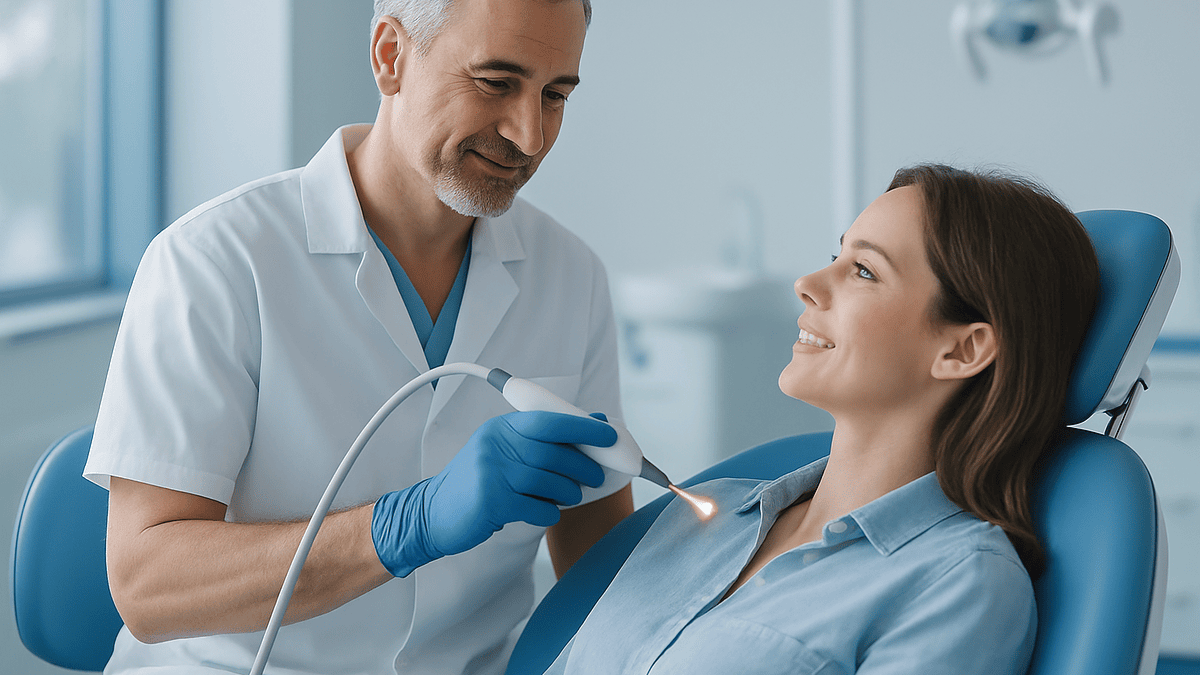
The short version: precision and bleeding control. A dental laser delivers a narrow beam of light at a wavelength chosen to be absorbed by a particular target, usually water, blood pigment or the mineral in enamel. Where the beam lands, tissue is vaporized or ablated (removed in microscopic layers) with very little pressure and no spinning metal.
For soft tissue, that matters because the same energy that cuts also seals small blood vessels. A dentist trimming a gum line with a scalpel expects bleeding and often places sutures; with a laser, the field usually stays clearer and stitches are frequently unnecessary. Better visibility means finer control over exactly how much tissue comes away, which is the whole point of gum reshaping.
For hard tissue, the appeal is different. Erbium-family lasers (a class of dental laser that is strongly absorbed by water) can remove decayed enamel and dentin without the vibration and high-pitched whine of a drill. Some people who dread that sensation find the laser easier to tolerate, and some small cavities can be treated with less numbing.
There is also a hygiene argument. Laser energy has an antibacterial effect at the surface it touches, which is why some periodontists (gum specialists) use it inside infected gum pockets after mechanical cleaning. Whether that translates into measurably better long-term gum health is a question the evidence answers only cautiously, as a later section explains.
None of this makes the laser a universal replacement. It is slower on large fillings, cannot remove old metal restorations, and requires specific training. The sensible way to read the rest of this article is as a map of where the tool genuinely earns its place.
How dental lasers actually work: light, water and tissue
Every dental laser is a matching game between a wavelength and a target. Diode lasers and neodymium (Nd:YAG) lasers emit light that is absorbed well by pigment and blood, so they behave like fine heat scalpels on gum tissue and barely affect enamel. Carbon dioxide lasers are absorbed by water in soft tissue and are also used for gum and lip lesions. Erbium lasers (Er:YAG and Er,Cr:YSGG) sit in a wavelength that water and the mineral hydroxyapatite both absorb strongly, which is what lets them cut tooth structure.

The hard-tissue mechanism is worth a plain description because it explains both the benefits and the limits. Erbium light is delivered alongside a fine water spray. The pulse flashes water molecules trapped in enamel and dentin into steam almost instantly; the tiny explosive expansion knocks away a microscopic chip of tooth. Repeat thousands of times per second and you have controlled removal without the frictional heat of a rotating bur. The water also cools the tooth, protecting the pulp (the living nerve and blood supply inside).
Soft-tissue cutting works differently. The beam heats cells until they vaporize, and the surrounding zone of gentle heat coagulates small vessels. That zone must be kept thin; too much energy or too slow a hand produces a wider band of heat damage that heals more slowly. Operator technique, not the machine alone, determines the result.
Two practical consequences follow. First, lasers need eye protection for everyone in the room, because the beam can damage the retina. Second, the tooth’s response to heat is the main safety consideration in hard-tissue work, which is why manufacturers and training programs emphasize water flow and pulse settings. Dental lasers are regulated medical devices cleared for specific uses, and dentists are expected to stay within those indications.
Laser gum contouring: when reshaping the gum line is worth doing
Gum contouring, also called gingivectomy or gingivoplasty when tissue is removed and reshaped, is the most common soft-tissue job dentists give to a laser. It comes up in three situations that have little to do with one another.
The first is a “gummy” smile where gum tissue covers more of the tooth than it needs to, so teeth look short. Sometimes the real issue is that the teeth erupted incompletely and are simply hiding under normal gum; trimming can reveal them. A dentist will usually probe first to check where the bone sits, because gum can only be safely reduced to a certain distance above bone. Go closer and the tissue becomes chronically inflamed.
The second is overgrowth caused by inflammation or by certain medicines. Some anti-seizure drugs, some blood-pressure medicines in the calcium-channel-blocker class and some transplant immunosuppressants are associated with gum enlargement. In those cases the laser removes bulk, but the swelling tends to return unless plaque control improves and the prescribing physician is consulted; no one should stop or change such a medicine on the dentist’s advice alone.
The third is practical: a filling or crown margin that sits just below the gum line and cannot be kept dry or reached. Trimming a millimeter or two of tissue lets the dentist see and seal the edge properly.
What a laser does not do is grow gum where it has receded. Recession exposes root surface and usually needs a grafting procedure, which is scalpel work with donated or repositioned tissue. If your concern is roots showing rather than too much gum, a laser is the wrong tool and a good dentist will say so.
Lasers for gum disease: what the evidence supports and where it stops
Gum disease begins as gingivitis, a plaque-driven inflammation of the gum edge that is reversible with thorough cleaning, and can progress to periodontitis, where the bone and fibers anchoring the tooth are lost. The NHS and MedlinePlus both describe the mainstay of treatment as professional removal of plaque and hardened tartar above and below the gum line (scaling and root planing), together with daily home cleaning.

Where do lasers fit? Mostly as an adjunct, not a replacement. After a hygienist or periodontist has mechanically cleaned a pocket, a soft-tissue laser tip can be passed inside it to remove diseased lining and reduce bacteria. Some clinicians use it instead of a scalpel in flap surgery, where the gum is lifted to reach deep deposits.
The Mayo Clinic notes that dentists measure pocket depth with a probe; healthy pockets are shallow, while pockets deeper than about 4 millimeters suggest periodontitis and deeper ones cannot be cleaned well without surgery. That measurement, repeated over time, is how any treatment, laser or not, is judged. Reduced depth and reduced bleeding on probing are the outcomes that matter.
Systematic reviews of laser adjuncts to scaling have generally found small or inconsistent added benefit over thorough conventional cleaning alone, and the results vary by laser type and study quality. That is not a verdict against lasers; it is a reason to be skeptical of any claim that a laser “eliminates” gum disease or replaces the unglamorous work of debridement and maintenance.
Periodontitis is a chronic condition managed rather than fixed. Whatever instruments are used, expect a maintenance schedule of cleanings and re-probing, and expect the daily brushing and interdental cleaning to carry most of the load.
Can a laser treat sensitive teeth?
Tooth sensitivity, that sharp jolt from cold, sweet or a toothbrush bristle, usually comes from exposed dentin. Dentin is the softer layer beneath enamel, and it is riddled with microscopic tubules leading to the pulp. When gum recedes or enamel wears, those tubules open to the mouth, and fluid movement inside them triggers the nerve.
The Cleveland Clinic lists the usual first steps: desensitizing toothpaste that calms the nerve or plugs tubules, professional fluoride to strengthen the surface, bonding resin over exposed roots and, when recession is the cause, gum grafting. Treating whatever caused the exposure, such as aggressive brushing or acid erosion, matters as much as sealing the surface.
Lasers enter this list as one way to occlude the tubules. Low-level laser energy is thought to alter nerve conduction temporarily, while higher-energy erbium or Nd:YAG pulses can melt and reseal the dentin surface so the tubules narrow. Studies do report reduced sensitivity after laser treatment, but many are small, follow-up is often short, and the placebo response in sensitivity research is famously large. Reviews tend to conclude that lasers are one reasonable option among several rather than clearly superior.
A practical point: sensitivity that appears suddenly, that lingers for more than a few seconds after the trigger is removed, or that comes with pain on biting is a different problem. It may signal a crack, a cavity near the pulp or an inflamed nerve, and no surface treatment will settle it. The dentist needs to examine and often X-ray the tooth before anyone discusses lasers.
If your dentist proposes laser desensitization, a fair question is what will be tried first and how the result will be judged at the next visit.
Laser cavity treatment: which fillings suit it and which don't
Tooth decay is the destruction of enamel and dentin by acid that bacteria produce from sugars. MedlinePlus describes treatment as removing the decayed material and restoring the tooth with a filling, or with a crown when too little tooth remains. The removal step is where an erbium laser can substitute for a drill.
Small to moderate cavities on chewing surfaces and near the gum line are the classic candidates. The laser ablates softened, water-rich decayed tissue faster than healthy tooth, which gives some selectivity, and the surface it leaves is rough and free of the smeared debris a bur produces. Some dentists find that helps bonding of tooth-colored composite resin. Because there is no vibration and less heat, a portion of patients manage small laser preparations with little or no local anesthetic; that is an individual response, not a guarantee, and the dentist will offer numbing if there is any discomfort.
Now the limits, which are real. Lasers are slower than a high-speed drill on large areas of enamel. They cannot remove existing metal amalgam or a metal crown, because reflected energy is hazardous and the material does not ablate. Shaping a tooth for a crown, where precise margins and smooth walls are needed, remains drill work. Deep decay close to the pulp still needs careful judgment about heat and about whether the nerve can be saved, and the laser changes none of that calculus.
So a realistic sentence is this: a laser can replace the drill for some fillings, particularly small ones in people who find the drill distressing, and the finished restoration is the same composite filling either way. The choice of material, the need for anesthetic and the long-term care of the tooth do not change.
Who is laser dentistry usually for, and who is usually asked to wait
Because a laser is a tool rather than a treatment, the question is really which situations favor it. Several patterns recur in practice.
People who need soft-tissue work in a visible area, such as gum contouring on front teeth, often do well with lasers because bleeding is minimal and the result can be judged in real time. Those who need a small frenectomy (release of the band of tissue under the tongue or lip) or removal of a benign fibrous lump are similar candidates. Children and adults with strong dental anxiety focused on the drill’s sound and vibration may be offered laser preparation for small cavities. People taking blood-thinning medicines may benefit from the reduced bleeding of laser soft-tissue surgery, although the dentist will still coordinate with the prescriber and no one should alter anticoagulant treatment on their own.
Others are usually asked to wait or steered elsewhere. Anyone with active, untreated gum inflammation will generally be asked to complete cleaning and improve home care before cosmetic gum reshaping, since inflamed tissue heals unpredictably and the “excess” gum may simply be swelling. People whose main complaint is receded gums need grafting, not removal. Teeth with existing metal fillings or crowns that need replacement go to the drill. Anyone with a photosensitivity disorder, or with a pacemaker or other implanted device, should mention it so the dentist can check manufacturer guidance for that specific laser.
Pregnancy is not a reason to avoid necessary dental care, but elective cosmetic procedures are typically deferred, and the dentist will discuss timing. As always, the person examining you weighs these factors together; a list on a website cannot.
When is laser dentistry used versus conventional tools? A side-by-side table
The table below summarizes where lasers commonly sit relative to standard instruments. It reflects typical practice patterns and mainstream guidance rather than a rule; individual dentists vary in training and equipment, and the right choice depends on the specific tooth and mouth.
| Job | Conventional tool | Laser role | Evidence picture |
|---|---|---|---|
| Gum reshaping (gingivectomy) | Scalpel, often sutures | Frequently used; less bleeding, usually no sutures | Well established for soft-tissue cutting |
| Gum disease pocket cleaning | Scaling and root planing | Adjunct after mechanical cleaning | Small or inconsistent added benefit in reviews |
| Small cavity removal | High-speed drill | Alternative for small lesions; slower | Comparable restorations; comfort may favor laser |
| Large fillings, crown preparation | Drill | Rarely; too slow, margins harder | Drill remains standard |
| Removing metal fillings or crowns | Drill | Not used | Contraindicated |
| Tooth sensitivity | Toothpaste, fluoride, bonding, grafts | One option to seal dentin tubules | Mixed; short follow-up in many studies |
| Frenectomy, small soft lesions | Scalpel | Commonly used | Established |
Two things stand out. The laser’s strongest ground is soft tissue, where the advantages of a sealed, bloodless field are immediate and visible. Its most contested ground is gum disease, where marketing has sometimes run ahead of the data. And in hard-tissue work it is a legitimate alternative for a limited range of cases rather than a new standard.
If a dentist recommends a laser for something outside these rows, that is not automatically wrong, but it is a reasonable moment to ask what the alternative would be and why the laser was chosen.
What the days and weeks after laser treatment usually look like
Recovery depends far more on what was done than on the fact a laser did it, so it helps to separate the three procedures in this article.
After gum reshaping, expect the treated edge to look pale or slightly whitish for a short while as the surface layer heals, then pink up. Mild soreness and tenderness when brushing near the site are common. Dentists usually advise soft foods for the first meals, gentle brushing with a soft brush, avoiding very hot or spicy food and not picking at the area. Over-the-counter pain relief, if needed, is a conversation for your dentist, who knows your medical history and other medicines. Because the laser seals small vessels, significant bleeding afterward is unusual, which is one of the practical advantages.
After laser cavity removal and a composite filling, the experience matches any new filling: the tooth may feel slightly odd or sensitive to cold as the pulp settles. The Cleveland Clinic notes that sensitivity following dental work is a recognized, usually temporary cause of tooth sensitivity. Bite feeling “high” or pain on chewing that does not ease should be reported, because a filling may need a minor adjustment.
After laser desensitization, some people notice relief straightaway and others find it builds over subsequent applications; the dentist will typically reassess at a follow-up visit and decide whether to repeat treatment or move to another approach.
For gum-disease treatment, the meaningful timeline is longer. Re-probing at a later maintenance visit, not how the gums feel in week one, tells you and your dentist whether the pockets have shallowed. The NHS advises that check-up intervals are set individually, anywhere from a few months to two years, based on your risk; people with periodontitis sit at the frequent end.
What are the downsides of laser dentistry?
Honest answers here are more useful than reassurance, so take the drawbacks in order of how often they matter.
Speed is the first. On anything larger than a small cavity, an erbium laser removes tooth structure more slowly than a high-speed drill, so appointments can run longer. For extensive restorations most dentists will still reach for the bur.
Scope is the second. A laser cannot remove amalgam or metal crowns, cannot prepare a tooth for a crown with the precision required, and cannot replace the physical scraping that removes hardened tartar from a root surface. The idea that a laser-equipped practice does everything by laser is not how careful dentists work.
Heat is the third. Both soft- and hard-tissue lasers can injure tissue if energy, pulse duration or water cooling is set poorly. On teeth, excess heat can inflame the pulp; on gums, it can widen the zone of thermal damage and slow healing. This is a training and technique issue rather than an inherent flaw, but it is a real one.
Anesthetic expectations are the fourth. Some people are told a laser means no numbing. For gum contouring and for many fillings, local anesthetic is still standard; the difference is that some small preparations can be tolerated without it. Being surprised by pain because a promise was made is worse than planning for numbing.
Evidence is the fifth. For gum disease and sensitivity, the added benefit over conventional care is modest or uncertain in systematic reviews. A laser adjunct is not harmful in trained hands, but it should not be sold as a shortcut past scaling, root planing and maintenance.
Finally, protective eyewear is non-negotiable for you and the team, and the dentist should be able to explain which device they use and what it is cleared for.
Why don't more dentists use lasers?
Given the appealing pitch, people are often surprised that many excellent dentists have never bought a laser, or own one that sits in a cupboard. Several reasons stack up, and none of them is that lasers are dangerous or fringe.
Training comes first. Using a laser well means understanding wavelength-tissue interactions, adjusting settings for each task and developing hand speed and angulation that differ from scalpel or drill work. Dental schools vary in how much laser instruction they offer, and continuing-education courses take time. A dentist who has spent decades achieving reliable results with conventional tools has a rational reason to keep doing what they know produces good outcomes.
Range comes second. Because a single laser cannot do every job, a practice wanting both hard- and soft-tissue capability may need more than one device, and even then the drill and scalpel remain essential. The laser adds an option rather than removing anything from the cabinet.
Evidence comes third. For the procedures where a laser clearly shines, soft-tissue cutting, a scalpel in skilled hands also works very well, and for the contested areas, gum disease and sensitivity, the added benefit is uncertain. When the data do not show a large advantage, adoption is naturally slower.
Workflow and maintenance matter too. Devices need calibration, fiber tips, water systems and safety protocols; appointments for laser cavity work can run longer.
None of this should worry you if your dentist does not offer lasers. Good dentistry is judged by diagnosis, technique, hygiene and follow-up, not by equipment. Equally, a dentist who does use a laser is not selling gimmicks if the indication is sound. The right question is not “do you have a laser?” but “for my problem, what tool would you choose and why?”
What people often get wrong about laser dentistry
Myths cluster around this topic, partly because the word “laser” carries a glow of modernity. Here are the ones dentists hear most, with the correction.
“Gums grow back after being lasered.” Not in the way people hope or fear. Gum tissue removed to a new contour does not regenerate to its old position, which is why the dentist plans the line carefully and checks the bone level first. What can happen is that inflammation-driven swelling returns if plaque control lapses or an enlarging medicine continues, so the gums look puffy again. That is recurrence of swelling, not regrowth of removed tissue. In the opposite direction, gums that have receded do not grow back on their own, laser or not; grafting is the route.
“Lasers mean no needles ever.” Some small cavities can be treated with little or no anesthetic. Gum surgery and deeper fillings generally still need numbing.
“Laser treatment gets rid of gum disease.” Periodontitis is a chronic condition. Lasers may help clean pockets, but ongoing maintenance and home care determine the long-term result.
“Lasers can do any filling.” They cannot remove metal restorations and are impractical for large preparations and crowns.
“A laser dentist is a better dentist.” Equipment is not a credential. Diagnosis, judgment and follow-up are.
“Lasers whiten teeth.” Some whitening systems use a light to warm the bleaching gel; the light itself does not whiten, and the evidence that light activation adds meaningful benefit over the gel alone is weak.
“Laser wounds don’t need care.” They heal with less bleeding but still need gentle hygiene and the soft-food, no-picking routine your dentist describes.
Questions to ask your care team
A ten-minute conversation before any procedure prevents most misunderstandings. These questions are phrased for a real appointment, not a checklist to recite; pick the ones that fit your situation.
- For my specific problem, what are the options, and why are you suggesting a laser over the alternative?
- What type of laser is it, and what is it cleared to treat? Is this a soft-tissue device, a hard-tissue device or both?
- How much of my gum will be removed, and how did you decide where the new line should sit? Did you check the bone level?
- Will I need local anesthetic? If we start without it, how do I signal that I want it?
- How long is the appointment likely to take compared with the conventional approach?
- What should the site look and feel like over the following days, and what would make you want to see me sooner?
- If this is for gum disease, how will we measure whether it has worked, and when will you re-probe the pockets?
- If this is for sensitivity, what will we try first, and what is the next step if the laser does not help?
- Do any of my medicines or health conditions change the plan? (Mention blood thinners, immunosuppressants, seizure or blood-pressure medicines, implanted devices, pregnancy and any photosensitivity.)
- Who do I contact after hours if something worries me?
Write the answers down or ask for them in your treatment summary. A team comfortable with its equipment will welcome these questions; hesitation to explain the choice of tool is itself useful information. And if you decide you would rather have the conventional approach, that is a legitimate preference, not a rejection of modern care.
When to call your doctor or dentist
Most laser dental procedures heal uneventfully, and the reduced bleeding is one reason. Still, complications can occur after any oral surgery or filling, and the signs are the same regardless of the instrument used.
Contact your dentist promptly if you notice bleeding from a treated gum site that does not stop with steady pressure from clean gauze, pain that increases after the first couple of days instead of easing, swelling that is spreading or making it hard to open your mouth, a foul taste or discharge from the site, or a filled tooth that becomes increasingly painful, throbs at night or hurts sharply on biting. Numbness of the lip, tongue or chin that persists well beyond the expected wearing-off of anesthetic also needs a call.
Seek urgent medical care, not just a dental appointment, if you develop fever with facial swelling, swelling that extends toward the eye or under the jaw, difficulty swallowing or breathing, or any sign of an allergic reaction such as hives or swelling of the lips and throat. MedlinePlus notes that untreated dental infections can spread to surrounding tissues, and swelling that affects the airway is an emergency.
Outside the recovery period, see your dentist for gums that bleed regularly when brushing, persistent bad breath, teeth that feel loose or are shifting, or gums pulling away from the teeth. The NHS describes these as signs of gum disease that warrant assessment rather than waiting for a routine check-up.
Every recommendation in this article is general. Your dentist and, where relevant, your physician have your history, X-rays and probing measurements, and the decision about whether a laser is the right tool for your mouth rests with them.
Frequently asked questions
Why would a dentist use a laser?
Mainly for precise soft-tissue work with less bleeding, such as reshaping gum lines or cleaning infected gum pockets, and sometimes to remove small areas of decay without drill vibration. The laser seals tiny vessels as it cuts and has a surface antibacterial effect. Dentists choose it case by case; for large fillings, crowns and removing metal restorations, conventional instruments remain standard.
What are the downsides of laser dentistry?
Lasers are slower than a drill on large areas, cannot remove metal fillings or crowns, and cannot replace mechanical scraping of tartar. Poor settings or technique can cause heat injury to gum or pulp, so training matters. Evidence of added benefit for gum disease and sensitivity is modest, and numbing is often still needed despite claims to the contrary.
Do gums grow back after being lasered?
Gum tissue removed to a new contour does not grow back to its previous position, which is why dentists plan the line carefully and check bone level first. Puffiness can return if inflammation recurs from plaque or certain medicines, but that is swelling, not regrowth. Gums that have receded also do not regrow; grafting is the usual approach.
Why don't more dentists use lasers?
Lasers require dedicated training, safety protocols and often more than one device to cover soft and hard tissue, yet they cannot replace the drill or scalpel. For many procedures conventional tools give equally good results, and for gum disease and sensitivity the added benefit is uncertain. Many excellent dentists therefore reasonably choose not to adopt them.
Does laser dentistry hurt?
Laser procedures are generally not more painful than conventional ones, and some small cavities can be treated with little or no anesthetic because there is no vibration or frictional heat. Gum reshaping and deeper fillings usually still involve local numbing. Afterward, mild soreness or temporary cold sensitivity is common; increasing pain should be reported to your dentist.
What are the laser dentistry pros and cons for gum disease?
The pro is that a laser tip can clean the lining of a gum pocket after scaling with minimal bleeding. The con is that systematic reviews show only small or inconsistent extra benefit over thorough conventional cleaning, and periodontitis still needs ongoing maintenance and daily home care. A laser is an adjunct, not a substitute.
Is laser gum contouring permanent?
The removed tissue does not return, so the new gum line is generally stable as long as the gums stay healthy. Swelling from plaque-related inflammation or from certain medicines can make gums look enlarged again, which is why dentists often insist on good gum health before contouring. Bone level limits how much can safely be removed.
How does laser cavity treatment compare with a drill?
An erbium laser removes decay by flashing water in the tooth to steam, producing controlled chips without vibration or the drill’s whine. For small cavities the resulting composite filling is equivalent. The laser is slower on large areas, cannot cut through metal, and is not used for crown preparation, so the drill remains standard for those.
Can a laser fix sensitive teeth permanently?
No treatment can promise permanent relief. Lasers can narrow the dentin tubules that transmit sensation and may reduce sensitivity, but studies are often small with short follow-up. Desensitizing toothpaste, fluoride, bonding and gum grafting are the established first options, and addressing the cause, such as hard brushing or acid erosion, matters as much as any sealing step.
Is laser dentistry safe for children?
Dental lasers are used in pediatric dentistry for small cavities and soft-tissue procedures such as releasing a tight tongue tie, often because children tolerate the absence of drill noise and vibration well. Protective eyewear is required, and the same limits apply as for adults. The pediatric dentist decides suitability based on the child’s needs and cooperation.
References
- MedlinePlus: Gum disease (periodontitis)
- MedlinePlus: Dental cavities
- NHS: Gum disease
- Cleveland Clinic: Teeth sensitivity
This article is for general information only and is not a substitute for professional medical advice. Please consult a qualified doctor about your individual situation.

More from the Blog
Why Teeth Discolor: How the Cause Decides Whether Teeth Whitening Will Work
Teeth discolor for three broad reasons: pigments from food, drink or tobacco settle on the outer enamel; enamel thins with age so the yellower…

How Orofacial Pain Is Diagnosed: Jaw Movement, Bite, Muscle and Nerve Examination
Orofacial pain is diagnosed mainly through a detailed history and a hands-on examination rather than a single test. Clinicians measure how the jaw opens…
Why Enamel, Dentin and Pulp Matter: Dental Anatomy Explained Layer by Layer
A tooth has three main living and non-living layers. Enamel is the hard outer shell that resists chewing forces and acid but cannot regrow…

Caring for a Child’s Space Maintainer: Brushing Around the Band and Foods to Avoid
Space maintainer care comes down to three habits: brush twice a day with fluoride toothpaste, angling the bristles to sweep plaque from where the…

What Can You Eat With Metal Braces? Foods That Break Brackets and Easy Swaps
With metal braces you can eat most foods once they are cut small and cooked soft: pasta, rice, eggs, fish, yogurt, soft fruit, steamed…
How Removable Orthodontic Appliances Work: Retainers, Expansion Plates and Functional Devices
Removable orthodontic appliances are custom-made devices patients can take in and out. The main types are retainers (Hawley and clear vacuum-formed) that hold teeth…