

When Do Arm Liposuction Results Show? Swelling, Sleeve Time and the Final Arm Contour
Key Takeaways
- The arm typically looks larger, not smaller, in the first days after liposuction because of the tumescent fluid infused during surgery and the inflammation that follows.
- Fat cells removed by liposuction do not grow back, but the fat cells that remain can enlarge with weight gain, which is why stable weight is central to a lasting arm contour.
- NHS guidance notes the treated area can take up to six months to settle fully, so judging the final arm shape before three months usually leads to disappointment or premature talk of revision.
- Liposuction does not tighten loose skin; the thin, mobile skin on the underside of the upper arm makes skin elasticity the single biggest variable in how smooth the result looks.
- A compression garment is typically worn for several weeks to limit fluid collection and support the skin, but wearing it longer than advised has no proven benefit and an overly tight sleeve can cause hand swelling or numbness.
- Sudden breathlessness, chest pain, confusion or a painful swollen calf after liposuction are emergency signs that need immediate care, not a wait for the next scheduled follow-up.
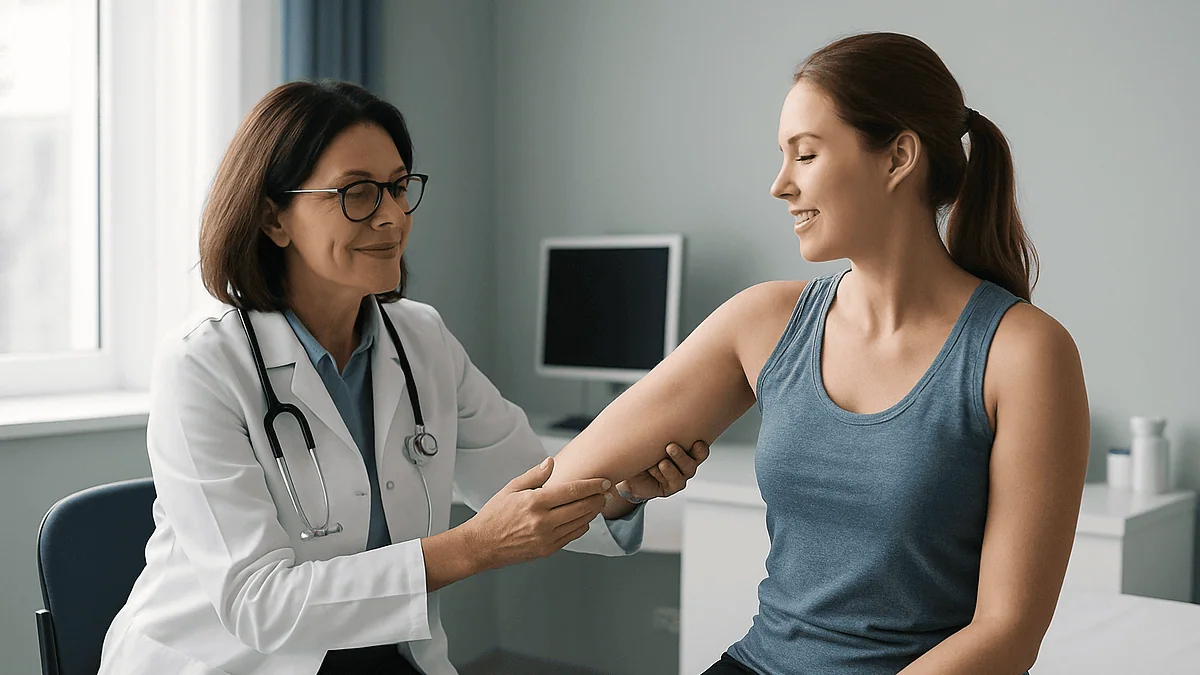
Arm liposuction results appear in stages rather than all at once. Bruising and the heaviest swelling usually ease over the first few weeks, a compression sleeve is typically worn for several weeks, and a clearer arm shape emerges over the following months. Mainstream guidance suggests the treated area can take up to six months to settle fully, and timelines vary from person to person.
Two weeks after surgery, she stood in front of the bathroom mirror in a short-sleeved shirt for the first time and felt her stomach drop. Her upper arms looked wider than they had before the procedure. Tight, shiny, faintly yellow along the inner edge. The sleeve dug in at the elbow. She had photographs of the day before surgery on her phone and could not see any difference at all.
That moment is common enough that surgical teams often warn people about it in the consultation, and still it catches almost everyone off guard. Arm liposuction results have a peculiar rhythm: the arm gets bigger before it gets smaller, the skin lags behind the fat, and the last stretch of settling happens so slowly that most people only notice it when an old shirt suddenly fits differently.
This article walks through that rhythm week by week, explains why arms behave differently from the abdomen or thighs, and separates what the evidence supports from what social media promises.
How arm liposuction works, and why results are never instant
Liposuction removes fat through a thin hollow tube called a cannula, which is passed under the skin through small incisions and connected to suction. For the upper arm, those incisions usually sit near the elbow or in the fold of the armpit, where a scar is easier to hide. Before suctioning, most surgeons infuse the area with a large volume of dilute fluid containing a local anesthetic and a medicine that narrows blood vessels; this is called the tumescent technique, and it is one reason the arm looks so swollen immediately afterward. The fluid is meant to be there. It takes days to drain and be absorbed.
Fat cells that are removed do not grow back, according to Mayo Clinic. What remains is a layer of fat that has been thinned and a sheet of skin that must now shrink onto a smaller frame. Skin does not do this on command. It contracts gradually as the small blood and lymph vessels that were disrupted during surgery heal and as fluid trapped between tissue layers is reabsorbed.
So the arm you see in the first fortnight is not the result. It is a work in progress made of three overlapping things: leftover infusion fluid, inflammation from the cannula passes, and skin that has not yet caught up. The final contour depends on which of those clears first and how much the skin is able to tighten, and neither can be judged accurately for months.
Understanding that mechanism matters because it changes what you look for. In the early weeks, the honest signs of progress are softer tissue, fading bruises and a sleeve that feels looser, not a slimmer silhouette in the mirror.
Arm liposuction recovery timeline: what the first two weeks usually look like
Day one to three is mostly about fluid. Some of the tumescent solution leaks back out through the small incisions, which can look alarming on a dressing but is expected. Bruising blooms over the inner arm and often tracks down toward the elbow because that is where gravity pulls it when you sit or stand. The arm feels heavy and tight, and reaching overhead or behind the back is uncomfortable.

Mayo Clinic notes that pain, swelling and bruising are expected after liposuction and that the surgeon may prescribe medicine to help control pain; how that is managed, and for how long, is a decision for the prescribing clinician based on your history. Compression garments, discussed in detail below, go on almost immediately and stay on around the clock in this phase.
By the end of the first week, most people are moving their arms normally for daily tasks such as dressing, eating and light typing. The NHS advises that people typically need a couple of weeks off work after liposuction and should avoid strenuous activity for around a month, though the exact window depends on the job and the extent of surgery.
Toward day ten to fourteen, the bruising usually shifts from purple to yellow-green and the skin may feel numb in patches or oddly sensitive, both of which Mayo Clinic describes as common and usually temporary. This is also when many people have their first follow-up appointment, where the team checks the incisions, looks for pockets of fluid and adjusts advice on compression. The arm is not yet smaller. It is, at best, softer.
Why arm liposuction swelling lingers longer than people expect
Swelling after any surgery is a mix of inflammation and fluid that the body’s lymphatic system, the network of tiny vessels that drains excess fluid from tissue, must clear. Liposuction disrupts many of those tiny vessels at once, so drainage is slower than after a simple cut. The arm has two extra disadvantages.
First, it hangs. Unlike the abdomen, which sits roughly level whether you stand or lie down, the arm spends most of the day pointing toward the floor. Fluid pools toward the elbow, forearm and even the hand, which is why some people notice puffy fingers or a watch that no longer fits in the first week. Second, the arm is narrow with relatively little fat to cushion the cannula’s path, so the inflammation involves a larger proportion of the tissue than in a bulky area.
Mayo Clinic explains that swelling after liposuction typically subsides within a few weeks, but that the treated area may not look leaner for several months, and that contour irregularities can appear temporarily as fluid settles unevenly. The NHS gives a longer outer bound, noting the treated area can take up to six months to settle completely.
In practice, most people describe two kinds of swelling: a soft, obvious puffiness that fades over weeks, and a firmer, deeper fullness that lingers, sometimes with small lumps or ridges under the skin. That firmer phase is healing tissue and, in some cases, early scar tissue beneath the surface. It softens slowly, and it is the main reason arm liposuction swelling seems to outlast the calendar people were quoted. Elevation, walking, and steady compression support lymphatic drainage; none of them shortcut it.
How long do you wear the compression sleeve after liposuction?
A compression garment is a firm, stretchy sleeve or vest designed to press evenly on the treated area. For the arms it usually extends from the wrist or forearm to the shoulder, sometimes as part of a vest that also covers the upper back. Its job is threefold: to limit the space where fluid can collect, to reduce bruising by supporting small vessels, and to encourage the skin to lie flat against the new contour as it heals.

The NHS states that after liposuction you may need to wear an elasticated support garment for several weeks. Mayo Clinic similarly describes compression garments as a standard part of recovery. Beyond that, the exact schedule is set by the surgical team and varies with how much fat was removed, how loose the skin was to begin with, and how the arm is healing at each follow-up. Many teams ask for continuous wear at first, then daytime wear only, then a gradual stop, but that pattern is a common practice rather than a fixed rule.
People often ask whether wearing the sleeve longer produces a tighter arm. There is no strong evidence that extending compression beyond what your team recommends improves the final contour, and a garment that is too tight at the elbow or wrist can cause its own problems, including skin marks, pain and swelling of the hand from restricted return of blood and lymph. A sleeve that leaves deep grooves, changes the color of your fingers, or causes tingling should prompt a call to the team rather than a decision to tough it out.
The compression sleeve after liposuction is a tool with a window of usefulness, not a talisman. Wear it exactly as advised, report problems early, and ask before changing the schedule.
Weeks three to eight: the first real glimpse of the arm contour
Somewhere around the third or fourth week, most people have a small, private moment of relief. The sleeve is looser. A long-sleeved shirt slides on without catching. The inner arm, when pinched, feels thinner than it did, even if it still looks puffy. This is the point where the soft fluid swelling has largely gone and what remains is deeper healing.
Mayo Clinic’s overview notes that within a few weeks the swelling should subside and that as it does the treated area starts to look leaner. It also cautions that fluid pockets, known as seromas, can form under the skin during this period and may need to be drained with a needle by the surgeon. A seroma is simply a collection of clear body fluid in the space where fat used to be. It feels like a soft, sometimes sloshing lump and is more common in areas where a lot of tissue was removed.
The NHS advises avoiding strenuous exercise for about four weeks after liposuction. Many teams then clear people for progressively more activity, though heavy overhead lifting or vigorous upper-body training may be delayed further because it drives blood flow, and therefore swelling, into the arm.
What does the arm look like at week eight? For most people, noticeably slimmer than before surgery but not yet smooth. Small ridges, a slightly uneven surface where the cannula passed, and areas that feel firm or rope-like under the skin are common. Some numbness usually persists. It is a legitimate improvement wrapped in an unfinished surface, and comparing photographs taken in the same light and position is more reliable than a glance in the mirror. Teams often take standardized images at this stage for exactly that reason.
When are arm liposuction final results actually visible?
The honest answer is that there is no single day when the result is declared finished. There is a stretch, typically from around three months onward, when changes become small enough that the arm you have is essentially the arm you will keep. The NHS puts the outer end of settling at up to six months. Mayo Clinic frames it as several months before the treated area looks leaner, with the caveat that final results depend on how the skin retracts.
Three things are still evolving in that window. Deep swelling continues to resolve, so the arm may lose a small amount of circumference between months three and six. Firmness and ridges soften as early scar tissue beneath the skin matures and remodels. And the skin itself continues to contract, a process that is slower in older skin, sun-damaged skin and skin that was already lax before surgery.
Numbness follows its own timeline. Mayo Clinic notes that altered sensation after liposuction is usually temporary but can occasionally be permanent; many people describe a gradual return of normal feeling over months, sometimes with a phase of tingling or hypersensitivity in between.
Scars at the incision sites, usually less than a centimeter each near the elbow or armpit, typically go through a red or dark phase before fading over a year or more, which is standard for surgical scars anywhere on the body. Sun protection on the scars during this phase is a widely given piece of advice.
Judging arm liposuction final results before the three-month mark tends to lead to disappointment or, occasionally, to requests for revision that a few more months would have made unnecessary. Most surgical teams ask people to wait at least six months before any decision about touch-up surgery, and that patience is grounded in the biology described above.
Arm liposuction results at a glance: the typical milestones
Timelines below are typical ranges drawn from Mayo Clinic and NHS guidance on liposuction recovery. They are not promises, and your team’s instructions take precedence over any table.
| Stage | What is usually happening | What most people notice | Typical guidance |
|---|---|---|---|
| Days 1–3 | Tumescent fluid draining, bruising forming, inflammation peaking | Arm looks larger than before surgery; tightness, heaviness | Continuous compression; rest; short walks |
| Days 4–14 | Fluid absorbing, bruises changing color, incisions closing | Soft puffiness, numb patches, stiffness reaching overhead | Time off work often a couple of weeks (NHS); first follow-up |
| Weeks 3–4 | Soft swelling largely gone; deeper firmness remains | Sleeve feels looser; arm thinner to the touch | Compression continues for several weeks (NHS); avoid strenuous activity around 4 weeks (NHS) |
| Weeks 5–8 | Deep swelling resolving; early scar tissue under skin | Visibly slimmer but uneven surface, small ridges | Gradual return to exercise as cleared by team |
| Months 3–6 | Skin retraction, scar remodeling, sensation returning | Smoother contour; small ongoing changes | Settling can take up to 6 months (NHS); revision decisions usually deferred |
| Beyond 6 months | Tissue largely stable; incision scars still fading | Arm shape stable if weight stable | Long-term results depend on weight maintenance (Mayo Clinic) |
Two patterns in this table deserve emphasis. The visible improvement arrives well after the discomfort has faded, so the hardest stretch psychologically is often weeks two to four, when you feel fine but do not yet look different. And the phase where the arm keeps quietly improving, months three to six, is also the phase when people are most tempted to judge the result as final. Knowing both in advance changes how the whole recovery feels.
Skin retraction: why the upper arm is less forgiving than the abdomen
Liposuction removes volume. It does not, by itself, remove skin. Whether the final arm looks smooth or slightly deflated depends on how well the skin contracts onto the smaller underlying shape, and this is the single biggest variable in arm liposuction results.
The skin of the upper arm, particularly along the underside between armpit and elbow, is thinner and more mobile than abdominal skin. It has usually been stretched and relaxed by decades of gravity and, in many people, by cycles of weight gain and loss. Mayo Clinic is explicit that liposuction does not improve loose, sagging skin and that people with poor skin elasticity may notice looseness afterward. The NHS makes the same point, describing liposuction as suitable for fat that does not respond to diet and exercise rather than as a treatment for excess skin.
Skin elasticity, meaning how readily skin springs back after being stretched, declines with age and with cumulative sun exposure. Smoking also impairs it and slows wound healing generally, which is why many surgeons ask people to stop well before and after the procedure. None of these can be measured precisely before surgery, which is part of why surgeons examine the arm by pinching and lifting the skin during consultation. A good pinch test is reassuring; a broad fold of loose skin that does not recoil suggests that removing fat beneath it may leave the arm looser rather than tighter.
This is where realistic expectations are set or missed. For an arm with firm skin and a modest pocket of fat, liposuction alone can produce a slimmer, smoother contour. For an arm with significant looseness, the more honest options are combining liposuction with skin removal, or accepting a result that is smaller but somewhat softer in outline. A candid conversation about your particular skin, not the average person’s, is the most useful part of any consultation.
Who arm liposuction is usually for, and who is usually asked to wait
Liposuction is a contouring procedure, not a weight-loss treatment. The NHS states this plainly, and Mayo Clinic describes the typical candidate as someone with a stable weight and pockets of fat that persist despite diet and exercise. For the arm, that usually means fullness along the back and underside of the upper arm that does not change much with training and does not come with a large amount of loose skin.
People are commonly asked to wait, or offered a different plan, in several situations:
- Weight is still changing, whether upward or downward. Mayo Clinic notes that results are generally long-lasting as long as weight remains stable, and that significant weight gain afterward can alter the fat distribution and the contour.
- Skin is markedly loose. As covered above, liposuction can make lax skin more noticeable rather than less.
- Health conditions affect healing or anesthesia risk, such as poorly controlled diabetes, heart disease or a bleeding tendency. Mayo Clinic lists these among the factors surgeons weigh before agreeing to operate.
- Smoking or nicotine use, because of its effect on wound healing and skin quality.
- Pregnancy, recent childbirth or breastfeeding, where the body’s shape and fluid balance are still shifting.
- Expectations that the procedure will produce a dramatically different arm, or that it will address weight rather than shape.
The decision about suitability rests with the surgical team after a full history and examination. Two people with arms that look similar in clothes may be given quite different advice once skin quality, medical history and goals are taken into account, and a recommendation to wait is not a rejection. It is often the step that makes the eventual result more predictable.
What people often get wrong about arm liposuction results
The myths around this procedure are remarkably consistent, and most come from photographs taken without context.
“You see the result in two weeks.” Photographs posted at two weeks usually show either a very small procedure or a result that will continue to change. Mayo Clinic and the NHS both describe a settling period measured in months, not days. If a two-week image looks finished, it is likely to look different again at three months.
“Wearing the sleeve longer makes the arm tighter.” Compression supports healing and limits fluid collection; there is no good evidence that wearing it beyond the recommended period improves skin retraction. Overly tight or prolonged compression can cause problems of its own.
“Liposuction tightens loose skin.” It does not, as Mayo Clinic states directly. Skin retraction after liposuction depends on the skin you already have.
“The fat comes back.” Removed fat cells do not regenerate, according to Mayo Clinic. Weight gain after surgery enlarges the fat cells that remain, in the arm and elsewhere, which can change the contour, but that is a different mechanism.
“Lumps mean it went wrong.” Firm areas and small ridges are common in the weeks after surgery as tissue heals and early scar forms under the skin. Many soften over months. Persistent irregularity is a recognized complication, but early unevenness is more often a phase than a verdict.
“More fat removed means a better arm.” Aggressive removal in a thin-skinned area raises the risk of a hollow or uneven surface and of loose skin. Surgeons often deliberately leave a layer of fat to keep the contour smooth.
“Everyone’s timeline is the same.” Age, skin quality, the amount removed and general health all shift the schedule. The ranges quoted here are typical, not guaranteed.
Risks and complications that can change the final contour
Liposuction is surgery, and its risks are the same in the arm as anywhere else, with a few local wrinkles. Mayo Clinic groups the recognized complications as follows, and each can influence how the arm eventually looks.
Contour irregularities. Bumpy, wavy or withered-looking skin can result from uneven fat removal, poor skin elasticity or unusual healing. Some irregularities improve as swelling resolves; others are permanent. This is the complication most directly tied to the aesthetic result.
Fluid accumulation. Seromas, described earlier, may need needle drainage. Left untreated, a large seroma can stretch the skin and leave a contour dip once it resolves.
Numbness and altered sensation. Usually temporary, sometimes permanent, and occasionally accompanied by nerve irritation.
Infection. Uncommon but possible at incision sites or deeper. Signs include increasing redness, warmth, pain, discharge or fever.
Internal puncture. Rare in the arm given its anatomy, but any cannula can injure deeper structures if it passes too deep.
Fat embolism. A rare emergency in which fat enters the bloodstream and lodges in the lungs or brain. Breathlessness, chest pain or confusion after liposuction need immediate care.
Kidney and heart problems, and local anesthetic toxicity. Both relate to the large fluid volumes and medicine used in the tumescent technique, which is one reason the amount removed in a single session is limited and why the procedure is carried out in a properly equipped facility with monitoring.
Blood clots. Any surgery carries some risk of deep vein thrombosis, a clot in a leg vein that can travel to the lungs. Early walking and, where the team judges it necessary, preventive measures reduce this risk; the CDC provides an accessible overview of clot warning signs.
Discussing these frankly does not mean they are likely. It means the decision to proceed, and the choice of how much to remove, should weigh them against the improvement you are hoping for.
Alternatives to arm liposuction, and when they are combined
Not every arm concern is a liposuction problem, and the right comparison depends on what is actually causing the shape you dislike.
No procedure. A legitimate option. Upper-arm fullness is normal anatomy for a great many people and carries no health consequence of its own. If the concern is mild or mostly about how a particular sleeve fits, watchful waiting costs nothing in risk.
Weight management and resistance training. Where the arm’s fullness is part of overall body fat, changes in weight affect it as they affect everywhere else, though fat loss cannot be directed at one area. Strength work builds the triceps and shoulder muscles, which can alter the arm’s silhouette even without fat change. Neither approach tightens loose skin.
Brachioplasty. This is the surgical term for an arm lift, an operation that removes excess skin, and often some fat, through an incision that usually runs along the inner arm from armpit toward elbow. It addresses looseness in a way liposuction cannot, at the cost of a longer scar, a longer recovery and a higher complication burden. Many surgeons combine liposuction with a limited brachioplasty when there is both excess fat and moderate skin laxity.
Non-surgical fat reduction and skin-tightening devices. A range of energy-based and cold-based treatments are marketed for the arms. Evidence for them is variable; effects are generally smaller and more gradual than surgery, and results for skin tightening in particular are modest and inconsistent across studies. They may suit people with very small concerns who are unwilling to accept surgical risk, but they should not be presented as equivalent to liposuction.
Which route fits your arm is a judgment your surgical team makes after examining skin, fat and your goals together. A consultation that offers only one option without explaining why the others were set aside is worth a second conversation.
Keeping the result: what happens to the arm in the years afterward
Once the arm has settled, the question shifts from when the result shows to how long it lasts. Mayo Clinic’s position is straightforward: liposuction results are generally long-lasting as long as you maintain your weight, because the fat cells that were removed do not grow back. Fat cells that remain, however, can expand. Gain a meaningful amount of weight after surgery and the arm will get fuller again, though it may store fat differently than before, since some of its capacity has been removed.
This has a practical implication. People who are still actively losing weight are usually advised to finish that process before surgery, both because the arm’s shape will keep changing and because further loss can leave skin looser. People whose weight fluctuates widely may find the contour less predictable over time.
Skin continues to age regardless of surgery. The gradual loss of elasticity that comes with the decades will affect a liposuctioned arm just as it affects an untreated one, so an arm that looks smooth at one year may show more looseness a decade later, particularly in people who had borderline skin quality to begin with. Sun protection slows this, and it matters for the small incision scars as well.
Exercise does not undo the result. Building the triceps and shoulder muscles tends to improve the arm’s outline, and there is no evidence that resistance training harms a healed liposuction site once the team has cleared full activity.
What none of this offers is a guarantee. A surgical contour is a starting point shaped by biology, habit and time, and the honest framing is that liposuction changes the arm’s baseline rather than fixing it in place.
Questions to ask your care team before arm liposuction
A good consultation should leave you able to describe, in your own words, what the procedure will and will not change about your arm. These questions help get there.
- Based on my skin, do you expect it to retract well, or is there a risk it will look looser afterward? Would you recommend combining liposuction with skin removal, and why or why not?
- How much fat do you plan to remove, and how much do you deliberately leave to keep the surface smooth?
- Where exactly will the incisions be, and how visible are those scars likely to be with my skin tone?
- What type of anesthesia will be used, and where will the procedure take place?
- How long do you expect me to wear the compression garment, and how will that schedule change over the weeks?
- When can I return to work, drive, lift my children, and resume upper-body exercise?
- What does the follow-up schedule look like, and who do I contact out of hours if something worries me?
- How do you handle fluid collections or contour irregularities if they occur, and how long do you wait before considering any revision?
- What is your policy if the result is less than we both hoped for?
- Is there anything about my medical history or medicines that changes the risk, and should any of them be adjusted beforehand? (Any change to a prescribed medicine is a decision for the prescribing clinician, never something to do on your own.)
Write the answers down or ask permission to record them. People consistently underestimate how much of a consultation they forget, and the answers to these questions are the yardstick you will measure your recovery against three months later.
When to call your doctor after arm liposuction
Most of what you will feel and see in the first weeks is expected: bruising, tightness, patchy numbness, small amounts of fluid on the dressings, and an arm that looks fuller than you hoped. A defined set of signs, however, should prompt a same-day call to your surgical team, and some warrant emergency care.
Call the team promptly if you notice:
- Redness, warmth or swelling that is increasing rather than easing, especially around an incision, or any discharge that is cloudy, smelly or persistent
- Fever or chills
- A soft, enlarging or sloshing lump under the skin, which may be a seroma that needs draining
- Pain that is worsening after the first few days instead of improving, or pain not controlled by the plan you were given
- Fingers that become cold, pale, blue-tinged or persistently tingly, or a hand that swells markedly, which can indicate the compression garment is too tight
- One arm becoming much more swollen, tight or discolored than the other
Seek emergency care immediately for:
- Sudden shortness of breath, chest pain, or coughing up blood
- Confusion, severe headache, weakness on one side, or difficulty speaking
- Fainting, a racing heart, or feeling very unwell in a way you cannot explain
- Swelling, warmth and pain in one calf or thigh, which the CDC lists among warning signs of a deep vein clot
- Heavy bleeding that soaks through dressings and does not stop with firm pressure
Mayo Clinic notes that fat embolism and blood clots, though rare, are medical emergencies after liposuction. If in doubt, err toward calling. Surgical teams would far rather hear about a harmless bruise than miss an early infection, and every decision about assessment and treatment belongs with the clinicians looking after you.
Frequently asked questions
How long is arm liposuction recovery time before I can go back to work?
The NHS suggests people typically need a couple of weeks off work after liposuction and should avoid strenuous activity for around four weeks. Desk-based work is often possible sooner than physical jobs, and lifting, overhead reaching or repetitive arm use may need a longer break. Your surgical team will tailor the timing to your job and how your arms are healing at follow-up.
Why is my arm liposuction swelling worse at the elbow and hand?
Gravity. The arm hangs downward for most of the day, so fluid from the treated upper arm drifts toward the elbow, forearm and sometimes the fingers. This is why rings or watches can feel tight in the first week. Elevating the arm when resting, walking regularly and wearing the compression garment as advised support drainage. Marked one-sided hand swelling, color change or numbness should be reported to your team.
How long do I wear the compression sleeve after liposuction on the arms?
The NHS describes wearing an elasticated support garment for several weeks after liposuction. The precise schedule depends on how much was removed, your skin quality and how the arm is healing, and it is set by your surgical team, often moving from continuous wear to daytime-only before stopping. Extending compression beyond the advised period has no proven benefit, and a sleeve that is too tight can cause problems of its own.
When are arm liposuction final results visible?
Most of the change is visible by around three months, with the NHS noting the treated area can take up to six months to settle completely. Deep swelling, firmness under the skin and skin retraction continue to improve during that window, so the arm at six months is generally smoother than at three. Surgical teams usually wait at least this long before considering any revision.
Is it normal to feel hard lumps in my arm weeks after liposuction?
Firm areas, ridges and small lumps are common in the weeks after liposuction as tissue heals and early scar forms beneath the skin. Many soften over the following months. A soft, enlarging or sloshing lump, however, may be a fluid collection called a seroma, which Mayo Clinic notes may need draining, so it is worth having any new lump checked rather than assuming it will settle.
Will arm liposuction get rid of loose or sagging skin?
No. Mayo Clinic states that liposuction does not improve loose, sagging skin, and removing fat beneath lax skin can make looseness more noticeable. Skin retraction depends on the elasticity you already have, which declines with age, sun exposure and smoking. Where skin looseness is significant, surgeons may suggest combining liposuction with an arm lift, or brachioplasty, which removes excess skin through a longer incision.
Does fat come back after arm liposuction?
The fat cells that were removed do not regenerate, according to Mayo Clinic. If you gain weight afterward, the fat cells that remain in the arm and elsewhere enlarge, which can change the contour. Results are described as long-lasting as long as weight stays stable. The arm may also store fat somewhat differently than before, because part of its fat-storing capacity has been removed.
Can I exercise my arms while waiting for the swelling to go down?
Gentle daily movement and walking are usually encouraged from early on because they support circulation and help reduce clot risk. The NHS advises avoiding strenuous activity for about four weeks after liposuction, and vigorous upper-body training or heavy lifting may be delayed further because it drives blood flow, and therefore swelling, into the arm. Your team will tell you when each level of activity is appropriate.
Will I have visible scars on my arms after liposuction?
Liposuction incisions are small, usually under a centimeter, and are typically placed near the elbow crease or in the armpit fold where they are less noticeable. Scars commonly look red or dark for months before fading over a year or more, which is normal for any surgical scar. Sun protection during that phase helps. People with a tendency to thick or raised scarring should raise it during consultation.
What signs after arm liposuction mean I should get help right away?
Seek emergency care for sudden shortness of breath, chest pain, confusion, weakness on one side, fainting, or a painful swollen calf, which can signal a clot or fat embolism. Call your surgical team the same day for increasing redness or warmth, discharge, fever, worsening pain, an enlarging lump, or a hand that becomes cold, discolored or persistently numb. When in doubt, call.
References
- Liposuction: NHS
- Liposuction: MedlinePlus Medical Encyclopedia
- About Venous Thromboembolism (Blood Clots): CDC
This article is for general information only and is not a substitute for professional medical advice. Please consult a qualified doctor about your individual situation.

More from the Blog
What Pectoral Augmentation Results Look Like Over Time: Realistic Expectations for Men
Pectoral augmentation results change for months after surgery. In the first week the chest usually looks swollen, high and tight; over 6 to 12…

What Are the Risks of Aesthetic Genital Surgery? Infection, Wound Healing and Sensation
Aesthetic genital surgery carries the general risks of any operation, including bleeding, infection and reactions to anesthesia, plus risks specific to this area: wound…
How Arm Liposuction Is Performed: Incision Points, Cannula Passes and Time Under Anesthesia
Arm liposuction removes fat from the upper arm through two or three small skin openings, usually near the elbow crease and the back fold…

Laser Liposuction Recovery: Compression Garment Days, Walking Early and Returning to Work
Laser liposuction recovery typically involves wearing a compression garment for several weeks, walking gently from the first day to lower clot risk, and returning…

How BBL and Lipofilling Is Performed: Liposuction, Fat Purification and Careful Transfer
A BBL lipofilling procedure reshapes the buttocks with a person's own fat in three stages. Liposuction removes fat from areas such as the abdomen,…

Mommy Makeover vs Staged Surgeries: Is One Combined Operation the Safer Choice for You?
Neither path is automatically safer. A mommy makeover combines abdominal and breast procedures under one anesthetic, which means a single recovery but a longer…