

When Do CoolSculpting Results Appear? Why Fat Freezing Takes Weeks to Show a Change

Key Takeaways
- Cryolipolysis injures fat cells rather than removing them, and immune cells take weeks to clear the debris, which is why the first visible change typically appears around 3 weeks and the fullest result at 2 to 3 months.
- A single treatment cycle reduced the thickness of the treated fat layer by roughly 14 to 28 percent by caliper and 10 to 25 percent by ultrasound in the published studies, a change in shape rather than a change in weight.
- Swelling during the inflammatory phase can make a treated area look fuller for the first week or two, so early photographs are not a reliable test of whether the treatment worked.
- Removed fat cells do not regrow, but surviving cells enlarge with weight gain, and the studies showing durable results were done in people whose weight stayed stable.
- Paradoxical adipose hyperplasia is a rare delayed enlargement of fat in the applicator's shape, appearing 2 to 5 months after treatment, and it has generally been addressed surgically rather than with more cryolipolysis.
- Rare cold-sensitive blood disorders, cold urticaria, pregnancy, hernia at the site and poor skin elasticity are standard reasons a clinician will defer or decline fat freezing.
CoolSculpting is a brand name for cryolipolysis, a procedure that cools fat cells until they are damaged and gradually cleared by the body. Because that clearance is a biological process, most people notice an early change after about 3 weeks, with the fullest effect typically appearing 2 to 3 months after a session. Timelines vary, and the treating team sets expectations for each area.
Day four after the appointment, and the abdomen looks, if anything, a little puffier than before. The treated patch is numb in places, oddly firm in others, and the mirror offers nothing that resembles the photographs in the consultation folder. It is a quiet, slightly deflating moment that many people describe, and it usually comes with one question: when do CoolSculpting results appear, and did it even work?
The answer is written into the biology rather than the device. Fat frozen in a clinic does not melt or drain away; it dies slowly, and the body’s own cleanup crews carry it off over weeks. Nothing about that process is visible on day four.
This explainer walks through what the procedure actually does, why the change arrives on a timetable of weeks rather than days, what the published evidence shows about how much fat is typically reduced, and which warning signs deserve a phone call rather than patience.
When do CoolSculpting results appear? The short, honest answer
Most people see nothing they can trust in the first fortnight. A systematic review of cryolipolysis studies in the journal Plastic and Reconstructive Surgery summarized the typical course this way: early changes become noticeable around 3 weeks after a treatment cycle, with the most visible reduction appearing at roughly 2 to 3 months, and some further settling after that (Ingargiola et al., PubMed). That window is the single most useful number in this article, and it is worth holding onto when the early days feel discouraging.
Why so slow? Because the treatment does not remove fat on the day. It injures fat cells, and the body then spends weeks dismantling and clearing them. A fresh bruise fades in about two weeks; this is a deeper, more gradual version of the same cleanup, happening a centimeter or more under the skin.
Three practical consequences follow. First, photographs taken at one week say almost nothing about the eventual outcome. Second, a treated area can look fuller before it looks smaller, because of fluid and inflammation. Third, people who plan a second session on the same area are usually asked to wait until the first result has declared itself, which is why many clinics review at around the two to three month mark rather than sooner.
One caution belongs here. These are typical ranges drawn from studies of cryolipolysis as a technique, not a guarantee attached to any brand of device or any individual body. Age, skin thickness, the area treated and how much fat was present all shift the timeline, and the treating team is the right source for a personal estimate.
What is CoolSculpting and how does it work?
CoolSculpting is a trade name for a machine that performs cryolipolysis. Cryolipolysis is a plain compound word: cryo means cold, lipo means fat, and lysis means breaking down. The idea is that fat cells are more sensitive to cold than the skin, nerves and blood vessels around them, so a carefully controlled chill can harm the fat while leaving the overlying tissue largely intact.
The observation behind it is older than the device. Dermatologists had long noticed that infants who sucked on ice pops sometimes developed small dimples in the cheek fat, a condition called popsicle panniculitis. Researchers later showed in animal and then human studies that cooling the skin surface for a set period reduced the fat layer underneath without damaging the skin (Avram and Harry, PubMed).
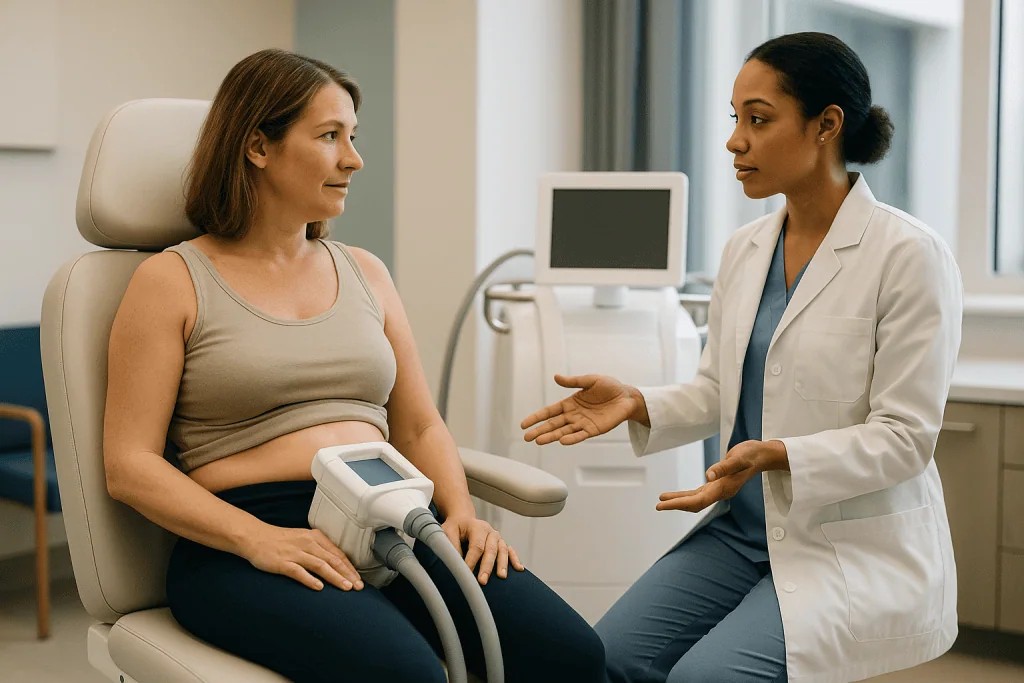
In a treatment session, a clinician applies a gel pad to protect the skin and then attaches an applicator. Many applicators use gentle vacuum to draw a fold of skin and fat between two cooling plates; others are flat and rest on the surface. The tissue is held at a cold but non-freezing temperature for a fixed period, commonly described in the literature as around 35 to 60 minutes per applicator placement, depending on the device generation (Ingargiola et al., PubMed). The area is then massaged for a couple of minutes, which studies suggest may improve the effect by adding mechanical stress to already-chilled cells.
Nothing is injected and nothing is cut, which is why cryolipolysis is grouped with non-invasive body contouring rather than with surgery. It targets the subcutaneous layer, the soft fat just beneath the skin that can be pinched. It does not reach visceral fat, the deeper fat packed around the organs, and it is not a treatment for obesity in any guideline.
Why fat freezing takes weeks to show a change: what happens inside the tissue
The delay comes down to the difference between a cell being injured and a cell being gone. Cooling does not burst fat cells on the spot. Instead, it triggers apoptosis, which is programmed cell death: an orderly shutdown in which the cell dismantles itself from the inside rather than rupturing. Biopsy studies described in the cryolipolysis literature show that fat cells look largely normal immediately after treatment, then begin to show signs of damage over the following days (Avram and Harry, PubMed).
Around the second or third day, an inflammatory response sets in. White blood cells, chiefly macrophages, move into the treated fat lobules. Their job is to engulf and digest the dying cells. This is a slow, deliberate operation. The inflammation peaks at roughly two weeks in biopsy samples and is still visible at a month, which is exactly the period in which people feel the area as firm, tender or numb.
Only as the macrophages finish their work does the fat layer actually thin. The cleared lipid is handled by the body’s ordinary fat-processing pathways through the liver. Published studies have measured blood lipids after treatment and found no meaningful rise in cholesterol or triglycerides, which fits with how gradually the material is released (Ingargiola et al., PubMed).
By about three months, biopsies show a thinner fat layer with fewer, smaller cells and a settled, scarless appearance. That timeline is why the visible change tracks months rather than days. A useful analogy is a construction site: demolition is quick, but hauling the rubble away is what takes the time, and the lot does not look different until the trucks have finished.
The first days after fat freezing: what the treated area commonly feels like
The treated area often looks and feels strange before it looks any smaller, and knowing that in advance saves a good deal of worry. Immediately after a vacuum applicator is removed, the drawn-up fold of tissue is typically red, cold and stiff, sometimes described as a frozen stick of butter. Massage softens it within minutes, but the color and some firmness can linger for hours.

Over the following week, the sensations most commonly reported in clinical studies include numbness or reduced sensation, tingling, aching, tenderness, mild swelling and bruising, particularly where suction was used (Ingargiola et al., PubMed). Numbness tends to be the longest lasting, often resolving within a few weeks. Some people describe a deeper, intermittent nerve-type pain beginning several days after treatment, more often after abdominal sessions; in the published series this generally settled on its own within a few weeks.
Swelling deserves special mention because it is the main reason the early mirror check disappoints. Fluid gathers in inflamed tissue, so the area can measure slightly larger for a week or two. That is not treatment failure, and it is not fat regrowth; it is the cleanup phase doing its job.
Everyday life is usually not interrupted. Most people in the studies returned to normal activity the same day, and there is no wound to protect. Ordinary movement and walking are generally encouraged, and loose clothing over the area is simply more comfortable while it is tender. Any specific advice on pain relief, compression garments or exercise should come from the clinician who performed the treatment, since recommendations differ by area and by the individual.
CoolSculpting results timeline: a week-by-week view of what studies describe
Timelines in marketing tend to be tidy. The clinical literature is messier but more trustworthy, and the table below condenses what published cryolipolysis studies and reviews describe at each stage (Ingargiola et al., PubMed; Avram and Harry, PubMed). Treat every row as a typical range, not a schedule anyone can promise.
| Stage | What is happening in the tissue | What people commonly notice |
|---|---|---|
| Day 0 to 3 | Fat cells chilled; early injury begins | Redness, firmness, numbness; no size change |
| Day 3 to 14 | Inflammation builds; immune cells arrive | Tenderness, bruising, possible swelling; area may look fuller |
| Week 3 to 4 | Dying cells being cleared; inflammation peaking then easing | First subtle softening or flattening for some people |
| Week 6 to 8 | Fat layer measurably thinning | Clothing may fit differently; change visible in photos |
| Month 2 to 3 | Most clearance complete; tissue settling | Fullest visible result; typical review point |
| Month 4 to 6 | Minor ongoing remodeling | Small further refinement reported in some studies |
Two patterns stand out. The visible curve is back-loaded: a large share of the eventual change appears between weeks six and twelve, which is why patience through the first month matters more than anything a person does at home. And the end point is soft rather than sharp; some studies have continued to measure modest improvement out to six months, so a review at three months captures most, though not necessarily all, of the effect.
Measurement method also shapes the story. Studies using calipers, ultrasound or 3D imaging detect thinning earlier and more precisely than the eye does. A person may be told the fat layer has reduced before they feel convinced by the mirror, and both can be true at once.
Does cryolipolysis work? What the evidence actually shows
The short version: yes, for its narrow purpose, with modest and measurable effects. The 2015 systematic review that gathered the available human studies found that a single treatment cycle reduced the thickness of the subcutaneous fat layer in the treated area by roughly 14 to 28 percent when measured with calipers, and by about 10 to 25 percent when measured with ultrasound (Ingargiola et al., PubMed). Earlier work by the technique’s original investigators reported figures in a similar range (Avram and Harry, PubMed).
Those percentages need translating. They describe the fat layer in one treated patch, not body weight, waist circumference overall or total body fat. A 20 percent thinning of a pinchable fold that was, say, 3 centimeters thick means a fold of around 2.4 centimeters afterward. Noticeable in fitted clothing and in side-by-side photographs; not transformative, and not a route to a different clothing size on its own.
The quality of the evidence also deserves a plain description. Many studies were small, short, lacked untreated comparison groups, or were funded by device manufacturers. Longer-term, independent, randomized trials remain limited. The reviews conclude that cryolipolysis is reasonably effective and generally safe for localized fat in appropriate candidates, while calling for better-designed studies. That is a fair summary rather than a ringing endorsement.
One thing the evidence does not support is any claim that one branded machine outperforms another, or that a particular clinic achieves better outcomes. Published comparisons of that kind do not exist in the mainstream literature, and marketing statements should not be mistaken for data.
How many CoolSculpting treatments are needed, and is one session worth it?
People often arrive hoping for a single appointment and a finished result. The literature suggests a more layered picture. The typical fat-layer reduction quoted above, roughly 10 to 28 percent depending on measurement, is the effect of one cycle on one applicator site (Ingargiola et al., PubMed). Some studies that treated the same area a second time, after the first result had matured, reported additional reduction, though the gain from a second round was not simply double the first.
Whether one session is “worth it” is therefore a personal judgment that depends on three things: how much fat is in the area, how large an area is being treated, and what the person considers a meaningful change. A small, well-defined bulge that fits inside a single applicator is the scenario in which one cycle is most likely to produce a result the person can see. A broader area may need several applicator placements in one visit simply to cover it, which is different from needing several visits.
Repeat treatment timing follows the biology. Because the first cycle’s effect is still emerging at two months, treating again before then means treating tissue whose final state is unknown. Clinicians in the published studies generally reassessed at around two to three months before deciding on another round.
No guideline sets a fixed number of sessions, and any clinic that promises a specific result from a specific count is going beyond the evidence. The decision on whether a second cycle is sensible, or whether a different approach would serve better, sits with the treating team after examining the actual result.
Who is cryolipolysis usually for, and who is usually asked to wait
The treatment was designed for a specific person: someone near a stable, healthy weight who has a localized pocket of pinchable fat that has not responded to diet and activity. Common sites in the published studies include the abdomen, flanks, inner and outer thighs, upper arms, back, and the fat beneath the chin (Ingargiola et al., PubMed). The fold has to fit the applicator, which is a practical limit as much as a medical one.
Cryolipolysis is not a weight-loss treatment. Guidance from health services on cosmetic procedures is consistent that non-surgical fat reduction is about shape, not weight, and is not a substitute for medical management of overweight or obesity (NHS). People with a high body mass index, or with mainly visceral rather than subcutaneous fat, are usually advised that the procedure will not address their concern.
Several groups are routinely asked to wait or to avoid it. The published contraindications center on cold-related conditions, because the treatment is a controlled cold injury: cryoglobulinemia, cold agglutinin disease and paroxysmal cold hemoglobinuria, which are rare blood disorders in which cold triggers clumping or breakdown of red cells, and cold urticaria, a cold-triggered hive reaction. Pregnancy, hernia at the treatment site, significant skin disease over the area, impaired skin sensation, and recent surgery in the region are also standard reasons for deferral.
Loose, lax skin matters too. Removing fat from beneath skin that has already lost elasticity can make the area look emptier rather than tighter, and a surgical opinion may be more appropriate. A frank conversation with a qualified clinician, who examines the area and takes a full medical history, is the only reliable way to sort these questions.
Why results differ from person to person, and from area to area
Two people can have the same treatment on the same day and see quite different things at three months. The variation is real, and the reasons are mostly biological rather than anything either person did.
Fat thickness is the first factor. Applicators cool from the surface inward, so the effect concentrates in the fat closest to the plates. Where the layer is thick, a 20 percent reduction can still leave a visible bulge; where it is thin, the same percentage may flatten the area almost completely. The published reduction figures of roughly 10 to 28 percent describe the layer, not the silhouette (Ingargiola et al., PubMed).
Tissue type is the second. Some fat is soft and easily drawn into a vacuum cup; some is fibrous and dense, especially in the male abdomen and in people who have had prior surgery or liposuction. Dense fat tends to be harder to treat evenly. The site matters as well: the submental area under the chin and the flanks are frequently described as responding well, while broad, flat regions can be harder to cover without gaps or ridges.
The immune response is the third, and the least predictable. The whole mechanism depends on inflammatory cells clearing damaged fat, and that process varies with age, circulation, body composition and medications that affect inflammation. Faster or slower clearance changes when results show rather than whether they do.
Finally, weight. Fat cells that survive the treatment can still enlarge. Studies note that the result holds best in people whose weight stays stable; a gain of several kilograms during the recovery window can blunt or hide the change entirely.
How long does CoolSculpting last? What happens to the treated fat over time
The honest answer is: the removed cells do not come back, but the remaining ones can grow. Cryolipolysis works by reducing the number of fat cells in the treated area, and adult fat-cell numbers are fairly stable; new fat cells are made slowly and at a low rate. Follow-up studies in the published reviews reported that measured reductions persisted at six months and, in the small number of longer studies, at a year and beyond, provided weight was stable (Ingargiola et al., PubMed).
That proviso carries the whole sentence. Fat cells store energy by swelling, not only by multiplying. If someone gains weight after treatment, the surviving cells in the treated area enlarge along with fat cells everywhere else, and the contour change can fade. The treated area may still hold slightly less fat than it otherwise would have, but the difference may be too subtle to see.
Nothing about the procedure changes appetite, metabolism or how the body distributes fat. People who maintain their result in the longer studies did so through ordinary means: regular physical activity and a stable eating pattern. Public health guidance for adults suggests at least 150 minutes a week of moderate-intensity aerobic activity plus muscle-strengthening work on two days, which is a general health recommendation rather than a maintenance protocol for any cosmetic procedure (CDC).
There is no evidence that touch-up sessions on a fixed schedule are needed to “hold” a result. Repeat treatment is a decision for the treating team based on what the area looks like after the first result has matured, not a subscription.
Risks and side effects of fat freezing, including paradoxical adipose hyperplasia
Cryolipolysis is generally described in reviews as low risk, and most of its effects are the expected, self-limiting ones already covered: numbness, tingling, redness, swelling, bruising, aching and firmness, usually resolving within days to a few weeks (Ingargiola et al., PubMed). Rarer reports include temporary changes in skin sensation lasting longer than two months, skin surface irregularities such as ridges or steps between treated zones, and uncommon cases of frostbite-type injury or discoloration where the protective gel pad was not placed correctly.
One complication needs plain explanation because it is the opposite of what anyone expects. Paradoxical adipose hyperplasia, often shortened to PAH, is a delayed, gradual enlargement of fat in the treated area, typically appearing two to five months after treatment as a firm, well-defined mass that follows the shape of the applicator. The tissue is not inflamed and does not shrink on its own. Early estimates placed the incidence at about 1 in 20,000 treatment cycles, though later reports have suggested it is more common than first thought and more frequent in men and with certain applicator types (Ingargiola et al., PubMed). Treatment, when wanted, has generally been surgical, usually liposuction, and is typically delayed until the tissue has fully matured.
Visceral fat, the deep fat around the organs, is not treated and not affected, which also means the procedure has no proven effect on the metabolic risks linked to abdominal fat. Nor does it address loose skin, stretch marks or cellulite.
Weighing these risks against an entirely cosmetic benefit is a personal calculation. A qualified clinician should walk through them before any consent is signed, and health-service guidance on cosmetic procedures recommends checking the practitioner’s training and registration and asking what happens if something goes wrong (NHS).
Alternatives to cryolipolysis: what else addresses localized fat
Cryolipolysis is one option among several, and a balanced consultation puts it in context rather than in isolation. The choices fall into three broad groups.
The first is lifestyle. Localized fat is a reservoir of stored energy, and a sustained calorie deficit combined with regular activity reduces fat overall, including in stubborn areas, though a person cannot direct where loss happens first. For anyone above a healthy weight, this is the approach every guideline places ahead of cosmetic treatment, and it is the only one that also lowers metabolic risk.
The second group is other non-invasive devices. Several technologies aim at the same subcutaneous layer by different means: focused ultrasound, radiofrequency heating, low-level laser, and injectable agents that dissolve small fat deposits under the chin. Evidence for each is of broadly similar quality to that for cryolipolysis, meaning modest measured reductions in small, often industry-funded studies. None has been shown in independent trials to be clearly superior, and none treats visceral fat or excess skin.
The third is surgery. Liposuction removes fat directly through small incisions using a suction cannula, under local or general anesthesia. It can remove more fat in a single procedure, treat larger or more fibrous areas, and sculpt more precisely, at the cost of anesthesia, incisions, a recovery period of weeks, compression garments and surgical risks including bleeding, infection, contour irregularity and, rarely, serious complications (Mayo Clinic; MedlinePlus). Where skin laxity is the main issue, procedures that remove skin, such as abdominoplasty, may be discussed.
Which route suits a particular person depends on the amount and type of fat, skin quality, health status, tolerance for downtime and the result they are hoping for. That weighing is the treating team’s job, done with the person, not for them.
What people often get wrong about fat freezing results
Myths cluster around this treatment, partly because the mechanism is invisible and partly because marketing fills the silence. A few corrections, grounded in the published literature.
“If nothing has changed by two weeks, it didn’t work.” Two weeks is still the inflammatory phase. The reviews put first visible changes at around three weeks and the main result at two to three months (Ingargiola et al., PubMed). Judging early is judging the wrong stage.
“The fat melts and drains out.” It does not. Cells die slowly and are digested by immune cells, with the lipid handled through normal metabolic pathways. Nothing is excreted in a way anyone would notice, and there is no detox.
“It’s a weight-loss treatment.” A single cycle thins one patch of fat by a fraction. Body weight typically changes by very little. Guidance on cosmetic procedures is explicit that these treatments reshape rather than reduce weight (NHS).
“Results are permanent no matter what.” The removed cells do not return, but surviving cells can enlarge with weight gain, and the studies that showed durable results involved stable weight.
“Massage, heat, supplements or special diets speed it up.” Post-treatment massage performed by the clinician immediately after the cycle is part of the standard protocol in studies. No evidence supports home massage, heat wraps, lymphatic devices or supplements accelerating fat clearance, and anything that promises faster results is selling, not citing.
“More cold, or longer, is better.” Temperature and duration are set to injure fat while sparing skin and nerves. Exceeding them raises the risk of frostbite and nerve injury without improving the result.
Questions to ask your care team before and after treatment
A good consultation should feel like an exchange, not a pitch. The following questions help a person understand what is realistic, and the quality of the answers says a good deal about the practitioner.
- Am I a suitable candidate for cryolipolysis, and what in my history or examination makes you say so?
- Which area are you proposing to treat, how many applicator placements will it take to cover it, and why?
- What degree of fat-layer reduction do published studies report for one cycle, and how would that look on my body?
- When should I expect to see a change, and when will you review the result before deciding on anything further?
- Would my skin elasticity, fat type or weight make a different approach, including surgery or no treatment, more sensible?
- What are the common side effects, how long do they usually last, and what pain relief do you advise?
- Have you seen paradoxical adipose hyperplasia in your practice, how do you monitor for it, and what happens if it occurs?
- What are your qualifications and registration, who is physically performing the treatment, and who do I contact if I have a problem after hours?
- What would make you decline to treat me, or stop a session partway through?
Written answers, before-and-after photographs of the clinician’s own cases with the timing stated, and a clear aftercare sheet are reasonable things to ask for. Health-service guidance on cosmetic procedures suggests taking time to decide, avoiding pressure to book on the day, and being cautious of time-limited offers (NHS). A practitioner who welcomes these questions, explains the limits of the evidence and sends a person away to think is behaving as a clinician should.
When to call your doctor after fat freezing
Most of what the treated area does in the weeks after cryolipolysis is expected and settles by itself. A few signs are not part of the normal course and warrant a call to the treating clinician, or to a doctor or emergency service if the practitioner cannot be reached.
- Severe or escalating pain that is not controlled by the measures your clinician advised, or pain that worsens after the first week instead of easing.
- Skin that blisters, turns white, grey, purple or black, or develops an open sore over the treated area; these can indicate a cold injury to the skin.
- Spreading redness, warmth, pus or a fever, which may signal infection even though there is no wound.
- Numbness or altered sensation that is still present beyond two months, or any new weakness in the area.
- A firm, enlarging lump in the shape of the applicator appearing two to five months after treatment, which is the pattern described for paradoxical adipose hyperplasia and should be assessed rather than massaged or re-treated.
- Any symptom that frightens you or that the aftercare sheet did not describe.
Seek emergency care without waiting for a callback if you develop chest pain, sudden shortness of breath, fainting, or a hot, swollen, painful calf, since these are not expected after cryolipolysis and need urgent assessment regardless of the cause.
People living with a cold-sensitive blood disorder, cold urticaria, or reduced skin sensation who have been treated despite those conditions should have a lower threshold for calling. Keep the clinic’s contact details, the date and sites of each cycle, and the applicator type on hand; that information makes any later assessment faster and more accurate. Every decision about further treatment, investigation or referral belongs with the treating team.
Frequently asked questions
When do CoolSculpting results appear after the first session?
Early changes are typically noticeable around three weeks after a cycle, with the main visible result appearing at two to three months, according to a systematic review of cryolipolysis studies. The first two weeks are the inflammatory phase, when the area may look fuller rather than smaller. Some studies measured small further improvement out to six months. Individual timing varies with fat thickness, the area treated and the person’s immune response.
Does cryolipolysis work, or is it a myth?
Published studies show that cryolipolysis produces a measurable, modest thinning of the treated subcutaneous fat layer, roughly 10 to 28 percent per cycle depending on how it was measured. The evidence base consists mostly of small, short, often industry-funded studies, so reviews describe it as reasonably effective for localized fat in suitable candidates while calling for better trials. It does not treat visceral fat, loose skin or excess weight.
How many CoolSculpting treatments are needed to see a difference?
No guideline sets a fixed number. The typical reduction figures in the literature describe one cycle on one applicator site, and some studies reported additional reduction after a second cycle once the first result had matured. A small bulge that fits one applicator may respond to a single cycle; a broad area may need several placements in one visit. The treating team decides after reviewing the result at about two to three months.
Is one session of CoolSculpting worth it?
That depends on the amount of fat in the area and what the person considers meaningful. One cycle thins the treated layer by a fraction, which is most visible when the pocket is small and well defined. For thicker or wider areas, a single cycle may produce a change that only measurements detect. A clinician who examines the area can give a realistic estimate; no one can promise a specific outcome.
What is CoolSculpting and how does it work in simple terms?
CoolSculpting is a brand name for cryolipolysis, a non-surgical procedure that cools a fold of skin and fat between plates for a set time. Fat cells are more cold-sensitive than skin and nerves, so the chill triggers programmed cell death in fat while sparing the tissue above it. The body’s immune cells then clear the dying fat over several weeks, gradually thinning the layer. Nothing is injected or cut.
How long does CoolSculpting last once results show?
The fat cells removed by the treatment do not regrow in adults, and follow-up studies reported persisting reductions at six months and, in a few studies, beyond a year. The condition attached to those findings is stable weight. Surviving fat cells enlarge if weight is gained, which can fade the contour change. No evidence supports scheduled maintenance sessions; any repeat treatment is a case-by-case decision for the treating team.
Why does the treated area look bigger a week after fat freezing?
Inflammation. Within days of treatment, immune cells move into the chilled fat to clear damaged cells, and the tissue holds extra fluid while that happens. Biopsy studies show this inflammatory phase peaking at about two weeks. Mild swelling, firmness and tenderness during this period are expected and are not fat regrowth. A firm, enlarging lump that appears months later, rather than days, is a different matter and should be assessed.
What is the CoolSculpting results timeline week by week?
In the published descriptions, days one to three bring redness, numbness and firmness; days three to fourteen bring tenderness, bruising and swelling as inflammation builds; weeks three to four may show the first subtle flattening; weeks six to eight often show a change in photographs and clothing fit; months two to three show the fullest result; and months four to six may add minor refinement. These are typical ranges, not a promise.
Can anything speed up CoolSculpting results?
Nothing with evidence behind it. Brief massage by the clinician immediately after the cycle is part of the standard protocol in studies and may modestly enhance the effect. Home massage, heat, lymphatic devices, supplements and special diets have not been shown to accelerate fat clearance. Keeping weight stable and staying active protects the result rather than hastening it. Claims of faster outcomes are marketing, not data.
What are the side effects of fat freezing, and are any serious?
Common effects are numbness, tingling, redness, swelling, bruising, aching and firmness, usually resolving within days to a few weeks. Less common are prolonged sensory changes, surface irregularities and cold injury to the skin if the protective pad fails. The notable rare complication is paradoxical adipose hyperplasia, a delayed enlargement of fat in the applicator’s shape appearing two to five months later, which has generally required surgical treatment.
References
This article is for general information only and is not a substitute for professional medical advice. Please consult a qualified doctor about your individual situation.
Add us as a Preferred Source to see more of our trusted health content across Google Search, AI Overviews and Discover.

More from the Blog

When Labial Discomfort Becomes a Surgical Question: Non-Surgical Steps Before Labiaplasty
Labiaplasty for discomfort is surgery that reduces or reshapes the inner vulval lips, usually considered only after simpler measures have been tried. Most labial…

How Is a Cosmetic Gynecology Plan Chosen? Labiaplasty, Vaginoplasty or Perineoplasty
A cosmetic gynecology plan is chosen by matching one clearly described concern to the anatomy behind it. Labiaplasty reshapes the outer folds (labia), vaginoplasty…

When Does Lipedema Need Surgery? Compression, Lymphatic Drainage and the Surgical Step
Lipedema usually needs surgery only when a documented period of conservative care, including fitted compression, lymphatic drainage, movement and weight stabilization, has not controlled…

Hi Def Liposuction Recovery: Weeks in Compression, Bruising and When Definition Appears
Hi def liposuction recovery typically involves wearing a compression garment for several weeks, with bruising fading over the first few weeks and swelling settling…
Do You Need a Thigh Lift or Thigh Liposuction? How Skin Elasticity Decides
Whether you need a thigh lift or liposuction depends mainly on skin elasticity, not on how much fat is present. Liposuction removes fat and…
Laser Aesthetics vs Body Surgery: Which Skin and Fat Concerns Each One Actually Suits
Laser aesthetics and body surgery solve different problems. Lasers work best on skin-level concerns such as texture, sun damage, fine lines, small scars, and…