

When Do Implants Settle After Breast Augmentation? How the Shape Reaches Its Final Look
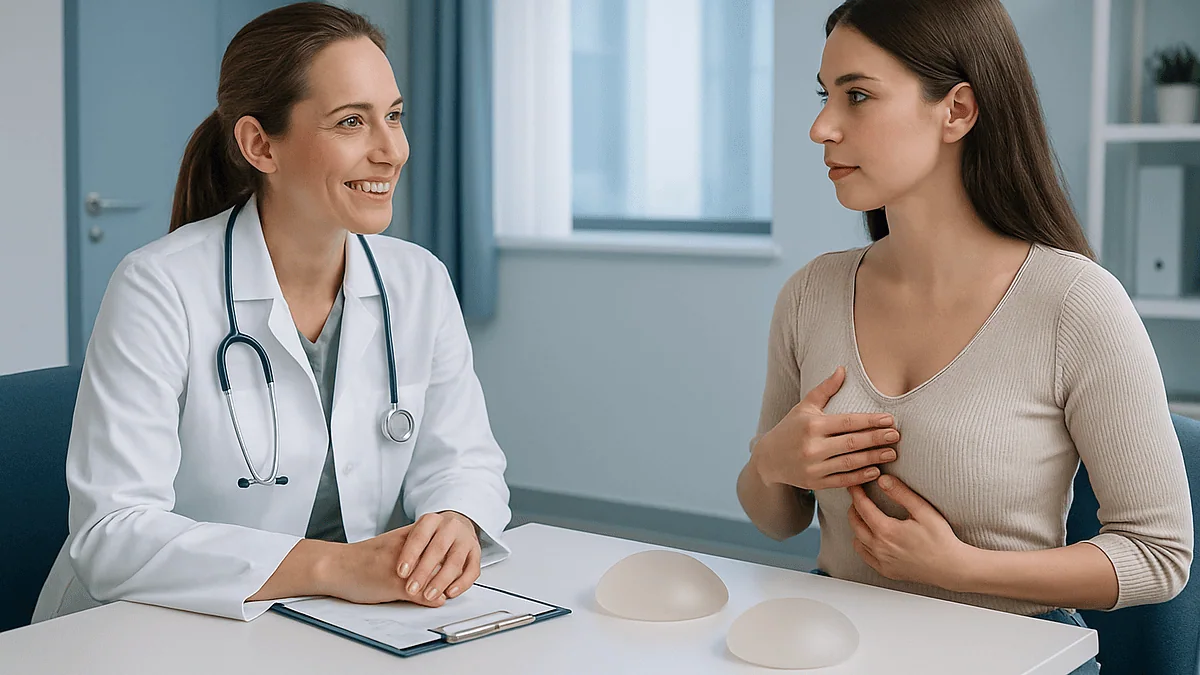
Key Takeaways
- The implant never changes size or shape after surgery; settling is the swelling, chest muscle, skin, and scar capsule around it adapting over time.
- Patient guides from Mayo Clinic and Cleveland Clinic describe swelling easing over weeks and the final breast shape developing over several months.
- Implants placed beneath the chest muscle or in a dual plane start higher and drop later than subglandular or subfascial implants, because the muscle must relax first.
- One side almost always settles before the other, often on the non-dominant arm side, and asymmetry that narrows over time is expected.
- Early firmness is normal, but firmness that develops or worsens after the breasts had softened is the typical sign of capsular contracture and should be assessed.
- The NHS advises avoiding strenuous activity for about six weeks and wearing a supportive sports bra for up to three months, with specifics set by your own surgeon.
Breast implants usually settle gradually rather than on a fixed date. Swelling and muscle tightness ease over the first several weeks, the implants drift lower and the lower breast fills out over the following months, and patient guides from Mayo Clinic and Cleveland Clinic describe the final shape taking several months. Timing varies with implant placement, tissue, and healing, so your surgical team judges what is normal for you.
Three days after surgery, standing sideways in the bathroom mirror, she tilts her head and frowns. The implants sit high and square, almost under her collarbones, and the lower half of each breast looks oddly flat. Her partner says it looks fine. The internet says “drop and fluff.” Her surgeon said “give it time.” None of that answers the question she actually has: is this what it is supposed to look like, and for how long?
Almost everyone who has breast augmentation asks some version of that question, and the honest answer is that early results are a draft, not the finished picture. Knowing when breast implants settle, and why they look the way they do in week one, turns an anxious wait into an informed one.
This explainer walks through what is physically happening under the skin, the typical timeline, what tends to speed things up or slow them down, and the handful of changes that should prompt a call rather than patience.
What does "settling" or "drop and fluff" actually mean?
“Drop and fluff” is not a medical term. It is patient shorthand for two overlapping changes that follow breast augmentation: the implant moving from a high, tight position down toward the natural fold under the breast (the drop), and the lower breast appearing fuller and rounder as swelling fades and tissue relaxes (the fluff). Surgeons tend to use plainer words such as settling, softening, or the breast “finding its final position.”
The important point is that the implant itself does not change. A silicone or saline implant leaves the operating room at its final volume and shape. What changes is everything around it: the skin envelope, the chest muscle if the implant sits beneath it, the thin scar layer the body builds around any implant, and the fluid that collects in tissue after surgery. As those elements adapt, the same implant looks different.
Think of a new pillow pushed into a slightly too-small pillowcase. On day one it is bunched up and tight at the top. Over time the fabric gives and the filling spreads evenly. Nothing about the pillow changed; the cover did.
Patient education from Mayo Clinic and Cleveland Clinic frames this the same way: swelling and soreness ease over weeks, while the final appearance develops over a longer period as tissues adjust. Understanding the distinction helps because it explains why early photos are a poor guide to the eventual result, and why two people with identical implants can look quite different at the two-week mark.
When do breast implants settle? The typical drop and fluff timeline
There is no single date. Settling is a curve, steep in the first weeks and flattening over months. The ranges below are drawn from mainstream patient guidance rather than any one surgeon’s rule, and they are typical patterns, not promises.

| Phase | What is usually happening | What it tends to look like |
|---|---|---|
| First days | Peak swelling; muscle spasm if placed under the muscle; dressings or a surgical bra in place | High, tight, often flattened at the bottom; nipples may point downward |
| Weeks 1–2 | Bruising and acute swelling begin to fade; many people return to desk work (NHS) | Still upper-heavy but less firm; early downward movement |
| Weeks 3–6 | Residual swelling clears; strenuous activity is commonly restricted for about six weeks (NHS) | Lower breast begins to fill; implants sit closer to the fold |
| Months 2–6 | Capsule matures; skin and muscle relax; scars begin to fade | Shape rounder and softer; often one side ahead of the other |
| Beyond 6 months | Tissue near its new equilibrium | Close to the final look; small refinements continue |
Cleveland Clinic’s patient guide notes that implants can take several months to settle into their final position, and Mayo Clinic describes swelling and bruising resolving over weeks with the overall result developing more slowly. Your own curve may run faster or slower than this table, which is why the question “is this normal for me?” belongs to your surgical team, who know your placement, implant type, and tissue.
How settling works: what actually happens under the skin
Four separate processes drive the change, and they run on different clocks.
Swelling (edema, meaning fluid collecting in tissue after injury) is the fastest. Surgery cuts and stretches tissue, and the body responds by flooding the area with fluid and inflammatory cells. That fluid adds bulk, mostly in the upper breast, and makes everything feel tight. As it drains over the first weeks, the breast loses that top-heavy look.
Muscle adaptation matters when the implant sits partly or wholly beneath the pectoralis major, the broad chest muscle. A muscle that has just been lifted off the ribs reacts by contracting, which pushes the implant upward and flattens its lower edge. Over weeks the muscle stops guarding and lengthens around the new shape.
Skin and the breast’s own tissue stretch next. The skin envelope has to accommodate more volume than it held before. Skin creeps gradually, which is why the lower pole (the part of the breast below the nipple) is the last area to round out.
Capsule formation is the slowest and most consequential. Every implanted device in the body gets wrapped in a thin layer of scar tissue called a capsule; this is normal and expected. A soft, pliable capsule lets the implant move naturally. If the capsule thickens and tightens, a complication called capsular contracture, the breast becomes firm and can be pushed upward again. Cleveland Clinic explains this process in its capsular contracture overview.
Put these together and the sequence makes sense: fluid leaves, muscle relaxes, skin yields, capsule matures. Each step hands a slightly different shape to the next.
Why do breast implants sit high at first?
The high, boxy early look alarms more people than almost any other part of recovery, and it is almost always the ordinary consequence of surgery rather than a sign that something is wrong.

Three forces push implants up in the first days. The first is swelling, which concentrates where tissue was handled most. The second is the chest muscle, which, when it sits over the implant, contracts in response to being lifted and effectively squeezes the implant toward the collarbone. The third is the tightness of the skin and the breast tissue itself, which have not yet stretched to hold the lower part of the implant. The pocket your surgeon created has a defined floor at the breast fold, but the tissues above it are briefly stronger than gravity.
Nipples often point slightly downward during this phase for the same reason: the implant is sitting above its destination, so the nipple rides on the lower slope of a mound that has not yet descended. As the implant drops, the nipple rotates toward neutral.
A surgical bra or compression garment, and in some practices a strap worn across the upper chest, is sometimes used during this period. The goal of those garments is support and swelling control; whether any of them meaningfully speeds the drop is not well established in the evidence, and recommendations vary between surgeons. Follow whatever instructions your own team gave you rather than something read in a forum.
Patience here is not passive. Mayo Clinic advises that you will likely have swelling and soreness for a few weeks and that the breasts’ final appearance takes longer to emerge. If the high position persists well past the expected window, or one side stays high while the other has clearly dropped, that is a reasonable question for your follow-up visit rather than a reason to adjust anything yourself.
Do implants look bigger once they drop?
Many people say yes, and the perception has a real basis even though the implant volume never changes.
In the early weeks the implant is compressed by a tight muscle and skin envelope and partly hidden by upper-pole swelling, which makes the breast look wide and shallow from the front. When the tissues relax and the implant descends, the lower pole rounds out and projects forward. Projection is what the eye reads as size. A breast that sticks out farther from the chest wall looks bigger from the front and in profile, even when the total volume is unchanged.
Swelling can push the perception the other way. Some people feel their breasts looked larger at day five, when they were full of fluid, and feel they “shrank” by week six. What they lost was edema, not implant. The cup size that fits once settling is complete is the honest one.
A practical consequence is that any judgment about size is unreliable in the first couple of months. Deciding at two weeks that the implants are too big, or too small, is deciding based on a shape that does not yet exist. Mainstream guidance from Mayo Clinic and the NHS consistently advises waiting for swelling to resolve and the result to mature before assessing the outcome, and surgeons generally defer any discussion of revision until the tissues have fully settled. There is no fixed waiting period written into any guideline; the standard is simply that the breast must have reached a stable shape.
If the finished result still feels wrong for your frame once it has settled, that is a legitimate conversation to have with your surgical team. Revision surgery exists precisely for that situation, with its own risks and recovery, and the decision belongs to you and the clinicians who know your anatomy.
Who tends to settle sooner, and who is usually asked to wait longer?
Settling speed is not random. Several factors predictably shift the timeline, and knowing which apply to you helps calibrate expectations.
Implant placement is the biggest variable. Implants placed under the chest muscle (submuscular) or in a dual plane, where the upper part is under muscle and the lower part under breast tissue, start higher and take longer to drop because the muscle must relax first. Implants placed above the muscle, beneath the breast tissue alone (subglandular), usually settle faster, though that placement carries its own trade-offs in coverage and rippling that your surgeon will have weighed.
Tissue characteristics come next. Someone who has been pregnant, breastfed, or lost weight often has a looser skin envelope that accommodates the implant quickly. Someone with tight, youthful skin and little natural breast tissue may wait longer for the lower pole to stretch.
Implant size relative to the pocket matters. A larger implant in a small frame has more stretching to do.
Implant surface and type can play a role. Textured implants were designed to grip the surrounding tissue and are not expected to move much after placement, so for those implants “settling” is mostly about swelling and softening rather than descent. Smooth implants move more freely within the pocket.
People who are usually asked to be especially patient include those having a breast lift at the same time as augmentation, where additional incisions and tissue repositioning extend healing, and those having revision surgery, where scar tissue from a previous operation behaves less predictably than untouched tissue. Smokers and people with conditions that slow wound healing are also counselled to expect a longer course; Mayo Clinic and the NHS both describe smoking as a factor that impairs healing and raises complication risk. None of this changes the destination, only how long the road is.
Do subfascial implants drop and fluff? Placement compared
Subfascial placement is a middle option that generates a lot of questions. The fascia is the thin, strong sheet of connective tissue covering the chest muscle. A subfascial implant sits on top of the muscle but beneath that sheet, rather than fully above it (subglandular) or beneath the muscle itself (submuscular).
Yes, subfascial implants settle, but the pattern is closer to subglandular placement than to submuscular. Because the muscle is not lifted, there is little muscle spasm to push the implant upward, so the dramatic high-and-tight phase of the first weeks is often milder. Swelling still occurs, the skin still stretches, and a capsule still forms, so softening and lower-pole filling continue over the following months. The fascia provides a snug layer that some surgeons feel gives a slightly more controlled descent, though high-quality comparative evidence on long-term shape between subfascial and other placements is limited, and claims that one plane reliably produces a better result should be treated cautiously.
Submuscular and dual-plane placement generally show the most pronounced drop because the muscle contributes both the initial upward pressure and the later relaxation. Subglandular placement shows the least, since only skin and breast tissue need to adapt.
What this means in practice: if you had a subfascial or subglandular augmentation and your breasts never looked strikingly high, that is expected, not a sign that settling was skipped. If you had a submuscular augmentation and your breasts still look high at four weeks, that is also expected. The placement decision was made for reasons that go beyond settling speed, including how much natural tissue you have to cover the implant and your activity level, and those reasons still apply.
What the first days and weeks after breast augmentation usually look like
Day-to-day recovery and settling run in parallel, and it helps to know what is ordinary at each stage.
The first two or three days are the sorest. Expect tightness across the chest, especially with submuscular placement, and difficulty lifting the arms high. Mayo Clinic notes that soreness and swelling are likely for a few weeks and that bruising is common. Your team will have given you instructions about dressings, showering, and any support garment; those instructions override anything generic.
By the end of the first week most people are moving comfortably around the house. The NHS advises that many people can return to work after about one to two weeks, depending on how physical the job is, and that driving should wait until it is comfortable to do so without discomfort and you are no longer taking medicines that affect alertness. Discuss timing with your surgeon rather than guessing.
Weeks two to six are the main softening window. Swelling clears, bruising yellows and fades, and the implants begin their visible descent. The NHS suggests avoiding strenuous activity, particularly upper-body exercise, for about six weeks, and wearing a supportive sports bra for up to three months. Light walking is encouraged early because it helps circulation and lowers the risk of blood clots, a small but real concern after any surgery.
Scars evolve on their own timeline. They typically look red and raised in the early months before gradually flattening and fading; full scar maturation can take a year or more, as general wound-healing guidance from the NHS describes. Scar care advice varies, and your team will tell you what, if anything, they recommend.
Nipple sensation often changes, becoming either reduced or oddly heightened, and commonly improves over months. Mayo Clinic lists altered sensation among the expected effects and notes it can persist in some people. Mention it at follow-up, but it rarely signals a problem.
How do I make my breast implants softer? What the evidence actually shows
This is one of the most searched questions after augmentation, and the honest answer is that time does most of the work, and the evidence for the various accelerating techniques is thinner than their popularity suggests.
Breasts feel firm early for the reasons already covered: fluid, muscle tension, and tight skin. As those resolve, softness follows. A soft, thin capsule is the main determinant of long-term softness, and capsule behavior is driven largely by factors you cannot control once surgery is done, including the surgical technique used and your individual healing biology.
Implant massage, sometimes called displacement exercises, is widely recommended by some surgeons and discouraged by others. The theory is that moving the implant within its pocket keeps the capsule roomy. Controlled evidence that massage reduces capsular contracture is weak and inconsistent, and for textured implants, which are designed not to move, massage is generally not advised. Follow your own surgeon’s instruction on this; do not start massaging because a forum said so, and do not stop if your surgeon asked you to continue.
Compression garments and bands support tissue and limit swelling, which indirectly helps comfort. Whether they change the final softness is unproven.
Supplements and creams marketed to “soften implants” have no reliable evidence behind them, and some can interfere with healing or bleeding. The NIH Office of Dietary Supplements is a sound place to check what is actually known about any supplement before taking it around surgery, and your surgeon should know about everything you take.
What demonstrably helps: not smoking, since smoking impairs blood flow and wound healing; following activity restrictions so that healing tissue is not repeatedly strained; and attending follow-up visits so that early firmness is assessed rather than assumed. If your breasts are still noticeably hard, or getting harder, several months in, that warrants evaluation rather than more waiting, which brings us to the next question.
Why have my breast implants gone hard? Capsular contracture explained
Early firmness is expected. Firmness that develops or worsens after the breasts had softened is a different matter, and the usual cause is capsular contracture.
Recall that the body wraps every implant in a thin scar capsule. In capsular contracture, that capsule thickens and tightens around the implant, squeezing it. The breast feels firm or hard, may look rounder and higher than before, can sit visibly differently from the other side, and in more advanced cases becomes painful or visibly distorted. Clinicians grade severity on a four-point scale (the Baker grades) running from a soft, normal-feeling breast to one that is hard, misshapen, and tender, as Cleveland Clinic’s capsular contracture page describes.
Why it happens is only partly understood. Low-grade bacterial contamination of the implant surface at the time of surgery, bleeding into the pocket, and individual scar-forming tendency are all implicated. Surgeons use a range of techniques during the operation aimed at lowering the risk, and placement beneath the muscle has been associated with lower rates in some studies, though evidence quality varies. Mayo Clinic lists capsular contracture among the recognized complications of breast augmentation and notes that it can require further surgery.
Capsular contracture can appear within the first year or many years later. It is not dangerous in itself, but it is a common reason people return for a second operation, which may involve releasing or removing the capsule and replacing or removing the implant.
Hardness is not always contracture. A collection of blood (hematoma) or fluid (seroma) in the first days causes a firm, swollen, often painful breast and needs prompt assessment. Late swelling on one side, developing years after surgery, is uncommon but should always be evaluated because it can indicate fluid around the implant that requires investigation. Any of these are reasons to be seen, not to wait and watch.
Breast implants dropping unevenly: when asymmetry is normal
One breast nearly always settles ahead of the other, and for many people this is the most unsettling stage of the whole process. At week four it is common to have one side rounded and soft and the other still high and firm, with the nipples at visibly different heights.
There are ordinary reasons for this. Most people have a dominant arm, and the muscle on that side is stronger and tighter, so a submuscular implant there often drops later. Natural breast asymmetry, which almost everyone has to some degree, means the two skin envelopes were never identical and stretch at different rates. The two sides may have had slightly different amounts of surgical handling and therefore different amounts of swelling. None of these change the eventual result; they change the order of arrival.
Surgeons generally expect uneven settling and judge symmetry only once both sides have reached a stable shape. Cleveland Clinic’s guidance that settling can take several months applies to each side independently.
What is not routine: a difference that is increasing rather than narrowing after the early weeks; one breast that becomes progressively harder while the other softens; an implant that drops below the natural fold so the nipple appears to ride high on the mound (sometimes called bottoming out); or an implant that drifts toward the armpit when lying down (lateral displacement). These are mechanical problems with the pocket or the capsule and are best assessed in person.
Resist comparing your two sides daily. Photographs taken in the same light and position every couple of weeks give a far more honest picture of direction of travel than a mirror check every morning, and they are useful to show your team at follow-up. If the gap is widening, say so; if it is narrowing, you are watching the expected process at the expected speed.
What people often get wrong about breast implant settling
A few persistent beliefs cause unnecessary worry, unnecessary action, or both.
“If they have not dropped by six weeks, something went wrong.” Six weeks is roughly the end of the acute swelling phase, not the end of settling. Mainstream guidance describes the final result developing over months. Submuscular implants and tight tissue routinely take longer.
“Massage will make them drop faster.” Massage is a matter of surgeon preference, the supporting evidence is limited, and it is not advised for some implant types. It is not a lever you should pull on your own.
“The implants are the wrong size; I can tell already.” Size judgments made while swollen, high, and compressed are judgments about a temporary shape. Wait for stability before drawing conclusions.
“Hard means contracture.” Early firmness is expected. Contracture is firmness that develops or worsens later, or that persists well beyond the usual softening window. The two feel similar but are not the same thing.
“Once settled, they are permanent.” Mayo Clinic is explicit that implants are not lifetime devices. Capsule changes, implant wear, pregnancy, weight change, and aging all alter the breast over the years, and many people have further surgery at some point for replacement or revision.
“Sleeping on your front or side ruins the result.” Most surgeons ask for back sleeping in the early weeks for comfort and to avoid pressure on healing tissue, not because side sleeping later would reshape the breast. Follow your own team’s timeline for returning to normal sleep positions.
“Supplements or creams can reshape or soften implants.” No reliable evidence supports this, and some products interfere with healing or bleeding. Check anything you are considering against NIH Office of Dietary Supplements information and tell your surgeon.
Correcting these ideas does not make waiting shorter, but it makes the waiting far less frightening.
Questions to ask your care team about settling
Follow-up appointments are brief, and it is easy to leave with the big question unasked. Bringing a short list keeps the conversation on what you actually want to know. These are worth raising at your pre-operative visit or your early post-operative checks.
- Where exactly were my implants placed (above the muscle, beneath it, dual plane, or subfascial), and how does that affect how long settling should take for me?
- Are my implants smooth or textured, and should I expect them to move within the pocket or stay where they are?
- Do you want me to do any massage or displacement exercises, and if so, when should I start and stop?
- What support garment or band do you want me to wear, for how long each day, and for how many weeks?
- At what point would you consider the high, tight look to be lasting longer than expected?
- When is it safe for me to return to upper-body exercise, running, and sleeping on my side?
- Which changes should prompt me to contact you the same day, and which can wait for the next scheduled visit?
- How will you assess symmetry, and when would you judge the result as final enough to discuss any concerns about size or shape?
- What is your approach if capsular contracture develops, and what are the signs I should watch for in the first year and beyond?
- How often should I be seen in the long term, and what ongoing checks or imaging are recommended for my implant type?
Write the answers down or ask whether the practice provides them in writing. Instructions differ between surgeons for good reasons, and the plan that applies to you is the one your own team sets, not the one described on a forum or in this article.
When to call your doctor: red-flag signs during settling
Most of what happens in the months after breast augmentation is expected and benign. A small number of changes are not, and the right response to them is a phone call, not another week of watching the mirror.
Contact your surgical team promptly, or seek emergency care if symptoms are severe, for any of the following:
- Sudden swelling, tightness, or enlargement of one breast, especially in the first days, which can indicate bleeding into the pocket (hematoma) and may need urgent treatment.
- Pain that is worsening rather than easing, or pain out of proportion to what you were told to expect.
- Fever, chills, or feeling generally unwell.
- Redness, warmth, or increasing tenderness spreading across the breast, or pus, foul-smelling discharge, or opening of the incision.
- Skin over the breast that looks dusky, pale, or blistered.
- Chest pain, shortness of breath, or a swollen, painful calf, which can signal a blood clot and need emergency assessment.
- A breast that becomes progressively hard, distorted, or painful after it had previously softened.
- An implant that appears to have shifted clearly below the fold, toward the armpit, or across the midline.
- Any new swelling, lump, or change in one breast appearing months or years after surgery, which should always be evaluated.
Mayo Clinic and the NHS both list infection, bleeding, capsular contracture, implant position problems, and rupture among the recognized complications of breast augmentation, and each is far easier to manage when reported early. If you are unsure whether a change counts, call anyway; surgical teams would much rather hear about a false alarm than a late presentation. Every decision about assessment, imaging, or further treatment sits with the clinicians who operated on you and know your specific implants and anatomy.
Frequently asked questions
When do breast implants settle after surgery?
Settling is gradual: swelling eases over the first few weeks and the final shape develops over several months, according to patient guides from Mayo Clinic and Cleveland Clinic. Implants beneath the muscle usually take longer than those above it, and tight tissue slows the process. Your surgical team can tell you what timeline fits your placement and anatomy.
Do implants look bigger once they drop?
They often appear bigger, even though volume is unchanged. As muscle and skin relax, the implant descends and the lower breast projects forward, which the eye reads as larger. Some people instead feel their breasts shrank, because early swelling that added bulk has gone. Judging size before settling is complete tends to mislead.
What is the typical drop and fluff timeline?
In broad strokes: high and tight in the first days, visibly softer by two to six weeks as swelling clears, and rounder and lower over the following months as the capsule matures and skin stretches. Cleveland Clinic notes settling can take several months. These are typical ranges, not a schedule your body is obliged to follow.
How do I make my breast implants softer?
Time does most of the work as swelling, muscle tension, and the scar capsule mature. Massage is recommended by some surgeons and discouraged by others, and the evidence that it changes outcomes is limited, so follow your own team’s instructions. Not smoking and respecting activity limits support healing. Supplements and creams marketed for softening lack reliable evidence.
Why have my breast implants gone hard?
Firmness in the first weeks is expected. Hardness that develops or worsens later, often with the breast looking rounder or higher, is the classic sign of capsular contracture, where the scar capsule around the implant tightens. Sudden early hardness with swelling can indicate bleeding. Either situation should be assessed by your surgical team rather than watched.
Do subfascial implants drop and fluff?
Yes, though less dramatically than submuscular implants. Because the chest muscle is not lifted, there is little muscle spasm pushing the implant upward, so the high, tight phase is usually milder. Swelling still fades, skin still stretches, and the capsule still matures, so softening and lower-pole filling continue over months.
Is it normal for breast implants to drop unevenly?
Very. Differences in arm dominance, natural breast asymmetry, and swelling mean one side almost always settles first. Surgeons assess symmetry only once both sides have stabilized. A gap that narrows over the weeks is expected; a gap that keeps widening, or one side becoming progressively harder, is worth raising at follow-up.
How long does it take for implants to soften?
Most softening happens in the first weeks as swelling clears, with continued softening over several months as the capsule matures, in line with Mayo Clinic and Cleveland Clinic recovery guidance. Submuscular placement and tight tissue lengthen the process. Breasts that remain hard or get harder after the usual window should be evaluated.
Why are my breast implants sitting high?
Swelling, a contracting chest muscle (if the implant is beneath it), and tight skin all push the implant upward in the early period. This usually resolves as those tissues relax over weeks to months. If one side stays high long after the other has dropped, or the position seems to be getting worse, ask your surgical team to check.
When should I worry about my breast augmentation recovery?
Call your surgical team promptly for sudden one-sided swelling, worsening pain, fever, spreading redness, wound discharge, dusky skin, or an implant that has visibly shifted. Seek emergency care for chest pain, shortness of breath, or a swollen painful calf. New swelling or a lump appearing months or years later should always be evaluated.
References
This article is for general information only and is not a substitute for professional medical advice. Please consult a qualified doctor about your individual situation.
Add us as a Preferred Source to see more of our trusted health content across Google Search, AI Overviews and Discover.

Planning This Treatment in Turkey
Our full guide for international patients: techniques, hospital stay, recovery and cost.
More from the Blog

Implant vs Flap Breast Reconstruction: How Body Type, Radiotherapy and Goals Shape the Choice
Implant reconstruction uses a silicone or saline device, usually after a tissue expander, and involves shorter surgery and recovery; flap reconstruction moves your own…
Breast Reduction After 50 and Beyond: What Surgeons Consider About Skin, Health and Screening
Breast reduction after 50 is common and age alone is not a barrier. Surgeons look instead at overall health, skin elasticity, medicines, smoking status…
Pain After Breast Augmentation: Tightness, Muscle Ache and Safe Ways to Stay Comfortable
Pain after breast augmentation is usually a tight, heavy, muscle-ache sensation across the chest that peaks in the first two to three days and…

Recovering From Accessory Breast Treatment: Arm Movement, Garments and Return to Work
Recovery after accessory breast removal usually means a few days of underarm soreness and swelling, gentle arm movement from the first day, a compression…

Warning Signs After Breast Reconstruction: Redness, Swelling and Flap Changes to Report Fast
After breast reconstruction, report spreading redness, new warmth, swelling that grows rather than settles, pain that worsens after day three, cloudy or foul-smelling drainage,…

Which Breast Lift (Mastopexy) Technique Suits You? Crescent, Donut, Lollipop and Anchor
Breast lift techniques are named for their incision shapes. A crescent lift removes a sliver of skin above the areola, a donut lift circles…