

When Does a Suspected Ulcer Need an Endoscopy? Age, Alarm Features and Failed Treatment

Key Takeaways
- Three triggers decide whether a suspected ulcer needs an endoscopy: age above the local guideline threshold (55 in UK guidance, 60 in US guidance), any alarm feature, or symptoms persisting after a full treatment course.
- Alarm features that override age include vomiting blood, black tarry stools, unexplained weight loss, swallowing difficulty, persistent vomiting and unexplained anemia.
- An upper endoscopy usually takes 15 to 30 minutes, requires fasting for about eight hours and sedation means no driving or important decisions for the rest of the day.
- H. pylori infection and NSAID painkillers cause most peptic ulcers, so breath or stool testing and a medication review often come before any camera in younger people without alarm features.
- Stomach ulcers are usually re-examined by endoscopy after the 4–8 week treatment course to confirm healing and exclude cancer; duodenal ulcers rarely need a repeat scope.
- A bleeding ulcer is treated through the scope itself using injections, heat or clips, and the test is typically performed within 24 hours of a stable admission.
A suspected ulcer usually needs an upper endoscopy when any of three things is true: the person is older than the age threshold set by local guidelines (55 or 60 in UK and US guidance) with new symptoms; alarm features such as bleeding, vomiting, trouble swallowing, unexplained weight loss or anemia are present; or symptoms persist after a full course of acid-suppressing treatment and infection testing. Younger people without these features are often tested for H. pylori and treated first.
The pharmacist has already asked twice whether the burning under the ribs comes before meals or after. The antacids have stopped working as well as they did in March. And now a search result is suggesting a camera down the throat, which feels like a large step for what might only be indigestion.
That gap, between “probably an ulcer” and “let’s look,” is exactly where most people get stuck. Understanding when is endoscopy needed for ulcer symptoms, and when it is reasonable to wait, is not a matter of how brave you are or how good your insurance is. It is a decision clinicians make with a fairly short list of criteria: your age, a handful of alarm features, and whether a proper trial of treatment has already failed.
This explainer walks through those criteria, describes what the procedure actually involves, and sets out what happens on the day an ulcer is found. The decision itself always rests with the team looking after you.
Why not every suspected ulcer gets a camera straight away
Here is a fact that surprises people: most upper abdominal pain that looks like an ulcer is not one. The NHS notes that indigestion is extremely common, and that many people with ulcer-like symptoms have no ulcer when examined. Acid reflux, a stomach lining that is irritated but not broken, and functional dyspepsia (pain without any visible damage) all produce the same gnawing ache after meals or at night.
An upper endoscopy is the only test that confirms an ulcer directly, because it lets a clinician see the lining of the esophagus, stomach and duodenum, the first part of the small intestine. But it needs fasting, usually sedation, a chaperone to take you home and a small risk of complications. Guideline bodies on both sides of the Atlantic therefore steer the procedure toward people in whom it is most likely to change what happens next.
The logic is risk-based. Two things make a lining problem more likely to be serious: age, because stomach cancer is uncommon in younger adults and becomes more frequent with each decade, and alarm features, which hint at bleeding, obstruction or a mass. Add a third trigger, symptoms that have not settled after a proper course of treatment, and you have the three questions this article is built around.
So when is endoscopy needed for ulcer symptoms? In short, when at least one of those triggers is present. When none are, a clinician will often test for Helicobacter pylori (H. pylori), the stomach bacterium behind many ulcers, treat if it is found, and reserve the camera for people who do not improve. That approach is deliberate, evidence-based and not a sign that your symptoms are being dismissed.
What an upper endoscopy involves, step by step
An upper endoscopy is also called a gastroscopy or EGD, short for esophagogastroduodenoscopy, which simply lists the three organs it inspects. A flexible tube roughly the width of a little finger carries a light and a tiny camera; the image appears on a screen beside the bed.
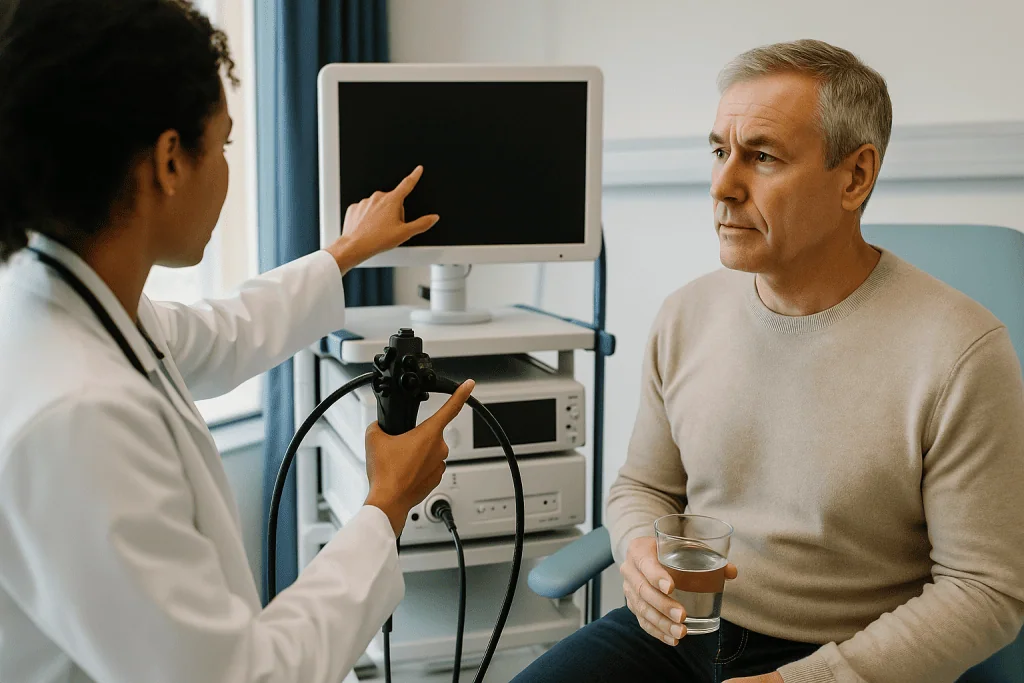
You will be asked not to eat for several hours beforehand, typically about eight according to the Cleveland Clinic, because food in the stomach blocks the view and raises the risk of inhaling anything that comes back up. Clear fluids are usually allowed until a shorter cut-off, and the booking team will tell you which medicines to pause and which to keep.
On the day, a nurse sprays the back of the throat with a numbing agent, and most people also receive a sedative through a small cannula in the hand. Some centers offer the test with throat spray alone, which lets you leave sooner. You lie on your left side with a plastic mouthguard between your teeth to protect them and the scope.
The clinician passes the tube over the tongue and asks you to swallow once; after that the scope does the work. Air is puffed in to open the folds of the stomach, which is why people describe a bloated, belching feeling. The lining is examined, photographs are taken and, if something looks abnormal, forceps passed down a channel in the scope pinch off samples smaller than a grain of rice. You do not feel a biopsy; the lining has no pain fibers of that kind.
The whole examination usually lasts 15 to 30 minutes, per the Cleveland Clinic, and you are monitored afterward until the sedation wears off. A written summary of what was seen is normally given before you leave, with biopsy results following later.
Age thresholds: why new symptoms after 55 or 60 change the plan
Two people with identical burning pain can be managed quite differently purely because one is 38 and the other is 62. That is not ageism; it is arithmetic about who is likely to have something other than a simple ulcer.
Stomach and esophageal cancers are rare in young adults and rise steeply with age. An ulcer that is actually a cancer, or a cancer sitting beside a benign ulcer, is far more plausible in later decades. Guidelines therefore pick an age above which new upper abdominal symptoms earn a direct look rather than a trial of treatment. UK referral guidance uses 55, and asks for urgent assessment when new dyspepsia is paired with weight loss in that age group; the American College of Gastroenterology uses 60 as its threshold in its dyspepsia guideline. Mayo Clinic likewise lists being older as one of the reasons a clinician may move straight to endoscopy.
The key word is new. Someone who has had the same mild heartburn for twenty years and is now 58 is in a different category from a 58-year-old whose pain began three months ago. Clinicians weigh the age, the onset and the pattern together.
Why not scope everyone to be safe? Because in people under the threshold without alarm features, the chance of finding a cancer at endoscopy is very low, and the test has small but real risks, costs time and often shows nothing that changes treatment. Testing for H. pylori and treating acid reversibly answers most of these cases.
If you are above the threshold, expect the conversation to start with the scope rather than end with it. If you are below it, the camera is still available; it is simply held in reserve for the alarm features and treatment failure described next.
Endoscopy alarm symptoms: the features that move the test to the front
Alarm features are findings that suggest an ulcer may have bled, scarred, blocked the stomach outlet or be something other than an ulcer. Their presence overrides age; a 30-year-old with any of them is usually offered an endoscopy promptly. Mayo Clinic and the NHS list broadly the same set:

- Vomiting blood, which may look bright red or like coffee grounds.
- Black, tarry, sticky stools, the sign of digested blood from the upper gut.
- Iron-deficiency anemia on a blood test without another obvious cause.
- Difficulty or pain when swallowing, or food feeling stuck.
- Unexplained weight loss.
- Persistent vomiting, especially of undigested food eaten hours earlier, which can mean the outlet of the stomach has narrowed.
- A lump or mass felt in the upper abdomen on examination.
Each one maps to a mechanism. Blood in vomit or stool means a vessel in the ulcer base has been eroded. Anemia means slow, invisible oozing over weeks. Swallowing trouble points to the esophagus rather than the stomach. Weight loss can simply reflect eating less because eating hurts, but it is also the classic early signal of a cancer, so it is never waved away.
This list is not a self-diagnosis tool, and it is not exhaustive. A family history of stomach cancer, previous stomach surgery, or long-term use of anti-inflammatory painkillers (NSAIDs) are also factors clinicians fold into the decision, even though they are not symptoms you feel.
What matters is that the presence of a single alarm feature changes the question from whether to look to how soon. Active bleeding is an emergency. Weight loss with new pain earns an urgent referral. Mild anemia found at a routine check may be scheduled within weeks. The treating team sets that urgency.
Failed treatment: when a full course has not settled things
The third trigger is the quiet one. No blood, no weight loss, no age concern, just symptoms that should have gone and have not.
Most suspected ulcers in younger people without alarm features are treated with a proton pump inhibitor, a class of medicine that switches off the acid pumps in the stomach lining so the raw area can heal. The NHS describes a typical course as lasting 4 to 8 weeks, with antibiotics added when H. pylori is found. Duodenal ulcers tend to heal toward the shorter end and gastric ulcers toward the longer, which is why the course length varies between people. Your prescriber chooses the medicine and the duration; this article describes only how the class works and the usual timescale.
If pain, nausea or early fullness persist after that course has genuinely been completed, several explanations become more likely. The infection may not have cleared, which is why guidelines ask for a repeat H. pylori test at least four weeks after antibiotics finish, per the NHS. An NSAID or aspirin may still be in the picture, sometimes in an over-the-counter cold remedy the person did not think to mention. The ulcer may be larger or deeper than average. Or there was never an ulcer, and the real problem is reflux, gallstones, pancreatic disease or functional dyspepsia.
Endoscopy answers several of these at once: it shows whether an ulcer exists, whether it has healed, and it allows biopsies for infection and for cells that should not be there. Mayo Clinic notes that clinicians may recommend endoscopy after treatment to confirm healing even when symptoms improve, and persistent symptoms make that recommendation stronger.
One caution: “failed treatment” means a full course taken as prescribed, not a week of tablets abandoned when the pain eased. Tell your clinician honestly what was taken and for how long; it changes the interpretation.
Who is usually asked to wait, and what test-and-treat means
If you are below the age threshold, have no alarm features and have not yet had treatment, the usual first step is a strategy called test-and-treat. A breath or stool test looks for H. pylori; if positive, antibiotics and acid suppression are prescribed; if negative, acid suppression alone is tried. The camera is reserved for people who do not improve.
The reasoning is that H. pylori and NSAID use together account for the great majority of peptic ulcers, according to the NIH’s National Institute of Diabetes and Digestive and Kidney Diseases, and both can be addressed without seeing the ulcer. The approach spares many people a procedure that would only confirm what the plan already assumes.
The table below summarizes how the three pathways differ. It is a guide to the conversation, not a substitute for it.
| Situation | Usual first step | Typical timing | Why |
|---|---|---|---|
| Vomiting blood, black stools, severe pain | Emergency endoscopy | Same admission, often within 24 hours | Bleeding or perforation needs direct treatment |
| Over 55 to 60 with new symptoms, or any alarm feature | Planned endoscopy | Urgent referral, usually within weeks | Higher likelihood of serious lining disease |
| Younger, no alarm features, no prior treatment | H. pylori test, then treatment | Review after a 4–8 week course | Most ulcers respond without a scope |
| Younger, no alarm features, treatment completed, still symptomatic | Endoscopy | Routine or urgent at clinician’s discretion | Confirms diagnosis, checks healing, allows biopsy |
Being asked to wait is not the same as being told nothing is wrong. It means the first test is a breath or stool sample rather than a camera, with the camera firmly in reserve. If anything on the alarm list appears during the waiting period, the pathway changes immediately.
Ulcer found during endoscopy: what happens in the room
People often picture an ulcer being “removed” during endoscopy. It is not. An ulcer is a crater in the lining, not a growth, so there is nothing to cut out. What the clinician does depends on what the crater looks like.
A clean, shallow ulcer with a pale base is photographed, measured and sampled. Biopsies are taken from the stomach lining to test for H. pylori and, for ulcers in the stomach itself, from the rim of the ulcer to make sure the cells are benign. Duodenal ulcers are almost never cancerous and are usually not biopsied for that reason, though the stomach lining may still be sampled for infection. Johns Hopkins Medicine describes these biopsies as a routine part of the examination.
If the ulcer shows signs of recent or active bleeding, treatment happens through the scope on the spot. Options include injecting a medicine that constricts blood vessels, applying heat or an electrical current to seal the vessel, or placing a small metal clip across it, as Mayo Clinic describes. These tools are why endoscopy is both the diagnostic and the first-line treatment for a bleeding ulcer.
Deep ulcers that look as though they may be close to perforating, or ulcers with an irregular, heaped-up edge that raises concern, are documented carefully and may prompt an earlier repeat scope or a scan.
Afterward, the clinician typically explains the findings in plain language, often showing you the photographs. The written report goes to the referring doctor, who adjusts treatment: a longer course of acid suppression, antibiotics if infection is confirmed, a firm instruction to stop a particular painkiller, or a follow-up appointment. Biopsy results arrive within days to a couple of weeks depending on the laboratory, and the team will say how you will receive them.
Endoscopy for stomach ulcer: why the stomach gets a second look
Not all ulcers are treated as equals. One of the most consistent recommendations across guidance is that an ulcer in the stomach (a gastric ulcer) is usually re-examined after treatment, while an ulcer in the duodenum often is not.
The reason is that a small proportion of stomach ulcers are cancers that have ulcerated, and a single set of biopsies can occasionally miss the abnormal cells. Mayo Clinic notes that a follow-up endoscopy after treatment may be recommended to confirm the ulcer has healed, even if symptoms have gone. Healing is the reassurance: a benign ulcer closes over with treatment; a cancer does not, however good the acid suppression.
The repeat scope is usually scheduled after the treatment course has run its 4 to 8 weeks, allowing time for the lining to recover. At that visit the clinician looks for a scar where the crater was, and if any ulceration remains, further biopsies are taken. Persistent gastric ulcers that fail to heal after a second course prompt a more detailed search for a cause, including rarer conditions in which the stomach makes excessive acid.
Duodenal ulcers follow a different logic. Cancer in the duodenum is very rare, so the question after treatment is simply whether symptoms have resolved and whether H. pylori has been cleared. That second question is answered by a breath or stool test rather than a camera, performed at least four weeks after antibiotics finish and after acid suppression has been paused, because residual medicine can give a false negative, as Mayo Clinic explains.
Knowing which type you have therefore shapes the coming months. It is a reasonable thing to ask directly: is this ulcer in my stomach or my duodenum, and does that mean a second look?
Bleeding ulcers and the emergency endoscopy
Everything so far describes a planned pathway with room for discussion. A bleeding ulcer collapses that timeline. Vomiting blood or passing black, tarry stools means an eroded vessel in the ulcer base, and the NHS lists both as reasons to seek emergency care rather than wait for a routine appointment.
In hospital, the first priorities are not the camera. Staff check blood pressure and pulse, place a cannula, send blood tests and may give fluids or a transfusion if a lot has been lost. Acid-suppressing medicine is often started intravenously to create an environment in which a clot can hold. Only when the person is stable is the endoscopy performed, typically within 24 hours of admission in most hospital protocols, sooner if bleeding is brisk.
The scope then does two jobs. It locates the source, which is not always an ulcer; esophageal tears, inflamed lining and enlarged veins in the esophagus can all bleed. And it treats the ulcer directly with the injection, heat or clip methods described earlier. The appearance of the ulcer base helps predict the risk of further bleeding: a visible vessel or fresh clot carries more concern than a clean base, and that assessment guides how long someone stays and how closely they are watched.
Rebleeding is possible in the days that follow, which is why patients are kept in hospital for observation and why a repeat endoscopy is sometimes arranged. If bleeding cannot be controlled through the scope, specialists in radiology can block the vessel from inside the artery, and surgery remains the backstop, as Mayo Clinic notes. Each step is a decision made by the team on the ward with the person in front of them.
Afterward, the focus shifts back to the cause: testing for H. pylori, reviewing every painkiller and blood thinner, and planning the follow-up scope if the ulcer was in the stomach.
Do ulcers need an endoscopy to be diagnosed? The alternatives explained
Strictly, yes: an ulcer is a visual diagnosis, and only a camera, or an X-ray study that outlines the crater, can confirm one exists. In practice, many people are treated for a suspected ulcer without ever seeing it, and that is an accepted approach when the three triggers are absent.
The tests that fill the gap each answer a slightly different question. A urea breath test detects H. pylori by having you swallow a labeled substance that the bacterium breaks down; the breakdown product appears in your breath. A stool antigen test finds pieces of the bacterium in a sample. Blood tests detect antibodies, but cannot distinguish current from past infection, which is why Mayo Clinic describes breath and stool tests as more useful for confirming active infection and for checking that treatment has worked. All three tests tell you whether the main cause of ulcers is present, not whether an ulcer is there.
An upper GI series, sometimes called a barium swallow, is a set of X-rays taken after drinking a chalky contrast liquid that coats the lining; an ulcer shows as a pocket of contrast. MedlinePlus lists it as an alternative to endoscopy. Its limits are that it cannot take biopsies, cannot treat bleeding and misses smaller or flatter ulcers, so it is used mainly when endoscopy is unsuitable.
A CT scan is rarely the first choice for an uncomplicated ulcer but becomes important if perforation is suspected, because free air outside the gut shows clearly.
So the honest answer to whether you need an endoscopy to diagnose an ulcer is that you need one to be certain, but you may not need certainty to be treated well. The decision about which route suits you rests with your clinician, weighing age, alarm features and what has already been tried.
What the days and weeks after an endoscopy usually look like
The first few hours belong to the sedative. You will rest in a recovery area until you are alert, and then go home with the person who came with you; MedlinePlus advises against driving, operating machinery or making important decisions for the rest of the day because judgment and reaction time remain impaired even when you feel normal.
A sore or scratchy throat is common and usually fades within a day. Bloating and belching from the air used to inflate the stomach settle within hours. If biopsies were taken, you may be asked to avoid alcohol or very hot drinks briefly. Most people eat normally that evening, starting with something light.
Over the following week the written report reaches your referring doctor, and biopsy results typically follow. If H. pylori is confirmed, antibiotic treatment begins; if a stomach ulcer was found, a follow-up scope is pencilled in for after the 4 to 8 week healing course described by the NHS. If the lining was normal, the conversation turns to other causes, which is itself useful information.
Complications are uncommon but worth knowing. The Cleveland Clinic and MedlinePlus list bleeding from a biopsy site, a reaction to the sedative, aspiration (inhaling stomach contents) and, rarely, perforation, a small tear in the wall of the gut that may need surgical repair. Perforation occurs in a very small fraction of diagnostic upper endoscopies; the risk is higher when the scope is used to treat bleeding or widen a narrowing.
The signs that something is wrong after the test are specific: severe or worsening abdominal pain, fever, difficulty swallowing that gets worse rather than better, vomiting blood, black stools, or chest pain and breathlessness. Any of these on the day or in the days after warrant urgent contact with the unit or emergency services rather than waiting for the follow-up appointment.
What people often get wrong about ulcers and endoscopy
“The first warning sign is always pain.” Often it is, a burning or gnawing ache between the breastbone and navel that comes and goes with meals. But the NHS points out that some ulcers produce no symptoms at all until they bleed, and the first sign may be tiredness from anemia or black stools. Pain is a clue, not a requirement.
“Stress and spicy food cause ulcers.” They can worsen symptoms, but the NIH’s digestive disease institute is clear that H. pylori infection and NSAID use cause most peptic ulcers. The stress theory was mainstream until the bacterium was identified; it is now a historical footnote.
“An endoscopy removes the ulcer.” It does not. The scope looks, samples and, when needed, seals a bleeding vessel. Healing comes from reducing acid, clearing infection and removing the offending painkiller.
“Once treated, an ulcer is gone forever.” Ulcers heal well when the cause is addressed, and most do not return once H. pylori is eradicated and NSAIDs are avoided. But recurrence happens if the infection is not cleared, if the painkiller creeps back, or in people who smoke. Nobody can promise a lifetime without one, and no honest clinician will.
“If I’m young, I’ll never be scoped.” Age is one trigger of three. Alarm features and treatment failure apply at any age.
“Feeling better means the ulcer has healed.” Symptoms often improve within days of starting acid suppression, well before the lining has closed. Stopping treatment early because the pain has eased is a common reason ulcers persist, which is why prescribers emphasize finishing the full course and why a stomach ulcer earns a follow-up look regardless of how you feel.
“A normal scope means it was all in my head.” It means the lining is intact. Functional dyspepsia is a real, well-described condition with its own management, and a normal endoscopy is the step that allows that diagnosis to be made confidently.
Questions to ask your care team before and after the scope
A good consultation leaves you knowing why a decision was made, not just what it is. These questions help, and none of them is awkward to ask.
Before the test, it is worth asking which of the three triggers applies to you: age, an alarm feature or treatment that has not worked. If none clearly applies, ask what the clinician expects the endoscopy to change. Ask whether you will be offered sedation or throat spray alone, how long you must fast, and which of your regular medicines should be paused, particularly blood thinners, diabetes medicines and acid suppressants, since the last can mask H. pylori on biopsy.
Ask who will be with you on the day and when you can expect to drive, work and make decisions again. If you live alone, say so early; some units will not perform a sedated procedure without someone to collect you.
After the test, the useful questions are about location and follow-up. Was the ulcer in the stomach or the duodenum? Were biopsies taken, and how will I receive the results? Will I need a repeat endoscopy, and roughly when? If H. pylori was found, how and when will we check it has cleared? Is there a painkiller I should stop, and what can I take instead for my arthritis or headaches?
Two final questions tend to be forgotten. First: what symptoms should make me contact you before the follow-up appointment? Second: if the scope was normal, what do you think is causing my symptoms, and what is the next step? Both keep the plan moving and both put the decision where it belongs, with the team who can see your results.
Writing the answers down, or bringing someone who can, is sensible when sedation is involved; people routinely forget conversations held in the recovery area.
When to call your doctor
Most suspected ulcers can be discussed at a routine appointment. A short list of signs should not wait for one. Call emergency services or go to an emergency department immediately if you vomit blood or material that looks like coffee grounds; pass black, tarry, sticky stools; develop sudden, severe abdominal pain that makes it hard to move or breathe, which can indicate perforation; feel faint, dizzy or notice a racing heartbeat alongside abdominal symptoms; or have chest pain, since heart problems can mimic indigestion. The NHS and Mayo Clinic list these as signs of a complicated ulcer that needs same-day assessment.
Contact your doctor promptly, within days rather than weeks, if you are losing weight without trying, find food sticking or swallowing painful, are vomiting repeatedly, have been told your blood count is low, or are over the age threshold used where you live and these symptoms are new.
Book a routine appointment if ulcer-like pain has lasted more than a couple of weeks, if it returns after a completed course of treatment, if you take NSAIDs or aspirin regularly and have developed upper abdominal pain, or if you have a family history of stomach cancer and new symptoms.
After an endoscopy, call the unit or seek urgent care for worsening abdominal pain, fever, swallowing that becomes harder, or any of the bleeding signs above.
None of this replaces individual advice. Whether you need an endoscopy, how urgently, and what happens afterward are judgments made by the clinicians who can examine you and see your results. This article is meant to make that conversation clearer, not to settle it.
Frequently asked questions
Do you need an endoscopy to diagnose an ulcer?
Only an endoscopy or a barium X-ray study can confirm an ulcer, because an ulcer is a visible crater in the lining. In practice, younger people without alarm features are often treated for a suspected ulcer after an H. pylori breath or stool test, with the scope reserved for those who do not improve. Being certain matters most when age, alarm features or treatment failure raise the stakes.
What are the first warning signs of a stomach ulcer?
The most common early sign is a burning or gnawing pain between the breastbone and navel, often worse on an empty stomach or at night and sometimes eased briefly by eating or antacids. Bloating, nausea and feeling full quickly can accompany it. Some ulcers cause no pain at all and first show as tiredness from anemia or black stools, which is why bleeding signs always need prompt assessment.
Can an ulcer be fully treated, or does it always come back?
Most peptic ulcers heal completely once the cause is addressed: clearing H. pylori, stopping the responsible painkiller and suppressing acid for a 4 to 8 week course. Recurrence is uncommon when infection is confirmed cleared and NSAIDs are avoided, but it can happen, particularly in people who smoke or need ongoing anti-inflammatory treatment. No clinician can promise an ulcer will never return.
What happens if an ulcer is found during an endoscopy?
The clinician photographs and measures it, takes small biopsies from the stomach lining to test for H. pylori and, for stomach ulcers, from the ulcer edge to check the cells are benign. If the ulcer is bleeding, it is treated on the spot with an injection, heat or a clip. Nothing is removed. Treatment afterward focuses on acid suppression, antibiotics if infection is confirmed, and reviewing painkillers.
Which endoscopy alarm symptoms mean I should not wait?
Vomiting blood or coffee-ground material, black tarry stools, sudden severe abdominal pain, and fainting or a racing heartbeat with abdominal symptoms are emergencies requiring same-day care. Unexplained weight loss, difficulty swallowing, persistent vomiting and unexplained anemia are urgent and should prompt a call to your doctor within days. Any of these overrides age in deciding whether an endoscopy is needed.
At what age is endoscopy recommended for new stomach symptoms?
UK referral guidance uses 55 and the American College of Gastroenterology uses 60 as the age above which new upper abdominal symptoms usually prompt endoscopy rather than a treatment trial. The threshold exists because stomach and esophageal cancers become more common with age. Below it, people without alarm features are typically tested for H. pylori and treated first. Your clinician applies the guidance used locally.
Does endoscopy for stomach ulcer need to be repeated?
Often, yes. Because a small proportion of stomach ulcers are cancers that have ulcerated, guidance commonly recommends a repeat endoscopy after the 4 to 8 week treatment course to confirm the crater has healed, even if symptoms have gone. Duodenal ulcers are almost never cancerous and usually do not need a second look; clearance of H. pylori is checked with a breath or stool test instead.
How long does an upper endoscopy take and will I be awake?
The examination itself usually lasts 15 to 30 minutes. Most people receive a sedative through a cannula that makes them drowsy and relaxed; many remember little of the procedure. Some units offer throat spray alone, which lets you drive and return to normal activities sooner. With sedation you need someone to take you home and should avoid driving or important decisions for the rest of the day.
Why do I have to stop acid medicine before an H. pylori test?
Proton pump inhibitors and some other acid-reducing medicines suppress the bacterium enough to produce a false negative on breath, stool and biopsy tests without clearing the infection. Clinicians therefore usually ask for a pause before testing and schedule confirmation tests at least four weeks after antibiotics end. Never stop a prescribed medicine on your own; your prescriber will tell you what to pause and when.
What if my endoscopy is normal but I still have pain?
A normal endoscopy means the lining of the esophagus, stomach and duodenum is intact, which rules out an ulcer and most lining cancers. It does not mean the pain is imagined. Functional dyspepsia, acid reflux without visible damage, gallstones and pancreatic conditions can all cause similar symptoms and have their own management. The result redirects the investigation rather than ending it.
References
- NHS: Stomach ulcer
- NIH NIDDK: Peptic ulcers (stomach or duodenal ulcers)
- MedlinePlus: EGD, esophagogastroduodenoscopy
This article is for general information only and is not a substitute for professional medical advice. Please consult a qualified doctor about your individual situation.

More from the Blog

Autoimmune Hepatitis Diagnosis: Antibody Tests, Imaging and When a Liver Biopsy Is Needed
Autoimmune hepatitis is diagnosed by combining blood tests (raised liver enzymes and immunoglobulin G), autoantibody tests such as ANA, anti-smooth muscle and anti-LKM1, and…

Living Gluten-Free With Celiac Disease: Label Reading, Eating Out and Travel Without Slips
A gluten free diet with celiac disease means removing all wheat, barley and rye, every day, for life, because even small amounts can damage…

Preparing for Gallstone Surgery: Blood Tests, Fasting and Which Medicines Are Paused
Preparing for gallstone surgery usually means a pre-assessment visit with blood tests (blood count, kidney and liver function, sometimes clotting), a fasting window of…

Why Variceal Banding Is Often Repeated: How Many Sessions and What Follow-Up Endoscopy Checks
Variceal banding is usually repeated every 2 to 4 weeks until the varices are flattened or gone, a point endoscopists call eradication. Liver guidance…

IBS Myths: Is It All in Your Head and Does Cutting Out Gluten Always Help?
IBS is not all in your head. It is a recognized disorder of gut-brain interaction in which the bowel and nervous system miscommunicate, producing…

Living With Chronic Liver Disease: Weight, Alcohol, Sleep and the Check-Ups That Matter
Living with chronic liver disease usually means protecting the working tissue you still have: avoiding alcohol if your team advises it, aiming for gradual…