

When Does Insomnia Need a Sleep Study? What the Overnight Test Can and Cannot Show
Key Takeaways
- Polysomnography records brain waves, breathing, oxygen and limb movements, but it cannot diagnose insomnia, which is identified from your history and a sleep diary.
- Chronic insomnia is generally defined as difficulty sleeping at least three nights a week for three months or more, and cognitive behavioral therapy for insomnia is the first-line treatment recommended by the NHS and Mayo Clinic.
- A sleep study is usually ordered for insomnia only when another disorder is suspected: witnessed breathing pauses, loud snoring, marked daytime sleepiness, leg kicking, dream enactment or treatment-resistant symptoms.
- Home sleep apnea tests measure airflow, effort and oxygen but not brain waves, so they cannot tell sleep from wake and can underestimate apnea in someone who lies awake for hours.
- Some people with insomnia are recorded as asleep far longer than they perceive, a finding called sleep state misperception that an overnight study can reveal.
- Sedating sleep aids and alcohol can worsen obstructive sleep apnea, which is one reason clinicians want breathing problems identified before insomnia is treated with medicines.
Insomnia on its own usually does not need a sleep study. Clinicians diagnose insomnia from your history and a sleep diary, and the usual first treatment is cognitive behavioral therapy for insomnia. An overnight test is typically ordered when something else is suspected: loud snoring or witnessed breathing pauses, heavy daytime sleepiness, leg kicking, unusual night-time behaviors, or insomnia that persists despite properly delivered treatment.
At 3:40 a.m. the ceiling has become very familiar. You know the sound the refrigerator makes when it cycles on, the faint tick of the hallway clock, the exact moment the first delivery truck rumbles past. You have tried warm milk, a new mattress, three apps and a podcast about rainfall. A friend says, with great confidence, that you need a sleep study. The idea is oddly appealing: wires, a lab, a printout that finally explains it.
Here is the uncomfortable truth that explains why the question of a sleep study for insomnia, and when it is actually needed, trips up so many patients: the overnight test was never designed to diagnose insomnia. It was designed to catch what happens to your breathing, your limbs and your brain waves while you are asleep. If your problem is that you cannot get to sleep in the first place, the machine may simply watch you lie there.
That does not make the test useless. It makes it a tool with a specific job, and knowing that job is the difference between a wasted night in a lab and a diagnosis that changes everything.
Should I get a sleep study if I have insomnia? The honest short answer
For most people whose only complaint is trouble falling or staying asleep, the answer is no, at least not as a first step. Insomnia is a clinical diagnosis, which means a clinician makes it by listening: how long you lie awake, how often, for how many weeks or months, and what it does to your days. The Mayo Clinic describes the standard workup as a medical history, a sleep history and often a sleep diary kept over a week or two, with an overnight study reserved for cases where another sleep disorder is suspected.
Why so cautious with a test that sounds so thorough? Because polysomnography, the formal name for the overnight sleep study, records physiology rather than experience. It measures brain waves, eye movements, muscle tone, heart rhythm, airflow, chest effort and blood oxygen. None of those channels can tell a technologist that you felt dread at bedtime, or that you were awake for 90 minutes replaying a conversation with your manager. The diary captures that. The wires do not.
There is a second, more practical reason. The treatment with the strongest evidence for long-term insomnia is cognitive behavioral therapy for insomnia, usually shortened to CBT-I, a structured program that retrains the habits and thoughts keeping you awake. The NHS and the Mayo Clinic both list it as the first-line approach. You do not need a sleep study to start it, and a normal study result would not change the recommendation.
So the question clinicians actually ask is not “does this person have insomnia?” but “is something else hiding underneath it?” Breathing that stops and restarts, legs that twitch all night, a brain that falls into dream sleep at the wrong moments: those are the problems the overnight test is built to find. The rest of this article is about recognizing when that second question needs answering.
What actually happens during an overnight sleep study
Polysomnography takes place in a sleep laboratory, often a room that looks more like a modest hotel than a hospital ward. You arrive in the evening, usually with your own pajamas and pillow if you want them. A technologist spends a good while applying small sensors: electrodes glued or taped to the scalp to record brain activity, sensors near the eyes to catch the rapid eye movements of dream sleep, sensors on the chin and legs to track muscle tone and movement, sticky pads on the chest for heart rhythm, elastic belts around the chest and abdomen for breathing effort, a small tube at the nostrils for airflow and a clip on a finger measuring blood oxygen.
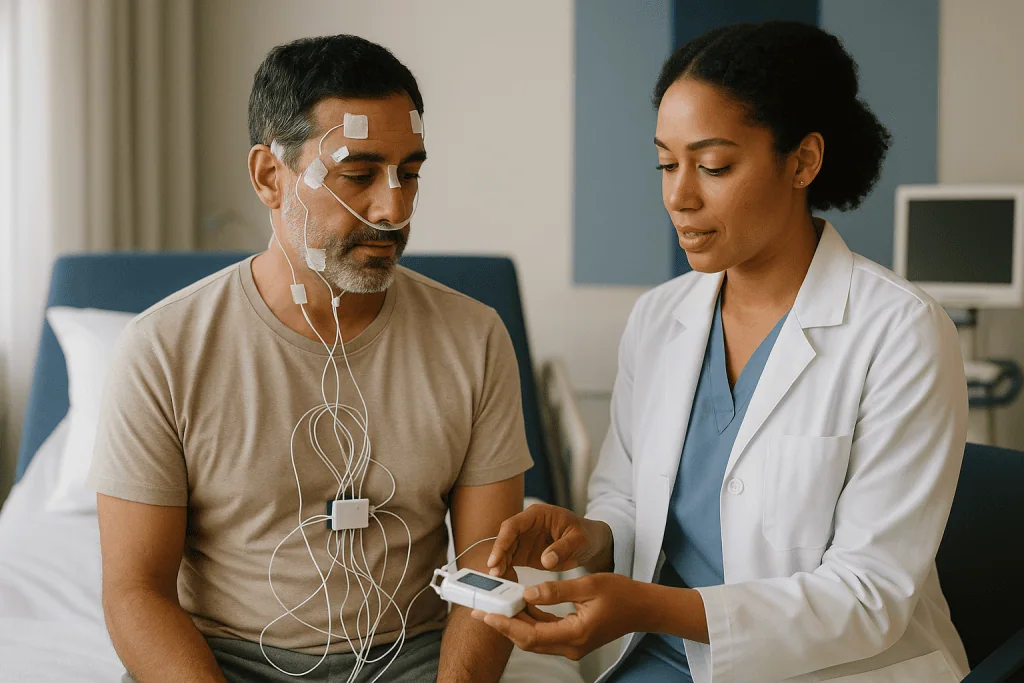
It sounds like a lot of hardware, and it is, but the wires are gathered into a single bundle so you can roll over and walk to the bathroom. A low-light camera and a microphone record the room so that snoring, talking or walking can be matched to what the sensors show. Then the lights go out.
The Mayo Clinic notes that the technologist monitors you from a separate room throughout the night and can come in if a sensor loosens. If breathing abnormalities appear early and are severe enough, some labs run a “split-night” protocol, where the second half of the night is used to try a breathing device while the sensors keep recording. That decision belongs to the lab and the ordering clinician, not to a preset rule.
In the morning the sensors come off, which takes a few minutes and a bit of adhesive remover. The data, often several hundred pages of 30-second “epochs,” are scored by a trained scorer and then interpreted by a sleep physician. That is why results typically take days to weeks rather than being handed to you at breakfast. According to the Cleveland Clinic, the test itself carries very little risk beyond mild skin irritation from the adhesive.
Does insomnia show up on a sleep study? What the overnight test cannot tell you
People are often surprised to learn that a sleep study can look almost normal in someone with miserable, years-long insomnia. There are three reasons, and each one matters for how you read your own result.
The first is the first-night effect. Many people sleep worse in a strange bed, covered in sensors, knowing they are being watched. Yet a smaller group of long-term insomnia patients sleep better in the lab than at home, perhaps because the bedroom at home has become a cue for wakefulness and the lab has not. Either way, one night may not represent your usual pattern. The Cleveland Clinic acknowledges that a single night of recording is a snapshot, not a full picture.
The second is a mismatch between what the brain waves show and what the person experiences. Some people with insomnia are scored as asleep for six hours and are convinced they slept for two. Sleep researchers call this sleep state misperception or paradoxical insomnia. It is not imagined; it is a real feature of the condition, and it is one of the few things a sleep study can genuinely reveal about insomnia itself, because it shows the gap between recorded and perceived sleep.
The third is simply that insomnia’s cause usually lives in the hours before bed and the thoughts during the night, not in the body’s wiring. Hyperarousal, the state of being physically and mentally keyed up at bedtime, does not have a dedicated sensor.
So what can the study tell someone with insomnia? It can confirm or rule out a second disorder. It can quantify how often breathing drops or oxygen dips. It can show whether limb movements are fragmenting sleep. And, occasionally, it can show that perceived wakefulness is longer than measured wakefulness, which can itself be a relief and a starting point for therapy. What it cannot do is replace the conversation that leads to an insomnia diagnosis.
Who is usually offered a sleep study for insomnia, and who is asked to wait
Think of the decision as a short list of “something else is going on” signals. When one or more are present alongside insomnia, the overnight test moves from optional to useful. When none are present, most clinicians ask patients to try the standard insomnia pathway first and revisit the question if it fails.

Signals that commonly prompt a study include loud, habitual snoring; breathing pauses or gasping noticed by a bed partner; waking with a headache or dry mouth; falling asleep unintentionally during the day despite feeling you barely slept at night; an urge to move the legs in the evening that eases with movement; kicking or thrashing reported by a partner; shouting, walking or acting out dreams during sleep; and sudden muscle weakness triggered by laughter or surprise, which can point to narcolepsy. The NHS lists several of these as reasons a general practitioner may refer someone to a sleep clinic.
Certain backgrounds raise the odds that breathing is the culprit. The NHS notes that sleep apnea is more likely with a larger neck circumference, with higher body weight, in people who smoke or drink alcohol, and in those who sleep on their back. None of these makes a study mandatory, but they tilt the conversation.
Who is usually asked to wait? Someone whose insomnia began after a clear stressor and who has not yet tried CBT-I or a structured sleep schedule. Someone whose main issue is lying awake at the start of the night with no snoring, no daytime sleepiness and no unusual movements. Someone for whom the “test” is really a hope for reassurance, since a normal result does not treat insomnia.
There is one more group that clinicians often do refer: people who have completed a proper course of CBT-I and still cannot sleep. Treatment resistance is itself a signal that a hidden disorder deserves a closer look. The judgment call always rests with the treating team, who can weigh symptoms, history and risk in a way no checklist can.
Insomnia vs sleep apnea: why the two get tangled so often
Obstructive sleep apnea is the condition most sleep studies are ordered to find. The NHS describes it as breathing that repeatedly stops and starts during sleep because the throat muscles relax and narrow the airway. Each pause ends with a brief arousal, often too short to remember, as the brain nudges the body to breathe again.
Here is where it collides with insomnia. Those micro-arousals can add up to a night that feels broken and unrefreshing. Some people with apnea wake fully at 3 a.m. and cannot get back to sleep, so they describe the problem as “insomnia.” They may never snore loudly enough to alarm a partner, or they may sleep alone. The classic apnea picture, a heavy snorer who dozes off at a red light, is only one version. Women and people of lower body weight in particular can present with fatigue, mood changes or middle-of-the-night awakenings rather than textbook sleepiness.
The reverse also happens. Someone with insomnia becomes convinced they have apnea because they wake often, and a study comes back clean. Both outcomes are useful, which is the point: the study answers a specific question about breathing with real numbers.
Those numbers are usually expressed as an apnea-hypopnea index, the average number of breathing pauses or partial reductions per hour of sleep. Clinicians use thresholds set by professional sleep medicine bodies to grade severity, and the grade feeds into what treatment is offered. Options range from positional and weight-related measures to a continuous positive airway pressure device, which gently pushes air through a mask to hold the airway open, and oral appliances that reposition the jaw.
Why does it matter so much to tell the two apart? Because some insomnia treatments make apnea worse. Sedating medicines, including certain sleep aids and alcohol, can relax the airway further. Treating apnea, on the other hand, often reduces the night awakenings that were being labeled insomnia. The Mayo Clinic lists untreated apnea among the conditions that can worsen sleep and overall health, which is why clinicians take even subtle hints seriously.
Beyond apnea: the other diagnoses an overnight test is built to catch
Breathing is the headline, but the sensors on the legs, chin and scalp are there for a reason. Each addresses a condition that can masquerade as insomnia.
Periodic limb movement disorder involves repeated, rhythmic jerks of the legs, sometimes the arms, during sleep. The sleeper rarely knows; the bed partner often does. The leg electrodes count these movements and the brain-wave channels show whether each one causes an arousal. A related waking condition, restless legs syndrome, is diagnosed by history rather than by the study, because its defining feature is an unpleasant urge to move that eases with movement and worsens in the evening. The two frequently travel together, and MedlinePlus notes that restless legs can delay sleep onset in a way that looks exactly like insomnia.
Narcolepsy is a disorder of the brain’s sleep-wake switching, in which dream sleep intrudes into the day. If a clinician suspects it, the overnight study is usually paired with a multiple sleep latency test the following day: a series of scheduled nap opportunities, roughly two hours apart, during which the sensors measure how quickly you fall asleep and whether you enter dream sleep. People with narcolepsy are often sleepy by day and, paradoxically, wake repeatedly at night.
Parasomnias are unwanted behaviors during sleep: sleepwalking, night terrors, sleep talking and, in older adults, physically acting out dreams. The combination of video, muscle-tone sensors and brain waves lets the physician see which stage of sleep the behavior arises from, which changes both the diagnosis and the advice.
Circadian rhythm disorders, where the internal body clock runs late or early relative to the schedule life demands, are usually assessed with diaries and wrist-worn actigraphy rather than a lab night, because the problem is timing rather than architecture. A night owl forced to rise at 6 a.m. will report “insomnia” at 11 p.m., but the fix is a clock problem, not a sleep-quality problem.
A good sleep physician reads your story first, then decides which of these the lab needs to look for. The test is targeted, not a fishing expedition.
Home sleep test for insomnia: what the smaller kit can and cannot do
Many people are now offered a home sleep apnea test instead of a lab night. You collect a small device, strap on a chest belt, a nasal tube and a finger oxygen probe, sleep in your own bed and return the kit the next day. The Mayo Clinic explains that these devices measure breathing, oxygen and heart rate but do not record brain waves, so they cannot tell whether you were asleep or awake, and they cannot score sleep stages or limb movements.
That limitation is exactly why the home kit is a poor tool for insomnia on its own. If you lay awake for three hours, the device may count that time as “sleep,” diluting the breathing index and potentially underestimating apnea. Home testing is generally reserved for adults in whom moderate to severe obstructive apnea is suspected and who have no other major sleep or medical condition clouding the picture. A borderline or negative home result in someone with strong symptoms is usually followed by an in-lab study.
One of the most common questions is how many hours of sleep are needed for a home test to count. Each laboratory sets its own minimum recording time for the data to be scoreable, and your sleep center will tell you theirs; if the device records too little usable time, the test is typically repeated rather than interpreted. Ask before you take the kit home rather than worrying about it at midnight.
| Tool | What it measures | Good for | Cannot do |
|---|---|---|---|
| In-lab polysomnography | Brain waves, eyes, muscle, heart, breathing, oxygen, video | Apnea, limb movements, parasomnias, narcolepsy (with daytime test) | Diagnose insomnia by itself |
| Home sleep apnea test | Airflow, effort, oxygen, heart rate | Suspected uncomplicated apnea | Tell sleep from wake; detect movements |
| Sleep diary | Your reported bed, wake and awake times | Diagnosing insomnia; guiding CBT-I | Detect breathing or movement problems |
| Actigraphy (wrist monitor) | Movement patterns over 1–2 weeks | Circadian timing; estimating sleep over time | Measure sleep stages or breathing |
Sleep diary, actigraphy and wearables: the tools that usually come first
The humblest instrument in sleep medicine is a sheet of paper. A sleep diary asks you to note, each morning, when you got into bed, roughly when you fell asleep, how many times you woke and for how long, when you got up, and how you felt. Over two weeks, patterns appear that no single night can show: the Sunday-night collapse, the 4 a.m. awakenings that cluster after late dinners, the slow drift of bedtime later and later. The Mayo Clinic lists the diary as a standard part of the insomnia evaluation, and it is the raw material a CBT-I therapist uses to set your sleep schedule.
Actigraphy adds an objective layer without the lab. A wrist device, worn continuously for a week or two, records movement and sometimes light exposure. Long still periods are interpreted as likely sleep. It is far from perfect, because lying motionless while awake is scored as sleep, but across many nights it is good at revealing timing problems and at checking whether the diary and the body agree.
Consumer wearables and phone apps sit in a different category. They estimate sleep stages from movement and heart rate using proprietary algorithms, and their accuracy for staging varies widely. They can be genuinely helpful for spotting trends in bedtime and total time in bed. They can also be harmful for people with insomnia, who sometimes become so fixated on a nightly “sleep score” that the number itself becomes a source of bedtime anxiety. Clinicians have an informal name for this: orthosomnia. If checking the app makes you feel worse, that is information.
What none of these tools do is measure breathing. If your diary shows frequent awakenings and your partner reports snoring, the next step is a breathing test, not a better app. The order matters: history and diary first, targeted testing second, and a device on the wrist as an aid rather than a verdict.
What the days and weeks after a sleep study usually look like
The morning after an in-lab study, most people go straight to work or home. There is no recovery in the medical sense; the only lingering effects are a little adhesive in the hair and, for some, a worse night than usual. Driving is fine unless you were already dangerously sleepy, in which case your clinician will have advised you beforehand.
Then comes the waiting. Scoring several hundred epochs by hand and having a physician interpret them takes time, and the Cleveland Clinic advises that results commonly take a week or more to reach you. A follow-up appointment, in person or by phone, is where the numbers are translated into plain language: how much you slept, how long it took, how often breathing or limb movements interrupted things, and what, if anything, the findings mean for your insomnia.
Three broad outcomes are common. The study finds a treatable disorder, most often sleep apnea, and you are offered a pathway for it. In that case, the weeks that follow involve fitting and adjusting a breathing device or oral appliance, and many people notice that the night awakenings they called insomnia become less frequent as breathing stabilizes. That change takes time and depends on using the treatment consistently, so it is not a promise, just the usual direction of travel.
The study is essentially normal, which is a good result that is often received as a disappointment. It means the problem is insomnia itself, and the next step is the treatment with the best evidence, usually a course of CBT-I. The NHS notes that CBT-I is typically delivered over several weeks, with sleep improving gradually as the schedule and habits take hold.
The study is inconclusive, perhaps because you barely slept or a sensor failed. A repeat night or a different test may be suggested. That is frustrating but not unusual, and it does not mean nothing is wrong. Whatever the result, the decision about what happens next is made together with the team that ordered the test.
What treating insomnia usually involves once the study is done, or skipped
Whether or not you ever set foot in a sleep lab, the treatment conversation ends up in roughly the same place. Guidelines on both sides of the Atlantic put cognitive behavioral therapy for insomnia first, ahead of medicines, for adults with persistent insomnia. The Mayo Clinic describes it as generally as effective as, or more effective than, sleep medicines over the long term, and the NHS recommends it as the first thing to try.
CBT-I works on two fronts. The behavioral part restricts time in bed to roughly the amount you actually sleep, so that sleep pressure builds and the bed is re-learned as a place for sleep rather than wakeful worry; the window is then widened as sleep consolidates. Stimulus control adds the rule of getting up if you are lying awake and returning only when sleepy. The cognitive part targets the thoughts that fuel hyperarousal, such as “if I do not sleep tonight tomorrow is ruined.” It is usually delivered over a handful of weekly sessions, in person, in groups or through structured digital programs.
Medicines have a place, and the decision to use them rests entirely with the prescribing clinician. Several classes exist. Some act on the brain’s main calming neurotransmitter system to shorten the time to fall asleep. Others block the wake-promoting orexin system, which is a newer mechanism. Low-dose sedating antidepressants are sometimes used off-label. Melatonin, a hormone that signals night to the body clock, is mainly useful for timing problems rather than for difficulty staying asleep. MedlinePlus cautions that sleep medicines are generally intended for short-term use and carry risks including next-day drowsiness and dependence.
What does not help, and sometimes harms, is alcohol as a sleep aid. It shortens sleep onset and then fragments the second half of the night, and it worsens apnea. If a study found breathing problems, treating those often has to come first, because sedatives can deepen the pauses. Never start, stop or change any prescribed medicine without discussing it with the clinician who prescribed it.
What is the 30/30 rule for insomnia? Rules of thumb sorted by evidence
The internet is full of numbered sleep rules, and the “30/30 rule” is one of the more popular. The problem is that it means different things depending on who is quoting it. Some use it to mean: if you have not fallen asleep within about 30 minutes, get out of bed and do something quiet until you feel sleepy. Others use it for morning light: get roughly 30 minutes of daylight within 30 minutes of waking. Neither phrase appears in major clinical guidelines by that name, so treat it as folklore wrapped around two real ideas.
The first idea is stimulus control, a core piece of CBT-I. The Mayo Clinic’s self-care advice is to leave the bedroom if you cannot fall asleep after a reasonable stretch, roughly 20 minutes, and return only when sleepy, without clock-watching. The exact number is less important than the principle: the bed should be associated with sleep, not with lying awake frustrated. Counting the minutes obsessively defeats the purpose, which is why many therapists say “when it feels like a while” rather than giving a timer.
The second idea is light timing. Morning daylight is the strongest signal the body clock receives, and getting outside soon after waking helps anchor a consistent schedule. This is well supported for circadian problems. It is a helpful habit for insomnia, though not a treatment on its own.
A short ranking of common rules, by how well the evidence supports them for insomnia:
- Fixed wake time every day, including weekends: strong support, central to CBT-I.
- Get up if lying awake: strong support as part of stimulus control.
- Morning daylight: good support for circadian timing, helpful habit for insomnia.
- No screens for an hour before bed: reasonable, mainly because screens delay bedtime and stimulate the mind; the light effect alone is modest.
- Warm bath, cool bedroom, no caffeine late: supported sleep hygiene, but sleep hygiene alone is rarely enough for persistent insomnia.
- “Catch up” by sleeping in or napping: counterproductive, because it drains the sleep pressure you need that night.
What people often get wrong about sleep studies and insomnia
“A sleep study will diagnose my insomnia.” It will not, for the reasons covered above. Insomnia is diagnosed from your story. The study looks for other disorders.
“If I sleep badly in the lab the test is ruined.” Not usually. Technologists are used to patients who sleep for only a few hours. Breathing events can be counted in whatever sleep you do get, and a poor night is itself a data point. Only very short recordings tend to need repeating.
“A normal result means nothing is wrong.” A normal result means breathing, movements and sleep architecture looked fine on that night. Insomnia can still be very real, and it has an effective treatment that does not depend on the study.
“I need the lab test, not the home kit, because the home kit is less accurate.” For uncomplicated suspected apnea, the home test is an accepted route and lets you sleep in your own bed. It is the wrong tool when insomnia, limb movements or a complex medical history are in play, and your clinician chooses between them for that reason, not because one is a lesser product.
“My wearable says I only get 40 minutes of deep sleep, so something is wrong.” Consumer devices estimate stages indirectly, and their staging accuracy is variable. A low number on an app is not a diagnosis and does not by itself justify a lab test.
“Sleep hygiene should be enough.” Cool room, no caffeine after lunch and no late screens are sensible. For insomnia that has lasted months, the evidence is clear that hygiene alone rarely resolves it; the active ingredient is the structured schedule and thought work of CBT-I.
“Needing a sleep aid means I failed.” Medicines are a tool a clinician may choose for a specific situation, often short-term and alongside therapy. Using one is a medical decision, not a moral one, and stopping one abruptly is not a good idea without advice.
“Insomnia is just stress; it will pass on its own.” Short-term insomnia often does. The Mayo Clinic defines chronic insomnia as trouble sleeping at least three nights a week for three months or more, and once it has settled in, it tends to persist until the habits maintaining it are addressed.
Questions to ask your care team before and after a sleep study
A sleep study is more useful when you walk in knowing what question it is meant to answer. These prompts are meant to help you have that conversation, not to replace it.
Before the test:
- What specific condition are you looking for with this study, and what in my history made you suspect it?
- Would a home test be appropriate for me, or do I need the in-lab version, and why?
- Should I keep taking my usual medicines, including any sleep aids, on the night of the study? (Follow the prescriber’s instructions exactly; do not change anything on your own.)
- Is there anything I should avoid that day, such as caffeine, alcohol or napping?
- What happens if I barely sleep? Will the night still be useful?
- Is a daytime nap test being planned as well, and will I need the whole next day free?
After the result:
- What did the study show, in plain terms, and what did it rule out?
- How does this result change the plan for my insomnia?
- If the result was normal, am I a candidate for cognitive behavioral therapy for insomnia, and how is it delivered here?
- If a breathing or movement disorder was found, what are all the treatment options, and what are their trade-offs?
- Are any of my current medicines likely to worsen what you found?
- When should I expect to notice a difference, and what would prompt a review sooner?
- Should the study ever be repeated, and under what circumstances?
Bring a bed partner’s observations if you have them. The description “he stops breathing, then snorts and rolls over” or “she kicks all night” is often more diagnostic than anything the patient can report. And ask for a written summary of the result, because sleep reports are dense and it helps to re-read them after the appointment.
When to call your doctor: red-flag signs that should not wait for a routine appointment
Insomnia itself is rarely an emergency, but some of the things that travel with it are. Contact your clinician promptly, or use emergency services where indicated, if any of the following apply.
- You have fallen asleep, or nearly fallen asleep, while driving or operating machinery. Stop driving until you have been assessed.
- A partner has witnessed you stop breathing during sleep, especially if you also wake gasping or choking, or if you have high blood pressure, heart disease or diabetes. The NHS lists witnessed pauses as a reason to seek assessment for sleep apnea, which is linked to cardiovascular risk when untreated.
- You have new chest pain, palpitations or shortness of breath at night.
- You are experiencing sudden muscle weakness when you laugh or are startled, or vivid hallucinations as you fall asleep or wake; these can point to narcolepsy.
- You are acting out dreams in a way that has injured you or a bed partner.
- You have thoughts of harming yourself, or your mood has sunk to the point that insomnia feels unbearable. Insomnia and depression commonly occur together, and MedlinePlus notes that persistent sleep loss can worsen mental health. Seek help the same day.
- You have been using alcohol, over-the-counter sleep aids or someone else’s prescription to get to sleep.
- Insomnia began alongside unexplained weight loss, night sweats, fever or new pain.
- Your sleeplessness has lasted more than three months despite your own efforts, or it is affecting your work, relationships or safety.
None of these lists is a diagnosis, and this article cannot tell you whether you personally need a sleep study. What it can do is help you describe your nights clearly, ask the right questions and understand what the answer means. The decision about testing, and about every treatment that might follow, belongs to you and the clinicians who know your history. If you take one thing from these pages, let it be this: the sleep study is a precise instrument for a specific set of problems, and insomnia has its own well-evidenced path that does not have to wait for a night in the lab.
Frequently asked questions
Should I get a sleep study done if I have insomnia?
Usually not as a first step. Insomnia is diagnosed from your history and a sleep diary, and the main treatment, cognitive behavioral therapy for insomnia, does not require a study. Clinicians order an overnight test when something else is suspected, such as loud snoring, witnessed breathing pauses, heavy daytime sleepiness, leg movements, unusual night-time behaviors, or insomnia that has not improved after proper treatment. Your treating team makes that call.
What does a sleep study show, exactly?
An in-lab study records brain waves, eye movements, muscle tone, heart rhythm, airflow, breathing effort, blood oxygen, leg movements and video. From these, a sleep physician can see how long you slept, which sleep stages you reached, how often breathing paused or oxygen dipped, whether limb movements disturbed sleep, and whether unusual behaviors arose from a particular stage. It does not measure thoughts, worry or how rested you felt.
Does insomnia show up on a sleep study?
Not reliably. Many people with severe insomnia have near-normal studies, partly because one night in a lab is a snapshot and partly because insomnia is driven by arousal and habits rather than a measurable physical fault. The study can show long time awake or a gap between perceived and recorded sleep, but its real value for insomnia patients is ruling in or out a second disorder such as sleep apnea.
Can a home sleep test diagnose insomnia?
No. Home kits measure breathing, oxygen and heart rate without brain waves, so they cannot tell whether you were asleep or awake. They are designed to confirm suspected uncomplicated obstructive sleep apnea. For someone with prominent insomnia, long periods of lying awake can distort the results, which is why an in-lab study is often preferred when both problems may be present. Your clinician chooses the tool based on your symptoms.
How many hours of sleep do you need for a sleep study at home?
Each sleep center sets its own minimum amount of usable recording for the test to be scored, so ask when you collect the kit. If the device captures too little, the test is typically repeated rather than interpreted. Try to follow your normal routine, avoid alcohol that evening unless told otherwise, and do not worry if you wake during the night; breathing events can still be counted in the sleep you do get.
What is the difference between insomnia and sleep apnea?
Insomnia is difficulty falling or staying asleep driven by arousal, habits and thoughts, with no breathing problem. Obstructive sleep apnea is repeated airway narrowing during sleep that causes brief awakenings and oxygen dips. The two overlap because apnea-related awakenings can feel like insomnia, and some people have both. A sleep study separates them, which matters because sedatives used for insomnia can worsen apnea.
What is the 30/30 rule for insomnia?
It is a popular rather than clinical term. Some people use it to mean getting out of bed if you are not asleep after about 30 minutes; others use it for roughly 30 minutes of daylight within 30 minutes of waking. Both borrow from evidence-based practices, stimulus control and morning light exposure, which are part of cognitive behavioral therapy for insomnia. The exact minute count matters far less than the principle.
Will I ever sleep again if I have insomnia?
Insomnia is highly treatable, and most people who complete a structured course of cognitive behavioral therapy for insomnia see meaningful improvement in how quickly they fall asleep and how long they stay asleep. No clinician can promise a specific outcome, and the condition can return under stress, but the skills learned tend to last. If a hidden disorder like sleep apnea is found and managed, night awakenings often ease as well.
Can I take my sleep medicine on the night of the study?
Follow the instructions of the clinician who ordered the study and the prescriber of the medicine. Some centers ask patients to continue their usual medicines so the night reflects real life; others ask for changes to avoid masking certain findings. Never stop or alter a prescribed medicine on your own for the test, since some sleep aids cause rebound insomnia or other effects when stopped abruptly.
What happens if I cannot sleep at all during the sleep study?
Technologists see this often and it rarely ruins the night. Even a few hours of sleep can reveal breathing pauses, limb movements or abnormal sleep architecture, and prolonged wakefulness is itself a recorded finding. If the recording is too short to score, your clinician may suggest a repeat night, sometimes with different preparation. Sleeping poorly in the lab does not mean the test failed or that nothing is wrong.
References
This article is for general information only and is not a substitute for professional medical advice. Please consult a qualified doctor about your individual situation.
Add us as a Preferred Source to see more of our trusted health content across Google Search, AI Overviews and Discover.

More from the Blog

Vascular Dementia Life Expectancy: What Studies Show, Why It Varies and What Shapes the Outlook
Large studies place average survival in vascular dementia at roughly 3 to 5 years after symptoms begin, shorter than the average for Alzheimer's disease,…

VP Shunt vs Endoscopic Third Ventriculostomy: How Surgeons Choose for Adult Hydrocephalus
In adults, surgeons choose between a VP shunt and endoscopic third ventriculostomy (ETV) mainly by where cerebrospinal fluid is blocked. A clear obstruction inside…

Tremor Treatment: How the Cause of Shaking Hands Shapes the Care Plan
Tremor treatment depends on the cause. Essential tremor is usually managed first with medicines such as beta-blockers or certain anticonvulsants, with deep brain stimulation…

Muscular Dystrophy Life Expectancy: How the Outlook Differs by Type and What Care Has Changed
Muscular dystrophy life expectancy depends mainly on the type. Several forms, including facioscapulohumeral and most adult-onset types, usually do not shorten life. Duchenne, the…

Myasthenia Gravis Treatment: How Medicines, Immunotherapy and Thymectomy Are Combined
Myasthenia gravis is treated in layers rather than with one medicine. Anticholinesterase tablets ease weakness within hours, corticosteroids and steroid-sparing immunosuppressants calm the autoimmune…

A Headache That Won’t Go Away: Common Causes, Pain Behind the Eyes and When to Be Assessed
A headache that won't go away is most often tension-type headache, a drawn-out migraine, or rebound headache from frequent pain relievers, and these usually…