

When Is a Female Hair Transplant Considered? Medical Treatment First, Then Stable Loss
Key Takeaways
- Hair at the back of the scalp is largely resistant to the hormones that drive pattern loss, which is why it is used as donor hair and why a thinning donor area undermines candidacy.
- Topical minoxidil typically needs at least six months of consistent use before it prevents further loss or begins regrowth, and its benefit stops if use stops.
- Telogen effluvium usually begins two to three months after a trigger such as illness, childbirth or rapid weight loss and often recovers without surgery.
- Transplanted hairs commonly shed within two to three weeks of surgery before regrowing from the retained follicles over the following months.
- MedlinePlus reports that most people see about 60 percent of new hair growth six to nine months after a transplant, so judging results earlier is premature.
- A transplant redistributes a fixed donor supply and does not halt loss of surrounding native hair, which is why medical treatment typically continues afterwards.
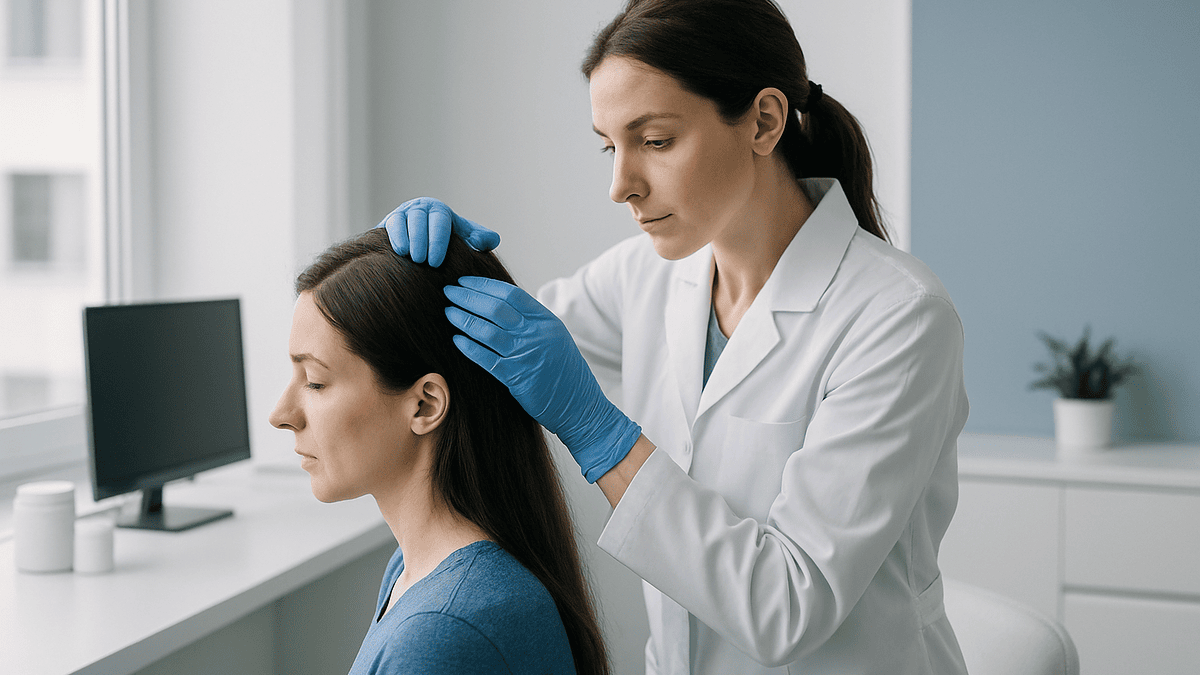
A female hair transplant is usually considered only after two conditions are met: the cause of hair loss has been diagnosed and treated medically, and the loss has stayed stable for a sustained period. Surgeons typically look for a clear pattern, enough dense donor hair at the back of the scalp, and no active scalp disease. The treating team makes the final call on candidacy.
She parts her hair in the bathroom mirror and sees more scalp than she did a year ago. The part has widened into a soft, pale strip. A photo from a friend’s wedding confirms it. By evening she has typed the question into her phone: when to consider female hair transplant, and whether she is even the kind of person who gets one.
The honest answer is less dramatic than the ads suggest. For most women, surgery is the last step in a sequence, not the first. A dermatologist works out why the hair is thinning, treats that cause, and then watches. Only when the loss has settled into something predictable does a transplant make sense, because moving hair into a scalp that is still losing hair tends to disappoint.
This article walks through that sequence: how the procedure works, who is usually a candidate, who is asked to wait, what recovery looks like, and the questions worth bringing to your care team.
How a female hair transplant actually works
A hair transplant moves living hair follicles from one part of your own scalp to another. A follicle is the tiny pocket of skin that grows a single hair or a small group of hairs. The surgeon takes follicles from the “donor” area, usually the back and sides of the head, and places them into the thinning “recipient” area at the front, crown or part line.
Two harvesting methods dominate. In follicular unit transplantation (FUT), a narrow strip of scalp is removed from the back of the head, divided under magnification into tiny grafts, and the wound is closed with stitches, leaving a fine linear scar. In follicular unit extraction (FUE), individual follicular units are punched out one at a time with a small circular tool, leaving pinpoint marks rather than a line. Both are performed under local anesthetic, which numbs the scalp while you stay awake. MedlinePlus describes a typical session lasting about four to eight hours depending on the number of grafts moved.
The reason the donor hair matters so much is biological. Hair at the back of the scalp is largely resistant to the hormonal signals that drive pattern hair loss, so it tends to keep growing after it is relocated. That resistance is what the whole procedure relies on. A transplant does not create new hair; it redistributes a fixed supply. If the back of the scalp is also thinning, which happens in a meaningful share of women with diffuse loss, the supply is unreliable and most surgeons will say so plainly.
One more point that surprises many readers: transplanted hairs usually shed within the first few weeks, then regrow from the root over the following months. That shedding is expected, not a sign of failure, and we return to the timeline later.
Why medical treatment comes first for female pattern hair loss
Female pattern hair loss is the most common cause of thinning in women. It typically shows as a widening part and reduced density over the top of the scalp while the frontal hairline stays largely intact, a pattern described by MedlinePlus and the NHS. It is driven by genetics and hormonal sensitivity of the follicles, and it progresses slowly over years.

Surgeons prefer that this process be treated before any graft is placed, for a practical reason. The transplanted hairs are resistant to pattern loss, but the native hairs around them are not. If the surrounding hair keeps thinning, the result can look patchy within a few years, with islands of transplanted hair standing in a field that has continued to recede. Medical treatment aims to slow that background loss so the overall picture stays coherent.
The most widely used first-line option is topical minoxidil, a vasodilator applied to the scalp that appears to prolong the growth phase of follicles and enlarge miniaturized hairs. Mayo Clinic notes that it takes at least six months of consistent use to prevent further loss and begin regrowth, and that benefit stops if use stops. Some clinicians also prescribe oral anti-androgen medicines for women where hormonal drivers are suspected; these need individual assessment because of side effects and pregnancy considerations. Whether any of these is appropriate, and for how long, is a decision for the prescribing clinician, not an article.
Harvard Health frames the goal of treatment realistically: the aim is to stabilize and modestly improve density, not to restore the hair of your twenties. That modest, steady response is exactly the state a transplant surgeon wants to see before operating, because it means the ground is no longer shifting underneath the work.
What "stable loss" means and why surgeons wait for it
Stable loss is a judgment, not a lab value. It means that over a sustained stretch of observation, the thinning has not noticeably advanced, the daily shedding is within the normal range, and any underlying driver has been addressed. Most people shed around 50 to 100 hairs a day, according to Mayo Clinic; shedding far beyond that, or a part that keeps widening on serial photographs, signals an active process.
How is stability actually assessed? Clinicians rely on a few concrete tools. Standardized photographs taken under the same lighting and part position, repeated several months apart, show change far more reliably than memory. A dermatoscope, a handheld magnifier, lets the clinician look for miniaturized hairs and estimate what proportion of follicles are still producing thin, short strands. A gentle hair-pull test gives a rough sense of how much hair is in the shedding phase. Blood tests look for contributors such as iron deficiency or thyroid disease.
Why not operate sooner? Because an active cause can be reversible, and surgery would then be unnecessary; or the cause can be progressive, and surgery would then be premature. Telogen effluvium, a diffuse shedding that follows a trigger such as illness, childbirth, significant weight loss or a new medicine, typically starts two to three months after the event and often resolves on its own over the following months, as the NHS and Mayo Clinic describe. Transplanting into that kind of scalp wastes donor hair on a problem that may be getting better by itself.
The waiting period is frustrating, especially when the mirror feels urgent. But the time is not wasted. It establishes a baseline, tests whether medical treatment works for you, and gives both you and the surgeon the evidence needed for a sound decision.
When to consider female hair transplant: the usual candidacy picture
Across mainstream guidance, the women who do best with transplantation share a recognizable profile. The list below is a description of what surgeons commonly look for, not a self-assessment tool; candidacy is decided in the consultation room after examination.

- A confirmed diagnosis, most often female pattern hair loss, with the cause understood and any treatable contributors already managed.
- Loss that has stayed stable for a sustained period on medical treatment, documented by photographs or clinical measures rather than impression alone.
- A defined area of thinning, such as a widened part, a receded frontal corner, a scar from surgery or injury, or a high hairline present since birth, rather than uniform thinning across the whole scalp.
- A dense, healthy donor area at the back and sides that is not itself affected by the same thinning.
- No active inflammatory or scarring disease of the scalp.
- General health that makes a lengthy procedure under local anesthetic reasonable, and realistic expectations about density.
The second and fourth points carry the most weight. A transplant can only move what exists, and it can only hold its shape if the surrounding hair stops thinning. Cleveland Clinic makes the same point in its patient guidance: results depend heavily on having enough healthy donor hair and on the type of hair loss.
Women with traction alopecia, hair loss from years of tight braids, buns or extensions, can also be reasonable candidates once the pulling has stopped for long enough that the follicles’ fate is clear. The same applies to scalp scars from procedures such as a facelift or from burns, where the problem is the absence of follicles in a specific, stable spot. In each case the logic is identical: a predictable area, a reliable supply, and a cause that is no longer moving.
Who is usually asked to wait, and why
Being asked to wait is not a rejection. It is usually the surgeon protecting both your donor hair and your expectations. The commonest reasons are worth knowing in advance so the conversation does not feel like a door closing.
Active shedding is the first. If the hair-pull test is positive or the loss is still advancing on photographs, the process has not settled. A transplant placed now may be undermined within a year or two. The usual advice is to continue medical treatment and reassess.
Diffuse thinning that includes the donor area is the second. In some women, pattern loss or a general shedding disorder affects the back of the scalp as well as the top, which means the “safe” zone is not safe. Grafts from a thinning donor area may themselves miniaturize after transplantation. Dermatoscopic examination of the back of the head is how this is checked.
Undiagnosed or untreated causes come third. Iron deficiency, thyroid disorders, polycystic ovary syndrome, restrictive dieting, and certain medicines can each contribute to shedding, as MedlinePlus and the NHS outline. Correcting these can improve density without surgery, and a surgeon will reasonably want that work done first.
Scarring alopecias form a distinct group. Conditions such as frontal fibrosing alopecia and lichen planopilaris cause inflammation that destroys follicles permanently. While the disease is active, grafts placed into the affected skin are likely to be lost. Dermatologists generally want the inflammation controlled and quiet for an extended period before any transplant is discussed, and some remain cautious even then.
Finally, surgeons often pause when expectations and anatomy do not match: a request for very high density across a large area when the donor supply is modest, for instance. Honest pre-operative conversation prevents later disappointment far more effectively than any technique.
Is there a best age for hair transplant in women?
There is no official minimum or ideal age in mainstream guidance, and the search phrase “best age for hair transplant female” tends to produce confident numbers that the evidence does not support. What matters is not the birthday but the stability and the diagnosis, and those correlate with age only loosely.
That said, age does shape the conversation in two ways. In younger women, say those in their late teens and twenties, pattern hair loss is often still evolving, and the final extent is hard to predict. A transplant designed around today’s thinning may look out of place once the surrounding hair continues to recede. Surgeons therefore tend to be more conservative with younger patients, favoring a longer period of medical treatment and observation before committing donor hair. Young women are also more likely to be experiencing a reversible shedding, such as telogen effluvium after illness, rapid weight change or a change in contraception, which deserves time to resolve.
In midlife, pattern loss often becomes more apparent around the menopausal transition, a point noted by MedlinePlus and Harvard Health. By this stage the pattern is usually clearer, which can make planning easier, provided the donor area has held up. Older women are not excluded by age itself; general health, scalp condition and donor supply are what the surgeon assesses.
The practical takeaway is that “ready” is a state, not a number. A woman in her twenties with a stable scar from an injury may be a straightforward candidate; a woman in her forties with rapidly advancing diffuse loss may be asked to wait. If someone quotes you a universal best age, treat it as marketing rather than medicine.
Why the diagnosis matters more than the hairline
Hair loss in women is a symptom with many causes, and a transplant is appropriate for only some of them. The examination that sorts these out is the most valuable part of the whole journey, which is why dermatology referral typically comes before any surgical consultation.
Female pattern hair loss, as discussed, is the main surgical candidate once stable. Telogen effluvium is the main impostor: it produces alarming, diffuse shedding roughly two to three months after a trigger, and it generally recovers over subsequent months without surgery. Traction alopecia from prolonged tension on the hair can become permanent at the temples and hairline if the pulling continues for years, and it responds to surgery only once the habit has stopped and the loss has settled.
Alopecia areata is an autoimmune condition that causes smooth, round patches and sometimes total scalp loss. Because the immune attack can recur anywhere, including in transplanted hair, surgery is not usually offered. Scarring alopecias destroy follicles through inflammation and leave skin that cannot reliably support grafts while disease is active.
Then there are the contributors that are not hair diseases at all: low iron stores, thyroid dysfunction, significant calorie restriction, postpartum hormonal shifts, and medicines including some used for blood pressure, mood and acne. The NIH Office of Dietary Supplements notes that iron deficiency is among the most common nutrient deficiencies worldwide and that women of reproductive age are at higher risk; hair shedding can be one of its consequences. Correcting a deficiency under medical supervision can change the picture entirely.
A careful history, scalp examination with a dermatoscope and targeted blood tests usually distinguish these. Occasionally a small scalp biopsy is needed, especially when scarring is suspected. None of this is glamorous, but it is the step that prevents the wrong operation.
Causes of hair loss in women and whether transplant is typically considered
The table below summarizes how common causes are usually approached. It reflects general clinical reasoning described by sources such as the NHS, Mayo Clinic and MedlinePlus; individual decisions always rest with the treating team.
| Cause | Typical first step | Transplant usually considered? |
|---|---|---|
| Female pattern hair loss | Topical or oral medical treatment; serial photographs | Yes, once stable and donor area is healthy |
| Telogen effluvium (shedding after a trigger) | Identify and address trigger; observe recovery over months | No; usually resolves without surgery |
| Traction alopecia | Stop tension on hair; allow time for regrowth | Sometimes, for permanent, stable areas |
| Alopecia areata | Dermatology-led immune-modulating treatment | Rarely; recurrence risk in grafts |
| Scarring alopecias | Control inflammation; confirm disease is quiet | Only after sustained inactivity, with caution |
| Scalp scars from surgery or injury | Allow scar to mature | Often, if blood supply is adequate |
| Iron, thyroid or nutritional causes | Correct the underlying problem | Not for the deficiency itself |
Two things stand out. First, most causes on the list are managed medically, and several improve without any procedure. Second, even where surgery is reasonable, it sits at the end of a line that starts with diagnosis and passes through a period of observation. That order is what the title of this article means by “medical treatment first, then stable loss.”
If your situation does not fit neatly into one row, that is common. Many women have more than one process at once: pattern loss plus a recent telogen effluvium, for example. Untangling them takes time and repeated examination, which is one more reason the waiting period exists.
What happens on the day, and is hair transplant painful?
Procedure day is long but usually calm. You arrive having washed your hair and, in most cases, having avoided alcohol and certain medicines as instructed by the team. The surgeon marks the recipient area and confirms the plan with you. For FUE, part or all of the donor area is trimmed short; for FUT, only the strip is trimmed, which some women prefer because surrounding hair can cover the site afterwards. Many surgeons offer limited-shave approaches for women specifically.
The scalp is then numbed with local anesthetic injections. This is the part most people describe as uncomfortable: a series of stings and pressure over a few minutes. Once the anesthetic takes effect, the harvesting and placement are generally felt as pressure or vibration rather than pain, and mild oral sedation is sometimes used to help with the hours of lying still. MedlinePlus notes that most people remain awake throughout and that sessions typically last four to eight hours.
So, is hair transplant painful? During the procedure, usually not beyond the initial injections. Afterwards, the scalp is typically sore and tight for a few days, with the donor area often the most tender. Swelling of the forehead can appear around the second or third day. Pain relief is managed with medicines the surgeon prescribes or recommends; the choice and schedule are theirs to set.
Grafts are placed into tiny incisions angled to match your natural hair direction, a detail that matters more for women than for men because the goal is usually to blend density into existing hair rather than build a new hairline. At the end, the donor area is dressed, and you are given written instructions on washing, sleeping position and activity. Most people go home the same day with someone to drive them.
What the following days, weeks and months usually look like
Recovery has a rhythm that catches people off guard if nobody describes it. The first week is about protecting the grafts: gentle washing as instructed, no scratching, sleeping with the head elevated, and avoiding sweat-heavy exercise. Small crusts form around each graft and typically lift off within about a week to ten days. Numbness in the donor area is common and usually fades over weeks to months.
Then comes the part that alarms almost everyone. Within two to three weeks, most of the transplanted hairs shed. MedlinePlus describes this clearly: the relocated hair falls out, and new growth begins from the retained follicles over the following months. This “shock loss” is expected. Occasionally some surrounding native hair sheds too, which usually regrows.
Growth restarts gradually. Early hairs are fine and may look sparse; they thicken over successive cycles. MedlinePlus states that most people see about 60 percent of new hair growth after six to nine months, with continued maturation afterwards. Hair grows at roughly one centimeter a month, so the texture and length needed to style over the area take time to accumulate. Judging the result before a year has passed tends to be premature.
Throughout this period, most surgeons ask that medical treatment for pattern loss continue, because it protects the native hair around the grafts. Stopping it is a decision for the prescribing clinician, not something to do because the surgery “fixed” things.
A sensible mental model: the procedure is a day; the result is a year. Women who go in knowing the shedding phase is coming tend to find the wait manageable. Those who were promised visible density in weeks often feel something went wrong when nothing did.
Risks, limits and the "how many grafts" question
Hair transplantation is minor surgery, but it is still surgery. MedlinePlus lists the recognized risks: bleeding, infection, scarring, numbness, inflammation of the follicles (folliculitis), and an unnatural appearance if grafts are placed poorly or in an unsustainable pattern. Swelling and temporary shedding of native hair are common and usually resolve. Rarely, grafts fail to grow, which is more likely if the donor hair was itself weak or the recipient skin was scarred or poorly supplied with blood.
The quieter limit is arithmetic. Every scalp has a finite donor supply, and the number of grafts that can be safely harvested without visibly thinning the back of the head is fixed. Online searches for large graft numbers, five thousand being a common figure, often assume that more is better. In practice, the number a surgeon proposes depends on the size of the area to be covered, the density of the donor zone, the thickness and color of the hair, and how much reserve should be kept for future sessions. A woman with diffuse thinning may have a far smaller safe harvest than the figure she read about, and a reputable surgeon will explain that rather than oversell.
We do not publish price or cost information in this magazine, and the number of grafts should never be the first question. The first question is whether your pattern, stability and donor area make any transplant sensible.
Two further points deserve honesty. Density after a single session is almost never equal to the original hair, because grafts are spaced to protect their blood supply. And a transplant does nothing to stop future loss of native hair; that is why medical treatment continues. Anyone presenting surgery as a one-time, permanent fix for a progressive condition is describing a wish, not the evidence.
Alternatives and complements to surgery
Surgery sits alongside several other approaches, and for many women one or more of these is sufficient. The strongest evidence belongs to the medical treatments discussed earlier, particularly topical minoxidil, which Mayo Clinic and Harvard Health describe as the mainstay for female pattern hair loss, with benefit emerging over six months or more and persisting only while use continues. Oral medicines that reduce androgen effects are used in selected women under specialist supervision.
Low-level laser therapy devices, such as combs and caps, have been studied for pattern hair loss, and Mayo Clinic notes that some evidence suggests they may improve hair density, while adding that more research is needed to establish long-term effects. Platelet-rich plasma injections, in which a sample of your own blood is concentrated and injected into the scalp, are offered widely; the evidence base is still developing and results vary between studies, so this is best described as promising rather than proven.
Nutritional correction matters when a deficiency exists. Replacing iron under medical guidance when stores are low can reduce shedding, as can treating thyroid disease. Supplements taken without a demonstrated deficiency have little evidence behind them, and high-dose products can cause harm; the NIH Office of Dietary Supplements is a reliable reference for what is actually known.
Camouflage deserves respect rather than dismissal. Scalp-colored fibers, tinted powders, volumizing cuts, and partial hairpieces can transform the look of a widened part within minutes, and the NHS specifically lists wigs and hairpieces among practical options. Scalp micropigmentation, a tattooing technique that mimics the shadow of short hair, can reduce the contrast of a visible part line.
None of these replaces diagnosis. All of them can be combined with, or chosen instead of, surgery, and the right mix is something to work out with your clinician based on what the examination shows.
What people often get wrong about female hair transplant
Myths cluster around this topic, and a few of them cause real harm by sending women into surgery too early or scaring them off entirely.
“Transplants are only for men.” The techniques are identical; the difference is in patterns and goals. Men often need a new hairline; women usually need density added within existing hair, which demands careful angling and blending but is routinely done.
“A transplant stops hair loss.” It does not. The grafts are resistant to pattern loss, but the native hair around them is not, which is why medical treatment typically continues afterwards.
“More grafts always means a better result.” Grafts are limited by donor supply, and over-harvesting thins the back of the head visibly. A smaller, well-planned session that preserves reserve is often wiser.
“Young people are losing hair at unprecedented rates.” Searches about younger generations losing hair reflect anxiety and social media visibility more than a documented epidemic. The causes seen in young adults are the familiar ones: stress-triggered shedding, restrictive dieting, tight hairstyles, hormonal conditions, and early pattern loss, all described in standard references such as the NHS and Mayo Clinic. What has changed is how closely people inspect their part in high-resolution selfies.
“Results are visible in weeks.” Transplanted hair sheds first, and meaningful growth takes months; MedlinePlus puts substantial new growth at six to nine months.
“If one surgeon says wait, find another who says yes.” A second opinion is reasonable. Shopping for a yes is how women end up with grafts in a scalp that keeps thinning. The waiting advice is usually the evidence talking.
“Shedding a lot means I need surgery urgently.” Heavy diffuse shedding is more often telogen effluvium, which tends to recover on its own, than a surgical problem. Urgency belongs to diagnosis, not to the operating room.
Questions to ask your care team before deciding
A good consultation should feel like a shared investigation rather than a pitch. These questions tend to surface the information that actually determines whether surgery is sensible for you.
- What is my diagnosis, and how confident are you in it? Was a dermatoscope used, and were blood tests reviewed?
- Is my hair loss stable? What evidence shows that, and over what period has it been observed?
- Have I had an adequate trial of medical treatment, and did it change anything?
- Is my donor area healthy, or does it show miniaturization too?
- Which technique do you recommend for me, FUT or FUE, and why? What will the donor scarring look like with my hair length?
- How many grafts do you propose, what area will they cover, and what density should I realistically expect after one session?
- Will I need more than one session, and how much donor reserve will remain afterwards?
- What are the specific risks in my case, and how are complications handled?
- Should I continue medical treatment after surgery, and who manages that?
- Can I see photographs of women with hair similar to mine in color, texture and pattern, taken at least a year after surgery?
- What happens if the result is thinner than hoped?
- Who do I contact after hours if something worries me during recovery?
Listen for how the answers are framed. Phrases such as “it depends on your donor supply,” “we would want another period of observation,” or “I would not recommend surgery yet” are signs of a clinician reasoning from your anatomy. Promises of guaranteed density, pressure to book quickly, or reluctance to discuss alternatives are signs to slow down. Bring a written list and someone to take notes; long consultations are hard to remember accurately, and the decision deserves a second reading at home.
When to call your doctor
Two situations call for prompt medical attention: certain patterns of hair loss before any surgery, and specific warning signs after it.
Before surgery, see a doctor rather than a hair clinic if you notice sudden or patchy loss, hair coming out in clumps, redness, scaling, pain, burning or itching of the scalp, pustules or crusting, loss of eyebrow or body hair, or hair loss accompanied by fatigue, weight change, irregular periods, excess facial hair or other new symptoms. The NHS and Mayo Clinic advise medical review for sudden, rapid or patchy loss because these point away from simple pattern thinning and toward conditions that need specific treatment. A widening part that has crept over years is less urgent but still deserves a proper diagnosis.
After a transplant, contact the surgical team without delay for any of the following:
- Bleeding that soaks dressings or does not stop with gentle pressure.
- Increasing pain, spreading redness, warmth, or pus at the donor or recipient site.
- Fever or chills.
- Swelling that spreads toward the eyes and worsens after the third day, or any change in vision.
- Multiple grafts dislodged by trauma or scratching.
- A rash, hives, breathing difficulty or swelling of the lips or face, which can indicate an allergic reaction and warrants emergency care.
Expected recovery includes mild soreness, small crusts, some forehead swelling in the first days, numbness, and shedding of transplanted hairs in the first few weeks. Those do not need a call. When in doubt, call anyway; a surgical team would much rather answer an unnecessary question than miss an infection. Every decision about treatment, including whether to proceed, pause or change any medicine, belongs with the clinicians who have examined you.
Frequently asked questions
How do you know if you're eligible for a female hair transplant?
Eligibility is decided by a clinician after examining your scalp, not by a checklist. Surgeons generally look for a confirmed diagnosis such as female pattern hair loss, loss that has stayed stable on medical treatment, a defined thinning area rather than uniform thinning, a dense healthy donor area at the back of the head, and no active scalp inflammation. Blood tests and dermatoscopic examination usually form part of that assessment.
What does female hair transplant candidacy depend on most?
Two factors carry the most weight: whether the loss has stopped advancing and whether the donor area is healthy. A stable pattern means grafts will not be stranded in a receding field, and a dense donor zone means there is enough resistant hair to move. Diagnosis, scalp health and realistic expectations matter too, but surgeons will usually decline or defer when either stability or donor supply is doubtful.
Is hair transplant painful for women?
The procedure itself is usually not painful once the local anesthetic has taken effect; the numbing injections at the start are the part most people find uncomfortable. Afterwards, the scalp is typically sore and tight for a few days, with the donor area most tender and some forehead swelling around the second or third day. Pain relief is prescribed or recommended by the surgical team, who set the plan.
Is there a best age for hair transplant in females?
No specific age is recommended in mainstream guidance. Readiness depends on whether the hair loss has stabilized, whether the cause is understood and treated, and whether the donor area is healthy. Younger women are often asked to wait longer because pattern loss may still be evolving and reversible shedding is more common. Older women are not excluded by age; general health and scalp condition are what the surgeon assesses.
How much do 5000 hair grafts cost?
This magazine does not publish price or cost figures, and graft numbers are a poor starting point for the decision. The number of grafts a surgeon can safely harvest depends on your donor density, hair characteristics and the area to be covered. Many women with diffuse thinning have a much smaller safe harvest than large figures seen online. Ask first whether any transplant is sensible for your pattern, then discuss numbers.
Why is Gen Z losing hair?
There is no documented generational epidemic. Young adults experience the same causes seen in every era: shedding triggered by stress, illness or rapid weight loss, restrictive diets, tight hairstyles, hormonal conditions, thyroid or iron problems, and early pattern hair loss. What has changed is visibility; high-resolution selfies and social media make a normal widening part easier to notice and discuss. A doctor can distinguish temporary shedding from a progressive pattern.
What is the usual female pattern hair loss treatment before surgery?
The most widely used first step is topical minoxidil, which appears to extend the growth phase of follicles and typically needs at least six months before preventing further loss or producing regrowth. Some women are prescribed oral medicines that reduce androgen effects after specialist assessment. Treatable contributors such as iron deficiency or thyroid disease are corrected. What is appropriate for you, and for how long, is decided by the prescribing clinician.
Does a hair transplant stop future hair loss?
No. The transplanted follicles are largely resistant to pattern hair loss, but the native hair around them is not and can continue to thin. That is why surgeons generally ask women to continue medical treatment after surgery and why operating on unstable loss tends to produce patchy results over time. A transplant adds hair to a defined area; it does not change the underlying process in the rest of the scalp.
How long before transplanted hair looks natural?
Most of the transplanted hairs shed within the first two to three weeks and then regrow from the root. Early growth is fine and sparse and thickens over successive cycles. MedlinePlus reports that most people see about 60 percent of new growth after six to nine months, with further maturation afterwards. Because hair grows roughly one centimeter a month, the length needed for styling takes additional time, so a full assessment is usually made around a year.
Can hair be transplanted into scalp scars or areas of traction alopecia?
Often, yes, provided the area is stable and well supplied with blood. Scars from surgery, burns or injury are frequently suitable once the scar has matured. Traction alopecia from years of tight styling can be treated surgically if the tension has stopped long enough to confirm the loss is permanent. Scarring alopecias caused by inflammation are different; those require the disease to be quiet for an extended period, and some clinicians remain cautious even then.
References
This article is for general information only and is not a substitute for professional medical advice. Please consult a qualified doctor about your individual situation.

Planning This Treatment in Turkey
Our full guide for international patients: techniques, hospital stay, recovery and cost.
More from the Blog

Aesthetic Scalp Surgery Recovery: Dressing Days, Scalp Tightness and When Swelling Settles
Recovery after aesthetic scalp surgery, including hair transplantation, usually follows a predictable arc: any dressing comes off within the first day or two, swelling…

How to Read an FUE Treatment Plan: Zones, Graft Distribution and What the Numbers Mean
To read an FUE hair transplant plan, start with the scalp diagram: each labeled zone (hairline, frontal, mid-scalp, crown) carries a graft count and…

What Happens on the Day of a Hair Operation: Check-In, Hairline Drawing and Graft Placement
On the day of a hair operation, you check in, confirm consent and your medical history, and the surgeon draws and agrees the new…
How Long to Stay in Istanbul After a DHI Hair Transplant: Washing Visits and the Flight Home
There is no guideline-fixed number of days to stay in Istanbul after a DHI hair transplant. Most care teams ask patients to remain nearby…

Why Washing, Heat and Intense Exercise Wait After PRP for Hair Loss: The First-Day Rules
After PRP for hair loss, most care teams ask patients to keep the scalp dry and untouched for a period measured in hours to…

Beard Transplant Myths: Will Transplanted Scalp Hair Look Different on Your Face?
Transplanted scalp hair keeps the traits of its origin, a principle called donor dominance, so hair moved to the face may differ slightly in…