

When Is a Hysterectomy Considered? The Treatments Usually Tried First for Fibroids and Bleeding

Key Takeaways
- Hysterectomy for fibroids or heavy bleeding is normally discussed only after medicines, a hormonal IUD or uterus-sparing procedures have been tried, declined with reason, or ruled out by anatomy.
- The NHS defines heavy periods as 80 milliliters or more per cycle or bleeding beyond 7 days, and clinicians use practical signs such as hourly pad changes and anemia to judge severity.
- Around 1 in 3 women develop fibroids, most often between 30 and 50, and many shrink after menopause without any treatment.
- When the ovaries are kept, hormone production continues after hysterectomy and menopause arrives at roughly the expected age rather than immediately.
- Periods stop permanently after any hysterectomy because the uterine lining is gone, but cyclical hormonal symptoms can continue if the ovaries remain.
- Typical full recovery is around 6–8 weeks according to the NHS, with hospital stays of up to 5 days and shorter recoveries after vaginal or laparoscopic routes.
A hysterectomy is usually considered only after less invasive options have been tried or ruled out. For fibroids and heavy menstrual bleeding, clinicians typically start with medicines such as a hormonal intrauterine device, tranexamic acid or hormonal contraception, then uterus-sparing procedures like endometrial ablation, uterine artery embolization or myomectomy. Hysterectomy becomes a serious option when symptoms stay severe, other treatments fail or are unsuitable, future pregnancy is not planned, or cancer is present.
The folder on the kitchen table has become a small archive: a scan report describing three fibroids, a note about iron levels that have slipped again, a leaflet about a hormonal coil, and a calendar with two weeks of each month quietly crossed out. Somewhere between the second ultrasound and the third conversation about options, the word hysterectomy entered the room, and it has not left.
Many people arrive at that word with two opposing fears. One is that surgery is being offered too soon, as a shortcut. The other is that it is being withheld, and that years more of bleeding, planning around bathrooms and cancelled plans lie ahead. Both fears are understandable, and both deserve a clear answer about what the evidence actually says.
This explainer walks through when is hysterectomy considered in mainstream guidelines, which treatments usually come before it, what the operation involves and what the weeks afterwards tend to look like. Every decision along that path stays with you and your treating team.
When is hysterectomy considered? The short version
Hysterectomy means surgical removal of the uterus, the muscular organ where a pregnancy grows and where the lining that becomes a period builds up each month. It is a major operation, and most guidelines treat it as a destination rather than a starting point.
Clinicians consider it in a fairly consistent set of circumstances. The NHS lists heavy periods, long-term pelvic pain, fibroids, endometriosis, adenomyosis, prolapse of the uterus and cancer of the uterus, cervix, ovaries or fallopian tubes among the medical reasons for hysterectomy. For cancer, the operation may be recommended early because the uterus itself is the problem. For benign conditions such as fibroids and heavy bleeding, the picture is different: surgery is usually discussed only after simpler measures have had a fair trial or are clearly unsuitable.
Three threads tend to run through every one of those conversations. The first is how much the symptoms are affecting daily life, not just how large the fibroids look on a scan. The second is whether you want the option of pregnancy in the future, because hysterectomy ends that option permanently. The third is what has already been tried, for how long, and with what result.
Timing matters too. A person whose bleeding has caused repeated anemia despite medication sits in a different place from someone who has just had a first ultrasound. Guidelines from the NHS and the Mayo Clinic describe hysterectomy for benign disease as appropriate when other treatments have failed, cannot be used, or have been considered and declined after a full discussion. The rest of this article unpacks each of those steps in turn.
What actually happens during a hysterectomy
Picture the uterus as an upside-down pear sitting low in the pelvis, with the cervix as its narrow neck opening into the vagina. A hysterectomy removes that pear, and sometimes neighboring structures, through one of three routes.
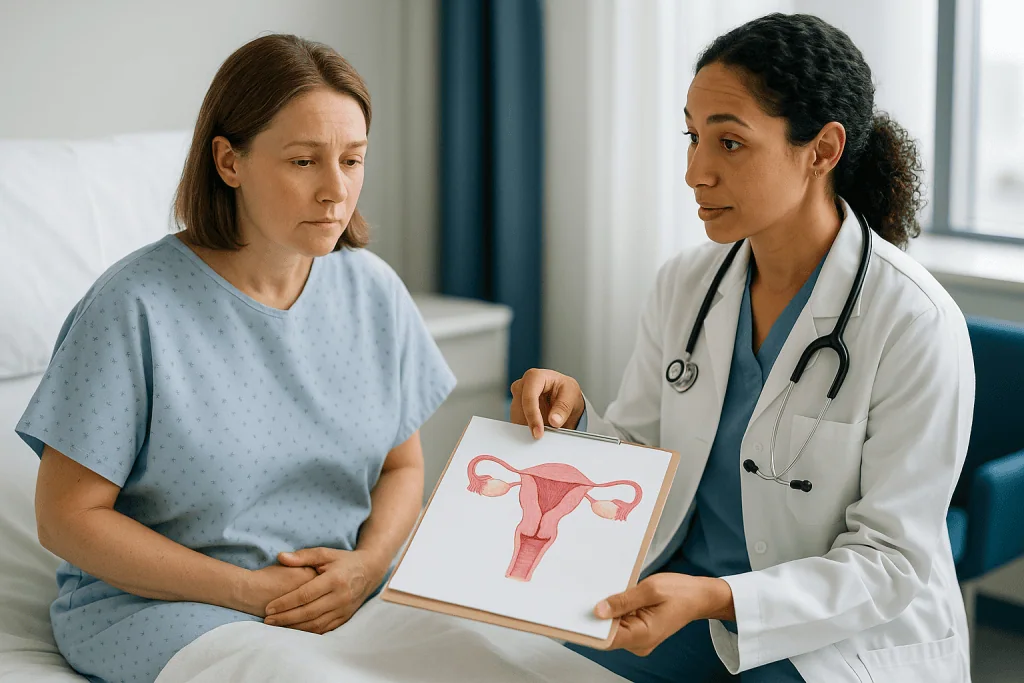
In a vaginal hysterectomy, the surgeon works entirely through the vagina, leaving no external scar. In a laparoscopic hysterectomy, several small cuts in the abdomen admit a camera and slender instruments, and the uterus is removed through the vagina or through one of the small openings. Some surgeons perform this with robotic assistance, which is a way of controlling the same instruments rather than a different operation. In an abdominal hysterectomy, a single larger incision is made, either horizontally along the bikini line or vertically, which gives more room when the uterus is very large or when cancer is being treated. According to the Mayo Clinic, the route is chosen on the basis of the reason for surgery, the size of the uterus, previous operations and the surgeon’s assessment.
Anesthesia is almost always general, meaning you are asleep. The surgeon separates the uterus from the ligaments that hold it in place and from its blood supply, then closes the top of the vagina with stitches that dissolve. Blood vessels that feed fibroids are sealed as part of this, which is why fibroid-related bleeding stops completely.
Length of stay varies with the route. The NHS notes that people typically stay in hospital for up to 5 days, with shorter stays more common after vaginal and laparoscopic approaches and longer stays after abdominal surgery. Before you reach any of this, however, there is usually a long stretch of other treatment, which is where the next sections begin.
Why fibroids and heavy bleeding are the usual starting point
Fibroids are non-cancerous growths of muscle and fibrous tissue in the wall of the uterus. They are extremely common: the NHS estimates that around 1 in 3 women develop them at some point, most often between the ages of 30 and 50. Many never cause symptoms and are found only by chance on a scan. Others cause heavy or prolonged periods, pelvic pressure, a sensation of fullness, frequent urination or pain during sex, depending on where they sit and how large they grow.
Heavy menstrual bleeding deserves a precise definition because people often underestimate it. The NHS describes heavy periods as losing 80 milliliters or more each cycle, bleeding for longer than 7 days, or both. In practice, clinicians ask simpler questions: Do you need to change protection every hour or two? Do you pass clots larger than a coin? Do you bleed through clothes or bedding? Have you been told you are anemic?
Fibroids are only one cause. Adenomyosis, where lining tissue grows into the uterine muscle, hormonal imbalances around perimenopause, polyps, clotting disorders and, less often, cancer of the uterine lining can all produce the same symptom. This is why a work-up usually includes a pelvic examination, blood tests for anemia and sometimes thyroid or clotting function, and an ultrasound. If the lining looks thick or bleeding is unusual for your age, a small biopsy or a camera test called hysteroscopy may be suggested.
The point of all this testing is practical. The right first treatment depends on the cause, and a hysterectomy offered without that groundwork would be a decision made in the dark.
Medicines usually tried first for heavy menstrual bleeding
For heavy bleeding without a dangerous cause, mainstream guidance begins with tablets and devices rather than operating rooms. The medicines fall into a few classes, each working by a different mechanism, and all of them are prescribed and adjusted by your clinician rather than chosen from a list.

Tranexamic acid is a non-hormonal medicine taken only during the days of bleeding. It slows the breakdown of blood clots in the uterine lining, so less blood escapes. It does not change cycle length or affect fertility, which makes it a common early choice for people hoping to conceive.
Non-steroidal anti-inflammatory drugs, the family that includes ibuprofen and naproxen, lower levels of prostaglandins, chemical messengers that drive both cramping and blood flow in the lining. They tend to help pain and bleeding together, though the reduction in bleeding is usually more modest than with hormonal options.
Combined hormonal contraception, whether pill, patch or ring, thins the lining and makes periods lighter and more predictable. Progestogen-only options, including a tablet taken for part of each cycle or an injection, work in a similar way by keeping the lining thin.
GnRH analogues are a different category altogether. They temporarily switch off the ovaries, producing a reversible menopause-like state that shrinks fibroids and stops bleeding. Because they cause hot flashes and bone thinning with prolonged use, the NHS notes they are used for short courses, often to shrink fibroids before surgery or to bridge the years to natural menopause.
The NHS suggests that if a medicine has not helped after about 3 months, a review is sensible. That review, not the calendar alone, is where the conversation may begin to move toward procedures.
The hormonal IUD: why guidelines list it before surgery
If one treatment sits at the front of nearly every heavy-bleeding pathway, it is the levonorgestrel intrauterine system, often simply called the hormonal coil or hormonal IUD. It is a small plastic frame placed inside the uterus that releases a progestogen hormone directly onto the lining.
The mechanism explains its popularity with guideline writers. Because the hormone acts locally, the lining stays thin all month and there is little to shed. Blood levels of the hormone remain low, so many of the side effects associated with tablets are reduced, although spotting and irregular bleeding in the first months are common while the lining adjusts. The NHS notes that it can take up to 6 months for periods to settle into a new pattern, and that for some people they stop altogether.
The device also serves as contraception, lasts for several years once fitted, and is fully reversible: remove it and fertility returns. That combination of effectiveness, reversibility and convenience is why the NHS describes it as a usual first choice for heavy periods when a hormonal option is acceptable.
It is not universal. A uterus distorted by large fibroids may not hold the device in place, and some people prefer not to use hormones at all. Fitting can be uncomfortable, and a small number of devices are expelled in the first months. The decision to try it, and for how long, belongs with your clinician.
Why does this matter for the hysterectomy question? Because a specialist asked to consider surgery will almost always want to know whether this option was tried, declined for a clear reason, or ruled out by anatomy. A documented, fair trial is part of what turns hysterectomy from a possibility into a justified recommendation.
Alternatives to hysterectomy for fibroids: uterus-sparing procedures
When medicines are not enough, there is still a middle ground between tablets and removing the uterus. Three procedures come up most often, and each keeps the uterus in place.
Endometrial ablation destroys the lining of the uterus using heat, cold, radiofrequency energy or microwave energy, usually through the cervix with no cuts. With the lining gone, there is little tissue to bleed. It is a short procedure, often done as a day case, and the NHS lists it as an option for heavy periods when fibroids are small or absent. It is unsuitable for anyone who may want a future pregnancy, because the uterus can no longer support one safely, so reliable contraception is still needed afterwards.
Uterine artery embolization, performed by an interventional radiologist, threads a thin tube through an artery at the wrist or groin and releases tiny particles that block the blood supply to the fibroids. Starved of blood, fibroids shrink over the following months. The NHS describes it as an option for people with fibroids who wish to avoid surgery, with the caveat that its effect on future fertility is uncertain and that cramping pain for several days afterwards is common.
Myomectomy removes the fibroids but leaves the uterus. It can be done hysteroscopically through the cervix for fibroids inside the cavity, laparoscopically, or through an open incision for larger or numerous fibroids. It is the usual choice when pregnancy is still planned. Its main limitation, according to the Mayo Clinic, is that new fibroids can grow and symptoms may return, which is why some people later move on to hysterectomy anyway.
Each of these has its own eligibility criteria, risks and recovery, and a gynecologist will usually discuss which ones genuinely apply to your anatomy before surgery is proposed.
Treatment options compared: a summary table
The sequence from medicine to surgery is easier to see laid out side by side. The table below summarizes the options discussed above in neutral terms, drawing on NHS and Mayo Clinic descriptions. It is a map, not a prescription: which rung applies to you depends on cause, anatomy, fertility plans and preference, and only your treating team can place you on it.
| Option | How it works | Uterus kept? | Future pregnancy possible? | Typical place in pathway |
|---|---|---|---|---|
| Tranexamic acid | Slows clot breakdown in lining during bleeding days | Yes | Yes | Early, non-hormonal |
| NSAIDs | Lower prostaglandins, easing flow and cramps | Yes | Yes | Early, often with pain |
| Combined or progestogen contraception | Keeps lining thin, regulates cycle | Yes | Yes, once stopped | Early, hormonal |
| Hormonal IUD | Local progestogen thins lining for years | Yes | Yes, once removed | Usually first-line hormonal |
| GnRH analogues | Temporarily switch off ovaries, shrink fibroids | Yes | Yes, once stopped | Short courses, often pre-surgery |
| Endometrial ablation | Destroys the lining | Yes | No | After medicines, small or no fibroids |
| Uterine artery embolization | Blocks fibroid blood supply | Yes | Uncertain | After medicines, fibroids present |
| Myomectomy | Removes fibroids surgically | Yes | Often yes | When pregnancy still wanted |
| Hysterectomy | Removes the uterus | No | No | When others fail, unsuitable or declined; cancer |
Two patterns stand out. Everything above the last row preserves the uterus, and most of it is reversible. Hysterectomy is the only option that guarantees an end to uterine bleeding, and the only one that cannot be undone. That asymmetry is the whole reason it usually comes last.
When is hysterectomy considered the right next step, and who is usually asked to wait
Guidelines are more specific than people expect about who moves forward and who is asked to pause. The NHS frames hysterectomy for benign conditions as appropriate when other treatments have been tried without success, cannot be used because of medical reasons or anatomy, or have been fully explained and declined, and when the person does not wish to retain fertility.
Several situations tend to tip the balance toward surgery. Bleeding that keeps causing anemia despite medicines and iron is one. A uterus enlarged by fibroids to the point of pressing on the bladder or bowel is another, particularly when embolization or myomectomy would be impractical because of fibroid number or position. Adenomyosis that has not responded to a hormonal IUD, or endometriosis with pain that persists after other surgery, can also lead here. Cancer of the uterus or cervix, or a precancerous change that cannot be treated more conservatively, sits in its own category where hysterectomy may be the first recommendation rather than the last.
Others are usually asked to wait or to try something else first. Someone who hopes to become pregnant will be steered toward myomectomy or medical treatment, because the operation is irreversible. A person approaching menopause may be offered a bridge, since fibroids commonly shrink and bleeding settles once periods stop, as the Mayo Clinic notes. Anyone with uncontrolled medical conditions that raise anesthetic risk, severe obesity, or a recent clot may be asked to optimize their health first. And someone who has had no trial of a hormonal IUD or medicines, without a clear reason, will often be asked to try that step before surgery is scheduled.
None of this is gatekeeping for its own sake. The goal is to make sure the person reaching the operating table has had every reversible option on the table first.
Can I get a hysterectomy at 30? Age, fertility and the decision
There is no lower age limit written into any major guideline. What exists instead is a heightened duty of care around a decision that cannot be reversed. A person of 30 who has exhausted other treatments for severe fibroids and is certain about not wanting pregnancy can be offered a hysterectomy. The conversations simply tend to be longer and more detailed.
Surgeons raise three concerns with younger patients. Fertility is the obvious one: removal of the uterus ends any possibility of carrying a pregnancy, and feelings about that can change over a lifetime. The second is the ovaries. In most hysterectomies for benign disease, the ovaries are left in place, so hormone production continues and natural menopause arrives at roughly the expected time. The Mayo Clinic notes that removing both ovaries before natural menopause brings on surgical menopause immediately, with implications for bone density, heart health and symptoms, which is why hormone therapy is often discussed in that situation. The third concern is that younger patients have more years ahead in which fibroids might have regressed naturally at menopause, a consideration that carries less weight when symptoms are already severe.
Against those concerns sits the reality of years lost to pain, anemia and planning life around bleeding. Guidelines do not ask younger patients to suffer for the sake of a principle. They ask for a documented trial of alternatives, a clear explanation of permanence, a discussion about the ovaries, and time to reflect.
If you are in this position, it can help to write down what you have tried, how long you tried it and what happened. That record turns an abstract conversation about age into a concrete one about your history, which is what the decision should rest on.
Types of hysterectomy: what female parts are left afterwards
Hysterectomy is a family of operations rather than a single one, and the name tells you which structures are removed. Knowing the vocabulary makes consent forms and clinic letters far less alarming.
A total hysterectomy removes the uterus and the cervix. It is the most common type for both benign and cancerous conditions. A subtotal, or supracervical, hysterectomy removes the body of the uterus but leaves the cervix in place; the NHS notes this is less often performed and that cervical screening must continue afterwards. A radical hysterectomy, used for some cancers, removes the uterus, cervix, the upper part of the vagina and surrounding tissue. When the fallopian tubes are removed as well, the term salpingectomy is added; when the ovaries are also removed, the operation is described as hysterectomy with bilateral salpingo-oophorectomy.
So what remains? After a total hysterectomy with ovaries conserved, you keep both ovaries, which continue to release hormones and eggs until natural menopause, although the eggs are simply absorbed by the body because there is no longer a path to the uterus. The vagina remains, closed at its top with dissolvable stitches; its length is largely unchanged. The vulva, clitoris and pelvic floor muscles are untouched. The bladder and bowel sit where they were, with the space once occupied by the uterus filled by shifting bowel loops.
Many surgeons now suggest removing the fallopian tubes even when the ovaries are kept, because evidence summarized by the Mayo Clinic indicates that some ovarian cancers begin in the tubes and the tubes serve no purpose once the uterus is gone. Whether to keep or remove the ovaries is a separate decision that depends on age, cancer risk and personal preference, and it is one to settle before surgery rather than in the anesthetic room.
Does a hysterectomy mean no period? Hormones and life afterwards
Yes. Periods are the shedding of the uterine lining, and once the uterus is gone there is nothing to shed. This is the one outcome a hysterectomy delivers with certainty, and for someone who has spent years managing heavy bleeding it is often the main reason for choosing surgery.
What happens to hormones depends entirely on the ovaries. If they are conserved, the monthly cycle of estrogen and progesterone continues, which means you may still notice cyclical breast tenderness, mood shifts or bloating even without bleeding. Natural menopause arrives when the ovaries wind down, at roughly the expected age, although the NHS notes that menopause may come a little earlier on average after hysterectomy, possibly because the ovaries’ blood supply is partly disrupted.
If both ovaries are removed, menopause begins immediately. Hot flashes, night sweats, vaginal dryness and sleep disturbance can start within days. For people below the typical age of natural menopause, clinicians usually discuss hormone replacement therapy to protect bone and heart health, and that conversation belongs with the surgical team before the operation.
Sexual function is a frequent, often unspoken, question. Evidence summarized by the Mayo Clinic suggests that for most people treated for benign conditions, sexual function and desire are unchanged or improve once pain and bleeding are gone. Changes are more likely when the ovaries are removed or when the operation was extensive, and vaginal dryness is treatable.
Contraception is no longer needed, and cervical screening stops after a total hysterectomy for benign disease unless previous abnormal results require continued vault smears. Those practicalities are worth confirming at the follow-up appointment, since they vary with the exact operation performed.
What to know before hysterectomy: what the following days and weeks usually look like
Recovery has a rhythm that most people recognize once it is described. The first day or two are about pain control, getting out of bed, passing urine once the catheter is removed and taking the first short walks along a corridor. Early walking is not optional encouragement; it is how clots in the legs are prevented, alongside compression stockings and, for many, a short course of injected blood thinners prescribed by the hospital.
Going home usually happens within a few days. The NHS describes a typical stay of up to 5 days, shorter for vaginal and laparoscopic routes. The first fortnight at home tends to involve tiredness that surprises people, some vaginal bleeding or brownish discharge as the top of the vagina heals, mild constipation and wound soreness. Light activity around the house is encouraged; lifting anything heavier than a kettle, vacuuming and strenuous exercise are discouraged until the abdominal tissues and the vaginal closure have strengthened.
The NHS puts full recovery at around 6–8 weeks for most people, with abdominal surgery at the longer end and laparoscopic or vaginal surgery often quicker. Driving generally waits until you can perform an emergency stop without pain, which the NHS places at roughly 3–8 weeks depending on the route; insurers may have their own rules. Sex and tampon use are usually deferred for at least 4–6 weeks, until the vaginal cuff has healed and any discharge has stopped.
Emotional recovery runs on its own timetable. Relief, grief, or both at once are common in the weeks afterwards, including among people who were completely certain about the decision. A follow-up appointment is usually arranged around 6 weeks, and that is the right place to raise anything that does not feel as expected.
What people often get wrong about hysterectomy
Myths cling to this operation, partly because it was once performed far more readily than it is now. Correcting a few of them changes how the decision feels.
“A hysterectomy always means menopause.” Only if the ovaries are removed. When they are conserved, which is the norm for benign conditions in people below the age of natural menopause, hormone production continues.
“Fibroids will turn into cancer if left alone.” The Mayo Clinic notes that fibroids are almost never cancerous and do not increase the risk of other uterine cancers. A rare cancer called leiomyosarcoma can look similar on a scan, which is why unusual rapid growth is checked, but fibroids themselves are benign.
“Surgery is the only thing that works for heavy bleeding.” The hormonal IUD, tranexamic acid and hormonal contraception control bleeding for many people, and ablation or embolization offer middle options. Hysterectomy is the only guarantee, which is not the same as being the only effective treatment.
“Once you have a hysterectomy you lose your sex drive.” Evidence summarized by major clinics does not support this for benign surgery with ovaries conserved; many report improvement once pain and bleeding are gone.
“You can be back at work in a week.” Some desk-based roles allow an earlier return after laparoscopic surgery, but the NHS frames typical full recovery at 6–8 weeks. Rushing tends to prolong fatigue rather than shorten it.
“Fibroids always need treating.” Fibroids without symptoms usually need nothing more than monitoring, and many shrink after menopause.
“Keeping the cervix preserves sexual function.” Studies cited by the NHS have not shown a consistent benefit, and keeping the cervix means continuing cervical screening.
Questions to ask your care team
A good consultation leaves you with answers rather than a leaflet. These questions are drawn from the points that most often cause regret or confusion afterwards, and they are phrased so you can write the answers down.
- What exactly is causing my bleeding or pain, and how confident are you in that diagnosis?
- Which non-surgical treatments have I tried, for how long, and do you consider each a fair trial?
- Are there uterus-sparing procedures that fit my anatomy, and why are they more or less suitable than hysterectomy?
- If I waited until menopause, what would you expect to happen to my symptoms?
- Which type of hysterectomy are you proposing, and which structures would be removed: uterus, cervix, tubes, ovaries?
- What is your recommendation about my ovaries, and what are the implications for hormones, bone and heart health either way?
- Which surgical route do you propose, and what in my case makes it the right one?
- What are the specific risks for me, including bleeding, infection, injury to the bladder or bowel, clots and reaction to anesthesia?
- How long are you expecting me to be in hospital, and what support will I need at home?
- When can I expect to drive, return to work, exercise and resume sex?
- Will I need cervical screening afterwards?
- What symptoms after surgery should prompt me to call, and who do I call?
- Is there a reason to decide now, or do I have time to think and come back?
That last question is often the most useful. For benign conditions, there is rarely a medical reason for urgency, and clinicians generally welcome a patient who returns a few weeks later with the decision settled rather than one who agrees in the room and doubts it afterwards.
When to call your doctor: red-flag signs before and after surgery
Most of this article is about choices made over months. Some situations are not choices and need prompt contact with a clinician or emergency services.
While living with heavy bleeding, seek urgent care if you are soaking through a pad or tampon every hour for several hours in a row, passing clots the size of a golf ball, or feeling faint, breathless, dizzy on standing or unusually fast-hearted. These can signal blood loss severe enough to need treatment that day. Bleeding after menopause, bleeding between periods that is new for you, or bleeding after sex should always be reported, because they need checking rather than watching.
After a hysterectomy, the NHS and Mayo Clinic advise contacting your care team promptly for:
- Fever or chills, or feeling generally unwell with no clear cause.
- Heavy, bright red vaginal bleeding, or discharge that becomes foul-smelling.
- Increasing rather than easing pain in the abdomen or pelvis, or pain not controlled by the medicines you were given.
- Redness, swelling, warmth, opening or discharge from a wound.
- Burning when passing urine, difficulty passing urine, or inability to open your bowels for several days with bloating or vomiting.
- Pain, swelling or warmth in one calf.
Call emergency services immediately for chest pain, sudden breathlessness, coughing up blood or collapse, since these can indicate a clot that has travelled to the lungs. The same applies to any sudden, severe abdominal pain.
Your discharge paperwork will include a direct number for the ward or surgical team; keep it somewhere visible. If you are unsure whether a symptom matters, that uncertainty is itself a reason to call. Your treating team would far rather hear about something minor than miss something serious, and every decision about what happens next rests with them.
Frequently asked questions
When is it necessary for a hysterectomy rather than optional?
It is closest to necessary when cancer of the uterus or cervix is present, when bleeding cannot be controlled by any other means and threatens health, or when a uterus damaged by severe infection or childbirth complications cannot be saved. For fibroids, heavy bleeding, adenomyosis and endometriosis it is usually a considered choice made after other treatments, not an emergency, and your treating team should explain which category you fall into.
What female parts are left after a hysterectomy?
After a total hysterectomy with ovaries conserved, you keep both ovaries, the vagina, vulva, clitoris and pelvic floor. The uterus and cervix are removed and the top of the vagina is closed. Fallopian tubes are often removed at the same time because they serve no purpose afterwards. If the ovaries are also removed, menopause begins immediately, so the exact plan for your ovaries should be settled before surgery.
Can I get a hysterectomy at 30?
There is no age cut-off in major guidelines. At 30, surgeons will usually want a documented trial of other treatments, a clear understanding that pregnancy will no longer be possible, and a specific discussion about keeping the ovaries to avoid early menopause. If symptoms remain severe after that process and you are certain about fertility, a hysterectomy can be offered. The decision rests with you and your gynecologist together.
Does a hysterectomy mean no period?
Yes. Periods come from the lining of the uterus, so once the uterus is removed there is no bleeding at all. If your ovaries are left in place, hormones continue to cycle, so you may still notice monthly breast tenderness or mood changes without any bleeding. If both ovaries are removed, those cyclical symptoms stop too, and menopausal symptoms begin instead.
What are the main medical reasons for hysterectomy listed by guidelines?
The NHS lists heavy periods, long-term pelvic pain, fibroids, endometriosis, adenomyosis, pelvic inflammatory disease, uterine prolapse and cancer of the uterus, ovaries, fallopian tubes or cervix. For the benign conditions in that list, the operation is usually reserved for people whose symptoms have not responded to other treatment or for whom other treatments are unsuitable, and who do not wish to retain the option of pregnancy.
What are the alternatives to hysterectomy for fibroids?
Options that keep the uterus include a hormonal IUD, tranexamic acid, hormonal contraception and short courses of GnRH analogues to shrink fibroids, followed by procedures such as uterine artery embolization, myomectomy to remove the fibroids, or endometrial ablation when fibroids are small. Which of these fits depends on fibroid size, number and position and on whether you hope to become pregnant, so suitability is assessed individually.
How long does it take to recover after a hysterectomy for heavy bleeding?
The NHS describes full recovery as taking around 6 to 8 weeks for most people, with a hospital stay of up to 5 days. Vaginal and laparoscopic operations tend toward the shorter end and abdominal surgery toward the longer. Tiredness often lasts longer than wound pain. Driving, heavy lifting and sex are usually deferred until your surgical team confirms the tissues have healed, typically several weeks.
Will a hysterectomy cause early menopause if my ovaries are kept?
Not immediately. With the ovaries conserved, hormone production continues and menopause arrives naturally. The NHS notes that menopause may occur somewhat earlier on average after hysterectomy, possibly because surgery slightly reduces blood flow to the ovaries, but this is a shift of months to a few years rather than an abrupt change. Removing both ovaries, by contrast, causes menopause straight away.
Can fibroids come back after treatment that keeps the uterus?
They can. After myomectomy, new fibroids may develop over time and symptoms can return, which the Mayo Clinic notes as the main limitation of that procedure. After embolization, treated fibroids shrink but others may grow. Hysterectomy is the only treatment after which fibroids cannot recur, which is one reason it is sometimes chosen by people who have already had a uterus-sparing procedure.
What should I know before hysterectomy about risks?
As with any major operation, risks include bleeding, infection, blood clots, reaction to anesthesia and injury to nearby organs such as the bladder, bowel or ureters. Longer-term considerations include vaginal cuff healing, possible changes in bladder or bowel function, and earlier menopause if the ovaries are affected or removed. Your surgeon should explain how these apply to your particular route, anatomy and health, and what is done to reduce them.
References
This article is for general information only and is not a substitute for professional medical advice. Please consult a qualified doctor about your individual situation.
Add us as a Preferred Source to see more of our trusted health content across Google Search, AI Overviews and Discover.

More from the Blog

What Does Vaginal Cancer Look Like? Early Signs, How It Can Feel and When to Be Examined
Early vaginal cancer often cannot be seen at all; the first sign is usually bleeding that is not a period, especially after sex or…

Sweat Rash Under the Breast: Why Intertrigo Develops, How It Looks and When to See a Doctor
A sweat rash under the breast is usually intertrigo: inflammation of skin folds where warmth, trapped moisture and skin-on-skin friction break down the surface.…

Questions to Ask Before Ovarian Cyst Surgery: Fertility, the Ovary and Alternatives
Before ovarian cyst surgery, the questions that matter most are whether the cyst can be removed while keeping the ovary (cystectomy) or whether the…

Blisters on the Vulva or Genital Area: Common Causes in Women and Why an Examination Helps
Genital blisters in women are most often caused by herpes simplex virus (HSV), but friction, ingrown hairs, blocked glands, boils, allergic skin reactions and…

Brown Discharge: What It Means Before or After a Period and When to See a Doctor
Brown discharge is usually old blood that has taken longer to leave the uterus, so it has oxidized and darkened. It is common at…

Vaginal Burning: Infection, Irritation, Menopause and Urinary Causes and When to Be Examined
Vaginal burning most often comes from a yeast infection, bacterial vaginosis, an irritant such as a scented wash, falling estrogen around menopause, or a…