

Which Problems Count as a Dental Emergency? Abscess, Broken Teeth and Bleeding Explained
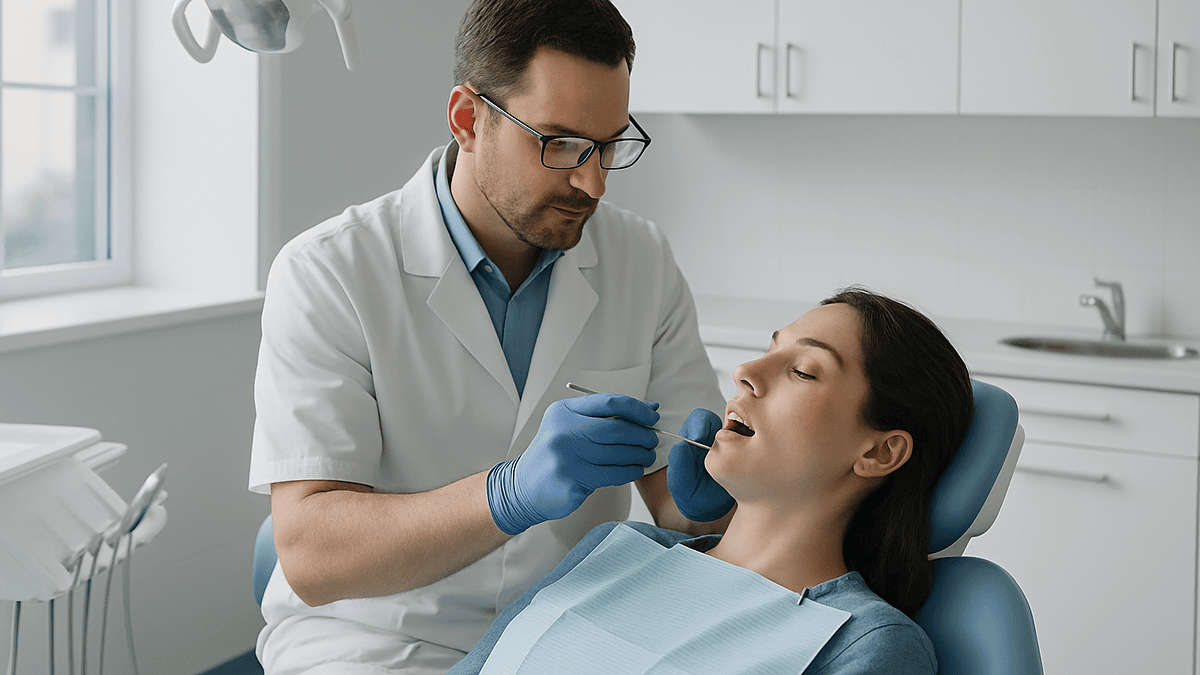
Key Takeaways
- A knocked-out permanent tooth has the best chance of being saved if it is replanted within about 30 minutes, so handle it by the crown and keep it in milk, not water.
- Facial swelling with fever, or any trouble swallowing or breathing, moves a dental infection from the dentist's chair to the emergency department.
- A toothache that suddenly stops can mean the nerve has died while the infection at the root continues, so silence after days of pain is a reason to book, not relax.
- Emergency departments can treat spreading infection, bleeding and jaw fractures, but very few have a dentist on site to fix the tooth itself.
- The so-called 3-3-3 rule for toothache is an internet shorthand for a pain-reliever schedule, not a clinical guideline, and it treats the symptom while the cause worsens.
- Knocked-out baby teeth should not be pushed back into the socket, because doing so can damage the permanent tooth developing underneath.
A dental emergency is any mouth problem that threatens your airway, your life, or a tooth you could otherwise keep: facial swelling with fever or trouble swallowing or breathing, bleeding that will not stop with firm pressure, a permanent tooth knocked out, or a jaw injury. Severe toothache, a spreading abscess and a broken tooth exposing nerve need same-day care. Chips, lost fillings and mild ache are urgent, not emergencies.
It is a quarter past nine on a Sunday night. Your cheek has been puffing up since lunch, the throbbing has moved from one molar to the whole side of your face, and the dentist’s answering machine is offering a Monday morning slot. So you stand in the bathroom, phone in one hand, pressing your jaw with the other, trying to decide: is this the kind of thing you drive to the hospital for, or the kind you sleep off?
Most people never learn the answer until they are in that bathroom. Dental problems sit in an odd gap. Dentists’ offices keep business hours, emergency rooms rarely have a dentist on site, and the mouth can hurt out of all proportion to danger, or feel almost fine while something serious brews under the gum.
Understanding what counts as a dental emergency is not about memorizing a list. It comes down to three questions: is anything blocking your airway, is anything bleeding that should have stopped, and is there a tooth that can only be saved in the next hour?
What counts as a dental emergency, in plain terms
Emergency medicine has a simple habit: it sorts problems by what happens if you wait. Applied to the mouth, that habit produces three tiers rather than one long list.
The top tier is anything that can harm you beyond the tooth. Infection that has spread into the face or neck, with swelling, fever, a stiff or swollen floor of the mouth, or difficulty swallowing or breathing, belongs here. So does bleeding that continues despite firm, sustained pressure, and any blow to the face that may have broken the jaw. Both the NHS and Mayo Clinic direct people with swelling plus fever or breathing and swallowing difficulty to an emergency department rather than waiting for a dental appointment.
The second tier is anything that can cost you a tooth or a night’s sleep. A permanent tooth knocked clean out is the classic example, because the odds of saving it fall steeply after the first hour. A tooth broken deeply enough to expose the soft inner tissue, a toothache severe enough that pain relief does nothing, or an abscess that is painful but still confined to the gum all need to be seen the same day or the next morning.
The third tier is genuinely uncomfortable but stable: a chipped edge, a lost filling or crown, a broken orthodontic wire, a dull ache that comes and goes. These should be seen within days, not weeks, yet they rarely justify a midnight drive.
The word emergency gets stretched by advertising, which is unhelpful when you are the one deciding. Keep the tiers in mind, and the rest of this article walks through how each common problem sorts itself into them.
What actually happens inside a tooth when things go wrong
A tooth is a layered structure, and the layers explain almost everything about pain and urgency.
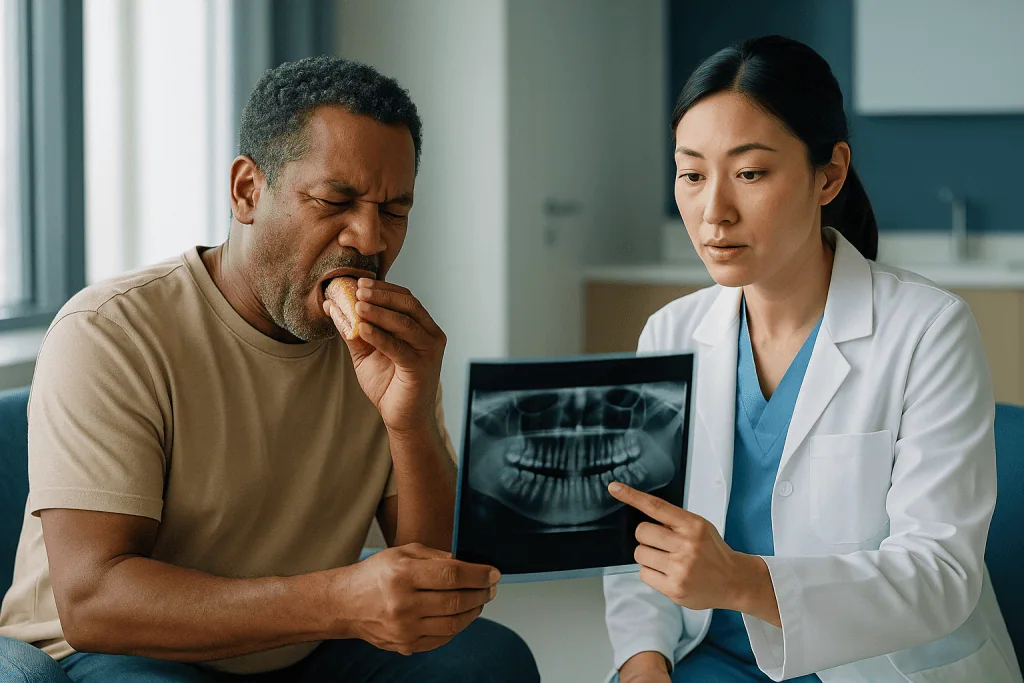
The outer shell is enamel, the hardest substance in the body and, usefully, completely free of nerves. Under it sits dentin, a softer, porous layer riddled with microscopic tubes that connect to the center. At the core lies the pulp: the living tissue of blood vessels and nerve fibers that keeps the tooth nourished and lets you feel temperature. Below the gum, the root anchors into a socket in the jawbone.
A chip that stays within enamel usually feels like nothing at all, which is why a rough edge on the tongue can be the only clue. Once decay or a crack reaches dentin, cold drinks and sweet foods start to sting, because fluid moving through those tiny tubes tugs on nerve endings. When bacteria reach the pulp, the tissue inflames inside a rigid chamber with nowhere to swell, and the result is the deep, pulsing ache people describe as unbearable.
If the pulp dies, pain may vanish for a while. This is the most misleading moment in the whole sequence. Mayo Clinic’s abscess guidance is explicit that the infection does not go away on its own; it continues to spread from the root tip into bone and soft tissue even as the tooth itself falls quiet. That spreading pocket of pus is an abscess.
Bleeding follows its own logic. The mouth is richly supplied with blood vessels and constantly bathed in saliva, which dissolves early clots. Both facts mean mouth wounds look dramatic and take patience to settle, while true uncontrolled bleeding remains uncommon.
Dental abscess: why swelling changes the whole picture
An abscess is a collection of pus caused by bacterial infection, and in dentistry it forms in one of two places: at the tip of a tooth root, usually after decay or a crack lets bacteria into the pulp, or in the gum alongside a tooth, often where gum disease has created a deep pocket.
Early on, an abscess is painful but contained. The tooth may feel tall when you bite, the gum may look red and shiny, and a bad taste can appear if a small channel opens and drains. The NHS advises seeing a dentist as soon as possible for a suspected abscess, and specifically warns against expecting a family doctor to treat it, because the source is the tooth itself and needs dental treatment to resolve.
What turns a painful nuisance into an emergency is spread. Bacteria can track through the soft tissues of the face and neck, producing cellulitis, which is a diffuse infection of the skin and underlying tissue. When that swelling reaches the floor of the mouth or the throat, it can begin to crowd the airway. Mayo Clinic lists fever combined with facial swelling, and any trouble breathing or swallowing, as reasons to go to an emergency room if a dentist cannot be reached.
Signs the infection has stepped up a tier include a firm, spreading swelling rather than a soft local bump, difficulty opening the mouth fully, a muffled voice, drooling because swallowing hurts, and feeling generally unwell with chills. Rarely, an untreated dental infection can spread to the bloodstream, a condition called sepsis, which is life-threatening.
The treatment principle is drainage plus removal of the source, whether that is a root canal or extraction. Antibiotics, which work by killing bacteria or halting their growth, are an adjunct the dentist may add when infection has spread; on their own they do not fix the tooth.
Broken, cracked and chipped teeth: which ones need same-day care
Not every break is equal, and the layers of the tooth tell you which tier you are in.
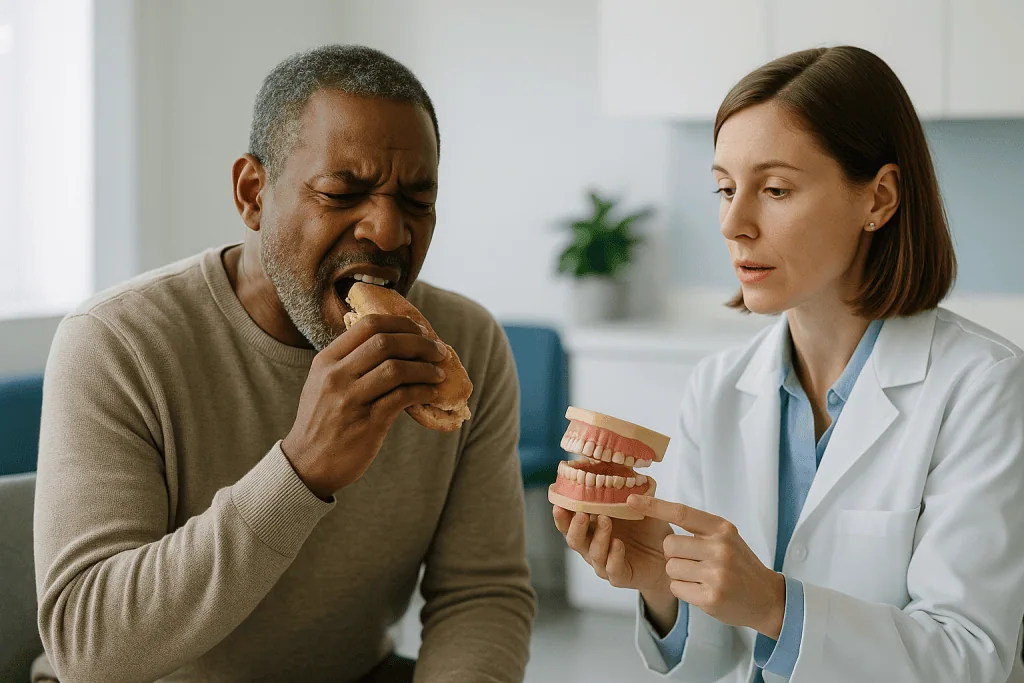
A chip confined to enamel is a cosmetic and comfort problem. The edge may scrape your tongue or cheek, and the NHS suggests covering a sharp point temporarily with sugar-free chewing gum or dental wax until you can be seen. An appointment within days is reasonable; a midnight visit is not.
A fracture that reaches dentin brings sensitivity to cold and sweet foods. It still usually falls into the urgent rather than emergency tier, because the pulp is not yet exposed, but the tooth is now vulnerable to bacteria and to further cracking under chewing forces. Sooner is better.
A break that exposes the pulp is different. You may see a pink or red spot in the center of the fracture, or a bleeding point, and the pain tends to be sharp and constant rather than triggered. MedlinePlus advises seeing a dentist promptly for a broken tooth with pain, both to protect the exposed tissue and to preserve the option of saving the tooth. If the tooth is also loose or pushed out of position, the same-day threshold is clearly met.
A cracked tooth that has not visibly broken can be the most puzzling. The classic sign is a brief, sharp pain on releasing a bite rather than on biting down, because the crack momentarily opens and closes. This needs a dental assessment within days, since cracks that run below the gum line can make a tooth unsaveable.
If you find the broken fragment, keep it moist in milk or saliva and bring it along; sometimes it can be bonded back. Rinse the mouth gently with warm water, and avoid chewing on that side.
Knocked-out tooth: the emergency that runs on a clock
Of every dental problem, this is the one where minutes genuinely matter, and where what you do at the roadside or the playground can decide whether the tooth survives.
When a permanent tooth is knocked out, the fibers that anchored it to the socket remain alive on the root surface for a short time. MedlinePlus and Mayo Clinic’s first-aid guidance both put the best chance of saving the tooth within about 30 minutes, with odds falling as the hour passes. Beyond that window, replantation can still be attempted, but long-term success becomes less likely.
The steps are the same across mainstream first-aid guidance:
- Pick the tooth up by the crown, the white part you normally see. Do not touch the root.
- If it is dirty, rinse briefly under water or with milk. Do not scrub, and do not wrap it in tissue, which dries the root.
- If the person is calm and conscious, try to place it back in the socket the right way round and hold it there with gentle bite pressure on a clean cloth.
- If that is not possible, keep the tooth in milk, in saliva inside the cheek if the person is old enough not to swallow it, or in a tooth-preservation solution if one is at hand. Plain water is the poorest option because it damages the root cells.
- Get to a dentist or emergency department straight away.
Baby teeth are the exception. MedlinePlus advises against replanting a knocked-out primary tooth, because forcing it back can damage the permanent tooth developing underneath. A dentist should still check the mouth for fragments and other injuries.
A tooth pushed sideways or partly out of the socket, rather than fully out, is also a same-day emergency, and should not be wiggled back by an untrained hand.
Bleeding in the mouth: after an extraction, after an injury, or out of nowhere
Mouth bleeding alarms people partly because saliva spreads a small amount of blood into a large pink pool. Sorting real emergencies from frightening-looking ones comes down to context and response to pressure.
After a tooth extraction, some oozing over the first day is expected. A clot forms in the socket, and that clot is the wound’s only dressing. The standard advice from dental first-aid sources is to bite firmly on a clean gauze pad or folded cloth placed directly over the socket, keeping steady pressure rather than checking every minute, and to avoid rinsing, spitting, smoking or drinking through a straw, all of which can dislodge the clot. Bleeding that soaks through pad after pad, that restarts heavily after settling, or that comes with dizziness or faintness, needs a same-day call to the dentist who did the procedure or, if they cannot be reached, an emergency department.
Bleeding after an injury follows the same rule: firm pressure first. A cut to the lip, tongue or inner cheek often looks worse than it is, but a deep laceration that gapes, one that crosses the border of the lip, or one that keeps bleeding despite pressure may need stitching.
Bleeding without any injury or procedure is a different signal. Gums that bleed when brushing usually point to gum inflammation and belong at a routine dental visit. Spontaneous bleeding that will not stop, easy bruising elsewhere, or bleeding in someone taking blood-thinning medicines, which work by slowing the body’s clotting process, deserves prompt medical assessment. Never stop or adjust a prescribed anticoagulant because of a mouth bleed; tell the dentist and the prescribing clinician and let them coordinate.
The red line is simple: bleeding that continues despite sustained firm pressure is an emergency wherever it is coming from.
Emergency, urgent or routine: a triage table
The table below gathers the common scenarios into the three tiers described earlier. It is a guide for deciding where to go tonight, not a substitute for the judgment of the clinician who examines you.
| What you notice | Tier | Where to go | What to do meanwhile |
|---|---|---|---|
| Facial or neck swelling with fever, trouble swallowing or breathing, or difficulty opening the mouth | Emergency | Emergency department now | Sit upright; do not lie flat |
| Bleeding that continues despite firm sustained pressure | Emergency | Emergency department now | Keep pressing with clean gauze |
| Suspected broken jaw after a blow to the face | Emergency | Emergency department now | Support jaw gently; nothing by mouth |
| Permanent tooth knocked out | Emergency | Dentist or ED within the hour | Replant or keep in milk |
| Tooth broken with exposed pulp, or loose or displaced after injury | Same day | Dentist today, out-of-hours service if needed | Keep fragment moist; avoid chewing on it |
| Severe toothache unrelieved by over-the-counter pain relief | Same day | Dentist today or next morning | Cold compress on cheek |
| Painful localized gum swelling without fever | Same day or next day | Dentist | Warm salt-water rinses |
| Lost filling or crown, chipped enamel, broken brace wire | Urgent, within days | Dentist appointment | Cover sharp edges with dental wax |
| Mild intermittent ache, bleeding gums when brushing | Routine | Next available dental visit | Keep brushing gently |
Two patterns are worth pausing on. First, the emergency-department tier is driven almost entirely by airway, bleeding and bone, not by how much a tooth hurts. Second, the knocked-out tooth is the only item where an ordinary dental office and an emergency department are equally valid first stops, because speed matters more than setting.
When in doubt between two tiers, telephone first. Most dental practices operate an out-of-hours line or a recorded message directing callers to an on-call service, and a brief conversation often settles the question.
What qualifies for an emergency dentist, and who is usually asked to wait
Dental practices and out-of-hours services use triage much as hospitals do, and it helps to know what the person on the phone is listening for.
Callers moved to the front of the queue typically describe one of the following: swelling that is growing or affecting the eye, throat or floor of the mouth; a tooth knocked out or displaced; bleeding that has not stopped with pressure; a fracture with visible pulp or a tooth that moves; or pain that has kept them awake, is not touched by over-the-counter medicine, and is spreading to the ear or jaw. Trauma to the face in a child, especially involving the front teeth, is also prioritized.
Callers usually asked to wait a day or two, or to book the next routine slot, include those with a lost filling or crown without pain, a chipped edge, a loose denture or retainer, a broken orthodontic wire that can be covered, mild sensitivity, and gums that bleed on brushing. None of these are trivial, and each is a reason to be seen soon; they are simply not problems that worsen meaningfully overnight.
Some groups tip the balance toward being seen sooner even with milder symptoms. People with weakened immune systems, whether from illness or from medicines that suppress immunity, can have infections that spread faster and present with less obvious swelling. People with diabetes, those who have had radiotherapy to the head and neck, and those taking medicines that affect bone healing or blood clotting are commonly asked to mention this at the start of the call so the triage can account for it.
The decision about where you fall always rests with the clinician who assesses you, and honesty on the phone helps them get it right. A calm, specific description, such as when it started, what makes it worse, whether you have a fever, is far more useful than a plea for urgency.
Going to the ER for tooth pain: what the emergency room can and cannot do
People arrive at emergency departments with tooth pain far more often than emergency physicians would like, and it is worth understanding why the visit so often ends in frustration on both sides.
Emergency departments treat threats to life and limb. For dental problems, that means they are well equipped to manage the emergency tier: spreading infection, airway compromise, uncontrolled bleeding and facial fractures. A physician can assess the swelling, order imaging if a deep neck infection or jaw fracture is suspected, start intravenous antibiotics where infection has spread beyond the mouth, drain a large abscess, and admit a patient whose airway is at risk. That is exactly what the NHS and Mayo Clinic guidance intends when it points people with fever, swelling and swallowing or breathing difficulty toward the hospital.
What most emergency departments cannot do is fix the tooth. Very few have a dentist on staff, and physicians are not trained or equipped to perform root canals, place fillings or extract teeth in most settings. For the person with severe pain from a decayed tooth but no swelling or fever, the visit typically results in pain management, sometimes a prescription for an antibiotic if infection is suspected, and firm advice to see a dentist as soon as possible. The underlying problem is still there the next morning.
This is not a reason to avoid the emergency department when red flags are present. Swelling that is closing the throat is a hospital problem, full stop. It is a reason to spend two minutes on the phone first when the problem is pain alone, because an out-of-hours dental service can often see you sooner, treat the cause, and spare you a long wait.
If you do go, bring a list of your medicines and allergies, and tell the staff about any bleeding disorders, immune conditions or recent dental work.
Is a rotten tooth a dental emergency?
A decayed tooth, the one that has been quietly crumbling for months, occupies a gray zone that catches many people out.
Decay itself is not an emergency. Tooth decay is a slow process in which acids produced by bacteria dissolve enamel and then dentin over months or years. A tooth with a visible hole, a dark spot or a jagged broken-down edge, but no pain, no swelling and no fever, belongs in the urgent tier: it needs a dental appointment soon, because untreated decay keeps advancing and eventually reaches the pulp, but it does not need to be seen tonight.
The moment decay changes tier is the moment it produces symptoms that signal pulp involvement or infection. Pain that wakes you, throbbing that spreads to the jaw or ear, a tooth that hurts to bite on, a bad taste, a bump on the gum or any facial swelling all indicate that bacteria have moved from the hard tissue into the living tissue and beyond. At that point the same rules apply as for any abscess: same-day dental care for local pain and swelling, an emergency department for spreading swelling with fever or difficulty swallowing.
A subtle trap deserves attention. A badly decayed tooth that once hurt and then stopped is not a tooth that has healed. Mayo Clinic notes that when the pulp dies, pain may ease while infection continues at the root tip. Silence after weeks of ache is a reason to book, not to relax.
Fragments of a rotten tooth breaking away can also leave sharp edges that cut the tongue, and a decayed tooth is weaker under chewing forces, so sudden fracture is more likely. Neither is dangerous in itself, but both are reasons to move the appointment up.
What the dentist can offer depends on how much sound tooth remains: a filling, a crown, a root canal, or extraction. That decision, like all of them, sits with the clinician examining the tooth.
What treatment for a dental emergency usually involves
Knowing what is likely to happen once you arrive takes some of the dread out of the journey.
Every visit starts with a history and examination. Expect questions about when the problem began, what triggers the pain, whether you have a fever, what medicines you take and any allergies. The clinician will look at the tooth, the gums, the face and neck, and will often take an X-ray, because the crucial question of how far infection has reached into bone or how deep a fracture runs cannot be answered by looking alone.
For an abscess, the priority is drainage. A dentist may open the tooth to release pressure from the pulp chamber, make a small incision in a swollen gum to let pus escape, or both. Local anesthetic, a medicine injected near the nerve to block pain signals temporarily, is used for all of this. Definitive treatment is either a root canal, which removes the infected pulp and seals the root, or extraction. Which one is offered depends on how much of the tooth can be saved, and that is a conversation to have with the dentist rather than something to decide in advance. Antibiotics are added when infection has spread or the person is medically vulnerable, not as a routine.
For a broken tooth, treatment ranges from smoothing an edge, through a bonded filling or temporary crown, to protecting an exposed pulp with a medicated dressing while the tooth’s fate is assessed.
For a knocked-out or displaced tooth, the dentist repositions it and splints it, meaning it is bonded to neighboring teeth with a thin wire or composite for a period of weeks so the socket can heal around it. A root canal is often needed later because the blood supply to the pulp rarely survives.
For bleeding, the dentist may pack the socket with a clotting dressing and place a stitch or two.
What the following days and weeks usually look like
Emergency dental care is very often the first chapter rather than the whole story, and the recovery period follows a fairly predictable arc.
In the first day or two after drainage of an abscess or an extraction, some soreness, mild swelling and a little oozing are expected. If antibiotics were prescribed, improvement in swelling and fever is usually noticeable within a couple of days as the bacterial load falls; if instead the swelling is spreading, the fever is climbing or swallowing is getting harder, that is a reason to call back the same day rather than finish the course and hope. Any decision about the antibiotic, including whether to stop early or switch, belongs to the prescriber.
Over the first week, a socket fills with a clot and then with soft healing tissue. Warm salt-water rinses after meals, gentle brushing that avoids the wound, and soft food that does not need chewing on that side are the standard advice from dental first-aid sources. Smoking slows healing and raises the risk of the clot dislodging, leaving a painful exposed socket.
Over the following weeks, follow-up appointments do the definitive work: completing a root canal that was started under pressure, fitting a permanent crown where a temporary one was placed, or removing a splint from a replanted tooth once the ligament has reattached. A replanted or displaced tooth typically stays splinted for a period of a few weeks, with the exact timing set by the dentist based on the injury.
Over months, the dentist watches for late complications. A tooth that suffered trauma can lose its blood supply quietly and darken or develop an abscess long after the injury, which is why a follow-up X-ray is often scheduled even when everything feels fine.
The pattern to hold onto: pain and swelling should trend downward day by day. A plateau is worth a call; a reversal is worth a same-day call.
What people often get wrong, including the 3-3-3 rule for toothache
Some of the most stubborn beliefs about dental emergencies are exactly backwards.
“The pain stopped, so it fixed itself.” A tooth that throbbed for days and then went quiet has often lost its pulp, not its problem. The infection at the root tip continues, and the next symptom may be facial swelling.
“Antibiotics will sort out an abscess.” Antibiotics slow bacteria in the surrounding tissue, but pus inside a rigid tooth or bony pocket has no blood supply for the medicine to reach. Without drainage and treatment of the tooth, the abscess returns. Repeated courses without dental treatment also drive antibiotic resistance.
“Put aspirin on the gum.” Placing a tablet against the gum does not deliver pain relief to the nerve and can chemically burn the soft tissue. Pain relievers work when swallowed, not when applied topically.
“The 3-3-3 rule.” This phrase circulates online as a shorthand for taking a common over-the-counter anti-inflammatory a fixed number of times a day for a fixed number of days. It is not a clinical guideline and does not appear in any mainstream dental or medical guidance. Two problems: the numbers are a one-size-fits-all schedule that ignores body weight, kidney function, stomach history and other medicines, and anti-inflammatories treat the symptom while the infection or fracture continues underneath. Follow the label or your pharmacist’s advice for pain, and treat pain lasting more than a day or two, the threshold both the NHS and Mayo Clinic use, as a reason to book, not to keep dosing.
“Scrub the knocked-out tooth clean.” Scrubbing strips the living cells on the root that make replantation possible. A gentle rinse is the limit.
“Bleeding gums are normal.” They are common, but they signal inflammation, and inflammation is the beginning of gum disease.
“A chipped tooth can wait until it hurts.” Enamel does not grow back, and a chip is an open door for decay and further cracking. Soon is better than eventually.
Questions to ask your care team
Emergency visits are rushed, and it is easy to leave with a numb mouth and no clear picture of what was done or what comes next. Writing questions down beforehand, or asking a companion to take notes, makes a real difference.
- What exactly is the diagnosis, and how far has the infection or fracture reached?
- Was this a temporary measure or definitive treatment, and if temporary, when does the definitive step need to happen?
- Can this tooth be saved, and what would each option, such as root canal, crown or extraction, involve for me?
- If antibiotics were prescribed, why were they needed in my case, and what should I do if I am not improving?
- What signs over the next few days would mean I should come back or go to the hospital?
- What can I eat and drink, and when can I brush normally around the area?
- Do any of my regular medicines, especially blood thinners or immune-suppressing medicines, change my aftercare?
- If a tooth was replanted or splinted, how long is the splint expected to stay, and what follow-up is planned?
- Who do I call out of hours if something changes tonight?
- Is there anything about my mouth that makes another emergency likely, and what would reduce that risk?
Two questions deserve emphasis. Asking whether treatment was temporary or definitive prevents the common scenario of a drained abscess that is never followed by root canal or extraction, and then flares months later. Asking what would prompt a return visit turns vague worry into a concrete plan, which is easier to act on at two in the morning.
None of these questions second-guess the clinician; they help the two of you make the decisions together, which is where every treatment decision should sit.
When to call your doctor
Most dental problems belong with a dentist, but some signs mean the problem has stopped being purely dental and needs medical care without delay. Go to an emergency department, or call emergency services, if you notice any of the following:
- Swelling of the face, jaw or neck that is spreading, especially if it involves the eye, the floor of the mouth or the throat
- Difficulty breathing, difficulty swallowing, drooling because swallowing hurts, or a voice that has become muffled
- Fever with facial swelling, or fever with chills and feeling very unwell
- Inability to open the mouth more than a finger’s width
- Bleeding that continues despite firm, sustained pressure, or bleeding with dizziness or fainting
- A blow to the face that leaves the teeth not meeting properly, the jaw unable to close, or numbness of the chin or lip
- Confusion, a racing heartbeat or cold, clammy skin alongside a dental infection, which can signal sepsis
Call a dentist the same day, using an out-of-hours line if needed, for a permanent tooth knocked out or displaced, a fracture with exposed pulp, a painful localized swelling, or toothache that pain relief does not touch. The NHS and Mayo Clinic both advise a dental appointment for any toothache lasting longer than one to two days, even when it is mild.
Contact your regular doctor or prescribing clinician, in addition to the dentist, if you take blood-thinning or immune-suppressing medicines, have diabetes, or have had radiotherapy to the head or neck, because these change how infections and wounds behave and how your care should be coordinated.
Uncertainty itself is a reason to phone. A short conversation with a triage nurse or on-call dentist costs nothing but a few minutes and is exactly what those services exist for. The final judgment about where and how you are treated rests with the clinicians who see you.
Frequently asked questions
What qualifies for an emergency dentist appointment?
Same-day dental care is usually reserved for a permanent tooth knocked out or displaced, a broken tooth with exposed pulp, painful swelling of the gum or face, bleeding that will not settle with pressure, and severe toothache that over-the-counter pain relief does not touch. Chips, lost fillings or crowns without pain, and mild sensitivity are urgent but typically wait a day or two. The triage clinician makes the final call based on your description.
What is the 3-3-3 rule for toothache, and should I follow it?
The 3-3-3 rule is an informal phrase circulating online for taking a common over-the-counter anti-inflammatory on a fixed schedule for several days. It is not a medical or dental guideline. Fixed schedules ignore individual factors such as kidney function, stomach history and other medicines, and pain relief does nothing for the infection or fracture underneath. Follow the product label or a pharmacist’s advice, and see a dentist if pain lasts more than a day or two.
What will the ER do for unbearable tooth pain?
An emergency department can assess for spreading infection, order imaging, give pain relief and, where infection is suspected, prescribe antibiotics. It can drain a large abscess and admit someone whose airway is threatened. What it usually cannot do is treat the tooth, because most emergency departments have no dentist on staff. Unless you have swelling, fever or difficulty swallowing, an out-of-hours dental service will often help faster.
Is a rotten tooth a dental emergency?
Not by itself. A decayed tooth without pain, swelling or fever is urgent and should be seen within days, because decay keeps advancing toward the nerve. It becomes a same-day problem when it causes throbbing pain, a gum bump, a bad taste or facial swelling, all of which suggest infection has reached the pulp or beyond. Swelling with fever or trouble swallowing is an emergency-department problem.
How long can a knocked-out tooth survive outside the mouth?
The best chance of saving a permanent tooth is replanting it within about 30 minutes, according to MedlinePlus and Mayo Clinic first-aid guidance, with odds falling as the first hour passes. Keeping the tooth moist in milk or in the cheek, and never letting the root dry or get scrubbed, extends that window somewhat. Get to a dentist or emergency department immediately either way.
Can a dental abscess go away on its own?
No. Mayo Clinic is clear that a tooth abscess will not resolve without treatment. The pain may ease if the nerve inside the tooth dies, but the infection at the root tip continues and can spread into the jaw, face and neck. Treatment involves draining the pus and dealing with the source through a root canal or extraction, with antibiotics added only when infection has spread or the person is medically vulnerable.
How do I stop bleeding after a tooth extraction at home?
Place a clean gauze pad or folded cloth directly over the socket and bite down with firm, steady pressure, resisting the urge to check every minute. Avoid rinsing, spitting, smoking or drinking through a straw, because these dislodge the clot that seals the wound. Light oozing on the first day is expected. Bleeding that soaks through repeated pads, restarts heavily or comes with dizziness needs a same-day call.
Is a chipped tooth a dental emergency?
Usually not. A chip confined to the enamel causes little or no pain and can be seen within days; a sharp edge can be covered temporarily with dental wax or sugar-free gum. It becomes a same-day matter if the break is deep enough to expose the pink pulp, if the tooth is loose or moved, or if pain is constant rather than triggered by cold or sweet foods.
Should a knocked-out baby tooth be put back in?
No. MedlinePlus advises against replanting a knocked-out primary tooth, because pushing it back into the socket can injure the permanent tooth forming underneath. Control any bleeding with gentle pressure, keep the tooth so the dentist can confirm it came out whole, and arrange a prompt dental check to look for fragments, other injuries and damage to neighboring teeth.
What are the warning signs that a tooth infection is spreading?
Swelling that is growing or firm rather than a soft local bump, swelling near the eye or under the jaw, fever, difficulty opening the mouth, trouble swallowing, drooling, a muffled voice and feeling generally unwell with chills all suggest infection has moved beyond the tooth. These are reasons to go to an emergency department rather than wait for a dental appointment, according to NHS and Mayo Clinic guidance.
References
- NHS – Dental abscess
- NHS – Toothache
- MedlinePlus – Tooth: broken or knocked out
- Cleveland Clinic – Abscessed tooth
This article is for general information only and is not a substitute for professional medical advice. Please consult a qualified doctor about your individual situation.

More from the Blog
Composite Bonding Results: Blending With Natural Teeth and What the Resin Cannot Change
Composite bonding results depend on how carefully tooth-colored resin is shade-matched, layered, and polished onto natural enamel; done well, it can disguise small chips,…
After Dental Trauma Care: Splints, Follow-Up Visits and How the Tooth Is Monitored
Dental trauma recovery usually involves a flexible splint worn for about two to four weeks depending on the injury, a soft diet, careful hygiene…

Who Is a Candidate for Laser Dentistry? Gums, Small Cavities and Sensitivity Explained
Laser dentistry candidates are usually adults and older children who need gum treatment (deep-pocket cleaning, reshaping, small soft-tissue procedures), have small or early cavities…

Broken Bracket or Poking Wire: Metal Braces Problems and When to Call the Orthodontist
If a bracket breaks or comes loose, the usual first step is to leave it in place, cover any sharp edge with orthodontic wax,…

How Gingival Aesthetics Is Performed: Mapping the Gum Line, Reshaping and Final Checks
A gum contouring procedure reshapes the edge of the gums so the teeth look longer, more even or better proportioned. The dentist or periodontist…

Recovering From Impacted Tooth Surgery: Swelling, Limited Mouth Opening and Soft Foods
Recovery from impacted tooth surgery usually takes up to two weeks, according to the NHS. Swelling of the cheek tends to peak around the…