

Who Is a Candidate for Laser Dentistry? Gums, Small Cavities and Sensitivity Explained

Key Takeaways
- Soft-tissue lasers absorb into water and blood, which is why gum procedures often bleed less and frequently need no sutures.
- Lasers cannot be used on teeth that already contain fillings, cannot reach decay between teeth and are not used to prepare crowns.
- About 42% of US adults aged 30 and older have some periodontitis, and lasers are an optional adjunct to, never a replacement for, scaling and root planing.
- Healthy gum pockets measure roughly 1–3 mm; pockets deeper than 4 mm may indicate periodontitis and are the ones re-measured to judge treatment.
- Evidence for laser desensitization of sensitive teeth is preliminary and short-term, so it belongs alongside first-line measures rather than replacing them.
- A whitish film over a laser-treated gum area in the first days is normal healing tissue and should not be scrubbed away.
Laser dentistry candidates are usually adults and older children who need gum treatment (deep-pocket cleaning, reshaping, small soft-tissue procedures), have small or early cavities in accessible spots, or have mild tooth sensitivity, and who have no conditions that make tissue healing unusually risky. Large deep cavities, teeth with metal fillings and some medical conditions may point toward conventional tools instead. Your dental team decides after an exam.
The receptionist asks a simple question over the phone: ‘Would you like to be seen by the dentist who uses the laser?’ You have a sore, puffy patch of gum behind a lower molar and a small dark spot on a front tooth the hygienist flagged last time. Suddenly you are weighing something you never expected to think about on a Tuesday morning.
Laser dentistry candidates are not chosen by enthusiasm for gadgets. They are chosen by tooth anatomy, tissue type, how far a problem has progressed and a handful of medical factors that have nothing to do with the mouth. The laser is one tool on a tray that still holds a drill, a scaler and a scalpel, and a thoughtful clinician reaches for whichever one fits the job.
This explainer walks through the three situations people ask about most, gums, small cavities and sensitivity, and lays out honestly where the evidence is solid, where it is thin and what the decision really rests on.
How laser dentistry works: light meets water, blood and mineral
A dental laser is a device that produces a single, tightly focused wavelength of light. Wavelength simply means the color of the light, including colors the eye cannot see, and each wavelength is absorbed by different substances. Some are soaked up by water and hemoglobin, the red pigment in blood. Others are absorbed by hydroxyapatite, the calcium mineral that makes up enamel and dentin. That absorption is the whole trick: where the light lands, energy is deposited, and tissue either vaporizes, coagulates or is gently removed layer by layer.
Soft-tissue lasers, often diode devices, target water and blood. They cut gum tissue and seal small blood vessels almost simultaneously, which is why bleeding during gum procedures is frequently reduced. Hard-tissue lasers, typically erbium-based, pulse energy into the water trapped inside tooth structure. The water flashes to steam and micro-fragments of enamel or dentin lift away, usually alongside a fine spray of cooling water. Cleveland Clinic’s overview describes these two families and notes that some devices are cleared for both soft and hard tissue work.
Two things follow from the physics. First, because the laser only affects what absorbs its wavelength, a well-chosen device can remove decayed, water-rich dentin while leaving harder, healthier tooth relatively untouched. Second, because there is no rotating bur, there is no vibration transmitted through the jaw, which many people find the most unpleasant part of a filling.
None of this makes the laser magic. It still requires a steady hand, correct settings for the tissue in question and eye protection for everyone in the room. What it changes is how tissue is removed, not whether it needs removing.
Who is a good candidate for laser dentistry?
The most common laser dentistry candidates fall into three overlapping groups, and it helps to see them together before drilling into each one.

- People with gum problems that need tissue work. This includes inflamed gum pockets being cleaned as part of periodontal therapy, excess gum tissue that needs reshaping around a crown, and small soft-tissue procedures such as releasing a tight band of tissue under the tongue or lip. Soft-tissue lasers are best established here.
- People with small, early cavities in reachable places. Erbium lasers can remove decay from enamel and dentin. They work best on shallow lesions on chewing surfaces or smooth surfaces where the dentist can see and aim directly.
- People with mild dentin sensitivity. Some low-power laser protocols are used to reduce the sharp twinge triggered by cold or sweet foods, usually alongside conventional desensitizing approaches.
Beyond the dental picture, a good candidate is someone whose general health supports normal healing, who can sit still with protective eyewear in place and who understands that the laser is a method rather than a guarantee. Children and adults with dental anxiety are often mentioned, because the absence of drill noise and vibration can make a visit less stressful, and because some soft-tissue procedures can be done with less or no injected anesthetic.
Notice what is not on the list. Being ‘a good candidate’ does not mean the laser will produce a better long-term result than conventional treatment. Mayo Clinic’s periodontitis guidance lists lasers among tools a dentist may use during scaling and root planing, the deep cleaning of tooth roots, without ranking it above hand or ultrasonic instruments. Candidacy is about fit, not superiority.
Who is usually asked to wait, or offered another approach
Some people are steered away from a laser for entirely sensible reasons, and knowing them in advance saves disappointment.
Deep or extensive cavities. Once decay has spread widely under enamel or approaches the pulp, the living center of the tooth containing nerves and blood vessels, a conventional handpiece removes bulk faster and lets the dentist feel the texture of remaining tooth. Cleveland Clinic notes that lasers cannot be used on teeth that already contain fillings, because the light interacts unpredictably with metal and composite materials.
Cavities between teeth or under old restorations. A laser is a line-of-sight instrument. If the dentist cannot aim the tip directly at the decay, it is the wrong tool.
Crowns, bridges and inlays. Preparing a tooth for a crown requires precise, smooth shaping over a large area, which remains the domain of rotary instruments.
Certain medical situations. Uncontrolled diabetes, active cancer treatment, some blood-thinning regimens and conditions affecting immune function slow healing after any gum procedure, laser or not. Pregnancy is often a reason to postpone elective gum surgery of any kind until after delivery, not because lasers are specifically harmful but because elective procedures are commonly deferred. Your dental team will ask about your medical history and may consult your physician before proceeding.
Anyone who cannot protect their eyes. Very young children or people unable to keep protective glasses on may be better served by other approaches.
Being asked to wait is a clinical judgment, not a rejection. It usually means the conventional route offers a more predictable outcome for your specific tooth or gum situation.
Laser dentistry for gum disease: pockets, reshaping and small surgeries
Gum disease is where lasers have their longest track record. Two terms matter. Gingivitis is early, reversible gum inflammation with redness and bleeding on brushing. Periodontitis is the later stage in which infection destroys the bone and fibers anchoring a tooth, creating deepening ‘pockets’ between gum and root. According to NIH’s National Institute of Dental and Craniofacial Research, about 42% of US adults aged 30 and older have some periodontitis, so this is not a niche question.
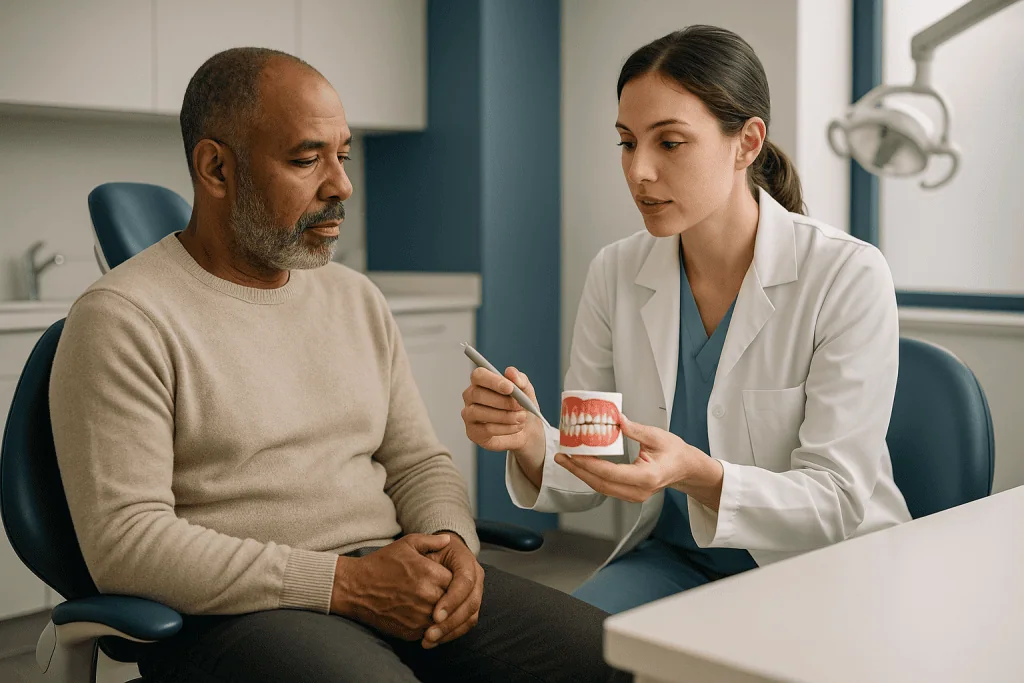
Healthy pockets measure roughly 1–3 mm when probed; Mayo Clinic notes that pockets deeper than 4 mm may indicate periodontitis. The core treatment remains scaling and root planing, physically removing hardened plaque and bacterial deposits from the root surface below the gumline. Where lasers enter is as an adjunct: a soft-tissue laser can remove the inflamed inner lining of the pocket and reduce bacteria on the tissue side, while hand or ultrasonic instruments still clean the root.
What does the evidence actually show? Systematic reviews of lasers added to conventional periodontal therapy have generally reported small or inconsistent additional improvements in pocket depth and attachment, with study quality often limited. Mainstream guidance from Mayo Clinic and the NHS therefore lists lasers as an option some dentists use, not as a required or clearly superior step. A candidate for laser periodontal care is someone already committed to the full program: deep cleaning, better daily plaque control and regular maintenance visits.
Lasers are more firmly established for smaller soft-tissue jobs. Gingivectomy, the removal of excess or overgrown gum tissue, and frenectomy, releasing the small fold of tissue that tethers the lip or tongue, are commonly done with soft-tissue lasers because bleeding is controlled and sutures are often unnecessary. Reshaping gums before a crown or to correct a ‘gummy’ smile falls into the same category.
Laser cavity treatment: which small cavities qualify
Tooth decay begins when bacteria in plaque convert sugars into acid, which dissolves mineral from enamel, the hard outer shell of the tooth. Mayo Clinic describes cavities as one of the most common health problems worldwide, and the earliest stage is a chalky white spot rather than a hole. At that stage no cutting of any kind is needed; fluoride and better plaque control can help remineralize enamel.
The laser question arises once a true cavity has formed but is still small. Erbium lasers can ablate carious enamel and the softer dentin beneath it. Because decayed dentin contains more water than healthy dentin, it absorbs the laser energy more readily, giving the instrument a degree of natural selectivity. Some dentists also use laser fluorescence devices, which shine light on the tooth and read back a signal that changes with mineral loss, to help detect early lesions before they are visible.
Good laser cavity treatment candidates share a few features:
- The cavity is shallow and confined to enamel or the outer dentin.
- It sits on a chewing surface or smooth surface the dentist can aim at directly.
- The tooth has no existing metal or composite filling.
- The person would benefit from avoiding vibration, drill noise or, in some cases, an injection.
After the laser removes decay, the tooth still needs a filling. Tooth-colored composite is placed exactly as it would be after conventional preparation. The finished tooth looks the same either way; what differs is the experience of getting there. Cleveland Clinic points out that laser preparation may reduce the need for anesthesia in some small cavities, though many dentists still offer numbing so that no one is surprised by a twinge partway through.
Can lasers help tooth sensitivity? What the evidence shows
That electric jolt when ice cream touches a tooth has a specific anatomy. Dentin, the layer under enamel, is riddled with microscopic tubes running toward the nerve. When enamel wears thin or gums recede and expose the root, those tubules are open to the outside world. Fluid inside them shifts with cold, sweet or touch, and the nerve reads that movement as pain. Cleveland Clinic’s guidance on sensitive teeth lists worn enamel, receding gums, grinding and aggressive brushing among the common causes.
Lasers enter this story in two ways. Some higher-energy protocols aim to melt and seal the surface of exposed dentin, narrowing or closing the tubule openings. Lower-energy ‘photobiomodulation’ approaches aim to calm nerve response without altering the surface. Both have been studied, and both show mixed results. Small trials often report reduced sensitivity in the weeks after treatment, but many lack long follow-up, use varied settings and struggle to separate laser effect from placebo, which is notoriously strong in pain research.
So who is a reasonable candidate? Someone whose sensitivity persists despite the first-line steps that mainstream guidance recommends: a soft brush, gentler technique, a desensitizing toothpaste used consistently and treatment of any grinding. Someone whose dentist has ruled out a cracked tooth, a cavity or a failing filling, all of which can masquerade as generic sensitivity. In that person, a laser session may be offered alongside fluoride varnish or bonding agents rather than instead of them.
The honest framing is this: laser desensitization is plausible, low-risk when properly done and supported by preliminary rather than definitive evidence. It should be presented as one option in a stepwise plan, not as a fix. If someone promises the twinge will vanish permanently after a single visit, treat the claim with the skepticism it deserves.
Which laser does what? A plain-language table
People are often surprised to learn that ‘the laser’ is really several instruments with different strengths. The table below summarizes the main families described by Cleveland Clinic and other mainstream sources, and who tends to be a candidate for each. It is a guide to the conversation, not a prescription.
| Laser family | What it interacts with | Typical dental uses | Usual candidates |
|---|---|---|---|
| Diode (soft-tissue) | Water and hemoglobin in gum tissue | Pocket lining removal, gum reshaping, frenectomy, uncovering implants | People needing minor gum surgery or adjunctive periodontal care |
| Erbium (hard and soft tissue) | Water inside enamel, dentin and gum | Small cavity removal, bone reshaping, some soft-tissue work | People with shallow, accessible cavities and no existing fillings |
| Neodymium-based | Pigment and blood | Deep pocket therapy, coagulation | Selected periodontal patients under specialist care |
| Carbon dioxide | Water in soft tissue | Precise soft-tissue cutting with strong sealing of vessels | People needing soft-tissue excision where bleeding control matters |
| Low-level therapeutic | Cellular targets, no cutting | Sensitivity protocols, post-procedure comfort | People with persistent mild sensitivity after first-line care |
A few observations flow from the table. A practice that owns only a soft-tissue diode cannot offer laser cavity treatment, no matter how the website is worded, so asking which device is in the room is a fair and useful question. Hard-tissue lasers are more expensive and demanding to master, which is one reason they are less common. And the low-level therapeutic category sits on the softest evidence, which is why it belongs in a plan rather than standing alone.
The table also explains why candidacy is job-specific. You might be an excellent candidate for laser gum reshaping and a poor candidate for laser cavity removal at the same appointment.
What the appointment and the following days usually look like
The visit begins like any other: an exam, often x-rays, and a discussion of what the laser will and will not be used for. Everyone in the room, including you, puts on wavelength-specific protective glasses. Depending on the procedure, you may receive local anesthetic, a topical numbing gel or nothing at all. Many soft-tissue procedures on small areas are done with topical gel only, while cavity preparation frequently still involves numbing so the experience is predictable.
During treatment you may hear a rhythmic popping or clicking sound from the laser pulses, feel a fine mist of water and notice a faint smell. There is no whine of a drill and no vibration through the jaw. Soft-tissue work often finishes without sutures because the laser seals vessels as it cuts.
The days afterward depend on which tissue was treated. After laser gum procedures, dental guidance such as Cleveland Clinic’s describes mild soreness, slight swelling and a whitish film over the treated area as the surface heals; this film is normal and should not be scrubbed off. Soft, cool foods for the first day or two and gentle brushing around the site are typical advice. Your team will give you a specific timeline for your case, and mainstream sources emphasize that healing speed varies with the size of the area, your overall health and how well plaque is controlled.
After laser cavity treatment, the tooth has a new filling and behaves like any freshly filled tooth. Mild temperature sensitivity for a short period is common after any filling and generally settles. Sensitivity treatments carry no downtime at all; you simply continue the daily measures your dentist recommended and report back on whether the twinge has changed. Follow-up visits, especially for periodontal care, are where the real outcome is judged, when pockets are re-measured against the baseline chart.
What are the downsides of laser dentistry?
This is one of the most-searched questions about lasers, and it deserves a straight answer rather than a shrug.
Limited scope. Lasers cannot remove existing fillings, prepare teeth for crowns or reach decay between teeth. For many appointments a drill still does most of the work, and a person who arrives expecting a fully drill-free visit may leave disappointed.
Heat. Every laser deposits energy. If settings are too high, cooling spray fails or the tip lingers, heat can travel toward the pulp or damage surrounding gum. Skilled operation and correct wavelength selection are the safeguards, which is why training matters more than the device.
Eye risk. The same light that vaporizes gum tissue can injure the retina. Protective eyewear is mandatory, and this is precisely why some very young children are not candidates.
Slower for large jobs. Removing a substantial volume of decay or bone layer by layer takes longer than with rotary instruments. Speed matters for comfort and for keeping a tooth dry during a filling.
Unproven advantage in outcomes. For periodontitis, the evidence that lasers improve long-term pocket depth or tooth survival beyond conventional therapy is inconsistent. For sensitivity, it is preliminary. A laser can make treatment more pleasant without making the result better, and honest clinicians say so.
Occasional false comfort. Because bleeding is reduced, some people assume nothing significant was done and skip aftercare. The gum has still been cut and needs the same gentle handling.
None of these downsides makes lasers a bad idea. They define the boundary within which good laser dentistry candidates are chosen, and a practitioner who explains them unprompted is usually one worth listening to.
Why don't more dentists use lasers?
If lasers are quieter and often bleed less, the natural follow-up is why they are not in every operatory. The reasons are practical rather than sinister.
Equipment is expensive and specialized. A hard-tissue erbium laser represents a substantial capital investment for a practice that already owns handpieces capable of doing the same work. Many dentists decide the marginal benefit for their patient mix does not justify the outlay.
Training takes time. Using a laser well is not intuitive for someone trained on tactile feedback from a bur. Settings differ by tissue, tip distance changes the effect and the learning curve is real. Dental schools vary in how much laser exposure they provide, so many clinicians would need additional continuing education.
The evidence is not compelling enough to force change. Professional guidance lists lasers as an option, not a standard. When conventional scaling and root planing, hand instruments and rotary preparation produce well-documented results, a cautious clinician sees little reason to change tools without stronger data.
Workflow. Because lasers remove bulk material slowly, a practice that treats many large cavities or does frequent crown work gains little. Practices focused on periodontal care, pediatric patients or cosmetic gum reshaping find more daily uses.
Regulation and safety infrastructure. Laser use requires safety protocols, signage, eyewear for every wavelength owned and sometimes staff certification. Smaller practices may find the overhead disproportionate.
The takeaway for you as a potential candidate is that a dentist who does not use a laser is not behind the times, and one who does is not automatically better. The right question is whether your specific problem is one where laser use offers a genuine benefit in comfort or bleeding control, and whether the clinician has appropriate training with the device in question.
Laser dentistry vs drill: an honest comparison
Framing this as a contest misses the point, because most laser dentists still use a drill daily. Still, people want to know how the experiences and results differ, so here is a level comparison.
Sensation. The drill produces high-pitched noise, vibration through the bone and a distinctive smell. The laser produces a popping sound, water mist and no vibration. Most people who have had both describe the laser as less unpleasant, and this is where anxious patients and children may benefit most.
Anesthesia. Small cavities prepared with an erbium laser sometimes require less or no injected anesthetic. Deeper work usually still needs numbing. Drill preparation of anything beyond the outer enamel almost always requires anesthetic.
Precision and selectivity. The laser has a natural preference for water-rich decayed tissue. The drill relies entirely on the dentist’s tactile judgment. In practice both approaches remove decay effectively when used by a skilled operator.
Speed. The drill is faster for large volumes. The laser is competitive for small lesions and soft tissue.
Bleeding and sutures. For gum work, the laser seals small vessels as it cuts, often eliminating sutures. A scalpel does not, and bleeding is managed with pressure or stitches.
Long-term outcome. For a filled tooth, the longevity of the restoration depends on the filling material, the seal at its edges and your plaque control, not on whether a laser or drill did the preparation. For periodontal pockets, mainstream reviews have not shown that laser adjuncts reliably produce better attachment or fewer lost teeth over years.
The pattern is clear. Lasers change how a procedure feels and, for gums, how it heals in the first days. They have not been shown to change how long the result lasts. For most people, that trade is worth understanding rather than either chasing or dismissing.
What people often get wrong about laser dentistry candidates
Misconceptions cluster around lasers, partly because marketing outruns the evidence. Here are the ones that most often send people to the wrong expectations.
‘Lasers mean no needles, ever.’ Sometimes true for tiny cavities and minor gum work. Frequently false for anything deeper. Anesthetic decisions are made tooth by tooth.
‘Laser treatment regrows lost gum or bone.’ Some periodontal laser protocols aim to encourage the body’s own repair, and small studies have reported gains in attachment. Mainstream guidance does not treat this as established, and no laser reliably restores bone that periodontitis has destroyed. Candidates should expect stabilization, not reversal.
‘If a dentist has a laser, they can do everything with it.’ A soft-tissue diode cannot touch a cavity. Ask which device is in the room.
‘Laser dentistry is like laser hair removal.’ The devices share only the word. Dental lasers target water, blood and tooth mineral at close range inside the mouth; cosmetic skin lasers target pigment in hair follicles. Being a candidate for one says nothing about the other.
‘Less bleeding means less healing needed.’ Sealed vessels reduce visible blood, but the tissue has still been cut and follows the same biological repair sequence.
‘A laser fixes sensitivity for good.’ Evidence supports short-term relief in some people; durability is uncertain, and sensitivity from grinding or recession returns if the cause is not addressed.
‘Lasers are experimental.’ Dental lasers have been used in clinics for decades and are cleared by regulators for specific uses. Established use and proven superiority are different things, and both can be true at once: safe, well-established and not clearly better than the alternatives for many jobs.
Questions to ask your care team
Walking in with a short list keeps the conversation focused on your mouth rather than on the equipment. Consider asking some of these.
- Which laser do you have, and is it cleared for soft tissue, hard tissue or both?
- For my specific problem, what would you do with the laser and what would you still do with conventional instruments?
- Will I need an injection, a topical gel only or nothing? What happens if I feel discomfort partway through?
- What is the alternative approach for this tooth or gum area, and how do the expected results compare in the long run, not just on the day?
- For gum treatment: how deep are my pockets now, and how will we measure whether the treatment worked at follow-up?
- For a small cavity: is it shallow enough for laser removal, and is there any existing filling that rules the laser out?
- For sensitivity: have we ruled out a crack, a cavity or a failing filling, and what first-line measures should I continue alongside any laser session?
- What should the treated area look and feel like over the first week, and what would be a sign that something is wrong?
- Is there anything in my medical history, medications or pregnancy plans that should change the timing or the tool?
- How much training and experience do you have with this device for this procedure?
Good clinicians welcome these questions. If the answers lean heavily on how comfortable the visit will be and lightly on what the evidence shows about results, gently steer back. Comfort is a legitimate reason to choose a laser, but it should be chosen with eyes open. Ultimately the decision rests with you and your treating team, weighing your anatomy, your health and your priorities together.
When to call your doctor
Most people recover from laser dental procedures with nothing more than mild tenderness. Certain signs, however, mean you should contact your dental team promptly, or seek urgent care if the practice is closed.
Call the same day if you notice:
- Bleeding that does not stop with firm, steady pressure from clean gauze after 20–30 minutes, or that restarts repeatedly.
- Pain that worsens after the second or third day instead of easing, or pain not controlled by the plan your team gave you.
- Swelling that increases rather than settles, particularly if it spreads toward the eye, jaw or neck.
- A foul taste or pus from the treated area, which can signal infection.
- A tooth that becomes sharply sensitive to biting or wakes you at night after cavity treatment, which may indicate pulp irritation.
- Numbness or altered sensation in the lip, chin or tongue lasting well beyond the expected duration of any anesthetic.
Seek emergency care immediately if:
- You develop fever with facial swelling, especially if swallowing or breathing feels difficult.
- Swelling closes the eye or makes it hard to open your mouth.
- You experience any visual change after a laser procedure, which requires urgent eye assessment even though it is rare when protective eyewear is used correctly.
The NHS and MedlinePlus both emphasize that dental infections can progress quickly, and that facial swelling with fever is never something to wait out. When in doubt, call; a brief conversation with your team is always preferable to an avoidable complication. Keep the practice’s after-hours number accessible before you leave the appointment, and confirm who to contact if symptoms arise on a weekend.
Frequently asked questions
What are the downsides of laser dentistry?
The main downsides are limited scope, heat risk if settings are wrong, mandatory eye protection, slower removal of large volumes of decay and no proven long-term advantage over conventional treatment for most conditions. Lasers cannot remove old fillings, reach decay between teeth or prepare crowns, so many appointments still involve a drill. Reduced bleeding can also lull people into skipping aftercare.
Is laser dentistry safe?
Yes, when performed by a trained clinician using a device cleared for the specific tissue and with protective eyewear for everyone present. Dental lasers have been used clinically for decades. Risks are mostly operator-dependent: excess heat near the tooth pulp, damage to surrounding gum or eye injury without glasses. Ask about training and which wavelengths the practice uses.
Who is a good candidate for laser dentistry for gum disease?
Someone with gingivitis or periodontitis who is already undergoing full conventional care, including scaling and root planing and improved daily plaque control, and whose general health supports normal healing. The laser is added to treat the inflamed pocket lining, not to replace root cleaning. People with uncontrolled diabetes or conditions affecting healing may be asked to wait.
Can a laser treat a cavity without a filling?
No. A hard-tissue laser removes decayed enamel and dentin, but the resulting space still needs a filling, usually tooth-colored composite. The laser changes how the decay is removed, with less vibration and noise, not whether restoration is needed. Very early white-spot lesions may not need any cutting and can sometimes be remineralized with fluoride and better plaque control.
Does laser dentistry hurt?
Most people report less discomfort than with a drill because there is no vibration or high-pitched noise, and small procedures may need only topical numbing gel. Deeper cavity work usually still involves local anesthetic. Afterward, mild soreness and slight swelling are common following gum procedures. Your team should explain exactly what sensation to expect for your specific treatment.
How long does it take to heal after laser gum treatment?
Healing time depends on the size of the treated area, your overall health and how well plaque is controlled afterward, so your dental team will give you a range specific to your case. Dental guidance describes mild soreness and a whitish healing film over the first days. Periodontal results are judged at follow-up visits when pocket depths are re-measured against the original chart.
Laser dentistry vs drill: which gives a better result?
For fillings, the long-term result depends on the restoration material, its edge seal and your oral hygiene, not on whether a laser or drill prepared the tooth. For gum disease, mainstream reviews have not shown lasers reliably improve long-term pocket depth or tooth retention beyond conventional therapy. Lasers mainly change comfort during treatment and early healing after gum work.
Can lasers help with sensitive teeth permanently?
The evidence does not support a permanent fix. Some studies report reduced sensitivity for weeks to months after laser sessions aimed at sealing exposed dentin tubules, but follow-up is often short and placebo effects are strong in pain research. Sensitivity linked to grinding, recession or acid wear tends to return if the underlying cause is not addressed alongside any laser treatment.
Why don't more dentists use lasers?
Hard-tissue lasers are costly, require additional training, remove bulk material more slowly than a drill and have not been shown to improve outcomes enough for professional guidance to require them. Practices focused on periodontal, pediatric or cosmetic gum work find more daily uses than general practices that do many crowns. A dentist without a laser is not behind the times.
Are children good laser dentistry candidates?
Often, yes, for small cavities and minor soft-tissue procedures such as releasing a tight lip or tongue tie, because the absence of drill noise and vibration reduces anxiety and sometimes the need for injections. The child must be able to keep protective eyewear on and sit still. Very young children who cannot cooperate with eye protection may be better served by other approaches.
References
- NIH National Institute of Dental and Craniofacial Research: Periodontal Disease in Adults
- NHS: Gum Disease
- MedlinePlus: Gum Disease
This article is for general information only and is not a substitute for professional medical advice. Please consult a qualified doctor about your individual situation.

More from the Blog
Composite Bonding Results: Blending With Natural Teeth and What the Resin Cannot Change
Composite bonding results depend on how carefully tooth-colored resin is shade-matched, layered, and polished onto natural enamel; done well, it can disguise small chips,…
After Dental Trauma Care: Splints, Follow-Up Visits and How the Tooth Is Monitored
Dental trauma recovery usually involves a flexible splint worn for about two to four weeks depending on the injury, a soft diet, careful hygiene…
Which Problems Count as a Dental Emergency? Abscess, Broken Teeth and Bleeding Explained
A dental emergency is any mouth problem that threatens your airway, your life, or a tooth you could otherwise keep: facial swelling with fever…
Broken Bracket or Poking Wire: Metal Braces Problems and When to Call the Orthodontist
If a bracket breaks or comes loose, the usual first step is to leave it in place, cover any sharp edge with orthodontic wax,…
How Gingival Aesthetics Is Performed: Mapping the Gum Line, Reshaping and Final Checks
A gum contouring procedure reshapes the edge of the gums so the teeth look longer, more even or better proportioned. The dentist or periodontist…

Recovering From Impacted Tooth Surgery: Swelling, Limited Mouth Opening and Soft Foods
Recovery from impacted tooth surgery usually takes up to two weeks, according to the NHS. Swelling of the cheek tends to peak around the…