Laser Hair Therapy
Laser hair therapy is a non-surgical treatment that uses low-level laser light to stimulate hair follicles and support thicker, healthier hair growth in suitable patients.
Quick answer
Laser hair therapy (low-level laser therapy) uses gentle red or near-infrared light to stimulate weakened but still-active scalp follicles, aiming to reduce shedding and support thicker hair over a course of repeated, short, non-surgical sessions. It is different from laser hair removal, which uses stronger, concentrated light to disable unwanted hair follicles on the face or body.
Laser Hair Removal and Laser Hair Therapy: Two Treatments, One Word Apart
Laser hair removal uses concentrated light energy to heat and disable unwanted hair follicles, so hair on the face or body grows back finer, slower or, in many treated follicles, not at all. Laser hair therapy does the opposite. It uses low-level red or near-infrared light to stimulate weakened follicles on the scalp, supporting hair growth in people who are losing it. The two treatments share a word and are constantly confused with each other, yet they point in opposite directions. This page explains both: what each involves, who each suits, what each honestly can and cannot achieve, and how to tell which one you are actually looking for.
If you are researching hair loss, the sections on laser hair therapy, candidacy and results will matter most to you. If you are considering laser hair removal for unwanted facial or body hair, the dedicated section further down answers the questions people ask most often, including side effects, hormonal hair and what to know before a first session. Neither treatment involves cutting or stitches. If you are looking for information about lasers used in operations, that is a different subject entirely, covered under laser surgery.
Hair loss is rarely only a cosmetic concern. For many people it is a visible marker of ageing, hormonal change, illness, stress, genetics or a period of physical strain. It can change how you feel in photographs, at work, in social settings, and in private moments such as looking in the mirror or washing your hair. Many people arrive at a consultation after months of trying shampoos, supplements, topical products or home devices, without ever learning whether their hair follicles are still active enough to respond to anything at all. That single question, are the follicles alive, shapes almost every sensible decision that follows.
The decision to begin treatment usually comes with understandable questions. Is this hair loss temporary or progressive? Will laser treatment be enough on its own, or should it sit alongside medication, platelet-rich plasma, mesotherapy, nutritional correction or transplantation? How long before any change is visible? These questions deserve answers grounded in medical evaluation rather than assumption. Hair loss is a health condition with multiple possible causes, and treatment should be planned according to diagnosis, hair density, scalp findings, medical history, expectations and long-term maintenance needs, not according to whichever device happens to be available.
What Is Laser Hair Therapy?
Laser hair therapy is a non-invasive treatment that uses low-level red or near-infrared light to stimulate hair follicles and support the hair growth cycle. The light energy reaches the scalp through a medical laser or light-emitting system designed specifically for hair restoration. Unlike surgical lasers that cut or remove tissue, low-level laser therapy works at a far lower energy intensity and does not heat or damage the scalp. You may also see it called photobiomodulation or LLLT; the terms describe the same approach.
The scientific principle is photobiomodulation. When certain wavelengths of light reach the cells around a hair follicle, they may improve cellular energy production, microcirculation and the signalling pathways involved in hair growth. In suitable patients, this can help shift follicles from a resting phase into an active growth phase, prolong the growth phase of the hair cycle, and support thicker hair shafts over time. The effect is biological and gradual, not mechanical or immediate.
Hair grows in cycles. The active growth phase is called anagen, the transition phase is catagen, and the resting or shedding phase is telogen. In the most common forms of hair loss, particularly androgenetic alopecia, follicles gradually miniaturise: they produce finer, shorter, less pigmented hairs with each cycle. Laser hair therapy aims to support these miniaturised follicles before they become permanently inactive. That timing detail explains most of what follows on this page, including why early treatment tends to be more rewarding than late treatment.
It is equally important to understand what laser hair therapy cannot do. It may improve hair density, hair thickness and scalp coverage in properly selected patients, especially when thinning is mild to moderate and follicles remain viable. It cannot create new follicles where follicles have been destroyed, and it is not a substitute for a hair transplant when bald areas have no meaningful follicular activity left. For many patients, laser therapy works best as one component of a broader medical hair restoration plan rather than as the entire answer.
Does laser hair therapy work?
Laser hair therapy can work for the right patient, and the right patient is someone whose follicles are weakened but still alive. In practice, that usually means early or moderate pattern hair loss rather than long-established bald patches. When it helps, the benefit tends to appear as reduced shedding, improved hair calibre and modestly better density over a course of months, not as dramatic regrowth in a few weeks. When the follicles in an area have already died, no amount of light will revive them, which is why an honest scalp assessment before treatment matters more than the device itself. Anyone promising certain results from any hair loss treatment is overstating what medicine can offer.
Does low-level laser therapy work for hair loss?
Low-level laser therapy is the formal name for this treatment, and research suggests it may help selected people with androgenetic alopecia when follicles are still active. Response varies from person to person and depends on the cause of the hair loss, how early treatment begins, the quality and dosing of the device, and whether sessions are followed consistently. It is not usually the right primary treatment for scarring hair loss, active inflammatory scalp disease or shedding driven by an untreated medical problem. The most useful way to think about it: low-level laser therapy is a supportive, non-surgical tool with a realistic but limited scope, best used inside a plan that also addresses whatever is driving the loss.
Who May Benefit from Laser Hair Therapy?
Laser hair therapy may be considered for men and women who notice progressive thinning, reduced hair volume, increased shedding or a widening part line. It is most often discussed with patients who have early to moderate pattern hair loss and want a non-surgical option, and it may also be used as supportive care after transplantation or alongside medical treatments when a physician believes the follicles can still respond.
The signs that typically bring people to a consultation include:
- A receding hairline or thinning at the crown
- Diffuse thinning across the top of the scalp
- Less ponytail volume or more visible scalp under bright light
- Increased hair on the pillow, in the shower drain or on the brush
- Hair that grows more slowly or feels finer than before
Diagnosis begins with a detailed medical history and scalp examination. The physician will usually ask about family history, recent illness, surgery, weight loss, childbirth, menopause, thyroid disease, anaemia, autoimmune conditions, current medications, stress and hair care practices. Each of these can drive shedding on its own, and several can act together.
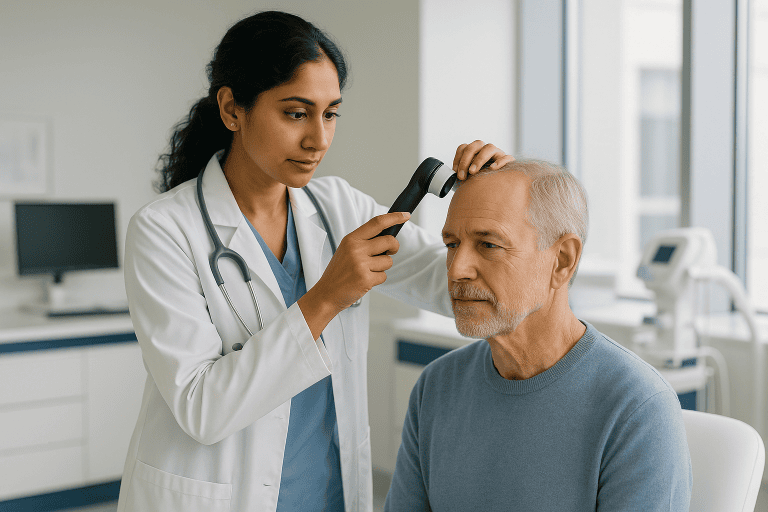
In many cases, dermoscopic scalp examination or digital hair analysis is used to evaluate hair shaft diversity, miniaturisation, follicular density, inflammation and general scalp health. Blood tests may be recommended when nutritional deficiency, thyroid imbalance, hormonal change or systemic illness could be contributing. This step is not bureaucracy; it is what separates a treatment that matches the cause from a treatment that merely matches the symptom.
Laser hair therapy tends to suit patients whose main problem is follicular weakening rather than complete follicle loss, people whose thinning was identified early, who can commit to repeated sessions, and who understand that results appear gradually. Patients with advanced baldness, extensive scarring alopecia, untreated scalp disease or expectations that no non-surgical treatment can meet will usually need a different strategy, and it is better to hear that plainly at the start.
Careful diagnosis before starting any programme is especially important, because hair loss patterns can look identical even when the underlying causes are different. A patient with iron deficiency, thyroid disease, inflammatory scalp disease or medication-related shedding may not benefit from laser therapy alone. At Acibadem, treatment planning may involve dermatology, hair restoration specialists and related medical disciplines when needed, so the visible symptom is considered together with your overall health rather than in isolation.
Conditions Laser Hair Therapy May Address
The most common indication is androgenetic alopecia, male or female pattern hair loss. In men this may appear as recession at the temples, thinning at the crown, or both. In women it more often appears as diffuse thinning over the central scalp with a preserved frontal hairline, although patterns vary considerably. Because androgenetic alopecia is progressive, ongoing management is usually needed to hold whatever improvement is achieved.
Laser therapy may also be considered for diffuse thinning when follicles remain active and the underlying trigger is being addressed. After a period of telogen effluvium, heavy shedding caused by stress, illness, childbirth, nutritional deficiency or surgery: it may be discussed as part of a supportive plan once the medical trigger has been identified and treated. In these cases the aim is not simply to stimulate growth but to help the scalp recover in a medically sound environment. Treating the trigger comes first; light comes second.
After a hair transplant, including procedures such as robotic hair surgery, laser therapy is sometimes used to support scalp healing and improve conditions for the existing, non-transplanted hairs. It does not replace the surgical placement of follicles, but it can form part of a maintenance plan designed to preserve surrounding native hair and support overall density over the years that follow.
Some patients look at laser therapy because they cannot tolerate, or prefer not to use, certain medications; others choose it as an adjunct to topical or oral treatment prescribed by their physician. Combinations can be sensible, but they should be planned deliberately, so the scalp is not exposed to overlapping irritation and the patient is not carrying an unnecessary treatment burden.
Laser hair therapy is not usually a primary treatment for scarring alopecias, active inflammatory scalp disease, fungal infection, untreated scalp psoriasis, or alopecia areata in its active autoimmune phase, unless a specialist decides it has a specific supportive role. In those conditions, controlling inflammation or the underlying disease is the priority. A proper diagnosis protects you from spending time and money on a treatment that does not match the cause of your hair loss.
How Laser Hair Therapy Is Performed
Preparation Before Treatment
The process begins with consultation and assessment. The physician evaluates the pattern, duration and severity of hair loss, reviews your medical history and examines the scalp. Photographs are often taken under standardised lighting to document baseline density and allow honest comparison later, memory is a poor judge of gradual change. In some patients, digital scalp imaging measures miniaturisation and density more precisely, and laboratory testing may be ordered if the picture suggests nutritional, hormonal, thyroid, autoimmune or inflammatory contributors.
Before each session, the scalp should be clean and free of heavy styling products, oils, powders or sprays that could block light penetration. You may be advised to avoid harsh chemical treatments or aggressive scalp procedures shortly beforehand. If you use a topical medication, the timing of application may be adjusted by your treating doctor so the scalp is not wet or irritated during treatment.
Because laser hair therapy needs no anaesthesia, there is no fasting and no pre-operative routine. Most patients arrive, complete the session and go straight back to their day. The plan is set out in advance so expectations about visit frequency, session length and follow-up are clear before treatment begins.
During the Session
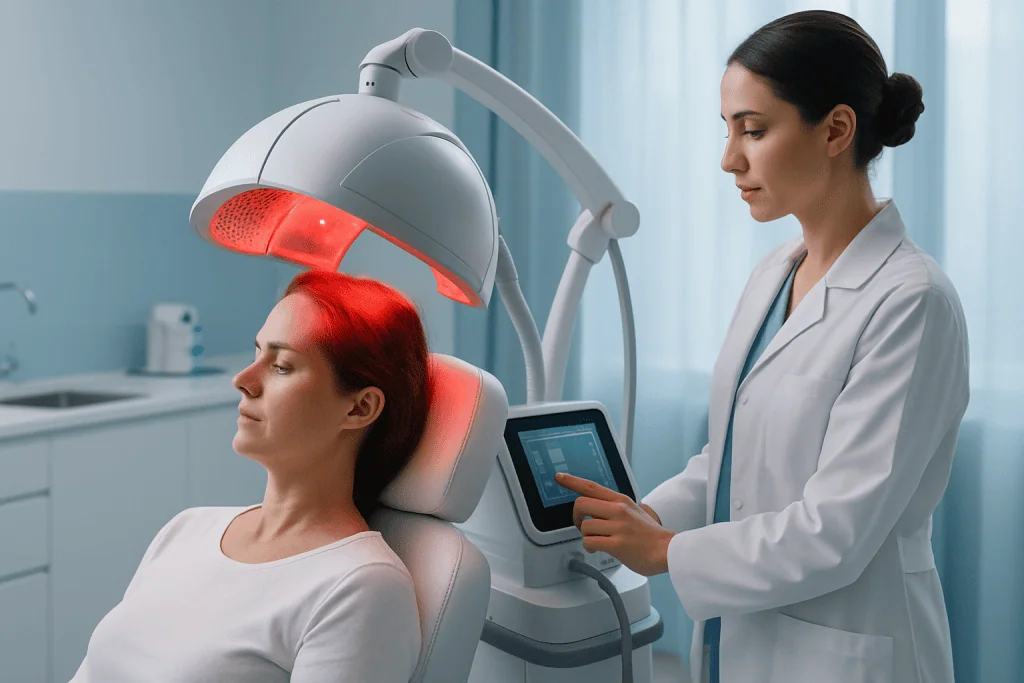
You sit comfortably while the device is positioned over or around the scalp. Protective eyewear may be used depending on the system. The device then delivers controlled low-level light to the thinning areas. Most people feel gentle warmth or nothing at all; the scalp is not being burned, cut or numbed.
Session length varies with the area treated and the technology used, but many sessions fit inside a short clinic visit. The clinical team follows a protocol based on your diagnosis, scalp condition and goals. Positioning and exposure time matter, because the light must reach the target areas consistently. More aggressive treatment does not mean better results: this therapy depends on appropriate dosing repeated over time, not on intensity.
The equipment may take the form of clinical laser panels, caps, hoods or other light-based systems that distribute low-level red or near-infrared energy evenly across the scalp. In a medical setting, the real advantage is not the hardware itself but what surrounds it: correct diagnosis, protocol selection, monitoring, and the ability to integrate other treatments when they are needed.
After the Session
There is typically no downtime. You can return to work, travel, social plans and normal routines immediately. The scalp should not feel burned or injured; mild, brief warmth or sensitivity is possible, but significant pain, blistering or persistent irritation is not an expected part of this treatment.
Hair washing and styling usually continue as normal unless you are given specific instructions. If you use topical medications or other scalp treatments, the team will explain the timing. One point cannot be repeated enough: a single session is not expected to produce visible change. Programmes involve multiple sessions over several months, followed by maintenance once improvement is achieved.
How Long Does a Course of Treatment Take?
Laser hair therapy requires patience, because hair grows slowly regardless of what stimulates it. Early changes may include reduced shedding or improved hair texture, but visible density typically takes months to judge fairly. Most patients are monitored across that period with clinical photographs and scalp evaluation, and treatment frequency depends on the protocol, the severity of thinning, and whether the therapy stands alone or sits within a combined plan.
Where hair loss is ongoing, above all in androgenetic alopecia, where genetic and hormonal influences continue for life, maintenance is often needed to hold results. The physician may adjust the plan if progress stalls, if shedding increases, or if another cause of hair loss becomes apparent along the way. The goal is a realistic, medically supervised programme, not a one-off cosmetic event.
Why Acting Early Matters
Hair loss treatment is more rewarding when follicles are still active. In progressive conditions, follicles do not vanish overnight; they miniaturise gradually, producing thinner and shorter hairs before eventually shutting down. Laser hair therapy is designed for that vulnerable middle stage. Waiting until large areas are completely bald narrows the non-surgical options considerably.
Acting early also gives physicians the chance to find treatable medical causes. Iron deficiency, thyroid disease, vitamin deficiencies, hormonal change, medication effects, inflammatory scalp disorders and sustained physical or emotional stress can all drive shedding. If these are never addressed, hair loss may continue no matter which device is pointed at the scalp.
Delay also widens the gap between expectation and what non-surgical treatment can deliver. Patients with mild or moderate thinning may improve density or slow visible progression with a combined plan. Patients with advanced follicle loss may need transplantation, or may find their options limited if donor hair is insufficient. Early evaluation clarifies the realistic range of choices before the condition becomes harder to manage.
There is an emotional argument too. Many people spend months or years cycling through unverified products while their anxiety grows alongside their shedding. A structured medical assessment cuts through that uncertainty. Even when laser hair therapy turns out not to be the right choice, a clear diagnosis and a named pathway leave you far better placed to decide what to do next.
Benefits of Laser Hair Therapy
For suitable patients, laser hair therapy offers several practical and medical advantages as part of a supervised hair restoration plan. None of them are dramatic on their own; together they explain why the treatment holds its place among non-surgical options.
| Benefit | What It Means for You |
|---|---|
| Non-surgical treatment | No incisions, stitches or donor-area harvesting: an option for patients who are not ready for surgery or do not need transplantation. |
| Minimal interruption to daily life | Most patients return to work, travel and normal routines immediately after each session. |
| Support for active follicles | The treatment is designed to stimulate weakened but viable follicles and may help improve hair thickness and density over time. |
| Compatible with broader plans | Where appropriate, it can sit alongside medical treatment, nutritional correction, platelet-based therapies or post-transplant maintenance. |
| No anaesthesia required | Sessions need no sedation or recovery room; most people feel only gentle warmth, or nothing at all. |
| Objective monitoring | Standardised photographs and scalp assessment show whether the treatment is producing meaningful change, rather than leaving it to impression. |
Recovery Timeline After Laser Hair Therapy
There is little to no physical recovery period, but the biological response unfolds slowly as the hair cycle changes. The table below sets out what most patients can reasonably expect at each stage.
| Time Period | What Patients Can Expect |
|---|---|
| Day 1 | Normal activities usually resume immediately. The scalp should not appear injured. |
| First week | Usual hair care continues unless instructed otherwise. No visible growth is expected this early; keeping to the session schedule is what matters. |
| First month | Some patients notice less shedding or an improved hair feel; many notice nothing visible yet. The care team reviews adherence and scalp tolerance. |
| Several months | Where improvements occur, they become easier to evaluate after repeated sessions. Standardised photographs allow fair comparison of density and coverage. |
| Longer term | Maintenance may be recommended, particularly for progressive conditions such as androgenetic alopecia. The plan is adjusted according to response and ongoing hair loss activity. |
What Influences Results from Laser Hair Therapy?
Results vary because hair loss is shaped by biology, genetics, hormones, scalp health, age, medication, nutrition and consistency of treatment. A good outcome begins with the right diagnosis: patients with early or moderate thinning and active follicles are generally better candidates than those with long-standing bald areas where follicles no longer function.
The type of hair loss matters. Androgenetic alopecia may respond while follicles are miniaturised but still present, especially when treatment starts early. Telogen effluvium may improve once its trigger is resolved, with laser therapy as supportive care in selected cases. Scarring alopecia needs specialist management, because follicle destruction and inflammation can permanently limit the potential for regrowth.
Consistency is a major factor in its own right. This therapy depends on repeated exposure over time; missing sessions or stopping early reduces the chance of seeing any benefit. Equally, more treatment is not automatically better, protocols should be medically appropriate and monitored, not intensified without reason.
Combination treatment improves the picture for some patients. Depending on diagnosis, the physician may recommend topical or oral medication, correction of iron or vitamin deficiencies, management of thyroid or hormonal conditions, platelet-rich plasma, scalp treatments or transplantation. Laser hair therapy may be one component of that plan rather than the whole of it.
Scalp health also shapes the response. Inflammation, seborrhoeic dermatitis, psoriasis, infection or irritation from harsh hair practices can interfere with growth and comfort, so treating the scalp environment can matter as much as stimulating the follicles. Be honest with your care team about styling habits, chemical treatments, tight hairstyles and heat exposure, all can contribute to breakage or traction-related loss that no light source will fix.
Finally, expectations must stay realistic. Laser hair therapy will not restore a teenage hairline or reverse advanced hair loss. The sensible aims are reduced shedding, improved hair calibre, modestly better density, slower progression, or support for other treatments. For many patients, a good result is measured not only in new growth but in stabilisation and a manageable long-term plan they trust.
Does laser therapy work for hair regrowth?
Laser therapy can support regrowth from follicles that are weakened but still alive; it cannot regrow hair from follicles that have died or been destroyed by scarring. That distinction decides almost everything. On a thinning crown with miniaturised follicles, low-level light may help hairs grow back thicker and stay in their growth phase longer. On a smooth, long-bald area, the honest answer is that regrowth from light alone is not a realistic expectation, and a surgical option such as transplantation is the more truthful conversation to have.
What Is Laser Hair Removal?
Laser hair removal is a treatment that uses concentrated light to disable hair follicles so that unwanted hair grows back finer, lighter and more slowly, and in many follicles stops growing altogether. The laser targets melanin, the pigment in the hair shaft; the absorbed light converts to heat, which damages the follicle’s ability to produce hair. This principle, called selective photothermolysis, is the reason the treatment works best on dark hair, which carries more pigment for the light to find.
Because a laser can only disable follicles that are in their active growth phase, and only a portion of your hair is in that phase at any moment, a course of several sessions spaced weeks apart is always needed. Treated hairs shed in the days and weeks after each session; hairs that were resting at the time return and are targeted in later sessions. Even after a completed course, occasional maintenance sessions are common, because some follicles recover partially and hormonal changes can activate new ones.
Skin tone and hair colour shape both safety and effectiveness. Modern devices can treat a wider range of skin tones than earlier generations, but settings must be chosen carefully for darker skin to protect the surrounding pigment, and very light, grey, red or white hairs respond poorly because they contain little melanin. This is one of several reasons the treatment belongs in experienced hands: device choice, wavelength and energy settings are clinical decisions, not defaults. In hospital settings, laser hair removal often sits within dermatology or plastic, reconstructive and aesthetic surgery services, where skin assessment comes before any light is fired.
Despite what some marketing implies, laser hair removal is not surgery. There is no cutting, no anaesthesia beyond optional numbing cream, and no theatre time; each session is an outpatient visit measured in minutes for small areas. The comparison below shows how it differs from laser hair therapy at a glance.
| Laser Hair Removal | Laser Hair Therapy | |
|---|---|---|
| Goal | Reduce or remove unwanted hair | Support growth of thinning scalp hair |
| Light energy | Concentrated; heats and disables follicles | Low-level; stimulates follicle activity without heating tissue |
| Typical areas | Face, underarms, legs, bikini area, back, chest | Scalp |
| Course | Several sessions weeks apart, plus maintenance | Repeated sessions over months, plus maintenance |
| Sensation | Brief snapping or stinging with each pulse | Gentle warmth or no sensation |
What are the negatives of laser hair removal?
The main negatives of laser hair removal are temporary skin reactions, the possibility of pigment changes, the need for multiple sessions, and the fact that results are usually long-term hair reduction rather than permanent removal of every hair. Most patients experience some redness and swelling around follicles for hours to a couple of days. Less common issues include:
- Temporary lightening or darkening of the treated skin, more likely with darker skin tones, recent tanning or unsuitable device settings
- Blistering, crusting or, rarely, burns and scarring, risks that fall sharply with experienced practitioners and proper skin assessment
- Paradoxical hypertrichosis, a rare reaction in which fine hair near the treated area becomes thicker, most often on the face
- Poor response in light, grey, red or white hair, which lacks the pigment the laser targets
- Regrowth over time, particularly where hormones continue to stimulate follicles
Sun protection before and after sessions, honest disclosure of medications and skin conditions, and a test patch on the skin being treated all reduce these risks. Discomfort during pulses is real but brief; cooling systems and numbing creams keep most sessions very tolerable.
Can laser remove PCOS hair?
Laser can significantly reduce the coarse, dark hair that polycystic ovary syndrome often causes on the face, neck, chest and abdomen, but it cannot switch off the hormonal signal that drives new growth. In practice this means people with PCOS often respond well hair-by-hair, yet need more sessions than average and ongoing maintenance, because untreated hormonal activity keeps recruiting fresh follicles. The most effective approach usually pairs laser treatment with medical management of the underlying condition, planned by the treating doctor. Going in with that understanding prevents the common disappointment of expecting a permanent, finished result from the laser alone.
What is Brazilian laser hair removal?
Brazilian laser hair removal treats the full bikini area, including the labial and perianal skin, removing all or almost all hair rather than just tidying the bikini line. Because the skin here is sensitive and often darker than surrounding areas, device settings matter, and sessions may feel sharper than on the legs or underarms. The same rules apply as elsewhere: several sessions across hair growth cycles, no waxing or plucking between them (shaving is fine), and strict avoidance of treatment over irritated or infected skin. Many patients choose it to end ingrown hairs and razor irritation as much as for the cosmetic result.
What do people wish they knew before laser hair removal?
The things patients most often say they wish they had known are practical rather than dramatic:
- It is a course, not an event, visible reduction builds across sessions, and skipping them slows everything down
- You shave before sessions but must not wax, pluck or epilate between them, because the laser needs the hair root in place
- Sun exposure and self-tanner around treatment dates raise the risk of pigment problems, so timing holidays matters
- Results depend heavily on your hair colour and skin tone, which is why an honest pre-treatment assessment is worth more than any discount
- “Permanent” usually means permanent reduction; a few fine hairs and occasional maintenance sessions are normal
- Hormonal conditions change the arithmetic, more sessions, more maintenance, better results when the underlying condition is managed
What Determines the Cost of Laser Treatments for Hair?
Many people search for the cost of laser hair removal surgery, although the treatment is not surgery in the strict sense: there is no operating theatre, anaesthetist or hospital stay to pay for. What you are paying for is clinician time, device quality, the size of the treated area and the number of sessions your hair and skin actually need. The same logic applies to laser hair therapy for hair loss, where the length of the programme and any combined treatments shape the total far more than any single session.
The factors that move the price, for either treatment, are consistent everywhere:
- Size and number of treatment areas: a full-leg course involves far more device time than an upper lip
- Number of sessions required, which depends on hair colour, skin tone, hormonal factors and the condition being treated
- The technology used and whether treatment is delivered in a medical setting with physician oversight
- Diagnostic work included, scalp analysis, photography and blood tests for hair loss patients
- Whether laser treatment stands alone or forms part of a combined plan
Published prices vary widely between providers, which is why headline price questions never have one honest answer. If you are weighing quotes from different providers, comparing what each quote actually includes matters more than comparing headline numbers: our guide on how to compare treatment package prices without missing hidden costs explains what to look for.
How Acibadem Approaches Laser Treatments for Hair
For anyone considering hair restoration, the quality of the evaluation matters as much as the treatment itself. Hair loss can be approached superficially, point a device at the scalp and hope, or it can be assessed medically. Acibadem’s approach emphasises diagnosis, appropriate candidacy and personalised planning, so you learn whether laser hair therapy is actually likely to help your specific pattern of hair loss before committing to it.
Care is provided by experienced physicians and clinical teams familiar with both medical hair loss and aesthetic expectations. Depending on your needs, dermatology, hair restoration, endocrinology, nutrition and other specialties may contribute to the evaluation, because hair loss is sometimes the first visible sign of another condition. Hospital-based care makes that wider assessment possible when the clinical clues point beyond the scalp.
Diagnostic pathways may include scalp examination, dermoscopic evaluation, standardised photography, laboratory testing and a review of everything you have already tried. These tools distinguish pattern hair loss from shedding disorders, inflammatory scalp disease, nutritional deficiency and other causes, which is particularly valuable if you have cycled through multiple treatments without ever being given a clear explanation.
Technology supports the plan rather than replacing judgement. In laser hair therapy, devices deliver controlled low-level light to thinning areas; imaging and documentation tools let physicians track change objectively over months. The honest measure of progress is a standardised photograph, not a feeling.
Follow-up is treated as part of the treatment, not an afterthought. Because the response unfolds over months, progress is reviewed at planned intervals using the same standardised photography taken at baseline, so improvement, stability or continued loss can be judged fairly rather than by impression. Reviews are also the point at which the plan is adjusted: session frequency may change, supportive treatments may be added or withdrawn, and if the response is not meeting realistic expectations, the conversation turns honestly to alternatives rather than simply extending the programme.
Personalised planning sometimes means hearing an uncomfortable answer. Some patients are suited to laser therapy alone; others gain more from a combined plan, medical therapy, correction of deficiencies or transplantation. Occasionally the most valuable outcome of a consultation is learning that laser therapy is not the right primary treatment at all. Ethical care includes stating limitations as plainly as possibilities.
A Considered Next Step for Hair Concerns
Whether your concern is hair you are losing or hair you do not want, the same principle applies: the laser is only as good as the assessment behind it. Laser hair therapy can be a worthwhile non-surgical option for suitable forms of thinning, particularly while follicles are weakened but still active, and its success rests on correct diagnosis, sensible timing, realistic expectations and consistent treatment. Laser hair removal can deliver lasting reduction of unwanted hair when hair colour, skin tone and any hormonal factors are properly weighed beforehand.
The most useful preparation for either treatment is information: understand what your follicles can still do, what the treatment genuinely offers, and what maintenance the years ahead will ask of you. Decisions made on that footing tend to age well.
Preparation
- A specialist evaluates the scalp, hair loss pattern, medical history, and current medications before treatment. The scalp should be clean and free of styling products on the day of the session. Patients may be advised to avoid harsh chemical hair treatments before therapy.
Aftercare
- Patients can usually resume normal activities immediately after each session. Follow the treatment schedule recommended by the specialist, as results typically require repeated sessions over several months. Continue prescribed hair care or medical treatments if advised.
Frequently Asked Questions
What affects the cost of laser hair therapy?
The final cost depends on the diagnosis, treatment course, device type, clinic setting, specialist involvement, follow-up needs and whether laser therapy is combined with other hair restoration treatments.
How can I get a personalised quote?
A personalised quote is prepared after reviewing your medical history, hair loss pattern, scalp findings and goals. Acibadem International can arrange a free consultation to help define the most suitable plan.
Is laser hair therapy usually included in a package?
Packages vary by provider. They may include consultation, scalp assessment, treatment planning, scheduled laser sessions and follow-up guidance, while travel or accommodation support may be arranged separately.
Will I need additional treatments?
Some patients may benefit from laser therapy alone, while others may require medication, PRP, scalp care or hair transplantation planning. A specialist decides suitability after assessment.
Is this information medical or financial advice?
No. This is general educational information. Treatment choice and cost should be confirmed through a specialist consultation and an individual quote.
Medically reviewed by the Acıbadem International Medical Board September 13, 2026
See our medical review board →
Update history
- PublishedJune 8, 2026
- Medical review approvedSeptember 13, 2026
- Last content updateSeptember 12, 2026
Trusted care for international patients
From the Acibadem Blog
Why Two Lasers Do Opposite Things: Laser Hair Therapy vs Laser Hair Removal Explained
Laser hair therapy and laser hair removal use light in opposite ways. Hair removal lasers deliver intense, pigment-seeking heat that damages the hair follicle…