

Why Two Lasers Do Opposite Things: Laser Hair Therapy vs Laser Hair Removal Explained
Key Takeaways
- Hair removal lasers use high energy absorbed by melanin to heat and damage follicles, while low-level laser therapy uses light too weak to warm tissue.
- The Mayo Clinic describes a typical laser hair removal course as two to six sessions spaced weeks apart, timed to catch follicles in their growth phase.
- Laser hair removal delays growth for months to years and often leaves finer regrowth, but Mayo Clinic states it does not guarantee permanent results.
- A low-level laser device has regulatory clearance for hereditary hair loss, yet Mayo Clinic notes the supporting studies are small and long-term data are lacking.
- Removing hair on the face or body cannot thin scalp hair, because the laser's heat stays within millimeters of where it lands and does not alter hormones.
- Paradoxical hypertrichosis, a rare increase in hair near a treated area, is a recognized laser hair removal risk and means more hair, not less.
Laser hair therapy and laser hair removal use light in opposite ways. Hair removal lasers deliver intense, pigment-seeking heat that damages the hair follicle so it grows less. Laser hair therapy, also called low-level laser therapy, uses much weaker red light intended to stimulate thinning scalp follicles; evidence for it is limited and mixed. One aims to stop growth, the other to support it, and neither is a guaranteed or permanent fix.
A woman in her thirties books an appointment to have the dark hair on her upper lip lasered away. On the same afternoon, her brother orders a red-light cap he hopes will thicken the crown he keeps checking in car mirrors. Both of them say they are getting “laser hair treatment.” Both are right, and both are describing devices that were built to do the reverse of each other.
The confusion is understandable. The word laser carries a science-fiction glow, and marketing on both sides leans on it heavily. Yet the debate over laser hair therapy vs laser hair removal is not really a debate at all; it is a question of dose. One device pours enough concentrated heat into a follicle to injure it. The other delivers light too gentle to feel warm, on the theory that follicles can be coaxed rather than cooked.
Understanding that single difference clears up most of the myths, including the persistent worry that removing hair on a chin could somehow thin hair on a scalp.
Laser hair therapy vs laser hair removal: the same word, opposite goals
A laser is simply a device that produces light of one precise color, or wavelength, in a tight beam. That is the only thing the two treatments truly share. Everything else, from the power of the light to the biology it targets, diverges.
Laser hair removal is a cosmetic procedure that uses a high-energy beam to heat the pigment inside hair and the follicle that produces it, so that the follicle is damaged and grows finer, slower, or not at all for a time. The Mayo Clinic describes it as a way to reduce unwanted hair, not a guaranteed permanent removal.
Laser hair therapy is the everyday name for low-level laser therapy, sometimes shortened to LLLT and also sold as red light therapy or photobiomodulation. Here the light is far weaker, usually in the red or near-infrared range, and the aim is to nudge miniaturizing scalp follicles in pattern hair loss back toward producing thicker strands. Mayo Clinic notes that a low-level laser device has regulatory clearance for hereditary hair loss and that a few small studies suggest improved hair density, while adding that more research is needed on long-term effects.
Think of it as the difference between a magnifying glass focusing sunlight to scorch a leaf and the diffuse sun that helps the plant grow. The tool is light in both cases. What matters is how much energy reaches the tissue and where it is aimed. Once that is clear, the two procedures stop looking like cousins and start looking like strangers who happen to share a surname.
How laser hair removal works: heat that seeks out pigment
The principle behind hair removal lasers is called selective photothermolysis, a long term for a simple idea: choose a wavelength that dark pigment absorbs strongly and surrounding skin absorbs weakly, then deliver it fast enough that the heat stays where the pigment is.
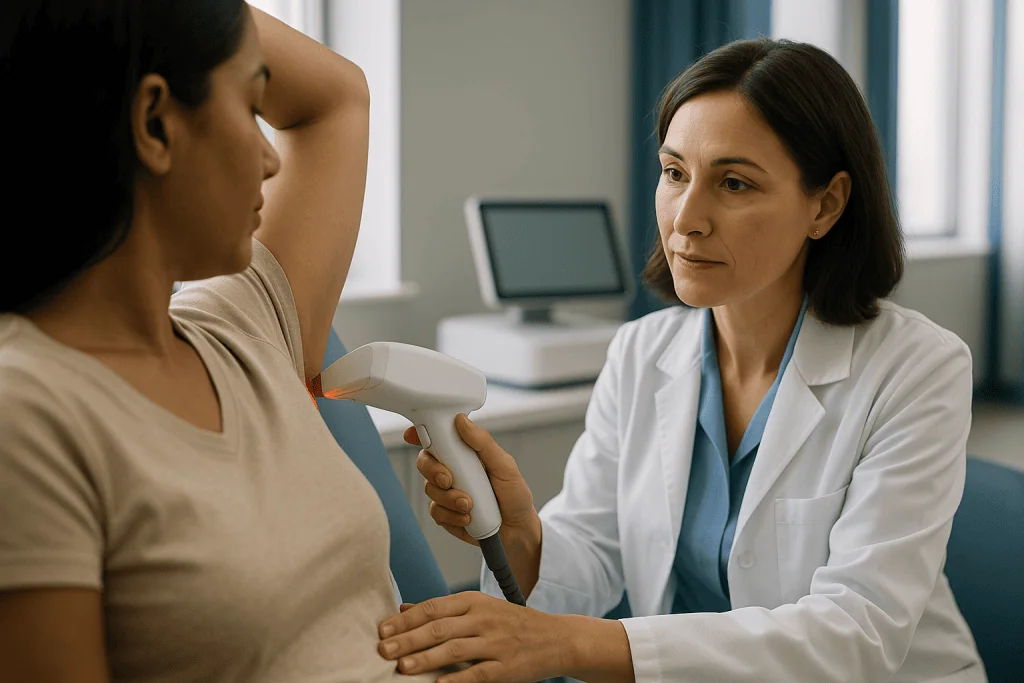
Melanin, the brown-black pigment that colors hair, soaks up the light. The absorbed energy becomes heat, which travels down the shaft into the bulb and the surrounding follicle wall. If enough heat arrives, the cells that regenerate the hair are injured. The follicle may then produce a thinner, paler hair, or nothing for an extended stretch.
This is why the Mayo Clinic explains that the procedure works best on people with light skin and dark hair: the contrast lets the laser find the target without heating the skin around it. Lighter hair contains less pigment to absorb energy, and darker skin contains more competing pigment, which raises the risk of burns and color changes. Newer devices and settings have widened who can be treated, but the treating team still weighs skin tone and hair color carefully before choosing a device.
Each pulse covers a small area, roughly the size of a coin, and many pulses are needed across a lip, an underarm, or a back. A cooling gel, chilled tip, or cold air is usually used to protect the skin surface while the deeper follicle heats. Patients often describe the sensation as a snapping rubber band or a quick sting of warmth. Cleveland Clinic notes the process is fast for small areas and takes longer for large ones.
Because hair only absorbs the energy well when it is anchored and growing, timing matters, which brings us to the hair cycle.
Low level laser therapy for hair growth: what the gentler light is trying to do
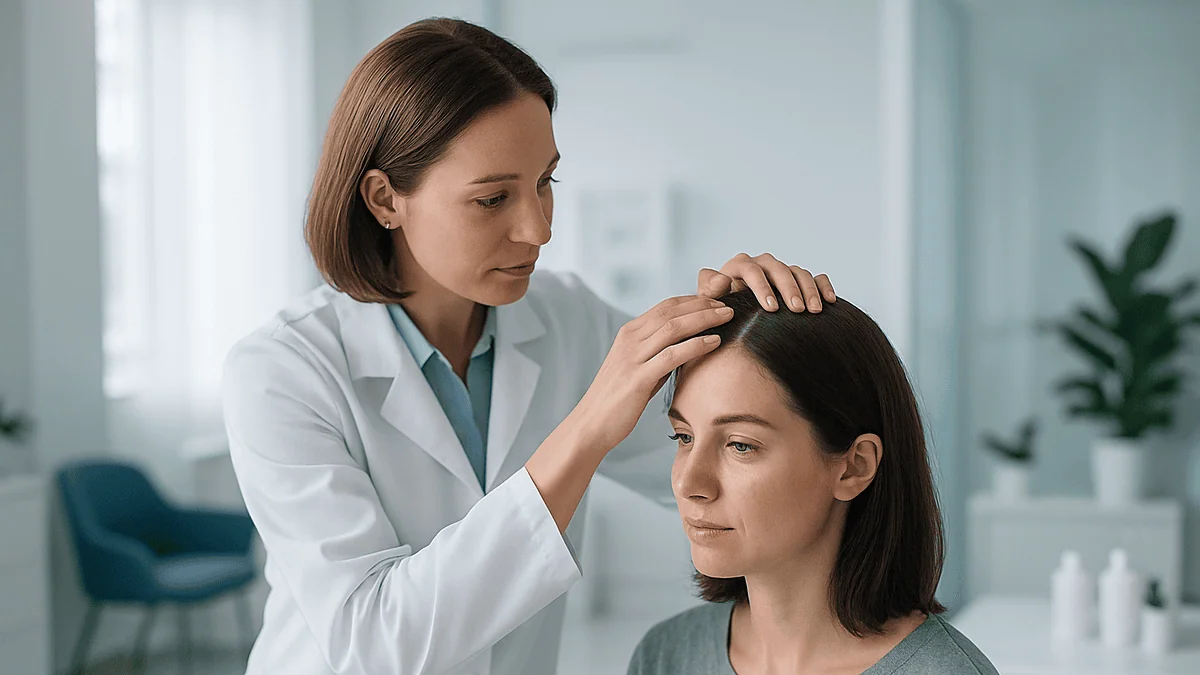
Low-level laser therapy takes the opposite approach. Its light, typically red or near-infrared, is delivered at a power far too low to heat tissue meaningfully. The device might be a comb, a band, a helmet, or a cap lined with small diodes, used at home or in a clinic setting.
The proposed mechanism is photobiomodulation, a term meaning that light changes how cells behave without damaging them. Laboratory work suggests red light can be absorbed by structures inside mitochondria, the energy factories of cells, potentially increasing cellular energy production and shifting follicles that have entered a resting phase back into an active growth phase. Improved local blood flow and reduced inflammation around the follicle have also been proposed.
Those are hypotheses drawn largely from cell and animal studies, and it is honest to label them that way. In people with androgenetic alopecia, the medical name for hereditary pattern hair loss, the follicles are not dead but miniaturized: they shrink over successive cycles and produce progressively finer, shorter hairs. The hope is that gentle light interrupts that miniaturization.
Harvard Health, writing about female pattern hair loss, notes that low-level laser devices have regulatory clearance for safety and that they may help some people, while cautioning that it remains unclear how well they work. Mayo Clinic frames the evidence similarly: a few small studies, improved density in some participants, and a need for larger and longer trials.
The practical takeaway is that laser hair therapy does not remove, burn, or reshape anything. If a device advertised for regrowth ever felt hot or left marks, that would be a reason to stop and ask a clinician, because heat is precisely what this category is designed to avoid.
Why the hair growth cycle explains the timing of both treatments
Every follicle on the body cycles through phases. Anagen is the active growth phase, when the hair is anchored deep in the follicle and connected to its blood supply. Catagen is a short transition. Telogen is the resting phase, after which the old hair sheds and a new one eventually begins. Follicles on the scalp spend years in anagen; those on the arms or legs spend only months there, which is why body hair stays short.

This cycle is the reason laser hair removal is never a one-visit event. Only follicles in anagen have a pigmented shaft anchored in place to conduct heat down to the bulb. At any moment, a portion of follicles in a given area are resting or shedding and will be largely untouched. The Mayo Clinic explains that most people need a series of treatments, usually two to six, spaced weeks apart so that follicles which were resting during one session are caught growing at the next. The same source notes that the interval tends to be shorter for fast-growing areas such as the upper lip and longer for slow-growing areas such as the back.
The cycle matters for laser hair therapy too, though in reverse. If red light does influence follicles, the change can only become visible once a hair completes a cycle and a new, hopefully thicker, strand emerges. That is a matter of months, not days, and it is one reason people abandon these devices early and conclude they did nothing. It is also why any early shedding, which some users report, is hard to interpret: it could be normal cycling, a shift in the cycle, or unrelated.
Patience is not a marketing slogan here; it is follicle biology.
Side-by-side: laser hair therapy vs laser hair removal
Set the two treatments next to each other and the contrast becomes stark. The table below summarizes what mainstream sources describe, with timelines drawn from the Mayo Clinic’s patient guidance.
| Feature | Laser hair removal | Laser hair therapy (low-level laser) |
|---|---|---|
| Goal | Reduce unwanted hair by damaging follicles | Support thicker growth in thinning scalp follicles |
| Light energy | High; produces heat | Very low; no meaningful heating |
| Target | Melanin in hair shaft and follicle | Cellular structures in the follicle (proposed) |
| Sensation | Snapping, stinging warmth | Usually none |
| Typical course | 2–6 sessions, weeks apart (Mayo Clinic) | Ongoing, repeated use over months |
| Where it is done | Clinic setting by trained practitioner | Clinic or home device |
| Strength of evidence | Well established for hair reduction | Limited; small studies, mixed results |
| Main risks | Irritation, pigment change, rare burns or scarring | Mild scalp irritation, dryness, itch; cost of unproven benefit |
| Permanence | Long-lasting reduction, not guaranteed permanent | Any benefit expected to fade if stopped |
Two rows deserve a second look. The evidence row is not symmetrical. Hair reduction with lasers is a mature, well-described cosmetic procedure whose limits are known. Low-level laser therapy sits in the category of plausible but unproven at scale, which is different from disproven and also different from established.
The permanence row cuts against optimistic marketing on both sides. Mayo Clinic is explicit that hair removal does not guarantee permanent results and that maintenance sessions are common. For laser therapy, because the underlying hereditary process continues, any effect would logically require continued use, much like other non-surgical hair loss treatments.
Who each treatment is usually for, and who is usually asked to wait
Laser hair removal is most often considered by adults bothered by hair on the face, underarms, bikini line, legs, chest, or back. It is also used medically for conditions such as pseudofolliculitis barbae, the painful ingrown hairs common after shaving coarse curly hair, and for hair growth driven by hormonal conditions. According to the Mayo Clinic, the best candidates have dark hair and lighter skin, though experienced practitioners treat a wide range of skin tones with appropriate devices.
People are commonly asked to wait or reconsider when the skin is tanned or recently sun-exposed, because extra pigment raises burn risk. Mayo Clinic advises avoiding sun before and after sessions and avoiding plucking or waxing for several weeks beforehand, since those remove the pigmented shaft the laser needs. Active skin infection, a history of keloid scarring, certain light-sensitizing medicines, and treatment around the eyes are all reasons a clinician may decline or delay; the Mayo Clinic specifically notes that eyelids, eyebrows, and surrounding skin are not treated. Pregnancy is usually treated as a reason to postpone elective cosmetic lasers, not because harm is proven but because safety data are lacking.
Laser hair therapy is usually discussed with adults who have early to moderate androgenetic alopecia and a confirmed diagnosis. That last point matters. Hair loss has many causes, including thyroid disease, iron deficiency, autoimmune alopecia areata, scarring alopecias, and medication effects, and the NHS advises seeing a GP when hair loss is sudden, patchy, or distressing. Red light will not address any of those, and using it can delay a diagnosis that has a specific treatment.
People with scarring alopecia, active scalp disease, or a photosensitive condition are generally asked to hold off. The treating team, not the device packaging, decides who is a reasonable candidate.
What the evidence actually shows for laser hair therapy
This is where honesty matters most, because hope sells devices. The plainest summary comes from the Mayo Clinic: a low-level laser device has regulatory clearance as a treatment for hereditary hair loss in men and women, a few small studies have shown improved hair density, and more studies are needed to show long-term effects.
Read each clause carefully. Regulatory clearance for a device in this category generally means it has been judged safe and substantially similar to existing devices; it is not the same as proof that it works as well as a medicine that passed large trials. Small studies means modest numbers of participants, often followed for months rather than years. Improved density means counting hairs per area on photographs, which can rise without a change anyone would notice in the mirror.
Harvard Health strikes the same tone for female pattern hair loss, describing the devices as an option that may help some people while stating that how well they work remains unclear. Neither source describes reversal of advanced baldness, and no mainstream body recommends laser therapy as a first-line or standalone treatment.
There are also structural reasons to stay cautious. Many published trials were funded by device makers. Sham devices with dim lights make blinding difficult. Wavelength, power, and session length vary between products, so a result with one device does not transfer to another. Real-world adherence, meaning wearing a cap for a set period several times a week for months, tends to be lower than in trials.
None of this means the approach is worthless. It means the correct sentence is “may modestly help some people with early pattern hair loss, with a low side-effect profile,” and nothing stronger. A clinician can help weigh that against options with deeper evidence.
Does laser hair removal cause hair loss on your head?
This is the most common crossover fear, and the answer is no. A laser aimed at the chin, underarm, or leg has no pathway to the scalp. The energy is absorbed within a few millimeters of where it lands and converted to heat on the spot; it does not travel through the bloodstream, alter hormones, or signal distant follicles. Pattern hair loss on the scalp is driven by genetics and androgen sensitivity, and cosmetic hair removal elsewhere does not change either.
The fear seems to arise from a real but different phenomenon. Mayo Clinic lists paradoxical hypertrichosis, meaning increased hair growth around a treated area, as a rare risk of laser hair removal, especially on the face and neck in people with darker skin. The mechanism is debated; one idea is that light too weak to destroy a follicle at the edge of the treatment zone may instead stimulate it, essentially delivering an accidental low dose of the same effect that hair therapy devices seek deliberately. It is uncommon, and it involves more hair, not less.
The reverse question also comes up: could a red-light cap for the scalp remove hair? Again no. The power levels are far below what is needed to heat a follicle. Some users report mild shedding in the first weeks of using a device, which may reflect normal cycling or a shift of follicles into a new cycle, but this is a temporary and poorly characterized observation rather than destruction of follicles.
One genuine caution: laser hair removal near the hairline, sometimes requested to tidy a low forehead or neck, is deliberately intended to stop growth there. Anyone planning a future hair transplant should tell the practitioner, because the design of a hairline is something the transplant surgeon will want to control.
What the days and weeks after each treatment usually look like
After laser hair removal, the treated skin typically looks and feels mildly sunburned: pink, warm, slightly swollen around each follicle. The Mayo Clinic describes redness and swelling lasting a few hours, with cool compresses and moisturizer used for comfort. Strict sun avoidance and broad-spectrum sunscreen are advised, because freshly treated skin is more prone to pigment changes.
Over the following days to weeks, treated hairs fall out. Many people mistake this for regrowth, since the shafts appear to keep growing before they shed; in fact they are being pushed out of damaged follicles. Shaving between sessions is usually permitted, while plucking or waxing is discouraged for the same reason as before treatment.
Sessions are spaced according to the growth cycle of the area. Mayo Clinic gives ranges of several weeks between treatments for faster-growing regions and longer intervals for slower ones, with most people completing a course of two to six visits. Afterward, hair-free periods of several months to years are described, with regrowth that is often finer and lighter and periodic maintenance sessions to keep the result.
The timeline for laser hair therapy is quieter and slower. There is no downtime, no redness expected, and nothing to see in the first weeks. Devices are typically used repeatedly across the week, and because a new hair must complete a cycle before any change shows, users are generally told to judge results only after several months of consistent use. Standardized photographs taken under the same lighting at the start and at intervals are more reliable than daily mirror checks, which reflect styling, humidity, and mood as much as follicles.
If a scalp device causes heat, stinging, or redness, that is not part of the expected course.
Laser hair therapy side effects compared with laser hair removal risks
Because the two treatments deliver such different amounts of energy, their risk profiles sit far apart, and it is worth being precise about each.
For laser hair removal, the Mayo Clinic and Cleveland Clinic describe a consistent list. Common and short-lived: skin irritation, redness, swelling, and discomfort at the treated site. Less common: pigment changes, either darkening or lightening, which can be temporary or in some cases lasting and are more likely in people with darker skin or recent sun exposure. Rare: blistering, crusting, scarring, changes in skin texture, graying of treated hair, and the paradoxical increased growth described earlier. Eye injury is a serious risk if the beam reaches the eye, which is why protective eyewear is standard and the eye area is not treated. The NHS emphasizes choosing a practitioner who is properly trained and using a device suited to the skin type, since most complications trace back to inappropriate settings.
For low-level laser therapy, reported side effects are generally mild: dryness or itching of the scalp, occasional irritation, a feeling of warmth from a helmet worn for a long stretch, and the transient shedding some users notice early. The larger, less visible risk is opportunity cost. Months spent relying on a device with limited evidence are months in which a treatable cause of hair loss may go undiagnosed, or in which an option with stronger evidence is not started. Follicles that have been miniaturized for years become harder to influence, so delay carries a biological cost as well as a financial one.
Neither treatment is recommended for use around the eyes without professional supervision, and any device should be stopped and discussed with a clinician if it causes pain, blistering, or persistent color change.
Where lasers fit alongside hair transplant and other hair loss treatments
Because this explainer sits in a hair transplant category, it helps to place both lasers on the wider map of hair loss care, without recommending any single route.
Mainstream sources such as the Mayo Clinic and the NHS describe several established approaches for pattern hair loss. Topical minoxidil, a medicine applied to the scalp, is thought to prolong the growth phase and widen follicles; it typically requires months of continued use before change is visible and must be continued to hold any gain. Oral finasteride, used in men, lowers the hormone that drives follicle miniaturization; it too works over months and carries its own side-effect discussion. Whether either is appropriate, and at what point, is a decision for the prescribing clinician, not a blog.
Hair transplant surgery moves follicles from areas genetically resistant to thinning, usually the back and sides, into thinning zones. It is the only approach that adds follicles rather than trying to rescue struggling ones, and it is a surgical procedure with its own recovery, risks, and limits set by how much donor hair exists.
Low-level laser therapy is usually discussed as an adjunct: something a person might use alongside medicines or after a transplant, in the hope of supporting existing follicles. Some surgeons offer it after transplant on the theory that it may support healing or growth of grafts, but the Mayo Clinic’s caution about small studies applies equally here; this is plausible, not proven.
Laser hair removal enters the transplant conversation from the opposite direction. It is occasionally used to refine a hairline that sits too low, to tidy the neck, or to address grafts placed in an unwanted position. That is a deliberate destruction of follicles and should only be planned with the surgeon who understands the overall design.
What people often get wrong about lasers and hair
A handful of misunderstandings show up again and again in consultations, and correcting them saves people money and worry.
The first is that “laser” implies a single, uniform technology. In truth, hair removal lasers operate at wavelengths chosen to be absorbed by melanin, at powers that heat tissue, while hair therapy devices use red or near-infrared light at powers that do not. Calling both “laser treatment” is like calling a blowtorch and a reading lamp “fire” because both emit light.
The second is that laser hair removal is permanent. Mayo Clinic is direct: it delays growth for long periods, often results in finer regrowth, and usually requires maintenance. The term permanent hair reduction, which regulators allow, is not the same as permanent removal.
The third is that a home red-light cap works like a medicine. Regulatory clearance for a device indicates safety and similarity to prior devices, not proof of efficacy comparable to drug approval. Harvard Health and Mayo Clinic both describe the evidence as limited.
The fourth is the crossover fear already addressed: that removing body hair thins scalp hair, or that a scalp device could cause baldness. Neither has a plausible mechanism.
The fifth is that shedding always means failure. Hair cycles. A shed hair is often a follicle clearing space for a new one, and early shedding after starting any hair growth treatment is described in patient guidance as a possible short-term effect. Judging a months-long process by two weeks of mirror anxiety is the most common way people talk themselves out of a fair trial or, equally, into continuing something that has not helped.
The sixth is that darker skin cannot have laser hair removal. It requires different devices and more caution, not exclusion.
Questions to ask your care team before either treatment
Good consultations are shaped by good questions. The list below is a starting point for a conversation, not a script, and the answers will properly depend on the person in the chair.
For laser hair removal, it is reasonable to ask which device will be used and why it suits this skin tone and hair color, since the Mayo Clinic notes that the match between light and pigment drives both results and risk. Ask how many sessions the practitioner anticipates and at what intervals, with the understanding that Mayo’s range of two to six is typical but individual. Ask what preparation is needed regarding sun exposure and hair removal beforehand, what the plan is if pigment changes or blistering appear, and who to contact after hours. Ask about training and, where relevant, registration, as the NHS advises. If a future hair transplant or hairline design is a possibility, say so before any facial or neck treatment begins.
For laser hair therapy, the first question is whether the cause of hair loss has been confirmed, and whether blood tests or a scalp examination are needed to rule out thyroid, iron, autoimmune, or scarring causes that need different care. Ask how the clinician reads the evidence, in plain terms, and how they would measure whether the device is helping over the months ahead. Ask how it fits with or compares to treatments that have more data, and what the plan is if there is no visible change after a fair trial. Ask what would prompt stopping.
For either, a useful closing question is simply: what would you want a family member to know before choosing this? Clinicians tend to answer that one honestly.
When to call your doctor
Most people experience nothing more than brief redness after laser hair removal and nothing at all from a low-level laser device. A small number of situations deserve prompt medical attention rather than watchful waiting.
After laser hair removal, contact the treating team or a doctor if the skin blisters, weeps, or crusts; if pain intensifies rather than fades over the first day or two; if redness spreads beyond the treated area or comes with warmth, swelling, pus, or fever, which can signal infection; or if patches of skin turn noticeably darker or lighter and do not begin to settle. Seek urgent care for any eye symptom after a facial treatment, including pain, light sensitivity, or blurred vision, since the Mayo Clinic identifies eye injury as a serious risk. Signs of an allergic reaction to a gel or numbing product, such as hives, facial swelling, or difficulty breathing, are an emergency.
With laser hair therapy, stop using the device and speak to a clinician if it produces burning, blistering, or persistent redness, since heat is not part of its design. More important, see a GP or dermatologist about the hair loss itself if it is sudden, comes out in clumps or round patches, is accompanied by scalp pain, scaling, or pustules, or coincides with fatigue, weight change, or menstrual changes. The NHS advises seeing a doctor when hair loss is sudden, patchy, or causing distress, because several treatable conditions, from thyroid disease to alopecia areata, present this way and will not respond to light of any strength.
The decision to start, continue, or stop either treatment, and to combine them with medicines or surgery, sits with the treating team who can examine the skin and scalp in person.
Frequently asked questions
Is laser hair therapy the same as laser hair removal?
No, they are opposite treatments that share a word. Laser hair removal delivers intense heat to pigmented follicles to reduce growth. Laser hair therapy, or low-level laser therapy, delivers weak red light intended to support thinning scalp follicles without heating them. One is a well-established cosmetic procedure with known limits; the other has limited and mixed evidence, as both the Mayo Clinic and Harvard Health note.
How does laser hair removal work on the follicle?
The laser emits a wavelength that melanin, the dark pigment in hair, absorbs strongly. The absorbed light becomes heat that travels down the shaft into the follicle and injures the cells that regenerate hair. Because only actively growing follicles conduct that heat well, several sessions are needed. The Mayo Clinic notes it works best when hair is dark and skin is lighter, so the pigment contrast guides the energy.
Does laser hair removal cause hair loss on the scalp?
No. The energy is absorbed within millimeters of the treated skin and has no pathway to distant follicles; it does not enter the bloodstream or change hormones. Scalp thinning is driven by genetics and androgens. The one related phenomenon, paradoxical hypertrichosis, is a rare increase in hair near the treated area, which Mayo Clinic lists as a risk, and it involves more hair rather than less.
Does low level laser therapy for hair growth actually work?
The honest answer is that it may modestly help some people with early pattern hair loss, but proof is limited. Mayo Clinic notes a low-level laser device is cleared for hereditary hair loss and that a few small studies show improved hair density, while more research is needed on long-term effects. Harvard Health says how well these devices work remains unclear. No mainstream body recommends it as a standalone first-line treatment.
What are the side effects of laser hair therapy?
Reported side effects are generally mild: scalp dryness, itching, occasional irritation, and a transient increase in shedding when starting, which is poorly characterized. Devices should not cause heat, pain, or blistering; if one does, stop and ask a clinician. The larger risk is indirect: relying on a device with limited evidence while a treatable cause of hair loss, such as thyroid or iron problems, goes undiagnosed.
How many sessions of laser hair removal are usually needed?
The Mayo Clinic describes a typical course of two to six treatments, spaced weeks apart so that follicles resting during one session are caught in their growth phase at the next. Intervals are shorter for fast-growing areas such as the upper lip and longer for slow-growing areas such as the back. Individual needs vary with hair color, skin tone, and the area treated, and maintenance sessions are common afterward.
Is laser hair removal permanent?
Not in the strict sense. Mayo Clinic states that laser hair removal delays hair growth for long periods, often months to years, and that regrowth tends to be finer and lighter, but it does not guarantee permanent removal. Regulators allow the phrase permanent hair reduction, which describes a lasting decrease in the number of hairs rather than a complete and lifelong absence. Most people plan for occasional maintenance.
Can I use a red light cap after a hair transplant?
Some surgeons offer low-level laser therapy after transplant in the hope of supporting graft healing and growth, but this rests on the same small studies that limit the evidence for hair therapy generally. Whether and when to use a device after surgery is a decision for the transplant team, who will weigh the timing against wound healing and any medicines prescribed. Follow their specific aftercare instructions rather than device packaging.
Who should not have laser hair removal?
Clinicians commonly delay or decline treatment when skin is tanned or recently sun-exposed, when there is active skin infection or a history of keloid scarring, during pregnancy as a precaution, and around the eyes, which the Mayo Clinic specifically excludes. People taking light-sensitizing medicines should raise this at consultation. Darker skin tones are not excluded but require devices and settings chosen with care to reduce burn and pigment risk.
How long before I know if laser hair therapy is helping?
Because a follicle must complete a growth cycle before a new, potentially thicker hair emerges, changes are judged over months rather than weeks. Studies cited by Mayo Clinic measured hair density after months of consistent use. Standardized photographs under identical lighting at the start and at intervals are more reliable than mirror checks. Agree in advance with a clinician what would count as benefit and when to reassess or stop.
This article is for general information only and is not a substitute for professional medical advice. Please consult a qualified doctor about your individual situation.

More from the Blog
Why the Cause of Hair Loss Sets the Plan: Tests Before Non-Surgical Hair Restoration
Before non-surgical hair restoration, clinicians usually confirm the cause first: a history and scalp examination, a gentle pull test, magnified scalp imaging (trichoscopy), and…
Who Is a Candidate for Laser Hair Therapy? Early Thinning vs Long-Standing Bald Areas
A laser hair therapy candidate is usually an adult with early to moderate hereditary (pattern) thinning, where follicles have shrunk but are still alive,…
How Scalp Micropigmentation Is Done: Pigment Dots, Session Spacing and Matching Your Hair Shade
Scalp micropigmentation is a cosmetic tattooing technique in which a trained practitioner deposits thousands of tiny pigment dots into the upper layer of the…
Hair Transplant Repair for International Patients: Photo Review, Staged Sessions and Follow-Up
Hair transplant repair for international patients usually begins with a remote photo review, followed by an in-person examination that checks the donor area, scar…
Hair Transplants for a Receding Hairline: Timing, Design and Realistic Density
A hair transplant can restore a receding hairline by moving follicles from the back of the scalp, where hair is genetically resistant to balding,…

Norwood 5: Planning Coverage When the Bridge Is Going
Norwood 5 describes advanced male pattern hair loss in which the band of hair separating the receded hairline from the thinning crown, the so-called…