

What Donor Assessment Before Hair Transplant Repair Reveals: Remaining Capacity and the Plan
Key Takeaways
- Follicles removed from the donor zone never grow back there, so every repair plan is a budget rather than a wish list.
- A follicular unit is a natural cluster of one to four hairs, and density counts of these units under magnification are the backbone of capacity estimates (Cleveland Clinic).
- Overharvesting shows as clustered white dots, a visible linear scar or finer remaining hair, each of which changes what the surgeon can safely do next.
- Transplanted hair commonly sheds within the first several weeks and the fuller result takes most of a year, so a donor zone or a result should not be judged early (MedlinePlus; Cleveland Clinic).
- Tightly curled hair grows from curved follicles, raising the risk that an extraction punch severs the graft, which is why texture changes technique choice.
- 5-alpha reductase inhibitors and minoxidil can stabilise surrounding hair over months but cannot add follicles to a depleted donor area, and any decision about them belongs to the prescriber (Mayo Clinic).
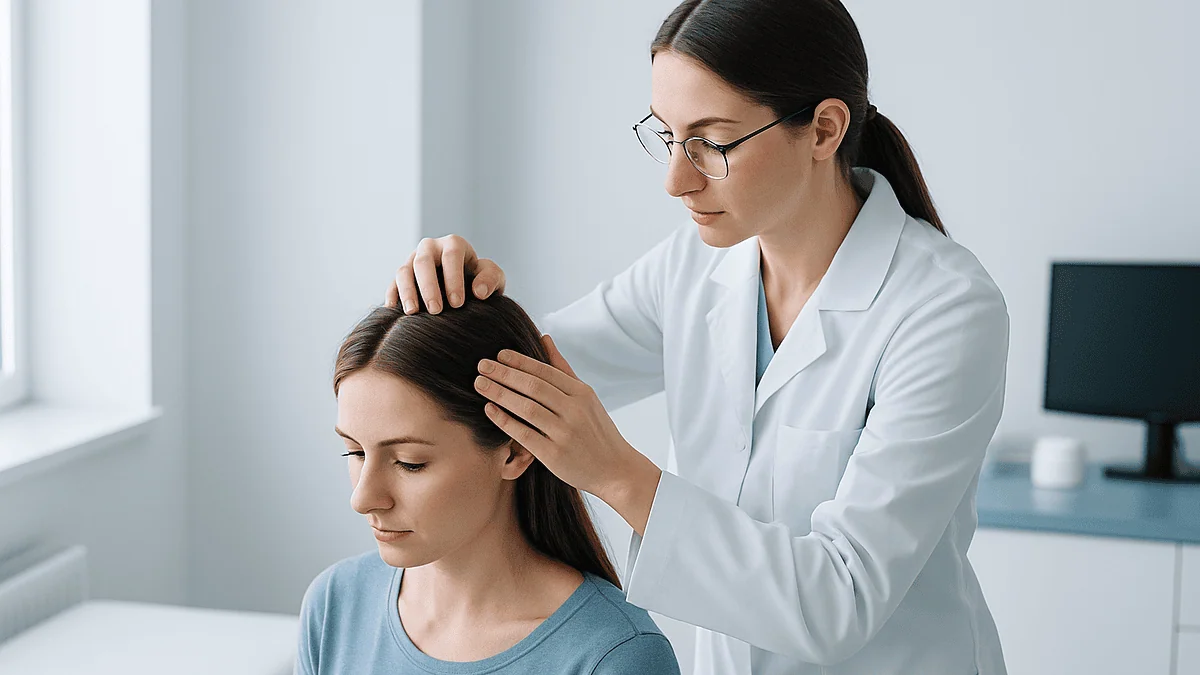
Donor area assessment before hair transplant repair is a structured examination of the scalp, beard and sometimes body hair that remains available after earlier surgery. It maps how many healthy follicular units are left, how evenly they are spread, where scarring sits and how fragile the skin has become. Those findings decide whether repair is realistic now, what it should prioritize, and whether waiting or medical therapy comes first.
He arrives with two photographs on his phone. One is the back of his head under harsh bathroom light, a pale patch where the hair has thinned into a moth-eaten look. The other is his hairline, with grafts that sit a little too far forward and point the wrong way. He wants the front fixed. The surgeon, instead, spends the first twenty minutes looking at the back.
That order of attention is the whole story of a repair consultation. A donor area assessment before hair transplant repair is not a formality squeezed in before the real planning starts. It is the planning. The front of the scalp tells you what a person wants; the donor zone tells you what is possible, and the gap between those two things is where honest medicine lives.
What follows explains what that assessment measures, what the findings usually mean, and why a careful surgeon will sometimes recommend doing less than a patient hoped for.
Why donor area assessment before hair transplant repair comes first
A hair transplant does not create hair. It redistributes it. Every graft placed in the hairline was lifted from somewhere else, usually the band of scalp above the ears and across the back of the head, which is the donor area. In most people with pattern hair loss, those follicles are genetically less sensitive to androgens, the hormones that shrink hair in the crown and front, which is why they keep growing after transplant (Cleveland Clinic).
The problem in repair is that this supply has already been spent once. Sometimes it was spent well, sometimes not. A previous session may have taken grafts from too small a zone, taken them too densely, or used a technique that damaged neighbouring follicles. The surgeon doing the repair inherits whatever is left, and no amount of skill at the recipient end changes the arithmetic at the donor end.
So the assessment answers three blunt questions. How much usable hair remains? Can it be removed without making the donor zone look visibly thin? And is the skin itself healthy enough to tolerate another round of extraction or a new incision? Only once those are settled does anyone talk about hairlines, density targets or which technique to use.
This is why a repair consultation often feels slower and more cautious than a first consultation. The margin for error is smaller. A first-time patient with an untouched donor zone has options; a repair patient has a budget, and the assessment is how that budget is counted. A person who understands this walks into the discussion with realistic expectations rather than frustration, and tends to make better decisions about what to prioritize.
What actually happens during a donor area assessment
The examination usually starts with the eyes and ends with instruments. The surgeon looks at the donor zone under good light from several angles and at a conversational distance, because that is how other people will see it. They are checking whether the earlier harvest is already visible, whether the zone looks patchy, and how the remaining hair falls when it is combed or when it is wet.
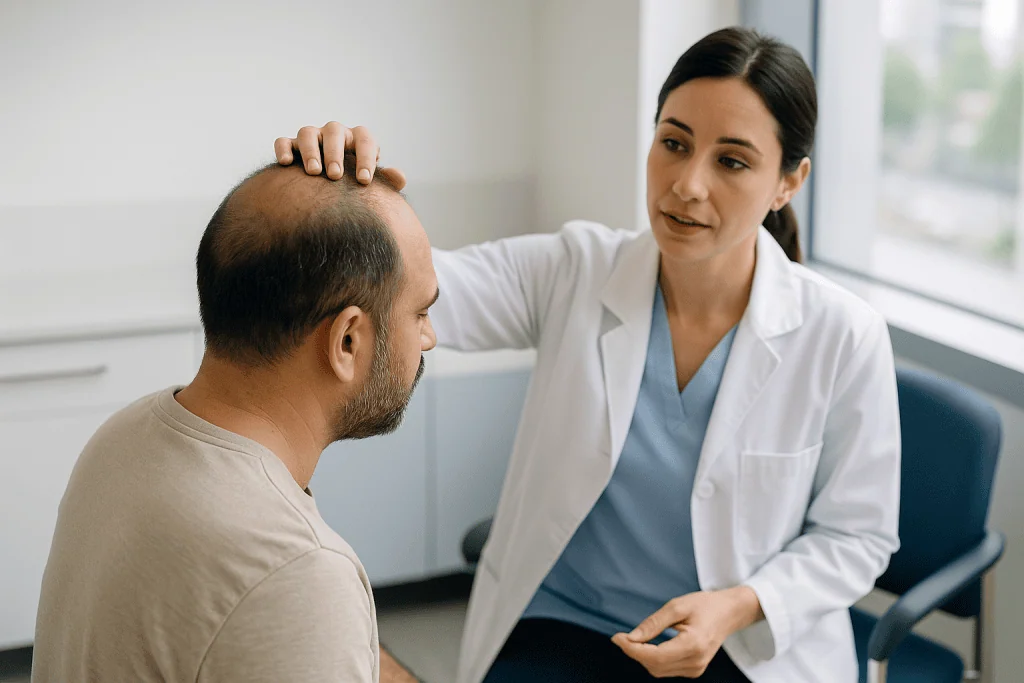
Then comes magnification. Trichoscopy, which is examining the scalp with a handheld or video dermatoscope, lets the surgeon count follicular units in small marked squares. A follicular unit is a natural cluster of one to four hairs that grows from a single opening in the skin; grafts are built from these clusters (Cleveland Clinic). Counting units per square centimeter in several spots gives a density map, which matters because density is rarely uniform after a previous harvest.
Under the same magnification the surgeon looks at hair caliber, which is the thickness of individual shafts, and at miniaturization, which is the progressive thinning of hairs under androgen influence. Miniaturized hair in the donor area is a warning that the zone is not as permanent as it looks today.
Finally, the skin. Fingers test how freely the scalp moves, which affects whether a strip excision could ever close comfortably. The surgeon traces old scars, notes any hypopigmented dots left by punch extraction, and feels for thickened or tethered tissue. Photographs with a consistent setup are taken so that later change can be compared against something objective. Many surgeons also check the beard and, less often, chest or other body hair as potential reserves, noting texture and growth cycle because body hair behaves differently from scalp hair.
None of this is painful, and most of it takes well under an hour. The consequences last a lifetime.
What a safe donor area means, and why it differs from person to person
Surgeons speak of the safe donor area as the region of scalp where hair is expected to persist for life, even as pattern loss advances elsewhere. The idea rests on a biological observation: follicles on the back and sides of the head are typically less sensitive to dihydrotestosterone, the androgen most responsible for male and female pattern hair loss (Mayo Clinic). Transplant those follicles forward and they keep their original programming.
The catch is that the boundaries of this zone are not drawn on a template. They depend on how far a person’s hair loss is likely to progress, which no one can know with certainty while they are still young. Someone in their twenties with aggressive thinning and a strong family history may have a much smaller true safe zone than their scalp suggests today, because the upper and lower edges of the donor band may thin over the following decades. Someone in their fifties with stable loss gives the surgeon far more confidence about where the margins lie.
Repair adds a second layer. If the previous surgeon harvested outside the conservative zone, those grafts may already be thinning in the recipient area, and the donor band may look depleted in places that should never have been touched. The assessing surgeon has to decide not only where the safe zone is now, but how much of it has already been compromised.
Family history, age at onset of thinning, the pattern of loss elsewhere on the scalp, and the presence of miniaturized hairs within the donor band all feed into this judgement. It is a judgement, grounded in anatomy and the natural history of androgenetic alopecia, not a measurement with a single right answer. A thoughtful surgeon will tell you where the uncertainty lies rather than pretend it does not exist.
Signs of donor area overharvesting and what they tell the surgeon
Overharvesting is the removal of more follicular units than the donor zone can lose without a visible change in appearance. It is the most common reason a repair assessment delivers difficult news, and it has a recognisable look under magnification and at arm’s length.

The first sign is unevenness. After follicular unit extraction, which is the removal of individual grafts with a small circular punch, a well-planned harvest leaves tiny white dots scattered evenly across a wide area, hidden by surrounding hair. A poorly planned one leaves dense clusters of dots in a narrow band, often directly behind the ears or in the lower occipital region, with sharply lower hair counts there than a few centimeters away. The scalp can take on a moth-eaten appearance when the hair is short or wet.
The second is scarring that outgrows its camouflage. After follicular unit transplantation, which removes a thin strip of skin and closes it with sutures, the linear scar is normally concealed by the hair above it. If the strip was taken too wide, closed under tension or placed too low, the scar may widen or the hair around it may thin, so the line shows through.
Third, the surgeon looks for depleted caliber. Even where unit counts seem acceptable, remaining hairs that are finer than they should be suggest that the harvest removed the strongest grafts and left weaker ones, or that androgen-driven thinning has begun inside the donor band.
Each finding changes the plan. Patchiness usually rules out further dense extraction from the same zone and may make the donor area itself a repair target, with grafts placed into the thin spots rather than taken from them. A visible strip scar may push the plan toward camouflage of the scar as a priority. Fine caliber lowers the expected visual return from every graft, so goals must shrink accordingly.
How remaining donor capacity is estimated
Capacity estimation is the point where observation turns into a number, and it is where honest surgeons are most careful about language. The method is straightforward in principle: measure the current density in several representative patches, define the conservative zone from which extraction is still acceptable, decide how much density can be removed before the zone looks thin, and multiply. The result is an estimate of harvestable grafts, not a guarantee.
What the assessment produces is less a single figure than a set of findings, each pulling the estimate up or down. The table below shows how typical findings translate into planning decisions.
| Assessment finding | What it usually means | How it shapes the repair plan |
|---|---|---|
| Even density across a wide donor band, no visible dot clusters | Previous harvest was distributed well | Further extraction may be reasonable within conservative limits |
| Dense punch scarring in a narrow band | Localized overharvesting | Avoid that band; consider grafting into it rather than from it |
| Widened linear scar | Strip taken too wide or closed under tension | Scar camouflage may become a priority; another strip is often unwise |
| Miniaturized hairs within the donor band | Zone may not be permanent | Smaller goals; medical therapy discussed with a prescriber first |
| Tight, immobile scalp | Low laxity | Strip excision less suitable; extraction technique favoured |
| Healthy, coarse beard hair | Possible supplementary reserve | Beard grafts may be considered for specific areas |
Two cautions deserve emphasis. First, the estimate assumes future loss stays within the predicted pattern, and loss is not always obliging. Second, the number of grafts that can be taken is not the same as the number that will look good when placed; fine hair covers less skin than coarse hair, so two people with identical graft counts can have very different visual outcomes. The assessment is a forecast built from today’s anatomy and the natural history of the condition. Treat it as a planning tool, not a promise.
Who is usually a candidate for repair, and who is asked to wait
Repair surgery tends to make the most sense for people whose donor zone still has reserve, whose hair loss pattern has settled enough to predict, and whose main complaints are correctable with a modest number of grafts. Typical examples include a hairline that sits too low or too straight, grafts angled against the natural direction, pluggy clusters that can be thinned and redistributed, and a visible strip scar that can be camouflaged with extracted grafts.
People who are often asked to wait fall into several groups. The first is anyone whose hair loss is still actively progressing. Transplanting into a moving target risks an island of transplanted hair surrounded by new thinning, and it spends donor reserve that may be needed later. Many surgeons want to see a period of stability, sometimes with medical therapy prescribed by the treating clinician, before committing more grafts (Mayo Clinic).
The second group is people whose previous surgery was recent. Transplanted hair commonly sheds within the first weeks and then regrows over several months, with the fuller result taking most of a year to appear (MedlinePlus; Cleveland Clinic). Judging a result, or a donor zone, before that cycle has finished means judging an unfinished picture.
The third is people whose donor zone is already visibly depleted. For them, the honest options may be limited to repairing the donor area itself, using beard or body hair in small quantities, or non-surgical camouflage, and a responsible team will say so.
Medical reasons matter too. Uncontrolled diabetes, bleeding disorders, active scalp conditions such as folliculitis or psoriasis flares, and certain medicines can raise surgical risk and are reviewed before any decision. Expectations are also assessed: someone hoping to recreate the density of their teenage years from a depleted donor zone is better served by a frank conversation than by a surgery date. The decision always rests with the treating team after that conversation.
Hair transplant donor area depletion: when the scalp is not enough
Some people reach a repair consultation with a scalp donor zone that cannot safely give more. The assessment then turns to other reserves, and this is where expectations most need careful management.
Beard hair is the most commonly considered alternative. The follicles under the chin and along the neck are typically coarse, grow in single or double units, and tolerate extraction well. Coarse hair covers skin efficiently, which can make beard grafts useful for adding bulk to the crown or mid-scalp, or for filling thin patches in a depleted donor band. But beard hair differs from scalp hair in texture and curl, so most surgeons avoid placing it in the hairline, where it would be seen up close. The assessment includes checking beard density, how the hair grows, and whether the person is content to lose some beard fullness.
Chest and other body hair are weaker reserves. Growth cycles differ, hairs are often finer and shorter, and the yield per extraction is less predictable. These grafts are generally reserved for adding coverage where appearance is less critical or for mixing with scalp grafts.
When even these reserves are limited, the conversation shifts from adding hair to managing appearance. Scalp micropigmentation, which is tattooing fine dots that mimic shaved hair, can reduce the contrast between scalp and hair in a depleted donor zone or along a strip scar. Hair styling, length and colour choices also change how visible a thin area is. These are not consolation prizes; for some people they produce a more natural everyday appearance than another round of surgery would.
The important point is that depletion is a finding, not a failure on the patient’s part. Recognising it early protects what remains and steers planning toward approaches that fit the anatomy rather than fight it.
Does hair texture change the assessment? Curly and afro-textured hair
Yes, and a surgeon who treats every scalp the same way is missing something. The shape of the hair shaft above the skin reflects the shape of the follicle beneath it. Straight hair grows from a straight follicle; tightly curled hair grows from a follicle that curves beneath the surface, often quite sharply.
That curve matters at the moment of extraction. Follicular unit extraction uses a small cylindrical punch that follows the hair down into the skin. With a straight follicle the punch tracks the hair accurately. With a curved follicle, the punch can cut across the lower part of the follicle, a complication called transection, in which the graft is severed and may not survive. Higher transection rates mean fewer viable grafts per extraction and more follicles lost without benefit, so a donor zone with afro-textured hair can be depleted faster than its hair count would predict if the technique is not adapted.
The assessment therefore spends extra time on three things. Under magnification the surgeon studies how the hair exits the skin and estimates the curvature below. They may perform a small test extraction of a few grafts to see how the follicles behave and how much transection occurs. And they weigh whether strip excision, which removes a sliver of skin with the follicles intact and lets them be separated under a microscope, might preserve more grafts in this particular scalp.
Texture also affects coverage. Tightly curled hair creates visual density with fewer grafts because each hair occupies more space, which can be an advantage in planning. Against that, some people with highly textured hair have a tendency toward keloid or hypertrophic scarring, which is thick, raised scar tissue, and a history of this is asked about directly because it affects the choice of technique and the appearance of the donor area afterwards.
How the assessment shapes the repair plan: priorities and staging
Once the donor findings are clear, the plan becomes an exercise in allocation. Every graft has to earn its place.
Most repair plans begin with what is most visible and most unnatural. A hairline that is too low, too straight or made of large plugs draws the eye from across a room, and correcting it often delivers more visual benefit per graft than any other step. Correction may involve removing or thinning the worst grafts and re-implanting them further back, then softening the edge with fine single-hair units. This uses relatively few grafts but requires meticulous technique.
Next in priority is usually the donor area itself when it is visibly damaged. Filling a widened strip scar or a patchy extraction zone with grafts, sometimes from the beard, can make a person comfortable wearing their hair short again. It is a quiet repair that patients often rank higher than they expected once they understand it is possible.
Crown coverage usually comes last, and sometimes not at all. The crown swallows grafts: its whorl pattern and wide area mean large numbers of follicles produce modest visual change, and crown loss often continues to expand with age. In a person with limited reserve, spending heavily on the crown can leave nothing for a later front that thins.
Staging is common. Rather than one large session, the plan may propose a smaller session, a long interval for the result to mature, which typically means most of a year before the full effect is seen (Cleveland Clinic), then reassessment of the donor zone before any further extraction. This protects against the single most expensive mistake in repair, which is spending the remaining reserve on the basis of a guess.
The plan is written with alternatives attached: what happens if loss progresses, what the non-surgical options are, and which steps could be deferred. That document, not the graft number, is the real product of a good assessment.
What the days and weeks after repair surgery usually look like
Repair surgery itself resembles a first procedure in its rhythm. It is performed under local anaesthesia, which numbs the scalp while the person stays awake, and commonly takes several hours, with longer sessions for larger graft numbers (MedlinePlus). Afterwards the recipient area is dotted with tiny crusts and the donor area is tender, with small punch wounds or a sutured line depending on technique.
In the first few days, swelling can drift from the forehead toward the eyes, and the donor zone may feel tight or sore. Teams give detailed instructions on sleeping position, gentle washing and avoiding anything that rubs the grafts. Scabs loosen over the following week or so. Numbness in the donor area, from small nerve branches disturbed by extraction or incision, is common and usually improves gradually over weeks to months.
Bumps in the donor area are a frequent worry. Small red or pimple-like spots around healed extraction sites are usually folliculitis, which is inflammation of hair follicles, or ingrown hairs as shaved stubble regrows through healing skin. Most settle on their own; your team may suggest warm compresses or review them if they persist or spread.
Then comes the part no one enjoys. Transplanted hairs commonly shed within the first several weeks after surgery before new growth begins, a normal phase of the follicle cycle rather than a sign of failure (MedlinePlus; Cleveland Clinic). Regrowth appears over the following months, fine at first and thickening as it matures, with the fuller picture typically taking most of a year (Cleveland Clinic).
Shaving the donor area again is a question of healing rather than a fixed date. Most teams ask people to wait until the donor skin has fully closed and crusting has cleared, and to use clippers gently rather than a razor the first time. Ask your own team for their timeline, since it depends on technique and how your skin heals. Follow-up visits, including photographs of the donor zone, are built into the plan so that future capacity can be judged against a clear baseline.
Do medicines help protect remaining donor supply?
Medicines cannot add follicles to the donor zone, but they can influence how much of the surrounding scalp keeps its hair, which affects how far the donor reserve has to stretch. Two classes come up in almost every repair conversation, and they are discussed here by mechanism only; whether either is appropriate for you is a decision for the clinician who knows your history.
The first is a 5-alpha reductase inhibitor, of which finasteride is the most widely used generic example. 5-alpha reductase is the enzyme that converts testosterone into dihydrotestosterone, the hormone that shrinks androgen-sensitive follicles. Lowering dihydrotestosterone at the scalp slows that shrinking in many people with male pattern hair loss, which can stabilise the areas around a transplant and reduce the chance that non-transplanted hair thins away from the grafted zone. It does not change the genetics of the donor follicles themselves. Effects take months to become apparent and reverse if the medicine is stopped, and it carries potential side effects that a prescriber will go through (Mayo Clinic).
The second is minoxidil, a topical or oral agent whose exact mechanism is not fully understood but which appears to prolong the growth phase of the follicle and improve blood flow around it. It is used in both men and women. As with the first class, benefit is judged over months rather than weeks, and stopping it allows the previous pattern of loss to resume (Mayo Clinic; NHS).
Neither is a substitute for a sound donor assessment, and neither should be started, stopped or changed because of something read in a magazine. What they offer, in the right person, is a steadier canvas: a scalp whose future shape is a little more predictable, which makes every planning decision about limited donor hair a little safer.
What people often get wrong about donor hair and repair
The donor area regrows. It does not. Extracted follicles are gone from the donor zone permanently; the surrounding hair simply hides the gaps until too many are taken. Every repair decision has to start from that fact.
The technique with the newest name is better. Searches for DHI versus FUE, or the garbled DHI versus DHT, assume a hierarchy that the evidence does not support. Direct hair implantation is a variant of follicular unit extraction in which grafts are placed using an implanter pen instead of pre-made incisions. Both are extraction methods; both deplete the donor zone graft for graft. No mainstream guideline rates one as superior, and for a repair patient the skill of the team and the conservatism of the harvest matter far more than the label on the instrument.
A famous person’s regrowth means there is a method you are missing. People ask what a particular billionaire used. No one outside that person’s care team knows, and the options available to anyone with pattern hair loss are the same: the medicine classes described above, transplant surgery, and camouflage. Celebrity before-and-after photographs are not evidence.
Supplements can rebuild the donor zone. Biotin and marine-protein products are heavily marketed. The National Institutes of Health notes there is little evidence that biotin supplements improve hair in people who are not deficient, and deficiency is rare (NIH Office of Dietary Supplements). Eat well, but do not expect a capsule to change graft counts.
Platelet-rich plasma is proven. Platelet-rich plasma involves injecting a concentrate of a person’s own platelets into the scalp. Studies are small and inconsistent, and major reference sources describe the evidence as limited rather than established (Mayo Clinic). It may be offered as an adjunct; it should not be presented as a way to recover a depleted donor area.
Losing hair in the shower means the transplant failed. Everyone sheds a modest number of hairs daily as part of the normal cycle (Mayo Clinic), and transplanted grafts shed before they regrow. Panic is understandable, but the biology is routine.
Questions to ask your care team before a repair
A good consultation leaves you with answers to all of these. If several go unanswered, that itself is information.
- What did the donor area assessment actually find, and can I see the magnified images and density counts alongside my photographs?
- Where do you place the boundary of my safe donor zone, and what makes you confident or uncertain about it given my age and family history?
- Did my previous surgery harvest outside that zone, and if so, are any transplanted grafts likely to thin in future?
- Roughly how much reserve do you estimate remains, and what assumptions sit behind that estimate?
- Which problems would you prioritise with that reserve, and what would you deliberately leave untreated?
- Is my donor area itself a repair target, and if so, what would you use to fill it?
- Would beard or body hair be part of the plan, and what would that mean for how my beard looks afterwards?
- Which technique do you recommend for my hair texture and scalp laxity, and why?
- Would you stage this over more than one session, and how long would you wait between stages before reassessing the donor zone?
- Should I see a dermatologist or prescriber about medical therapy to stabilise my hair loss before surgery, and for how long would you want to see stability?
- What are the realistic non-surgical alternatives if we decide the donor area cannot give more?
- How will you document the donor zone afterwards so that a future surgeon, possibly not you, can judge what remains?
- What signs after surgery should prompt me to contact you, and how do I reach the team outside normal hours?
Write the answers down. A repair plan is a long-term document, and the person reviewing it in a decade may be you, standing in front of a mirror, trying to remember what was promised and what was merely hoped.
When to call your doctor
Most of what the donor and recipient areas do in the weeks after repair surgery is uncomfortable but ordinary: tenderness, tightness, small crusts, mild swelling, patchy numbness and the discouraging early shed. A short list of signs, however, should prompt a call to the surgical team the same day, and a visit to urgent care or an emergency department if the team cannot be reached.
Bleeding from the donor or recipient area that does not stop with firm, steady pressure for several minutes, or that soaks through dressings repeatedly, needs prompt attention. So does any sign of infection: spreading redness, increasing rather than easing pain, warmth, swelling that worsens after the first few days, pus or cloudy discharge from extraction sites or along a strip scar, or a fever. Folliculitis bumps that multiply quickly, merge, or are accompanied by feeling unwell fall into the same category.
Seek emergency care immediately for signs of a severe allergic reaction to any medicine given around surgery, such as swelling of the lips, tongue or throat, difficulty breathing, widespread hives or feeling faint. Sudden severe swelling that closes the eyes, a strip wound that gapes open, or numbness that spreads or is accompanied by weakness are also reasons not to wait for a routine appointment.
Beyond the acute phase, contact your team if the donor area develops a raised, thickening scar, if hair loss appears in a new pattern, or if transplanted hair has not begun to regrow within the timeframe your surgeon described. For anyone on prescribed medical therapy, new mood changes, sexual side effects, chest pain, rapid heartbeat or unexplained swelling should be reported to the prescribing clinician, who alone should decide whether to adjust treatment. Everything in this article is background; the people who examined your scalp are the ones who can act on it.
Frequently asked questions
What is a safe donor area in a hair transplant, and can it shrink?
The safe donor area is the band of scalp above the ears and across the back of the head whose follicles are typically resistant to the hormone that drives pattern hair loss. It can appear to shrink over decades as thinning advances at its upper and lower edges, which is why surgeons take age, family history and any miniaturized hairs in the zone into account before harvesting.
What are the signs of donor area overharvesting?
Common signs are a moth-eaten or patchy look when hair is short or wet, clusters of tiny white dots concentrated in a narrow band, a strip scar that has widened or shows through the hair, and remaining hairs that are noticeably finer than those nearby. A surgeon confirms these under magnification by comparing follicular unit counts across several spots in the donor zone.
Is it normal to have bumps on the donor area after a hair transplant?
Small red or pimple-like bumps in the donor zone are common in the weeks after surgery and usually represent folliculitis, which is inflammation of hair follicles, or ingrown hairs as shaved stubble regrows. Most settle on their own. Bumps that spread quickly, become painful, produce pus or come with fever should be reported to your surgical team promptly.
Which is better, DHI or FUE, when a donor area is already depleted?
Neither is established as superior. Direct hair implantation is a version of follicular unit extraction that places grafts with an implanter pen rather than into pre-made incisions; both remove grafts individually and deplete the donor zone graft for graft. For repair, the conservatism of the harvest and the team’s experience with your hair texture matter far more than the technique’s name.
What did a famous billionaire use to regrow his hair?
Nobody outside a celebrity’s own care team can know, and speculation is not evidence. The options available to anyone with pattern hair loss are the same regardless of fame: medicines such as 5-alpha reductase inhibitors or minoxidil prescribed by a clinician, transplant surgery within the limits of the donor area, and camouflage. Judge any approach by mainstream medical evidence rather than by photographs of public figures.
When can I shave the donor area after a hair transplant?
The right time depends on healing rather than a fixed date. Most teams ask you to wait until the donor skin has fully closed and all crusting has cleared, then to start with clippers rather than a razor and to keep clear of the recipient area until cleared to touch it. Ask your own surgeon for their timeline, since it varies with technique and how your skin heals.
Can beard or body hair repair hair transplant donor supply?
To a limited extent. Beard hair is coarse and tolerates extraction well, so it can add bulk to the crown or fill thin patches in a depleted donor band, though it is usually kept out of the hairline because its texture differs. Chest and other body hair are less predictable reserves. Neither restores the scalp donor zone; they extend what is possible when it is spent.
How long after a previous hair transplant should I wait before a repair assessment?
Long enough for the earlier result to mature. Transplanted hair commonly sheds in the first several weeks and regrows over months, with the fuller picture taking most of a year according to Cleveland Clinic and MedlinePlus. Assessing the donor zone before then risks judging an unfinished result, so most surgeons prefer to see a settled picture before planning further extraction.
Does finasteride protect the donor area for future hair transplants?
Not directly. Finasteride lowers dihydrotestosterone, the hormone that shrinks androgen-sensitive follicles, so it can slow thinning in the areas around a transplant and reduce how far donor reserve must stretch. It does not add follicles to the donor zone or change their genetics. Whether it is appropriate for you, and for how long, is a decision for the prescribing clinician after discussing side effects.
Can PRP or supplements improve a weak donor area before repair?
The evidence is limited. Platelet-rich plasma studies are small and inconsistent, and reference sources describe it as unproven rather than established. The National Institutes of Health notes little evidence that biotin supplements help hair in people without deficiency, which is rare. Neither should be relied on to recover a depleted donor zone; discuss any adjunct with your treating team.
References
This article is for general information only and is not a substitute for professional medical advice. Please consult a qualified doctor about your individual situation.

Planning This Treatment in Turkey
Our full guide for international patients: techniques, hospital stay, recovery and cost.
More from the Blog

Preparing for Scalp Micropigmentation: Skin Type Review, Tanning, Alcohol and What to Pause
Scalp micropigmentation preparation usually starts with a skin type review covering tone, scarring tendency and any active scalp condition, followed by a few weeks…

How an Afro Hair Transplant Is Performed: Curved Punches, Curl-Aware Extraction and Placement
An afro hair transplant uses the same follicular unit extraction or strip principles as any hair transplant, adapted to hair that curves beneath the…
Crown Hair Transplant: Why the Vertex Is the Hardest Zone to Restore
A crown hair transplant is considered the most technically demanding restoration because hair at the vertex grows in a spiral whorl that requires a…
3,000-Graft Hair Transplants: What That Session Actually Covers
A 3,000-graft session is a large hair transplant, delivering roughly 6,000 to 7,500 individual hairs, since each graft contains one to four. It can…

FUE vs FUT: Scars, Yield and Recovery: the Neutral Comparison
FUE removes follicles one at a time, leaving tiny dot scars and a quicker donor-area recovery; FUT removes a thin strip of scalp, leaving…

What to Ask Before Aesthetic Scalp Surgery: Photos, Hairline Goals and What the Plan Covers
Before hairline lowering surgery, also called forehead reduction, ask how far your hairline can realistically move given your scalp laxity, where the incision will…