

3,000-Graft Hair Transplants: What That Session Actually Covers
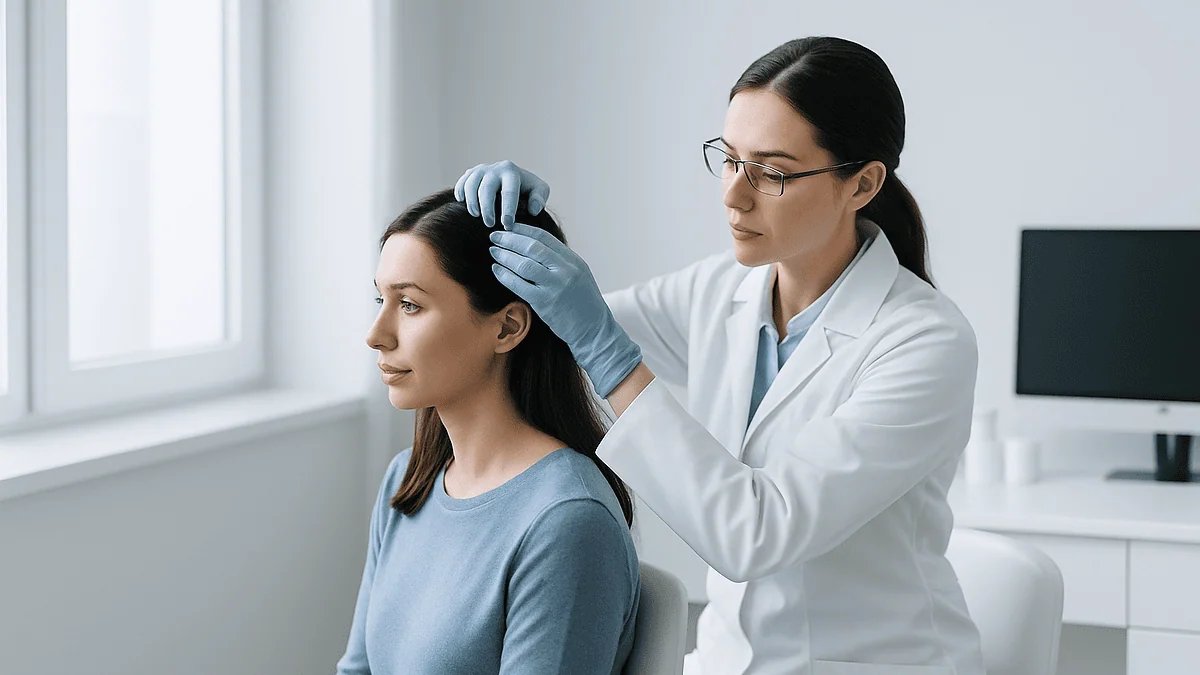
Key Takeaways
- A 3,000-graft transplant moves roughly 6,000 to 7,500 individual hairs, because each follicular-unit graft contains one to four hairs (averaging about 2.2).
- At typical implant densities of 30 to 45 grafts per square centimeter, 3,000 grafts cover roughly 70 to 100 cm², while complete Norwood 6 baldness can exceed 200 cm².
- Transplants restore about 40 to 50 percent of native density; results look full because the eye generally doesn't register thinning until density drops below roughly half of original.
- A 3,000-graft FUE session commonly takes six to ten hours and is sometimes split across two consecutive days to limit graft time outside the body.
- Transplanted hairs shed within about six weeks before regrowing, and final results shouldn't be judged before 12 to 18 months: the crown matures last.
- Lifetime donor supply is commonly estimated at 4,000 to 7,000 grafts, so a single 3,000-graft session can spend half or more of everything you'll ever have.
A 3,000-graft session is a large hair transplant, delivering roughly 6,000 to 7,500 individual hairs, since each graft contains one to four. It can typically rebuild a receded hairline and mid-scalp, or add meaningful density across moderate thinning (around Norwood stages 3 to 5). It usually cannot fully cover advanced baldness, and results take 12 to 18 months to mature.
The photograph that persuades most people to book a consultation is never the “after.” It’s the month-four picture: the one where a man who paid for 3,000 grafts stares into his bathroom mirror at what looks like a five o’clock shadow on his scalp and wonders whether he’s been had. Forums are full of that exact moment.
He hasn’t been had, usually. He’s simply living inside a biological timeline nobody explained in plain numbers. Transplanted follicles shed their shafts, sit dormant for a season, then push out new hair on a schedule that ignores impatience entirely.
The number 3,000 gets thrown around as though it were a standard unit of transformation, like a gallon of paint. It isn’t. What that session covers depends on the size of your bald canvas, the thickness of each hair, and, the part almost no marketing page mentions, how much your pattern is still moving. Let’s do the actual arithmetic.
Is 3,000 Grafts a Lot for a Hair Transplant?
Yes: it sits in the upper-middle range of what surgeons perform in a single session. Small procedures for early recession might use 800 to 1,500 grafts. Sessions above 4,000 in one sitting become logistically demanding: grafts survive best when their time outside the body is short, and a surgical team can only extract and place so many follicular units before quality slips. Cleveland Clinic notes that a typical transplant session runs four to eight hours, and a 3,000-graft day pushes toward the long end of that window.
Context matters more than the raw number, though. On a man with early frontal recession, 3,000 grafts would be overkill, more supply than the bald area can sensibly absorb. On a fully bald Norwood 6 scalp, the same 3,000 grafts spread thin, like buttering two slices of toast with butter meant for one.
There’s also a supply-side reality. Most people carry a finite lifetime donor reserve, commonly estimated in the surgical literature at 4,000 to 7,000 usable grafts from the back and sides of the scalp, depending on density and scalp characteristics. A 3,000-graft session can spend half or more of that budget in a single day. That’s not a reason to fear the number; it’s a reason to make sure the plan behind it accounts for where your hair loss is headed, not just where it stands today.
Grafts vs. Hairs: The Math Most People Get Wrong
A graft is not a hair. This single confusion drives more disappointment, and more misleading comparisons between clinics, than anything else in this field.
Scalp hair grows in natural bundles called follicular units, each containing one to four hairs. When a surgeon quotes 3,000 grafts, they mean 3,000 of these bundles. Because the average follicular unit holds roughly 2.2 hairs, a 3,000-graft session typically moves somewhere between 6,000 and 7,500 individual hairs.
The composition of those grafts shapes the result. Single-hair units create a soft, natural hairline edge; three- and four-hair units build density behind it. A skilled plan sorts them deliberately:
- Single-hair grafts along the frontal edge, where anything thicker looks pluggy
- Two-hair grafts in the transition zone just behind the hairline
- Three- and four-hair grafts in the mid-scalp, where bulk matters most
This is also why two people with identical graft counts can walk away with visibly different results. A patient whose donor hair averages 2.5 hairs per graft receives about 1,000 more hairs from the same 3,000 grafts than someone averaging 2.1. Hair shaft thickness compounds the effect, coarse or wavy hair scatters light and hides scalp far better than fine, straight hair. When comparing before-and-after photos online, you’re often comparing biology as much as surgery.
How Much Area Can 3,000 Grafts Actually Cover?
Here’s the arithmetic clinics rarely spell out. Surgeons typically implant grafts at densities of roughly 30 to 45 follicular units per square centimeter, with the higher figures reserved for the hairline where the eye scrutinizes hardest. Divide 3,000 grafts by those densities and you get a coverage footprint of roughly 70 to 100 square centimeters, about the area of a large smartphone screen.
Now measure the demand. A receded frontal zone and hairline might occupy 30 to 40 cm². Add the mid-scalp and you’re near 70 to 80 cm². A fully bald crown adds 25 cm² or considerably more. Complete Norwood 6 baldness can exceed 200 cm², double or triple what one session supplies at reasonable density.
A representative allocation for a 3,000-graft plan looks something like this:
| Zone | Approximate area | Typical graft allocation |
|---|---|---|
| Hairline and frontal band | 30–40 cm² | 1,200–1,500 |
| Mid-scalp | 30–40 cm² | 1,000–1,300 |
| Crown (partial coverage) | 25 cm² or more | 0–800 |
These figures are planning conventions drawn from surgical practice, not fixed rules, head size, hair caliber, and curl all shift them. The honest takeaway: 3,000 grafts comfortably rebuilds the front two-thirds of a moderately bald scalp, or fully treats one large zone. It rarely does everything at once.
Which Norwood Stages Suit a 3,000-Graft Session?
The Norwood scale: the standard classification for male pattern loss, running from stage 1 (minimal) to stage 7 (a horseshoe of hair around a bald dome), is the most useful shorthand for matching graft counts to reality.
A 3,000-graft session fits most naturally at stages 3 to 5. At Norwood 3 with vertex thinning, it can restore the hairline and reinforce the crown. At Norwood 4, it typically rebuilds the front and mid-scalp convincingly. At Norwood 5, it covers the priority zones but usually leaves the crown lighter, banked for a possible second round.
Stages 6 and 7 are where marketing and mathematics part ways. You will find “Norwood 6 transformation with 3,000 grafts” showcased online, and some of those results are genuinely impressive, but look closely and the density is strategic, not uniform: a strong frontal frame, a combed-back style doing heavy lifting, a crown left thin or bare. That can still be a life-changing outcome. It is not full coverage, and no honest surgeon will frame it that way.
One caveat cuts the other direction: pattern loss diagnosed early may still be progressing. Mayo Clinic notes that hereditary hair loss advances gradually and predictably, which means a scalp that measures Norwood 3 at 28 may be trending toward 5 by 40. Good surgical planning treats the destination, not the snapshot, which sometimes means delaying surgery, and often means discussing medical options with a dermatologist to slow the loss around the transplant.
What Do 3,000 Grafts Look Like: Really?
Not like your hair at 18. That expectation, more than any surgical failure, explains the “unsatisfactory result” posts that rank alongside clinic galleries in search results.
Native scalp carries roughly 80 to 100 follicular units per square centimeter. Transplants typically restore 30 to 45 per square centimeter, call it 40 to 50 percent of original density. The reason results can still look full is an optical quirk clinicians lean on: the scalp generally doesn’t read as “thinning” to the naked eye until density falls below about half of its original level. Restore hair to just above that threshold and the eye fills in the rest, especially at normal conversational distance.
What separates a natural result from an obvious one usually isn’t the count: it’s placement. Hairs exit the scalp at specific angles: nearly flat and forward at the hairline, more upright toward the crown’s whorl. A surgeon who replicates those angles, and who draws a hairline with soft, slightly irregular edges rather than a ruler-straight band, can make 3,000 grafts read as unremarkable, everyday hair. That is the highest compliment a transplant can earn.
Lighting is the stress test. Results that look dense in a clinic photo can look thinner under harsh overhead light or when wet, because you’re seeing the true graft-per-centimeter figure without styling assistance. Ask any clinic you consult to show results in unflattering light. The good ones will.
How Long Does a 3,000-Graft Surgery Take?
Plan for a full working day, commonly six to ten hours with FUE, sometimes split across two consecutive days. Cleveland Clinic puts a typical session at four to eight hours, and 3,000 grafts sits firmly at the ambitious end of a single sitting.
The day divides into distinct phases. After local anesthetic numbs the scalp (you’re awake throughout, per MedlinePlus, and many people watch television or doze), the team extracts follicular units one by one from the donor zone: a rhythm of hours, not minutes. Technicians then sort grafts under magnification by hair count while the surgeon creates thousands of tiny recipient incisions, each set at a deliberate angle. Placement, the final stretch, is painstaking: each graft seated into its incision like a seedling.
Two timing details matter more than the total:
- Time outside the body. Grafts are living tissue kept in chilled holding solution between extraction and placement. Shorter out-of-body time is generally associated with better graft survival, which is one argument some surgeons make for splitting very large sessions across two days.
- Team fatigue. Hour nine of microsurgical placement is not hour two. Ask who is placing your grafts and how the team paces a long day.
A session that finishes suspiciously fast deserves questions, not celebration. In this procedure, speed and precision pull in opposite directions.
FUE or FUT: Does the Method Change What 3,000 Grafts Cover?
Not the coverage: a graft is a graft once it’s placed. What changes is how the 3,000 grafts leave your donor area, and what evidence of that remains.
With FUT (follicular unit transplantation, the “strip” method), the surgeon removes a narrow strip of scalp from the back of the head, closes the wound, and a technician team dissects the strip into individual grafts under microscopes. It leaves a linear scar, typically concealable under hair kept longer than a close buzz. Harvesting 3,000 grafts this way is efficient, and because the strip comes from the densest, most permanent donor zone, graft quality tends to be consistent.
With FUE (follicular unit excision), each graft is punched out individually with a small circular tool, leaving scattered dot scars that fade and hide well even with short haircuts. The trade-off at the 3,000-graft scale: the surgeon must harvest across a wider swath of donor scalp, and overharvesting can visibly thin the donor zone: a complication that’s difficult to reverse.
Neither method wins outright, which is why both remain in mainstream use. FUE dominates current demand, largely for scar preferences and shorter hairstyles. FUT retains advocates for large sessions and for preserving FUE capacity for future procedures. What the evidence supports most clearly is this: the skill and honesty of the team matter far more to your outcome than the acronym on the brochure.
Your Donor Area Is the Real Budget
Every transplant is a relocation, not a creation. The hairs at the back and sides of your head are genetically resistant to the hormonal miniaturization that drives pattern baldness: that’s the entire premise of the surgery, and it’s why those hairs generally keep growing after they’re moved. But the reserve is finite, and it does not replenish.
Estimates in the surgical literature commonly place lifetime donor capacity between 4,000 and 7,000 grafts, varying with donor density, scalp laxity, and hair characteristics. Frame a 3,000-graft session against that ceiling and the strategic question becomes obvious: this one procedure may consume 45 to 75 percent of everything you will ever have to work with.
That framing should shape three decisions:
- Where the grafts go first. The frontal third of the scalp frames your face and delivers the most visual return per graft. The crown, by contrast, is a density sinkhole: its whorl pattern exposes scalp and can quietly absorb 1,500 grafts or more.
- What you hold in reserve. If your pattern is still evolving, spending the entire budget at 30 can leave nothing for the loss that arrives at 40.
- Whether medical management joins the plan. Prescription treatments that slow androgenetic loss, worth discussing with a dermatologist, protect the native hair around your grafts, effectively stretching the donor budget.
A surgeon who talks about your donor area as carefully as your bald area is a surgeon thinking in decades. That’s the one you want.
The Growth Timeline: What Happens Month by Month
MedlinePlus describes the sequence plainly: transplanted hair sheds within about six weeks, and new growth from those same follicles appears over the following months. The follicle survives the move; the hair shaft doesn’t. Knowing this in advance turns the timeline from alarming to merely tedious.
Here’s the arc most patients experience, acknowledging that individual variation is wide:
- Weeks 1–2: Scabbing, redness, and swelling settle. The grafts anchor into their blood supply: the fragile window.
- Weeks 2–8: Shock loss. Most transplanted shafts shed, and some neighboring native hairs may temporarily shed too. This is the demoralizing stretch; it is also expected physiology.
- Months 3–5: New growth emerges as fine, sparse, sometimes wiry hairs. Coverage looks patchy because follicles wake on staggered schedules.
- Months 6–9: The visible turn. Many patients see perhaps half to two-thirds of their eventual result, with shafts still thickening.
- Months 12–18: Maturation. Hairs gain caliber, texture normalizes, and the crown, which reliably lags the hairline, catches up last.
Judge nothing before month twelve. The one-year-later disappointment posts online split into two camps: genuine underperformance, and crown-heavy cases evaluated months before the crown was done growing. Photograph yourself monthly under the same light. Memory is a terrible instrument for measuring gradual change; a camera roll is honest.
Why Some 3,000-Graft Results Disappoint
Search results for this topic include a telling entry: “3000 Grafts | 1 Year Later | Unsatisfactory Result.” Those posts deserve a straight answer, because the causes are knowable and mostly preventable.
Expectation mismatch leads the list. A patient promised “full coverage” of a Norwood 5–6 scalp with 3,000 grafts was set up to be disappointed by arithmetic before the first incision. The grafts grew; the plan oversold them.
Graft survival varies. Published case series generally report survival rates in the range of 85 to 95 percent under good conditions, but rough handling, extended time outside the body, dehydration of grafts, and poor placement technique all erode that figure. A 15-point drop in survival on a 3,000-graft session is 450 grafts, roughly 1,000 hairs, that never grow.
Ongoing native loss is the quiet saboteur. The transplant holds; the untreated hair around it keeps miniaturizing. Two years later the frame has shifted and the result looks thinner, even though every transplanted follicle is doing its job. This is why many surgeons pair surgery with medical management of the underlying condition.
Untreated non-pattern causes matter too. The NHS and Mayo Clinic both note that thyroid disease, iron deficiency, significant stress, and autoimmune conditions can drive hair loss, and transplanting into a scalp with an undiagnosed, unstable condition invites poor outcomes. A proper workup before surgery isn’t bureaucracy; it’s insurance.
Will You Need a Second Session?
Possibly, and it’s better to know that going in than to discover it at year three. MedlinePlus states it directly: achieving the desired fullness may require several transplant sessions.
Three scenarios commonly send patients back:
- The crown was deferred. Many 3,000-graft plans deliberately concentrate on the frontal two-thirds and leave the crown for a later round, once the first result has matured and the remaining donor supply can be measured accurately.
- The pattern advanced. Pattern hair loss is progressive. A hairline rebuilt at 32 can find itself standing alone by 42 if the native hair behind it continues to recede, creating an island effect that a second session (or earlier medical management) addresses.
- Density touch-ups. Some patients simply want more than the roughly 40 to 50 percent of native density a first pass provides, and add 800 to 1,500 grafts to the same zones.
Timing matters. Most surgeons prefer to wait 12 months or more between sessions, partly to let the first result declare itself fully, partly to let the donor area recover before another harvest.
The financial and biological implications are the same: treat the first 3,000 grafts as chapter one of a plan, not the whole book. Ask your surgeon to sketch what a second session would target, what it would cost in donor supply, and what happens if you never have one. The answers reveal how far ahead they’re actually thinking.
Recovery: The First Two Weeks, Honestly
The good news: recovery from a hair transplant is more inconvenience than ordeal. The procedure is outpatient, done under local anesthetic, and MedlinePlus notes that most people can return to work within two to five days, though “can” and “want to” diverge if your job involves an audience, because your scalp will announce itself.
Expect, roughly in order: a snug bandage or none at all depending on technique, pinpoint scabs across the recipient area for seven to ten days, some swelling that can migrate down toward the forehead and eyes around days two to four, and itching as everything heals. Discomfort is usually managed with whatever your surgical team recommends; the donor area often aches more than the recipient zone, particularly after a strip procedure.
The behavioral rules exist to protect grafts during their fragile first days, before they’ve fully anchored into blood supply:
- No scratching or picking at scabs, however insistent the itch
- Gentle washing only, per your team’s specific protocol
- Sleeping with the head elevated for the first several nights
- No strenuous exercise, heavy lifting, or heavy sweating for one to two weeks
- Protecting the scalp from direct sun while it heals
By week two, most visible evidence has faded enough that casual observers notice little, especially if surrounding hair was left long enough to comb over the work. Then begins the long, boring middle of the timeline, where patience does the heavy lifting.
Risks, Red Flags, and When to See a Doctor
Hair transplantation is generally considered safe when performed by qualified practitioners, but it is surgery, and MedlinePlus lists the standard risks: bleeding, infection, scarring, and the possibility that grafts fail to take. Add to that list temporary numbness of the scalp, small cysts at graft sites, and shock loss of surrounding native hair, which usually recovers.
Contact your surgical team or a doctor promptly if you notice:
- Fever, or chills, in the days after surgery
- Spreading redness, warmth, or swelling around the donor or recipient areas
- Pus or foul-smelling discharge from any wound
- Bleeding that doesn’t stop with gentle pressure
- Pain that intensifies after the first few days instead of easing
- Numbness that persists beyond several weeks
There’s an equally important doctor visit that belongs before surgery. Hair loss is a symptom, not a single disease. The NHS and Mayo Clinic both point out that thyroid disorders, iron deficiency, autoimmune conditions such as alopecia areata, scalp infections, significant stress, and certain medications can all cause shedding, and several of those causes are treatable without surgery, while others make transplantation inappropriate until stabilized. Sudden, patchy, or rapid hair loss in particular warrants medical evaluation, not a graft quote.
A dermatologist’s diagnosis costs a fraction of a transplant and can save you from spending 3,000 irreplaceable grafts on the wrong problem. No reputable surgeon skips that step; if a clinic does, keep walking.
Questions Worth Asking Before You Commit to 3,000 Grafts
The consultation is where good outcomes are actually decided, months before any incision. These questions separate careful surgical planning from volume-driven sales:
- “Why 3,000, show me the measurement.” A credible number comes from measuring your bald area in square centimeters and multiplying by a target density, and often from a densitometry check of your donor zone. A number quoted in the first five minutes, sight unseen, is a sales figure.
- “Where does my pattern end up, and what’s the plan for that?” Listen for talk of donor reserves, staged sessions, and medical management of ongoing loss, evidence of decade-scale thinking.
- “Who extracts, who makes incisions, who places?” In some clinics the surgeon does most of the work; in others, technicians do. You’re entitled to know before, not after.
- “Show me results in harsh light, wet hair, and at 18 months.” Curated gallery lighting flatters everyone. Unforgiving conditions tell the truth.
- “What happens if I’m in the unlucky minority?” Every honest practice has cases that underperformed. How a clinic discusses them reveals more than its best photos do.
One more, for yourself rather than the surgeon: have I had the underlying cause of my hair loss diagnosed and, where possible, stabilized? A transplant placed into a still-moving pattern is furniture arranged on a sinking floor. Get the floor steady first, then 3,000 grafts can do exactly what the arithmetic says they can.
Frequently asked questions
Is 3,000 grafts a lot for a hair transplant?
Yes: it’s a large session, in the upper-middle range of what’s performed in a single sitting. Smaller procedures for early recession use 800 to 1,500 grafts, while single sessions rarely exceed 4,000 because graft survival and team precision decline over very long days. Whether 3,000 is enough depends on your bald area: it suits moderate loss (roughly Norwood 3 to 5) far better than advanced baldness.
How many hairs is 3,000 grafts?
Roughly 6,000 to 7,500 hairs. Each graft is a follicular unit: a natural bundle containing one to four hairs, averaging about 2.2. Composition matters as much as count: single-hair grafts build a soft hairline edge, while three- and four-hair grafts create density behind it. Two patients with identical graft counts can receive over 1,000 more or fewer hairs depending on their donor hair’s characteristics.
How much area can 3,000 grafts cover?
Roughly 70 to 100 square centimeters at typical implant densities of 30 to 45 grafts per square centimeter, about the area of a large smartphone screen. That’s usually enough to rebuild a receded hairline plus the mid-scalp, or to fully treat one large zone. It generally falls well short of covering complete baldness, since a fully bald scalp can exceed 200 square centimeters.
Can 3,000 grafts cover a Norwood 6?
Not fully, at natural-looking density. A Norwood 6 scalp can exceed 200 square centimeters of bald area, roughly double what 3,000 grafts supply at standard densities. Surgeons managing Norwood 6 cases with 3,000 grafts typically prioritize the frontal zone and mid-scalp, leaving the crown light or bare, which can still transform how someone looks face-on, but it’s strategic framing, not complete coverage.
How long does a 3,000-graft hair transplant take?
Usually six to ten hours, and some surgeons split it across two consecutive days. Cleveland Clinic describes typical sessions running four to eight hours, and 3,000 grafts sits at the demanding end. The day involves extracting grafts one by one, sorting them under magnification, creating thousands of angled recipient incisions, and placing each graft individually. Excessive speed is a warning sign, not a selling point.
How long until I see results from 3,000 grafts?
Meaningful change appears around months six to nine, with full results at 12 to 18 months. First comes a discouraging phase: transplanted hairs shed within about six weeks of surgery, per MedlinePlus, and new growth doesn’t emerge until roughly months three to five. Hairs then thicken gradually, and the crown reliably matures months behind the hairline. Judging the outcome before one year is premature.
Do transplanted hairs fall out?
Yes, temporarily and predictably. Most transplanted hair shafts shed within about six weeks of surgery, a phase often called shock loss, and some neighboring native hairs may shed too. The follicles themselves survive the move and begin producing new hair over the following months. Because donor follicles come from zones genetically resistant to pattern baldness, the regrown hair is generally long-lasting once established.
Is a 3,000-graft transplant permanent?
The transplanted follicles are generally long-lasting, because they come from the back and sides of the scalp, where hair is resistant to the hormonal process driving pattern baldness. What isn’t permanent is the untreated native hair around the grafts, pattern loss is progressive, so surrounding hair can continue thinning for years. That’s why many patients pair surgery with medical management, discussed with a dermatologist, and sometimes a later second session.
Can 3,000 grafts do the hairline and crown at the same time?
Sometimes, but usually with compromise. Covering the hairline, mid-scalp, and crown convincingly can demand 4,000 grafts or more in total, so a 3,000-graft plan spanning all three zones spreads density thin. Most surgeons prioritize the frontal two-thirds, which frames the face and delivers the most visual impact, and either allocate a modest portion to the crown or defer it to a second session.
What if I don't have enough donor hair for 3,000 grafts?
Then a smaller, well-placed session is the honest answer. Donor capacity varies widely with density, scalp laxity, and hair caliber, and overharvesting causes visible, hard-to-reverse thinning at the back of the head. A responsible surgeon measures your donor zone before quoting any number and may recommend fewer grafts, staged sessions, medical management of ongoing loss, or, in some cases, advising against surgery altogether.
References
This article is for general information only and is not a substitute for professional medical advice. Please consult a qualified doctor about your individual situation.

Planning This Treatment in Turkey
Our full guide for international patients: techniques, hospital stay, recovery and cost.
More from the Blog

Preparing for Scalp Micropigmentation: Skin Type Review, Tanning, Alcohol and What to Pause
Scalp micropigmentation preparation usually starts with a skin type review covering tone, scarring tendency and any active scalp condition, followed by a few weeks…

How an Afro Hair Transplant Is Performed: Curved Punches, Curl-Aware Extraction and Placement
An afro hair transplant uses the same follicular unit extraction or strip principles as any hair transplant, adapted to hair that curves beneath the…
Crown Hair Transplant: Why the Vertex Is the Hardest Zone to Restore
A crown hair transplant is considered the most technically demanding restoration because hair at the vertex grows in a spiral whorl that requires a…
What Donor Assessment Before Hair Transplant Repair Reveals: Remaining Capacity and the Plan
Donor area assessment before hair transplant repair is a structured examination of the scalp, beard and sometimes body hair that remains available after earlier…

FUE vs FUT: Scars, Yield and Recovery: the Neutral Comparison
FUE removes follicles one at a time, leaving tiny dot scars and a quicker donor-area recovery; FUT removes a thin strip of scalp, leaving…
What to Ask Before Aesthetic Scalp Surgery: Photos, Hairline Goals and What the Plan Covers
Before hairline lowering surgery, also called forehead reduction, ask how far your hairline can realistically move given your scalp laxity, where the incision will…