

Laser Eye Surgery in Turkey: Risks, Side Effects, and Safety
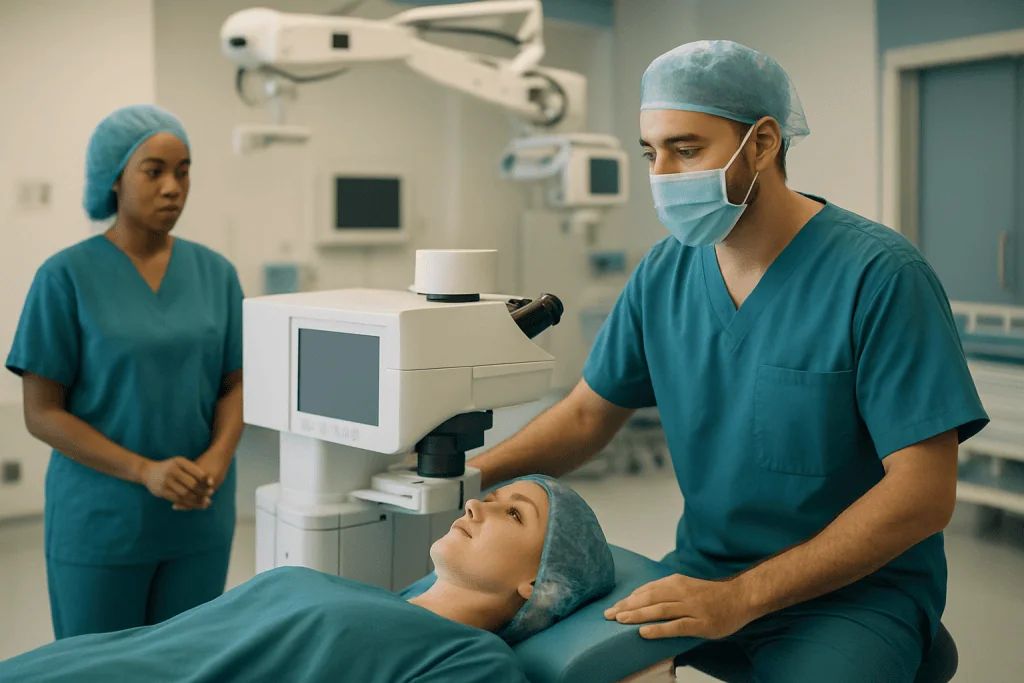
Laser eye surgery in Turkey is a short outpatient procedure performed under numbing drops, usually with same-day discharge. Safety depends less on the country than on careful patient selection, thorough corneal testing, an experienced ophthalmology team and planned follow-up before you fly. This guide explains LASIK, PRK and SMILE, the honest risks and side effects, and how to plan travel around recovery rather than the other way round.
You are weighing up laser eye surgery in Turkey and you want a straight answer to a fair question: is it safe, what can go wrong, and how do you fit assessment, treatment and follow-up into a trip abroad? This guide covers exactly that. It explains who the treatment suits and who it does not, how LASIK, PRK and SMILE differ, which side effects are normal and which are not, and how to plan travel so that recovery, not the flight home, sets the timetable.
It also describes how the process works for international patients treated with Acibadem International in Istanbul and elsewhere in Turkey, from the online review before you travel to the checks that happen before you leave.
At a glance
- Procedure type: Outpatient laser vision correction (LASIK, PRK or SMILE)
- Purpose: To reduce dependence on glasses or contact lenses by reshaping the cornea
- Anaesthesia: Numbing eye drops in most cases; general anaesthesia is rarely needed
- Hospital stay: Usually same-day discharge after a short observation period
- Early recovery: Often days, though vision commonly fluctuates before it settles
- Vision stabilisation: Typically weeks to months, depending on technique and healing
- Flying home: Only after your ophthalmologist confirms travel clearance at follow-up
- Suitable department: Ophthalmology / Eye Care
- International patient support: Interpreters, airport–hotel–hospital transfers, accommodation guidance and remote follow-up coordination
What laser eye surgery in Turkey involves
Laser eye surgery is a group of procedures that reshape the cornea, the clear front surface of the eye, so that light focuses more accurately on the retina. It is used to correct refractive errors: myopia (short-sightedness), hyperopia (long-sightedness) and astigmatism, alone or in combination. The aim is to reduce your dependence on glasses or contact lenses. It is not a treatment for eye disease, and it does not stop the eye ageing.
Three techniques dominate modern practice: LASIK, PRK and SMILE. They differ in how the corneal tissue is accessed, how quickly the surface heals, and which prescriptions they suit. None is universally “best”. The right technique for one person can be the wrong one for another with a similar prescription, which is why detailed corneal measurement matters more than the name of the procedure.
When you plan laser eye surgery in Turkey as an international patient, the treatment itself is only one part of the pathway. A properly run programme includes preliminary review before you travel, in-person diagnostic testing, the procedure, at least one early follow-up check, and a clear plan for what happens after you go home. You can read more about how laser surgery is organised across Acibadem’s departments, but the shape of the eye pathway is always the same: measure first, decide second, treat third.
When is it recommended?
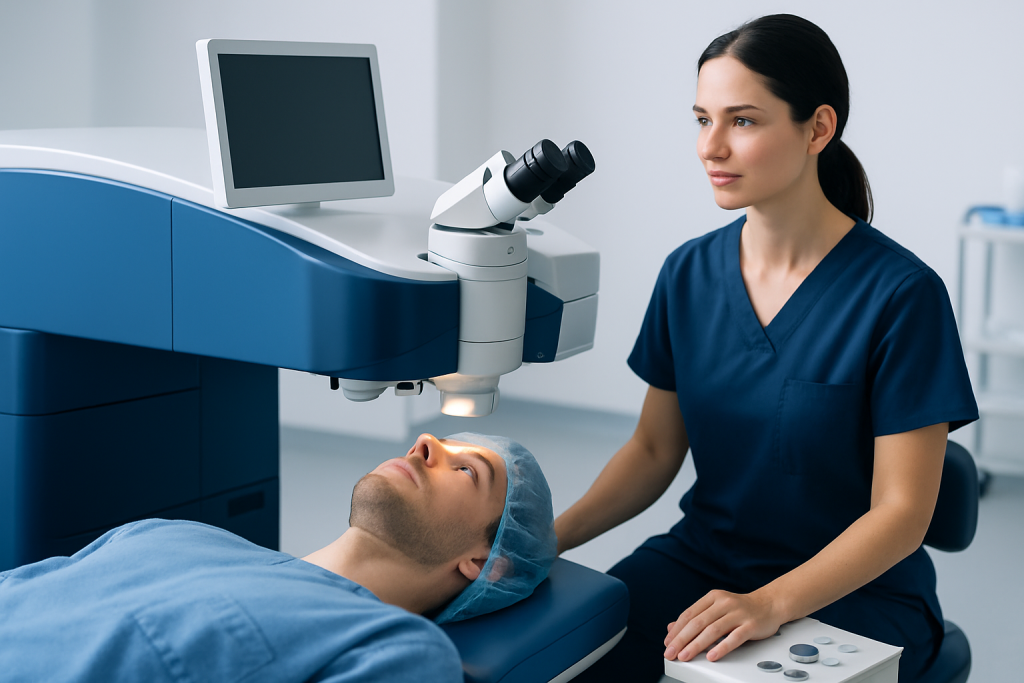
Laser vision correction is usually considered when you want to reduce your need for glasses or lenses and your prescription has been stable for a period your ophthalmologist considers adequate. A prescription that is still changing is a reason to wait, because treating a moving target tends to produce a result that drifts.
Practical motivations are legitimate. Some people find contact lenses uncomfortable or hard to tolerate; others work, travel or play sport in conditions where glasses and lenses are a genuine nuisance. What matters is that lifestyle preference comes second to medical suitability, not the other way round.
There are also clear reasons to delay or decline treatment. An unstable prescription, certain corneal conditions, untreated dry eye, an active eye infection, pregnancy-related vision changes and age-related lens changes can all make laser surgery the wrong choice, sometimes temporarily, sometimes permanently. A careful preoperative assessment exists precisely to find these issues before a laser is involved.
Who is a good candidate?

The typical good candidate is an adult with a stable prescription, healthy corneas of adequate thickness, a reasonable tear film and no significant untreated eye disease. Just as important: a good candidate understands the limits of the procedure. Laser surgery reduces dependence on glasses; it does not promise perfect vision in every situation, and it does not prevent the reading-vision changes that come with age.
Suitability rests on far more than your prescription. The ophthalmology team examines corneal thickness and shape, pupil size, tear production, retinal health, previous eye problems and your general medical history. Severe dry eye, keratoconus or suspected corneal instability, poorly controlled diabetes, some autoimmune conditions and certain medications can all change the recommendation.
Behaviour matters too. You are a better candidate if you can follow instructions precisely: stopping contact lens wear before assessment when advised, attending every follow-up, using prescribed drops on schedule and protecting your eyes during recovery. If the examination shows you sit on the borderline, a responsible surgeon discusses alternatives rather than forcing a marginal decision. That conversation is a feature of good care, not a sales failure.
LASIK, PRK and SMILE compared
Each technique has a distinct profile, and the differences matter most in the first weeks of healing.
LASIK creates a thin corneal flap, reshapes the tissue beneath it with a laser, and repositions the flap. Visual recovery is often quick and early discomfort tends to be mild. The trade-off is the flap itself, which introduces a small category of flap-related complications and means eye rubbing and impact sports need particular care early on.
PRK treats the corneal surface directly, with no flap. It is often considered where the cornea is thinner or where lifestyle factors make a flap undesirable. The surface takes longer to heal, so early recovery is slower and less comfortable than LASIK, and vision typically sharpens more gradually.
SMILE is a flapless technique in which a small piece of corneal tissue (a lenticule) is removed through a tiny incision. It is used for selected prescriptions and appeals to patients wanting a minimally invasive approach, though it is not suitable for every refractive error.
| Technique | Access | Early recovery pattern | Key consideration |
|---|---|---|---|
| LASIK | Corneal flap | Often fast, mild discomfort | Flap care; avoid eye rubbing and impact early on |
| PRK | Surface treatment, no flap | Slower, more discomfort in the first days | Longer surface healing; bandage lens usually worn |
| SMILE | Small incision, no flap | Generally comfortable, gradual sharpening | Suits selected prescriptions only |
Sometimes none of these is the right answer. Lens-based procedures, or simply continuing with glasses or contact lenses, are valid outcomes of a good assessment. The safest treatment is the one matched to your measurements, not the one most heavily advertised.
Online evaluation before travel
For international patients, the pathway usually begins remotely. The team reviews your age, current prescription, eye history, general medical conditions, medications and any previous eye procedures. This preliminary step exists to answer one question: is an in-person assessment worth the trip?
Be clear about what an online review can and cannot do. It can identify obvious reasons the surgery is unlikely to suit you. It cannot confirm suitability, because that depends on measurements that can only be taken in person: corneal topography, pachymetry (thickness measurement), refraction, tear film assessment and a full eye health examination. Any provider who confirms you as a candidate from a form and a photograph is skipping the step that makes this procedure safe.
If the preliminary review is favourable, you can plan travel with a realistic idea of the likely technique, the expected timeline, and how many days you should allow in Turkey for testing, treatment and early follow-up. Acibadem’s approach to pre-travel screening is described in more detail in how surgical risks and safety checks are explained before you travel.
Before the procedure
The in-person examination confirms or overturns the preliminary picture. Expect vision testing, refraction, corneal mapping, thickness measurement, tear film assessment, intraocular pressure measurement and retinal evaluation. Your doctor will also go through your medical history, your expectations and anything that could raise risk or slow healing.
Contact lenses temporarily change the shape of the cornea, so you will usually be asked to stop wearing them for a period before assessment and treatment. How long depends on the lens type, soft and rigid lenses differ, and your doctor will set the exact timing. Tell the team about all medications and supplements, previous eye conditions, allergies, pregnancy status and any history of dry eye.
Practical preparation is simple: arrange not to drive yourself after the procedure, skip eye makeup, perfume and creams around the eyes on the day if advised, bring sunglasses, and plan a quiet first day. If you want a structured way to prepare your questions for the consultation, the safety and consent checklist for surgery in Turkey is a good starting point.
What happens on the day
Laser eye surgery is a day procedure. After final measurements and checks, numbing drops are applied so you should not feel sharp pain during treatment. You stay awake, and the team talks you through each step. Pressure sensations, bright lights and moments of blurred vision are normal during the procedure; the laser treatment itself is brief, usually a matter of seconds per eye, though you should expect to spend considerably longer in the unit for preparation and immediate post-procedure checks.
The steps vary by technique. In LASIK, the flap is created and the tissue beneath is reshaped. In PRK, the surface layer is removed before reshaping. In SMILE, the lenticule is extracted through a small incision. Afterwards, your vision may already seem different, but blur, haze, watering and light sensitivity are entirely normal at first. Depending on the method, the team may place a bandage contact lens (standard after PRK) or give you eye shields for rest. Before you leave, you receive your drop schedule, activity restrictions and follow-up times in writing.
Discharge and the first hours
An overnight stay is rarely needed. After a short observation period and a satisfactory immediate check, you return to your hotel the same day. Because your vision will be blurred and your eyes may be watery and light-sensitive, you need arranged transport: this is one of the practical points international patient coordination handles for you.
Discharge timing depends on the technique and how your eyes look immediately afterwards. You leave with written instructions, prescribed drops and the time of your first follow-up visit. Travel clearance is individual: some patients are cleared to fly relatively soon, while others, particularly after PRK, where the surface heals more slowly, are advised to stay longer for checks. The comparison in flying after eye surgery explains why the technique changes the travel advice.
Recovery timeline
Recovery varies by person and by technique. Early improvement is often noticeable quickly, but fluctuating vision before stabilisation is normal, not a sign of failure. Dryness, glare, halos, mild discomfort and light sensitivity are common during healing and usually ease with time and consistent aftercare.
| Timeframe | What to expect |
|---|---|
| First 24 hours | Blurred or hazy vision, watering, light sensitivity and mild irritation. Rest is usually recommended; use drops exactly as prescribed. |
| First week | Vision often starts to sharpen, especially after LASIK or SMILE, with day-to-day fluctuation. Dryness, night glare and a gritty sensation may continue. PRK improves more slowly at this stage. |
| Weeks 2–4 | Daily activities feel easier, but vision can still vary. Follow-up visits confirm the cornea is healing as expected. |
| Months 1–3 | Vision usually becomes more stable. Night-vision symptoms and dryness often improve, though some people need longer management. |
| Final result | Assessed over weeks to months depending on technique and healing. A minor residual prescription can remain in some cases. |
Your surgeon sets the timing for returning to work, screens, exercise, swimming, makeup and travel. Treat the table above as a general pattern, not a personal schedule.
What to avoid during recovery
Do not rub your eyes, even when they feel itchy or gritty. Rubbing interferes with healing and, after LASIK in particular, can disturb the flap. Use lubricating and medicated drops as prescribed, and wear the shields or sunglasses you are given.
For a period your doctor will define, avoid swimming pools, hot tubs, saunas, dusty environments, eye makeup and contact sports. These restrictions lower the chance of irritation, infection and accidental trauma while the surface is vulnerable. Showering is usually fine, but keep soap, shampoo and direct water out of the eyes early on.
Driving, work, screen time and exercise come back in stages. Feeling eager is not the same as being ready; following the surgeon’s timing is one of the most reliable things you can do for a predictable result.
Risks and possible complications
Laser eye surgery is widely performed, but no surgical procedure is free of risk, and it is worth being precise about what the risks actually are.
Common, usually temporary effects include dry eyes, glare, halos and starbursts around lights at night, light sensitivity and fluctuating vision during healing. These typically improve over weeks to months, but in a minority of people they persist longer and need ongoing management, dry eye in particular can outlast the expected healing window.
Less common but more significant complications include infection, inflammation, delayed surface healing, corneal haze (mainly after PRK), flap-related problems after LASIK, and under- or over-correction leaving a residual prescription. In some cases an enhancement procedure is considered after specialist reassessment; in rare cases vision does not improve as hoped. Some patients still need glasses for specific tasks, night driving, fine detail, or reading as they get older.
The single most effective safety measure is patient selection. Most avoidable problems trace back to treating eyes that should not have been treated, or choosing the wrong technique for the cornea in front of the surgeon. Thorough preoperative testing, conservative planning and scheduled follow-up are what “safe” actually looks like in practice: the same principles described in how risks and side effects of treatment in Turkey are managed.
How healing is monitored
Follow-up is not an optional extra after laser eye surgery; it is part of the treatment. Early checks confirm that the corneal surface or flap is settling properly, that pressure and inflammation are within expected limits, and that your drop regimen is doing its job. This is why travel clearance is given at a follow-up visit rather than assumed in advance.
Certain findings during healing, a marked drop in vision, escalating pain, significant redness or discharge, are treated as urgent by ophthalmologists precisely because they can signal infection or other complications that respond best to prompt assessment. Structured follow-up exists so that such findings are caught early, whether at your in-person checks in Turkey or through the ophthalmic care arranged near your home afterwards. Remote communication with your treating team can support the planned parts of follow-up once you have returned.
Results and realistic expectations
The goal is reduced dependence on glasses and contact lenses, and many patients gain clearer uncorrected vision for daily life. Results vary with the type and degree of refractive error, corneal characteristics, healing response, age and any coexisting eye conditions. A surgeon who promises a fixed outcome is promising something no examination can support.
Two long-term points deserve honesty. First, laser surgery does not stop presbyopia: the age-related change that makes reading harder from the mid-forties onwards happens in the lens, not the cornea, so reading glasses can still become necessary years after a well-executed procedure. Second, a degree of prescription drift (regression) can occur over years in some people, and cataract can still develop later in life exactly as it would have without surgery. Ten years on, most of what has changed in a treated eye is ageing, not the laser, but it is ageing the laser never claimed to prevent.
Travel planning for international patients
Plan the trip around three fixed points: preoperative assessment, treatment day and the early follow-up review your doctor requires before clearance. The procedure is short; the days that make it safe sit either side of it. How many days you need in Turkey depends on the technique and how your eyes look at follow-up, so build slack into your return booking rather than a hard deadline.
Bring your passport, previous prescriptions, glasses, contact lens details and any eye records you have. Travel with sunglasses. Do not schedule intensive sightseeing straight after surgery, light-sensitive, tired eyes and a full itinerary do not mix, and do not assume you can fly home without clearance.
Acibadem International supports international patients with interpreters, airport–hotel–hospital transfers and accommodation guidance, which matters most in the first blurry hours after treatment and when instructions need to be understood exactly.
How cost works
The cost of laser eye surgery in Turkey is built from several components rather than a single fixed figure. What you are quoted reflects the technique recommended, the complexity of your prescription, the technology used, the depth of diagnostic testing required, the hospital setting, and how much follow-up care your stay includes.
Packages for international patients typically bundle some or all of the following: preliminary review, in-person consultation, preoperative measurements and tests, the procedure itself, standard discharge instructions and scheduled early follow-up visits. Non-medical support, interpreter assistance, transfers, accommodation coordination, is included in some packages and not others.
Just as important is what a package usually excludes: flights, hotel nights, meals, travel insurance, extra nights if healing needs more time in Turkey, treatment for unrelated medical issues, medicines beyond the standard plan, and any care you choose to have elsewhere afterwards. A properly prepared written quotation, issued after medical review, sets out inclusions and exclusions explicitly: that document, not a headline figure, is the honest basis for comparing providers.
Why choose Acibadem
Travelling abroad for eye surgery means you need more than a laser. You need screening that is willing to say no, communication you fully understand, and a follow-up plan that works across borders. Acibadem International structures its pathway around those needs: preliminary review before travel, detailed in-person ophthalmic assessment, treatment matched to measurement, and coordinated follow-up before and after you fly.
Practical support, interpreters, transfers, accommodation guidance and remote communication after your return, sits alongside the clinical pathway. For an eye procedure, where instructions and timing carry real weight, understanding every step in your own language is a safety measure, not a comfort.
Above all, the question the assessment answers is whether laser eye surgery is right for your eyes. If it is, you proceed with a clear plan and realistic expectations. If it is not, you are told so plainly and the alternatives are explained.
Medical review and disclaimer
This guide has been medically reviewed by the Acibadem International medical team. It is intended to provide general educational information for international patients considering laser eye surgery in Turkey.
It does not replace a personal consultation, formal diagnosis or treatment plan from a qualified ophthalmologist. Every eye is different, and suitability for laser eye surgery depends on detailed examination findings, medical history and professional judgment.
Recommendations, recovery, risks and expected results can only be confirmed after individual assessment with appropriate eye testing.
Step by step
- Initial contact. You contact Acibadem International about laser eye surgery, your goals and possible travel dates.
- Medical record submission. You share your glasses or contact lens prescription, eye history, medical details and any previous eye records.
- Preliminary medical review. The team reviews whether an in-person ophthalmology assessment is worth arranging.
- Treatment plan and quotation. If it makes sense to proceed, you receive a proposed pathway, likely timeline and a written quotation showing inclusions and exclusions.
- Travel planning. Appointments, transfers and accommodation guidance are arranged around the assessment and follow-up dates.
- Arrival. You are guided to your consultation and testing appointments after arriving in Turkey.
- In-person consultation. An ophthalmologist examines your eyes in detail, confirms or revises suitability, and explains your options.
- Preoperative tests. Corneal mapping, thickness measurement, refraction and tear film assessment are completed before final approval.
- Treatment. The procedure is performed as a planned outpatient treatment using the technique matched to your measurements.
- Observation and discharge. You recover briefly under observation and usually return to your hotel the same day.
- First control. The early follow-up check assesses healing and reviews your eye drop plan.
- Travel clearance. Once your doctor confirms healing is on track, you receive travel advice and discharge instructions.
- Remote follow-up. Planned follow-up guidance continues remotely after you return home, with local ophthalmic care arranged as part of the plan where needed.
Your checklist
- Passport or valid travel identification
- Current glasses prescription and any recent eye test reports
- Contact lens details and how often you wear them
- Complete medical history, including chronic conditions
- List of current medications and supplements
- Known drug, latex or eye drop allergies
- Details of previous eye procedures or surgeries
- Details of any previous non-eye surgeries
- Current symptoms such as dryness, glare, blurred vision or contact lens intolerance
- Relevant test results, scans or ophthalmology reports if available
- Photos or imaging if specifically requested by the care team
- Emergency contact information and travel insurance details if applicable
- Sunglasses for the days after treatment
Key takeaways
- Laser eye surgery may suit adults with a stable prescription and healthy corneas, confirmed only by in-person testing, never by an online form alone.
- LASIK, PRK and SMILE heal differently; the technique changes both the recovery pattern and the travel advice.
- Dryness, glare, halos and fluctuating vision are common during healing; serious complications are uncommon but real, which is why follow-up is part of the treatment.
- No laser procedure prevents age-related reading changes, and a residual prescription can remain in some cases.
- Plan your trip around assessment, treatment and follow-up clearance: the flight home comes last, not first.
Frequently asked questions
How much does laser eye surgery cost in Turkey?
There is no single figure, because the quotation is built from your case: the technique recommended, the complexity of your prescription, the diagnostic testing needed, the hospital setting and how much follow-up your stay includes. Packages differ in what they bundle, so the meaningful comparison is a written quotation issued after medical review, with inclusions and exclusions listed explicitly, not a headline price.
Is laser eye surgery in Turkey safe?
Safety depends less on the country than on how the treatment is run: thorough patient selection, detailed corneal testing, experienced ophthalmology teams, proper infection control and scheduled follow-up before travel clearance. Those elements exist in well-run centres in Turkey as they do elsewhere. The useful question is not “is the country safe?” but “does this provider measure first, decline unsuitable candidates, and plan follow-up properly?”
Is laser eye surgery completely safe?
No surgical procedure is. Common temporary effects include dryness, glare, halos and fluctuating vision during healing. Less common complications include infection, inflammation, flap-related problems after LASIK, corneal haze after PRK, and under- or over-correction leaving a residual prescription. Careful candidate selection and follow-up reduce risk substantially, but they cannot eliminate it, and any claim otherwise should make you cautious.
What happens 10 years after LASIK?
Many people continue to enjoy reduced dependence on glasses years after treatment, but the eye keeps ageing. Presbyopia, the reading-vision change that begins in the mid-forties, still happens because it occurs in the lens, not the cornea. Some people experience a degree of prescription drift over the years, and cataract can develop later in life exactly as it would have without surgery. LASIK corrects a refractive error; it does not freeze the eye in time.
Which technique is best: LASIK, PRK or SMILE?
None is best in the abstract. LASIK usually offers fast visual recovery but involves a corneal flap. PRK avoids a flap and may suit thinner corneas, at the price of slower, less comfortable early healing. SMILE is flapless and minimally invasive but suits selected prescriptions only. The choice follows from corneal thickness and shape, tear film quality, prescription and lifestyle, which is why it is made after measurement, not before.
How long should I stay in Turkey for laser eye surgery?
Long enough for the preoperative assessment, the treatment day and at least one early follow-up review: the visit at which travel clearance is decided. The total depends on the technique and how your eyes look at follow-up; PRK generally needs more patience than LASIK or SMILE. Book flexible return travel rather than a hard deadline.
Is the procedure painful?
Numbing drops are used, so sharp pain is not expected during treatment, though pressure sensations and bright lights are normal. Afterwards, stinging, grittiness, watering and light sensitivity are common in the first days, and the level of discomfort varies by technique: PRK tends to be the least comfortable early on because the surface heals more slowly.
Can I fly home soon after laser eye surgery?
Many patients travel after a short recovery period, but only after the ophthalmologist confirms clearance at follow-up. The timing depends on the technique used, the condition of your eyes at the check, and whether early healing needs further monitoring. Cabin air is dry, so lubricating drops and a lighter schedule around the flight are usually advised as part of the discharge plan.
Add us as a Preferred Source to see more of our trusted health content across Google Search, AI Overviews and Discover.

Update history
- PublishedJune 22, 2026
- Medical review approvedSeptember 13, 2026
- Last content updateSeptember 13, 2026
References2
- NHS: Laser eye surgery and lens surgery nhs.uk
- MedlinePlus: Laser eye surgery (LASIK) medlineplus.gov
More Patient Guides

HoLEP in Turkey: How It Compares With TURP and What Recovery Involves
HoLEP in Turkey treats enlarged prostate tissue with laser enucleation; learn how it compares with TURP, recovery, travel and follow-up.
Porcelain Veneers in Turkey: Who Is Suitable and How Many Visits Are Needed?
Porcelain veneers in Turkey can enhance tooth shape and colour in two visits for suitable patients after a personalised dental assessment.

How to Prepare for a Sedation Procedure in Turkey
Prepare safely for a sedation procedure in Turkey with guidance on fasting, medicines, travel, recovery and follow-up.

Treatment Delays in Turkey: What Happens If Tests or Recovery Change Your Schedule
Treatment delays in Turkey can happen if tests or recovery change your plan. Learn how to manage appointments, travel, accommodation and follow-up.