

Flying After Eye Surgery: LASIK, Retinal Laser and Cataract Compared

You can usually fly after eye surgery once your surgeon has examined the eye and confirmed it is stable. After uncomplicated LASIK or cataract surgery, that often means shortly after the first follow-up. Retinal surgery is different: if a gas bubble was placed inside the eye, flying is unsafe until the bubble has completely resolved and your retina specialist has confirmed it.
You have a surgery date and a flight you would like to catch. Whether those two dates work together depends on which procedure you are having. Flying after eye surgery is a genuinely different question for LASIK, retinal procedures and cataract surgeryand one of the three carries a rule that allows no flexibility at all.
That rule concerns intraocular gas. If your retinal surgeon places a gas bubble inside your eye, you must not fly until an examination confirms the bubble has completely gone. Everything else in this guide is about planning and judgement. The gas bubble rule is absolute. This guide explains the timelines that typically apply to each procedure, why the aircraft cabin matters, and what your surgeon is actually checking before agreeing that you can travel.
At a glance
- LASIK and corneal laser: travel is often possible after the first post-operative check, if your surgeon agrees
- Cataract surgery: commonly cleared after an early follow-up confirms stable healing, with no complications
- Retinal laser (no surgery): often soon after review, though dilating drops blur vision temporarily
- Retinal surgery with gas: no flying, and no high-altitude land travel, until the bubble has fully resolved
- Cabin air: very dry, which can worsen irritation after almost any eye procedure
- The deciding factor: an examination of your eye, not a number of days copied from a general guide
Can you fly after eye surgery?
Yes, in most cases, once two conditions are met. The eye has to be stable, and the surgeon who operated has to have examined it and agreed to the flight. Flying after eye surgery is rarely a problem in itself for uncomplicated LASIK or cataract patients; the risk lies in flying before the first check, when a treatable problem could go unnoticed until you are hours from the team that operated.
The safe interval therefore depends on three things: the procedure, how your individual eye is healing, and whether anything was placed inside the eye that reacts to pressure changes. A corneal laser patient with a smooth first review sits at one end of the range. A retinal patient with an intraocular gas bubble sits at the other, grounded entirely until the gas has been absorbed. Reduced cabin pressure makes intraocular gas expand, which can raise the pressure inside the eye rapidly, causing severe pain and permanent loss of vision.
If you are having treatment in Turkey with a flight home already in mind, raise the travel date before surgery rather than booking around an assumed timeline. Your surgical team sets the follow-up schedule before discharge, and whatever your own surgeon says about your eye overrides every general timeline in this guide, including the table below.
Flying timelines after LASIK, retinal laser and cataract surgery
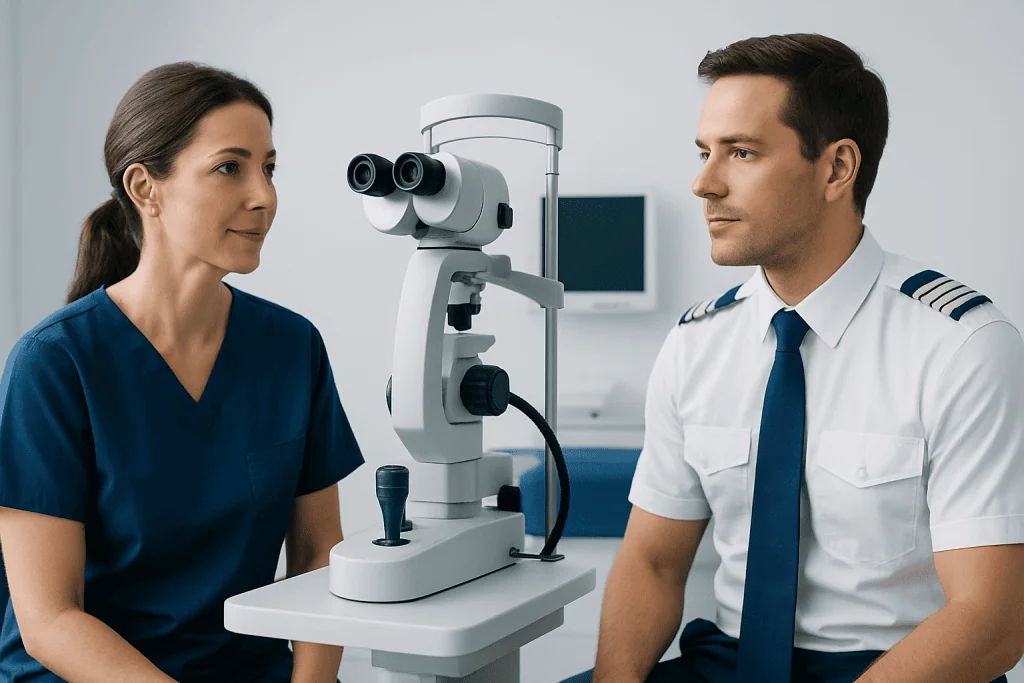
Treat this table as a planning framework, not clearance. Your surgeon may extend any of these windows because of your prescription, the state of the eye surface, raised pressure, inflammation, retinal findings, a complication, or simply the need for one more review before you go.
| Procedure | Typical travel planning approach | Important caution |
|---|---|---|
| LASIK or similar corneal laser surgery | Often considered after the first post-operative assessment, sometimes within a few days for uncomplicated cases | Do not travel before the clinic has checked the corneal flap or treated surface |
| Surface laser treatments (such as PRK) | Usually a longer wait than flap-based LASIK, because the surface takes longer to settle | Discomfort and blurred vision can persist through the early days |
| Retinal laser treatment without surgery | May be possible soon after review if vision is adequate and there is no detachment concern | Dilating drops blur vision temporarily; do not drive yourself |
| Vitrectomy or retinal detachment repair without gas | Timing varies from days to weeks and is set individually by the retina specialist | Vision and post-operative positioning requirements affect travel safety and comfort |
| Retinal surgery with a gas bubble | No flying until the bubble has fully resolved and the specialist confirms it at examination | Avoid aircraft and significant altitude gain on land, including mountain routes |
| Uncomplicated cataract surgery | Often possible after an early follow-up confirms stable healing and pressure | Keep the drop schedule and any remaining review appointments |
For international journeys, build in slack. A short-haul flight may be physically easier than a long-haul one, but the cabin-pressure restriction attached to a retinal gas bubble applies equally to every commercial flight, however brief. And if a review is scheduled for the day after your procedure, do not book a departure that forces you to miss it: that review is precisely what makes the flight reasonable.
Cataract patients planning a specific route home can find more detail in our guide on flying after cataract surgery, which covers that operation on its own terms.
How soon can you fly after retinal surgery?

Only when your retina surgeon says so. If no gas bubble was used, the interval may run from days to weeks depending on why you needed surgery, how stable the retina looks, your eye pressure, your vision, and any positioning instructions you were given. There is no single timeline that applies safely to everyone, which is why this is the one area where flying after eye surgery cannot be planned from a table.
If a gas bubble was used, the picture is stricter. Different gases persist for different lengths of time: shorter-acting gases may resolve within a few weeks, while longer-acting gases can remain in the eye for two months or more. These are broad ranges, not clearance dates. The type and concentration of gas, and how your eye absorbs it, vary enough that only an examination can confirm the bubble has gone. You may notice a shifting line or bubble at the edge of your vision while gas remains, but the absence of that sensation does not prove the gas has resolved. Do not fly on an estimate, a feeling, or a number of days you read online, including here.
One further point that matters beyond air travel: tell every healthcare professional involved in your care that you have had retinal surgery with gas in the eye. Nitrous oxide anaesthesia can be dangerous while intraocular gas remains, so an anaesthetist treating you for anything else needs to know. Some clinics provide a wristband or card stating the gas type and surgery date; if you are given one, keep it with you until your specialist confirms clearance.
Remember also that the restriction is about altitude, not aircraft specifically. Driving over a high mountain pass or taking a cable car exposes the eye to the same pressure drop. Ask your specialist about land routes as well as flights if your journey home involves either.
Why is flying not recommended straight after eye surgery?
Three reasons, in descending order of severity. First, pressure. Commercial aircraft cabins are pressurised to the equivalent of roughly 1,800 to 2,400 metres of altitude, not to sea level. For most healed eyes this is irrelevant. For an eye containing gas, it is the whole problem: as ambient pressure falls, the gas expands and eye pressure climbs. This is why the gas bubble rule has no exceptions.
Second, dryness. Cabin humidity is far lower than most indoor environments, and a recently operated eye surface, particularly after corneal laser treatment, is already prone to dryness and irritation. This is a comfort and healing issue rather than a danger, but it is real, and it is why lubricating drops belong in your hand luggage rather than the hold.
Third, distance. The early post-operative days are when problems are most treatable and when your operating surgeon is best placed to treat them. Flying early does not just risk discomfort; it puts you out of reach of the team that knows exactly what was done to your eye. This logic applies well beyond ophthalmology: our overview of flying after surgery, procedure by procedure shows how the same principle produces very different waiting times across specialties.
Eye conditions and situations that rule out flying
The clearest absolute barrier is an intraocular gas bubble. Beyond that, clinicians generally advise against flying with a very recent retinal detachment repair still under review, uncontrolled eye pressure, a significant active infection, recent serious eye trauma, or any acute post-operative problem that has not yet been assessed. In each case the issue is instability: the eye’s condition could change during the hours you are unreachable.
A burst blood vessel on the white of the eye, a subconjunctival haemorrhage, sits in a different category. On its own, this common finding looks dramatic but is generally harmless and typically settles without treatment; by itself it is not usually a barrier to flying. The context changes the picture: when it follows recent eye surgery or an injury, or appears alongside pain or a change in vision, clinicians will want to examine the eye before agreeing that travel makes sense, because the visible bleed may not be the whole story.
Some situations do not prevent flying but make the journey harder. Reduced vision complicates airport navigation. Dilating drops blur near vision and increase light sensitivity for hours. None of this grounds you, but it argues for a companion, airport assistance, sunglasses, and not driving yourself to the terminal.
- Never fly with a known intraocular gas bubble unless your retina specialist has confirmed it has resolved.
- Delay travel if the flight would force you to miss a required early post-operative review.
- Ask about altitude restrictions for mountain routes as well as flights.
LASIK and cataract surgery: different operations, different travel questions
People often ask which of the two is riskier, but the comparison does not really work: they treat different problems in different parts of the eye. LASIK reshapes the cornea to reduce dependence on glasses or contact lenses; its considerations include dry eye symptoms, glare or halos, fluctuating vision, under- or over-correction, and uncommon flap-related or infection complications. Cataract surgery removes the clouded natural lens and replaces it with an artificial one; its considerations include inflammation, infection, pressure changes, retinal problems and occasionally the need for further treatment. Your personal risk in either case depends on corneal thickness and shape, dry eye, prescription stability, cataract severity, retinal health, glaucoma, diabetes, medicines and any previous eye surgery.
For travel planning, the procedure name matters less than the review findings. An uncomplicated LASIK patient may be cleared quickly; a cataract patient may need more time in one case and less in another. The question your surgeon answers is not “how long does LASIK take to heal” but “is this eye, today, stable enough to be far from us tomorrow”.
Does either procedure hurt more, and does that affect the flight?
Neither is usually described as severely painful during the procedure itself, because numbing drops or other anaesthesia are used; pressure, bright lights and watering are the common sensations. Afterwards, LASIK typically brings burning, grittiness, tearing and light sensitivity that ease as the surface settles, while surface laser treatments tend to involve a longer stretch of discomfort. After cataract surgery, mild scratchiness and a foreign-body sensation are common, whereas significant or worsening pain is not an expected part of recovery and is something surgeons ask patients to report. For the flight itself, the practical consequence is the same in every case: dry cabin air amplifies whatever surface irritation you still have, so time the journey for when that irritation has largely settled.
Making the flight itself easier
Keep every prescribed drop, antibiotic, anti-inflammatory, pressure-lowering, lubricating, in your hand luggage with your prescription or medication list, and follow the schedule exactly as your surgeon set it. Any change to that schedule is your surgeon’s decision, not something to improvise mid-journey. Set reminders if the flight crosses time zones.
Wear sunglasses outdoors and in bright terminal buildings if you are light-sensitive. Do not rub or press on the treated eye, and angle the overhead air vent away from your face if it worsens dryness. If you were given a rigid shield for sleep, your aftercare plan states when to wear it; check rather than guess whether that includes sleeping on the plane.
Before leaving Turkey, save your clinic’s contact details, ask for a concise treatment summary stating the procedure, the lens or gas used if any, and your drop regimen, and identify where ophthalmic care is available near your home. It is also worth reading our general guide on warning signs to report before flying home after surgery in Turkey, which explains what surgeons across specialties want to hear about before a patient boards. However the itinerary is arranged, the clinical decision about your flight always belongs to your surgeon.
Step by step
- Discuss travel before treatment. Tell your surgeon the date, destination and duration of the planned flight before your procedure. Ask specifically whether your treatment could involve a gas bubble, positioning requirements, or follow-up visits that would change the plan.
- Keep the early follow-up. Attend every post-operative check before travelling, especially the first review after LASIK or cataract surgery. That examination is what turns a general timeline into your timeline.
- Get specific clearance. Ask the direct question: “Am I cleared to fly on this date?” Record the answer and any restrictions. Retinal patients should also ask whether any gas remains and whether altitude travel of any kind is permitted.
- Ask what would change the plan. Have your surgeon tell you which findings or symptoms in your particular case should delay the flight, and write them down alongside the clinic’s contact details.
- Prepare your hand luggage. Prescribed drops, lubricants, sunglasses, a shield if advised, and your treatment summary all go in the cabin bag, ideally in original labelled containers.
- Plan a low-stress airport journey. Do not drive yourself if your vision is blurred or your pupils are dilated. Request airport assistance if useful, allow extra time, and consider a companion for the first journey home.
- Protect the eye in flight. Use the drops your surgeon approved, avoid touching or rubbing the eye, and keep the air vent from blowing directly into your face.
Your checklist
- Documented clearance to fly from your operating surgeon, for your specific date.
- A clear answer on whether a retinal gas bubble was used, and, if so, confirmation at examination that it has fully resolved.
- All required post-operative checks attended before departure.
- Prescribed drops and lubricants in hand luggage, with the schedule written down.
- Sunglasses, plus any eye shield your surgeon has advised.
- A plan that avoids driving while vision is blurred or pupils are dilated.
- Your clinic’s contact details and a concise treatment summary.
- A note of what your surgeon told you to report, and where ophthalmic care is available at home.
- A companion or airport assistance arranged if vision is limited.
Key takeaways
- Your own surgeon’s clearance matters more than any standard timeline, including the ones in this guide.
- Uncomplicated LASIK and cataract patients are often able to travel after a satisfactory early follow-up.
- Retinal surgery with a gas bubble means no flying, and no significant altitude gain on land, until examination confirms the gas has gone.
- Dry cabin air worsens surface irritation, so approved drops belong in your hand luggage.
- A treatment summary and your clinic’s contact details make care at home simpler if anything needs checking.
Frequently asked questions
Can you fly after laser eye surgery?
Usually, yes, often within days for uncomplicated LASIK, once the first post-operative check has confirmed the flap and eye surface are healing well. Surface laser treatments such as PRK typically need longer because the surface takes more time to settle. Retinal laser is a separate question and depends on the underlying retinal condition. In every case, the flight date should follow the review, not precede it.
How long after eye surgery can you fly?
There is no universal answer. Uncomplicated LASIK and cataract patients are often cleared shortly after an early follow-up; vitrectomy without gas may mean days to weeks at the specialist’s discretion; and retinal surgery with a gas bubble means no flying until examination confirms the gas has fully resolved, which can take weeks to two months or more depending on the gas used.
How soon can I fly after retina surgery?
Only when your retina specialist confirms it. Without gas, the interval is set individually based on retinal stability, pressure, vision and positioning requirements. With gas, flying is unsafe until the bubble is completely gone: a fact only an examination can establish, whatever any general timeline suggests.
Can you fly with a burst blood vessel in your eye?
A subconjunctival haemorrhage on its own, a burst vessel on the white of the eye with no other findings, is generally harmless, usually settles without treatment, and is not in itself a typical barrier to flying. When it follows recent surgery or injury, or appears with pain or vision changes, clinicians prefer to examine the eye before travel, because the visible bleed may not be the whole picture.
Why is flying not recommended after surgery?
Three broad reasons: cabin pressure is lower than at sea level, which is dangerous with intraocular gas; cabin air is very dry, which irritates a healing eye surface; and flying early puts you far from the team best placed to treat a problem in the days when problems are most treatable. The balance of these factors differs by procedure, which is why waiting times vary so widely.
How do I know whether a gas bubble is still in my eye?
Through examination by your retina specialist at follow-up. You may notice a moving line or bubble in your vision while gas remains, but the absence of that sensation cannot reliably confirm the gas has disappeared. Never plan a flight around an estimate, a sensation, or a typical duration for the gas type.
Can cabin pressure damage my eyes after LASIK or cataract surgery?
For most uncomplicated LASIK and cataract recoveries, cabin pressure itself is not the main concern once your surgeon has cleared travel. The practical issues are dry cabin air, fatigue, missed drop doses and distance from your surgical team. An intraocular gas bubble is the major exception, because falling pressure makes the gas expand.
Should I wear an eye patch or shield on the plane?
Only if your surgeon has instructed it. Rigid shields are often prescribed for sleep after certain procedures to prevent accidental rubbing, but they are not automatically needed in flight. Check your written aftercare plan; if you intend to sleep on board and a shield was prescribed for sleeping, pack it in your hand luggage. Sunglasses help with light sensitivity in terminals and outdoors.
Add us as a Preferred Source to see more of our trusted health content across Google Search, AI Overviews and Discover.

Update history
- PublishedAugust 17, 2026
- Medical review approvedSeptember 2, 2026
- Last content updateSeptember 2, 2026
References3
- NHS: Cataract surgery nhs.uk
- NHS: Laser eye surgery and lens surgery nhs.uk
- MedlinePlus: Retinal detachment repair medlineplus.gov
More Patient Guides

Septoplasty Recovery: Week by Week
Learn what to expect after deviated septum surgery: a week-by-week septoplasty recovery timeline, when it is usually safe to fly home, and…

Gallbladder Surgery Recovery: Week by Week
Learn what to expect after gallbladder surgery: a week-by-week recovery timeline, pain, diet, wound care, when it is safe to fly home…

Robotic Hysterectomy Recovery: Week by Week
Recovery from robotic hysterectomy week by week: pain, lifting, wounds, driving, flying home safely, warning signs and questions to ask before you…

Breast Reconstruction Recovery: Week by Week
DIEP flap recovery week by week: hospital stay, drains, pain, walking, showering, driving, when it is usually safe to fly home, and…