

Which Questions Matter Before a Cystoscopy? Flexible or Rigid, Biopsy Plans and Next Steps

Key Takeaways
- A flexible cystoscopy is done awake with anesthetic gel and takes about five to 15 minutes according to Mayo Clinic, while a rigid cystoscopy under sedation or general anesthesia typically takes 15 to 30 minutes.
- Visible blood in the urine is the most common reason for cystoscopy because imaging alone can miss small or flat lesions on the bladder lining.
- An active urinary tract infection usually postpones the test, which is why a urine sample is checked on arrival.
- Coffee is not medically forbidden before a flexible cystoscopy under local anesthetic, though caffeine can intensify the urge sensation during bladder filling; rigid procedures carry fasting rules set by the anesthesia team.
- The NHS notes that biopsy results may take a few weeks, so asking who will deliver them and when is one of the most useful pre-procedure questions.
- Fever, flank pain, heavy or clotted bleeding, or inability to pass urine after a cystoscopy are red flags that warrant a same-day call to the care team.
The questions that matter most before a cystoscopy are which type of scope is planned (flexible under local anesthetic or rigid under sedation or general anesthesia), whether a biopsy or treatment is expected during the same visit, how medicines such as blood thinners should be handled, how long results take, who will explain them, and what the follow-up plan looks like if the bladder lining shows anything unusual.
The letter arrives with a time, a department name and a sentence that says a thin camera will be passed into the bladder. Most people read it twice. Then the real questions start, usually around midnight: will it hurt, do I need someone to drive me, and what exactly are they looking for?
A cystoscopy is one of the most common procedures in urology, yet it is remarkably under-explained. The appointment itself may last a few minutes. The anxiety can last weeks. Much of that gap closes once a person knows the difference between a flexible and a rigid scope, understands whether a biopsy is on the agenda, and has a short list of questions before cystoscopy ready for the clinic.
This explainer walks through what the test checks, what happens in the room, where coffee and blood thinners fit in, and what the following days and the next steps usually look like, using mainstream clinical sources rather than forum lore.
What is a bladder exam and what does it check for?
A cystoscopy is a direct look at the inside of the bladder and the urethra, the tube that carries urine out of the body. A cystoscope is a thin tube with a light and a camera at the tip; it is passed through the urethra so the clinician can see the lining of the bladder on a screen. Imaging such as ultrasound or CT shows the bladder from the outside. Only a cystoscopy shows the surface from within, which is why it remains the reference test for many urinary complaints.
According to the NHS and Mayo Clinic, it is commonly used to investigate blood in the urine, repeated urinary tract infections, urinary frequency or urgency that has no clear cause, pain when passing urine, difficulty emptying the bladder, and incontinence that does not fit an obvious pattern. It can also check for bladder stones, narrowing of the urethra (a stricture), an enlarged prostate pressing on the urethra, and abnormal growths that may or may not be cancer.
Some cystoscopies are purely diagnostic. Others are planned as a working visit: removing a small stone, taking a tissue sample, placing or removing a ureteral stent (a soft tube that keeps the channel from the kidney open), or treating a stricture. The word on the appointment letter may be the same. The experience is not. That single distinction drives most of the sensible questions before cystoscopy, because it determines the type of scope, the anesthesia, the fasting rules and the recovery.
One more framing point helps. The test is used to find things, and it is also used to rule them out. For many people with a single episode of visible blood in the urine, a clear cystoscopy is exactly the reassurance that imaging alone cannot offer.
Flexible or rigid cystoscopy: which one is planned, and why it matters
A flexible cystoscope is a soft, bendable fiber-optic or digital scope roughly the width of a drinking straw. A rigid cystoscope is a straight metal instrument with a wider working channel that allows larger tools to pass through. Both show the same bladder lining; they differ in comfort, setting and what can be done during the visit.
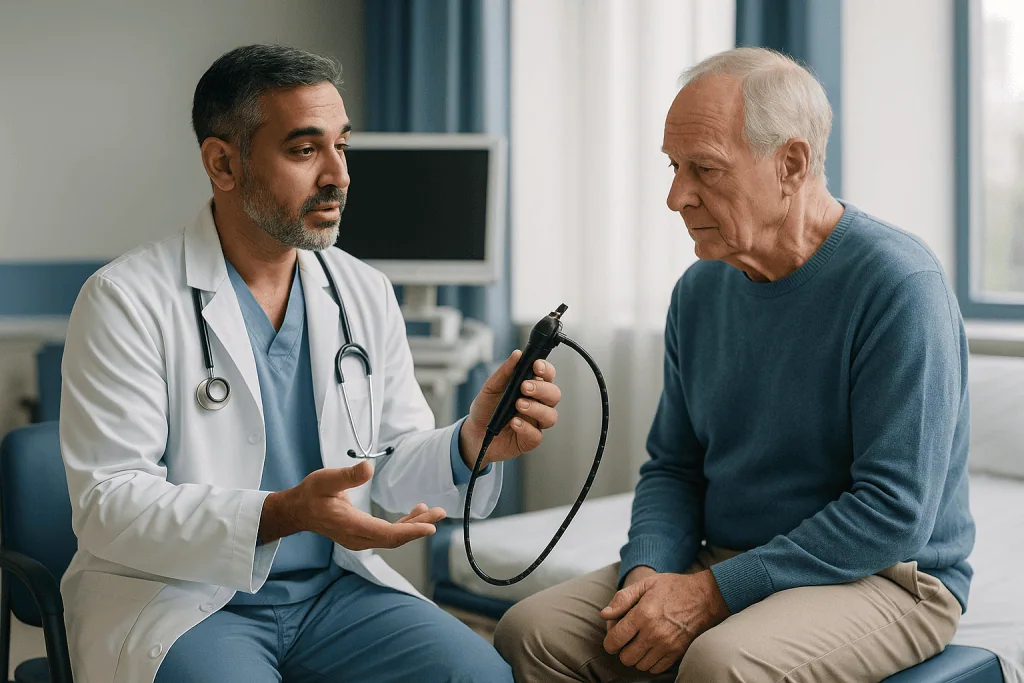
Flexible cystoscopy is usually performed in an outpatient room with a local anesthetic gel applied to the urethra. The NHS and Mayo Clinic describe it as the standard choice when the aim is to look rather than operate. Mayo Clinic puts a typical office cystoscopy at five to 15 minutes. Rigid cystoscopy is done in an operating room under spinal, general anesthesia or sedation and, per Mayo Clinic, typically takes 15 to 30 minutes. It is chosen when the team expects to take larger biopsies, resect a growth, remove a stone or treat a stricture.
| Feature | Flexible cystoscopy | Rigid cystoscopy |
|---|---|---|
| Setting | Outpatient clinic room | Operating room |
| Anesthesia | Local anesthetic gel | Spinal, general or sedation |
| Typical duration (Mayo Clinic) | 5–15 minutes | 15–30 minutes |
| Fasting | Usually not required | Usually required |
| Main purpose | Diagnosis, surveillance, small procedures | Biopsy, resection, stones, strictures |
| Going home | Same day, often able to drive | Same day or overnight; escort needed |
If the letter does not say which type is planned, that is the first question to ask. Almost every practical decision that follows depends on it.
Flexible cystoscopy: what to expect in the room
A flexible cystoscopy begins with a urine sample, used to check for infection before anything is passed into the bladder. The NHS notes that an active urinary tract infection usually means the test is postponed. After changing into a gown, the person lies on an examination couch, typically on their back with knees apart, and the area is cleaned.
An anesthetic gel is applied to the opening of the urethra and given a few minutes to work. The gel numbs the lining and also lubricates the passage. The scope is then introduced slowly. Most people describe pressure or a stinging sensation rather than sharp pain, strongest as the scope passes the external sphincter, the muscle that controls urine flow. Breathing out slowly and relaxing the pelvic floor at that moment genuinely helps.
Once inside, sterile water or saline is run through the scope to fill the bladder gently so the walls open out and can be inspected. This produces a familiar and slightly odd urge to urinate. The clinician looks at the urethra, the bladder neck, the two ureteric openings where urine enters from the kidneys, and the whole bladder surface. Many clinics have the screen angled so the patient can watch and ask what they are seeing.
Anatomy changes the experience. The female urethra is short and straight, so the scope reaches the bladder quickly. The male urethra is longer and curves around the prostate, so the passage takes a little longer and the pressure sensation is more noticeable. Neither route is inherently worse; they are simply different, and clinicians are used to both.
The scope comes out, the bladder is emptied, and most people are dressed and leaving within half an hour of arriving.
Who is usually offered cystoscopy, and who is usually asked to wait
The strongest reason for a cystoscopy is visible blood in the urine, known clinically as gross hematuria. Guideline bodies in the United Kingdom and the United States treat it as a symptom that needs a direct look at the bladder, because it is the most common first sign of bladder cancer and because it also arises from stones, infection and prostate enlargement. Microscopic blood found on a routine dipstick is handled more selectively, weighed against age, smoking history and other risk factors, and the treating team decides whether a scope is justified.

Beyond blood, the test is offered for recurrent infections that keep returning despite treatment, for lower urinary tract symptoms that are unexplained or not responding to medicines, for suspected strictures, and for surveillance after bladder cancer treatment. Surveillance is a large share of all cystoscopies; people treated for early bladder tumors often return at planned intervals for years.
Who is asked to wait? Anyone with a confirmed active urinary infection, since introducing a scope can push bacteria upward toward the kidneys. Someone acutely unwell with a fever. Pregnancy prompts a discussion about whether the question can safely be deferred or answered another way. For rigid procedures, people taking anticoagulants (blood thinners) need an individual plan, because biopsy sites bleed, and that plan belongs to the prescribing clinician and the surgeon together; no one should stop or alter a blood thinner on their own.
Children undergoing cystoscopy are almost always examined under general anesthesia in a pediatric setting, where the focus is on preparation, comfort and a parent being present at waking.
Can I drink coffee before a cystoscopy? Food, fluids and medicines
For a flexible cystoscopy under local anesthetic, the NHS states that people can usually eat and drink normally beforehand. Coffee is not forbidden on medical grounds. Two caveats are worth knowing. Caffeine is a mild bladder irritant and a diuretic, so a large coffee shortly before the appointment can make the urge to urinate during bladder filling feel more intense. Many clinics also ask for a mid-stream urine sample on arrival, and arriving with a comfortably full bladder makes that easier. A modest cup is unlikely to change anything; a triple espresso on an empty stomach may make the ten minutes less pleasant than they need to be.
Rigid cystoscopy is different. Because it involves sedation or general anesthesia, Mayo Clinic notes that fasting instructions will be given, typically no food for several hours and clear fluids only up to a set time. Black coffee sometimes counts as a clear fluid and sometimes does not, depending on the anesthesia department, so the honest answer is to follow the written instructions for that specific hospital rather than a general rule.
Medicines deserve a separate question. Routine medicines are usually continued. Blood thinners, antiplatelet drugs and some diabetes medicines may need adjustment before a rigid procedure or planned biopsy, and that decision rests entirely with the prescribing clinician and the surgical team. Antibiotics are not routinely given before a flexible cystoscopy; some people with particular risk factors may be offered a preventive course, and that too is a clinical judgment.
Bring a list of everything taken, including supplements and over-the-counter painkillers. It is the single most useful item to carry through the door.
Questions before cystoscopy about pain, anesthesia and getting home
Pain is the question almost everyone wants to ask and many feel awkward raising. The evidence-based answer is that flexible cystoscopy is uncomfortable rather than painful for most people, with the anesthetic gel reducing but not abolishing sensation. Cleveland Clinic and the NHS both describe a stinging or pressure feeling and a strong urge to urinate as the bladder fills. People who have had the test before frequently say the anticipation was worse than the event.
Rigid cystoscopy under spinal or general anesthesia involves no awareness during the procedure. Afterward, there is usually a burning sensation on urinating for a day or two, and more so if tissue has been removed. Pain relief after discharge is arranged by the team, and the plan for what to take, and when, belongs to them.
Getting home follows the anesthesia. After a flexible cystoscopy with local gel, Mayo Clinic notes that most people can drive themselves and return to usual activities straight away. After sedation or general anesthesia, an adult must accompany the person home and ideally stay with them that first night; driving, operating machinery and signing legal documents are off the table for the rest of the day.
Useful questions in this cluster include: Which anesthetic is planned, and can I ask for something different if I am very anxious? Will I be able to watch the screen? How soon can I go back to work or exercise? If a biopsy is taken, how will that change my discharge instructions? Asking these before the day, rather than on the couch, lets the answers sink in.
Will there be a biopsy? What "biopsy plans" really means
A biopsy is the removal of a small piece of tissue so it can be examined under a microscope by a pathologist. In the bladder, that decision is usually made in one of two ways: planned in advance because imaging or a previous scope has already shown something, or made on the spot when the clinician sees an area of lining that looks abnormal.
During a flexible cystoscopy, small biopsies can be taken through the working channel in some settings, usually with a tiny forceps, and the sample is correspondingly small. More often, if something suspicious is seen, the clinician describes it, photographs it, and arranges a rigid procedure under anesthesia. That second procedure may be a biopsy alone or a transurethral resection of bladder tumor (TURBT), where the growth is shaved away with a loop instrument and the base is sampled to see how deep it goes. Depth matters enormously in bladder cancer, because treatment pathways separate at the muscle layer.
Some centers use enhanced imaging during rigid cystoscopy, such as a dye that makes abnormal cells glow under blue light, to help identify flat lesions that are hard to see under white light. Where this is available, the team will explain whether it is relevant.
The questions that matter are concrete. Is a biopsy expected today, or only if something is seen? If something is seen on a flexible scope, will it be sampled then or booked for a second visit? Who tells me what was found, and will I get photographs or a written note? Knowing the plan removes the fear of being told something unexpected while still on the couch.
Cystoscopy biopsy results: how long they take and what the report may say
Tissue removed during a cystoscopy goes to a histopathology laboratory, where it is fixed, sliced, stained and read by a specialist. That process cannot be rushed in the way a blood test can. The NHS advises that biopsy results may take a few weeks to come back, and most teams arrange a results appointment or a telephone call at the time of discharge. If no date is given, asking for one is reasonable.
The report itself tends to fall into a small number of categories. It may describe normal bladder lining (urothelium). It may show inflammation, which fits with infection, irritation or, in some people, a chronic bladder pain condition. It may show changes that are not cancer but are worth noting, such as metaplasia, where the lining cells have changed type. If a tumor is present, the report will usually state the grade, meaning how abnormal the cells look, and the stage, meaning how deep the growth extends into the bladder wall. A finding confined to the lining is managed very differently from one that has reached the muscle.
Visual findings from the scope itself are available immediately and are often discussed in the room. Stones, strictures, an enlarged prostate and inflammation are seen directly. Only tissue findings wait for the laboratory.
A sensible set of cystoscopy biopsy results questions: When should I expect to hear, and from whom? Will the result be explained in person? If the result is uncertain, what is the next test? What happens if I have heard nothing by the expected date? Writing down the answers before leaving spares a lot of refreshing of patient portals.
What are the risks of cystoscopy? Risks and side effects in plain language
Cystoscopy is generally safe, which is one reason it is used so widely, but no procedure that passes an instrument into the body is risk-free. Mayo Clinic, the NHS and MedlinePlus describe a consistent short list.
The most common effects are minor and short-lived: a burning sensation on urinating, a need to pass urine more often, and a small amount of blood in the urine, typically for a day or two. These reflect irritation of the urethra and bladder lining and settle on their own.
Urinary tract infection is the most important complication to understand. Introducing a scope can carry bacteria into the bladder, and symptoms such as fever, chills, back pain or urine that becomes cloudy and foul-smelling in the days afterward need prompt medical attention. The risk is low for a simple flexible cystoscopy and higher when tissue is removed or when the person already has risk factors, which is why some are offered preventive antibiotics.
Less common risks include heavier bleeding, usually after biopsy or resection; difficulty passing urine because of swelling, which may need a temporary catheter; and, rarely, a small perforation of the bladder wall during resection, which the surgical team manages at the time. Anesthetic risks apply to rigid procedures and are discussed separately by the anesthesia team.
Honest risk conversations work in both directions. Ask what the team’s experience of complications looks like for the procedure planned, what would be done if bleeding or retention occurred, and what the alternative would be if the test were not done at all. Cystoscopy risks and side effects are real but mostly minor; the greater risk for many people is leaving a cause of bleeding unexamined.
What the days after cystoscopy usually look like
The first urination after the scope is the one people remember: a sharp, hot sting that eases over the following trips to the bathroom. Drinking more water than usual over the first day or two dilutes the urine and reduces the burn; the NHS specifically recommends this. Pink-tinged urine is expected and should fade. A warm bath or a warm compress over the lower abdomen helps some people, and ordinary over-the-counter pain relief is often sufficient after a flexible procedure, though which product and how much is a question for the team, not an article.
After a flexible cystoscopy with local anesthetic, most people return to work and normal activity the same day. Sexual activity can resume once the burning has settled and any blood in the urine has cleared, which for most people is within a few days.
After a rigid cystoscopy with biopsy or resection, the recovery is longer. There is often a catheter for a period, more noticeable bleeding including small clots, and a stretch of days when heavy lifting and strenuous exercise are discouraged so the raw area inside the bladder can heal. Teams give written instructions about activity and about when the catheter comes out. Those instructions vary with what was done, and they override anything general written here.
Emotionally, the waiting is the hardest part. For a diagnostic scope that looked clear, that wait is over in the room. For a biopsy, the interval until results is a good time to write down questions, nominate someone to come to the results appointment, and avoid the temptation to interpret vague portal entries alone.
What happens next: surveillance, imaging and the follow-up plan
A clear cystoscopy often ends the investigation. If the symptom was a single episode of visible blood and both the bladder lining and the upper tract imaging are normal, many people are discharged with advice to return if bleeding recurs. The NIH’s National Institute of Diabetes and Digestive and Kidney Diseases describes cystoscopy and imaging as complementary: the scope looks at the bladder, and ultrasound or CT looks at the kidneys and ureters, the tubes that connect them.
When a stricture, stone or prostate enlargement is found, the next step is a treatment conversation about options, which may range from watchful waiting to medicines to a procedure. When a growth is found and removed, the pathology report shapes everything that follows. Tumors confined to the lining are commonly managed with surveillance cystoscopies at planned intervals, sometimes with medicine instilled directly into the bladder through a catheter to lower the chance of recurrence; the choice and schedule sit with the urology team. Tumors reaching the muscle lead to a different pathway and a multidisciplinary discussion.
Surveillance deserves a word, because people are sometimes surprised by it. Bladder tumors have a known tendency to come back, which is why those who have had one are asked to return for repeat scopes over several years. Each visit is typically a flexible cystoscopy, shorter and more familiar than the first.
The questions here are practical. Is this the end of the work-up, or the start of a program? If surveillance is planned, how often and for how long? Who coordinates the appointments? What symptoms between visits should prompt an earlier call? Clarity about next steps is as reassuring as the result itself.
What people often get wrong about cystoscopy
The first myth is that a cystoscopy means the team already suspects cancer. In practice it is a routine way to investigate blood, infection and urinary symptoms, and most scopes do not find a tumor. The procedure is a question, not a verdict.
The second is that it is unbearably painful. Reputable sources, including the NHS and Cleveland Clinic, describe discomfort, pressure and a strong urge to urinate rather than severe pain for flexible procedures under local gel. People who cope badly with pelvic examinations should say so in advance; options exist, from additional time with the anesthetic gel to planning the test under sedation.
Third, that women are rarely scoped. Cystoscopy is common in women, who are disproportionately affected by recurrent urinary infections and some bladder pain conditions, and the short female urethra makes the flexible procedure quick.
Fourth, that normal imaging makes a scope unnecessary. Ultrasound and CT image the bladder from outside and can miss small or flat lesions on the lining. Guideline pathways for visible blood in the urine include a direct look for exactly this reason.
Fifth, that blood thinners should be stopped before any cystoscopy. For a diagnostic flexible scope they are often continued; for biopsy or resection a specific plan is needed. The decision is individual and belongs to the prescribing clinician, never to a general article or a well-meaning relative.
Finally, that a clear result means no follow-up. Sometimes true, often not. The follow-up plan is part of the result, and it is worth asking for it explicitly rather than assuming silence means all is well.
Questions to ask your care team before a cystoscopy
A short, written list changes the quality of a pre-procedure conversation. These are the questions that experienced clinicians say they wish more people asked.
- Is this a flexible or a rigid cystoscopy, and why was that type chosen for me?
- What anesthesia is planned, and what are the alternatives if I am very anxious or have had a difficult experience before?
- Do I need to fast, and does coffee or black tea count as a clear fluid under your anesthesia rules?
- Which of my medicines, including blood thinners, supplements and diabetes medicines, should I continue, and who makes that call?
- Is a biopsy expected today, only if something is seen, or planned for a separate visit?
- If tissue is taken, how long will the results take and how will I receive them?
- Will I need someone to take me home, and can I drive the next day?
- What symptoms afterward are normal, and which ones mean I should call?
- If the scope is clear, is the investigation finished, and what should bring me back?
- If something is found, what are the likely next steps, and who coordinates them?
Add anything specific to your situation: a known latex allergy, a history of difficult catheterization, mobility limits that affect positioning on the couch, or a preference for a clinician of a particular gender, which many departments can accommodate if asked in advance. None of these is a difficult or unusual request.
Take the list and a pen. Clinics move quickly, and the answer heard in the room is rarely the answer remembered an hour later. Having a companion present at the pre-assessment, with permission, doubles the chance that the important points stick.
When to call your doctor after a cystoscopy
Mild burning, slightly pink urine and the need to pass urine more often are expected after a cystoscopy and usually settle within a day or two, as the NHS and Mayo Clinic describe. Contact the urology team or your doctor promptly if any of the following occur.
- A temperature of 100.4°F (38°C) or higher, shaking chills, or feeling generally unwell, which can signal a urinary infection spreading toward the kidneys.
- Pain in the flank or lower back, especially on one side.
- Urine that becomes cloudy or foul-smelling, or burning that worsens rather than eases after the first couple of days.
- Bright red blood that does not clear, blood clots, or bleeding that is heavier than a pink tinge, particularly after a biopsy or resection.
- Inability to pass urine, or passing only small amounts with a painfully full bladder, which may indicate retention needing a catheter.
- Severe or increasing abdominal pain, or a swollen, tense abdomen.
- After general or spinal anesthesia: persistent vomiting, difficulty breathing, chest pain, or a severe headache that worsens on sitting up.
If you cannot reach the team and symptoms are severe, especially fever with flank pain, heavy bleeding or inability to urinate, seek urgent care or emergency services rather than waiting for the next working day. These complications are uncommon, and they are treatable, but they are treated best early.
Everything in this article is general information drawn from mainstream clinical sources. The specific plan for your scope, your medicines and your follow-up belongs to the team caring for you, who know your history, and their written instructions take precedence over anything here.
Frequently asked questions
Can I drink coffee before a cystoscopy?
For a flexible cystoscopy under local anesthetic gel, the NHS says you can usually eat and drink normally, so a modest coffee is fine. Caffeine is a mild bladder irritant and a diuretic, so a large amount may make the urge sensation during the test stronger. For a rigid cystoscopy under sedation or general anesthesia, follow the hospital’s written fasting instructions, which decide whether black coffee counts as a clear fluid.
What is a bladder exam and what does it check for?
A bladder exam, or cystoscopy, uses a thin lighted camera passed through the urethra to view the inside of the bladder directly. It is used to investigate blood in the urine, recurrent infections, unexplained urgency or frequency, pain on urination and difficulty emptying, and to check for stones, strictures, prostate enlargement and abnormal growths. It can also be used to take biopsies or carry out small treatments.
What is a flexible cystoscopy and what should I expect?
A flexible cystoscopy uses a soft, bendable scope passed into the bladder under local anesthetic gel in an outpatient room. You lie on a couch, the gel numbs the urethra, and the scope is introduced while sterile fluid fills the bladder so the lining can be seen. Most people feel pressure and a strong urge to urinate rather than sharp pain. It usually takes a few minutes and most people drive home afterward.
What are the risks of cystoscopy?
Common effects are mild: burning on urination, frequency and pink-tinged urine for a day or two. The main complication is urinary tract infection, signaled by fever, chills or back pain afterward. Less common risks include heavier bleeding after biopsy, temporary difficulty passing urine, and rarely a small perforation during resection. Anesthetic risks apply to rigid procedures. Mayo Clinic and the NHS describe cystoscopy as generally safe.
What are cystoscopy risks and side effects after a biopsy?
After a biopsy or resection, bleeding is more noticeable and may include small clots, burning lasts longer, and a catheter may be needed for a period. Infection risk is higher than after a diagnostic scope, which is why some people are offered preventive antibiotics. Heavy lifting is usually discouraged while the bladder heals. The surgical team gives written instructions specific to what was done, and those take precedence.
How long do cystoscopy biopsy results take?
The NHS advises that biopsy results may take a few weeks, because tissue must be processed, stained and read by a pathologist. Visual findings such as stones or strictures are known immediately. Most teams book a results appointment or call at discharge; if none is offered, ask for one and ask whom to contact if nothing has arrived by the expected date.
Do I need to stop blood thinners before a cystoscopy?
Not automatically. For a diagnostic flexible cystoscopy, anticoagulants are often continued. For a rigid procedure with planned biopsy or resection, an individual plan is needed because biopsy sites bleed. That decision rests with the prescribing clinician and the surgical team together. Never stop, pause or change a blood thinner on your own; bring your full medicine list to the pre-assessment and ask directly.
Is cystoscopy different for women and men?
The procedure and findings are the same, but anatomy changes the experience. The female urethra is short and straight, so the scope reaches the bladder quickly. The male urethra is longer and curves around the prostate, so passage takes slightly longer and pressure is more noticeable. Cystoscopy is common in women, particularly for recurrent urinary infections and bladder pain conditions.
Can I drive home after a cystoscopy?
After a flexible cystoscopy with local anesthetic gel, Mayo Clinic notes that most people can drive and resume normal activities the same day. After a rigid cystoscopy under sedation, spinal or general anesthesia, you must have an adult take you home and should not drive, operate machinery or make important decisions for the rest of that day. Confirm the specific rule with your team.
What happens if the cystoscopy is clear?
A clear cystoscopy often ends the investigation, especially when upper tract imaging is also normal, and many people are discharged with advice to return if symptoms recur. Sometimes further tests are still needed for symptoms that persist. Ask explicitly whether the work-up is finished, what should bring you back, and who to contact, rather than assuming silence means the matter is closed.
References
- NHS: Cystoscopy
- MedlinePlus: Cystoscopy
- Cleveland Clinic: Cystoscopy
- NIH NIDDK: Cystoscopy and Ureteroscopy
This article is for general information only and is not a substitute for professional medical advice. Please consult a qualified doctor about your individual situation.

More from the Blog

Living With Interstitial Cystitis: Diet Triggers, Symptom Tracking and Flare Planning
The most commonly reported interstitial cystitis diet triggers are coffee and other caffeinated drinks, alcohol, carbonated beverages, citrus fruits and juices, tomatoes, spicy foods,…

Recovery After Bladder Stone Removal: Burning, Blood-Tinged Urine and the First Week
After bladder stone removal, mild burning when passing urine and pink or blood-tinged urine are common for the first few days and usually settle…

How Penile Implant Surgery Works: The Procedure and Who Is Considered for It
Penile implant surgery places a device inside the two erection chambers of the penis so a person with erectile dysfunction can produce a firm…

Why Are Urinary Tract Infections in Men Investigated More Closely? How Treatment Differs
Urinary tract infections are uncommon in men, so clinicians usually look for an underlying reason such as an enlarged prostate, a stone, incomplete bladder…

After Cystitis Treatment: Hydration, Completing Antibiotics and Follow-Up If Symptoms Return
After bladder infection treatment, most people feel noticeably better within one to two days of starting antibiotics, but the course is usually completed exactly…

What to Expect After Varicocele Repair: How Semen Parameters Are Rechecked Over Months
After varicocele repair, semen is usually rechecked with a laboratory semen analysis around three months later, because sperm take roughly two to three months…