

Who Benefits Most From Dental Robotics? Tight Spaces, Full-Arch Cases and Limited Bone
Key Takeaways
- In dental robotics a surgeon holds and controls the drill throughout; the robotic arm only resists movement outside a pre-planned path and stops at a planned depth.
- The strongest mechanical case for robotic guidance is where tolerances are tight: narrow single-tooth gaps, full-arch prostheses on four to six implants, and thin bone near the inferior alveolar nerve or maxillary sinus.
- Robotics does not shorten healing; the Mayo Clinic describes bone integration around an implant as taking several months regardless of how the site was drilled.
- Most published evidence measures placement accuracy, a surrogate outcome, and long-term comparisons against printed guides and freehand surgery are still being gathered.
- Printed static guides and camera-based dynamic navigation reach the same planned positions in many mouths, so a robot is one option among several rather than the only precise route.
- Smoking, uncontrolled diabetes and active gum disease affect implant integration far more than the guidance method, and persistent lip or chin numbness after surgery is a same-day call.
Dental robotics most often helps when the margin for error is thin: a single narrow gap between healthy teeth, a full-arch case where several implants must line up for one connected prosthesis, or a jaw with limited bone close to a nerve or sinus. The robot steers the drill along a pre-planned path while the surgeon controls it. Evidence is early, and the treating team decides whether it adds value.
The gap is the width of a pencil. A woman in her fifties runs her tongue over the space where a lateral incisor used to be and asks the question everyone in that chair eventually asks: is there room to put anything in there at all? Her neighbors on either side have roots that lean toward each other like people sharing an umbrella. A millimeter off, and one of them gets hurt.
Down the hall, a retired machinist is weighing a very different problem. He has worn a full lower denture for a decade, and what he wants is a set of teeth fixed in place on a handful of implants. His dentist has mentioned a surgical robot. He is politely skeptical. He spent forty years around machines, and he knows they are only as good as the person setting them up.
Both of them are asking, in their own way, who benefits from dental robotics. The honest answer is narrower and more interesting than the brochures suggest.
What does dental robotics actually mean?
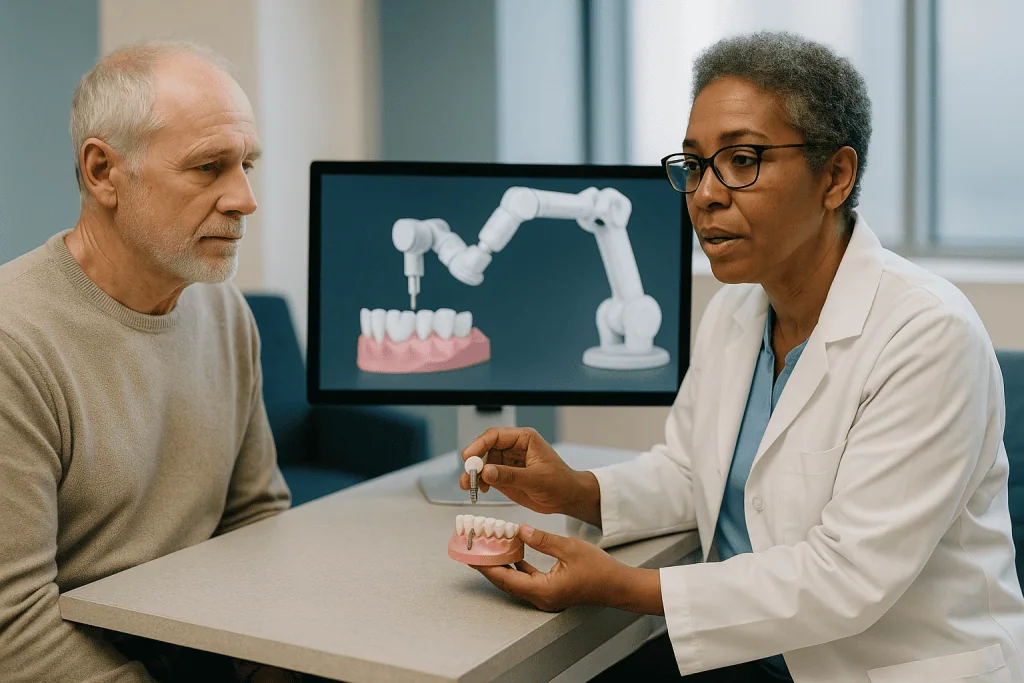
Start by clearing away the image of a machine working alone while the surgeon watches. In dentistry, a robot is a computer-controlled arm that holds or steers the drill while a human surgeon supplies the hands, the judgment and the decision to proceed. The closest everyday comparison is lane-keeping assistance in a car: you still drive, but the wheel nudges you back when you drift.
Most systems in use today rely on a technique called haptic guidance. Haptic means touch-based; the arm lets the surgeon move freely inside the planned path and firms up, like a wall you can feel but not see, when the drill tries to leave it. Depth is limited the same way, so the bit stops where the plan says it should stop rather than where a tired wrist says it might.
The plan itself comes from a cone-beam CT, a three-dimensional dental X-ray that maps bone thickness, nerve canals and sinus floors in a single short scan. Software lets the team place a virtual implant in that scan, angle it, and check what sits nearby before anyone picks up an instrument.
Two things follow from this. First, the robot is only as good as the scan and the plan behind it; a flawless execution of a poor plan is still a poor result. Second, robotics belongs to a family of computer-guided approaches that also includes printed surgical guides and camera-tracked navigation. Understanding who benefits from dental robotics means understanding what it adds over those siblings, not whether it beats an imaginary version of freehand surgery done badly. The Mayo Clinic describes the underlying implant procedure and its staged nature in plain terms, and everything here builds on that foundation.
How does robot-assisted implant placement work, step by step?
The appointment begins long before the drill. After the cone-beam CT, the surgeon and often a restorative dentist decide together where the final tooth should sit, then work backward to the implant position that supports it. This is sometimes called prosthetically driven planning: the crown leads, the screw follows.
On the day of surgery, a small tracking device is fixed to nearby teeth or to the jaw itself. Its job is registration, the process of telling the robot exactly where the real jaw is compared with the scan on the screen. If the tracker shifts even slightly during the procedure, the plan and the patient no longer agree, so most systems check alignment repeatedly and pause if something drifts.
Once registered, the surgeon guides the drill with the arm attached. Inside the planned corridor the arm moves lightly. At the edges it resists. At the planned depth it stops. The surgeon still controls speed, irrigation and the moment-to-moment decision to keep going, and can disengage and finish freehand if the situation calls for it.
The implant, a small titanium or ceramic post that replaces the root, is then seated along the same path. Many teams take a second scan or a series of X-rays afterward to confirm that what was planned is what was placed.
The Mayo Clinic notes that the full implant journey often unfolds over several months because bone needs time to knit around the post before a permanent crown is attached. Robotics changes how the surgical minutes are spent; it does not shorten the biology that follows. That distinction matters for anyone expecting a faster overall result.
Who benefits from dental robotics most?
Ask an experienced implant surgeon which cases keep them up the night before, and the same three come up. A single implant squeezed between two roots that lean inward. A full arch where four to six implants must share the load of one connected prosthesis. A jaw that has thinned so much that the nerve canal or the sinus floor sits a few millimeters from where the implant needs to go.
These are the situations where the case for robotics is strongest, and the reason is mechanical rather than magical. In each, the acceptable range of positions is small, and the consequence of missing it is disproportionate. A slightly off-angle implant in a wide, forgiving space at the back of the jaw can still be restored well. The same angle error in a narrow front gap can breach a neighbor’s root or leave no room for a crown that looks like a tooth.
A robot’s contribution is to hold the drill to a line and a depth chosen in calm conditions, on a screen, rather than under the pressure of a live surgical field where bleeding, saliva and a patient’s tongue all compete for attention.
It also matters who is on the other side of the drill. Surgeons who place large numbers of implants may already achieve very consistent positions freehand for routine cases. The people who gain most from any guidance tool are often not the patients with the easiest anatomy but those whose anatomy leaves no room for the ordinary variability of a human hand.
The Cleveland Clinic describes the anatomical prerequisites for implants, including adequate bone and healthy gum tissue, and every group below is defined by pushing against one of those limits.
Tight spaces: why a single narrow gap is harder than it looks
A missing lower incisor or a congenitally absent upper lateral incisor often leaves a gap that measures barely wider than the implant itself. The roots on either side may converge below the gum line even when the crowns look neatly spaced. On a two-dimensional X-ray this can be easy to underestimate; the cone-beam CT reveals the true geometry.

The engineering problem is angular tolerance. Picture a drill entering the bone at the gum line and traveling ten millimeters downward. A tilt of a few degrees at the top becomes a displacement of a millimeter or more at the tip. In a wide molar site that shift may be irrelevant. Between two converging roots it can be the difference between an intact neighbor and a damaged one.
Static surgical guides, the printed plastic templates that fit over the teeth and direct the drill through a metal sleeve, handle many of these cases well. Their limitation is bulk. The sleeve and its housing need space, and in a narrow gap or a mouth that does not open widely, the guide itself may not fit. Robotic arms do not need a sleeve seated in the gap; the guidance lives in the arm’s resistance rather than in a physical tunnel, which is the practical reason narrow anterior sites feature so prominently in discussions of who benefits from dental robotics.
The aesthetic stakes add a second layer. Front teeth are where a crown’s emergence from the gum is most visible. The implant’s angle dictates whether the final tooth can look like it grew there. Precision here serves appearance as much as safety.
None of this means every narrow gap requires a robot. It means narrow gaps are where the case for extra guidance, of some kind, is easiest to make.
Full-arch cases: when every implant depends on the others
Replacing an entire upper or lower set of teeth on implants changes the nature of the problem. The Cleveland Clinic describes full-arch restorations in which a fixed bridge of teeth is anchored on a small number of implants, commonly four to six per jaw. Because those implants carry one rigid prosthesis, they are no longer independent. They form a team, and the prosthesis is only as good as their alignment.
Two things become critical. Parallelism, meaning the implants emerge in compatible directions so the bridge can seat on all of them without strain. And passive fit, the goal that when the bridge is screwed down it sits without rocking or twisting. Small angular differences across a jaw can be corrected with angled connectors, but the corrections have limits, and every workaround consumes space that the final teeth need.
Freehand full-arch surgery relies on the surgeon’s ability to hold a mental three-dimensional picture of four or more trajectories across a curved jaw. Guides and robots externalize that picture. For robotics specifically, the appeal is that each implant is drilled to the same plan as the others, referenced to the same tracker, in one sitting.
There is a practical wrinkle. In a jaw with no remaining teeth, the tracker cannot clip onto anything, so it is fixed to the bone with small pins. That adds a step and a little discomfort, and it means the team must be confident the tracker will not shift when the surrounding tissue is retracted.
Full-arch treatment also involves the largest amount of surgery in a single visit, so the recovery expectations discussed later in this article are most relevant here. The robot addresses geometry. Swelling, bruising and the weeks of soft food remain a human experience.
Limited bone: threading the needle near nerves and sinuses
Bone shrinks after teeth are lost. The Mayo Clinic explains that when a jaw is too thin or too soft to hold an implant, a bone graft may be needed first, and that the graft can take several months to become strong enough to support surgery. Robotics does not replace that biology. Where it may help is in the cases that sit at the margin: enough bone to place an implant, but only if the implant lands exactly where the plan says.
In the lower jaw, the structure of concern is the inferior alveolar nerve, which runs inside a canal through the bone and supplies feeling to the lower lip and chin. Drill into it and the result can be numbness that is sometimes permanent. In the upper jaw, the maxillary sinus, the air-filled cavity behind the cheek, often sits just above the sockets of the back teeth. Breach its floor and infection or sinus problems can follow.
A cone-beam CT shows both structures. A plan can keep the implant a safe distance away. The question is whether the drill follows the plan. Depth control is where robotic arms make their clearest mechanical contribution: the arm stops at the planned depth regardless of how the bone feels, and soft bone can feel deceptively easy to drill through.
Angulation matters too. Where bone is narrow, tilting an implant to stay within it is a recognized strategy, but an intentional tilt requires holding an unusual angle steadily, which is precisely the kind of task a guided arm is built for.
Alternatives exist for limited bone, including grafting, sinus lifts that add bone beneath the sinus floor, shorter or narrower implants, and zygomatic implants anchored in the cheekbone. Each carries its own trade-offs, and choosing among them belongs to the surgical team, not to any single technology.
Who is usually asked to wait, and who is offered another route?
Robotics does not change the medical prerequisites for implant surgery, so the people asked to pause are largely the same as for any implant. The Mayo Clinic and Cleveland Clinic both point to conditions that interfere with healing, including uncontrolled diabetes, heavy smoking and active gum disease, as reasons to treat the underlying problem first. Children and adolescents are usually asked to wait until jaw growth is complete, because an implant does not move with the growing bone the way a natural tooth does.
Some medicines call for a conversation with the prescriber before any jaw surgery. Drugs in the antiresorptive class, used to slow bone loss in osteoporosis and some cancers, work by suppressing the cells that remodel bone; in a small number of people this can impair healing of the jaw after surgery. Blood-thinning medicines raise a separate question about bleeding. Neither is an automatic barrier, and no one should stop or change a prescription on their own; the dental team coordinates with the treating physician.
A few situations are specific to robotics. The arm and tracker need physical access, so a person who cannot open the mouth widely, or who struggles to stay still for a longer appointment, may be better served by a guide or a freehand approach. Someone with a straightforward site, such as a wide gap in the back of the jaw with generous bone, may gain little from the added setup.
Head and neck radiation, certain immune conditions and recent major illness are also weighed case by case. These are not judgments about the person. They are judgments about timing and about matching the tool to the job, and the treating team makes them with the whole medical picture in view.
Dental robot vs surgical guide vs freehand: how the approaches compare
Robotics is one member of a family. Seeing the siblings side by side makes its role clearer than any description of the robot alone. Each approach below aims at the same target, an implant placed where the plan says, and each trades something to get there.
| Approach | How position is controlled | Real-time correction | Practical demands | Where it tends to fit |
|---|---|---|---|---|
| Freehand | Surgeon’s judgment, aided by X-rays and landmarks | Surgeon adjusts by feel | Least equipment; shortest setup | Forgiving sites with ample bone and space |
| Static printed guide | Physical template with a metal sleeve directs the drill | None; the plan is fixed once printed | Needs room for the guide; a lab or printer step | Many single and multiple implants, including full arch |
| Dynamic navigation | Cameras track the drill and display it on the scan | Surgeon watches a screen and corrects manually | Line of sight to trackers; screen focus | Cases where a guide will not fit |
| Robotic guidance | Arm physically resists movement outside the plan and stops at depth | Built in; the arm constrains the drill | Arm access, tracker fixation, longer setup | Narrow gaps, full arch, thin bone near nerve or sinus |
Two honest caveats belong under this table. First, all three guided approaches depend on the same cone-beam CT and the same planning quality; the robot’s added value is in execution, not in vision. Second, the published evidence comparing them is young, and a well-executed static guide in experienced hands remains a strong option for most cases. The dental robot vs surgical guide question rarely has a universal answer; it has a case-by-case one.
What the evidence really shows about who benefits from dental robotics
Here is where a careful reader should slow down. Most published research on robotic implant placement measures accuracy: how far the placed implant sits from the planned one, at the top, at the tip and in angle. Accuracy is a sensible thing to measure, and early reports describe small deviations. But accuracy is a surrogate. It stands in for the outcomes patients actually care about, such as whether the implant integrates, whether the nerve is untouched, whether the crown looks right and lasts.
Those harder outcomes have not yet been followed in large numbers over long periods for robotic systems. Many studies are small, come from single centers, involve the surgeons who helped develop the technology, or are performed on models rather than people. That does not make them wrong. It makes them preliminary.
No major national guideline body currently recommends robotics as a standard of care for implant placement, and none advises against it. The NHS describes implants as a treatment offered when a dentist judges it clinically appropriate, without specifying a placement technique. That silence is not disapproval; it is the normal state of a young technology.
What can be said with reasonable confidence is mechanistic. Physical constraint of a drill’s depth and angle is a plausible way to reduce the variability of human hands, and variability matters most where tolerances are tight. That is the evidence-based version of who benefits from dental robotics: not everyone, and not because the robot is superior in some general sense, but because certain anatomies punish small errors and the robot is designed to prevent small errors.
A fair summary to carry into any consultation: the rationale is strong, the accuracy data are encouraging, and the long-term comparative evidence is still being gathered.
Are robotic dental implants safe? Risks, limits and honest unknowns
The core surgical risks are the same regardless of how the drill is guided, and the Mayo Clinic lists them plainly: infection at the site, injury to neighboring teeth or blood vessels, nerve damage causing pain or numbness in the lip, gums or chin, and sinus problems when upper implants intrude on the sinus cavity. Implant failure, meaning the bone does not integrate with the post, is also possible and is more likely in smokers and in people whose bone or general health is compromised.
Robotics adds a few risks of its own, most of them about the interface between machine and mouth. Registration error, where the tracker and the scan disagree, would send a precise arm to a precise wrong place; systems guard against this with repeated checks, but the safeguard depends on the team using it. Tracker movement mid-procedure is a related concern, especially when the tracker is pinned to bone in a jaw without teeth. Setup takes longer than freehand surgery, which means more time with the mouth open and the tissues retracted.
Then there is the question of over-reliance. A guided arm can create a sense of certainty that discourages the surgeon from questioning the plan when the live anatomy looks different from the scan. Good teams treat the robot as a second opinion, not a final one.
Alternatives should always be on the table. A fixed bridge supported by neighboring teeth, a removable partial or full denture, or simply leaving a gap are all legitimate choices, each with its own maintenance and lifespan considerations described by the Cleveland Clinic. A person who decides that any implant surgery is more than they want has made a reasonable decision, and no technology changes that.
What the days and weeks after robotic dental implant surgery usually look like
The robot leaves the room; the healing does not speed up. What follows is the ordinary course of implant recovery, and the Mayo Clinic describes it in familiar terms: swelling of the gums and face, bruising of the skin and gums, pain at the implant site and minor bleeding are common in the first days. Soft foods are usually advised while the site settles, and stitches, if they are not the dissolving kind, are typically removed at a follow-up visit.
Pain control is a conversation with the surgeon. Over-the-counter and prescription analgesics work by different mechanisms, and which is appropriate depends on the person’s other medicines and health; the prescribing clinician decides, and this article deliberately gives no doses. Antibiotics are not universal after implant surgery and are used when the treating team judges the risk warrants them.
The longer timeline is set by osseointegration, the process by which bone grows onto the surface of the implant and locks it in place. The Mayo Clinic notes this can take several months, and it is the reason a permanent crown or bridge is often fitted in a later visit rather than on the day. Some full-arch cases receive a temporary fixed prosthesis soon after surgery; whether that is appropriate depends on how firmly the implants seat and is a surgical judgment, not a given.
Habits during this window matter more than the technology used on the day. Smoking impairs healing, and the Cleveland Clinic lists it among the main threats to implant success. Gentle cleaning around the site as instructed, attending follow-up appointments, and reporting anything unexpected early are the patient’s contribution to an outcome no robot can guarantee.
What people often get wrong about dental robotics
The first misunderstanding is that the robot operates on its own. It does not. A surgeon holds the handpiece throughout, controls the speed, and can override or disengage at any moment. The arm constrains; it does not command.
The second is that robotics makes the whole process faster. The surgical minutes may be spent differently, but the months of bone healing are unchanged, and the setup and registration steps often make the appointment itself longer, not shorter.
The third is that a robotic placement guarantees the implant will succeed. Integration depends on bone quality, systemic health, smoking status and oral hygiene far more than on how the hole was drilled. The Cleveland Clinic’s list of factors affecting implant outcomes does not include the guidance method at all.
The fourth is that robotics is the only precise option. Printed surgical guides have been used for years and, in suitable mouths, deliver planned positions reliably. Dynamic navigation offers screen-based guidance without a physical template. Robotics is one more tool, and often not the necessary one.
The fifth, in the opposite direction, is that a robot is a gimmick with no rationale. The mechanical logic of constraining depth and angle in a narrow or nerve-adjacent site is sound; what remains unproven is the size of the benefit in long-term outcomes.
A sixth error is subtler: assuming the scan is the truth. A cone-beam CT is a snapshot. Bone can change between scan and surgery, and the surgeon’s live judgment still matters. The people who get the most from robotic dental implant surgery are treated by teams who understand all of this and choose the tool for the right reasons.
Questions to ask your care team before robot-assisted implant placement
A good consultation is a two-way exchange, and the questions below are meant to open it rather than to test anyone. Most teams will welcome them; a team that discourages them is telling you something too.
- What about my particular anatomy makes robotic guidance worth considering, and what would you do if the robot were not available?
- Do I have enough bone, or would a graft or sinus lift come first, and how many months might that add?
- Which structures are close to the planned implant, and how much distance does the plan keep from them?
- How is the tracker attached in my case, and what happens if it moves during surgery?
- Will I have a temporary tooth or prosthesis during healing, and if not, why not?
- Which of my medicines or health conditions have you discussed with my physician, and do any need attention before we proceed?
- What are the alternatives to an implant here, including doing nothing for now?
- How will you confirm afterward that the implant sits where it was planned?
- What will the first week feel like, and what specifically should prompt me to call?
- How many visits does the whole process involve, and what does maintenance look like once the final tooth is fitted?
Bring a list of every medicine and supplement you take, including anything for bone density or blood clotting, and mention if you have ever had radiation to the head or neck. Ask for the plan to be shown to you on the scan; most software can rotate the virtual implant so you can see for yourself where it sits relative to the nerve or sinus. Understanding the geometry of your own jaw is the most reassuring thing a consultation can offer, and it costs nothing but a few minutes.
When to call your doctor
Some discomfort after implant surgery is expected. Certain signs are not, and they deserve a same-day call to the surgical team or, out of hours, to an emergency service. The Mayo Clinic and the Cleveland Clinic both describe the kinds of problems that need prompt attention, and the list below reflects them.
Call promptly if you notice bleeding that does not slow with firm pressure on gauze after about half an hour, swelling that keeps increasing after the third day rather than settling, or pain that worsens instead of easing and is not controlled by what you were prescribed. Numbness or tingling of the lip, chin or tongue that persists beyond the wearing off of the local anesthetic is a red flag for nerve involvement and should be reported the same day, because early assessment matters.
Fever, a foul taste or discharge from the site, a spreading redness of the skin, or difficulty swallowing or opening the mouth can signal infection. For upper jaw implants, new nasal congestion on one side, nosebleeds, or air passing between mouth and nose may indicate a sinus communication. An implant or temporary prosthesis that feels loose, or a sudden clicking, should be checked rather than tested at home.
Seek emergency care immediately for swelling that affects breathing, swelling spreading toward the eye or down the neck, chest pain, or signs of an allergic reaction such as hives or a swollen tongue.
In the longer term, gums that bleed or recede around an implant, persistent bad breath, or a crown that feels different when biting warrant a routine appointment. Every one of these judgments, from whether to adjust a medicine to whether an implant should be removed, belongs to the treating team. This article explains; it does not decide.
Frequently asked questions
Who benefits most from dental robotics?
People whose anatomy leaves little room for error benefit most: a narrow gap between converging roots, a full-arch case where several implants must align for one prosthesis, or a jaw with limited bone near a nerve or sinus. In these situations the robot’s ability to constrain angle and depth addresses a real problem. For a wide site with generous bone, the added setup may offer little, and the treating team weighs that.
Is robotic dental implant surgery done without a surgeon?
No. A surgeon holds the handpiece and controls the drilling at every moment. The robotic arm guides by resisting movement outside the planned corridor and stopping at the planned depth, working much like lane-keeping assistance in a car. The surgeon can disengage the arm and continue freehand at any point if the live anatomy differs from the scan or the tracker appears to have moved.
Are robotic dental implants safe?
The surgical risks are broadly the same as for any implant, including infection, nerve injury, sinus involvement and failure of the bone to integrate, as the Mayo Clinic describes. Robotics adds specific technical risks such as registration error or tracker movement, which teams guard against with repeated alignment checks. Long-term safety data comparing robotic to conventional placement remain limited, so the honest answer is that the mechanism is sound and the evidence is still maturing.
How does robot assisted implant placement differ from a printed surgical guide?
A printed guide is a plastic template that sits on the teeth and directs the drill through a fixed metal sleeve; once printed, it cannot adapt. A robotic arm needs no template in the mouth, constrains the drill physically in real time, and can be adjusted during surgery if the surgeon changes the plan. Guides need room to seat, which is why narrow gaps and limited mouth opening are the cases where robotics is most often discussed.
Does a dental robot make the implant heal faster?
No. Healing is governed by osseointegration, the biological process in which bone grows onto the implant surface, and the Mayo Clinic notes this can take several months. Robotics may change how the surgical minutes are spent and how precisely the implant is positioned, but it has no effect on the biology that follows. Anyone expecting a faster overall timeline should discuss realistic staging with the surgical team.
Can I have robotic implant surgery if I have limited bone?
Sometimes, but not always. Where bone is very thin or soft, the Mayo Clinic explains that a bone graft is often needed first and may take several months to mature before implants can be placed. Robotics helps in the marginal cases where enough bone exists if the implant lands exactly where planned, particularly near the nerve canal or sinus floor. Whether your jaw falls into that category is a decision for the surgeon after a cone-beam CT.
Who is usually told to wait before any implant surgery, robotic or not?
Children and adolescents whose jaws are still growing, people with uncontrolled diabetes, heavy smokers, and anyone with active gum disease are commonly asked to address those issues first, according to the Mayo Clinic and Cleveland Clinic. People taking antiresorptive bone medicines or blood thinners usually need coordination between the dentist and the prescribing physician. None of these are automatic refusals; they are matters of timing and preparation.
What does recovery look like after a full-arch case placed with a robot?
The first days typically bring swelling, bruising, some bleeding and soreness, and a soft diet, much as the Mayo Clinic describes for implant surgery generally. Full-arch treatment involves the most surgery in a single visit, so these effects can be more pronounced than after a single implant. A temporary fixed prosthesis is sometimes fitted soon after surgery if the implants seat firmly, while the permanent bridge follows once the bone has integrated over several months.
Does robotic guidance guarantee my implant will not fail?
No technology can promise that. Integration depends on bone quality, general health, smoking and oral hygiene far more than on how the hole was drilled, and the Cleveland Clinic lists these factors without mentioning the guidance method at all. Robotics aims to reduce positional error, which matters most in tight or nerve-adjacent sites. It cannot control whether bone bonds to the implant afterward, so the same aftercare applies.
Which signs after implant surgery mean I should call right away?
Call the same day for bleeding that does not slow with firm pressure, swelling that keeps increasing after the third day, worsening pain, fever, discharge from the site, or numbness of the lip, chin or tongue that outlasts the anesthetic. Seek emergency care for swelling that affects breathing or spreads toward the eye or neck. The surgical team decides what each sign means; reporting early gives them the best chance to help.
References
This article is for general information only and is not a substitute for professional medical advice. Please consult a qualified doctor about your individual situation.

More from the Blog

How Inlays and Onlays Are Placed: Shaping, Impressions, Lab Fabrication and Bonding Explained
An inlay onlay procedure usually takes two visits. First, the dentist numbs the tooth, removes decay or an old filling, and shapes the cavity…
Imaging in Implantology: How Panoramic X-Rays and 3D Scans Guide Implant Position and Depth
Implantology imaging combines two-dimensional dental X-rays, most often a panoramic film, with a three-dimensional cone beam CT (CBCT) scan when the clinician needs to…

Why Jaw Growth Decides When Implantology Can Place an Implant in a Younger Patient
Dental implants for teenagers are usually postponed until the jaw has stopped growing, because an implant fuses to bone and cannot move with the…
How Mini Implants Are Placed: Flapless Insertion, Same-Day Denture Fitting and What to Expect
A mini implant procedure places one or more narrow titanium posts into the jawbone, usually through a small pierce in the gum rather than…

All On 4 Healing Timeline: Soft Diet Weeks, Bone Integration and the Final Bridge Switch
All-on-4 healing usually unfolds in stages. Swelling and soreness peak in the first two to three days and settle over one to two weeks,…

Mini Implant Problems Explained: Loosening, Wear of Denture Attachments and When to Call
Mini implant problems most often fall into three groups: the implant itself loosening because bone has not bonded to it or has later receded,…