

Who Is a Candidate for Clear Aligners? Bite Types, Gum Health and Wear Commitment
Key Takeaways
- Clear aligners move teeth through the same bone-remodeling process as fixed braces, which is why they only work during the hours they are actually in the mouth.
- Active periodontitis is one of the few near-absolute reasons to pause aligner treatment, because orthodontic force applied through infected bone can loosen teeth; the NIDCR reports close to half of US adults over 30 show some periodontal disease.
- Bite problems located in the teeth, such as mild crowding, spacing and modest overjet, suit aligners far more reliably than problems rooted in jaw position, large rotations or vertical movements.
- Dental implants cannot be moved by any orthodontic appliance, so the usual sequence is to straighten first and place the implant once final tooth positions are known.
- The NHS puts typical orthodontic treatment at 18 to 24 months, with very mild aligner cases often shorter and cases that stop tracking often longer.
- Retention after treatment is usually lifelong, and a retainer that stops fitting snugly is an early warning that teeth are drifting back.
Most people with mild to moderate crowding, spacing or bite problems, healthy gums and a full set of adult teeth can be considered for clear aligners. The main things that lead a team to say wait or choose another option are active gum disease, untreated decay, severe or skeletal bite discrepancies, and honest doubt about wearing trays roughly 20 to 22 hours a day. Only an orthodontic examination can confirm candidacy.
She had the photo on her phone before she sat down: a wedding picture, mouth closed, smile held back. Forty-three years old, two teenagers of her own, and a lower front tooth that had slowly drifted forward over a decade. She did not want metal. She wanted to know, in plain terms, whether clear aligners were a real option for someone like her or a nice idea that would fall apart at the first consultation.
It is one of the most common questions orthodontic teams hear, and the honest answer is more interesting than yes or no. The list of clear aligners candidates has grown a great deal as the technology matured, yet three things still decide it: the shape of the bite, the health of the gums, and whether the person will actually wear the trays.
This explainer walks through each of those in turn, with the evidence where it exists and a candid note where it does not.
How clear aligners actually move teeth
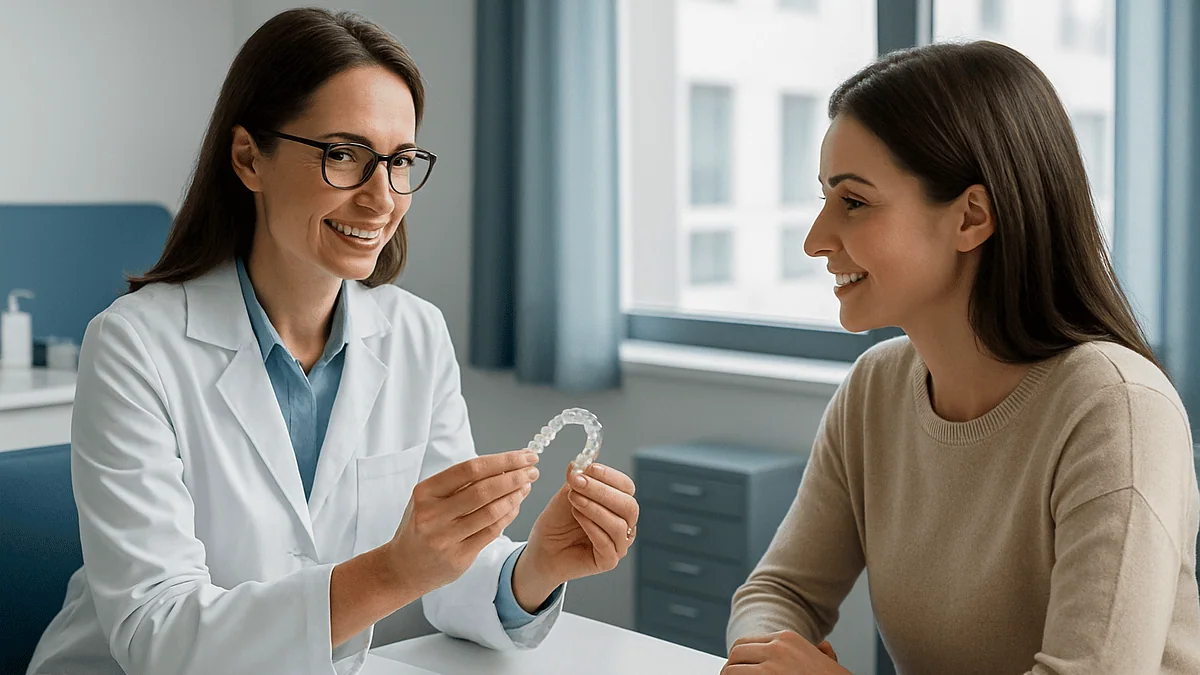
A clear aligner is a thin, removable tray of medical-grade plastic shaped to fit over the teeth. Each tray is made slightly different from the current tooth position, so putting it on presses gently on specific teeth. That pressure is the whole trick.
Teeth sit in bone but are not fused to it. Each root is held by a ligament, and when steady force is applied, cells on the compressed side of the socket slowly remove bone while cells on the stretched side build new bone. The tooth migrates a fraction of a millimeter, the socket remodels around it, and the next tray nudges it again. Fixed braces use the same biology; they simply deliver the force through wires and brackets bonded to the teeth. The NHS describes both approaches as ways of applying gentle, sustained pressure over months to reposition teeth and jaws.
Modern aligner plans start with a digital scan or impression of the mouth. Software then maps the planned path for every tooth and generates a sequence of trays. Small tooth-colored bumps called attachments are often bonded to certain teeth so the plastic has something to grip when a tooth needs to rotate or move vertically. Some plans also use tiny elastics hooked between trays to pull the upper and lower arches into a better relationship.
Two things follow from this mechanism. First, aligners only work while they are in the mouth; a tray in a pocket exerts no force at all. Second, some movements are easier for plastic than others. Tipping a crown sideways is straightforward. Dragging a whole root through bone, pulling a tooth downward, or spinning a round canine tooth are harder, which is why candidacy depends so much on what kind of movement the bite needs.
Who are the usual clear aligners candidates?
The profile that most reliably suits aligners is an adult or older teenager with all permanent teeth in place, healthy gums, no untreated decay, and a bite problem the team classifies as mild to moderate. That covers a wide group: slightly crowded lower front teeth, small gaps, teeth that have drifted after braces worn years ago, or a modest overbite where the upper front teeth sit a little too far ahead of the lower ones.
Motivation matters as much as anatomy. Because the trays are removable, the treatment only works for someone who will keep them in for most of the day and night, take them out only to eat and brush, and move to the next tray on schedule. People who travel for work, who already wear a night guard, or who simply dislike the idea of anything fixed to their teeth often find this structure fits their lives well.
Gum and bone health is the third pillar. Orthodontic movement relies on healthy bone remodeling around the root. If the supporting bone has already been lost to periodontal disease, moving a tooth can loosen it further. Teams therefore look for stable gums before anything else, and someone with a history of gum disease that is now well controlled can still be a candidate, provided the periodontal team agrees.
Age by itself is not a barrier. MedlinePlus notes that malocclusion, the medical term for teeth that do not line up properly when the jaws close, can be corrected in adults as well as children, though adult treatment may take longer because growth is finished. In practice, candidacy has far more to do with what the bite needs and what the person is willing to commit to than with the year on a birth certificate.
What disqualifies you from clear aligners, and who is asked to wait
Very few people are told never. Far more are told not yet, and the distinction matters.
The most common reason to pause is active gum disease. Periodontitis, the advanced form of gum disease in which infection destroys the bone that anchors teeth, needs to be treated and stable before any orthodontic force is applied. The same goes for untreated cavities: decay under a tray sits in a warm, sealed environment, and a filling placed mid-treatment can change how the tray fits. Most teams want a clean bill of dental health first.
Bite problems rooted in the jaw bones themselves, rather than in the position of the teeth, are a genuine limit. A large underbite where the lower jaw sits well ahead of the upper, a significant open bite where the front teeth never touch, or an asymmetric jaw often need jaw surgery combined with orthodontics, or fixed appliances that can deliver forces plastic cannot. The NHS lists these severe discrepancies among the cases where surgery may be considered alongside braces.
Teeth that must move a long way in specific directions are another sticking point. Pulling a tooth downward into the bite, rotating a rounded canine or premolar by a large angle, or bodily shifting molars backward are movements where aligners have historically been less predictable than fixed braces, and many teams either add auxiliaries or advise braces for that phase.
Then there is the person, not the mouth. Someone who knows they will not wear the trays consistently, a young child who still has baby teeth, or a patient with a health condition that affects bone healing may all be steered elsewhere. None of this is a judgment; it is the team matching the tool to the job.
Which bite types respond well to aligners? A plain-language guide
Orthodontists sort bites into categories, and the category often predicts how comfortable a team will feel offering aligners. The table below summarizes the general pattern; individual cases vary and only an examination can place you in one.
| Bite feature | What it means | Typical aligner suitability |
|---|---|---|
| Mild crowding | Teeth overlap slightly because the arch is a little short of space | Usually well suited |
| Spacing | Gaps between teeth, often at the front | Usually well suited |
| Mild overbite (overjet) | Upper front teeth sit somewhat ahead of the lower ones | Often suitable, sometimes with elastics |
| Deep bite | Upper front teeth cover too much of the lower front teeth | Case by case; vertical movement is harder for plastic |
| Crossbite | One or more upper teeth close inside the lower teeth | Single-tooth cases often suitable; wide jaw-based cases may need other appliances |
| Open bite | Front teeth do not meet when the back teeth close | Mild dental cases sometimes suitable; skeletal cases often need more |
| Underbite | Lower teeth or jaw sit ahead of the upper | Mild cases sometimes; significant jaw discrepancy usually needs fixed appliances or surgery |
| Severe rotations | A tooth turned far from its ideal position | Less predictable; attachments or braces often preferred |
Notice the pattern. Problems located in the teeth themselves, especially in the front, sit at the easy end. Problems located in the jaw relationship or requiring large vertical or rotational movement sit at the hard end. Clear aligners for overbite is one of the most searched phrases in this area, and the honest answer is that a modest overjet is frequently treatable while a large one driven by jaw position is a different conversation.
Crowding, spacing and the space question
Crowding is the single most common reason adults ask about aligners, and it raises a question that decides a lot of plans: where will the space come from?
Teeth need room to line up. When the arch is only slightly short, a team can create space by gently widening the arch, tipping the front teeth forward a little, or shaving tiny slivers of enamel from between neighboring teeth. That last technique, sometimes called interproximal reduction, removes fractions of a millimeter from each contact and is well within what aligners handle. For many mildly crowded lower front teeth, this is the entire plan.
Moderate crowding is where the discussion becomes more nuanced. Pushing front teeth forward to make room can leave them sitting too far ahead of the lips, and widening an arch has limits set by the bone and gums. Some moderate cases still suit aligners, particularly when the person accepts that the front teeth will end up slightly more forward than they started.
Severe crowding often requires removing one or more teeth to create space. Aligners can close extraction spaces, but pulling neighboring teeth bodily toward each other through bone without letting them tip is one of the movements where plastic has been less predictable than fixed braces. Many teams either choose braces for these cases or plan a hybrid: braces to close the gaps, aligners to finish.
Spacing is usually the easier direction. Closing small gaps between front teeth is a modest movement and a classic aligner case. The exception is a gap caused by a tooth that never developed or was lost; here the team must decide whether to close the space with teeth or hold it open for a future implant, which changes the whole plan.
Gum health before aligners: why the periodontal exam comes first
If one item on the candidacy list deserves to be underlined, it is this one. Gum health is not a formality checked off before the interesting part; it is the foundation everything else rests on.
Gum disease begins as gingivitis, inflammation of the gum edge caused by plaque, and can progress to periodontitis, in which the infection spreads below the gum line and destroys the ligament and bone that hold teeth in place. The National Institute of Dental and Craniofacial Research reports that close to half of US adults aged 30 and older show some form of periodontal disease, and the proportion rises with age. A great many prospective aligner patients therefore arrive with at least early gum involvement, often without knowing it.
Why does this matter for tooth movement? Because orthodontic force works by remodeling the bone around the root. In healthy tissue that remodeling is controlled and reversible. In inflamed, infected tissue the same force can accelerate bone loss, and a tooth that has already lost part of its bony support can become loose or drift unpredictably. Mayo Clinic notes that untreated periodontitis can eventually lead to tooth loss on its own; adding orthodontic force to that picture is asking for trouble.
The practical sequence is well established. Gums are examined and measured, any disease is treated, home care is brought up to a standard the team is happy with, and only then does tooth movement begin. Someone with a history of periodontitis that is now stable can often proceed, usually with closer monitoring and more frequent cleanings during treatment. Aligners have one modest advantage here: because they are removable, brushing and flossing are easier than around brackets and wires, which helps people keep the gums calm while the teeth move.
Fillings, crowns, implants and missing teeth
Adult mouths carry history, and every piece of dental work changes the plan a little.
Ordinary fillings are rarely a problem. The tray simply fits over them. The caveat is timing: because the trays are made from a scan of the teeth as they are today, a large filling or crown placed after the scan can alter the shape enough to spoil the fit. Teams generally ask that any planned restorative work be finished before scanning, or postponed until the movement phase ends.
Crowns and veneers move with the tooth underneath them, so they do not prevent aligner treatment. They do complicate attachments, the small bonded bumps that give the tray leverage, because bonding to porcelain is less reliable than bonding to enamel and can mark the surface. A team may plan the movement to avoid attachments on those teeth or accept a compromise.
Implants are the important exception. An implant is a titanium post fused directly to the jaw bone; it has no ligament and cannot move. Aligners cannot shift an implant, and a tray that presses on one will simply push the neighboring teeth instead. That is not always a disadvantage: a well-placed implant can serve as a fixed anchor to move other teeth against. But someone considering both an implant and aligners is usually advised to straighten first and place the implant second, when the final tooth positions are known.
Missing teeth raise a planning decision rather than a barrier. The team must decide whether to close the gap by moving neighbors together, or to hold or even open the space for a future replacement. Bridges, which link two or more teeth into a single rigid unit, restrict movement of every tooth in the span and may need to be sectioned or replaced as part of the plan.
Teens and adults: does age change who qualifies?
Age changes the conversation, not the eligibility.
For younger teenagers, the first question is whether all the permanent teeth are present. Aligners rely on a stable, complete set of teeth to fit against; trays designed for a mouth that still has baby teeth or partially erupted molars lose their grip as those teeth change. Some aligner systems include features that leave room for erupting teeth, and orthodontic teams do treat adolescents with them, but the NHS notes that many orthodontic plans in young people are timed around the arrival of the adult teeth and periods of jaw growth.
Growth is a double-edged factor. In a growing teenager, certain jaw discrepancies can be guided with functional appliances that harness growth to improve the relationship between the jaws. Once growth is complete, that window closes and the same discrepancy may need tooth movement alone, or surgery. This is one reason a teenager with a moderate underbite might be offered a different pathway than an adult with the same bite.
Adults, for their part, bring three things a team weighs carefully. Bone remodels more slowly with age, so MedlinePlus observes that adult treatment can take longer. Adults are far more likely to have gum disease, restorations and missing teeth, each of which shapes the plan. And adults are often better at wearing removable appliances consistently, because the decision to start is their own.
None of this means there is an upper age limit. People in their sixties and seventies are treated when their gums and bone are healthy. What changes with age is the list of questions the team asks before saying yes, and the honesty required about how long the process may take.
The wear commitment: what roughly 22 hours a day really means
Here is the part of candidacy no scan can measure. A tray in a case on the kitchen counter moves nothing.
Most orthodontic teams and aligner manufacturers ask for the trays to be worn somewhere around 20 to 22 hours out of every 24, removing them only to eat, drink anything other than water, and clean the teeth. Your own team will give you their exact target; the point is that it leaves roughly two hours a day, total, for meals, coffee and brushing. That sounds generous until you add up a leisurely breakfast, a working lunch, a dinner out and an evening snack.
The biology explains the strictness. Bone remodeling needs sustained pressure. When a tray comes out, the ligament begins to relax within hours, and repeated gaps mean the tooth never quite reaches the position the next tray was built for. Miss enough hours and the new tray will not seat fully, the plan drifts off track, and a refinement scan and a fresh set of trays may be needed. Treatment length stretches accordingly.
Honest self-assessment is therefore a legitimate part of deciding whether you are a candidate. People who eat frequently through the day, who sip sweetened or acidic drinks at their desk, or who know from experience that they lose small objects tend to struggle. People who eat structured meals and are comfortable with a routine often find the discipline easier than expected within a couple of weeks.
Teams sometimes use a simple test: they ask a prospective patient to imagine not snacking between meals for the next year and a half. Those who wince are not bad candidates; they are being given useful information about which appliance will actually work for them. Fixed braces, which cannot be removed, sidestep this problem entirely.
What the first days and weeks with aligners usually look like
Once the plan is approved and the trays arrive, the early experience follows a fairly predictable rhythm.
The first tray typically feels tight and the teeth feel tender to bite on for a few days. This is the ligament registering the new force, and it is expected rather than alarming. Speech may lisp slightly for a day or two until the tongue adapts to the plastic. Attachments bonded to the teeth can feel rough against the inside of the lips at first; the tissue toughens quickly. Saliva production often increases briefly.
Removing and reinserting the trays is awkward in week one and automatic by week three. Most people learn to take them out over a sink rather than a restaurant table, and to carry a small case so a tray is never wrapped in a napkin and forgotten.
Trays are changed on a schedule set by the team, commonly every one to two weeks, though the interval is individual and the team will tell you theirs. Each change brings a fresh round of mild tightness that settles in a day or so. Check-ups happen every several weeks so the team can confirm that the teeth are tracking, meaning they are keeping up with the positions the trays expect.
Overall duration depends on how far the teeth need to move. The NHS notes that orthodontic treatment usually takes between 18 and 24 months, with simpler cases finishing sooner and complex ones running longer. Aligner plans for minor crowding can be considerably shorter than that range, while plans involving bite correction often sit within it. Any figure quoted at a consultation is an estimate, and refinements, meaning extra trays to finish movements that did not fully track, are common enough that most teams build them into expectations from the start.
Clear aligners vs braces: how the options compare for different people
The choice between aligners and fixed braces is rarely about which is better. It is about which is better for this bite and this person.
Fixed braces win on control. Because the brackets are bonded and the wire is continuous, the orthodontist can apply forces in three dimensions without relying on the patient to do anything. Large rotations, vertical movements, closing extraction spaces without tipping, and correcting significant jaw discrepancies with elastics or auxiliary appliances are all areas where braces have a longer and more predictable track record. Compliance is built in; you cannot forget to wear them.
Aligners win on daily life. They are removable for eating and cleaning, so oral hygiene is easier and dietary restrictions are fewer. There are no wires to break and no brackets to irritate the cheeks. Many adults simply prefer how they look. The trade-off is that every one of those advantages depends on the person putting the tray back in.
Comfort is roughly a draw. Both cause tenderness after adjustments or tray changes. Braces cause more soft-tissue irritation; aligners cause more speech adjustment early on.
Treatment time is often similar for comparable cases, with the NHS range of 18 to 24 months applying broadly to orthodontics as a whole. Aligners may finish faster for very mild cases and slower when tracking problems require refinements.
There is also a third option: doing nothing, or waiting. A mildly crowded lower incisor that bothers no one and can be cleaned properly does not need treatment. Orthodontics is a choice, not a medical necessity, for most adults, and a good team will say so when the bite is stable and healthy.
Hybrid plans exist too. Some people begin with braces for the difficult movements and switch to aligners for the finishing phase. The decision, like every other in this article, rests with the treating team.
Jaw joint pain, grinding and clenching: do they rule you out?
Many adults asking about aligners also live with a clicking jaw, morning headaches or a partner who complains about nighttime grinding. These are common, and they do not automatically disqualify anyone, but they change the conversation.
Temporomandibular disorders, often shortened to TMD, are a group of conditions affecting the jaw joint and the muscles that move it. The National Institute of Dental and Craniofacial Research notes that symptoms include pain in the jaw or face, limited movement, and clicking or popping, and that for most people the symptoms are temporary and improve with conservative care. The Institute also states that there is no evidence orthodontic treatment either causes or reliably treats TMD, which cuts both ways for a prospective patient: aligners are not a treatment for jaw pain, and having jaw pain does not by itself mean aligners are unsafe.
What teams do want is stability. Active, painful TMD is generally settled first, because changing the bite while the joint is inflamed makes it hard to tell what is causing what. Once symptoms are controlled, treatment can proceed with monitoring.
Bruxism, the medical term for grinding or clenching the teeth, matters for a practical reason: heavy grinders can wear through or crack trays faster than expected. Because trays are changed frequently, this is usually a nuisance rather than a barrier, and some people find that the plastic acts as a modest cushion at night. A team may build in spare trays or adjust the change schedule.
Where clenching has already worn the teeth flat, the team may plan the final bite differently, and may recommend a night guard after treatment to protect both the teeth and the retainers. Anyone with jaw symptoms should mention them at the first visit rather than hoping they go unnoticed.
Retainers: the part of candidacy nobody mentions at the start
Ask about aligners and the conversation centers on the months of treatment. Ask an orthodontist what worries them most and the answer is often what happens afterward.
Teeth do not stay where they are put. The ligament and bone around a newly moved tooth take many months to fully reorganize, and the soft tissues of the lips, tongue and cheeks keep pushing. Left alone, teeth drift back toward their old positions, a process called relapse. The NHS is direct on this point: retainers, the custom appliances worn after active treatment, are essential to hold the result, and teeth may move back if they are not worn as advised.
Retainers come in two broad forms. Removable retainers look much like a thin aligner or a wire-and-acrylic plate and are typically worn full-time at first and then at night. Fixed retainers are thin wires bonded to the back of the front teeth, invisible from the front and not dependent on memory. Many teams use both. The wearing schedule is individual and comes from the team, but the underlying message is the same: some form of retention is usually lifelong.
This has a direct bearing on candidacy. Someone who has already relapsed once after braces worn in adolescence, because the retainer went in a drawer, is a perfectly good candidate for aligners provided they understand why the same thing will happen again without retention. And someone who doubts they will wear a night retainer for years may want to discuss fixed retention before starting, rather than after.
Retainers also need care. They are cleaned like aligners, replaced when they warp or crack, and checked at dental visits. A retainer that no longer fits snugly is an early sign that teeth are shifting and a reason to call the team promptly.
What people often get wrong about clear aligner candidacy
Several beliefs about who can and cannot use aligners circulate widely enough to deserve direct correction.
Myth: aligners are only for cosmetic cases. Aligners move teeth by the same biology as braces and are used for genuine bite correction, not just straightening front teeth. What limits them is the type and size of movement, not whether the goal is appearance or function.
Myth: if you had braces before, you cannot have aligners. Relapse after earlier orthodontics is one of the most common reasons adults seek aligners, and these cases often involve modest movements well suited to plastic. The prior treatment is a reason to talk carefully about retention, not a barrier.
Myth: gum disease is a minor detail. The reverse is true. Active periodontitis is one of the few near-absolute reasons to pause, because moving teeth through infected bone risks loosening them. Treat the gums first; the aligners will still be there.
Myth: a virtual or mail-order assessment is as good as an examination. A photograph cannot measure gum pockets, detect decay between teeth, assess bone levels or evaluate the jaw joint. Candidacy decisions rest on a clinical examination and radiographs, meaning dental X-rays, reviewed by a qualified clinician.
Myth: aligners are faster than braces. For comparable cases the NHS range of 18 to 24 months applies broadly to orthodontics. Very mild aligner cases can be short; cases that stop tracking can run long.
Myth: you can wear them less and just take longer. Inconsistent wear does not simply slow treatment; it lets teeth drift between trays so the next tray no longer fits, which means new scans and new trays. The commitment is not negotiable in the way many people hope.
Myth: once the teeth are straight, you are finished. Retention is lifelong for most people, and skipping it is the most reliable way to undo the work.
Questions to ask your care team before you decide
A first consultation goes better with a short list in hand. These questions are the ones that tend to surface the information that actually matters.
- Which category does my bite fall into, and which specific movements does my plan need? Ask the team to point out any movement they consider less predictable with aligners.
- What is the condition of my gums and bone on today’s examination and X-rays, and is anything needed before we start?
- Do any of my fillings, crowns, bridges or implants change the plan, and should any dental work be done before or after treatment?
- How many hours a day will you ask me to wear the trays, and what happens to the plan if I fall short?
- How long do you estimate treatment will take for my case, and how likely is it that I will need refinements, meaning extra trays at the end?
- Would fixed braces, a hybrid approach, or waiting be reasonable alternatives for me, and what would each involve?
- Will I need attachments or elastics, and where will they be placed?
- What retention do you recommend afterward, fixed, removable or both, and for how long?
- Who do I contact if a tray cracks, an attachment comes off, or a tooth feels loose, and how quickly should I expect a response?
- If I grind my teeth or have jaw joint symptoms, how does that affect your plan?
Write the answers down. A team that welcomes these questions and answers them specifically is telling you something reassuring about how the next year and a half will go. A consultation that skips straight past gum health and wear expectations is a reason to ask again, or to seek a second opinion, before committing.
When to call your doctor: red flags during aligner treatment
Most of aligner treatment is uneventful, and mild tenderness for a few days after each tray change is expected. Some signs, however, warrant a prompt call to the orthodontic team or dentist rather than waiting for the next scheduled visit.
- A tooth that feels noticeably loose, moves visibly when touched, or changes color. Orthodontic tenderness is normal; a wobbling tooth is not.
- Gums that bleed heavily, swell, recede visibly from a tooth, or produce pus. These can indicate gum infection progressing under treatment.
- Severe or worsening pain that does not settle within a few days of a tray change, or pain concentrated in one tooth, which may signal decay, a cracked tooth or a problem with the nerve.
- A tray that will not seat fully on a tooth, or a persistent gap between tray and tooth, meaning the teeth are not tracking and the plan needs review.
- Sudden difficulty opening the mouth, jaw locking, or new severe jaw joint pain.
- Sores, ulcers or a raw patch inside the mouth that does not heal within about two weeks. The NHS advises that any mouth ulcer lasting longer than three weeks should be checked.
- Signs of an allergic or irritant reaction to the plastic or attachment material, such as widespread redness, itching or swelling of the lips and gums.
- Fever, facial swelling, or swelling spreading toward the eye or neck alongside dental pain. This can indicate a spreading infection and needs same-day medical or dental care, or emergency care if breathing or swallowing is affected.
Anyone experiencing difficulty breathing, difficulty swallowing, or rapidly spreading facial swelling should seek emergency care immediately rather than contacting the orthodontic office. For everything else on this list, the treating team is the first call; they know the plan, the mouth and the history, and every decision about pausing, adjusting or continuing treatment rests with them.
Frequently asked questions
What disqualifies you from clear aligners?
The most common reasons a team declines or delays aligners are active gum disease, untreated decay, and bite problems rooted in jaw position rather than tooth position, such as a large underbite or open bite. Movements aligners handle less predictably, including big rotations and pulling teeth downward, may also lead a team toward braces. Honest doubt about wearing trays most of the day is a legitimate reason too. Most of these are reasons to wait or choose differently, not permanent exclusions.
Am I a candidate for clear aligners if I had braces as a teenager?
Very often, yes. Teeth that have drifted after earlier orthodontics usually need modest movements that suit aligners well, and relapse after braces is one of the most common reasons adults seek treatment. The important conversation is about retention afterward, since the same drift will recur without a retainer. Your team will also check gum health and any dental work done since, which shape the plan more than the earlier braces do.
How do you tell if you are a candidate for clear aligners at home?
You cannot confirm it at home, and that is worth knowing before spending time on online quizzes. Candidacy depends on measurements of gum pockets, dental X-rays showing bone levels and roots, and an assessment of how the jaws meet, none of which a photograph captures. What you can do at home is reflect honestly on whether you would wear trays roughly 20 to 22 hours a day and stop snacking between meals. That self-assessment is genuinely useful information for your consultation.
Do clear aligners work for an overbite?
For a mild to moderate overjet, where the upper front teeth sit somewhat ahead of the lower, aligners are frequently used, sometimes with small elastics between the trays to improve how the arches meet. A large overbite caused by the position of the jaws rather than the teeth is a different situation and may need fixed appliances, growth-guiding appliances in teenagers, or surgery in adults. Only an examination can tell which kind you have.
Can I get clear aligners if I have gum disease?
Not while it is active. Gum disease must be treated and stable before tooth movement begins, because orthodontic force through inflamed, infected bone risks accelerating bone loss and loosening teeth. Someone with a history of periodontitis that is now well controlled can often proceed with closer monitoring and more frequent cleanings. Aligners have a modest advantage here because they are removable, making thorough brushing and flossing easier than around brackets and wires.
Are clear aligners vs braces a real choice, or is one always better?
It is a real choice that depends on the bite and the person. Braces offer more control for large rotations, vertical movements, extraction spaces and significant jaw discrepancies, and compliance is built in. Aligners are removable, easier to clean around and preferred by many adults for appearance, but they only work if worn consistently. Treatment time is broadly similar for comparable cases. Some plans combine both, and the treating team makes the recommendation.
How many hours a day do clear aligners need to be worn?
Most orthodontic teams ask for roughly 20 to 22 hours out of every 24, with the trays removed only to eat, drink anything other than water, and clean the teeth. Your own team sets the exact target. Falling short does not simply slow treatment; it lets teeth drift between trays so the next one no longer fits, which usually means a new scan and additional trays. Consistent wear is the single factor most within the patient’s control.
Is there an age limit for clear aligners?
There is no upper age limit. Adults in their sixties and seventies are treated when their gums and bone are healthy, though MedlinePlus notes adult treatment can take longer because bone remodels more slowly once growth is complete. For younger patients, the main question is whether all permanent teeth are present, since trays need a stable set of teeth to fit against. Age shapes the questions a team asks, not the eligibility itself.
Can clear aligners move dental implants or teeth with crowns?
Implants cannot be moved by any orthodontic appliance because they are fused directly to bone with no ligament; teams usually straighten first and place implants afterward, or use an existing implant as a fixed anchor. Crowns and veneers move with the tooth beneath them and do not prevent treatment, though bonding attachments to porcelain is less reliable, so the plan may avoid attachments on those teeth or accept a compromise.
How long does clear aligner treatment usually take?
It depends on how far the teeth need to move. The NHS states that orthodontic treatment usually takes between 18 and 24 months, with simpler problems finishing sooner and complex ones running longer. Aligner plans for minor crowding can be considerably shorter than that range, while plans involving bite correction often fall within it. Refinements, meaning extra trays to finish movements that did not fully track, are common, so any estimate given at consultation should be treated as approximate.
References
- NHS: Orthodontics
- MedlinePlus: Malocclusion of teeth
- NIH National Institute of Dental and Craniofacial Research: Periodontal (Gum) Disease
- NIH National Institute of Dental and Craniofacial Research: TMD (Temporomandibular Disorders)
This article is for general information only and is not a substitute for professional medical advice. Please consult a qualified doctor about your individual situation.

More from the Blog
How Orthodontic Treatment Moves Teeth: Pressure, Bone Remodeling and Adjustment Visits
Orthodontic treatment works by applying light, continuous pressure to teeth through braces, aligners or other appliances. That pressure compresses the ligament on one side…

Why Straws and Smoking Matter After Wisdom Teeth Removal: Dry Socket Explained
Dry socket is a painful complication after wisdom teeth removal in which the protective blood clot in the empty socket is lost or fails…
How Laser Assisted Dental Procedures Work: Cleaning First, Then Precise Light Treatment
A laser assisted dental procedure uses a focused beam of light, chosen for the tissue being treated, after the tooth or gum has first…

Living With TMJ Treatment: Soft Foods, Wide Yawns to Avoid and Daily Jaw Habits
A soft diet for TMJ means choosing foods that need little chewing, such as yogurt, eggs, cooked grains, flaky fish and well-cooked vegetables, for…

What Halitosis Treatment Can Change and How Quickly Breath Usually Improves
Halitosis treatment can usually change the source of the odor rather than mask it: bacterial coating on the tongue, gum disease, dry mouth, or…
What Bruxism Treatment Can and Cannot Do: Protecting Teeth vs Stopping the Grinding
Bruxism treatment results depend on which goal you mean. Custom night guards and dental repairs reliably protect teeth from further wear, but current evidence…