

Who Is a Candidate for Robotic Knee Replacement? What Orthopedic Surgeons Weigh

Key Takeaways
- Eligibility for robotic knee replacement is essentially the same as for conventional knee replacement: advanced arthritis, persistent functional loss and a fair trial of non-surgical care.
- The surgeon performs every step of a robotic-assisted operation; the system builds a patient-specific plan and constrains the cutting tools to it.
- Published evidence shows robotic assistance improves how closely implant position matches the plan, but long-term differences in function or implant survival are not yet established.
- MedlinePlus puts the typical lifespan of an artificial knee at roughly 15 to 20 years, which is why surgeons weigh age and activity level carefully in younger people.
- Partial knee replacement, where robotic planning attracts particular interest, requires arthritis confined to one compartment and an intact anterior cruciate ligament.
- Smoking, uncontrolled diabetes and active infection are the health factors most likely to delay surgery, because they raise wound and infection risk regardless of technique.
A robotic knee replacement candidate is generally an adult with advanced knee arthritis whose pain and stiffness limit daily life despite non-surgical care such as exercise, weight management and medicines. Surgeons also weigh overall health, bone quality, joint deformity, prior surgery and a person's goals. The robotic system is a planning and cutting aid, not a separate operation, so the core criteria match conventional knee replacement.
The stairs to her daughter’s apartment have eleven steps. She has counted them, because for the past two years each one has required a pause, a hand on the rail and a small negotiation with her right knee. The physical therapy helped for a while. So did the injections. Now she is sitting across from an orthopedic surgeon who has just used the word “robotic,” and the question in her head is simple: does that apply to me?
It is one of the most common things surgeons are asked today, and one of the most misunderstood. Being a robotic knee replacement candidate is not a special category reserved for the young, the fit or the technologically curious. It is, almost entirely, the same decision as any knee replacement, with a few additional questions about anatomy and imaging layered on top.
This explainer walks through what orthopedic surgeons actually weigh, what the evidence does and does not show, and what to ask before you decide.
What makes someone a robotic knee replacement candidate?
Start with the disease, not the machine. Knee replacement, which surgeons call arthroplasty (a procedure that replaces damaged joint surfaces with metal and plastic components), is performed mainly for osteoarthritis, the wear-related breakdown of the smooth cartilage that lets bones glide. Inflammatory arthritis, post-injury damage and a few rarer conditions make up the rest.
The Mayo Clinic frames the core question as whether pain and stiffness are interfering with ordinary activities such as walking, climbing stairs and getting in and out of chairs, and whether reasonable non-surgical treatment has stopped helping. That is the threshold for any knee replacement, robotic or not.
A robotic knee replacement candidate therefore looks like a conventional candidate first. Surgeons typically weigh:
- The severity of joint damage on X-ray, and whether it matches the person’s symptoms
- How much daily function has been lost, and for how long
- Whether exercise, weight management, bracing, medicines or injections have been tried in a meaningful way
- General health: heart, lung, kidney and metabolic conditions that shape surgical risk
- Skin, circulation and infection risk around the knee
- Realistic expectations about what surgery can and cannot do
Only after those boxes are considered does the technology question arise. A robotic system adds a planning and execution layer; it does not change who needs a new knee. What it can change is how the surgeon maps your specific anatomy, which is why a handful of anatomical questions get extra attention, covered later in this article.
One caution belongs up front. No robotic system, and no surgeon, can promise a particular outcome. The evidence on robotic assistance is still maturing, and the decision to operate, and how, sits with the treating team after examining you in person.
How robotic knee replacement actually works
The word “robotic” conjures an autonomous arm operating while the surgeon watches. That is not what happens. In robotic-assisted knee replacement, the surgeon performs the operation; the system helps plan it and constrains the tools to that plan.
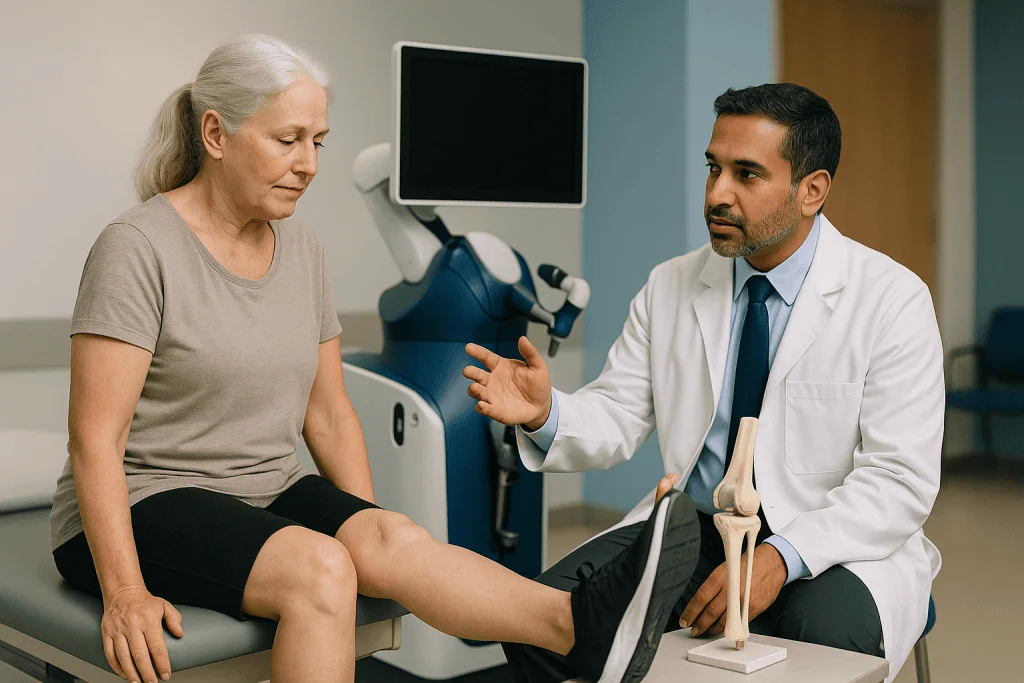
The process usually begins with imaging. Some platforms use a CT scan (a detailed cross-sectional X-ray) taken before surgery to build a three-dimensional model of the knee. Others build the model in the operating room by touching a probe to landmarks on the exposed bone. Either way, the surgeon uses the model to decide where each implant component should sit, how the leg’s alignment (the line from hip through knee to ankle) should be set, and how tight or loose the surrounding ligaments will be through the full range of motion.
During the operation, the robotic arm or a handheld guided tool helps the surgeon make the bone cuts. Many systems use haptic boundaries, meaning the tool resists or stops if the surgeon strays from the planned area, a bit like a stencil that pushes back. Tracking markers pinned to the bone let the system follow the knee as it moves.
The implants themselves are the same families of metal and polyethylene components used in conventional surgery. The incision, anesthesia options, hospital stay and rehabilitation follow the same principles the NHS and Mayo Clinic describe for knee replacement in general.
What the technology is designed to add is precision and reproducibility: cuts closer to the plan, and a plan tailored to the individual rather than to average anatomy. Whether that precision translates into a knee that feels better years later is the open scientific question, and an honest surgeon will say so.
The first thing surgeons weigh: what you have already tried
Before any discussion of robots, most orthopedic surgeons want to know the story of the knee. Osteoarthritis is a chronic condition, and both the NHS and Mayo Clinic describe a stepped approach in which surgery sits at the end, not the beginning.
That ladder usually includes several rungs. Strengthening the muscles around the knee, particularly the quadriceps, offloads the joint and is one of the best-supported non-surgical measures. Weight management reduces the load through the knee with every step. Activity modification, walking aids and bracing can buy time. Pain-relieving medicines, from topical anti-inflammatories to oral classes, are used according to a prescriber’s judgment about each person’s risks. Injections of corticosteroid, and in some settings other agents, may offer temporary relief.
None of these steps reverses cartilage loss. Their job is to control symptoms and preserve function for as long as reasonably possible, because an artificial knee has a finite lifespan. MedlinePlus notes that an artificial knee typically lasts 15 to 20 years, which is one reason surgeons prefer not to operate before it is clearly warranted.
Surgeons therefore listen for a pattern: pain that persists at rest or at night, function that keeps shrinking despite genuine effort at conservative care, and a person who understands that surgery trades one set of problems for a recovery period and a small but real set of risks.
If that pattern is not yet present, being told to wait is not a rejection. It is the same evidence-based advice a robotic knee replacement candidate receives at every center, because the technology does not lower the bar for operating. It simply changes how the operation is planned once the bar is met.
Who is usually a robotic knee replacement candidate, and who is usually asked to wait
Picture two people in the same waiting room. One has bone-on-bone arthritis on X-ray, limps after ten minutes, wakes at night with a throbbing knee and has spent a year on a structured exercise program with diminishing benefit. The other has moderate arthritis, aches after tennis and has never worked with a physical therapist. Both may eventually have surgery. Only the first is likely to be offered it now.

People commonly considered suitable candidates share several features:
- Advanced arthritis confirmed on imaging that matches where and how the knee hurts
- Persistent, function-limiting pain despite a fair trial of non-surgical care
- Medical conditions that are present but reasonably controlled
- Enough bone stock and soft-tissue health to support an implant and heal an incision
- Willingness to commit to rehabilitation, which is where a good result is earned
People often asked to wait or to address something first include those with an active infection anywhere in the body, uncontrolled blood sugar, untreated heart or lung disease that makes anesthesia riskier, significant skin problems over the knee, or very poor circulation in the leg. Current smokers are frequently asked to stop for a period before surgery because smoking impairs wound healing and raises infection risk, a point the NHS makes in its preoperative guidance.
A separate group is asked to wait for a different reason: their symptoms do not yet justify the risks. That is a judgment call about quality of life, and it belongs to the person and their surgeon together.
Robotic assistance does not shift any of these categories. Where it may matter is at the margins of anatomy: unusual deformity, retained hardware from earlier fractures, or a knee that is a borderline fit for a partial replacement, discussed below.
Is there a robotic knee replacement age limit?
Nobody is too old on the calendar alone, and nobody is automatically the right age either. Surgeons weigh physiological age, meaning how the heart, lungs, kidneys, cognition and mobility are actually functioning, far more than the number on a birth certificate.
The Mayo Clinic notes that knee replacement is most often performed in people in their sixties and older, and that the operation can be considered at any adult age when arthritis is severe enough. Older adults in good general health routinely undergo knee replacement. What changes with advancing age is the emphasis placed on preoperative assessment: anesthesia planning, medication review, fall risk, home support and the realistic pace of rehabilitation.
At the younger end, the conversation turns to implant lifespan. Because MedlinePlus puts the typical life of an artificial knee at roughly 15 to 20 years, a person in their forties faces a meaningful chance of needing a second operation, called a revision, later in life. Revisions are technically more demanding and carry higher risk than first-time surgery. Surgeons therefore push harder on non-surgical options in younger people and may discuss partial replacement or, in specific cases, realignment surgery on the bone.
Does robotic assistance change any of this? Not in terms of eligibility. The planning tools are the same for a 48-year-old and an 82-year-old. Some surgeons value the precise alignment planning particularly in younger, more active people, on the reasoning that a well-positioned implant may wear more evenly, but that is an inference from engineering principles rather than a proven long-term outcome, and it should be presented as such.
The short version: there is no robotic knee replacement age limit written into any guideline. There is only an individual assessment of risk, benefit and what a person wants the next decades to look like.
Weight, diabetes and smoking: the health factors that carry the most weight
Three modifiable factors come up in almost every candidacy discussion, and they deserve plain, respectful explanation because they are about risk, not judgment.
Body weight matters for two reasons. Mechanically, more load through the knee accelerates arthritis and stresses an implant. Surgically, higher body mass is associated with longer operations, more difficult exposure and higher rates of wound complications and infection. Cleveland Clinic and the NHS both note that surgeons may recommend weight loss before surgery. This is not a hard cutoff in most settings; it is a conversation about lowering risk, and many people with higher body weight have successful knee replacements after careful planning.
Diabetes affects healing and immune defense. Poorly controlled blood sugar around the time of surgery raises infection risk, so surgeons and anesthesiologists typically ask for evidence of reasonable control before scheduling. How that is achieved, and any medicine adjustments, belongs to the person’s own physician.
Smoking constricts small blood vessels, reduces oxygen delivery to healing tissue and roughly doubles the trouble surgeons have with wounds. The NHS advises stopping smoking before an operation to reduce complications. Support to quit is part of good preoperative care, not a lecture.
Other conditions get attention too. Heart and lung disease shape anesthesia risk. Kidney function affects fluid and medicine handling. Rheumatoid arthritis and its immune-suppressing treatments require coordination with a rheumatologist about timing. Dental infections, urinary infections and skin breaks are addressed first, because bacteria can travel through the bloodstream to a fresh implant.
Every one of these applies equally to conventional and robotic surgery. The robot cannot improve wound healing, blood sugar or lung function. It can only cut bone where it is told to, which is why surgeons spend so much of the candidacy conversation on the person rather than the platform.
Robotic vs traditional knee replacement: what the evidence actually shows
Here is where honesty matters most. Robotic assistance is newer than conventional knee replacement, and the two are compared constantly, often with more enthusiasm than data.
What the published literature consistently shows is that robotic systems improve how closely the final implant position matches the preoperative plan, with fewer alignment outliers. Some studies report less soft-tissue disturbance and lower early pain scores. Long-term comparisons of implant survival and patient-reported function beyond a few years are still limited, and where differences exist they are modest. Mainstream sources such as Cleveland Clinic describe robotic assistance as a tool that may improve accuracy while noting that conventional replacement remains highly effective.
| Question | Conventional knee replacement | Robotic-assisted knee replacement |
|---|---|---|
| Who performs the cuts | Surgeon with manual jigs and guides | Surgeon, with a robotic arm or guided tool constraining cuts to a plan |
| Planning | Standard templates, adjusted during surgery | Patient-specific 3D model from CT or intraoperative mapping |
| Implants used | Established metal and polyethylene components | Same implant families |
| Track record | Decades of long-term data | Growing but shorter follow-up |
| Who is eligible | Adults with advanced arthritis after non-surgical care | The same population |
| Operative time | Typically shorter | May be somewhat longer, especially early in a surgeon’s experience |
Two points follow. First, a surgeon’s experience with whichever method they use matters more than the label. Second, being a robotic knee replacement candidate does not mean the robotic option is superior for you; it means it is available and appropriate. Either method can be a reasonable choice, and the treating team should explain why they favor one in your case.
Robotic partial knee replacement candidates: when only one compartment is worn
The knee has three compartments: the inner (medial) side, the outer (lateral) side, and the space behind the kneecap (patellofemoral). Arthritis does not always attack all three. When damage is confined to one, surgeons may consider a partial knee replacement, also called unicompartmental arthroplasty, which resurfaces only the worn section and leaves healthy cartilage and ligaments untouched.
Partial replacement is where robotic assistance has attracted particular interest, and where the candidacy conversation becomes more specific. The success of a partial replacement depends heavily on placing a small implant precisely within a small space while keeping the natural ligaments balanced. Historically, partial replacements have had somewhat higher revision rates than total replacements, and imprecise positioning is one suspected reason. Robotic planning is intended to address exactly that weakness, although long-term data confirming better survival remain incomplete.
Robotic partial knee replacement candidates typically need:
- Arthritis limited to one compartment on imaging and examination
- An intact anterior cruciate ligament, the central stabilizing band of the knee
- A knee that is not severely bowed or knock-kneed
- Reasonable range of motion without fixed bending
- Absence of inflammatory arthritis, which tends to involve the whole joint
The appeal is understandable. The NHS notes that partial replacement usually involves a smaller incision, shorter hospital stay and quicker recovery than total replacement, and the knee often feels more natural because more of the original structure remains. The trade-off is the possibility that arthritis progresses in the remaining compartments, eventually requiring conversion to a total replacement.
Not everyone who hopes for a partial replacement qualifies. Imaging that looks single-compartment in the clinic can reveal wider damage once the joint is open, and surgeons should discuss in advance what they will do if that happens. This is a decision to make together, with the fallback plan agreed before anesthesia.
Bone quality, deformity and previous surgery: the anatomy questions
Once the general health picture is settled, the conversation narrows to the knee itself, and this is where a robotic knee replacement candidate is assessed slightly differently from a conventional one.
Bone quality comes first. Implants need a solid foundation, and severe osteoporosis (thinning, fragile bone) can complicate fixation and raise fracture risk during and after surgery. Robotic systems also rely on tracking pins anchored in the bone, so very poor bone stock is a practical consideration surgeons weigh.
Deformity is next. Many arthritic knees drift into a bowed or knock-kneed shape as one compartment collapses. Correcting alignment is a core goal of replacement, and complex deformities demand careful planning. Some surgeons find the three-dimensional model particularly helpful here; others manage deformity well with conventional techniques and long experience. Extreme deformity or major ligament insufficiency may require more constrained implant designs, which not every robotic platform accommodates.
Previous surgery matters in two ways. Metal plates, screws or rods from an old fracture can distort imaging and physically block planned cuts, sometimes requiring removal in a separate operation first. Prior infection in the joint raises the stakes considerably and usually calls for additional testing to be sure it has cleared.
Range of motion also enters the calculation. A knee that cannot straighten fully or bend adequately before surgery tends to have a harder time regaining motion afterward, whatever the technique.
None of these factors is an automatic exclusion. They are the details that determine whether robotic assistance offers a planning advantage, a neutral effect or an unnecessary complexity in a given knee. A surgeon who has examined you and studied your imaging is the only person who can make that call, and it is entirely reasonable to ask them to explain their reasoning in plain terms.
What the imaging and planning visit involves
For many people, the first tangible difference of the robotic pathway is an extra appointment. Depending on the system a surgeon uses, a CT scan of the hip, knee and ankle may be ordered so that the leg’s overall alignment, not just the knee, can be modeled. Other platforms skip preoperative CT and gather the anatomical data in the operating room.
The scan itself is quick and painless, involving lying still on a table while the machine rotates around the leg. It carries a small radiation dose, which is one reason some surgeons prefer imageless systems; both approaches are in mainstream use.
From the imaging, the surgeon builds a plan: implant sizes, the depth and angle of each bone cut, and the target alignment. Increasingly, surgeons discuss the philosophy of that alignment with patients. A traditional “mechanical” alignment sets every knee to the same neutral axis, while “kinematic” or personalized approaches aim to restore the individual’s native geometry. Both have advocates, neither has been proven superior in long-term studies, and the choice reflects surgeon judgment.
Standard preoperative steps run alongside. The Johns Hopkins overview of knee replacement describes blood tests, a medical evaluation, review of medicines and a discussion of anesthesia options. Many centers run a preoperative education class covering what to expect and how to prepare the home.
Practical preparation is worth taking seriously: arranging help for the first week or two, clearing walkways of rugs and cords, setting up a chair with arms, and confirming who will drive to follow-up visits. The NHS recommends this kind of home preparation as part of a smooth recovery.
Ask at this visit how the team decides between total and partial replacement, and what happens if the plan changes once surgery begins. Good teams welcome that question.
What the following days and weeks usually look like
Recovery after robotic-assisted knee replacement follows the same arc as conventional surgery, because the body is healing the same bone cuts and soft tissue. Timelines below are typical ranges reported by mainstream sources, not promises; individual recovery varies widely.
The operation itself generally takes one to two hours under general or spinal anesthesia, according to the NHS. Most people are helped to stand and take steps with a walker or crutches the same day or the next, a practice supported by evidence that early movement reduces clot risk and stiffness. The Mayo Clinic notes that many people go home within a day or two, and some centers offer same-day discharge for selected patients.
The first two weeks center on pain control, wound care, swelling management with ice and elevation, and a daily exercise program from a physical therapist. Blood-clot prevention is standard and may include compression devices, early walking and anticoagulant medicines, which work by slowing the blood’s clotting cascade; the specific approach is decided by the surgical team.
Weeks two through six bring steady gains in bending and straightening. The NHS indicates that many people can return to driving at around 6 to 8 weeks, once they can control the pedal safely and are no longer taking sedating pain medicine, and that return to work depends on the job, often between 6 and 12 weeks for less physical roles.
By three months most people walk without aids and manage stairs. Full recovery, including maximum strength and the fading of that “new knee” awareness, commonly takes up to a year. Kneeling can remain uncomfortable long term for some people, regardless of technique.
Follow-up visits check the wound, range of motion and X-rays. Rehabilitation effort, more than the surgical tool, is the biggest variable people control.
What people often get wrong about robotic knee replacement
Enthusiasm for new technology breeds myths, and several deserve gentle correction.
“The robot does the surgery.” It does not. The surgeon makes every decision and performs every step; the system constrains tools to a plan the surgeon created. Skill and experience remain central.
“Robotic means a smaller scar and faster recovery.” Incision length is determined by the need to expose the joint safely and place the implant, not by the robot. Some studies report lower early pain, but recovery milestones described by the NHS and Mayo Clinic are the same for both approaches.
“The implant is different and lasts longer.” The implants are the same established designs. Whether more precise placement extends implant life is plausible but not yet demonstrated in long-term data.
“If I qualify for robotic surgery, I must be a special case.” Eligibility is essentially identical to conventional replacement. Qualifying says little about your knee and much about what equipment your surgeon uses.
“I should have surgery earlier to take advantage of the technology.” Operating before symptoms warrant it exposes you to risk without proportional benefit, and starts the clock on implant wear sooner. The threshold does not move.
“Robotic surgery has no downsides.” Operative time can be longer, pin sites add small additional wounds, and preoperative CT adds a radiation dose. These are minor but real.
“A conventional replacement is outdated.” Conventional knee replacement has decades of outcome data and remains one of the most reliable operations in orthopedics. Choosing it is not settling.
The through-line is this: the most important predictors of a good result are appropriate patient selection, an experienced surgeon and committed rehabilitation. The robot is an instrument in service of the first two.
Questions to ask your care team
A candidacy consultation goes better when you arrive with specific questions. Write the answers down, or bring someone who will. These are the ones surgeons say they wish more people asked.
- Based on my imaging and examination, how advanced is my arthritis, and which compartments are involved?
- Have I genuinely exhausted the non-surgical options that are reasonable for me, or is there something still worth trying?
- Am I a candidate for partial replacement, and if so, what is the plan if the joint looks different once surgery begins?
- Why do you recommend robotic assistance, or conventional technique, for my knee specifically?
- How many knee replacements do you perform each year, and how long have you used this method? (An honest answer, whatever it is, tells you something.)
- Which alignment philosophy do you use, and why?
- What health factors of mine raise my risk, and what can I do about them before surgery?
- What complications do you discuss with every patient, and how are they managed if they occur?
- Will I need a preoperative CT scan, and what does that involve?
- What does the first week at home realistically look like, and what support will I need?
- Who do I contact after hours if something worries me?
- What would you expect this knee to be like at three months, one year and ten years, and what would change that?
Notice that most of these questions apply to any knee replacement. That is deliberate. Whether you are a robotic knee replacement candidate matters far less than whether you are a well-informed knee replacement candidate who trusts the team and understands the trade-offs.
If the answers feel rushed or vague, asking for a second opinion is a normal and respected part of orthopedic care, not an insult to anyone.
When to call your doctor
Two moments call for prompt contact with your care team: before surgery, if your health changes, and after surgery, if recovery veers off course.
Before a scheduled operation, tell the surgical team about any new infection (a cold with fever, a urinary infection, a dental abscess, a skin break near the knee), any chest pain or breathlessness, a new medicine, or a fall. These can change the timing of surgery and are far better raised early than on the day.
After surgery, the Mayo Clinic, NHS and MedlinePlus describe warning signs that should be reported the same day:
- Fever, chills or shaking
- Increasing redness, warmth, swelling or drainage from the wound, or the wound edges separating
- Pain that worsens rather than improves after the first few days, or that is not controlled by the plan you were given
- New calf pain, tenderness, swelling or warmth in either leg, which can signal a blood clot
- Numbness, tingling or weakness in the foot that is new or spreading
- Inability to bear weight when you previously could
Call emergency services immediately, rather than the clinic, for sudden shortness of breath, chest pain, coughing up blood or fainting. These can indicate a clot that has traveled to the lungs and are treated as emergencies.
Months or years after surgery, seek review for a knee that becomes newly painful, swollen, unstable or hot, or for any fever without an obvious cause. Late infection and implant loosening are uncommon but treatable when caught early.
None of this is meant to alarm. Most recoveries are uneventful. The point is that your surgical team wants to hear from you when something feels wrong, and every decision about what to do next belongs with them.
Frequently asked questions
Am I a good candidate for knee replacement if my X-ray shows severe arthritis but I can still walk?
Possibly, but imaging alone does not decide it. Surgeons weigh how much pain and stiffness limit your daily life and whether non-surgical care such as strengthening exercise, weight management and medicines has stopped helping. Some people with severe X-ray changes manage well for years; others with moderate changes are badly limited. The decision rests on symptoms, function and overall health, assessed in person by your treating team.
Does being a robotic knee replacement candidate mean I need a special type of implant?
No. Robotic-assisted knee replacement uses the same established families of metal and polyethylene implants as conventional surgery. What differs is the planning and the way bone cuts are guided, not the device left in your knee. Your surgeon selects implant size and design based on your anatomy and the surgical plan, and that choice is made the same way whether or not a robotic system is used.
Is there a robotic knee replacement age limit for older adults?
There is no age cutoff in any mainstream guideline. Surgeons focus on physiological health, meaning how well the heart, lungs, kidneys and cognition are functioning, along with mobility and home support. Older adults in reasonable health undergo knee replacement routinely. What changes with age is the thoroughness of preoperative assessment and anesthesia planning, not eligibility for robotic assistance, which follows the same criteria at any adult age.
Robotic vs traditional knee replacement: which recovers faster?
Current evidence does not show a consistent, meaningful difference in recovery milestones. Some studies report lower early pain and less soft-tissue disruption with robotic assistance, but the timelines mainstream sources describe, such as walking the day after surgery and driving at around six to eight weeks, apply to both. Rehabilitation effort, general health and surgeon experience influence recovery speed more than the technique used for the bone cuts.
Who are typical robotic partial knee replacement candidates?
People whose arthritis is confined to a single compartment of the knee, who have an intact anterior cruciate ligament, reasonable range of motion and no severe bowing or knock-knee deformity. Inflammatory arthritis usually rules it out because it affects the whole joint. Partial replacement preserves more natural structure and typically recovers faster, but arthritis can progress elsewhere in the knee, so the treating team should discuss the fallback plan in advance.
Will I need a CT scan before robotic knee replacement?
It depends on the system your surgeon uses. Some platforms require a preoperative CT scan of the hip, knee and ankle to build a three-dimensional model; others create the model in the operating room by mapping landmarks on the bone. A CT scan is quick and painless but involves a small radiation dose. Your surgeon will explain which approach they use and why, and whether any additional imaging is needed for your case.
Can I have robotic knee replacement if I have had previous knee surgery?
Often yes, but prior surgery requires extra planning. Retained plates or screws can distort imaging and block planned cuts, sometimes requiring removal first. A history of joint infection calls for additional testing to confirm it has cleared, because a new implant is vulnerable to bacteria. Scar tissue and altered anatomy may also influence the approach. Your surgeon will review old operative records and imaging before deciding.
Does body weight disqualify someone from robotic knee replacement?
Not automatically. Higher body weight is associated with increased wound complications, infection and technical difficulty, so surgeons may recommend weight loss before surgery and discuss the added risks openly. Many people with higher body weight have successful knee replacements after careful preparation. This consideration is identical for conventional and robotic surgery, because the robotic system affects bone cuts, not healing. The judgment belongs to the treating team after individual assessment.
How long does a knee replacement last, and does robotic assistance change that?
MedlinePlus notes that an artificial knee typically lasts 15 to 20 years, and the Mayo Clinic states most can be expected to last more than 15 years. Whether robotic assistance extends that is unknown; more precise implant positioning is plausibly linked to more even wear, but long-term studies confirming longer survival are not yet available. Activity level, body weight and implant design all influence longevity as well.
What are the main risks surgeons discuss with a robotic knee replacement candidate?
The same risks as any knee replacement: infection, blood clots in the leg or lungs, bleeding, nerve or blood vessel injury, stiffness, persistent pain, implant loosening or wear over time, and fracture around the implant. Robotic-specific considerations are minor and include small pin-site wounds, potentially longer operative time and, with some systems, a preoperative CT radiation dose. Anesthesia carries its own risks, which the anesthesia team reviews separately.
References
This article is for general information only and is not a substitute for professional medical advice. Please consult a qualified doctor about your individual situation.

More from the Blog

Recovery After Trauma Surgery: Why Physiotherapy Starts Early and How Milestones Are Set
Trauma surgery recovery usually begins within a day of the operation, when a physiotherapist helps the patient sit, breathe deeply and, where the repair…

Total vs Partial Shoulder Replacement: Which Joint Surfaces Are Replaced and Why
A total shoulder replacement resurfaces both sides of the ball-and-socket joint: the rounded top of the upper arm bone and the shallow socket on…

What Do Feet Usually Look Like After Clubfoot Treatment? Realistic Long-Term Expectations
After successful clubfoot treatment, most feet look close to typical: the sole sits flat on the floor, the foot points forward, and ordinary shoes…

Hip Precautions After Hip Replacement: Which Movements Are Limited Early and for How Long
Hip precautions after hip replacement are movement limits that protect the new joint while the surrounding soft tissue heals. After a posterior approach they…

Does Foot Pain Always Need Surgery? Orthotics, Injections and When an Operation Makes Sense
No. Most foot pain is managed without an operation. Conditions such as plantar fasciitis, bunions, Morton's neuroma and many fractures usually respond to footwear…

Flying Home After Hand Surgery: Splints, Swelling and Timing Your Follow-Up Abroad
Most people can fly after minor hand surgery once the anesthetic has fully worn off, pain is controlled with the medicines they were prescribed,…