

Flying Home After Hand Surgery: Splints, Swelling and Timing Your Follow-Up Abroad

Key Takeaways
- Aircraft cabins are pressurized to the equivalent of roughly 6,000 to 8,000 feet, which slightly increases tissue swelling and dehydration but does not directly damage a surgical wound.
- A plaster or fiberglass cast applied within the previous 24 to 48 hours is usually split lengthwise before a flight so it can expand if the hand swells at altitude.
- Keeping the hand above the elbow and the elbow above the heart lets gravity drain post-operative swelling, and gentle movement of free fingers acts as a pump.
- Clot risk rises on flights longer than about four hours and with recent surgery, but hand operations carry far lower risk than hip or knee surgery because the legs stay mobile.
- The three-month no-fly rule applies to certain eye operations that leave a gas bubble in the eye, not to hand surgery.
- Stitches, splint removal and therapy for tendon or nerve repairs run on fixed schedules, so a home follow-up should be booked before departure, not after landing.
Most people can fly after minor hand surgery once the anesthetic has fully worn off, pain is controlled with the medicines they were prescribed, and the surgeon has cleared the trip, often within a few days. Fresh casts are usually split before flying because swelling at cabin altitude can tighten them. Longer waits apply after general anesthesia, complex reconstruction or higher clot risk. The treating team sets the timing.
The boarding pass is on the kitchen table, the suitcase is half packed, and the hand that would normally zip it shut is wrapped in a bulky dressing with two fingers poking out. The procedure went well. The surgeon said so. Yet the question nobody quite answered in the recovery bay is the one that matters tonight: is flying after hand surgery actually sensible, and if so, when?
It is a practical worry, not a dramatic one. Hands do not keep you alive the way hearts and lungs do, which is exactly why patients tend to under-plan. They assume a small operation means a small problem, then discover at the gate that a rigid cast and a seven-hour flight are an awkward pairing, or that the stitches are due out in a city three time zones away.
This explainer walks through what cabin air does to a healing hand, why some casts get split before takeoff, how clot risk really works, and how to time a follow-up when home and the operating table are in different countries.
What actually happens to your hand in an aircraft cabin
An airliner at cruising height is not pressurized to sea level. The cabin is held at roughly the air pressure found at 6,000 to 8,000 feet above sea level, according to the CDC Yellow Book chapter on air travel. For a healthy passenger this is a non-event. For a hand that was operated on days ago, three things change at once.
Lower pressure first. Any gas trapped in the body expands as the cabin climbs, which is why ears pop and why a sealed bag of chips puffs up. Hand surgery rarely leaves gas pockets inside tissue, so the direct effect on the wound is small. The indirect effect is bigger: lower pressure and dry air nudge fluid toward the tissues, and a hand that already has post-operative swelling can swell a little more.
Humidity second. Cabin air is drier than most deserts, often below 20 percent relative humidity. Dehydration thickens the blood slightly and makes it easier to forget to drink, which matters for clot prevention and for general comfort.
Position third, and this is the one that does the most harm. A hand that dangles beside an armrest for hours sits below the heart, and gravity pulls fluid into the fingers. Surgeons call this a dependent position; it simply means hanging downward. Dependent swelling, in plain terms edema, is the puffy, tight feeling that makes a dressing feel like a vice by the time the drinks cart arrives.
None of these effects is dangerous on its own. Together, inside a rigid cast or an over-tight bandage, they can compress tissue enough to restrict blood flow, which is why the next few sections spend so much time on splints, casts and elevation rather than on the flight itself.
Flying after hand surgery: who usually flies and who is asked to wait
Hand surgery covers a wide range. A carpal tunnel release, which opens the ligament pressing on a nerve at the wrist, often takes under half an hour under local anesthetic. A finger tendon repair, a fracture fixed with plates, or a reconstruction after a crush injury is a different scale of operation with a different recovery.

Patients who are usually allowed to fly fairly soon share a few features. The procedure was minor and done under local or regional anesthetic, meaning only the arm was numbed. Pain is controlled with oral medicines. The dressing is soft or the splint is removable. There is no drain, no open wound that needs daily packing, and no concern about blood supply to the fingers. The surgeon has looked at the hand after the anesthetic wore off and is satisfied.
Patients who are commonly asked to wait fall into recognizable groups. Anyone who had a general anesthetic within the previous day or two, because drowsiness, nausea and unsteadiness make air travel unpleasant and occasionally unsafe. Anyone with a fresh plaster or fiberglass cast that has not been split. Anyone whose operation involved repairing blood vessels, where swelling could compromise circulation. People with a personal or family history of blood clots, recent cancer treatment, pregnancy or hormone therapy may be asked to wait longer or to take specific precautions, since surgery adds to a clot risk that long flights already raise, as the CDC notes.
The honest answer is that there is no universal number of days. Travel medicine guidance distinguishes minor procedures from major surgery and defers to the operating team on the rest. Your surgeon knows what was done inside your hand; the airline does not.
How soon can you fly after surgery? A comparison of typical hand procedures
Because the question is asked so often, it helps to see how surgeons tend to think about it. The table below is a guide to the conversation, not a timetable. Every row ends with the same instruction: confirm with the treating team.
| Procedure type | Usual anesthetic | Usual immobilization | Main flying concern |
|---|---|---|---|
| Carpal tunnel or trigger finger release | Local or regional | Soft dressing, sometimes a light splint | Dressing tightness, dependent swelling |
| Ganglion or small lump removal | Local | Soft dressing | Wound protection, bleeding through dressing |
| Fracture fixation with plates or wires | Regional or general | Rigid cast or splint | Cast tightness, swelling, pain control |
| Tendon or nerve repair | Regional or general | Protective splint for weeks | Accidental use, splint position, therapy timing |
| Reconstruction with skin or vessel repair | General | Bulky dressing, strict elevation | Circulation to fingers, infection, clot risk |
Two patterns stand out. First, the anesthetic matters almost as much as the cut. General anesthesia, where you are fully asleep, leaves most people foggy for 24 hours and more cautious teams prefer a longer buffer before travel. Second, rigid immobilization raises the stakes, because a cast cannot stretch when the hand swells.
The CDC Yellow Book lists recent surgery among the conditions that need individual assessment before flying and emphasizes that the surgeon’s judgment should guide timing. That is less satisfying than a number, and more accurate than any number could be.
Flying with a splint: what changes at the airport and in the seat
A splint is a rigid support that holds part of the hand still, usually made of molded plastic or padded aluminum and held on with straps or bandage. Unlike a cast, most splints can be loosened or removed, which makes them far friendlier to air travel.
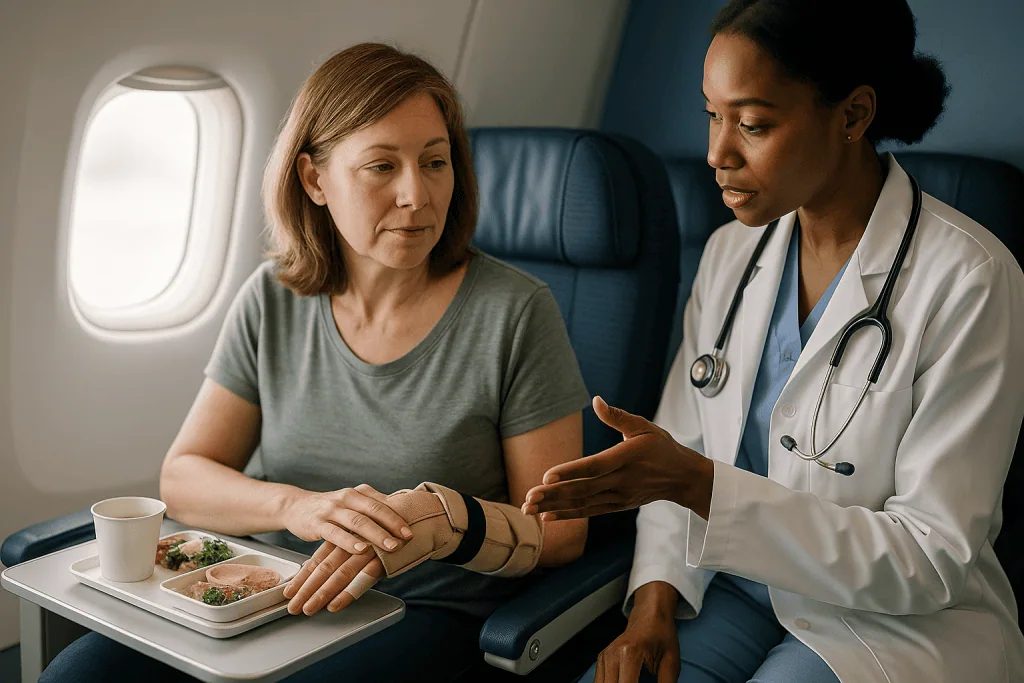
Security screening is the first hurdle. Metal splints will set off the scanner, and the dressing underneath cannot be unwrapped on request. A letter from the surgical team describing the splint and any metal inside the hand smooths this considerably. Most airports have procedures for passengers with medical devices, and arriving early buys the time to use them without stress.
In the seat, the goal is simple: keep the hand at or above heart level as often as possible. A small pillow on the tray table, the hand resting on the opposite shoulder, or a folded jacket on the armrest all work. Every hour or so, if the surgeon has permitted it, gently wiggle the free fingertips to pump fluid back out of the hand. This is not exercise; it is drainage.
Watch the straps. A splint fitted to a hand at its least swollen will feel tight by mid-flight. If it can be loosened a notch without changing the position of the hand, that is usually acceptable, but ask before you travel whether the splint may be adjusted and how far. Some splints after tendon repair hold the fingers at a precise angle, and changing that angle can undo the repair.
Sling or no sling is a frequent question. A sling keeps the hand up when walking through the terminal, but it also encourages the elbow and shoulder to stiffen. Many hand therapists prefer that patients hold the hand up actively rather than hang it in fabric for hours. Again, follow the specific instruction you were given.
Flying with a cast on arm: why a fresh cast is usually split before takeoff
A plaster cast dries and hardens over the first day or two, and the NHS advises keeping a newly cast limb raised during that period because swelling peaks in the first few days. That timing collides directly with early flights.
Here is the mechanism. A cast is molded to the arm as it is on the day of fitting. Over the following 48 hours the tissue inside swells, then over the following weeks it shrinks as the swelling settles. In a pressurized cabin the early swelling can be slightly worse, and a cast that was snug at the hospital becomes tight at altitude. Tight enough, and it begins to squeeze the veins, then the arteries, then the nerves. Fingers go pale or blue, pins and needles set in, and pain climbs out of proportion to the injury.
Travel medicine guidance, including the CDC Yellow Book, and most airline medical policies therefore recommend that a cast applied within the previous 24 to 48 hours be split along its length, a process called bivalving, before the patient flies. A bivalved cast is cut into two halves and held together with bandage or tape, so it can expand slightly as the arm swells while still protecting the bone.
If your cast was fitted more than a few days before the flight and the hand has already settled, splitting may not be needed. Ask. The decision belongs to the team that fitted it, and it is far easier to arrange in clinic than at a departure gate.
Fiberglass casts behave similarly to plaster for this purpose. Removable fracture braces, which are increasingly common for stable fractures, avoid the problem entirely because the straps can be loosened.
Swelling after hand surgery: what elevation really does and what it cannot do
Swelling is not a complication. It is the body delivering fluid, immune cells and repair proteins to a wound, and every hand that has been operated on will swell to some degree. The art is keeping it from tipping into harm.
Elevation works by gravity alone. Fluid that has leaked into tissue drains back through small veins and lymph channels, and those channels empty more easily when they slope downhill toward the heart. A hand held at shoulder height drains; a hand resting in the lap does not. The commonly taught target is to keep the hand above the elbow and the elbow above the heart, which on a plane means the hand on the opposite shoulder or propped on a pillow against the window.
Elevation cannot reverse a cast that is already too tight, and it cannot prevent swelling entirely. Both are worth saying plainly, because patients sometimes blame themselves for a puffy hand after doing everything right.
Movement of the free joints helps more than most people expect. Each gentle bend and straighten of an unaffected finger squeezes the small veins and pushes fluid along. Shoulder rolls and elbow bends do the same higher up. Within the surgeon’s instructions, these small movements can be repeated throughout a flight.
Cold packs are often used on the ground but are impractical in a cabin and may not be allowed through security in gel form. A bag of ice from the galley wrapped in a cloth can help if the dressing is thin enough to let cold through, but never place it directly on skin and never on a numb area, since the warning signal of cold injury is missing.
Finally, dressings matter. A bandage wound too tightly on day one becomes a tourniquet by day three. If the fingertips look darker or feel colder than those on the other hand, that is a signal to act, which the final section covers.
Blood clot risk after hand surgery: an honest look at the numbers
A deep vein thrombosis, or DVT, is a clot that forms in a deep vein, usually in the calf or thigh. If a piece breaks away and lodges in the lungs it becomes a pulmonary embolism, which can be life-threatening. These are the clots that travel medicine worries about, and they deserve a calm, proportionate explanation.
The CDC states that most travelers are at low risk, that the risk rises on journeys longer than about four hours, and that recent surgery is one of the factors that adds to it. Prolonged sitting slows blood flow in the leg veins; surgery triggers clotting pathways as part of healing. Add dehydration from dry cabin air and the picture is complete.
What the evidence does not say is that hand surgery carries the same risk as hip or knee replacement. Lower limb operations are the classic high-risk setting because the legs themselves are immobilized. After hand surgery the legs are free, the anesthetic is often local, and the patient walks out the same day. Risk is therefore closer to baseline for most people, though not zero, and it climbs with age, obesity, a previous clot, active cancer, pregnancy, recent hormone therapy or a long flight.
The basic protections are the same ones the NHS recommends for any long journey: get up and walk the aisle regularly, flex and point the feet while seated, drink water rather than alcohol, and avoid crossing the legs for long stretches. Graduated compression stockings reduce leg swelling and may lower clot risk; whether you should wear them, and whether a blood-thinning medicine is appropriate before a flight, is a decision for the surgical team based on your personal risk profile. Nobody should start or stop an anticoagulant on their own for a trip.
Pain control in the air: how the medicines work and why timing matters
Pain after hand surgery tends to peak in the first 48 to 72 hours as the local anesthetic wears off and swelling builds, then settles over the following week. Flying during that window is possible, but it demands planning rather than hope.
Three classes of medicine are commonly prescribed. Acetaminophen reduces pain signaling in the central nervous system and is usually the foundation. Non-steroidal anti-inflammatory drugs, such as ibuprofen, block the enzymes that drive inflammation and are often added when the stomach and kidneys allow it. Opioids act on receptors in the brain and spinal cord to blunt pain perception; they are typically reserved for short periods after bigger procedures and come with drowsiness, constipation and dependence risks that make them poor companions for long-haul travel.
The practical issues are these. Take medicines on the schedule your prescriber set, not when pain becomes severe, because catching up on pain is harder than staying ahead of it. Keep every medicine in its original labeled packaging in hand luggage with a copy of the prescription, since some countries restrict opioids and even some common painkillers. Think about time zones before departure; a dosing interval does not change because the clock does, so note the time of the last dose in your home time and count forward from there.
Avoid alcohol while taking opioids or while the anesthetic is still wearing off. Both deepen drowsiness, and both dehydrate.
None of this is a recommendation to use any particular drug. The prescribing clinician has weighed your kidney function, stomach history, other medicines and the scale of the operation. If the plan does not seem to fit a long flight, raise that before you travel so it can be adjusted by the person entitled to adjust it.
What the first days and weeks after hand surgery usually look like
Recoveries vary, but a rough map helps with travel planning. The ranges below reflect common patient information from MedlinePlus and the NHS for routine procedures such as carpal tunnel release; complex reconstructions run on longer timelines set by the surgeon.
Day one is numb and bulky. The anesthetic block may last well into the evening, which is pleasant for pain but risky for the hand, because you cannot feel a tight dressing or a burn from a hot cup. Elevation and rest are the whole job.
Days two to four are the swelling peak. Pain is at its highest, the dressing feels tightest, and this is the period when a fresh cast is most likely to cause trouble in the air. Most surgeons would rather a patient with a rigid cast not fly during these days unless the cast has been split.
Days five to ten bring the first real improvement. Swelling starts to fall, pain medicines can often be reduced on the prescriber’s advice, and a soft dressing may be changed to a lighter one. For many minor procedures this is a comfortable window for a short or medium flight.
Around two weeks the wound is usually checked and non-dissolving stitches removed; MedlinePlus notes that for carpal tunnel release the recovery of grip and full comfort can take several weeks to months even when the wound has healed.
Weeks three to six are about therapy. Tendon and nerve repairs often need a hand therapist to guide movement, and the protective splint may stay on for most of this period. Fractures are usually still immobilized. Flying is often fine, but therapy appointments are not optional, and that is the subject of the next section.
Timing your follow-up abroad: stitches, wound checks and therapy
The follow-up visit is where hand surgery is quietly won or lost. Stitches that stay in too long leave track marks and harbor bacteria; a splint left on past its date stiffens joints; a tendon repair that is not moved on schedule scars down. If you live in one country and were operated on in another, this visit needs a named person and a date before you board.
Three pieces of paper make this manageable. The first is an operation note, a short written summary of what was done, what was repaired and what hardware, if any, was placed. The second is a wound and splint plan: when the dressing may be changed, whether stitches are dissolving or need removal, and the exact date the splint can come off. The third is a therapy prescription, written in plain language, that a hand therapist at home can follow without phoning the surgeon.
Ask the operating team who will remove the stitches and where. Many primary care practices and nurse-led clinics can remove stitches and check a wound, but they need to know what they are looking at. A photograph of the wound at the final clinic visit, taken with permission on your own phone, gives the home clinician a baseline to compare against.
Build slack into the timeline. If the stitches are due out on day fourteen and the flight home is on day thirteen, a delayed flight or a slow appointment system pushes you past the window. Scheduling the home appointment before departure, rather than after landing, removes most of that risk.
Finally, agree how to reach the surgical team remotely if something looks wrong in the first weeks. An email address that is checked and a clear instruction about which local service to attend in an emergency are worth more than any souvenir.
Can I fly a week after surgery? Answering the question honestly
For most minor hand operations, a week is comfortably inside the range many surgeons accept, provided the anesthetic was local or regional, pain is controlled by mouth, the dressing has been checked, and any cast has been split or has already accommodated the early swelling. The CDC Yellow Book frames recent surgery as a matter for individual assessment rather than a fixed ban, and a week is long enough for the swelling peak to have passed in uncomplicated cases.
A week may not be enough in several situations. After a general anesthetic combined with a larger operation, some teams prefer that patients avoid long-haul flights for longer, particularly if the surgery itself raised clot risk. After reconstruction involving blood vessels or skin grafts, the surgeon may want to see the hand at seven to ten days before anyone travels, because that is when graft failure or circulation problems tend to declare themselves. After any operation where a drain is still in place or a wound is still open, travel is usually postponed until that is resolved.
The flight itself changes the answer. A ninety-minute domestic hop a week after a trigger finger release is a different proposition from a fourteen-hour journey a week after fracture fixation under general anesthetic. Longer flights mean longer immobility, more dehydration and fewer options if something goes wrong.
So the honest reply to “is it safe to fly one week after surgery” is: often yes for minor hand procedures, sometimes no for bigger ones, and always a question for the person who did the operation. Write down their answer and the reasoning behind it. You may need to repeat both to a gate agent or a home clinician.
What people often get wrong about flying after hand surgery
The myth that spreads fastest is the three-month rule. People hear that someone was told not to fly for three months and assume it applies to all surgery. The origin is specific: some eye operations that place a gas bubble inside the eye require no flying until the gas has dissolved, because the bubble expands at altitude and raises pressure inside the eye. That can take weeks to months depending on the gas used. Hand surgery does not leave gas in the body, and the three-month figure has no bearing on it.
A second error is thinking the pressure change itself damages the wound. It does not. The risks come from swelling inside a rigid shell, from sitting still for hours, and from dehydration. Address those and the altitude is almost irrelevant.
A third is underestimating the anesthetic. Patients focus on the small incision and forget that a general anesthetic affects balance, judgment and nausea for a day or more. Airports are busy, confusing places, and a drowsy person with one working hand is more likely to fall, miss a connection or lose documents.
Some patients assume a cast is the safest possible option for travel because it is the strongest. The opposite is often true. A removable splint that can be loosened adapts to swelling; a fresh cast cannot.
Others believe compression stockings or aspirin are enough to cancel clot risk. Stockings help with leg swelling and may reduce DVT risk, but the evidence for aspirin as a travel precaution is weak, and neither replaces walking, hydration and an individual assessment by the surgical team.
The last mistake is the quiet one: flying home before the follow-up is arranged, then discovering that nobody at home knows what was done. The paperwork section above exists to prevent exactly that.
Questions to ask your care team before you fly
The most useful conversation about flying after hand surgery happens before the operation, when there is time to change the plan. Bring the flight details and ask directly.
Start with the surgery itself. What anesthetic will be used, and how long will its effects last? Will I have a cast, a splint or a soft dressing, and can it be loosened or split if the hand swells? Is there anything inside the hand, such as plates or wires, that security scanners will detect, and can I have a letter describing it?
Move to the journey. Given what you are doing and the length of my flight, what is the earliest day you would be comfortable with me traveling? What should the hand look like on the morning of the flight for you to be happy? How should I position it in the seat, and which movements are allowed and which are forbidden?
Then risk. Do I have any factors that raise my clot risk, and do you want me to wear compression stockings or take any medicine for the flight? Which of my pain medicines are appropriate to take on board, and how should I handle the time difference? Is there anything I must not combine with them?
Finish with follow-up. When are stitches due out, and who should remove them? When does the splint come off, and does that need a surgeon or can a therapist do it? What is the therapy plan, written down, for a therapist at home to follow? How do I contact you if something looks wrong, and what should I do if I cannot reach you?
Write the answers down or ask for them by email. Memory is unreliable in the hours after anesthesia, and these details are the ones that keep a good operation good.
When to call your doctor: red-flag signs during and after the flight
Most post-operative hands are uncomfortable, puffy and a little numb. Those are expected. The signs below are not, and each warrants contacting the surgical team or, if you are mid-flight or far from them, the nearest emergency service.
Call urgently if the fingers beyond the dressing or cast turn pale, blue or gray, feel unusually cold, or lose sensation that was present before. Pain that keeps climbing despite elevation and prescribed medicines, or pain that feels far worse than the injury should produce, can signal that pressure inside the dressing or inside the tissue is cutting off blood supply. Pins and needles that spread or deepen fall into the same category. These are circulation emergencies, and a cast or bandage may need to be released within hours to protect the hand.
Seek care the same day for signs of infection: spreading redness around the wound, warmth, swelling that increases after it had started to fall, pus or a bad smell from the dressing, or a fever. Bleeding that soaks through the dressing and continues after firm elevation also needs assessment.
Treat the legs and chest as seriously as the hand. Pain, warmth or swelling in one calf, especially after a long flight, may indicate a deep vein thrombosis. Sudden breathlessness, chest pain that worsens on breathing in, a rapid heartbeat, coughing up blood, or feeling faint are possible signs of a pulmonary embolism and are a reason to call emergency services immediately, as the NHS and Mayo Clinic both advise.
If you are in the air, tell the cabin crew. Airlines carry medical kits and can seek ground-based medical advice. Do not wait for landing to mention cold blue fingers or chest pain.
When in doubt, make the call. A reassuring conversation costs little; a hand left in a too-tight cast overnight can cost a great deal more. Every decision about loosening, removing or revising a dressing rests with the treating team or the clinician in front of you.
Frequently asked questions
Is it safe to fly one week after hand surgery?
Often yes for minor procedures done under local or regional anesthetic, once pain is controlled, the dressing has been checked and any cast has been split or has accommodated the early swelling. Bigger operations, general anesthesia, vessel repair or high clot risk may call for a longer wait. The CDC treats recent surgery as a matter for individual assessment, so the final word belongs to your surgeon.
Why can't you fly for three months after surgery?
That restriction comes from certain eye operations in which a gas bubble is placed inside the eye; the gas expands at cabin altitude and can dangerously raise eye pressure until it dissolves, which can take weeks to months. It is not a general surgical rule and does not apply to hand surgery, which leaves no trapped gas. Your own waiting time is set by your operation and anesthetic, not by this figure.
What conditions should you not fly with?
Travel medicine guidance such as the CDC Yellow Book lists situations needing assessment or a delay: very recent major surgery, uncontrolled heart or lung disease, a recent heart attack or stroke, a collapsed lung or recent chest surgery, severe anemia, late pregnancy and active infectious illness. Recent minor hand surgery is not on that list by itself, but it still needs the surgeon’s go-ahead.
What happens if you fly with pleural effusion?
A pleural effusion is fluid around the lung that reduces how much the lung can expand. Cabin air contains less oxygen than air at sea level, so someone already short of breath may become more breathless at altitude. Fitness to fly with an effusion depends on its size, cause and the person’s oxygen levels, and is assessed by the treating physician, sometimes with a test that simulates cabin conditions.
Can I fly with a cast on my arm?
Usually, with conditions. A cast fitted within the previous 24 to 48 hours is commonly split lengthwise before a flight so it can expand if the arm swells, and many airlines require this. Older casts on a settled arm may not need splitting. Keep the arm elevated during the flight and watch the fingers for color or sensation changes. Confirm the plan with the team that fitted the cast.
How soon can you fly after carpal tunnel surgery?
Carpal tunnel release is typically done under local anesthetic with a soft dressing, so many surgeons are comfortable with short flights within days once pain is controlled and the wound has been checked. Longer flights and any complication may extend that. MedlinePlus notes that full recovery of grip and comfort can take weeks to months even after the wound heals, so plan follow-up and therapy at home.
Does flying with a splint cause problems at airport security?
Metal in a splint or inside the hand will usually trigger the scanner, and the dressing cannot be removed on request. A short letter from the surgical team describing the splint and any implanted hardware makes screening smoother, and arriving early allows time for a manual check. Removable splints are generally easier than casts because they can be loosened if the hand swells during the flight.
How do I reduce blood clot risk on a flight after surgery?
Walk the aisle regularly, flex and point your feet while seated, drink water, limit alcohol and avoid crossing your legs for long periods, as the NHS advises for any long journey. Graduated compression stockings may help, and some people with higher risk are prescribed a blood-thinning medicine before travel. Whether either applies to you is a decision for the surgical team based on your personal risk.
Should I keep my hand elevated for the whole flight?
As much as is practical. Resting the hand on the opposite shoulder, on a pillow against the window or on a bag on the tray table keeps it above heart level and lets swelling drain. Short breaks are fine. Combine elevation with gentle movement of any fingers the surgeon has cleared, since each small bend pushes fluid out of the hand.
What if my stitches are due out after I have flown home?
Arrange the appointment before you leave. Ask the operating team for a written note stating the operation, the stitch type, the removal date and the splint plan, and take a photograph of the wound at the last clinic visit. Many primary care practices and nurse-led clinics can remove stitches and check wounds if they know what was done. Agree a way to contact the surgeon remotely in case of concern.
References
This article is for general information only and is not a substitute for professional medical advice. Please consult a qualified doctor about your individual situation.

More from the Blog
How Periacetabular Osteotomy (PAO) Reorients a Shallow Hip Socket, Step by Step
A periacetabular osteotomy (PAO) treats hip dysplasia by cutting the pelvic bone around the socket, rotating the freed socket so it covers more of…

How Long Does an Ankle Replacement Last? Honest Limits and What Affects Implant Wear
An ankle replacement does not last forever. Pooled data from a systematic review of total ankle replacement reported that close to nine in ten…

What Can a Knee Replacement Realistically Restore? Pain Relief, Bending, Kneeling and Sport
A knee replacement can realistically restore reliable, largely pain-free walking, stair climbing and sitting, and most people regain a bend of well over a…

Life After Shoulder Replacement: Reaching, Lifting Limits and Getting Back to Sport
Life after shoulder replacement usually means far less pain and a return to most everyday tasks, with reaching, gentle sport and light lifting typically…
Carpal Tunnel Surgery and Pregnancy: Why Many Teams Wait Until After the Birth
Carpal tunnel surgery during pregnancy is rarely performed because the condition is usually driven by pregnancy-related fluid retention and often eases after the birth.…

Private Hip Replacement: UK Costs, Waiting Times and the Abroad Option
A private hip replacement in the UK typically costs £11,000–£17,000, while NHS waits for the same operation can stretch well beyond the 18-week referral-to-treatment…