

Why Is a Fever During Chemotherapy Treated as Urgent? What to Do the Moment It Starts

Key Takeaways
- Guidelines define fever in neutropenia as a single oral reading of 38.3°C (101°F) or a sustained reading of 38.0°C (100.4°F) for an hour, and many services ask patients to call at that point or lower.
- Neutrophils generate the visible signs of infection such as pus and redness, so during a nadir a fever may be the only warning of a bloodstream infection.
- On most standard regimens the neutrophil count is lowest about 7 to 12 days after treatment and recovers over the following week, which is why 21-day cycles are common.
- UK guidance asks hospitals to give the first intravenous antibiotic within one hour of arrival for suspected neutropenic sepsis, before the blood count result is back.
- Fever reducers and corticosteroids can mask a chemotherapy fever, which is why teams ask you to check your temperature and call before taking anything.
- Blood cultures are drawn from both a vein and any central line before antibiotics start, because growth in the line sample alone points to the line as the source.
A fever during chemotherapy is treated as an emergency because chemotherapy can lower neutrophils, the white blood cells that fight bacteria, so an ordinary infection can spread quickly with few warning signs. If your temperature reaches the threshold your team gave you, commonly 38.0°C (100.4°F), call your chemotherapy emergency line or go to the emergency department at once, day or night, before taking any fever-reducing medicine.
It is a little after two in the morning, nine days after the second infusion, and the thermometer reads 100.6°F. Nothing else seems wrong. No cough, no sore throat, just a dull ache and a sense of being colder than the room. The temptation is obvious: drink some water, pull up the blanket, and see what the morning brings.
Every oncology team in the world would ask you not to do that. The question of fever during chemotherapy, what to do and how fast, is one of the few in cancer care where the answer is the same whoever is asking: pick up the phone now. The reason is not that a fever itself is dangerous. It is that, in the days after chemotherapy, a fever may be the only visible sign of an infection that the body can no longer fight on its own.
This article explains why that is, what the numbers on the thermometer mean, what will happen when you arrive at the hospital, and how the following days usually unfold.
Fever during chemotherapy: what to do in the first ten minutes
Start by checking the number properly. Use a digital thermometer under the tongue or in the ear, wait at least 15 minutes after a hot or cold drink, and read it once. Do not take a second reading hoping for a lower one, and do not average the two. If you feel shivery or unwell but the reading is below your threshold, note the time and check again in 30 minutes.
Then resist the medicine cabinet. Fever-reducing medicines such as acetaminophen or ibuprofen will bring the temperature down, and in doing so they can hide the single most useful piece of information your team has. Most chemotherapy services ask patients not to take anything for a fever until they have spoken to a nurse or doctor. If you have already taken something, say so when you call; it changes how your reading is interpreted, not whether you should be seen.
Next, call the 24-hour chemotherapy line or alert number you were given at your first appointment. Many teams hand out a wallet card for exactly this moment. Open with the words that matter: “I am on chemotherapy, my last treatment was on this date, and I have a temperature of this number.” That sentence moves you to the front of almost any queue. The U.S. National Cancer Institute advises patients to treat fever during cancer treatment as urgent and to contact their care team right away.
While you wait for a call back, gather your medication list, your treatment schedule and a bag with a phone charger. If you are told to go to the emergency department, do not drive yourself if you feel dizzy or faint. Bring the alert card and hand it to the triage nurse before you sit down. If you cannot reach your team within a few minutes, go straight to the nearest emergency department and explain that you are having chemotherapy.
Why does chemo give you a fever?
Strictly speaking, chemotherapy does not usually cause the fever. Infection does, and chemotherapy opens the door. Most chemotherapy medicines work by interrupting cells that divide rapidly. Cancer cells divide rapidly, but so do the cells in the bone marrow that produce white blood cells. For a window after each treatment, the body makes far fewer neutrophils, the white cells that swallow and kill bacteria, and any bacterium that would normally be dealt with silently can take hold.
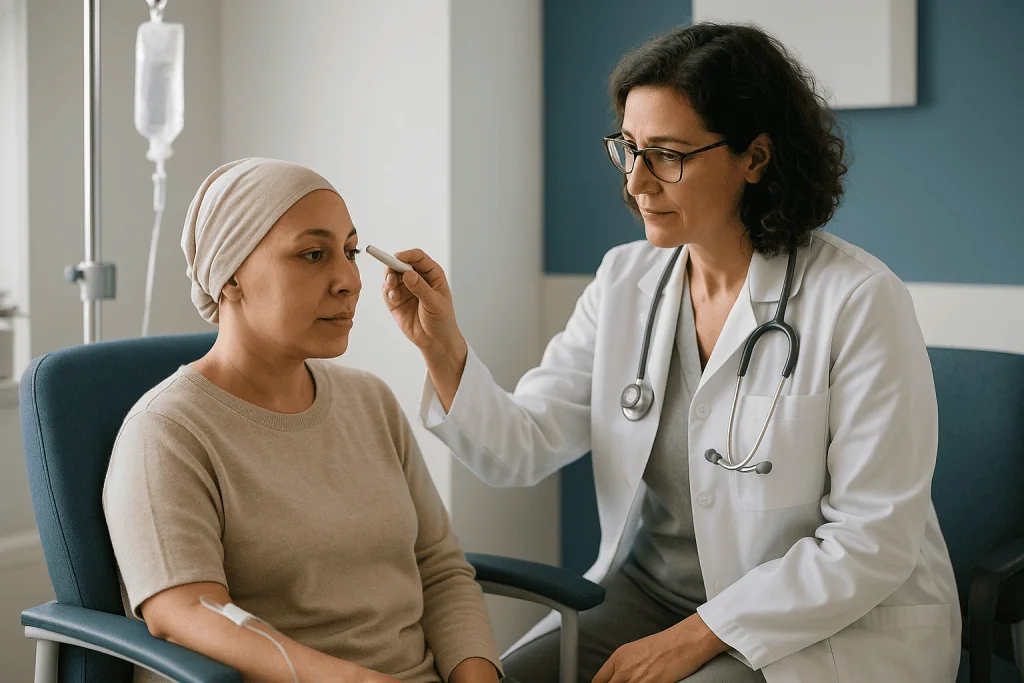
The sources of infection are mostly ordinary. The gut lining, which chemotherapy also irritates, is home to billions of bacteria that can slip into the bloodstream through small breaks. A central venous line (a long-term tube placed into a large vein for giving treatment) is a direct route from skin to blood. Mouth sores, a urine infection, a chest infection, or a patch of broken skin all count. According to the NCI, infection during neutropenia can arise from the person’s own normal bacteria rather than from anyone else’s germs.
There are other, less common reasons a temperature can rise. Some chemotherapy medicines cause what is called drug fever, a reaction that typically appears within hours of the infusion. Blood transfusions can trigger a short-lived fever. Granulocyte colony-stimulating factors, injectable medicines that push the marrow to make neutrophils faster, can cause bone aches and a mild temperature. Certain cancers, particularly lymphomas and some leukemias, produce their own fevers.
None of that changes the first response. Clinicians cannot tell, from the bedside, whether a fever in a neutropenic patient is a harmless drug reaction or the start of a bloodstream infection. The guideline position from the Infectious Diseases Society of America is clear: fever in a patient with neutropenia is treated as infection until proven otherwise. The sorting out happens in hospital, with blood tests, not at home with a guess.
What actually happens inside the body: neutrophils, nadir and a quiet immune system
Picture the bone marrow as a factory running three shifts. Neutrophils are its highest-volume product and its shortest-lived: each one circulates for roughly a day before it is used up or recycled. The factory keeps pace only because it never stops. Chemotherapy, by design, slows every fast-dividing production line, including this one. Within days, the number of neutrophils in the blood falls, reaches a low point, and then climbs back as the marrow recovers.
That low point is called the nadir, and it is the period when the risk of serious infection is highest. Doctors measure it with the absolute neutrophil count, or ANC, a figure on a routine blood test. Neutropenia simply means a low ANC. The IDSA guideline defines severe neutropenia as an ANC below 500 cells per microliter, or a count expected to fall below that level within the next 48 hours; the deeper and longer the nadir, the greater the risk.
Here is the part most people are never told. Neutrophils do not just fight infection; they create its visible signs. Pus is mostly dead neutrophils. Redness, swelling and warmth around a wound come from neutrophils and the chemical signals they release. Strip them away and an infected line site may look clean, a pneumonia may produce no sputum, and an abdominal infection may cause only vague discomfort. Fever, generated by a different part of the immune system, may be the only alarm still working.
That is also why the threshold between “an infection” and “sepsis” can be crossed quickly. Sepsis is the body’s overwhelming, disorganized response to infection, and the NHS describes it as a life-threatening emergency in anyone. In a person with no neutrophils, bacteria multiply in the bloodstream with little resistance, and the hours between a first chill and dangerously low blood pressure can be few. Speed is not an abundance of caution; it is the treatment.
Neutropenic fever temperature: what number counts as a fever during chemotherapy?
The honest answer is that the number depends on which guideline your service follows, and your own team’s figure overrides anything written here. The IDSA defines fever in a neutropenic patient as a single oral temperature of 38.3°C (101°F) or higher, or a temperature of 38.0°C (100.4°F) or higher sustained for at least an hour. UK guidance from NICE uses a simpler single trigger of 38°C. Some units ask patients to call at 37.5°C, reasoning that an early phone call costs nothing and a missed fever can cost a great deal.
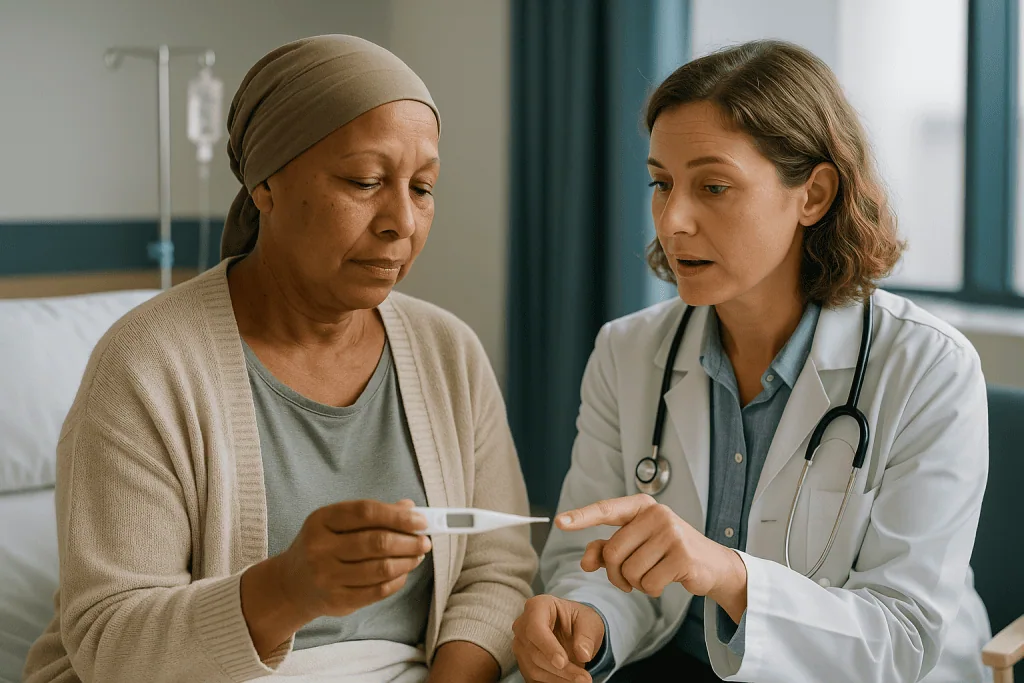
Where you measure matters. Oral and ear readings are standard. Rectal temperatures are avoided during neutropenia because the probe can tear fragile tissue and introduce gut bacteria into the blood, which is also why suppositories are generally avoided in this period. Underarm readings run lower and are the least reliable in adults.
Two situations catch people out. The first is a fever that is masked. Corticosteroids, which are part of many chemotherapy regimens and anti-sickness plans, blunt the temperature response, as do everyday fever reducers. A patient on steroids who feels unwell with a normal reading still needs to call. The second is the absence of fever altogether in someone who is clearly deteriorating. Older adults and people who are very unwell can present with a low temperature, confusion or a racing heart instead of a high reading. The NHS sepsis guidance lists these as reasons to seek emergency help regardless of the thermometer.
A practical habit helps here. Keep one reliable digital thermometer, use the same one each time, and know your personal baseline. Many people run a little below 37°C; for them, a reading of 37.8°C may represent a bigger change than the number suggests. Write the threshold your team gave you on the thermometer case, and treat it as a line, not a suggestion.
Why a febrile neutropenia emergency cannot wait until morning
Febrile neutropenia is the clinical name for fever plus a low neutrophil count, and emergency departments treat it with the same urgency as a suspected heart attack or stroke. The reasoning is arithmetic. Bacteria in the bloodstream multiply exponentially, the body’s main defense is absent, and the damage from sepsis, falling blood pressure, failing kidneys, fluid in the lungs, accumulates by the hour rather than the day.
Guidelines therefore focus on the clock. UK NICE guidance asks that patients with suspected neutropenic sepsis receive their first dose of intravenous antibiotics within one hour of arriving at hospital, before the blood count result is even back. The IDSA guideline makes the same point in slightly different words: empirical antibiotics, meaning treatment chosen on the basis of likely bacteria rather than confirmed ones, should be started promptly after blood cultures are drawn and should not wait for test results. Hospitals audit this interval, often calling it “door to needle” time, because delays have repeatedly been linked to worse outcomes in published series.
This is why the triage conversation is so direct. A nurse who hears “on chemotherapy, fever” is trained to bypass the usual waiting process. It is also why oncology teams become uneasy when a patient reports having had a temperature “for a day or two” before calling. The treatment that works best is the one started earliest, and the window in which it works best is measured in hours.
One reassurance belongs here. Most people who come in with a chemotherapy fever are assessed, started on antibiotics, watched closely and recover without complication. The urgency of the system exists precisely so that this remains true. Calling at 2 a.m. and being told after tests that it was probably a drug reaction is not a wasted trip; it is the system working exactly as intended.
How long does nadir last after chemo?
For most standard chemotherapy schedules, the neutrophil count begins to fall within a few days of treatment, reaches its lowest point roughly 7 to 12 days after the dose, and recovers over the following week. The NCI and Cleveland Clinic both describe this window as the time of highest infection risk, which is why many teams schedule a blood test around day 10 and why a 21-day cycle is so common: it gives the marrow time to recover before the next dose.
| Phase of a typical 21-day cycle | What is happening to neutrophils | What it means in practice |
|---|---|---|
| Day 0 (treatment day) | Count usually normal or near normal | Treatment proceeds only if the count is adequate |
| Days 1–6 | Count falling as marrow slows | Early side effects dominate; infection risk rising |
| Days 7–12 (nadir window) | Count at its lowest, sometimes near zero | Highest-risk period; any fever is an emergency |
| Days 13–21 | Count recovering | Risk falls; energy often returns |
Those ranges are typical, not universal. Regimens used for leukemia and before a stem cell transplant are designed to empty the marrow almost completely, and nadirs lasting two to three weeks or more are expected. Some targeted medicines and immunotherapies barely touch the neutrophil count at all. Previous radiotherapy to large areas of bone, older age, poor nutrition and some inherited traits can deepen or prolong the dip. Growth factor injections, when prescribed, shorten it.
Because the exact timing varies, the safest approach is to ask your team two questions at the start of each regimen: when is my nadir expected, and does that change with each cycle? Then write those dates on a calendar. A fever on day 9 and a fever on day 20 are both reasons to call, but knowing you are in the nadir window helps you take the first one seriously even when you feel otherwise fine.
Who is at highest risk, and who may be managed differently
Not everyone with a chemotherapy fever carries the same risk, and emergency teams use structured scoring to tell them apart. The most widely used tool, the MASCC score, awards points for features such as mild rather than severe symptoms, normal blood pressure, absence of lung disease, solid tumor rather than blood cancer, being an outpatient when the fever began, younger age and not being dehydrated. The IDSA guideline uses this score, alongside the expected length of neutropenia, to separate low-risk from high-risk episodes.
High-risk features include a neutrophil count expected to stay very low for more than a week, blood cancers and stem cell transplant, a central line that looks infected, significant mouth or gut inflammation, kidney or liver problems, pneumonia, low blood pressure, confusion, or a previous serious infection during treatment. People with these features are admitted and treated with intravenous antibiotics from the outset.
At the other end, the IDSA and the American Society of Clinical Oncology recognize a carefully defined low-risk group, typically people with solid tumors, short expected nadirs, no worrying examination findings and reliable home support, who may be switched to oral antibiotics and monitored at home after an initial period of hospital observation. This is the only sense in which anyone is “asked to wait,” and it happens after assessment, never instead of it. The decision belongs to the treating team, who will also check that you can reach the hospital quickly, have a phone, and have someone with you.
Two groups deserve a particular mention. Older adults can deteriorate with fewer signs and are often assessed more cautiously. Children on chemotherapy follow their own pediatric pathways, which share the same principle, same-day assessment for any fever, with age-appropriate thresholds set by the pediatric oncology team. In every case, the person at home does not do the risk scoring; the hospital does.
What happens when you arrive at the hospital with a chemo fever
The first hour is busy, and knowing the sequence makes it less unsettling. At triage you will have your temperature, heart rate, blood pressure, breathing rate and oxygen level recorded, and you should be moved promptly to a treatment area, ideally a single room, to reduce exposure to other people’s infections.
A nurse or doctor will place an intravenous cannula if you do not already have a line and take blood for a full blood count, kidney and liver tests, and markers of inflammation. Before any antibiotic is given, blood cultures are drawn, meaning samples sent to the laboratory to see whether bacteria grow. The IDSA guideline recommends at least two sets, and if you have a central line, one set from the line and one from a vein, because growth in the line sample alone points to the line as the source. A urine sample is usually requested, a swab may be taken from the throat or any wound, and a chest X-ray is arranged if you have breathing symptoms.
Then the antibiotics start, generally a broad-spectrum intravenous medicine chosen to cover the bacteria most likely to be dangerous in neutropenia. The aim across guidelines is to have this running within an hour of arrival, before the blood count is back. If your blood pressure is low you will receive intravenous fluids; if your oxygen level is low, oxygen.
A doctor will examine you from head to toe, paying particular attention to the mouth, the skin around any line, the chest, the abdomen and the area around the back passage, which is a common hidden source. Expect to be asked about your regimen, your last treatment date, recent antibiotics, allergies and any travel. Over the next day or two, the team watches your observations, waits for cultures, and refines the plan. Most people are admitted for at least that period.
How to treat an infection during chemotherapy: what the treatment usually involves
Treatment follows a pattern that is remarkably consistent across guidelines, even though the individual medicines vary by hospital and by local patterns of antibiotic resistance. The first step is empirical therapy: an intravenous antibiotic from the beta-lactam class with activity against a wide range of bacteria, including Pseudomonas, a bacterium that is particularly dangerous in neutropenia. The IDSA guideline recommends a single such agent as the usual starting point, with additions only for specific reasons.
Those reasons include suspicion that a central line is infected, in which case an antibiotic active against skin bacteria is often added; low blood pressure or signs of severe sepsis; pneumonia; or a known history of resistant organisms. The choice is a clinical judgment made by the admitting team and often reviewed by an infectious diseases specialist.
Reassessment at 48 to 72 hours is the next fixed point. By then, blood cultures have usually either grown an organism or stayed clear. If a bacterium is identified, treatment is narrowed to target it. If cultures are negative, the fever has settled and the neutrophil count is recovering, antibiotics may be stepped down or stopped, with the length of treatment depending on the source found and the trajectory of the count. If fever persists beyond roughly four to seven days despite antibiotics and the neutrophil count remains very low, the IDSA guideline advises considering antifungal treatment, because fungal infections become more likely the longer the nadir lasts.
Two further points surprise many patients. Growth factor injections are not routinely started to treat an established fever; evidence shows they shorten neutropenia but have not been proven to change outcomes once infection is under way, so their use is a case-by-case decision. And a central line that is clearly the source may need to be removed, which feels like a setback but is often the fastest route to recovery. Every one of these decisions sits with the treating team, who will explain the reasoning as results come in.
The following days and weeks: how long after chemo do you feel better?
If cultures stay negative and the fever settles quickly, which is the most common course, discharge often follows once you have been fever-free for a day or more and the neutrophil count is on its way up. Some people go home on oral antibiotics to complete a course; others need none. You will usually be given a blood test appointment within days and asked to keep taking your temperature.
The episode also feeds back into your treatment plan. Your oncologist may delay the next cycle until counts recover fully, prescribe growth factor injections to shorten future nadirs, add preventive antibiotics for later cycles, or adjust the regimen. These are standard responses, not signs that treatment is failing, and the trade-offs will be discussed with you rather than decided in your absence.
As for feeling better in a broader sense, the NHS describes a familiar rhythm within each cycle: fatigue and other side effects tend to peak in the first week or so after treatment, ease through the second, and lift further in the third, which is one reason many people describe “a good week” before the next dose. A febrile episode can flatten that curve for a cycle, both because infection is exhausting and because hospital admission disrupts sleep and appetite.
Fatigue after chemotherapy as a whole is cumulative and can outlast the final treatment by weeks to months, according to Mayo Clinic and NHS guidance; it gradually improves for most people but on its own schedule. Gentle, regular activity, protected sleep, and eating little and often have the best evidence for helping. What does not help is measuring yourself against the day of the first infusion. Recovery is a slow tide, not a switch, and a fever in week two does not mean the tide has turned.
Lowering the risk of infection between cycles: what the evidence supports
Nothing eliminates the risk of a chemotherapy fever, but a short list of habits reduces it, and they are worth distinguishing from the folklore that surrounds them. Hand hygiene heads the list. Washing with soap and water, or using an alcohol-based rub, before eating, after using the bathroom and after touching shared surfaces is the single intervention with the broadest evidence, and the CDC places it first in its advice for people with low white cell counts.
Food safety comes next. The concern is not exotic; it is ordinary food poisoning in a body that cannot fight it. Cooking meat, poultry, eggs and seafood thoroughly, avoiding unpasteurized dairy and juices, washing produce well, and keeping cooked and raw foods separate are the measures with the strongest basis. Rigid “neutropenic diets” that ban all fresh fruit and salad have not shown a clear benefit in controlled studies, and most centers now emphasize safe handling over blanket exclusion.
Vaccination matters, with one firm rule. Inactivated vaccines, including the annual influenza shot and COVID-19 vaccines, are recommended during chemotherapy and timed by your team for the best response. Live vaccines are avoided while the immune system is suppressed. Household members being vaccinated protects you indirectly.
Other measures are quieter but real: good mouth care with a soft brush, since mucositis is a gateway for gut bacteria; keeping the skin around a central line clean and dry and reporting any redness or tenderness; avoiding close contact with people who have obvious infections; wearing gloves for gardening and litter trays; and seeing a dentist before treatment starts rather than during a nadir. For people whose regimens carry a high expected risk, teams may prescribe preventive antibiotics or growth factor injections. Whether those apply to you is a question for your oncologist, who will weigh your regimen, your blood counts and your history.
What people often get wrong about fever during chemotherapy
“It is only a low-grade fever.” During neutropenia, there is no such thing as a reassuring low-grade fever. The guideline thresholds sit at 38.0°C to 38.3°C precisely because higher numbers arrive late. A reading at your team’s threshold is the alarm, not a preliminary warning.
“I feel fine otherwise, so it cannot be serious.” Feeling fine is the problem. Without neutrophils, infection produces fewer symptoms, and people with bacteria already in the bloodstream can look and feel reasonably well for hours. The thermometer sees what you cannot.
“I will take something for it and see if it comes down.” Fever reducers reliably bring the temperature down whether the cause is a harmless drug reaction or early sepsis. All they prove is that the medicine works. Teams ask patients to call first for this reason.
“It is probably the chemo itself.” It might be, and that is a conclusion reached in hospital after cultures and an examination, not one you can safely reach at home. Drug fever and infection are indistinguishable at the bedside.
“I had a fever last cycle and it was nothing, so this one will be too.” Each nadir is a fresh roll of the dice, and some regimens deepen the dip with successive cycles. A previous episode, if anything, increases the attention your team will pay to the next one.
“I should avoid bothering the on-call team at night.” The 24-hour line exists for exactly this call. Oncology nurses would far rather speak to ten people with drug fevers than miss one person with a bloodstream infection.
“Antibiotics will wait until the blood test confirms neutropenia.” Guidelines reverse this: cultures are taken, antibiotics are started, and the count is checked in parallel. Treatment is not held back for confirmation, because the cost of a delay is higher than the cost of an unneeded dose.
“A neutropenic diet means no fresh food at all.” Evidence supports safe handling and thorough cooking, not the elimination of washed fruit and vegetables. Ask your dietitian rather than following a forwarded list.
Questions to ask your care team before and during chemotherapy
The time to understand the fever plan is a calm appointment, not a feverish night. These questions cover the ground that matters most, and the answers are worth writing down and keeping with your thermometer.
- What temperature should make me call, and should I call at a lower number if I feel unwell or shivery without a fever?
- Which number do I call, day and night, and what should I do if no one answers within a few minutes?
- When is my nadir expected on this regimen, and does the timing shift in later cycles?
- Will I have a blood test around the nadir, and will you contact me if the count is very low?
- Am I considered high risk for febrile neutropenia, and are growth factor injections or preventive antibiotics part of my plan?
- Are there any medicines, including fever reducers and steroids, that could hide a fever, and how should I handle them?
- Which emergency department should I go to, and is there a card or letter I can hand to triage?
- If I am admitted with a fever, what usually happens to the timing of my next cycle?
- Which vaccines should I have, when, and which should my household have?
- How should I care for my central line at home, and what changes at the site should I report the same day?
- Is there food I should avoid during the nadir, and can I speak to a dietitian?
- If I live far from the hospital or alone, what extra arrangements would you suggest for the nadir window?
Bring someone with you if you can; the person who will be in the car at 2 a.m. should hear the answers too. And if the plan changes, a new regimen, a new line, a new side effect, ask whether the fever plan changes with it. It often does.
When to call your doctor: red flags during and after chemotherapy
The simplest rule is also the most reliable: a temperature at or above the threshold your team gave you, at any time of day or night, means calling the chemotherapy emergency line immediately or going to the emergency department. Do not wait to see if it settles, and do not take a fever reducer first. If you cannot reach your team, go directly to the nearest emergency department and say that you are on chemotherapy.
Call urgently even without a fever if you notice any of the following, because they can signal infection or sepsis when the temperature response is blunted:
- Shaking chills or shivering, especially within an hour or two of a central line being flushed or used
- A temperature below 36°C (96.8°F), which can occur in severe infection
- New confusion, unusual drowsiness or difficulty staying awake
- A fast heartbeat, fast breathing or breathlessness at rest
- Feeling faint, dizzy on standing, or passing very little urine over a day
- Redness, swelling, pain or discharge around a central line or any wound
- A new cough with chest pain, or painful or burning urination
- Severe mouth pain, difficulty swallowing, or new abdominal pain and diarrhea
- A rash, or skin that is mottled, pale or bluish
- Simply feeling that something is badly wrong, which clinicians take seriously in people on chemotherapy
The NHS sepsis guidance adds that anyone with suspected infection who develops slurred speech, severe breathlessness, or a rash that does not fade when pressed needs emergency services, and that advice applies with extra force during neutropenia.
After an admission for a chemotherapy fever, the same rules apply for the remainder of that nadir and every nadir that follows. Fever returning after discharge, a line site changing in appearance, or symptoms that improved and then worsened all warrant a same-day call. Nothing in this article replaces the instructions your own oncology team has given you; where they differ, follow your team, and when in doubt, call.
Frequently asked questions
Why does chemo give you a fever?
Most fevers during chemotherapy are caused by infection rather than by the medicine itself. Chemotherapy lowers neutrophils, the white cells that fight bacteria, so ordinary germs from the gut, skin, mouth or a central line can enter the bloodstream. Some medicines, transfusions and growth factor injections can also raise the temperature briefly, but because these cannot be told apart from infection at home, every fever is assessed as infection first.
How long does nadir last after chemo?
For most standard regimens the neutrophil count falls over the first week, reaches its lowest point around 7 to 12 days after treatment and recovers over the following week, according to the National Cancer Institute and Cleveland Clinic. Intensive regimens for leukemia or before a stem cell transplant can produce nadirs lasting several weeks. Your team can tell you the expected window for your specific treatment.
What is the neutropenic fever temperature I should act on?
Act on the number your own team gave you, which overrides any general figure. The Infectious Diseases Society of America defines neutropenic fever as a single oral temperature of 38.3°C (101°F) or higher, or 38.0°C (100.4°F) or higher lasting an hour. UK guidance uses 38°C as a single trigger, and some services ask patients to call at 37.5°C. Feeling shivery or unwell without a fever also warrants a call.
Is febrile neutropenia an emergency even if I feel well?
Yes. Febrile neutropenia, meaning fever with a low neutrophil count, is treated as an emergency precisely because people can feel reasonably well in the early hours of a bloodstream infection. Without neutrophils the body produces fewer signs of infection, and the hours between a first chill and sepsis can be few. Guidelines call for assessment and intravenous antibiotics as soon as possible, not after symptoms worsen.
Can I take acetaminophen or ibuprofen for a fever during chemotherapy?
Most chemotherapy services ask you not to take any fever-reducing medicine until you have spoken to your team, because these medicines lower the temperature regardless of the cause and can hide the only sign of infection. If you have already taken something, still call and say so, since it changes how your reading is interpreted. Decisions about any medicine during treatment rest with your prescribing clinician.
How to treat an infection during chemotherapy: what does the hospital do?
Treatment begins with blood cultures followed immediately by a broad-spectrum intravenous antibiotic, aimed to start within about an hour of arrival. Over the next 48 to 72 hours the team reviews culture results, narrows or stops antibiotics if a specific bacterium is found or none grows, and considers antifungal treatment if fever persists beyond several days with very low counts. A central line that is the source may need removal.
How long after chemo do you feel better?
Within a typical cycle, the NHS describes side effects and fatigue peaking in the first week or so, easing in the second and lifting further in the third. Overall fatigue is cumulative and can take weeks to months to settle after the final treatment, according to Mayo Clinic and NHS guidance. A fever and hospital admission can flatten the curve for that cycle, but most people regain the usual rhythm afterwards.
Will a fever during chemotherapy delay my next cycle?
It may. After a febrile episode, oncologists commonly wait for the neutrophil count to recover fully before the next dose, and some will add growth factor injections or preventive antibiotics for later cycles or adjust the regimen. These are standard responses designed to keep treatment safe rather than signs that it is failing. The timing and any changes are decided by your treating team and discussed with you.
Do I need to go to the emergency department if I have a fever six days after chemotherapy?
Yes, or at minimum call your chemotherapy emergency line immediately for instructions. Day six sits at the start of the typical nadir window, when the neutrophil count is falling or already low. A fever at this point is assessed as possible infection until blood tests and cultures say otherwise. If you cannot reach your team within a few minutes, go directly to the nearest emergency department.
Can a chemotherapy fever be managed at home instead of in hospital?
Only after a hospital assessment, and only for a carefully defined low-risk group. Guidelines from the IDSA and the American Society of Clinical Oncology allow some people with solid tumors, short expected nadirs, stable observations and reliable support to switch to oral antibiotics and home monitoring after initial evaluation. That decision is made by the treating team using a risk score, never by the patient at home.
References
This article is for general information only and is not a substitute for professional medical advice. Please consult a qualified doctor about your individual situation.

More from the Blog

What Molecular Response Means in Myeloid Leukemia and How Often It Is Measured
In chronic myeloid leukemia, molecular response describes how far the level of BCR-ABL1, the abnormal gene that drives the disease, has fallen in the…
Bleeding, Breathing Changes or Fever After Head Cancer Treatment: When to Call Your Team
After head and neck cancer treatment, call your care team the same day for any fever at or above the threshold they gave you…

Is a Second Pathology Review Useful for Lymphoma? Why Subtype Accuracy Matters
A second pathology review of a lymphoma biopsy is widely considered worthwhile, especially before treatment begins. Lymphoma has dozens of subtypes that can look…

Preparing for HIPEC: Bowel Preparation, Fasting and the Medication Review Before Surgery
Preparing for HIPEC usually begins several weeks before surgery and centers on three tasks: a structured medication review covering blood thinners, diabetes medicines and…

What the Pathology Report Says After Basal Cell Carcinoma Removal and Why Margins Matter
After basal cell carcinoma removal, the pathology report confirms the diagnosis, names the growth pattern (subtype), and states whether cancer cells reach the cut…
Can a Second Opinion Change a Pancreatic Cancer Plan? When Surgical Review Is Requested
A second opinion can change a pancreatic cancer plan, though it more often confirms one. A surgical review re-reads the scans to judge whether…