

Why Is a Night Headband Worn After Prominent Ear Surgery? Duration, Sleep and Sports

Key Takeaways
- The stitches placed during otoplasty hold the cartilage in position, but the new shape only becomes stable once scar tissue matures around them over several weeks, which is why protection continues long after the skin has healed.
- Night is the risky time because sleepers change position without waking and a folded ear pressed into a pillow for hours strains healing cartilage far more than a brief daytime bump.
- The NHS and Mayo Clinic describe a bulky head bandage for the first few days followed by a soft headband at night for roughly two to six weeks, with the exact schedule set by the surgeon.
- A headband should be loose enough to slide a finger underneath and wide enough to cover the whole ear; tightening it does not improve the result and can cause pressure sores.
- NHS guidance puts return to school or work at about one to two weeks, swimming at around four to six weeks, and contact sports at around twelve weeks after ear correction surgery.
- In the first weeks of life, prominent ears can sometimes be reshaped with a molding splint while cartilage is still soft, a non-surgical alternative that is no longer possible once the cartilage firms in infancy.
After otoplasty, the surgery that sets prominent ears closer to the head, a soft headband is usually worn at night so that rolling over in sleep does not fold the ear forward and strain healing cartilage and stitches. Health services typically describe a bulky dressing for the first few days, then a night headband for roughly two to six weeks, with contact sports avoided for longer. Your surgical team sets the exact timing.
The bandage comes off at the follow-up visit, and for the first time a ten-year-old sees ears that sit quietly against his head. Then the nurse hands over something that looks like a tennis sweatband, and the child’s face falls. A headband after otoplasty, every night, for weeks? He had assumed the hard part was over.
Parents ask the same thing in different words. Why a headband at all, if the stitches are already in? How long does it really need to stay on? Can she sleep on her side? When can he go back to football, or swimming, or the trampoline in the garden?
The answers are less mysterious than they seem. They come down to one fact about cartilage, one fact about sleep, and a handful of typical timeframes that health services publish and surgeons adjust for each patient.
What does a headband after otoplasty actually do?
Otoplasty is surgery to reshape or reposition the outer ear, most often to set prominent ears closer to the side of the head. The NHS describes it as a procedure usually done under local anesthetic in adults and general anesthetic in children, typically lasting one to two hours.
The ear owes its shape to cartilage, the firm but flexible tissue that also gives the nose its structure. During the operation the surgeon works through a cut hidden behind the ear, then either scores the cartilage so it bends more easily, removes a small piece of it, or places permanent stitches that hold it in a new fold. Often all three are combined. The Mayo Clinic notes that the exact technique depends on what needs correcting.
Here is the part patients rarely hear explained. Those stitches do not create the new shape on their own. They act like a splint on a bent sapling: they hold the cartilage in position while scar tissue forms around it. Until that scar has matured, the correction is only as strong as the sutures, and cartilage has a long memory. Bend it back toward its old position hard enough or often enough and it will try to return there.
The headband after otoplasty is the least invasive way to protect that vulnerable window. It keeps the ear pressed lightly against the head so that a pillow, a hand, or a sleeve cannot flip it forward. It also absorbs small knocks and keeps the dressing over the incision in place.
What it does not do is reshape anything. The band is a guard, not a corrective device, and wearing it more tightly or for longer than advised will not improve the result.
Why is the headband mainly worn at night?
Daytime is, oddly, the safer time. An awake adult or an older child knows the ears are tender and steers clear of doorframes, hairbrushes and hugs from enthusiastic relatives. The flinch reflex does its job.

Sleep switches that reflex off. People change position dozens of times a night without waking, and a sleeper who rolls onto one side buries the ear in the pillow with the full weight of the head behind it. If the ear lands folded forward, that pressure sits on freshly stitched cartilage for hours. The Mayo Clinic lists avoiding sleeping on the side as a standard part of otoplasty recovery for exactly this reason, and health services describe the night headband as the practical way to enforce it when willpower is asleep.
There is a second nocturnal problem: hands. Children in particular rub, scratch and pull at anything that itches, and healing incisions itch. A band that covers both ears puts a layer of fabric between fingers and stitches.
The third issue is the pillowcase. Small amounts of fluid can leak from the incision behind the ear in the first days, and a band that holds a light dressing in place keeps that fluid off bedding and reduces the chance of the dressing peeling away.
Some surgeons ask for daytime wear too, especially during the first week or two, or for younger children, or for anyone with a job or hobby where the ear might be bumped. Others are content with nights only once the bulky bandage is off. Both approaches appear in mainstream guidance, and neither is wrong; the choice reflects the surgeon’s technique and their read of the individual patient. What matters is following the plan you were given rather than one you found online.
How long to wear a headband after otoplasty
The honest answer is a range, not a number. The NHS describes a head bandage worn for the first few days, followed by a headband worn at night for several weeks. The Mayo Clinic gives the same picture and puts the night-band phase at roughly two to six weeks after the bandage is removed.
Why the spread? Cartilage heals slowly and scar tissue keeps strengthening for months, so there is no single day when the ear becomes safe. Surgeons choose a stopping point where the risk of a nighttime fold has dropped enough to be acceptable, and they weigh that against how well a particular patient is likely to tolerate the band. A restless six-year-old and a calm adult who sleeps on their back may be given different instructions after identical operations.
Technique also matters. Where the surgeon relied heavily on permanent sutures to create the fold, they may want protection for longer while scar tissue takes over the job. Where cartilage was scored or trimmed as well, the new shape may be more self-supporting earlier. Only the person who did the operation knows which applies.
Patients often ask whether stopping a few days early does any harm. The evidence is not detailed enough to say precisely where the risk changes, so the cautious position is that the band is cheap insurance against an expensive problem: a lost correction may mean a second operation. The reverse question, whether wearing it longer helps, has a clearer answer. Beyond the period your surgeon advises, the band adds nothing but sweat and a sore scalp.
Write the date your team gives you on the calendar, and ask at each follow-up whether it still stands.
The first week: from head bandage to night headband
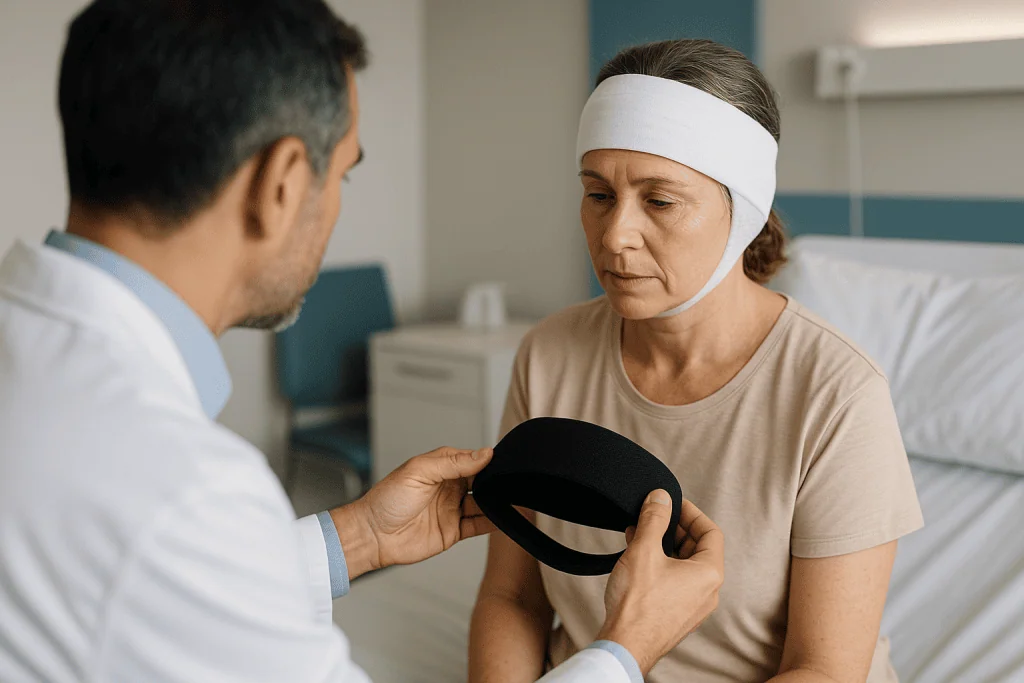
Most people go home the same day. The NHS notes that the ears are typically wrapped in a bulky dressing that covers the whole head, rather like a turban, and it stays on for the first few days. Its job is compression: pressing the ears gently against the skull so that swelling is limited and blood cannot pool under the skin.
That pooling has a name worth knowing. A hematoma is a collection of blood trapped in the tissues after surgery, and in the ear it is the complication surgeons watch for most closely in the first 48 hours. The pressure dressing is the main defense, which is why patients are asked not to loosen or remove it themselves, however hot and itchy it becomes.
Expect the ears to ache rather than throb once the anesthetic wears off. Pain-relieving medicines are usually prescribed or recommended; the choice and timing belong to the surgical team, who will also say which common over-the-counter painkillers to avoid because some increase bleeding. Sleeping propped on two pillows helps drain fluid and eases the pounding feeling many people notice when lying flat.
Hair washing is usually off-limits while the dressing is on. So is bending over, heavy lifting and anything that raises blood pressure in the head.
At the first follow-up, typically within the first week, the dressing comes off and the ears are checked. They will look swollen, bruised and slightly too flat against the head. This is normal and temporary. The incision behind each ear may have dissolvable stitches or ones removed at a later visit; the NHS puts stitch removal, where needed, at around a week to ten days.
This is also the moment the headband after otoplasty takes over from the bandage, and when your team will confirm exactly how and when to wear it.
Otoplasty recovery time: what weeks two to six usually look like
The second week is when life starts to feel ordinary again. The NHS suggests most adults return to work, and most children to school, around one to two weeks after surgery, depending on how they feel and what their day involves. A desk job is different from a nursery classroom full of flailing elbows.
Swelling recedes steadily but not evenly. Bruising fades through the familiar purple-green-yellow sequence over two to three weeks. The ears may feel numb, tingly, or oddly cold; the small nerves that supply the skin were disturbed during surgery and take weeks to months to settle. Cleveland Clinic describes this altered sensation as an expected part of recovery rather than a warning sign.
The night headband is now the main daily task, and this is where compliance quietly slips. The ears look fine, the incisions have closed, the child is sleeping through the night, and the band gets forgotten on a sleepover or left in a drawer after a late night. It helps to think of this phase the way orthodontists think of retainers: the visible work is done, but the tissues are still learning their new position.
Clothing deserves a moment’s thought. Pulling a tight sweater or T-shirt over the head can catch the top of the ear and yank it forward. Button-front shirts and wide necklines are easier for a few weeks. Glasses can usually be worn but may need adjusting so the arms do not press on the incision line.
By the end of week six, most surgeons are ready to release patients from the band and from most restrictions. The final shape, though, keeps refining. The Mayo Clinic notes that the ears continue to settle for some months as swelling fully resolves, so early photographs are not the finished result.
Sleeping after otoplasty: positions, pillows and restless nights
Back sleeping is the goal, and for most people it is a new skill. A rolled towel or a firm pillow placed along each side of the body acts as a gentle bumper that makes rolling over less likely. Some parents put a spare pillow on either side of a child in the same way. Travel neck pillows, the horseshoe kind, hold the head centered for people who tend to drift.
Elevation matters as much as position in the first week or two. Sleeping with the head raised on two pillows, or with the head of the bed propped, reduces the throbbing that comes with lying flat and helps swelling drain overnight.
The headband goes on last, after teeth are brushed and the bedroom light is off, so it is not tugged during the evening routine. It should sit over both ears with the ears lying flat and relaxed beneath it, not pushed up, down or folded. Run a finger around the rim of each ear before settling: if any part feels bent, take the band off and start again.
Side sleepers who wake to find themselves on their side should not panic. A soft band and a soft pillow mean most brief episodes cause no harm; the danger is a hard fold held for hours. Reposition, check the ear is flat, and go back to sleep.
Children may resist the band for a few nights. Letting them choose the color, putting a matching band on a favorite toy, and treating it as a bedtime ritual rather than a punishment usually wins the argument within a week. Very young children who repeatedly pull it off overnight should be discussed with the surgeon, who may suggest a different style, a light hat over the top, or a different schedule. Do not improvise with tape or tighter fastenings.
What should a post-otoplasty headband feel like?
Surgeons rarely specify a brand and this article will not either, because the qualities that matter are simple and available in any soft sports or sleep band.
Width comes first. The band must cover the entire ear from the top rim to the earlobe with some margin, so a narrow hairband that sits across the middle is useless. Something around the width of a hand, as sold for sport or for sleeping in, is the usual choice.
Fabric should be soft, breathable and stretchy. Cotton or a cotton blend is kinder to sweaty scalps than synthetic fleece. Seams that run across the ear can rub the incision, so smooth or seam-free designs are preferable.
Fit is where people go wrong in both directions. Too loose and the band rides up in the night, leaving the ear exposed. Too tight and it presses on the incision, restricts blood flow to the skin, and can cause pressure sores or, in rare cases, damage the healing skin over the cartilage. The right tension is snug enough to stay put when you shake your head gently, and loose enough that you can slide a finger comfortably underneath. The Mayo Clinic’s own language is a loose headband, which is a useful corrective for anyone tempted to strap the ears down.
Watch the skin. Redness that fades within half an hour of removing the band in the morning is normal; a red mark that persists, or any blistering or broken skin, means the band is too tight or has a seam in the wrong place, and the team should hear about it.
Buy two so one can be washed while the other is in use. Machine-washed cotton dries quickly and wearing a clean band each night lowers the chance of skin irritation around an incision that is still sealing.
Sports after ear pinning surgery: a typical return timeline
Ear pinning is the everyday name for the same operation, and sport is the question parents ask most. The logic is the same as for sleep: the risk is a blow or a fold to healing cartilage, so activities are graded by how likely they are to involve one.
The NHS gives the framework most surgeons follow. Gentle activity resumes within days. Swimming waits until the incisions are fully healed, which the NHS puts at around four to six weeks, partly because of infection risk and partly because water pressure and goggles straps pull on the ear. Contact sports wait longest, around twelve weeks, because a stray elbow in rugby, a headguard in boxing, or a fall on a bike can undo the correction or cause a hematoma even after the skin has healed.
| Activity | Typical earliest return | Why the wait |
|---|---|---|
| Walking, light chores | Within the first few days | Low risk to the ear; avoid bending and straining |
| School or desk work | About 1 to 2 weeks | Swelling and soreness settling; band may be needed at school for younger children |
| Running, cycling on quiet paths, gym without contact | Roughly 2 to 4 weeks | Raised blood pressure and sweating early on; helmet straps must not press the ear |
| Swimming | Around 4 to 6 weeks | Incision must be fully closed; goggle straps and water pressure |
| Contact and ball sports, martial arts | Around 12 weeks | Direct blows can fold the ear or cause bleeding under the skin |
These are typical ranges drawn from NHS guidance, not a promise. A surgeon may shorten or lengthen any of them, and a headguard or scrum cap may be requested for a further period after return. The final call belongs to the treating team.
Who is otoplasty usually for, and who is asked to wait?
Prominent ears are common, run in families, and are entirely harmless. Surgery is offered for how they make a person feel, not for any medical need, which is why the decision is treated so carefully.
Age is the first filter. The Mayo Clinic notes that otoplasty can be considered from around age five, when the ear has reached most of its adult size and the cartilage is firm enough to hold stitches. The NHS explains that many surgeons prefer to wait until a child is old enough to understand the procedure and to want it themselves, rather than have it chosen for them. A child who is not bothered by their ears is usually not a candidate, whatever a parent or grandparent feels.
The headband is part of this calculation. A child who cannot tolerate a soft band on their head for a few weeks, or who will pull it off every night, is at higher risk of a disappointing result, and a thoughtful surgeon may suggest waiting a year or two.
Adults are candidates at any age, provided general health allows a minor operation. People who smoke are usually asked to stop well before surgery because smoking slows skin healing and raises infection risk. Bleeding disorders, medicines that thin the blood, poorly controlled diabetes and active skin infections around the ear are all reasons a team may postpone.
Newborns are a special case. In the first weeks of life the cartilage is unusually soft because of maternal hormones still in the baby’s system, and some prominent ears can be reshaped without surgery by fitting a small molding splint, worn continuously for several weeks. This window closes in early infancy. It is a genuine alternative for some babies and worth raising with a pediatrician early, but it is not otoplasty and it is not available once the cartilage has firmed.
Washing hair, skin care and keeping the headband clean
Once the bulky bandage is off, the incision behind the ear is usually left open to the air or covered with a light dressing. The MedlinePlus general guidance on surgical wounds applies: keep the area clean and dry, wash hands before touching it, and follow the specific instructions from your team about when it may get wet.
Hair washing is the practical challenge. Most surgeons allow gentle washing once the dressing is removed, typically from the end of the first week, with lukewarm water, a mild shampoo and no scrubbing near the incision. Tilting the head back so water runs away from the ears, and patting rather than rubbing dry, protects the wound. Hair dryers should be on a cool setting and kept well away, because the numb skin over the ear cannot feel heat properly and can burn without warning.
Avoid hair products near the incision for a few weeks. Hairspray, gel and dye all irritate healing skin, and a hairdresser’s clip or comb catching the ear is a surprisingly common way to cause pain.
The NHS advice on stitches is to leave them alone: no picking, no pulling at loose ends, and no antiseptic creams unless the team has prescribed one. A small amount of clear or slightly blood-tinged fluid in the first days is expected; thick yellow or green discharge is not.
Sun is the long-term skin issue. The scar behind the ear is hidden, but the skin of the ear itself is thin, freshly disturbed and prone to darkening if it burns. A hat outdoors for the first few months, and sunscreen once the incision has closed, help the ear color match its neighbor.
Wash the headband regularly. A band worn for eight hours a night collects oil and sweat, and an incision that is not yet fully sealed is a route for bacteria.
What a headband can and cannot prevent: risks and alternatives
It helps to be clear about what the band protects against and what it does not, because patients sometimes blame themselves, or the band, for problems it was never designed to stop.
The band lowers the risk of the ear being folded or knocked while the cartilage is weak. That reduces the chance of the correction loosening or of one ear ending up further forward than the other. It also holds a light dressing in place and offers some protection against minor bumps.
It does not prevent infection, which the Cleveland Clinic lists among the recognized risks of otoplasty along with bleeding, hematoma, and changes in skin sensation. Infection of ear cartilage is uncommon but taken seriously because cartilage has a poor blood supply and heals slowly once infected. Nor does the band prevent the stitches themselves from working loose over time, or a stitch from becoming visible under thin skin behind the ear, which occasionally requires a small procedure to remove it. Overcorrection, where the ear sits too flat, and asymmetry between the two ears are surgical outcomes rather than headband failures.
Wearing the band too tightly introduces a risk of its own: pressure on the skin over the cartilage can cause a sore, and in rare cases skin breakdown. This is why guidance says loose.
Alternatives depend on age and goals. For newborns, molding splints applied in the first weeks may reshape soft cartilage without surgery. For older children and adults, minimally invasive suture techniques performed through very small incisions exist in some centers, but the evidence comparing them with conventional surgery is limited and they still require a period of protection afterward. The simplest alternative is to do nothing: prominent ears cause no physical harm, and hair, hats and time change how people feel about them.
What people often get wrong about the night headband
Tighter is better. This is the most common and the most harmful misunderstanding. The band is not reshaping the ear and cannot improve on the surgeon’s work. Its job is to stop the ear flipping forward, which a snug, soft band does perfectly well. Cranking it tight risks pressure sores and does nothing for the result.
Once the stitches are out, the ear is healed. Skin closes in a week or two; cartilage and the scar tissue around it take far longer to firm up. The NHS timelines of several weeks of night wear and around three months before contact sport exist because the inside of the ear is still catching up with the outside.
If the ear looks good, the band can stop. Ears usually look good from the day the bandage comes off. That is the surgery working, not the healing being finished. A correction lost at week three looks exactly like a correction that was going to hold, right up until the night it does not.
The band will fix an ear that has already moved. It will not. If one ear seems to be drifting forward, or looks different from the other in a way it did not before, the answer is a call to the team, not a tighter band or more nights.
Any headband will do. A narrow hairband or a knitted headband that sits across the middle of the ear leaves the top rim exposed and can actually fold it. The band must cover the whole ear.
Children can be trusted to keep it on. Most cannot, at least not at first, and that is not a failing. Parents checking the band at bedtime and again if they are up in the night is part of the plan.
Wearing it longer than advised is harmless extra insurance. It is harmless to the ear but not to the scalp, and it prolongs an inconvenience with no measurable benefit once the team has signed off.
Questions to ask your care team
A ten-minute conversation before surgery saves weeks of second-guessing afterward. These are the questions that most often go unasked.
- How long will the full head bandage stay on, and who removes it?
- After that, do you want the headband worn at night only, or during the day as well, and for how many weeks?
- What exactly should it cover, and how loose should it be? Can you show me on the ear?
- What should I do if my child pulls it off in the night or refuses to wear it?
- Which painkillers are appropriate afterward, and which common ones should we avoid because of bleeding risk?
- When can hair be washed, and are there any products to avoid near the incision?
- Are the stitches dissolvable, or will they need removing, and when?
- When can school, work, swimming and specific sports resume, and do you want a headguard for any period after that?
- What does normal swelling, bruising and numbness look like in the first weeks, and what would make you want to see the ear early?
- How will I reach the team out of hours if something worries me?
- If the correction loosens, what are the options, and what would that involve?
Write the answers down, or ask whether the team has a printed sheet. Instructions given in the fog after anesthesia are easily misremembered, and the person accompanying the patient home should hear them too.
It is also worth asking how many follow-up visits are planned. Knowing there is a check at one week, six weeks and a few months out makes it easier to hold questions for the right moment rather than worrying alone between appointments.
When to call your doctor
Most otoplasty recoveries are uneventful, and the aches, itching, numbness and lopsided swelling of the first weeks are expected. A short list of signs, though, should prompt a same-day call to the surgical team rather than a wait until the next appointment.
Bleeding that soaks through the dressing, or sudden severe pain in one ear in the first two days, especially if the ear feels tight and looks swollen or purple, may indicate a hematoma. Blood trapped under the skin needs to be released promptly to protect the cartilage, so this is not a wait-and-see situation.
Signs of infection include spreading redness or warmth around the incision, thick yellow or green discharge, an unpleasant smell, or a fever. Cartilage infections are uncommon but can progress quickly, and the CDC’s general guidance on surgical site infection is to report these signs without delay.
Skin that turns dark, blistered or broken under the headband, or a patch that stays white or pale and does not pink up, suggests pressure damage and the band should come off until the team has seen the ear.
An ear that suddenly looks different from the other, sits noticeably further forward, or develops a new sharp ridge or step in its shape may mean a stitch has loosened. Call before the next planned visit.
Seek emergency care immediately for chest pain, difficulty breathing, swelling of the face or lips, or a widespread rash after surgery or after taking a new medicine, as these can indicate a serious allergic reaction. Uncontrolled bleeding that does not slow with firm gentle pressure over the dressing is also an emergency.
When in doubt, call. Surgical teams would far rather look at a normal ear than miss a problem, and the phone number for out-of-hours concerns should have been part of your discharge information.
Frequently asked questions
How long do you wear a headband after otoplasty?
Typically for several weeks at night after the initial head bandage is removed; the Mayo Clinic describes a range of about two to six weeks and the NHS says several weeks. The exact duration depends on the surgical technique, the patient’s age and how well the band is tolerated, and the surgeon sets and adjusts it at follow-up visits.
Can I sleep on my side after otoplasty?
Back sleeping with the head raised is advised in the early weeks, because side sleeping presses the ear into the pillow with the weight of the head behind it. A soft headband reduces the harm if you roll over, and pillows placed along each side of the body help keep you on your back. Ask your team when side sleeping can resume.
What happens if you don't wear the headband after ear surgery?
The main risk is that the ear folds forward during sleep or is knocked before the cartilage and scar tissue have firmed, which can loosen the correction and leave one ear more prominent than the other. Not every missed night causes harm, but a lost correction may require a second operation, so the band is regarded as low-cost insurance.
What is the typical otoplasty recovery time?
Most people return to school or work within one to two weeks according to the NHS, wear a night headband for several weeks, avoid swimming for around four to six weeks and contact sports for about twelve weeks. Swelling and numbness can take a few months to fully settle, and the final ear shape continues to refine over that time.
When can you play sports after ear pinning surgery?
Gentle activity resumes within days, non-contact exercise usually within two to four weeks, swimming once incisions are fully healed at around four to six weeks, and contact or ball sports at around twelve weeks, based on NHS guidance. Your surgeon may adjust these ranges and may ask for a headguard for a further period after return.
Should the headband be tight after otoplasty?
No. Guidance describes a loose, soft band that keeps the ears flat without pressing on them. You should be able to slide a finger underneath. A band that is too tight can cause pressure sores or skin damage over the healing cartilage and does not improve the surgical result, which is created by the stitches, not by compression.
Do adults need a headband after otoplasty, or just children?
Adults are usually asked to wear one too, because the mechanism is the same: cartilage held by stitches needs protection from folding during sleep while scar tissue forms. Adults may be given a shorter or night-only schedule if they sleep on their back reliably, but the decision rests with the surgeon based on the technique used.
Can you wear glasses after otoplasty?
Usually yes once the bulky bandage is removed, though the arms of the glasses may press on the incision line behind the ear and can need adjusting or padding for a few weeks. Sunglasses and sports goggles with tight straps should wait longer. Check with your team, particularly about wearing glasses under the headband at night.
When can I wash my hair after ear correction surgery?
Generally once the head bandage is removed, often around the end of the first week, using lukewarm water, mild shampoo and no rubbing near the incision. Keep hair dryers on a cool setting and away from the ears, since numb skin cannot sense heat well. Your surgical team will confirm the exact timing for your case.
Is there a non-surgical alternative to otoplasty?
For newborns, yes: in the first weeks of life the ear cartilage is soft enough that a molding splint worn continuously for several weeks can reshape some prominent ears without surgery. This window closes in early infancy. For older children and adults, surgery remains the established approach, and doing nothing is always a legitimate option since prominent ears cause no physical harm.
References
- NHS: Ear correction surgery, including ear pinning
- MedlinePlus: Surgical wound care
- NHS: How should I care for my stitches?
This article is for general information only and is not a substitute for professional medical advice. Please consult a qualified doctor about your individual situation.

More from the Blog

Which Noses Are Candidates for Revision Rhinoplasty? Breathing, Shape and What Is Assessed
A revision rhinoplasty candidate is usually someone whose nose has fully healed from a previous operation, typically around a year later, and who has…

What Scar Revision Surgery Can and Cannot Do: Realistic Results and the Year-Long Maturation
Scar revision surgery can make a scar narrower, flatter, better aligned with skin creases, or less tight, but it cannot erase a scar; it…

Thyroid Eye Disease and Orbit Surgery: When Bulging Eyes Need Orbital Decompression
Orbital decompression is surgery that removes bone or fat from the eye socket so a swollen eye can settle back and the optic nerve…

How Zygoma Reduction Surgery Reshapes the Cheekbone: Osteotomy, Repositioning and Fixation
Zygoma reduction surgery reshapes the cheekbone by cutting the zygomatic bone in planned locations (osteotomy), sliding the freed segment inward and slightly back (repositioning),…

How Long Does Non-Surgical Facial Rejuvenation Last? Maintenance Schedules Explained
Non-surgical facial rejuvenation is temporary, and how long it lasts depends on the method. Botulinum toxin injections typically wear off after about three to…

Liquid Facelift Risks: Bruising, Lumps and the Vascular Warning Signs to Know
A liquid facelift uses injectable dermal fillers across several areas of the face, so its risks are the risks of fillers, multiplied by volume…