

Why Sun Exposure Matters Before Vascular Laser Treatment and How Long to Stay Out of It

Key Takeaways
- Hemoglobin and melanin both absorb the green and yellow light used by most vascular lasers, so a tan puts a competing target directly in the beam's path.
- Common pre-treatment guidance asks for no tanning or sunburn for at least two to four weeks, and Mayo Clinic's laser resurfacing advice extends unprotected-sun avoidance to about two months.
- Lowering laser energy to compensate for tanned skin also lowers the effect on the vessel, which is why clinicians usually postpone rather than compromise.
- Self-tanner adds no melanin but stains the surface enough to absorb light and mask true skin color, so most teams ask for it to fade over days to about a week.
- Near-infrared light at 1064 nanometers is absorbed less by melanin than shorter wavelengths, one reason device choice matters for deeper skin tones.
- Sunlight is a recognized trigger of rosacea flares and new telangiectasia, so sun protection after treatment helps preserve results rather than just protecting healing skin.
Sun exposure matters before vascular laser treatment because a tan adds melanin to the skin surface, and melanin absorbs the same light the laser aims at blood vessels, raising the risk of burns and pigment changes while weakening the effect on the vessel. Most guidance asks patients to avoid tanning and sunburn for at least two to four weeks beforehand, and some protocols advise about two months; the treating team sets the exact timing.
The appointment had been booked for weeks. Then came a bright Saturday on a friend’s boat, a hat that blew off, and by Sunday evening a familiar pink glow across the nose and cheeks. On Monday the reminder text arrived, and with it a question that suddenly felt urgent: does a weekend in the sun change anything?
For anyone weighing up vascular laser sun exposure before a session, the honest answer is yes, and often more than people expect. Vascular lasers work by aiming light at blood. Sun-darkened skin sits between that light and its target, and it does not stay out of the way.
This explainer walks through what actually happens inside the skin, why clinicians ask about recent sun with such consistency, how long the usual waiting ranges are and where they come from, and what the days after treatment tend to look like. Every timing decision, in the end, belongs to the person holding the handpiece.
Why vascular laser sun exposure before treatment is the first question on the form
Look at almost any pre-treatment questionnaire for a vascular laser and the same line appears near the top: any sun, tanning bed or self-tanner in the last month? It often sits above questions about allergies or previous procedures. That ordering is not an accident.
A vascular laser is a device that delivers a single, tightly chosen color of light designed to be absorbed by blood rather than by the tissue around it. The whole method depends on the target vessel soaking up more light than the skin above it. A tan rearranges that balance. Extra pigment in the surface layer absorbs part of the beam before it reaches the vessel, which means more heat where you do not want it and less where you do.
Clinicians can respond in two ways, and neither is ideal. They can lower the energy to protect the surface, which also weakens the effect on the vessel and may turn the session into an expensive shrug. Or they can keep the settings and accept a higher chance of a burn, a blister or a patch of skin that ends up darker or lighter than its neighbors. Most prefer a third option: postpone until the tan has faded.
Among everything a patient brings into the room, recent sun is arguably the single most controllable factor. Skin type, vessel depth and medical history are fixed or slow to change. Whether the skin carries a fresh tan on the day is a choice made in the preceding weeks, which is why the question gets asked early, and why it deserves an honest answer rather than a hopeful one.
How a vascular laser actually works: light, blood and the color of skin
Every color of light is absorbed differently by different substances. Hemoglobin, the iron-containing protein that carries oxygen in red blood cells and gives blood its red color, absorbs strongly in the green and yellow parts of the spectrum. Vascular lasers exploit that appetite.
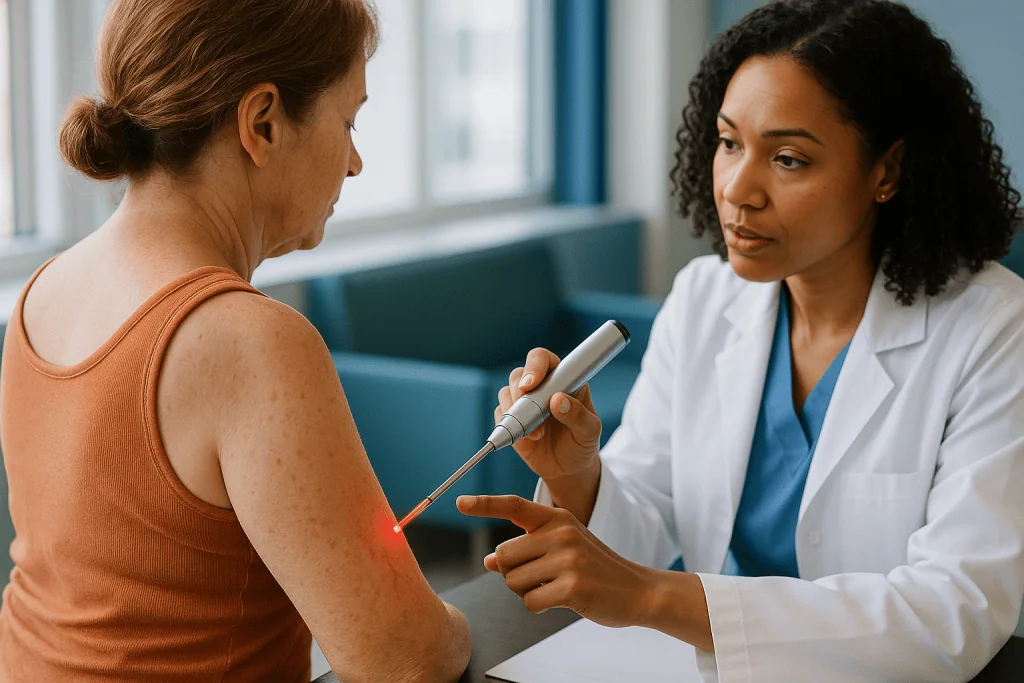
Devices used for facial redness, broken capillaries and spider veins commonly emit green light (around 532 nanometers), yellow light (roughly 585 to 595 nanometers, the pulsed dye laser family) or near-infrared light (1064 nanometers, often used for deeper or larger vessels). A nanometer is a billionth of a meter and is simply how wavelengths are measured. Cleveland Clinic describes laser therapy as one of the standard approaches for small visible vessels, alongside injection treatments for leg veins.
The physics has a name: selective photothermolysis. In plain terms, the wavelength and the pulse length are chosen so that the vessel heats up and is damaged while the surrounding skin barely warms. The injured vessel wall collapses and the body gradually clears the remnants over the following weeks. Many devices spray a cooling agent or press a chilled tip against the skin a fraction of a second before each pulse to protect the surface.
Here is the catch. Melanin, the pigment that colors skin and hair, also absorbs green and yellow light, and it absorbs the shorter wavelengths particularly well. In untanned skin the clinician sets the energy for a known amount of melanin. Add a tan and the surface begins competing with the vessel for the same photons. The laser has no way to tell the difference; it heats whatever absorbs its light.
What a tan does inside the skin that the laser can see
A tan is not a cosmetic layer that sits on top of the skin. It is a biological response to injury. Ultraviolet light damages the DNA of skin cells, and specialized cells called melanocytes respond by producing more melanin and passing it up into the surrounding cells as a kind of umbrella. Cleveland Clinic’s overview of melanin describes this as the skin’s attempt to shield itself from further ultraviolet damage.
That extra pigment is distributed exactly where a vascular laser beam enters: the epidermis, the outermost living layer. In a tanned face, the beam meets a denser screen of melanin before it can reach the tiny vessels a millimeter or so below. Two things follow. The surface absorbs more energy and may be heated past the point of safety. The vessel receives less energy and may not be treated effectively.
Sunburn adds a further layer of risk. Burned skin is already inflamed, swollen and repairing itself. Laser heat on top of that injury compounds the damage and increases the odds of blistering and lasting pigment change.
Recent sun also muddies the clinician’s assessment. Skin is often classified by how it responds to sun using the Fitzpatrick scale, a six-step system from very fair skin that always burns to deeply pigmented skin that rarely burns. Settings are chosen partly on that basis. A tan can make skin look one or two steps darker than its true type, which pushes the clinician toward guesswork.
The tan does fade. Pigmented cells migrate upward and shed as the outer layer renews itself over a matter of weeks, which is precisely why waiting works.
How long to stay out of the sun before vascular laser treatment
People want a number, and the honest answer is a range that the treating team narrows for each patient.

Common pre-treatment instructions ask for no deliberate tanning, tanning beds or sunburn for at least two to four weeks before a vascular laser session. Some guidance runs longer: Mayo Clinic’s patient information on laser resurfacing advises avoiding unprotected sun exposure for about two months before the procedure, and the reasoning about melanin and heat transfers directly to vascular devices. Cleveland Clinic likewise lists sun avoidance among the standard preparations for laser skin treatments.
Why the spread? Several variables shift the safe window:
- How deep the tan is. A faint color from a lunchtime walk fades faster than a week at the beach.
- Natural skin tone. In deeper skin tones the baseline melanin is already higher, so any added tan narrows the margin further, and device choice matters more.
- Wavelength. Near-infrared light at 1064 nanometers is absorbed less by melanin than green or yellow light, so some clinicians treat closer to recent sun with it, though caution still applies.
- The body area. Faces and hands typically see more incidental sun than covered skin.
Sunburn is a separate case. The rule is not simply a fixed number of weeks; the skin must first be fully healed, with no redness, tenderness or peeling, and then the usual waiting period begins.
One reframing helps. “Staying out of the sun” does not mean living indoors. It means arriving with skin the same color it was at the consultation. Daily sunscreen, shade and a hat achieve that for most people. What breaks the rule is a change in color, whether from a beach, a balcony or a tanning bed.
Who vascular lasers are usually for, and who is usually asked to wait
Vascular lasers are most often used for visible redness and small vessels near the skin surface. Typical reasons include the persistent flushing and broken capillaries of rosacea (a long-term inflammatory skin condition that mainly affects the central face, as the NHS describes it), scattered telangiectasia (dilated small vessels visible as fine red or purple lines), cherry angiomas (small bright-red bumps made of clustered vessels) and port-wine stains, which are flat red birthmarks present from birth. Spider veins on the legs are sometimes treated with lasers too, although Mayo Clinic notes that injection treatment called sclerotherapy remains a mainstay for many leg veins.
Suitability is assessed in person, and several situations commonly lead a team to postpone:
- A recent tan, sunburn, tanning-bed session or self-tanner on the treatment area.
- An active skin infection, cold sore or open wound in the field.
- Pregnancy, where many teams defer elective laser work as a precaution rather than because of proven harm.
- Recent use of oral retinoids for acne, a medicine class that alters skin healing; the prescribing clinician advises on timing, and nobody should stop a prescribed medicine on their own to fit a laser appointment.
- Medicines that increase sun sensitivity, including some antibiotic classes, which can raise the risk of a reaction to intense light.
- A history of keloid or abnormal scarring, or conditions that flare with skin injury.
Skin tone by itself is not an exclusion. Deeper skin can be treated, but it calls for careful device selection, often longer wavelengths, conservative test spots and, above all, no recent tan, because the margin for error is smaller. In every case the decision to proceed, adjust or wait rests with the treating team after examining the skin on the day.
Does sunscreen before laser treatment count as staying out of the sun?
Sunscreen is necessary, and it is not sufficient. Both halves of that sentence matter.
The CDC recommends a broad-spectrum sunscreen (one that blocks both UVA and UVB) with SPF 15 or higher, reapplied at least every two hours and after swimming or sweating, alongside shade during the midday hours from about 10 a.m. to 4 p.m., a wide-brimmed hat and clothing that covers the skin. The NHS advises SPF 30 or above with good UVA protection, applied generously, and points out that most people use far less than the tested amount. Used that way, sunscreen sharply reduces the ultraviolet dose reaching the skin.
It does not reduce it to zero. An SPF 30 product applied perfectly still lets a fraction of UVB through, and real-world application is rarely perfect. Missed patches, thin layers, sweat and time all chip away at protection. Over a long day outdoors, skin can still tan through sunscreen, and a tan is a tan regardless of how it was earned.
The practical rule before a vascular laser session is therefore layered. Wear sunscreen every morning on the treatment area so incidental exposure stays truly incidental. Use shade, hats and timing to avoid deliberate sun. Skip anything whose purpose is to change skin color. Sunscreen also helps an existing tan fade faster by preventing new pigment from being added while the old pigment sheds.
On the day itself, most teams ask for clean skin with no sunscreen, makeup or moisturizer, since products can interfere with cooling and light delivery. Applying sunscreen again afterward, once the team gives the go-ahead, is usually part of the aftercare rather than a departure from it.
Tanning bed before laser, self-tanner and "just a little color": what counts as exposure
Patients sometimes assume the warning is about beaches and forget the less obvious sources. Each deserves a plain answer.
Tanning beds emit ultraviolet light, mostly UVA, and they produce melanin exactly as the sun does. From the laser’s perspective there is no difference between a bed tan and a beach tan. The World Health Organization’s cancer research agency classifies ultraviolet-emitting tanning devices as carcinogenic to humans, which is a separate reason to leave them alone well beyond the pre-treatment window.
Self-tanners and spray tans work differently. Their active ingredient, dihydroxyacetone, reacts with proteins in the dead cells of the very outer skin layer to produce a brown color. No melanin is made and no ultraviolet is involved. Even so, most teams ask patients to stop and let the color fade before treatment. The pigment darkens the surface enough to absorb some laser light, it hides the skin’s true color during assessment, and it can look uneven, which makes judging redness harder. Because it sits in cells that shed naturally, the color usually lifts over a matter of days to about a week.
Tinted moisturizers, bronzers and foundation are simpler: they wash off, and the team will remove them before treatment.
Then there are the quiet exposures. UVA passes through window glass, so a long drive or a desk beside a sunny window counts. Clouds filter some ultraviolet but not all of it; the NHS notes that skin can burn on overcast days. Snow, sand and water reflect ultraviolet upward, which is why a winter ski trip can leave a face as tanned as a summer holiday. None of these needs to be feared, but all of them belong in the honest conversation with the care team.
Sun timing and laser risk at a glance
The table below summarizes the situations clinicians most often encounter and how they generally respond. It is a guide to the conversation, not a substitute for the examination on the day.
| Situation on the treatment area | What it means for the skin | Usual approach of the treating team |
|---|---|---|
| Fresh sunburn (red, tender or peeling) | Skin already inflamed and repairing; extra heat compounds the injury | Postpone until fully healed, then observe the standard waiting period |
| Active, visible tan | High surface melanin competes with the vessel for light | Postpone, commonly for several weeks, until color returns to baseline |
| Tan fading (roughly 2–4 weeks since last exposure) | Pigment shedding; some residual darkening possible | Assess in person; may proceed, adjust settings, or wait a little longer |
| No recent sun, daily sunscreen and shade | Skin at its natural baseline tone | Proceed as planned if other criteria are met |
| Self-tanner or spray tan | Surface stained brown; no extra melanin but light absorption and masking | Stop and allow color to lift, typically days to about a week |
| Tanning-bed session in recent weeks | Melanin increased exactly as with sunlight | Treated the same as a natural tan; postpone |
Two patterns stand out. First, the response to almost every form of recent exposure is a delay rather than a compromise on settings, because turning down energy quietly costs effectiveness. Second, the only row that leads to a straightforward “proceed” is the one describing ordinary, protected daily life. The timing ranges echo the two-to-four-week floor common in practice and the longer two-month horizon Mayo Clinic gives for laser resurfacing; the team decides where a given patient sits within them.
What happens if you have laser treatment on tanned skin
It helps to be concrete about what clinicians are trying to avoid, without dramatizing it.
The most immediate risk is a thermal injury to the surface: a burn that may blister, crust or weep in the days after treatment. The surface has absorbed energy meant for a vessel below it, and it responds like any burned skin.
The more common and longer-lasting consequence is a change in color. Post-inflammatory hyperpigmentation, described by Cleveland Clinic as darker patches that develop after skin inflammation or injury, can appear where the laser heated tanned skin, and it tends to persist for months. Hypopigmentation, patches lighter than the surrounding skin, is less frequent but can be more stubborn because it reflects damage to the pigment-producing cells themselves. Both are more likely in deeper skin tones and in skin carrying a fresh tan. Scarring is uncommon with modern devices and proper settings, but a tan is one of the factors that raises the odds.
There is a quieter failure mode. A cautious clinician faced with tanned skin may lower the energy to keep the surface safe. The session then becomes low-yield: the vessel receives too little heat to close, and the patient has spent an appointment and a recovery window for very little. That outcome frustrates everyone, which is why postponement is usually preferred over a diluted treatment.
A note on the evidence: much of the specific timing guidance comes from clinical experience and expert consensus rather than large randomized trials, because deliberately treating tanned skin to measure harm would be unethical. The underlying physics of melanin absorption is well established. If there is any doubt about recent exposure, saying so before the first pulse is always the safer path.
Planning treatment around holidays, seasons and outdoor life
Most people cannot simply stop living outdoors, and they should not have to. The trick is sequencing.
Vascular laser treatment is rarely a single visit. Cleveland Clinic notes that spider vein treatments often need several sessions spaced weeks apart, and redness from rosacea is frequently managed in a course as well. That means the sun rule applies not just before the first appointment but in the gaps between sessions and for a period afterward. Planning a course during months of lower ultraviolet intensity, typically autumn and winter in much of the United States, is a common and sensible strategy, and it is why many teams see demand rise once summer ends.
If a beach holiday is fixed, count backward from it rather than forward from today. The trip comes first, then the waiting window the team has advised, then the session. Booking the laser appointment the week after returning almost always ends in a rescheduled visit.
People who work or exercise outdoors need a different toolkit. Wide-brimmed hats, ultraviolet-protective clothing rated by UPF (a fabric rating similar in spirit to SPF), shifting runs or shifts away from midday, and generous, repeated sunscreen application keep the treatment area at baseline without banning fresh air. The CDC’s sun-safety guidance covers each of these measures.
Parents arranging port-wine stain treatment for a child face the same math with the added variable of school breaks and sports seasons. The principles do not change: protect the area consistently, avoid deliberate sun, and keep the team informed about any exposure so that settings match the skin in front of them, not the skin on the consultation photos.
Sun exposure after vascular laser: what the days and weeks usually look like
The sun rule does not end when the treatment does. Freshly treated skin is more vulnerable to ultraviolet than it was before, and the aftercare timeline reflects that.
In the first hours, treated skin usually looks red and feels warm or slightly swollen, much like a mild sunburn. Cool compresses and gentle skincare are typical advice. With pulsed dye lasers in particular, some settings produce purpura, a bruise-like purple or gray discoloration where vessels have been deliberately ruptured; this commonly fades over days to about two weeks. Near-infrared and lower-energy settings tend to cause less visible bruising but may need more sessions.
During the following weeks the body clears the closed vessels and any surface inflammation settles. This is the period when post-inflammatory hyperpigmentation can develop if the area is exposed to sun, because inflamed skin responds to ultraviolet by producing more melanin. Teams generally ask for strict sun protection throughout: daily broad-spectrum sunscreen, shade, hats and no tanning. Mayo Clinic’s laser aftercare advice emphasizes avoiding unprotected sun while the skin heals, and the same caution applies after vascular treatment.
Looking further out, sun protection becomes part of maintaining results rather than just protecting healing. The NHS lists sunlight among the common triggers of rosacea flares, and ultraviolet damage is a driver of new telangiectasia over time. Treated vessels do not usually reopen, but new ones can form, and unprotected sun speeds that process. People who treat the redness and then return to old sun habits are often disappointed a year or two later, not because the laser failed but because the underlying cause carried on.
What people often get wrong
A handful of beliefs come up so regularly that they deserve direct correction.
“Sunscreen means I can still sunbathe.” Sunscreen reduces ultraviolet; it does not eliminate it, and deliberate sun exposure through sunscreen still tans skin. The goal before treatment is unchanged skin color, which sunscreen supports but cannot guarantee on a beach.
“A base tan protects the skin.” A tan is evidence of ultraviolet damage, not a shield. The CDC is explicit that tanned skin is damaged skin, and for laser purposes a tan is the very thing that raises risk.
“Tanning beds are not real sun.” They emit ultraviolet and produce melanin just as sunlight does. The laser cannot tell the source, and the World Health Organization classifies these devices as carcinogenic.
“Self-tanner is fine because it has no UV.” True on the ultraviolet point, but the surface stain absorbs light and hides baseline skin color. Most teams ask for it to fade first.
“Cloudy or cold days do not count.” Ultraviolet passes through cloud and reflects off snow and water. Skin can tan or burn without feeling hot.
“Darker skin cannot have vascular laser treatment.” Deeper skin tones can be treated with appropriate wavelengths, settings and test spots. What deeper skin cannot easily tolerate is a fresh tan on top of its natural melanin.
“Once the veins are gone, they are gone for good.” Treated vessels rarely reopen, but new ones can appear, and sun is a major reason they do. Protection after treatment is part of the treatment.
Each of these myths has a kernel of logic, which is why they persist. Each also collapses against the same fact: the laser heats whatever absorbs its light.
Questions to ask your care team
A good consultation leaves no guesswork about sun. These questions tend to draw out the answers that matter.
- How long before my session should I avoid deliberate sun, and does that change if I have a tan now? The answer should be specific to your skin and the device planned, not a generic number.
- Which wavelength will you use, and how does my skin tone affect that choice? Understanding whether the plan involves green, yellow or near-infrared light helps you understand why the sun rule is stricter or looser.
- Should I stop self-tanner, and how far in advance? Confirm rather than assume.
- What should I do if I get accidental sun or a burn before the appointment? Knowing the postponement policy in advance removes the temptation to hide a red weekend.
- Will you do a test spot first? Small trial pulses in an inconspicuous area are common practice, particularly for deeper skin tones or uncertain recent exposure.
- Do any of my medicines increase light sensitivity, and who decides whether the timing needs adjusting? Bring a full list, including over-the-counter products and supplements. Any change to a prescribed medicine belongs with the prescriber.
- How many sessions are you anticipating, how far apart, and what sun rules apply between them?
- What will the treated area look like in the first two weeks, and when can I start sunscreen and makeup again?
- What signs should prompt a call, and who do I call? Ask for the after-hours route, not just office hours.
Write the answers down. Instructions given in a consultation have a way of blurring by the time a sunny weekend arrives, and a note on the phone is easier to consult than a memory.
When to call your doctor
Most vascular laser sessions are followed by predictable redness, warmth and, with some devices, bruising that settles on its own. Certain signs fall outside that pattern and warrant a prompt call to the treating team or, if they cannot be reached, urgent care.
Before treatment, contact the team if you have had a sunburn, a tanning-bed session or a notable tan on the area since your consultation, if a cold sore, rash or infection has appeared in the treatment field, or if you have started a new medicine, particularly one you have been told increases sun sensitivity. None of these means treatment is off the table; all of them mean the plan may need adjusting.
After treatment, red-flag signs include:
- Blistering, open or weeping skin, or skin that looks white, gray or leathery rather than red.
- Redness or swelling that spreads beyond the treated area or worsens after the first two to three days instead of improving.
- Increasing pain, throbbing or heat, or yellow discharge, which can indicate infection.
- Fever or feeling generally unwell in the days after treatment.
- New dark or pale patches forming in the treated area over the following weeks.
- Any change in vision, eye pain or unusual light sensitivity if the treatment was near the eyes.
Bruising that fades over days to about two weeks, mild flaking and temporary tenderness are commonly described and usually need no more than the aftercare already advised. Anything that feels wrong, escalates or does not follow the timeline you were given is reason enough to call. Clinicians would rather hear about a false alarm than miss an early complication, and the person who examined your skin is the right one to judge what comes next.
Frequently asked questions
How long should I avoid the sun before vascular laser treatment?
Most guidance asks for at least two to four weeks without tanning, tanning beds or sunburn, and some protocols, including Mayo Clinic’s advice for laser resurfacing, extend unprotected sun avoidance to about two months. The exact window depends on how tanned the skin is, its natural tone and the wavelength planned. Your treating team sets the timing after examining your skin and may postpone if color has changed since the consultation.
Is it safe to have laser treatment on tanned skin?
It carries higher risk and is usually postponed. Tanned skin holds extra melanin that absorbs the laser’s light before it reaches the target vessel, raising the chance of burns, blisters and lasting dark or light patches while reducing the effect on the vessel. Clinicians generally prefer to wait until the tan fades rather than lower the energy, because weaker settings also mean a less effective session.
Does wearing sunscreen before laser treatment count as staying out of the sun?
Sunscreen is essential but not a substitute for avoiding deliberate sun. The CDC recommends broad-spectrum SPF 15 or higher reapplied every two hours, alongside shade and hats; the NHS advises SPF 30 or above. Even used well, sunscreen lets some ultraviolet through, and skin can still tan over a long day outdoors. The practical goal is unchanged skin color, which daily sunscreen supports when paired with shade and no sunbathing.
Can I use a tanning bed before laser treatment if I skip real sun?
No. Tanning beds emit ultraviolet light and increase melanin exactly as sunlight does, so the laser encounters the same competing pigment. The World Health Organization’s cancer agency also classifies ultraviolet tanning devices as carcinogenic to humans. Treating teams apply the same waiting period to a bed tan as to a beach tan, and many advise avoiding tanning beds altogether.
Do I need to stop self-tanner before a vascular laser session?
Usually yes. Self-tanner does not add melanin or involve ultraviolet, but it stains the outer dead skin cells brown, which can absorb some laser light and hides your true skin color during assessment. Because the color sits in cells that shed naturally, it typically lifts over days to about a week. Ask your team how far in advance to stop, and arrive with clean, product-free skin.
What happens if I get sunburned a week before my appointment?
Tell the team as soon as possible; the session will very likely be rescheduled. Sunburned skin is inflamed and repairing itself, and laser heat on top of that injury raises the risk of blistering and pigment changes. The usual approach is to wait until all redness, tenderness and peeling have resolved, then observe the standard pre-treatment sun-avoidance period before treating.
How long should I avoid sun exposure after vascular laser treatment?
Strict protection is generally advised for several weeks while the skin heals, with daily broad-spectrum sunscreen, shade and hats and no tanning. Treated skin is more sun-sensitive and more prone to post-inflammatory hyperpigmentation during this period. Longer term, sun protection helps prevent new vessels and rosacea flares, since sunlight is a recognized trigger. Your team will give a timeline specific to the device and settings used.
Can people with darker skin have vascular laser treatment?
Yes, with appropriate planning. Deeper skin tones contain more baseline melanin, so clinicians often choose longer wavelengths such as 1064 nanometers, use conservative settings and perform test spots first. The margin for error is narrower, which makes avoiding any recent tan especially important. Suitability and device choice are decided by the treating team after assessing the skin in person.
Why do clinics ask about sun exposure instead of just adjusting the laser settings?
Because adjusting settings downward protects the surface at the cost of effectiveness. The energy that would have closed the vessel is reduced along with the risk to the skin, so the session may achieve little. Postponing until the tan fades allows the clinician to use settings matched to your true skin type, which is both safer and more likely to treat the vessels intended.
What are the warning signs after vascular laser treatment that need a doctor?
Call your treating team promptly for blistering or open skin, skin that looks white or gray, redness or swelling that spreads or worsens after the first two to three days, increasing pain, yellow discharge, fever, new dark or pale patches, or any eye symptoms if treatment was near the eyes. Mild redness, warmth and bruising fading over days to about two weeks are commonly described and usually expected.
References
This article is for general information only and is not a substitute for professional medical advice. Please consult a qualified doctor about your individual situation.

More from the Blog
Surface Reconstruction Recovery: Early Supervised Walking, Physical Therapy and Milestones
Surface reconstruction recovery after ocular surface surgery usually unfolds in stages: the corneal surface layer re-covers over days, comfort and light sensitivity settle over…

Before Aesthetic Filling: Blood Thinners, Alcohol and Supplements Your Doctor Will Review
Before dermal fillers, clinicians typically review anything that increases bruising or bleeding: prescribed anticoagulants and antiplatelet drugs, over-the-counter anti-inflammatory painkillers, supplements such as fish…

Reconstruction After Cancer or Infection: How Grafts, Flaps and Staged Surgery Are Planned
Reconstructive surgery after cancer or infection rebuilds tissue removed by a tumor operation or destroyed by infection, using skin grafts, flaps of tissue moved…

Why Hands Show Age Early: Volume Loss, Visible Veins and Sun Spots and How Each Is Treated
Hands show age early because their skin is thin, has very little fat beneath it, and spends decades in sunlight without protection. Over time…
Hand Rejuvenation Recovery: Swelling, Bruising and Why Heavy Hand Use Waits a Few Days
After hand filler, mild swelling, tenderness and some bruising across the back of the hand are common and typically ease over several days to…
Caring for the Donor Site After a Skin Graft: Dressings, Discomfort and How It Heals
Skin graft donor site care means keeping the area where skin was taken clean, covered and moist while new skin grows back from below.…