

Tixel: How Thermo-Mechanical Resurfacing Compares With Laser and Microneedling

Key Takeaways
- Tixel creates fractional thermal injury by touching skin for milliseconds with a titanium tip heated to about 400 degrees Celsius, using conduction rather than laser light or penetrating needles.
- Because no light is emitted, periorbital treatment needs no eye shields, which is the main reason it is studied for crepey under-eye and eyelid skin where laser and microneedling are awkward.
- Published split-face and small prospective studies report roughly one point of improvement on five-point wrinkle scales after two to three sessions, with two to four days of redness versus a week or more for ablative laser.
- The evidence base consists of dozens of small trials and case series, mostly under 60 participants with short follow-up; no large multicenter randomized trial or long-term safety registry exists.
- Heat is not pigment-selective, so post-inflammatory hyperpigmentation remains a risk in medium and deep skin tones, and conservative settings, test patches and strict sun protection are standard precautions.
- Use of the same heated-tip principle for meibomian gland dysfunction dry eye is supported only by small uncontrolled studies and is investigational or off-label in many countries, requiring an eye specialist's judgment.
Tixel is a thermo-mechanical skin resurfacing device that briefly touches the skin with a heated titanium tip to create tiny controlled thermal injuries, prompting collagen remodeling without laser light or penetrating needles. Small clinical studies report improvements in fine lines, especially around the eyes, with shorter redness than ablative laser. Evidence remains limited to small trials, so realistic expectations and a qualified clinician matter.
Scroll through any skin-care feed this month and you will meet the same clip: a clinician presses a small grid-patterned tip against the crepey skin under someone’s eye, lifts it, and moves on. No laser goggles, no bleeding pinpricks. The caption usually promises tighter eyelids by the weekend. As of September 2026, searches for tixel have climbed alongside those videos, partly because the device treats an area most lasers avoid and partly because a run of small studies, several of them indexed in PubMed, have given the marketing a scientific-sounding backbone.
There is also an odd wrinkle in the search results themselves. Type the word into a browser and half the page belongs to an unrelated ticket-resale platform that shares the name. People asking whether Tixel is “a trustworthy site” are usually asking about concert tickets, not their eyelids. This piece is about the skin device only.
What follows is an honest look at how thermo-mechanical resurfacing works, how it compares with fractional laser and microneedling, and how strong the evidence really is behind the before-and-after reels.
What is Tixel and how does thermo-mechanical resurfacing work?
Thermo-mechanical resurfacing means transferring heat into the skin by direct contact rather than by light or electricity. Tixel does this with a small titanium plate studded with a nine-by-nine grid of tiny pyramids, 81 in total, heated to roughly 400 degrees Celsius. A motor pushes the plate forward so the pyramid tips touch the skin for a few thousandths of a second, then retracts. The contact time and how far the tips protrude are set by the clinician, and those two settings decide whether the treatment is superficial or reaches deeper into the dermis.
The physics is simple conduction, the same way a hot pan transfers heat to a steak. Because contact is so brief, the heat is delivered as a burst that evaporates water in the outermost layer and creates a column of coagulated tissue beneath each pyramid. Between those columns the skin is untouched. Dermatologists call this a fractional pattern: a fraction of the surface is injured, the rest stays intact and acts as a reservoir for repair. Fractional lasers work on the same principle, which is why comparisons are so natural.
The pyramid tips are blunt enough that they do not pierce the skin the way microneedling needles do. Wound healing is triggered mainly by heat, not by mechanical puncture. In the days that follow, the body clears the damaged columns and lays down new collagen, the structural protein that gives skin its firmness. Tiny channels also stay open for a short window, which is why some clinicians apply topical products right after treatment, an approach researchers call assisted drug delivery.
Three features set the device apart from what most people picture when they hear “resurfacing.” No laser light is emitted, so there is no risk of retinal damage to the eye during periorbital work and no eye shields are required. No consumables such as needles are punctured into tissue. And the energy source is a heated metal surface, so the effect does not depend on how much pigment or water the skin contains, a point that matters for darker skin tones and that the next sections return to.
What changed recently to make tixel trend again?
Nothing dramatic happened to the device itself; it has been in use in Europe for about a decade. What shifted is attention. Three threads came together in 2025 and 2026.
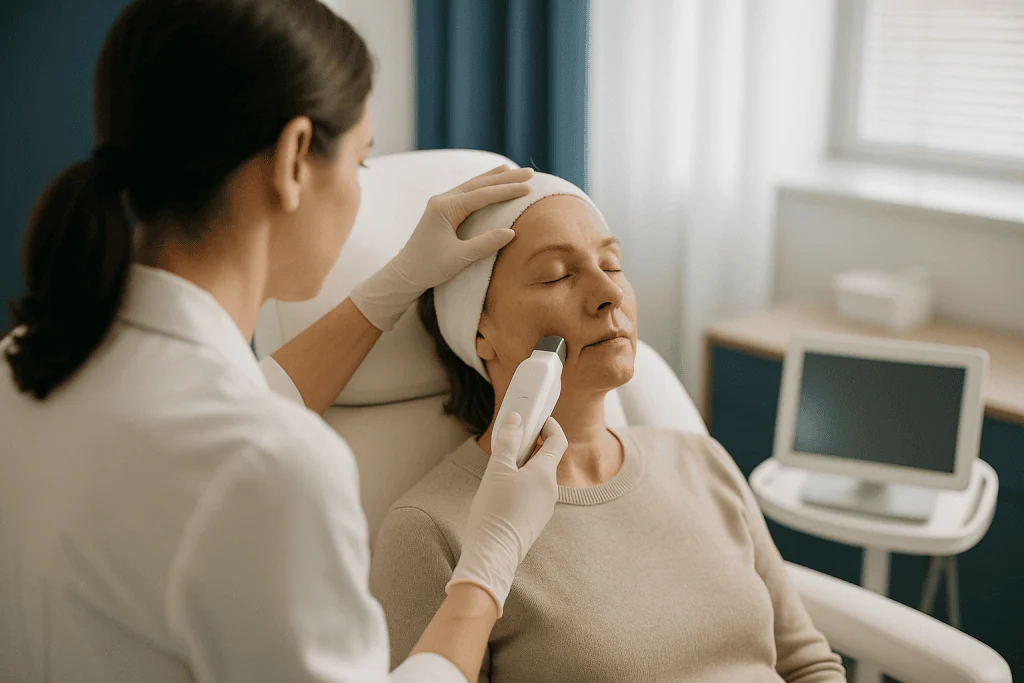
First, the periorbital story. Videos of eyelid treatment travel well because the area is hard to treat by other means and results, when they appear, are visible in a selfie. Second, ophthalmology. Small published studies on using the same heated-tip principle for meibomian gland dysfunction, a common cause of dry eye in which the oil glands along the eyelid margin become blocked, have brought the name into eye-clinic conversations and onto dry-eye forums. Third, the published literature has quietly accumulated. A PubMed search for the device now returns dozens of papers, including split-face comparisons and small randomized trials on wrinkles, acne scars and drug delivery, whereas a search in 2016 returned a handful of case series.
Regulatory status should be stated plainly. The device carries a CE mark in Europe, meaning it meets European safety requirements for its labeled indications, and has clearance in a number of other markets for skin resurfacing. Its use for dry eye is not a cosmetic add-on you should expect at every clinic; in many countries that application is investigational or off-label, and the decision about whether it is appropriate belongs to an eye specialist.
One more recent change is in how mainstream sources talk about resurfacing generally. Patient-facing guidance from institutions such as the Mayo Clinic and Cleveland Clinic on laser resurfacing and microneedling has become more explicit about downtime, pigment risk in deeper skin tones, and the need to see a trained clinician rather than a spa technician. Those pages do not mention Tixel by name, but they set the standard against which any newer resurfacing technology should be measured: what does it improve, how long does recovery take, and who is at risk of a bad outcome. Keep those three questions in mind as the evidence is laid out below.
What does Tixel do for your skin?
The honest one-sentence answer is: it triggers the same collagen-remodeling response as other fractional resurfacing methods, at a depth and intensity the clinician chooses, using heat delivered by touch.
The concerns most often treated, and the ones most often studied, are fine lines and crepey texture around the eyes and mouth, mild to moderate acne scarring, uneven texture on the cheeks, and photodamage on the neck and chest. Some clinics also use it on the eyelid itself to tighten loose upper-lid skin, and on stretch marks, though the published data there is thin.
Mechanistically, three things happen after a session. Within hours the treated columns form tiny brown micro-crusts, which flake off over three to seven days. Over the following weeks fibroblasts, the cells that manufacture collagen, migrate into the healed columns and deposit new fibers. Over two to three months that new collagen matures and the skin’s surface becomes smoother and slightly firmer. Nothing is removed in the way a deep chemical peel or fully ablative laser strips the surface; the change comes from remodeling beneath it.
Two consequences follow from that. Improvement is gradual rather than instant, and the studies that exist report modest percentage reductions in wrinkle scores rather than transformations. A typical published result is a one-point improvement on a five-point wrinkle scale after two or three sessions, judged by blinded assessors. That is meaningful but not the “ten years younger” of the caption.
The other thing Tixel does, and it is the one that interests researchers most, is open transient channels through the skin barrier. Small trials have used those channels to deliver topical anesthetics, anti-scarring agents and vitamin preparations more effectively than applying them to intact skin. This is not something to try at home with over-the-counter products; the choice of what, if anything, goes on the skin afterward is a medical decision, because a compromised barrier absorbs both the useful and the irritating.
Is Tixel good for under eyes? What tixel for under eyes can and cannot fix
This is the question behind most of the current search traffic, so it deserves precision. The under-eye area has several separate problems that people lump together, and Tixel is relevant to only some of them.
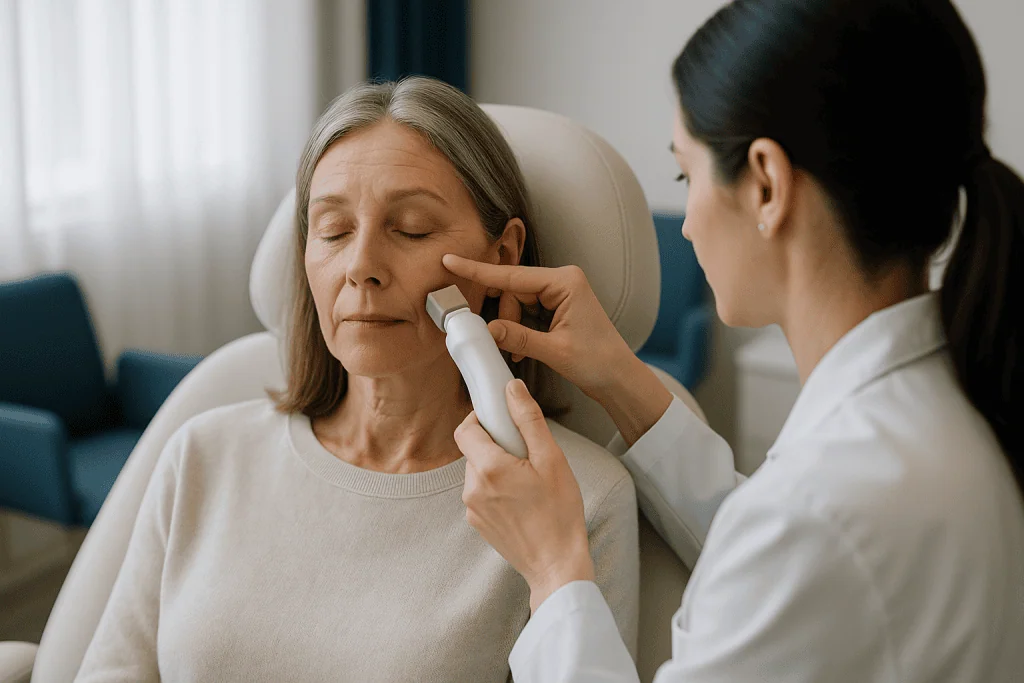
- Fine, crepey lines and loose thin skin: this is the strongest use case. Published split-face and small prospective studies of periorbital wrinkles report visible smoothing after two to three sessions, with redness lasting about two days and no reported eye injuries because no light is emitted.
- Dark circles from pigment: heat-based resurfacing can help superficial pigment slightly, but circles caused by melanin deposition respond unpredictably, and in darker skin tones heat can worsen pigment. Evidence is anecdotal.
- Dark circles from shadowing or thin skin over blood vessels: resurfacing may thicken the skin marginally over time, but the effect is small and slow.
- Puffiness and fat pads: no resurfacing device treats herniated fat. That is a surgical or, at minimum, an anatomical conversation.
- Hollowing from volume loss: also not a resurfacing problem.
Why is the eyelid attractive territory for this device specifically? Two reasons. Fractional lasers around the eye require intraocular metal shields placed under the eyelid, which many patients dislike and many clinicians reserve for aggressive treatments. Microneedling on eyelid skin, which is under a millimeter thick in places, carries a real risk of bruising and of needles reaching structures you do not want reached. A blunt-tipped heated plate with a controlled protrusion depth sidesteps both issues.
The caveat is that the eyelid is unforgiving of over-treatment. Excess heat can cause prolonged swelling, and there are case reports in the wider resurfacing literature of eyelid retraction after aggressive ablation. The published Tixel eyelid studies used conservative settings and reported no such events, but they were small, typically 20 to 40 participants. “Good for under eyes” is a fair summary for crepey texture in experienced hands; it is not a fix for every under-eye complaint.
Tixel vs microneedling: what actually differs?
People compare these two because both leave a grid of tiny marks and both have shorter downtime than ablative laser. The similarity is superficial.
Microneedling uses fine solid needles, usually between 0.5 and 2.5 millimeters long, to puncture the skin thousands of times. The injury is purely mechanical: a physical wound that bleeds slightly, triggering platelet activation and a wound-healing cascade. Cleveland Clinic describes the typical course as pinpoint bleeding, redness for a few days and gradual collagen improvement over several sessions. There is no heat unless the device is a radiofrequency microneedling system, which pairs needles with electrical energy delivered at the needle tip.
Tixel’s injury is thermal. The pyramid tips do not puncture; they press and heat. There is no bleeding, which matters for two groups: people on blood-thinning medicines, whose clinician may be more comfortable with a non-bleeding technique, and people prone to bruising around the eyes. Heat also does something puncture alone does not: it causes immediate collagen contraction in the coagulated columns, which some clinicians believe gives a small early tightening effect. Whether that translates into better long-term results than needling is unproven; no adequately powered head-to-head trial exists.
Depth control is different too. A microneedle penetrates to its full length unless the operator adjusts it; a heated tip’s effective depth depends on both protrusion and contact time, giving the clinician two dials rather than one. In practice this makes Tixel easier to keep superficial on thin skin and harder to push very deep, which is why microneedling remains more common for deep ice-pick acne scars.
Where the two converge is in the middle ground: mild acne scarring, texture, and enlarged pores on the cheeks. Here small studies of each show similar modest gains, and the choice often comes down to the clinician’s experience, the patient’s tolerance for pinpoint bleeding, and skin tone. Microneedling without heat has a long safety record in darker skin because it does not heat melanin; Tixel’s heat is not pigment-selective, and early reports suggest a low but not zero rate of post-inflammatory darkening.
How Tixel compares with fractional laser resurfacing
Fractional lasers come in two families, and the comparison changes depending on which one you mean.
Ablative fractional lasers, most often carbon dioxide or erbium, vaporize columns of tissue with light. They produce the most dramatic collagen response and the longest recovery; the Mayo Clinic describes a week or more of raw, oozing skin followed by redness that can persist for months after fully ablative treatment, and several days after fractional ablative work. Pigment changes and, rarely, scarring are recognized risks, and the risk of darkening is higher in deeper skin tones because laser energy is absorbed by melanin.
Non-ablative fractional lasers heat columns beneath an intact surface using wavelengths absorbed by water. Recovery is shorter, results are gentler, and several sessions are the norm.
Tixel sits between the two, and this is its most defensible claim. Histology studies, in which treated skin is biopsied and examined under a microscope, show that at longer contact times it produces coagulation columns comparable in depth to a fractional carbon dioxide laser on moderate settings, yet clinical recovery in published series runs two to four days of redness rather than a week. The explanation offered is that heat conduction leaves less carbonized debris than vaporization, and the surface, while injured, is not opened as widely.
Three practical differences follow. Eye safety: laser requires protective eyewear for everyone in the room and shields for periorbital work; a heated tip requires neither. Pigment: laser energy is absorbed selectively by melanin and water; conductive heat is not, which in theory reduces the chance of uneven pigment absorption, though heat itself can still provoke post-inflammatory hyperpigmentation. Consistency: laser output is measured in joules and is highly reproducible; conductive heat transfer depends on tip temperature, contact time, skin hydration and how firmly the handpiece is applied, so operator technique carries more weight.
What laser still does better is depth and power for severe photodamage and deep scars. If the goal is a single aggressive session on badly sun-damaged cheeks, ablative laser has decades of evidence; Tixel has small series. If the goal is periorbital texture with a return to work in two days, the newer device has a genuine argument.
Tixel vs laser vs microneedling: a side-by-side summary table
The table below distills the practical differences. Figures for recovery are typical ranges reported in patient-information pages from the Mayo Clinic and Cleveland Clinic for laser and microneedling, and in small published studies for Tixel; individual experience varies with settings and skin type.
| Feature | Tixel (thermo-mechanical) | Ablative fractional laser | Non-ablative fractional laser | Microneedling |
|---|---|---|---|---|
| Energy source | Heated titanium tip, conduction | Laser light, vaporization | Laser light, heating below surface | Mechanical needles |
| Skin punctured? | No, pressed and heated | Surface vaporized in columns | No | Yes, thousands of punctures |
| Bleeding | None | Oozing common | None | Pinpoint bleeding |
| Typical redness | About 2 to 4 days | About 1 to 2 weeks, pink for longer | About 1 to 3 days | About 2 to 4 days |
| Eye protection required | Not required | Goggles plus eye shields near eyes | Goggles plus shields near eyes | Not required |
| Use on eyelids | Studied, with conservative settings | Possible with shields, higher risk | Limited | Generally avoided on lid skin |
| Pigment risk in darker skin | Low to moderate, limited data | Higher | Moderate | Low |
| Depth of published evidence | Small trials and case series | Extensive, decades | Extensive | Moderate, many small trials |
| Sessions typically discussed | 2 to 4 | 1 to 2 | 3 to 5 | 3 to 6 |
Two readings of this table are worth drawing out. Row by row, Tixel looks like a compromise: the downtime profile of non-ablative approaches with a depth closer to ablative ones. Column by column, the evidence row is the sobering one. Laser resurfacing is backed by decades of randomized and observational data; the thermo-mechanical device has a few dozen small studies. A treatment can be genuinely promising and still under-studied, and both statements are true here. Session counts are ranges clinicians commonly discuss, not prescriptions; the right number for any person is set by the treating clinician after examining the skin.
What the evidence actually says about tixel, graded
Grading evidence means asking how the study was designed, how many people it included, and who judged the result. Applying that lens to the published literature indexed in PubMed:
Randomized or split-face controlled trials. A small number exist. Split-face designs treat one side of the face with one method and the other with a comparator, using the person as their own control. Trials of this type have compared Tixel with fractional carbon dioxide laser for periorbital wrinkles and with microneedling or laser for acne scars, generally in 20 to 40 participants, with blinded photographic assessment. They mostly report similar efficacy with shorter downtime and less pain for the heated-tip device. Grade: moderate for short-term texture outcomes, weak for durability beyond six months because follow-up was short.
Prospective observational series. The bulk of the literature. Groups of 10 to 60 people treated and photographed before and after, sometimes scored by independent raters. These consistently show modest improvement in wrinkle and scar scales and low complication rates. Grade: weak to moderate; without a control arm, expectation and photography can inflate results.
Histology and mechanism studies. Biopsies of treated skin demonstrating coagulation columns and later collagen deposition. These are convincing on mechanism but say nothing about how the skin looks to the person in the mirror. Grade: strong for mechanism, not applicable to outcomes.
Drug-delivery studies. Several small randomized trials show that topical agents applied after treatment penetrate more effectively and, in scar studies, improve outcomes over the device alone. Grade: moderate for penetration, weak for clinical benefit.
Dry eye studies. A handful of small, mostly uncontrolled series in ophthalmology journals report improved gland function and symptom scores. Grade: weak; investigational.
What is missing is easy to state: no large multicenter randomized trial, no study with several years of follow-up, no robust data in the darkest skin phototypes, and no independent safety registry. Expert opinion among dermatologists who use the device is favorable, but expert opinion sits at the bottom of any evidence hierarchy. The fair summary is that Tixel probably works about as well as comparable fractional treatments for mild to moderate concerns, with a real downtime advantage, and that the certainty around that statement is lower than the marketing implies.
What a tixel treatment feels like and how long recovery takes
A session begins the way most resurfacing appointments do: cleansed skin, photographs, and a discussion of settings. Many clinicians apply a topical numbing cream beforehand for deeper settings; for superficial eyelid work some skip it, because the contact time is so short that each touch feels like a quick, hot snap rather than a sustained burn. Patients in published series rated pain around three to five on a ten-point scale without anesthesia, lower than fractional carbon dioxide laser at comparable depth.
The handpiece is applied in overlapping squares across the treatment zone. A full face takes roughly 20 to 30 minutes; the eyelids alone, a few minutes each. There is a faint smell of heated tissue, similar to laser but less pronounced, and no smoke plume requiring an evacuator.
Immediately afterward the skin is red and feels like a sunburn, tight and warm. Cooling and a bland occlusive ointment are usual. By the next morning the grid of tiny brown dots is visible; these are the micro-crusts over each coagulated column, and they are the reason people say the skin looks like it has “sandpaper freckles” for a few days. They must be allowed to fall off on their own; picking them is the commonest cause of prolonged marks.
Redness generally settles over two to four days on the face and can linger a little longer on the neck and chest, where skin heals more slowly. Makeup is usually permitted once the crusts have shed. Strict sun avoidance and daily broad-spectrum sunscreen are non-negotiable for several weeks, because freshly remodeled skin darkens easily; this is standard advice across all resurfacing, echoed on Mayo Clinic and NHS cosmetic-procedure guidance.
Results follow the collagen timeline: a little glow at two weeks from surface renewal, and the real textural change emerging over eight to twelve weeks. Sessions, when more than one is planned, are typically spaced about a month apart to let each remodeling cycle finish. How many sessions, at what settings, on which areas, and whether any topical is applied afterward are decisions for the treating clinician, not a menu to choose from.
Tixel side effects: what is common, what is rare, who should be cautious
Every resurfacing method injures skin on purpose, so side effects are a matter of degree and duration rather than presence or absence.
Expected and short-lived. Redness, warmth, swelling that is most noticeable around the eyes on the first two mornings, dryness, tightness, and the grid of micro-crusts described above. Itching during the flaking phase is common. These resolve within a week for most people in published series.
Less common. Prolonged redness lasting weeks, especially in fair skin with a tendency to flush. Post-inflammatory hyperpigmentation, the temporary darkening of treated skin as it heals, reported in a small percentage of participants and more likely in medium to deep skin tones and after sun exposure. Acne or milia flares in the weeks after, as follicles react to occlusive aftercare. Reactivation of cold sores around the mouth in people with a history of herpes simplex; clinicians often address this preventively before perioral treatment, and that is a prescribing decision for them.
Rare but reported in the broader resurfacing literature. Infection of the healing surface, hypopigmentation or lightening that can be persistent, and scarring, usually after aggressive settings, overlapping passes or wound infection. The published Tixel series are too small to estimate how rare these truly are; absence of a complication in a 30-person study does not mean the risk is zero.
Groups for whom extra caution applies, based on general resurfacing guidance from the Mayo Clinic and Cleveland Clinic: people who have taken oral isotretinoin recently, those with active skin infection or inflammatory conditions such as eczema or psoriasis in the treatment area, anyone with a history of keloid or hypertrophic scarring, people who are pregnant, those with poorly controlled diabetes or immunosuppression that slows healing, and people with recent significant sun exposure or a tan. A history of eyelid surgery or eye conditions such as glaucoma warrants specific discussion before any periorbital work.
Skin tone deserves its own line. The pigment-independent mechanism is a theoretical advantage over laser, but heat provokes melanocytes regardless of how it arrives. Anyone with deeper skin should expect a clinician experienced in treating their skin type to start conservatively, possibly with a test patch, and to build in longer intervals between sessions.
Tixel for dry eye and meibomian gland dysfunction: what is established and what is investigational
Meibomian gland dysfunction is a condition in which the small oil glands lining the eyelid margin become blocked or produce poor-quality oil, so the tear film evaporates too quickly and the eye feels gritty, tired and irritated. The Mayo Clinic lists it among the most common causes of dry eye. Established management, per Mayo Clinic and NHS guidance, centers on warm compresses, eyelid hygiene, lubricating drops, and, where a clinician judges it appropriate, prescription anti-inflammatory drops or in-office procedures that heat and express the glands.
The thermo-mechanical idea is that brief conducted heat applied to the outer eyelid skin, near the gland openings, may liquefy stagnant oil and reduce inflammation in a way similar to other in-office thermal treatments. A small number of studies in ophthalmology journals, mostly uncontrolled and involving a few dozen participants followed for weeks to a few months, report improvements in symptom questionnaires, tear-film break-up time and gland expressibility after a short series of sessions.
Read that paragraph carefully for what it does not say. There is no large randomized trial comparing the approach to sham treatment or to established therapy. Follow-up is short. Outcome measures such as symptom scores are susceptible to placebo effects, which are well documented in dry-eye research. Evidence grade: weak, expert opinion plus small observational data.
Regulatory status for this use varies by country; in many places it is off-label or investigational, meaning the device is being used for a purpose beyond its cleared indication, under the responsibility of the treating clinician. That is not unusual in medicine and it is not the same as unsafe, but it does mean the decision belongs to an eye specialist who has examined the eyelids, ruled out other causes, and discussed alternatives with the person in front of them. Anyone with dry eye symptoms who is considering it should have that conversation with an ophthalmologist or optometrist first, not with a cosmetic clinic. Dry eye is also occasionally a sign of an underlying condition, from thyroid disease to autoimmune disorders, that needs its own assessment.
Common myths about Tixel, including the one about it being a website
“Is Tixel a trustworthy site?” The most searched question has nothing to do with skin. An online ticket-resale platform shares the name. The skin device is a medical instrument used in clinics; you cannot buy a session on a ticketing site, and reviews of that platform tell you nothing about resurfacing. If you are researching the treatment, add the word “skin” or “dermatology” to your search.
“It’s laser without the laser, so it’s completely safe.” No light does not mean no injury. A 400-degree tip creates real thermal wounds. Over-treatment, sun exposure and poor aftercare cause the same pigment problems and, rarely, scarring seen with any resurfacing. Safety comes from settings and skill, not from the energy source.
“Results are instant.” Any glow at one week is surface renewal and mild swelling. Collagen remodeling takes eight to twelve weeks, and studies assess outcomes at three months for that reason. Before-and-after clips filmed days apart are showing you swelling.
“It replaces eyelid surgery.” It tightens crepey skin modestly. It does not remove fat pads, lift a heavy brow or correct significant excess skin. Small studies show a point or so of improvement on wrinkle scales, not a surgical result.
“It’s proven better than laser.” A few small split-face studies show comparable efficacy with less downtime. “Comparable with less downtime in small trials” is a real advantage, but it is not “proven superior,” and no large trial exists.
“Anyone can do it, so a spa is fine.” Because there is no laser licensing requirement in some places, the device can end up in less regulated hands. The NHS cosmetic-procedures guidance is blunt on this point for all skin treatments: check who is treating you, what training they have, and what happens if something goes wrong. Thin eyelid skin is the last place to economize on expertise.
“It cures dry eye.” Small, short, uncontrolled studies report symptom improvement in meibomian gland dysfunction. Nothing in that sentence supports the word “cure.”
Who is a reasonable candidate, and what to ask at a consultation
The person who tends to do well in published series is someone with mild to moderate concerns, realistic expectations, skin that is not tanned, and the willingness to follow aftercare for several weeks. Typical examples: fine lines and crepey texture around the eyes in someone who does not want the shields and week-long recovery of ablative laser; shallow rolling acne scars on the cheeks; sun-related texture change on the neck or chest where slower healing makes aggressive laser risky.
Less suitable, or needing a different plan first: deep ice-pick scars, significant skin laxity, dark circles driven by pigment or hollowing, active acne or eczema in the treatment zone, recent isotretinoin, a history of abnormal scarring, or an upcoming beach holiday.
Questions worth taking into the room:
- What specifically do you expect this to improve on my face, and what will it not change?
- Have you treated my skin tone with this device, and how do you adjust settings for it?
- How many sessions do you anticipate, and how will we decide whether to continue?
- What is your plan if I develop prolonged redness or darkening?
- Who do I contact after hours if something looks wrong?
- Will anything be applied to my skin after treatment, and why?
- What is the alternative you would suggest if you did not have this device?
That last question is revealing. A clinician who owns one tool tends to recommend it. A clinician who can explain why microneedling, a non-ablative laser or simply better sun protection might serve you equally well is giving you a comparison rather than a pitch.
Notice what is absent from this list: device settings, contact times, number of passes. Those are clinical decisions, set by the person treating you based on examination, and the published ranges vary widely by indication. A consultation is where those choices are made and explained, and any clinician unwilling to explain them is telling you something.
When to see a doctor after Tixel or any resurfacing treatment
Most people need nothing more than the aftercare sheet they leave with. A minority develop problems that improve with prompt attention and worsen without it. Contact the treating clinician, or seek urgent medical care if they are unreachable, for any of the following.
Red flags in the first two weeks:
- Increasing rather than decreasing pain, swelling or redness after day two, or redness spreading beyond the treated area, which can signal infection.
- Yellow or green discharge, honey-colored crusting, or a foul smell from the skin.
- Clusters of small painful blisters, especially around the mouth or eyes, which may indicate a cold-sore virus flare; this can be serious near the eye and needs same-day assessment.
- Fever, chills or feeling generally unwell.
- Any change in vision, eye pain, a gritty sensation that does not settle, sensitivity to light, or difficulty closing the eyelid fully after periorbital treatment.
- Marked asymmetry of the eyelids or a pulled-down lower lid.
Reasons to book a review in the following weeks and months:
- Darkened patches that are still deepening after a month despite sun avoidance.
- Pale or white patches emerging in treated areas.
- Raised, thickened or itchy areas that could be developing into scars.
- Redness persisting beyond six weeks, or a new persistent flush.
- Texture that looks worse at three months than before treatment.
A separate note for anyone who came to this topic through dry eye. Eye discomfort, redness, discharge or blurred vision that is new or worsening deserves assessment by an eye professional regardless of any cosmetic plan, because those symptoms overlap with infections and inflammatory conditions that need their own treatment. Never adjust or stop any prescribed eye drops or other medicine on the basis of a cosmetic consultation; that decision rests with the clinician who prescribed them.
Finally, if you have an existing skin condition, take medicines that affect healing or bleeding, or have any eye disease, the right time to see a doctor is before the appointment, not after. A dermatologist or ophthalmologist can tell you whether a heat-based treatment is reasonable for you at all.
An editor's view: what matters most when weighing tixel against the alternatives
Having read the literature and watched a great many clips, here is the opinion this magazine is prepared to stand behind.
The downtime claim is real. Two to four days of redness for a treatment that reaches a depth comparable to a moderate fractional laser is a genuine clinical advance, and for the eyelids, where laser is awkward and needles are unwise, it fills a gap that was previously filled mostly by doing nothing. That is the strongest argument for the device and it is grounded in histology and consistent small studies.
The efficacy claim is modest and should be sold as modest. A point on a wrinkle scale, a smoother texture in a blinded photograph, a slightly firmer lid: these are the outcomes the data support. Anyone promised more is being sold a video, not a study.
The evidence gap is the part that should shape decisions. Dozens of small studies are not the same as one large one, and the absence of long-term follow-up means nobody can yet say how durable results are or how often late pigment problems appear in deeper skin. That does not make the treatment reckless; it makes it a treatment to approach with a clinician who talks about uncertainty honestly.
Skill matters more than the machine. Conductive heat is operator-dependent in a way laser energy is not; pressure, hydration and overlap all change the dose the skin receives. The same device produces a subtle improvement in one pair of hands and a month of swelling in another. Credentials, experience with your skin tone and a clear complication plan are worth more than any technology comparison.
And the cheapest, best-evidenced resurfacing intervention remains daily sunscreen. Every patient-information page from the Mayo Clinic to the NHS says the same thing about protecting remodeled skin, and the same physics protects skin that has never been treated at all. If a new device is the reason someone finally starts wearing it, that alone may be its most reliable benefit.
Frequently asked questions
What does Tixel do for your skin?
Tixel creates a grid of tiny controlled heat injuries in the skin, which the body repairs by producing new collagen over the following two to three months. Small studies report smoother texture, softer fine lines around the eyes and mouth, and modest improvement in shallow acne scars. It does not remove fat, lift heavy tissue or replace surgery, and results build gradually rather than appearing overnight.
Is Tixel a trustworthy site?
That question usually refers to an unrelated online ticket-resale platform that shares the name; it has no connection to the skin-resurfacing device discussed here. If you are researching the cosmetic treatment, search with the words skin or dermatology added. Trust in the treatment itself depends on the clinician’s training, experience with your skin type and willingness to explain both the evidence and the risks.
How much is Tixel for eyes, in terms of time and sessions?
This magazine does not publish prices, which vary widely by region and clinic. In terms of commitment, published eyelid studies typically involved two to three sessions spaced about a month apart, each taking a few minutes per eye, with around two days of redness and swelling afterward. The number of sessions appropriate for any individual is decided by the treating clinician after examining the skin.
Is Tixel good for under eyes?
For fine, crepey lines and thin loose skin under the eyes, small studies show modest smoothing, and the absence of laser light makes the area easier to treat safely than with fractional laser. It is not effective for puffiness from fat pads, hollowing from volume loss, or dark circles caused mainly by pigment, which respond unpredictably and can worsen with heat in darker skin tones.
Tixel vs microneedling: which is better for acne scars?
Neither has been shown superior in a large trial. Microneedling punctures skin mechanically and has more data for deep ice-pick scars, while Tixel delivers heat without bleeding and may suit shallow rolling scars and people who bruise easily or take blood thinners. Small comparative studies show similar modest gains. The choice depends on scar type, skin tone and the clinician’s experience with each method.
What are the most common tixel side effects?
Redness, warmth, swelling that peaks on the first two mornings, and a grid of tiny brown micro-crusts that flake off within about a week are expected. Less common effects include prolonged redness, temporary darkening of treated skin, acne flares and cold-sore reactivation. Rare complications reported across resurfacing generally include infection, lightening of skin and scarring, usually after aggressive settings or poor aftercare.
How long does a tixel treatment take to show results?
Surface renewal gives a slight glow within one to two weeks, but that is partly swelling. The collagen remodeling responsible for real textural change takes eight to twelve weeks, which is why studies assess outcomes at about three months. Published series describe gradual improvement over a short course of sessions rather than a dramatic change after one visit.
Is Tixel safe for dark skin?
Its heat is delivered by contact rather than absorbed by pigment, which is a theoretical advantage over laser, but heat itself can provoke post-inflammatory hyperpigmentation in medium and deep skin tones. Published data in the darkest skin phototypes is limited. Clinicians experienced with darker skin generally start with conservative settings, may perform a test patch, and insist on strict sun protection afterward.
Can Tixel treat dry eye?
A few small, mostly uncontrolled studies report improved symptoms and gland function in meibomian gland dysfunction after heated-tip treatment of the eyelid skin. The evidence is weak, follow-up is short, and the use is investigational or off-label in many countries. Anyone with dry eye should be assessed by an ophthalmologist or optometrist, who decides whether it is appropriate alongside established treatments.
Who should not have Tixel?
General resurfacing guidance advises caution or avoidance for people with active skin infection, eczema or psoriasis in the area, recent oral isotretinoin, a history of keloid scarring, pregnancy, uncontrolled diabetes or immunosuppression, a current tan, or certain eye conditions when treating the eyelids. A dermatologist or, for periorbital work, an eye specialist should review your history before any session.
References
- Cleveland Clinic: Microneedling: procedure, benefits and risks
- Cleveland Clinic: Laser skin resurfacing
- NHS: Cosmetic procedures: things to consider and choosing a practitioner
- PubMed (NIH): Published studies on thermo-mechanical fractional injury (Tixel)
This article is for general information only and is not a substitute for professional medical advice. Please consult a qualified doctor about your individual situation.

More from the Blog

Scar Treatment Results: What Realistic Improvement Looks Like and Why Sessions Repeat
Realistic scar treatment results mean a scar that is flatter, softer, paler and less noticeable, not a scar that vanishes. Scar tissue is permanent,…

Neck Lift Recovery Time: Healing Stages, Scars and Results That Settle
Most people look socially presentable about two to three weeks after a neck lift, once visible bruising fades and swelling starts to settle. Full…
How to Prepare for Microneedling: Sun, Retinoids and the Two Weeks Before Your Session
Preparing for microneedling usually means keeping the skin out of strong sun and free of sunburn or tan for the two weeks beforehand, pausing…
IPL Photorejuvenation Results: Why Spots Darken Before They Fade and How Sessions Build
IPL photorejuvenation results usually appear gradually. Treated brown spots often turn darker and coffee-ground-like for several days before flaking away over one to two…

Surface Reconstruction Recovery: Early Supervised Walking, Physical Therapy and Milestones
Surface reconstruction recovery after ocular surface surgery usually unfolds in stages: the corneal surface layer re-covers over days, comfort and light sensitivity settle over…

Before Aesthetic Filling: Blood Thinners, Alcohol and Supplements Your Doctor Will Review
Before dermal fillers, clinicians typically review anything that increases bruising or bleeding: prescribed anticoagulants and antiplatelet drugs, over-the-counter anti-inflammatory painkillers, supplements such as fish…