

RF Microneedling vs Traditional Microneedling: What the Added Heat Changes for Scars
Key Takeaways
- Both procedures create thousands of controlled micro-injuries in the dermis, but only RF microneedling delivers radiofrequency heat through the needle tips, which contracts existing collagen and widens the treated zone around each needle.
- Rolling and deeper boxcar acne scars have the clearest rationale for the added heat; narrow ice-pick scars often sit below the reach of either method and are usually handled with different techniques.
- Small comparative trials suggest a modest advantage for RF microneedling on scar scores, but they are limited in size and blinding, so the evidence supports a probable extra benefit rather than proven superiority.
- Visible redness after traditional microneedling typically settles over one to three days, while RF treatment commonly adds swelling and a few extra days of recovery; the collagen response underneath continues for months with both.
- Traditional microneedling has a low rate of post-inflammatory hyperpigmentation across skin tones because the epidermis is pierced rather than removed or heated, which is why it remains a first-line option for many people with deeper skin.
- Raised keloid or hypertrophic scars are a reason to avoid needling of any kind, since provoking more collagen can enlarge them, and active infection, cold sores or acne in the treatment area are standard reasons to postpone.
RF microneedling and traditional microneedling both create controlled micro-injuries that prompt the skin to rebuild collagen. RF microneedling adds radiofrequency heat through the needle tips into deeper skin, which may tighten tissue and reach more of a scar's base. Both can improve indented acne scars; direct comparison studies are limited, downtime differs, and the right choice depends on scar type, skin tone and a clinician's assessment.
The mirror in a dermatology consultation room is unforgiving in a specific way: overhead light, no filter, and a clinician tilting your chin toward the window so the shadows fall into every indent. That is usually the moment someone asks the question this article answers. They have read about rf microneedling vs microneedling, seen two very different price tiers on a menu they were handed at reception, and want to know whether the heat is worth the extra downtime, or whether it is marketing wrapped around the same needle.
It is a fair question, and the honest answer is more textured than the comparison charts suggest. The two procedures share a foundation. They part ways in what happens at the needle tip, how deep that effect reaches, and which scar shapes are most likely to respond.
What follows is the version of that conversation a careful clinician would have with you: what each procedure actually does to the skin, what the published evidence does and does not show, and the questions worth bringing to your own appointment.
How does traditional microneedling actually work on a scar?
Picture the skin as two main layers. The epidermis is the thin outer sheet you can see and touch. Beneath it sits the dermis, the thicker living layer where collagen, the protein that gives skin its structure, is made by cells called fibroblasts. Most indented scars live in the dermis. That is why creams applied to the surface rarely change them.
Traditional microneedling, sometimes called collagen induction therapy, uses a device studded with fine, sterile needles that puncture the skin thousands of times in a session. Each puncture is tiny and closes within hours, but together they send a strong signal: the skin reads the micro-injuries as a wound and switches on its repair program. Growth factors are released, fibroblasts migrate to the area, and over the following weeks new collagen and elastin are laid down in a more organized pattern than the scar tissue they replace.
Needle length is the main variable a clinician adjusts. Published reviews describe lengths from a fraction of a millimeter for superficial texture up to roughly three millimeters for deeper scars, with depth matched to the area treated and the goal (Alster and Graham, PubMed). The epidermis is pierced rather than removed, which is a meaningful difference from ablative lasers and chemical peels: the surface stays largely intact, the barrier recovers quickly, and the risk of pigment change is lower.
The effect is cumulative. Most people are advised to expect a series of sessions spaced weeks apart, and clinicians commonly quote several treatments before judging the response (Cleveland Clinic). Collagen remodeling is slow biology; the skin you see at three months is not the skin you will see at six.
What is RF microneedling, in plain language?
RF stands for radiofrequency, a form of electrical energy that oscillates at the frequencies used for radio transmission. When that energy passes through living tissue, the tissue resists it slightly, and resistance produces heat. Medicine has used this principle for decades in surgical devices that seal small blood vessels.
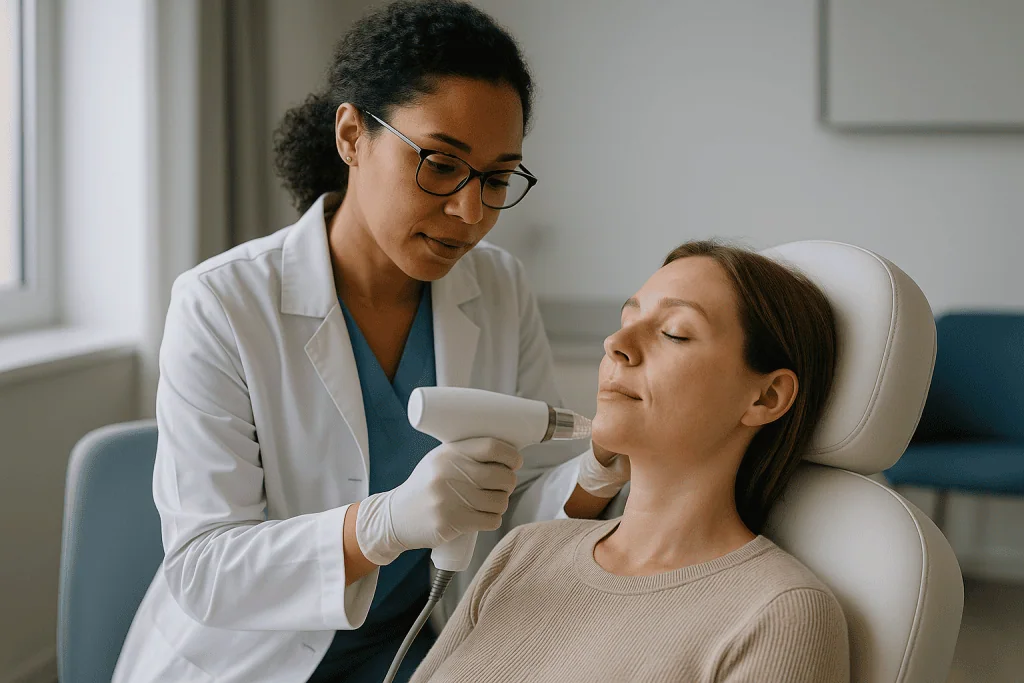
RF microneedling combines the two ideas. The needles are the same in spirit, fine and sterile, but each one acts as an electrode. Once the needles are at their set depth, a brief pulse of radiofrequency energy travels down the shaft and heats the dermis around the tip. Many devices insulate the upper part of each needle so the epidermis is spared most of the heat, with the energy released only in the deeper portion where scar collagen sits.
Why add heat at all? Collagen fibers respond to warming in two ways. In the short term they contract, which is why skin can look slightly tighter soon after treatment. In the longer term, controlled thermal injury triggers a second wave of repair on top of the mechanical wound from the needle, and the heated zone is wider than the pinprick itself. A needle alone treats a column of tissue; a needle plus heat treats a small sphere around that column.
The clinician controls three variables rather than one: needle depth, energy level and pulse duration. That flexibility is the appeal. It is also why technique matters more. Too much energy too close to the surface can injure the epidermis; too little and you have paid for a slower, more expensive version of ordinary microneedling. Neither outcome is a property of the technology so much as of how it is used.
Is RF needling the same as microneedling? Where the two diverge
People searching for a straight answer deserve one: no, they are not the same procedure, although one is built on the other. Both puncture the skin with fine needles to trigger collagen remodeling. Only RF microneedling delivers energy through those needles. Everything else that differs flows from that single fact.
The first divergence is the nature of the injury. Traditional microneedling produces a purely mechanical wound. The body repairs it the way it repairs any small cut, and the surrounding tissue is untouched. RF microneedling produces a mechanical wound plus a thermal one, so the healing response is larger and the treated volume extends beyond the needle track.
The second is what the skin surface experiences. In conventional microneedling the epidermis is pierced but not heated, and it usually recovers within a day or two. With RF, most of the heat is meant to stay below the surface, but some warmth reaches the epidermis, and swelling is more common in the first days.
The third is the range of tissue that can be influenced. Because heat spreads, RF microneedling has been studied not only for scar texture but also for mild skin laxity and for the deeper, oil-producing structures involved in acne. Traditional microneedling is primarily a texture and pigment tool. Neither replaces surgery for significant sagging, and neither is a treatment for raised scars, which are discussed later.
Finally, there is the question of who can operate the device. Regulations vary by region, but in general the addition of energy delivery places RF microneedling in a higher-risk category. In the United Kingdom, for example, health authorities advise checking a practitioner’s training and the setting for any energy-based cosmetic procedure (NHS).
RF microneedling vs microneedling: what the added heat changes for scars
Here is the part that matters most for someone weighing the two. An indented, or atrophic, acne scar is essentially a depression where the dermis lost volume and the collagen that remains is bound down in a tight, disorganized web. Improving it means loosening that web, encouraging new collagen to fill the floor, and ideally lifting the edges so the shadow softens.
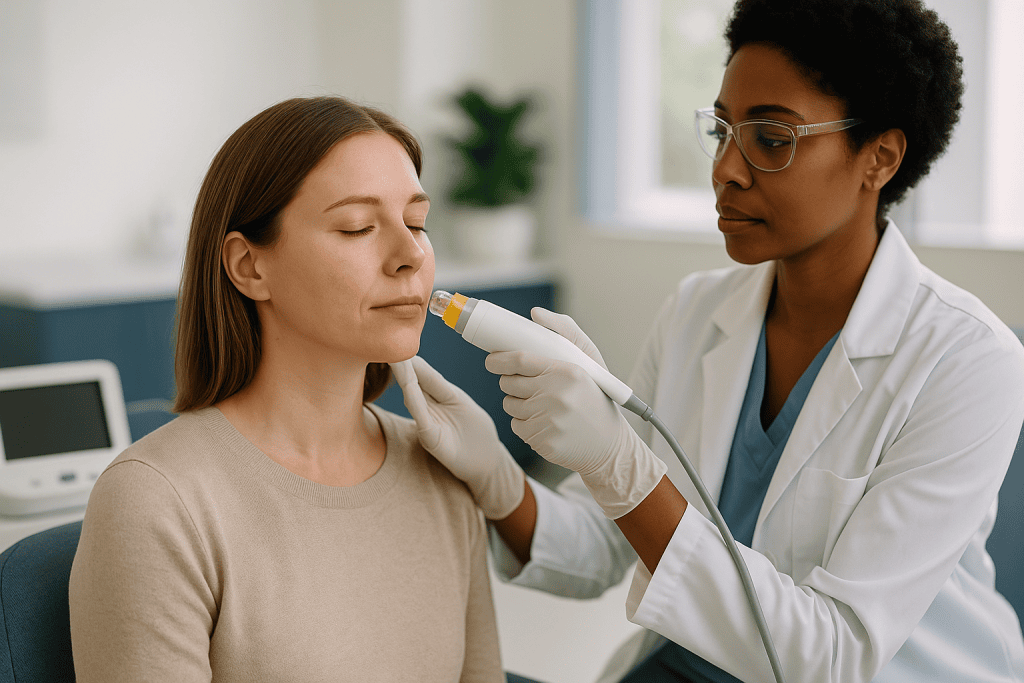
Traditional microneedling addresses the first two. The needles break up the fibrous bands mechanically and provoke fresh collagen. The change is gradual and, in the published series, most visible in shallow-to-moderate scars where the base is within reach of the needle (Alster and Graham, PubMed).
The added heat in RF microneedling changes the equation in three ways. It denatures and contracts the existing collagen around the tip, which can tighten a scar’s edges as well as its floor. It widens the zone of injury, so a scar wider than a needle track receives treatment across its base rather than at a few points. And it drives a more vigorous remodeling response, which some clinicians believe allows fewer sessions, although that is a clinical impression rather than a settled finding.
What the heat does not do is turn a deep scar into a shallow one in a single visit, nor guarantee a better result for every scar type. A narrow, very deep ice-pick scar is difficult for either method because the base sits below where needles safely reach. Broad, gently sloping rolling scars are where the volumetric effect of heat has the clearest logic.
Both approaches also share a ceiling. Published reviews describe improvement in scar appearance and texture, not disappearance, and results depend on skin quality, scar age and how many sessions are completed (Alster and Graham, PubMed). A clinician who examines the scars in raking light can usually predict which mechanism best fits what they see.
Does RF microneedling for acne scars work on every scar type?
Dermatologists sort atrophic acne scars into three shapes, and the shape predicts response more than almost anything else (Cleveland Clinic). Knowing your own mix is the single most useful piece of homework before a consultation.
- Ice-pick scars are narrow and deep, like a puncture from a fine tool. Their floor often sits deeper than microneedling of either kind can safely reach, and clinicians frequently pair them with other techniques such as punch excision or focal chemical treatments.
- Boxcar scars are round or oval with sharp vertical edges, similar to a chickenpox scar. Shallow boxcars respond reasonably to both approaches; deeper ones benefit from methods that soften the edge, and here the collagen contraction from heat has a plausible advantage.
- Rolling scars are broad, shallow depressions caused by fibrous bands tethering the skin to deeper tissue. They read as an uneven, wavy surface rather than distinct holes. Both methods can release the bands; the wider treatment volume of RF microneedling suits their breadth.
Then there is the category neither method should be used on. Hypertrophic scars are raised but stay within the original wound; keloids are raised and grow beyond it. Both represent overproduction of collagen. Deliberately injuring them to provoke more collagen risks making them worse, and keloid-prone people are routinely asked to avoid elective needling anywhere on the body (NHS). If your scars are lumpy rather than sunken, this comparison is not the right conversation, and a clinician can discuss injections or silicone-based approaches instead.
Most faces carry a mixture. A realistic plan often treats the rolling and boxcar scars with needling of some kind and handles the ice-picks separately. That layering is normal, not a sign that one method failed.
RF microneedling vs microneedling side by side
The table below summarizes the practical differences most people care about. The timelines are typical ranges drawn from clinical reviews and patient-information resources, not promises; your own healing depends on skin type, energy settings and depth.
| Feature | Traditional microneedling | RF microneedling |
|---|---|---|
| Mechanism | Mechanical micro-injury only | Mechanical micro-injury plus radiofrequency heat in the dermis |
| Zone treated | Column around each needle track | Wider sphere of tissue around each insulated needle tip |
| Scar shapes with clearest rationale | Shallow boxcar and rolling scars, surface texture | Rolling and deeper boxcar scars; mild laxity |
| Typical surface recovery | Redness resembling sunburn for roughly one to three days (Alster and Graham, PubMed) | Redness plus swelling, commonly a few days longer than needling alone |
| Sessions | Series of several treatments spaced weeks apart (Cleveland Clinic) | Series of treatments; some clinicians use fewer, though evidence is limited |
| Pigment risk in deeper skin tones | Low, because the epidermis is not removed or heated | Low to moderate depending on settings; needs experienced operator |
| Anesthesia | Topical numbing usually sufficient | Topical numbing; some settings need additional comfort measures |
| Key risks | Infection, prolonged redness, tram-track marks, pigment change | Same, plus thermal burn, grid-pattern marks, rare fat loss |
Two cautions when reading it. First, the recovery ranges describe the visible surface; the collagen response underneath continues for months with both methods, so judging results at two weeks tells you very little. Second, the differences in the risk row are differences of kind, not certainties. A well-performed RF treatment on a suitable candidate can be uneventful, and a poorly performed traditional treatment can leave marks. The device sets the range of possible outcomes; the operator and the candidate selection determine where in that range you land.
Is RF microneedling better than just microneedling? What the evidence shows
Better is the word everyone uses, and it is worth being precise about what the research can and cannot support.
For traditional microneedling, the evidence base is reasonably mature. A widely cited review in a dermatologic surgery journal summarizes multiple studies showing measurable improvement in atrophic acne scars, with a favorable safety profile across skin types and a low rate of pigment problems (Alster and Graham, PubMed). Patient-facing resources from major academic centers describe it as an established option for scars, texture and fine lines (Cleveland Clinic).
For RF microneedling, published studies also report improvement in acne scars and in skin laxity, and several small trials have compared it directly with traditional microneedling. The honest summary of those comparisons is that RF microneedling often shows a modestly larger or faster improvement in scar scores, but the trials are small, frequently unblinded, use different devices and settings, and follow patients for a limited time. That is enough to say the added heat probably does something extra for the right scars. It is not enough to say it is superior for everyone, or to quantify the difference reliably.
Three points deserve emphasis. Study populations skew toward rolling and boxcar scars, so the apparent advantage may not extend to ice-pick scars. Reported downtime and discomfort are consistently greater with RF. And much of the enthusiasm in consumer media comes from device marketing rather than from independent trials, which is a reason for calm rather than for dismissal.
If a clinician tells you the two are roughly equivalent for shallow scars and that heat earns its place mainly for broader, deeper depressions or when mild laxity accompanies the scarring, they are reflecting the evidence accurately. If anyone promises a percentage improvement, ask which study it came from.
Who is either procedure usually for, and who is usually asked to wait?
Good candidates for both procedures look similar on paper: adults with indented acne or surgical scars, realistic expectations, generally healthy skin and no active disease in the area to be treated. Beyond that, the decision is individual, and the following groups are routinely asked to postpone or to choose a different approach.
Anyone with active acne, cold sores, eczema, psoriasis or any open wound in the treatment field is asked to wait until the skin has settled. Needling through active inflammation risks spreading infection and worsening scarring. People with a history of keloids or hypertrophic scars are usually steered away entirely, for the reasons described earlier.
People taking medicines that thin the blood or suppress the immune system need a conversation with the prescriber before any elective skin procedure; nothing should be paused without that clinician’s agreement. Those who have recently completed a course of an oral retinoid for severe acne have traditionally been asked to wait several months, because of concern about impaired healing. That advice has been debated in recent literature, and the timing is a decision for the treating team rather than a fixed rule.
Pregnancy and breastfeeding are generally reasons to defer elective cosmetic procedures, mainly because safety data are lacking rather than because harm is proven (NHS). Uncontrolled diabetes, a history of poor wound healing, and certain connective tissue conditions are also flagged during screening.
For RF microneedling specifically, implanted electronic devices such as pacemakers are a contraindication for many radiofrequency systems, and metal implants in the treatment area need to be disclosed. Very recent sun exposure or a fresh tan increases pigment risk with any energy-based procedure, so clinicians often ask people to arrive with untanned skin and to stop using strong exfoliating products for a period beforehand, on their specific instructions.
What is the downside of RF microneedling? Risks in neutral terms
The search phrase people type is blunt, so the answer should be too. RF microneedling carries every risk of traditional microneedling plus a set that comes with heat.
Shared risks include temporary redness and swelling, pinpoint bleeding, dryness and flaking, and a small chance of infection if the skin is not kept clean or if equipment is not sterile. Both can produce tram-track or grid marks if needles are dragged or placed too densely, and both can trigger cold-sore outbreaks in people who carry the virus. Post-inflammatory hyperpigmentation, meaning dark patches left after the skin heals, is possible with either, though the mechanical-only approach has the lower rate (Alster and Graham, PubMed).
Heat adds three concerns. Thermal burns can occur if energy reaches the epidermis, either from settings that are too aggressive or from needles that fail to insert fully so the uninsulated portion sits near the surface. These typically heal but may leave pigment change or, rarely, small scars of their own. Persistent grid-pattern marks that follow the needle array are more visible after RF than after plain needling because each point has a heated halo. And there are case reports of fat loss beneath the skin when energy is delivered too deeply in thin areas such as the temples or under the eyes, leaving a subtle hollow.
The practical downsides are less dramatic but affect daily life: more swelling in the first days, greater discomfort during treatment, a longer wait before makeup can be applied, and a higher cost per session that is not always offset by needing fewer sessions.
None of this makes RF microneedling unsafe in experienced hands. It makes it a procedure where operator training, device settings and candidate selection carry more weight, which is exactly why the questions in a later section matter.
What do the following days and weeks usually look like?
The first evening after either procedure looks and feels like a moderate sunburn: warm, pink to red, and slightly tight. With traditional microneedling this typically fades over one to three days, and many people return to work the next day with a bare face or mineral sunscreen (Alster and Graham, PubMed). With RF microneedling the redness is joined by puffiness, particularly around the eyes and cheeks where the skin is looser, and the visible phase commonly lasts a few days longer.
Days two to five bring dryness. The micro-channels have closed, but the surface sheds fine flakes as the epidermis renews itself. Some people notice tiny dark dots at each needle site after RF treatment; these are minute crusts and should be left to fall away rather than picked. Gentle cleansing, a bland moisturizer and strict sun protection are the standard aftercare, and clinicians usually ask you to avoid active ingredients such as retinoids and acids until the skin is calm, on their instructions rather than a fixed calendar.
Around the second week the skin often looks smoother and slightly plumper. This early glow comes largely from swelling and surface renewal, not from new collagen, and it may soften before the real result arrives.
Collagen remodeling proceeds on a scale of months. Reviews describe continued improvement well beyond the last session, with the treatment course itself spread over several visits separated by weeks (Cleveland Clinic). The interval allows one repair cycle to settle before the next stimulus.
Judging the outcome means comparing standardized photographs taken before treatment and several months after the final session, in the same lighting. Bathroom mirrors, phone cameras and memory are all unreliable witnesses to a change that happens a fraction at a time.
Does skin tone change the choice between RF and traditional microneedling?
It changes it more than most comparison articles admit. The central concern for anyone with medium to deep skin tones is post-inflammatory hyperpigmentation: melanin-producing cells respond to inflammation by overproducing pigment, leaving patches darker than the surrounding skin that can outlast the original scar by months.
Traditional microneedling has a strong reputation here. Because the epidermis is pierced rather than removed or heated, the pigment cells that live at its base are spared most of the insult, and published series report low rates of pigment change across a range of skin types (Alster and Graham, PubMed). This is a large part of why the technique became a popular alternative to ablative lasers, which carry a well-documented pigment risk in darker skin.
RF microneedling occupies a middle position. Its insulated needles are designed precisely to keep heat away from the epidermis, and when that design works as intended the pigment risk stays low. The margin for error is narrower, though. If insertion depth is shallow, if energy is set high, or if the device delivers heat along the full needle length, the epidermis warms and the risk rises. The best safeguard is an operator who treats a wide range of skin tones regularly and who is willing to start conservatively, sometimes with a small test area.
Aftercare weighs more heavily too. Sun exposure in the weeks after treatment is the most common trigger for pigment change with either method, and consistent broad-spectrum sunscreen is not optional. Some clinicians pre-treat with pigment-regulating skincare before energy-based procedures; whether that is appropriate is a decision for the treating team.
A person with deep skin and shallow rolling scars may reasonably be advised that plain microneedling offers most of the benefit with the smallest pigment risk, and that heat is a second step to consider only if the response plateaus.
What people often get wrong about RF microneedling vs microneedling
The myths tend to travel in pairs, one overselling and one dismissing.
Myth: RF microneedling is just microneedling with a bigger price tag. The heat is a real physiological difference with a plausible mechanism and supporting, if limited, trial data. What is fair to say is that for shallow scars the extra effect may be small and the extra downtime is not.
Myth: more heat or deeper needles always means better results. Both have a therapeutic window. Beyond it, you trade collagen stimulation for burns, prolonged redness and pigment change. Conservative settings repeated over a series generally outperform aggressive single sessions.
Myth: the glow after one session is the result. Early smoothness is swelling and surface renewal. Collagen takes months, and the meaningful comparison is made well after the final treatment.
Myth: there is a single best type of microneedling. There is not. Rolling pens, motorized pens and RF devices suit different scar shapes, skin tones and tolerances for downtime. The question to ask is not which is best but which fits these scars on this face.
Myth: home rollers do the same job. Consumer rollers use short needles that stay in the epidermis, cannot reach scar tissue in the dermis, and are hard to keep sterile. Health authorities caution against deeper needling outside a clinical setting because of infection and scarring risk (NHS).
Myth: needling helps raised scars. Keloids and hypertrophic scars are collagen excess; provoking more collagen can enlarge them.
Myth: results are permanent. New collagen is real tissue and does not vanish, but skin continues to age and acne can leave new marks. Maintenance is a conversation, not a failure.
Questions to ask your care team before choosing
A good consultation is a two-way examination. You are assessing the clinician’s reasoning as carefully as they are assessing your skin. These questions tend to reveal both.
- Which scar types do you see on my face, and which of them do you expect each method to reach? A confident answer will name rolling, boxcar or ice-pick and explain the match.
- Why are you recommending heat, or recommending against it, for my scars specifically? The answer should refer to depth and breadth of the scars, not to the device you happen to own.
- What are the risks for my skin tone, and how do you adjust depth and energy to manage them? Ask whether a small test area is an option.
- How many sessions do you anticipate, how far apart, and at what point would you reassess rather than continue?
- What does your typical patient look like on day one, day three and day seven, and when is it realistic to return to work or wear makeup?
- Are any of my current medicines, supplements or skincare products relevant, and should any be discussed with the prescriber before we proceed? Do not stop anything on your own.
- What training and experience do you have with this specific device, and who will be operating it on the day?
- What happens if I develop a burn, an infection or pigment change? Who do I contact, and how quickly can I be seen?
- Will you take standardized photographs before and after, so we can judge the change objectively?
- What alternatives exist for the scars needling is unlikely to help, and can those be combined with this plan?
Bring the list. Write down the answers. If any response leans on superlatives or guarantees rather than mechanisms and ranges, that is information too.
When to call your doctor after RF or traditional microneedling
Most recoveries are uneventful, and mild redness, warmth, dryness and pinpoint crusting are expected. A small number of reactions are not, and the difference is usually clear if you know what to watch for.
Contact the clinician who treated you, or seek medical care, promptly if you notice any of the following:
- Redness or swelling that worsens after the first two to three days rather than easing, or that spreads beyond the treated area.
- Increasing pain, heat or firmness in the skin, or any yellow or green discharge; these can indicate infection, which needs assessment and possibly treatment.
- Blistering, weeping or a white or gray patch in the treated zone after RF microneedling, which may signal a thermal burn.
- Clusters of small painful blisters, especially around the lips, suggesting a cold-sore outbreak triggered by the procedure.
- Fever, chills or feeling generally unwell in the days after treatment.
- A rash, hives or facial swelling that could indicate an allergic reaction to a numbing cream or product applied to the skin.
- Dark or light patches appearing as the redness fades, or a persistent grid pattern that has not softened after several weeks.
Seek urgent care immediately for swelling of the lips or tongue, difficulty breathing, or a rapidly spreading area of hot, red skin with fever, since these can represent a severe allergic reaction or a serious skin infection.
Do not attempt to treat suspected infection or burns with leftover creams, home remedies or antibiotics from a previous prescription. Photograph the area in good light, note when the change began, and let the treating team decide on next steps. They know the settings used and can distinguish an expected reaction from one that needs intervention. Every decision about further sessions, changes to your skincare or any medicine belongs with them.
Frequently asked questions
Is RF microneedling better than just microneedling?
For broader or deeper indented scars and mild laxity, RF microneedling probably adds a benefit, because heat contracts collagen and treats a wider volume around each needle. For shallow scars and surface texture, the difference may be small while downtime and risk are greater. Comparative trials are few and small, so no one can honestly promise it is better for every person.
What is RF microneedling, and how is the heat delivered?
RF microneedling is microneedling in which each fine needle also acts as an electrode. Once the needles reach a set depth, a brief pulse of radiofrequency energy heats the dermis around the tip. Most devices insulate the upper needle so the surface is spared. The heat contracts existing collagen and triggers a stronger repair response than the needle puncture alone.
Is RF needling the same as microneedling?
No. They share the same foundation of fine needles creating controlled micro-injuries, but RF needling adds energy delivery through those needles into deeper skin. That single difference changes the size of the treated zone, the amount of swelling afterward, the range of possible complications and, in many regions, the level of training expected of the operator.
What are the main RF microneedling downsides?
The main downsides are more swelling and discomfort than plain microneedling, a longer visible recovery, higher cost per session and a small set of heat-specific risks: thermal burns, persistent grid-pattern marks and, rarely, fat loss under thin skin if energy is delivered too deeply. Infection, pigment change and cold-sore flares are shared with traditional microneedling.
What is the best type of microneedling for acne scars?
There is no single best type. The right choice depends on scar shape, depth, skin tone and how much downtime you can accept. Shallow rolling scars in deeper skin tones often suit traditional microneedling; broader, deeper depressions with some laxity have the clearer rationale for RF. A clinician who examines the scars in raking light can match method to anatomy.
Does RF microneedling for acne scars work on ice-pick scars?
Usually not well on its own. Ice-pick scars are narrow and very deep, and their base often sits below the depth needles can safely reach, with or without heat. Clinicians commonly combine needling of the surrounding rolling and boxcar scars with other techniques for the ice-picks, such as punch excision or focal chemical treatment. Layering approaches is normal.
How long does recovery take after RF microneedling compared with regular microneedling?
Redness after traditional microneedling typically fades over one to three days, according to published reviews. RF microneedling adds swelling and commonly extends the visible phase by a few days. Dryness and fine flaking follow in the first week with both. The collagen change that improves scars develops over months, so early smoothness is mostly swelling rather than the final result.
Is RF microneedling safe for darker skin tones?
It can be, when insulated needles keep heat away from the epidermis and settings are conservative. The margin for error is narrower than with traditional microneedling, which has a well-documented low rate of pigment change across skin types. An operator experienced with deeper skin tones, a possible test area and strict sun protection afterward are the main safeguards.
Who should not have RF or traditional microneedling?
People with active acne, cold sores, eczema or open wounds in the area are asked to wait until the skin settles. A history of keloid or hypertrophic scarring is a reason to avoid needling. Pregnancy, uncontrolled diabetes, poor wound healing and certain medicines need discussion with the prescriber. Implanted electronic devices are a specific concern for radiofrequency systems.
Can I do RF microneedling or microneedling at home?
Home rollers use short needles that stay in the outer skin layer and cannot reach scar tissue in the dermis; they are also difficult to keep sterile. Radiofrequency devices are not suitable for home use. Health authorities caution against deeper needling outside a clinical setting because of infection and scarring risk. Scar treatment belongs with a trained clinician.
References
- Cleveland Clinic: Microneedling: What It Is, Uses, Benefits and Results
- Cleveland Clinic: Acne Scars: Types, Causes and Treatment
- NHS: Acne: Complications (scarring types)
- NHS: Cosmetic procedures: things to consider
This article is for general information only and is not a substitute for professional medical advice. Please consult a qualified doctor about your individual situation.

More from the Blog
Why Skin Grafts Sometimes Fail: Pressure, Infection, Smoking and the Signs Your Team Watches
Skin grafts fail most often because something separates the graft from the wound bed before new blood vessels can grow into it: a pocket…
Caring for the Skin After Cryotherapy: Dressings, Showering and Leaving the Crust Alone
After cryotherapy, keep the treated spot clean, let any blister flatten on its own, and leave the crust in place until it separates by…

Questions to Ask Before Your First Botulinum Toxin (Botox) Treatment: Goals and Repeat Timing
Before a first botulinum toxin (Botox) treatment, ask what result is realistic for your face, who will perform the injections and their medical qualifications,…

Reconstructive Surgery Recovery: Drains, Dressings and the Weeks of Swelling Explained
Recovery after reconstructive surgery moves in stages: drains usually come out within the first one to three weeks once output falls, dressings are reduced…
Dermabrasion Risks Explained: Pigment Changes, Scarring and Infection Signs to Report
Dermabrasion risks include temporary redness and swelling, changes in skin color that can be lasting in deeper skin tones, scarring when treatment goes deep,…

Facial Reconstruction After Trauma: How Bone, Nerve and Soft-Tissue Repairs Are Sequenced
Facial trauma reconstruction surgery is sequenced by priority, not by appearance. Life-threatening problems come first: the airway, bleeding, the brain and the neck. Sight-threatening…