

Why Surgeons Ask You to Stop Smoking Before Disease Reconstruction Surgery
Key Takeaways
- Nicotine constricts the small skin vessels that a moved flap or graft depends on, and carbon monoxide from smoke displaces oxygen from red blood cells, so both effects hit the far edge of a reconstruction first.
- The WHO's review of tobacco and surgery found that quitting at least four weeks before an operation was linked to fewer complications, with each additional smoke-free week associated with roughly a 19 percent improvement in outcomes.
- MedlinePlus advises quitting four to six weeks before surgery and staying smoke-free for at least four weeks afterward, because the wound edge remains weak while collagen is being laid down.
- Carbon monoxide in the blood falls toward normal within about 12 hours of the last cigarette, so even a short smoke-free window before anesthesia improves oxygen delivery, though wound-specific gains take weeks.
- Nicotine replacement removes smoke but not nicotine, so most surgical teams treat it, and vaping, as something to disclose and usually pause around the operation rather than as equivalent to smoking.
- A flap that turns pale, dusky or cool in the first week is a same-day call to the surgical team, because early recognition of a blood-flow problem widens the options for dealing with it.
Surgeons ask patients to stop smoking before reconstructive surgery because nicotine narrows small blood vessels and carbon monoxide lowers the oxygen reaching tissue, so skin flaps and grafts moved to repair a defect may not survive. Evidence summarized by the WHO links quitting at least four weeks before an operation with fewer complications, with further gains for each additional smoke-free week. Timing and any nicotine-replacement decisions rest with the treating team.
The biopsy came back weeks ago, the skin cancer on the side of the nose has been removed, and now a second appointment is about closing the hole it left behind. The surgeon draws a small diagram of where skin will be borrowed from the cheek, then pauses and asks the question that feels like it belongs somewhere else: “Do you smoke?”
For many people that moment lands as a judgment. It isn’t. The request to stop smoking before reconstructive surgery has almost nothing to do with lifestyle lectures and everything to do with plumbing. A flap of living skin moved from one place to another survives on a handful of tiny vessels, and cigarette smoke is remarkably good at pinching them shut.
This explainer walks through what actually happens to a healing wound when smoke is in the picture, how long surgeons typically ask people to stay smoke-free, what the evidence says about patches and vapes, and how to talk about all of it honestly with your care team.
Why do surgeons ask you to stop smoking before reconstructive surgery when the disease is already treated?
Reconstruction after disease is a repair job. A cancer has been cut out of the nose, lip, scalp, jaw or breast; an infection has destroyed tissue; a chronic condition has left a wound that will not close. The reconstructive surgeon’s task is to rebuild what is missing using tissue from elsewhere on the same body, sometimes combined with an implant.
Removing the disease was the first hurdle. Reconstruction is a different kind of operation, because the tissue being moved has to stay alive in a new location before it can do anything useful. A skin graft is a thin sheet of skin lifted completely free and laid onto a raw surface, where it must grow new blood vessels from the bed beneath it. A flap is a block of skin, fat and sometimes muscle that keeps its own blood supply, either through a stalk of vessels left attached or through vessels that are cut and rejoined under a microscope elsewhere. Both are living transplants, and both are unforgiving of poor blood flow.
That is why the smoking question comes up at this stage even if nobody raised it before the cancer was removed. Excision wounds are usually closed edge to edge, with healthy tissue on both sides. Reconstruction asks tissue to survive on a narrower margin, often in a face that has already been operated on or irradiated. The MedlinePlus patient guidance on smoking and surgery frames the concern plainly: smoking makes wounds heal more slowly and raises the chance of infection and other complications, and the advice is to quit before the operation and stay smoke-free through recovery.
Surgeons are not being cautious for its own sake. A flap that fails on the nose can mean a second operation, a longer scar, a visible depression, or a delay in the very outcome the patient has been waiting for since the diagnosis.
How smoking works against a healing wound, step by step
Picture the blood supply to a patch of skin as a network of country lanes rather than highways. The vessels at the edge of a flap are among the narrowest in the body, and healing depends on oxygen, nutrients and immune cells arriving through them in steady traffic.
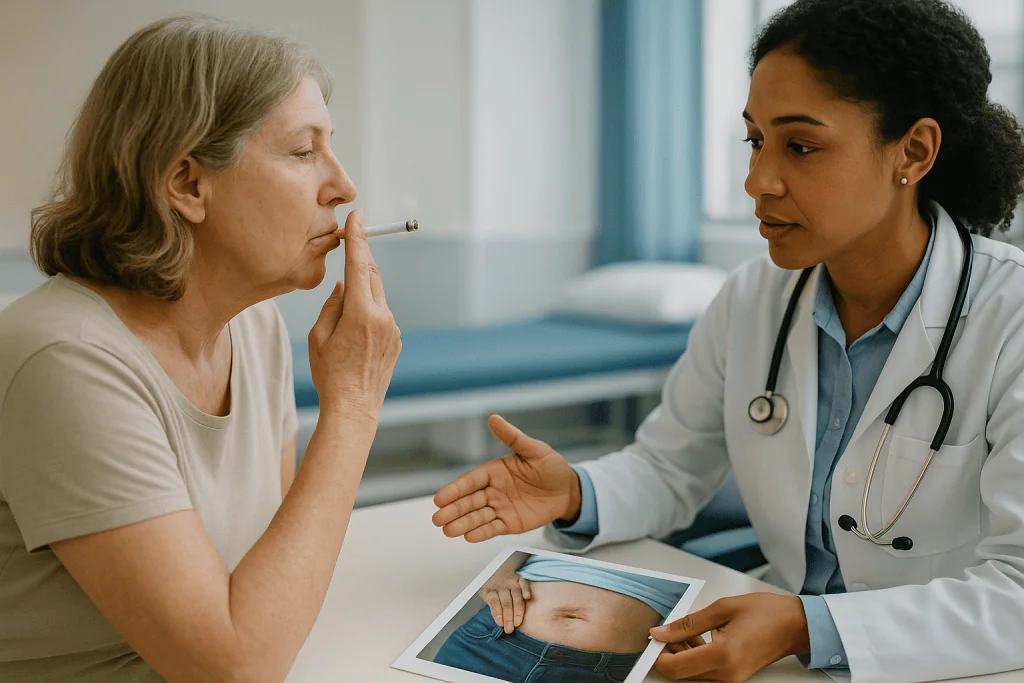
Nicotine is the first problem. It triggers the release of stress hormones that make small arteries constrict, so the lanes narrow within minutes of a cigarette and stay narrow for a while afterward. Skin temperature and measured blood flow in the fingers and face drop after smoking, which is why cold hands are so common among heavy smokers. In a freshly moved flap, that same squeeze happens right where the margin for error is smallest.
Carbon monoxide is the second. It binds to hemoglobin, the oxygen-carrying protein in red blood cells, far more tightly than oxygen does, so a portion of each red cell arrives at the wound carrying the wrong cargo. Less oxygen means the cells that lay down new collagen and build new capillaries work more slowly. The CDC notes that carbon monoxide levels in the blood begin returning toward normal within about 12 hours of the last cigarette, which is one reason even a short smoke-free window before an operation matters.
Third comes the immune effect. Smoke impairs the white blood cells that clear bacteria from a wound, so infection gains a foothold more easily. Fourth, smoking makes blood stickier and more prone to clotting inside small vessels, a particular hazard where a microsurgeon has just stitched two vessels roughly a millimeter wide back together.
None of these effects acts alone. Narrowed vessels, oxygen-poor blood, a blunted immune response and clot-prone flow stack on top of one another, and the tissue with the least reserve, the far edge of the flap, pays first.
Smoking and wound healing after surgery: what the evidence actually shows
The honest summary is that this is one of the better-established relationships in surgical medicine, and also one where the exact size of the risk depends on the type of operation, how much a person smokes, and how the study was designed.
The World Health Organization reviewed the evidence on tobacco and surgical outcomes and concluded that smokers face substantially higher rates of wound complications, infection, breathing problems and cardiac events after surgery than non-smokers. Its summary also reported that people who stopped smoking at least four weeks before an operation had a lower risk of complications, and that each additional tobacco-free week was associated with roughly a 19 percent improvement in health outcomes, attributed to better blood flow throughout the body. Those are population-level associations, not guarantees for any one patient, but the direction is consistent across studies.
Plastic and reconstructive surgery has produced some of the most vivid findings, largely because flap and graft failure is visible and easy to count. Studies of facial flaps, breast reconstruction and abdominal wall repair repeatedly show more partial flap loss, more wound-edge breakdown and more infections in current smokers than in former or never smokers. Where the studies differ is on how quickly quitting closes that gap; some show former smokers approaching the risk of never smokers, others show a residual difference that persists for years.
Two limits deserve mention. Most of the data come from observational studies, which cannot fully separate smoking from other habits that travel with it. And the randomized trials of pre-operative quitting programs, while encouraging, are small and mostly measure wound complications rather than the specific fate of a facial flap. The picture is clear enough that every major surgical body advises quitting; the precise numbers should be read as estimates.
Why flaps and grafts are especially vulnerable to smoke
A straightforward incision heals from two sides. Blood flows in from the skin on the left and the skin on the right, and the wound edge sits in the middle of a well-supplied field. Reconstruction breaks that symmetry.
A local flap on the face, the kind used to close a defect on the nose or cheek after skin cancer removal, is lifted from nearby skin and swung or slid into position while still attached at its base. Blood enters only through that base. The tip of the flap, which is usually placed exactly where the cosmetic stakes are highest, is the point farthest from its supply. Surgeons design flaps with a safe ratio of length to width for this reason. Smoking narrows the vessels that ratio depends on, so a flap that would survive comfortably in a non-smoker can lose its tip in a smoker.
A free flap takes this further. Tissue is disconnected entirely, moved to the head and neck or breast, and its artery and vein are sewn to vessels at the new site under a microscope. For the first several days everything rides on those two joins. Nicotine-driven spasm or a small clot at the join can stop flow completely, and the team monitors color, warmth and capillary refill closely during that window.
Skin grafts have no vessels of their own at all. They survive the first day or two by soaking up fluid from the bed beneath, then new capillaries have to grow up into them. Oxygen-poor, sluggish blood in the bed slows that ingrowth, and grafts can lift or fail in patches.
Radiation adds a further layer for many disease-reconstruction patients. Irradiated tissue already has scarred, narrowed vessels, so smoking on top of it removes reserve that was thin to begin with.
How long should you stop smoking before reconstructive surgery?
People ask this hoping for a single number, and clinical guidance tends to give a range rather than a threshold. The MedlinePlus patient instructions on smoking and surgery advise quitting at least four to six weeks before an operation and remaining smoke-free for at least four weeks afterward. The WHO summary points to four weeks as the point at which studies show a measurable drop in complications, with continued gains for each further week.
Why four weeks, roughly? Different systems recover on different clocks. Carbon monoxide clears within hours. Vessel constriction from nicotine eases over days once nicotine is gone. The cilia that sweep mucus out of the airways need several weeks to recover, which matters for anesthesia and chest infections. The immune and healing cells in the skin appear to need weeks too, which is why very short quit windows have not shown the same wound benefit in studies.
Two practical points follow. First, an earlier quit is better than a later one, and there is no evidence that quitting a short time before surgery increases risk, despite an old worry that stopping abruptly might cause a spike in coughing. That concern has not held up in reviews. Second, reconstruction after cancer often sits inside a wider treatment plan, and the surgical team weighs the timing of quitting against the timing of the disease. Some reconstructions can reasonably wait; others cannot.
Timing, then, is a conversation rather than a rule. If a person is told the operation is eight weeks away, that is the window to use. If it is sooner, the team will say what they consider workable, and may adjust the type of reconstruction to reduce reliance on marginal blood supply. The decision about when to operate rests with the treating team, informed by an honest account of the patient’s smoking.
Who is usually asked to wait, and who usually goes ahead
Not every reconstructive plan carries the same exposure to smoke, so surgeons weigh the request differently depending on what they intend to do.
Patients most often asked to postpone until they are smoke-free are those facing a long or complex flap on the face, a free flap for the head and neck or breast, an operation on tissue that has already been irradiated, or a repeat reconstruction after a previous failure. In these cases the tissue has little reserve, and many surgical teams will decline to perform an elective flap reconstruction in an active smoker, offering instead to reschedule once a smoke-free period is confirmed.
Patients who commonly proceed with fewer conditions include those whose defect can be closed directly or with a small skin graft, those whose reconstruction is time-critical because the underlying disease will progress if the wound is left open, and those in whom the surgeon can choose a lower-risk technique. In head and neck cancer, for instance, a team may weigh a short smoke-free window against the urgency of clearing the tumor and closing the resulting defect in a single operation.
There is also a middle path. Some teams stage reconstruction, treating the disease first, letting the wound heal by simpler means or under a temporary dressing, and returning for the definitive repair once the patient has stopped smoking. Others select a flap design with a wider base and shorter reach that tolerates poorer blood flow.
Chronic conditions influence the judgment too. Diabetes, peripheral arterial disease, previous radiation and long-term steroid use each independently impair healing, and a smoker who also carries one of these is usually counseled more firmly. None of this is about deserving surgery. It is about matching the operation to the tissue’s ability to survive it, and that assessment sits with the team who will be holding the scalpel.
What changes in the body after the last cigarette: a timeline
The following table gathers the recovery milestones most relevant to surgery. Ranges are typical, drawn from CDC and WHO summaries, and vary between individuals.
| Time since last cigarette | What is typically changing | Why it matters for reconstruction |
|---|---|---|
| Hours | Carbon monoxide in blood falls toward normal; heart rate and blood pressure settle | More oxygen is carried to tissue; anesthesia is safer |
| Days | Nicotine clears; small vessels constrict less; sense of smell and taste begin to return | Skin blood flow improves at flap and graft edges |
| Two to four weeks | Airway cilia recover; cough and mucus may transiently increase then improve; circulation improves | Fewer chest complications; immune cells in skin function better |
| Four to eight weeks | Wound-healing cells and collagen formation approach non-smoker levels in studies | The window most guidance cites for a measurable drop in wound complications |
| Months to years | Cardiovascular risk continues to fall; lung function stabilizes | Longer-term surgical and general health benefits |
A few points stand out. The earliest gains are about oxygen delivery and anesthetic safety, which is why anesthesiologists welcome even a day or two without smoke. The wound-specific gains take longer, which is why reconstructive surgeons keep asking for weeks rather than days.
The transient increase in cough during the second and third weeks surprises people and sometimes sends them back to cigarettes. It reflects the airways clearing debris that had accumulated while the cilia were paralyzed, and it generally settles. Telling the team about it is worthwhile; treating it as a sign that quitting was a mistake is not.
These milestones describe averages. Someone who has smoked heavily for decades will not travel through them at the same pace as an occasional smoker, and coexisting conditions slow several of them.
Nicotine patches before surgery: what the evidence says and what remains uncertain
This is the question surgeons hear most often after the request to quit, and it deserves a straight answer: the evidence is mixed, and reasonable clinicians land in different places.
Nicotine replacement therapy, the class of products that deliver nicotine without smoke through a patch, gum, lozenge, inhaler or spray, roughly doubles the chance of quitting successfully compared with willpower alone, according to the NHS quit-smoking guidance. Its purpose is to blunt withdrawal so that a person can stop inhaling the roughly 7,000 chemicals in smoke, including carbon monoxide and the tars that damage vessels and airways.
The tension is that nicotine itself is the vessel-constricting component. In animal studies, nicotine delivered without smoke still reduces blood flow in skin flaps. In human studies the picture is less clear-cut: several reviews of surgical patients using nicotine replacement have not found a consistent increase in wound complications compared with abstinence, while a few small studies raise concern for specific procedures. The plain reading is that replacement nicotine is very likely less harmful to a healing wound than continued smoking, and probably somewhat less favorable than no nicotine at all, with the size of that difference uncertain.
How this plays out in practice varies. Some reconstructive teams accept nicotine replacement during the quit period and ask patients to stop it a short time before and after the operation. Others prefer nicotine-free approaches for high-stakes flaps. Non-nicotine medicines exist that act on the brain’s nicotine receptors or on craving pathways, and some teams favor them in surgical patients for exactly this reason. Each has its own precautions and is prescribed only after a clinical assessment.
What patients should take from this is not a rule but an instruction: tell the surgeon and anesthesiologist exactly what you are using and when, and let the prescribing clinician make the call about which aid fits the operation planned.
Is vaping before plastic surgery a safer alternative?
Many people switch to an e-cigarette in the weeks before surgery believing they have addressed the concern. From the perspective of the flap, the switch is partial at best.
Vaping removes combustion, and with it carbon monoxide and most of the tar-based toxins. That is a real difference for the lungs and for oxygen carriage, and it is why public health bodies, including the NHS, regard vaping as substantially less harmful than smoking for people who would otherwise continue to smoke. Reconstructive surgeons, though, are worried about a narrower question: does the tissue they move get enough blood in the first week?
Most e-liquids contain nicotine, and many deliver it in amounts comparable to or higher than cigarettes. Nicotine constricts skin vessels regardless of how it arrives. Small studies measuring skin blood flow after vaping show reductions similar to those seen after smoking, and animal research on skin flaps exposed to e-cigarette vapor has shown tissue loss approaching that seen with cigarette smoke. The human surgical evidence is thin because vaping is relatively new, so the honest statement is that vaping has not been shown to be safe for flap or graft healing, and there is a plausible mechanism for harm.
Other components add unknowns. Flavoring agents and the propylene glycol and glycerin base produce compounds when heated whose effects on wound healing have not been studied in surgical patients. Cannabis vaping introduces a further set of questions about anesthesia and airway irritation.
The practical position most surgical teams take is that vaping counts as nicotine use and is treated in the same way as nicotine replacement: disclose it, discuss it, and expect to be asked to stop it around the operation. A person who has moved from cigarettes to a vape has made progress worth acknowledging; the next step, for the sake of the reconstruction, is usually to come off nicotine altogether for the window the team specifies.
What the days and weeks after reconstruction usually look like
Recovery has a rhythm, and knowing it helps explain why the smoke-free request extends well past the operating room door.
In the first 48 to 72 hours the team is watching the flap or graft itself. Nurses check color, warmth and the speed at which the skin pinks up after gentle pressure, sometimes hourly for a free flap. A dusky or pale patch at the flap edge in this window can signal a blood-flow problem, and early recognition allows the team to act. A cigarette during this period causes exactly the vessel spasm they are trying to prevent, which is why smoke-free means no exceptions in hospital.
Days three to seven bring swelling and bruising, which peak and then begin to subside. Grafts are often left under a bolster dressing for several days and then inspected; this is when the team learns how much has taken. Stitches on the face are commonly removed within the first week or two, while deeper sutures dissolve on their own.
Weeks two to four are the period of wound-edge strength. Collagen is being laid down and the scar is still weak; this is when a breakdown at the suture line most often appears in smokers. MedlinePlus advises staying smoke-free for at least four weeks after surgery for this reason, and many surgeons ask for longer for facial work where scar quality is so visible.
From about week six onward the scar matures over months, flattening, softening and fading from pink toward skin tone. Sun protection, scar massage when the team approves it, and avoiding smoke all influence how that final appearance settles. People who return to smoking in this phase often notice slower fading and a firmer, more raised scar, which is consistent with the reduced oxygen supply to remodeling tissue.
Follow-up visits are scheduled through this whole arc, and they are the place to raise any concern about how the wound looks or feels.
How your team may check, and why it is not about catching you out
Some reconstructive units ask patients to confirm they have stopped smoking before a high-stakes operation, and a few use a test to do so. Understanding what that involves takes the sting out of it.
The usual test measures cotinine, a substance the body makes as it breaks down nicotine, in urine, saliva or blood. Cotinine stays detectable for several days after the last nicotine exposure, so it gives a picture of the past week rather than the past hour. It does not distinguish cigarettes from nicotine patches or vapes, which is one reason the team asks patients to be explicit about any replacement product they are using; a positive test in someone on a prescribed patch is expected, not alarming.
A second approach measures exhaled carbon monoxide with a handheld monitor. This does distinguish smoking from nicotine replacement, because only combustion produces carbon monoxide, but it reflects only the past day or so.
Why do some teams test? A flap reconstruction on the face may be a single opportunity to get the result right, and the surgeon is asking the patient to carry a genuine risk if smoking has continued. Testing gives both parties an objective footing for a difficult decision, and it protects the patient from an operation that has a meaningfully higher chance of failing.
What testing is not is a moral audit. Nicotine dependence is a recognized medical condition with a biological basis, and relapse is common even among people who badly want to quit. A patient who has slipped in the weeks before surgery is far better served by saying so than by hoping it goes unnoticed. The team can reschedule, adjust the plan, or reinforce support. What they cannot do is design around a risk they do not know about.
What people often get wrong about smoking and reconstruction
Several beliefs surface again and again in pre-operative clinics, and most of them are understandable half-truths.
“I only smoke a few a day, so it barely counts.” Light smoking still delivers nicotine and carbon monoxide to the same small vessels. Studies show a dose relationship, so fewer cigarettes is better than more, but the vessel constriction from even one cigarette lasts for a period of time that overlaps with the next one in most daily smokers.
“Quitting right before surgery is dangerous.” An older concern held that stopping within a few weeks of an operation increased chest complications because of a rebound in cough. Systematic reviews have not supported this, and current guidance is that any smoke-free period before surgery is beneficial, with longer being better.
“I stopped for the operation; now it’s done I can start again.” The wound is still weak for weeks after closure and the scar remodels for months. The post-operative smoke-free period is where much of the visible benefit is secured, particularly for facial scars.
“The cancer is out, so the risky part is over.” For reconstruction, the risky part is the survival of the transplanted tissue, and that risk peaks in the first week after the repair, not during the excision.
“Patches are the same as smoking to a surgeon.” Most teams regard replacement nicotine as a much smaller concern than smoke, even where they prefer patients to pause it around the operation. Conflating the two leads people to abandon a quit aid that is helping.
“If I don’t tell them, it can’t affect the outcome.” The tissue does not know what the chart says. Non-disclosure removes the team’s ability to choose a safer technique or a better time.
The thread running through these myths is a tendency to think of smoking as a background habit rather than an active pharmacological event at the wound edge. Reframing it that way makes the surgeon’s request feel less like a rule and more like physics.
Staying smoke-free through surgery: cravings, support and what helps
A cancer diagnosis and an operation are among the most stressful events a person will face, and stress is the classic trigger for reaching for a cigarette. Planning for that reality is more useful than willpower alone.
Cravings follow a predictable pattern. Mayo Clinic’s guidance on nicotine cravings notes that most last only a few minutes before fading, and that people who prepare a short list of alternatives, moving to a different room, drinking water, chewing something, calling someone, ride them out more successfully. The number of cravings per day falls steadily over the first weeks.
Support roughly doubles quit rates compared with going it alone, according to NHS guidance, whether through a quitline, a structured program or regular contact with a clinician trained in cessation. Many hospitals have a smoking-cessation service that will see surgical patients specifically, and asking the reconstructive team for a referral is a reasonable request at the first consultation.
Medicines have a place for many people. Nicotine replacement in its various forms, and the non-nicotine prescription options that act on craving and withdrawal pathways in the brain, each have evidence behind them. Which, if any, suits a given patient depends on their medical history, the operation planned and the surgeon’s preference about nicotine around the procedure; that assessment belongs to the prescribing clinician rather than to an article.
Practical household changes matter too. Removing cigarettes, lighters and ashtrays from the home before the quit date, asking others in the house to smoke outside, and identifying the two or three situations most tightly linked to smoking so they can be altered, all reduce the number of times a person has to actively resist.
A slip is not a failure of the whole effort. It is information about a trigger, and it is worth telling the team so the plan can be adjusted rather than abandoned.
Questions to ask your care team about smoking and your reconstruction
The pre-operative consultation moves quickly, and questions about smoking are easy to leave unasked. These are the ones that tend to change decisions.
- What type of reconstruction are you planning, and how dependent is it on a small blood supply? A skin graft, a local flap and a free flap carry different exposure to smoke, and knowing which is proposed frames everything else.
- How long would you like me to be smoke-free before this operation, and is the date flexible if I need more time?
- Is there a version of this reconstruction that would be safer for someone who has recently quit, and what are its trade-offs in appearance or function?
- How do you feel about nicotine replacement in the weeks before surgery, and when would you want it stopped around the operation? Do you view vaping the same way?
- Can you refer me to a stop-smoking service, and will they coordinate with your team about timing?
- Will you test for nicotine or carbon monoxide before surgery, and what happens if the result is positive?
- How long after the operation do you want me to remain smoke-free, and what specifically are you worried about if I start again?
- What would a flap or graft problem look like in the first week, and who do I call if I see it?
- Does my radiation history, diabetes or other condition change how firmly this advice applies to me?
- If I cannot stop completely, would you still operate, and how would the plan change?
Writing the answers down helps, as does bringing a second person to listen. Surgeons generally welcome these questions; a patient who understands why the request is being made is far more likely to follow it, and the team would much rather adjust a plan in clinic than manage a struggling flap on the ward.
When to call your doctor after reconstructive surgery
Most healing after reconstruction is uneventful, but the signs of a blood-flow problem in a flap or graft are time-sensitive, and the team would rather hear from you early than late. Contact the surgical team the same day, or seek urgent care out of hours, if you notice any of the following.
- A flap or graft that turns pale, white, dusky purple, blue or black, or that becomes markedly cooler or firmer than the surrounding skin. Color change at the edge or tip of a flap in the first week is the most common early warning of compromised circulation.
- Rapidly increasing swelling under the flap, or a tense, shiny area that may indicate bleeding beneath the tissue.
- Bleeding that soaks through dressings or does not stop with gentle pressure for ten minutes.
- Spreading redness, increasing warmth, thick or foul-smelling discharge, or a wound edge that begins to separate.
- Fever, chills or feeling generally unwell in a way that is new since the operation.
- Pain that is escalating rather than settling, or pain that is out of proportion to the appearance of the wound.
- For head and neck reconstruction: difficulty breathing, difficulty swallowing saliva, or a change in voice.
- Calf pain or swelling, chest pain or sudden breathlessness, which can indicate a blood clot and need emergency assessment.
It also helps to tell the team about things that do not feel like emergencies but might change their advice: a return to smoking or vaping, a new medicine started by another clinician, or a cough that has appeared since quitting. A brief phone call is never a nuisance in the first few weeks after a flap.
None of these signs means that the reconstruction has failed. Many flap problems caught early can be addressed, and some changes in color are simply bruising. The judgment about what is happening, and what to do about it, belongs to the team who performed the operation.
Frequently asked questions
Why do surgeons care about smoking for reconstruction if I already had the cancer removed without a problem?
Because reconstruction moves living tissue that must survive on a limited blood supply, whereas an excision wound heals from healthy skin on both sides. A flap on the nose receives blood only through its base, and nicotine constricts exactly those small vessels. The risk to the transplanted tissue peaks in the first week after the repair, not during the removal of the disease, which is why the question is raised at this stage.
Quit smoking before surgery: how long is long enough?
Guidance from MedlinePlus advises stopping four to six weeks before an operation and staying smoke-free for at least four weeks afterward. The WHO summary identifies four weeks as the point where studies show a measurable drop in complications, with further benefit from each additional week. Shorter periods still help with oxygen delivery and anesthesia. The surgeon decides how the timing fits the urgency of the underlying disease.
How does smoking affect wound healing after surgery in plain terms?
Smoke does four things to a healing wound at once: nicotine narrows small vessels, carbon monoxide reduces the oxygen the blood can carry, the chemicals impair the white blood cells that fight infection, and blood becomes more prone to clotting in tiny vessels. Together these slow the growth of new capillaries and collagen, so wound edges separate more often and grafts and flaps lose tissue at their margins.
Can I use nicotine patches before surgery instead of quitting outright?
Nicotine replacement removes smoke, carbon monoxide and tar but still delivers nicotine, which constricts vessels. Human studies have not shown a consistent increase in wound complications with replacement nicotine compared with full abstinence, but the evidence is limited, and some surgeons prefer patients to pause it around a high-risk flap. Tell the surgeon and anesthesiologist what you are using; the decision about which aid to use, and when to stop it, sits with the prescribing clinician.
Is vaping before plastic surgery treated the same as smoking?
Most reconstructive teams treat vaping as nicotine use rather than as smoking, but not as harmless. Vaping removes combustion products, yet nicotine-containing e-liquid still constricts skin vessels, and small studies show reductions in skin blood flow similar to cigarettes. The surgical evidence on wound outcomes is thin because vaping is relatively new, so it has not been shown to be safe for flap healing. Disclose it and expect to be asked to stop around the operation.
Will the surgeon test me to see if I have stopped?
Some units do, particularly before complex flap reconstruction. A urine, saliva or blood test for cotinine, a breakdown product of nicotine, reflects roughly the previous week and cannot distinguish cigarettes from patches, so tell the team about any replacement product. A handheld exhaled carbon monoxide monitor detects recent smoking specifically. Testing is used to make a shared, objective decision about proceeding, not as a judgment.
Is it dangerous to quit smoking only a week or two before an operation?
Current evidence says no. An older concern held that stopping shortly before surgery might increase chest complications because of a temporary rise in cough as the airways clear, but systematic reviews have not supported an increase in risk. Any smoke-free period before surgery is considered beneficial, with longer being better. A cough in the second or third week after quitting is common and usually settles.
How long after reconstruction do I need to stay smoke-free?
MedlinePlus advises at least four weeks after surgery, and many surgeons ask for longer for facial work because the scar continues to remodel for months. The wound edge is weakest during weeks two to four, when collagen is being laid down, and this is when suture-line breakdown most often appears in people who resume smoking. Your surgeon will specify the period they consider appropriate for your operation.
What are the signs that a flap is not getting enough blood?
Color is the main clue. A flap that turns pale or white suggests too little arterial inflow; one that becomes dusky purple or blue suggests blood is not draining. Either can be accompanied by the tissue feeling cooler or firmer than nearby skin, or by rapidly increasing swelling. These changes are most likely in the first week and warrant a same-day call to the surgical team rather than watchful waiting.
Does smoking affect how my facial scar will look in the long run?
Yes, in ways consistent with reduced oxygen supply. Scars remodel over months, flattening and fading as collagen reorganizes, and people who smoke during this phase often notice slower fading and firmer, more raised scars. Smoking also increases the chance of wound-edge separation, which widens the final scar. Sun protection, following the team’s scar-care advice and remaining smoke-free all influence the appearance that settles.
References
- MedlinePlus: Smoking and surgery
- WHO: Smoking greatly increases risk of complications after surgery
- CDC: Benefits of Quitting Smoking
- NHS: Quit smoking
This article is for general information only and is not a substitute for professional medical advice. Please consult a qualified doctor about your individual situation.

More from the Blog
How Long Lip Filler Lasts, and How Long It Takes to Settle
Most hyaluronic acid lip fillers last roughly six to twelve months, and some people see results for up to eighteen months, according to the…
Why You Stop Contact Lenses Before Laser Eye Surgery and How It Changes the Measurements
Contact lenses rest on the cornea and gently flatten or mold it, so measurements taken while the eye still carries that borrowed shape can…
RF Microneedling Results Timeline: Why Collagen Remodeling Takes Months, Not Days
Most people see little change in the first two weeks after RF microneedling because the treatment works by triggering a wound-healing response, and new…
How Cryoablation (CRYO) Works: Image-Guided Probes, the Freeze Cycles and What You Feel
Cryoablation destroys a targeted patch of tissue by freezing it. A doctor guides one or more thin probes into the target using ultrasound, CT…
Dermal Fillers vs Botulinum Toxin: Volume vs Movement and Why Many Plans Use Both
Dermal fillers and botulinum toxin (widely known by the brand name Botox) treat different problems. Fillers are injected gels that restore lost volume and…

Collagen-Stimulating Treatments vs Fillers: Building Your Own Collagen or Adding Volume
Dermal fillers add volume right away by placing a soft gel, most often hyaluronic acid, beneath the skin. Collagen-stimulating treatments work differently: they prompt…