Strabismus Disorders
Learn about strabismus disorders (misaligned eyes): common symptoms, causes, how doctors confirm the diagnosis, and treatment options that may help.

Quick answer
Strabismus disorders are conditions in which the two eyes do not point in the same direction, so one eye turns inward, outward, upward, or downward. Often called a squint or crossed eyes, they can affect children and adults. Treatment may include glasses, patching, prisms, botulinum toxin injections, or eye muscle surgery, depending on the type and cause.
What is strabismus disorders?
Strabismus disorders are a group of eye conditions in which the two eyes do not point in the same direction at the same time. The everyday word for this is a squint, and some people say crossed eyes or wall eyes. When one eye looks straight at an object, the other may turn inward (toward the nose), outward (toward the ear), upward, or downward. The misalignment may be there all the time or only some of the time, and it may switch between the eyes.
Normally, six small muscles around each eye work together so that both eyes aim at the same target. The brain then merges the two slightly different pictures into a single three-dimensional image. In strabismus disorders, this teamwork breaks down. The problem may be in the muscles themselves, in the nerves that control them, in the brain’s ability to coordinate the eyes, or in the way the eyes focus.
Strabismus is common in young children and is one of the main reasons children are referred to an eye specialist. It can also begin in adulthood, where it is often linked to another medical condition. Doctors group strabismus disorders by the direction of the turn:
- Esotropia – an eye turns inward.
- Exotropia – an eye turns outward.
- Hypertropia – an eye turns upward.
- Hypotropia – an eye turns downward.
They are also described by whether the turn is constant or intermittent, and by whether the angle of misalignment stays the same in every direction of gaze (comitant) or changes depending on where the person looks (incomitant). These details matter because they point toward different causes and treatment approaches.
Strabismus disorders symptoms
The most obvious sign of strabismus disorders is a visible misalignment of the eyes. However, small angles can be hard to notice, and children rarely complain because they usually do not know that their vision is different from anyone else’s. Symptoms also depend on age. A young child’s brain often adapts by ignoring the picture from the turned eye, so double vision is uncommon in children. An adult whose eyes were straight and then become misaligned usually notices double vision right away.
Common symptoms and signs include:
- One eye that appears to look in a different direction from the other, either all the time or only sometimes.
- Eyes that do not move together, or that seem to wander when the person is tired, unwell, or daydreaming.
- Squinting or closing one eye, especially in bright sunlight.
- Tilting or turning the head to see better.
- Double vision (seeing two images of a single object), mainly in older children and adults.
- Eye strain, headaches, or tired eyes after reading or screen use.
- Poor depth perception, such as difficulty judging distances or catching a ball.
- Reduced vision in one eye that is not corrected by glasses (amblyopia, often called lazy eye).
In intermittent exotropia, one of the more common types in children, the outward drift may appear only when the child looks at distant objects, is tired, or is in bright light, and the child may close one eye to cope. In accommodative esotropia, the inward turn often becomes more noticeable when the child focuses on something close, such as a book. In adults with strabismus caused by a nerve problem, the double vision is often worse when looking in a particular direction.
It is worth knowing that some babies under about four months of age have eyes that occasionally appear to cross because their eye coordination is still developing. Persistent or constant misalignment at any age, or any misalignment after this early period, should be assessed by an eye care professional.
Causes and risk factors
Strabismus disorders have many possible causes, and in a large share of childhood cases no single cause is ever found. What is known is that anything that disturbs the muscles, nerves, or brain pathways that align the eyes, or that makes it hard for the eyes to focus together, can lead to a squint.
Recognized causes include:
- Refractive errors – focusing problems such as farsightedness (hyperopia). A child who is strongly farsighted has to work hard to focus on near objects, and this extra focusing effort can pull the eyes inward.
- Poor vision in one eye – if one eye sees much less clearly because of a cataract, a scar, or another eye disease, the brain may stop keeping that eye aligned and it can drift.
- Problems with the eye muscles – a muscle may be weak, tight, scarred after injury, or affected by thyroid eye disease or a muscle disorder.
- Problems with the cranial nerves – three nerves (the third, fourth, and sixth cranial nerves) control eye movement. Damage from a head injury, a stroke, diabetes, high blood pressure, inflammation, or, rarely, a tumor can cause a nerve palsy and a sudden squint.
- Brain and developmental conditions – cerebral palsy, Down syndrome, hydrocephalus (fluid build-up in the brain), and prematurity are all associated with a higher rate of strabismus.
- Genetics – strabismus often runs in families, although no single gene explains most cases.
Risk factors that raise the chance of developing strabismus disorders include:
- A parent or sibling with strabismus.
- Being born prematurely or with a low birth weight.
- Significant uncorrected farsightedness or a large difference in prescription between the two eyes.
- Neurological or developmental conditions.
- Previous eye surgery or eye injury.
- In adults, diabetes, thyroid disease, high blood pressure, stroke, and head trauma.
Strabismus is not caused by reading in dim light, sitting too close to the television, or a child deliberately crossing the eyes. These are common beliefs but they are not supported by evidence.
Strabismus disorders diagnosis
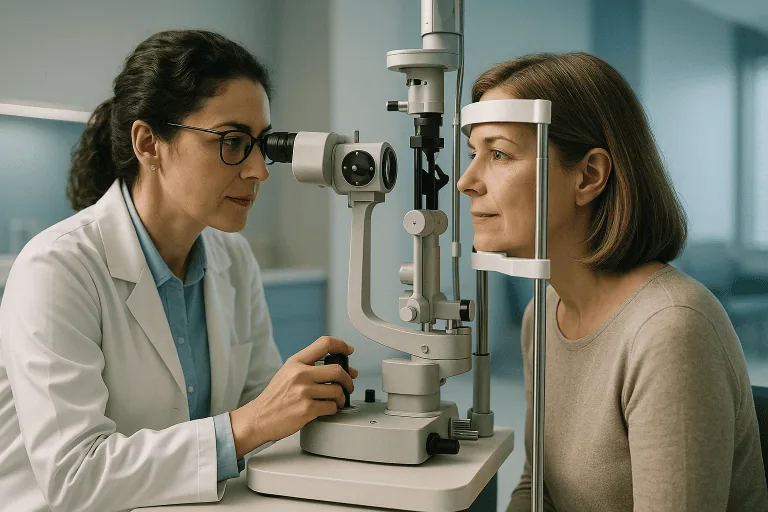
The diagnosis of strabismus disorders is made by an eye care professional, usually an ophthalmologist (a doctor who specializes in eye conditions) or an orthoptist (a specialist in eye movement and binocular vision). In many hospitals, including Acibadem, this care is provided through the Ophthalmology department, often in a pediatric or strabismus clinic. The examination is adjusted to the person’s age, and most tests are painless.
A typical assessment may include:
- History – when the turn was first noticed, whether it is constant or intermittent, which eye is affected, any double vision, family history, birth history, and general health.
- Visual acuity testing – measuring how well each eye sees on its own, using letters, pictures, or matching games for young children, to check for amblyopia.
- Corneal light reflex test (Hirschberg test) – shining a small light at the eyes and checking whether the reflection sits in the same place on each pupil.
- Cover test and alternate cover test – covering one eye and then the other while the person looks at a target. The examiner watches for any movement of the uncovered eye, which reveals a squint and helps distinguish a constant turn from a hidden (latent) one.
- Prism cover test – using prisms of different strengths to measure the exact size of the misalignment, usually at both near and distance and sometimes in different gaze directions.
- Eye movement (ocular motility) testing – asking the person to follow a target in all directions to see whether any muscle is underacting or overacting.
- Tests of binocular vision – checking whether the eyes work together for depth perception (stereopsis) and whether the brain is suppressing one eye.
- Cycloplegic refraction – using eye drops that temporarily relax focusing and widen the pupil so the true glasses prescription can be measured. This is especially important in children, because uncorrected farsightedness is a common cause of esotropia.
- Dilated eye examination – looking at the back of the eye to rule out cataract, retinal disease, or other structural problems.
Imaging such as a CT or MRI scan of the brain and orbits is not needed for most childhood strabismus. Your doctor may request it when a squint appears suddenly, when there are other neurological signs, when a nerve palsy is suspected, or when the pattern does not fit a typical childhood type. Adults with new double vision may also need blood tests, for example to check for diabetes, thyroid problems, or myasthenia gravis (a condition affecting the connection between nerves and muscles).
Strabismus disorders treatment options
Treatment for strabismus disorders aims to protect or restore vision in each eye, to help the eyes work together where possible, to relieve double vision, and to improve eye alignment. The right plan depends on the type of strabismus, its cause, the person’s age, and whether amblyopia is present. Many people need more than one form of treatment over time, and follow-up visits are usually part of care for many years.
Observation. For small or intermittent squints that are not affecting vision, your doctor may recommend regular monitoring rather than immediate treatment, watching for any change in the angle, control, or vision.
Glasses. Correcting a focusing error is often the first step. In accommodative esotropia, glasses that fully correct farsightedness may straighten the eyes partly or completely when they are worn. Some children need bifocal lenses, which have extra power for near work. Glasses may also be prescribed simply to give each eye the clearest possible image.
Treatment of amblyopia. If one eye has reduced vision, the stronger eye may be patched for a set number of hours each day, or blurred with atropine eye drops, to encourage the brain to use the weaker eye. This does not straighten the eyes by itself, but it is a priority in children because vision that is not developed during childhood is difficult to recover later.
Prisms. Prisms are wedge-shaped lenses, either built into glasses or applied as a thin film, that bend light so the two images fall into line. They are mainly used to relieve double vision in adults and in some cases of small-angle strabismus.
Eye exercises (orthoptic therapy). For a limited group of conditions, particularly convergence insufficiency (difficulty turning the eyes inward for near work), structured exercises supervised by an orthoptist may help. Exercises are not effective for most constant squints.
Botulinum toxin injections. A small dose of botulinum toxin can be injected into an overacting eye muscle to weaken it temporarily, allowing the opposing muscle to pull the eye toward a straighter position. The effect wears off over months, but in some cases the improved alignment persists. It may be used in certain childhood esotropias, in some adult cases, or as a diagnostic or temporizing step.
Strabismus surgery. Surgery adjusts the position or length of one or more eye muscles to change the balance of forces on the eye. Muscles may be weakened by moving them further back on the eyeball (recession) or strengthened by shortening them (resection). The operation is usually done under general anesthesia in children and under general or local anesthesia in adults, and most people go home the same day. In some adults, adjustable sutures allow the surgeon to fine-tune the alignment shortly after surgery. It is important to understand that surgery corrects the mechanical alignment; it does not correct amblyopia, and it may not restore full three-dimensional vision if the eyes were misaligned from early childhood. More than one operation is sometimes needed over a lifetime, and glasses are often still required afterward.
Treatment of the underlying cause. When strabismus is due to a nerve palsy, thyroid eye disease, myasthenia gravis, or another medical condition, managing that condition comes first. Some acquired palsies improve on their own over several months, so doctors often wait for the alignment to stabilize before considering surgery.
Living with strabismus disorders and outlook
The outlook for strabismus disorders varies widely and depends largely on the cause, the age at which treatment starts, and whether amblyopia is caught early. In children, early detection and consistent treatment give the best chance of developing good vision in both eyes and some degree of binocular vision. Children who wear glasses or patches often adapt well when the routine is made part of normal life, and parents play a central role in keeping treatment on track.
Alignment achieved with glasses or surgery does not always stay the same. Squints can recur, drift in the opposite direction, or change as a child grows, which is why long-term follow-up is standard. Adults who have surgery for a long-standing squint often report that they are more comfortable in social situations and that eye contact feels easier, even when depth perception does not fully return.
Practical points that many people find helpful include:
- Keeping every follow-up appointment, even when the eyes look straight, because changes can be subtle.
- Making sure glasses are worn as prescribed and are updated when the prescription changes.
- Telling teachers or caregivers about patching schedules so treatment continues consistently.
- Protecting the better-seeing eye with appropriate eyewear during sports if one eye has permanently reduced vision.
- Seeking support if a child is teased or an adult feels self-conscious; the appearance of a squint can affect confidence, and this is a legitimate reason to discuss treatment.
Strabismus does not damage the eye itself, but untreated amblyopia in childhood can leave permanently reduced vision in one eye. Adults with strabismus generally keep the vision they have, though they may continue to experience double vision or poor depth perception if these are not addressed.
Frequently asked questions
What is strabismus disorders in simple terms?
Strabismus disorders are conditions in which the eyes are not lined up with each other, so one eye looks straight ahead while the other turns in, out, up, or down. The turn may be constant or come and go. It is often called a squint or crossed eyes, and it can affect children and adults for different reasons.
What are the first strabismus disorders symptoms parents should notice?
Parents often first notice that one eye seems to look in a different direction, especially in photographs or when the child is tired. Other early signs can include closing one eye in bright light, tilting the head, or bumping into things. Because young children rarely complain, any persistent misalignment after the first few months of life should be checked by an eye specialist.
What are the most common strabismus disorders causes?
In children, the most common identifiable causes are focusing problems such as farsightedness, poor vision in one eye, and a family tendency, though many cases have no clear cause. Conditions such as prematurity, cerebral palsy, and Down syndrome increase the risk. In adults, new strabismus is more often related to nerve or muscle problems linked to diabetes, thyroid disease, stroke, or head injury.
How is strabismus disorders diagnosis made?
An ophthalmologist or orthoptist confirms the diagnosis with a clinical examination rather than a single test. This typically includes checking vision in each eye, cover tests that reveal how the eyes move when one is covered, prism measurements of the angle, eye movement testing, and a refraction with dilating drops. Brain imaging is reserved for cases where a neurological cause is suspected.
What are the main strabismus disorders treatment options?
Treatment may include glasses, patching or drops for a weaker eye, prisms for double vision, eye exercises in selected cases, botulinum toxin injections, and surgery on the eye muscles. The plan is tailored to the type of squint, the person’s age, and the underlying cause, and many people need a combination of approaches with long-term follow-up.
Can strabismus disorders be treated in adults?
Yes. Adults with strabismus can often be helped with prisms, botulinum toxin, or surgery, whether the squint began in childhood or developed later. Surgery in adulthood may improve alignment and comfort and can sometimes relieve double vision, although it may not restore full depth perception if binocular vision never developed. A specialist can discuss what is realistic in an individual case.
Will a child outgrow strabismus?
A true squint does not usually go away on its own, although brief crossing in babies under a few months old is often normal. Because untreated strabismus can lead to permanently reduced vision in one eye, waiting to see whether a child outgrows it is generally not recommended. Early assessment allows treatment to start while the visual system is still developing.
When to see a doctor
Any eye misalignment that is constant, that persists beyond about four months of age, or that appears for the first time at any age should be evaluated by an eye care professional. Routine vision screening in early childhood is also important, because some squints are too small to see without testing.
Seek urgent medical attention if you or your child has any of the following:
- A sudden new squint or sudden double vision, particularly in an adult.
- Double vision together with a severe headache, weakness, numbness, difficulty speaking, dizziness, or trouble walking.
- A squint that appears after a head injury.
- A drooping eyelid, an enlarged or unequal pupil, or pain around the eye alongside the misalignment.
- A white or unusual reflection in the pupil of a child, or a squint together with a sudden loss of vision.
- Bulging or redness of the eye with restricted eye movement.
- In an infant, a squint accompanied by poor feeding, vomiting, an enlarging head, or unusual drowsiness.
These features can indicate a nerve, brain, or other serious condition that needs prompt assessment.
Medically reviewed by the Acıbadem International Medical Board September 9, 2026
See our medical review board →
Update history
- PublishedSeptember 9, 2026
- Medical review approvedSeptember 9, 2026
- Last content updateSeptember 9, 2026