Ankle Fracture — Explained by Medical Evidence, Not Myths

An ankle fracture can involve the tibia, fibula, or talus and may be stable or unstable. Pain, swelling, bruising, and difficulty bearing weight are common, but symptoms can overlap with a severe sprain.
Key Takeaways
- An ankle fracture can involve the tibia, fibula, or talus and may be stable or unstable.
- Pain, swelling, bruising, and difficulty bearing weight are common, but symptoms can overlap with a severe sprain.
- Diagnosis usually includes a physical exam and X-rays; CT or MRI may be used in more complex cases.
- Treatment may include a splint, cast, boot, crutches, pain control, physical therapy, or surgery depending on the fracture.
- Early medical assessment helps reduce the risk of poor healing, chronic pain, stiffness, or arthritis.
An ankle fracture is a break in one or more bones that form the ankle joint, and it can range from a small crack to a more complex injury that affects joint stability. Proper diagnosis matters because what seems like a simple sprain can sometimes be an ankle fracture that needs immobilization, close follow-up, or surgery.
Overview: what an ankle fracture really means
An ankle fracture is a break in one or more of the bones that make up the ankle joint. Most commonly, it affects the lower end of the tibia or fibula, and sometimes the talus, the bone that sits between the leg and the heel. Some fractures are small and stable, while others disrupt the alignment of the joint and require more involved treatment.
This matters because ankle injuries are often described casually as “twists” or “sprains,” yet symptoms can overlap. A person may still move the ankle or even take a few steps and still have a fracture. Medical evaluation helps distinguish a broken ankle from a soft tissue injury and guides the safest plan for healing.
Evidence-based care focuses on the exact fracture pattern, whether the joint is stable, whether the bones remain in good alignment, and whether there are related injuries to ligaments, cartilage, skin, nerves, or blood vessels. This approach is more helpful than common myths, such as assuming all fractures need surgery or that all swelling after a fall is “just a sprain.”
Symptoms and signs
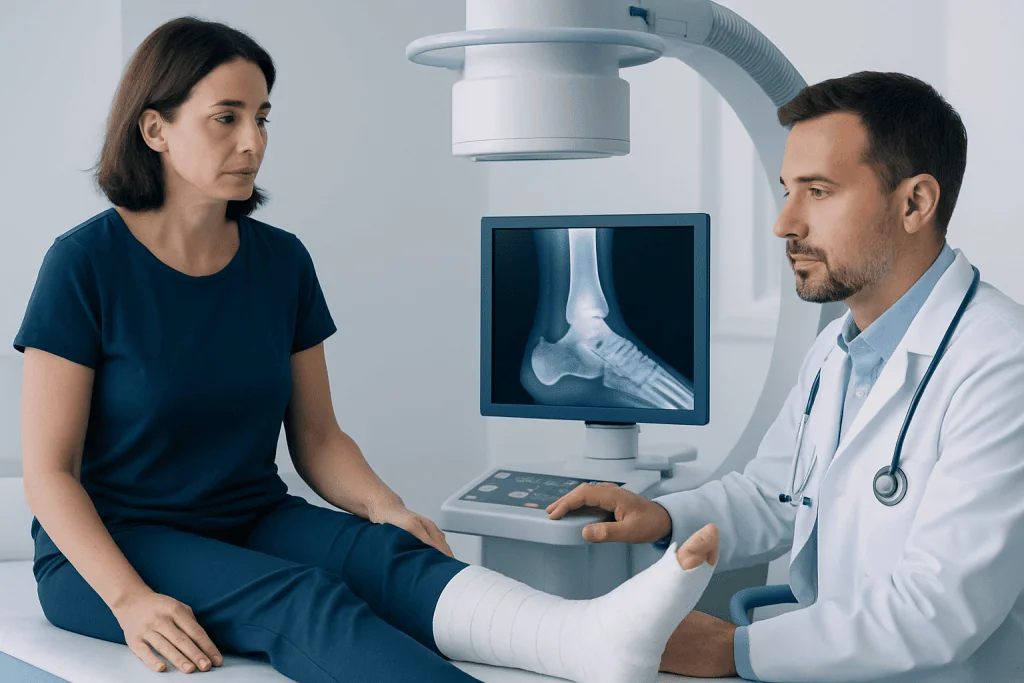
The symptoms of an ankle fracture can vary from mild to severe. Pain is usually immediate and often worsens with standing or walking. Swelling and bruising are common, and the ankle may feel tender to touch, especially over the bone rather than only over the ligaments.
Some people notice a popping sensation at the time of injury. In more obvious fractures, the ankle may look misshapen or out of place. In severe injuries, the skin may be broken or stretched tightly over the bone, which needs urgent care.
Common signs include:
- Pain around the ankle after a twist, fall, sports injury, or accident
- Swelling and bruising that develop quickly
- Difficulty bearing weight or walking normally
- Tenderness over the bony parts of the ankle
- Reduced range of motion
- Visible deformity in more severe cases
Symptoms can overlap with a severe sprain, which is why imaging is often needed. A sprain affects ligaments, while a fracture affects bone, but both can occur together in the same injury.
Causes, fracture types, and risk factors

An ankle fracture usually happens when the ankle is forced beyond its normal range of motion. This can occur during a slip, trip, fall, sports collision, awkward landing, or motor vehicle accident. Low-energy injuries can cause simple fractures, while higher-energy trauma may lead to multiple breaks, dislocation, or damage to surrounding tissues.
Doctors classify ankle fractures by which bone is involved, where the break is located, and whether the joint remains stable. A fracture may involve the lateral malleolus (outer ankle), medial malleolus (inner ankle), posterior malleolus (back of the tibia), or more than one of these areas. When ligaments are also torn or the ankle joint is displaced, the injury may be unstable and more likely to need surgery.
Certain factors can increase risk or affect healing:
- Participation in contact or jumping sports
- Falls, especially in older adults
- High-impact trauma such as car or motorcycle accidents
- Weakened bone from osteoporosis or other bone conditions
- Poor balance, prior ankle injury, or unsafe footwear
- Smoking, diabetes, or circulation problems that may slow recovery
Because fractures and ligament injuries can occur together, a clinician may also assess for related problems such as a severe ankle sprain or tendon injury when evaluating the ankle.
How an ankle fracture is diagnosed
Diagnosis starts with a careful history and physical examination. A doctor will ask how the injury happened, where the pain is located, whether the person can bear weight, and whether there was swelling, a snap, or immediate inability to walk. The ankle is then examined for tenderness, bruising, deformity, skin injury, and circulation or nerve problems.
X-rays are the main test used to confirm an ankle fracture and show whether the bones are aligned. In some situations, repeat X-rays may be taken after swelling settles or while the person is standing, if it is safe to do so, to better understand stability. Clinical decision tools such as the Ottawa Ankle Rules may help determine when X-rays are likely to be needed.
More advanced imaging is sometimes recommended. A CT scan can provide a clearer view of complex fracture patterns, especially when the joint surface is involved. MRI is less commonly used at first for a straightforward fracture, but it can help assess ligaments, cartilage, bone bruising, or hidden injuries if symptoms and X-rays do not match.
If the injury is severe, the medical team also checks for signs of an open fracture, compartment syndrome, or disrupted blood flow. These are less common but urgent problems that need rapid treatment.
Treatment options: from immobilization to surgery
Treatment depends on the location of the fracture, whether the bones are displaced, and whether the ankle joint is stable. Stable fractures with good alignment may be treated without surgery using a splint, cast, or walking boot. Weight-bearing may be limited for a period of time, and follow-up imaging is often used to confirm that the bones remain in the correct position during healing.
Early care usually includes rest, elevation, ice as advised by a clinician, and pain relief. Crutches or another walking aid may be needed. As the fracture begins to heal, the plan may shift toward gradual movement, strengthening, and balance work, often with physical therapy and rehabilitation to reduce stiffness and help restore function.
Surgery may be recommended if the fracture is unstable, the bones are out of place, the joint surface is disrupted, or there is an open injury. Surgical treatment usually aims to realign the bones and hold them in place with plates, screws, or other fixation methods. This falls within orthopedic surgery and is followed by a structured recovery plan.
In complex cases, imaging such as computed tomography (CT) scanning may help surgical planning. The goal of treatment is not simply to heal the bone, but to preserve ankle alignment and joint function, which can lower the risk of chronic pain or post-traumatic arthritis later on.
Recovery, rehabilitation, and self-care
Recovery from an ankle fracture is gradual and varies widely. A simple, stable fracture may heal with immobilization over weeks, while a complex fracture can require a longer period of limited weight-bearing and rehabilitation. Healing time depends on the fracture pattern, age, bone health, smoking status, circulation, and whether surgery was needed.
Rehabilitation focuses on restoring motion, strength, balance, and confidence in walking. The ankle often becomes stiff after time in a cast or boot, and the calf muscles can weaken quickly. Guided exercises can help improve mobility safely without stressing the healing bone too soon.
Self-care during recovery often includes:
- Keeping follow-up appointments and imaging visits
- Using the cast, splint, or boot exactly as instructed
- Elevating the ankle to help reduce swelling
- Avoiding premature weight-bearing if told not to walk on it
- Doing prescribed exercises only when approved by the care team
- Reporting increasing pain, numbness, skin changes, or cast problems promptly
Even after the bone heals on X-ray, the ankle may still feel stiff or swollen for some time, especially later in the day or after activity. Gradual return to sports or demanding work is usually safer than rushing back too early.
Prevention and when to seek medical care
Not every ankle fracture can be prevented, but risk can be reduced. Supportive footwear, attention to uneven ground, strength and balance training, and sport-specific conditioning may lower injury risk. Older adults may benefit from fall-prevention strategies and assessment of bone health, especially if there is concern for osteoporosis.
A person should seek medical care promptly after an ankle injury if there is significant pain, rapid swelling, bruising, tenderness directly over the bone, or difficulty bearing weight. Deformity, numbness, coldness in the foot, or broken skin over the injury needs urgent evaluation. It is also wise to get checked if an ankle “sprain” is not improving as expected.
Myths can delay treatment. Walking on the ankle does not reliably rule out a fracture, and swelling alone does not confirm a sprain. A proper exam and imaging help avoid missed injuries and support a safer recovery.
For people who need specialist evaluation, Acibadem International’s multidisciplinary teams in JCI-accredited hospitals diagnose and treat ankle injuries for international patients, including non-surgical care, imaging, rehabilitation, and surgery when appropriate.
Frequently asked questions
How can someone tell the difference between an ankle fracture and a sprain?
It can be difficult to tell without a medical exam and often an X-ray. Both injuries can cause pain, swelling, bruising, and trouble walking. Tenderness directly over the bone, visible deformity, or inability to bear weight may raise concern for a fracture, but these signs are not perfect.
Can a person still walk with an ankle fracture?
Yes, some people can still walk or limp with certain ankle fractures, especially smaller or more stable ones. That is why the ability to take a few steps does not rule out a broken ankle. Persistent pain after an injury should be assessed by a qualified clinician.
Do all ankle fractures need surgery?
No. Many ankle fractures can heal well without surgery if the bones are in good alignment and the joint is stable. Surgery is more likely when the fracture is displaced, unstable, open, or associated with joint misalignment.
How long does ankle fracture recovery usually take?
Recovery time varies depending on the severity and type of fracture, overall health, and whether surgery was required. Bone healing often takes weeks, but swelling, stiffness, and weakness can last longer. Full return to sport or heavy activity may take additional time and rehabilitation.
What should someone do right after a possible ankle fracture?
The ankle should be rested and protected, and medical advice should be sought promptly. Elevation and ice may help with swelling if appropriate, but a person should avoid putting weight on the ankle until it has been evaluated. Emergency care is important if the ankle looks deformed, the skin is broken, or the foot feels numb or cold.
Can an untreated ankle fracture cause long-term problems?
Yes, a missed or poorly healed fracture can lead to chronic pain, instability, stiffness, and early arthritis in the ankle joint. Problems are more likely if the bones heal out of alignment or if associated injuries are overlooked. Early diagnosis and follow-up help reduce these risks.
References
- American Academy of Orthopaedic Surgeons
- National Institute for Health and Care Excellence
- American College of Radiology
- Mayo Clinic
- MedlinePlus
This article is for general information only and is not a substitute for professional medical advice. Please consult a qualified doctor about your individual situation.
Joint and spine care in Turkey — expert assessment & treatment
JCI-accredited · board-certified surgeons · reply within 24h