

Central Venous Catheter Placement: An Evidence-Based Patient Guide

A central venous catheter provides longer-lasting access to the bloodstream than a standard peripheral IV. The best catheter type and insertion site depend on the planned treatment, vein health, medical history and expected duration of use.
Key Takeaways
- A central venous catheter provides longer-lasting access to the bloodstream than a standard peripheral IV.
- The best catheter type and insertion site depend on the planned treatment, vein health, medical history and expected duration of use.
- Ultrasound guidance, sterile technique and imaging checks help clinicians place central lines safely.
- Possible complications include bleeding, infection, blood clots and, rarely, injury to nearby structures.
- Good catheter care and prompt attention to warning signs can reduce complications.
Central venous catheter placement is a procedure used to insert a flexible tube, often called a central line, into a large vein leading to the heart. It can support treatments that require reliable vein access, including certain medications, intravenous nutrition, dialysis and repeated blood sampling.
Overview: what central venous catheter placement involves
Central venous catheter placement is a procedure in which a clinician inserts a thin, flexible tube into a large central vein. The catheter tip is positioned in a large vein near the heart, allowing fluids and medicines to enter the bloodstream efficiently. The device may be called a central venous catheter, central line, central venous access device or CVC.
Unlike a short IV placed in the hand or arm, a central line can remain in place for days, weeks, months or longer, depending on its type and purpose. It may have one or more separate channels, called lumens, so different treatments can be given without repeated needle insertions.
Central lines are used in hospitals and outpatient settings. They can be important during serious illness, surgery, cancer treatment, long-term antibiotic therapy or when veins are difficult to access. The care team discusses the anticipated benefits, alternatives and risks before recommending the procedure.
How a central line works and who may benefit
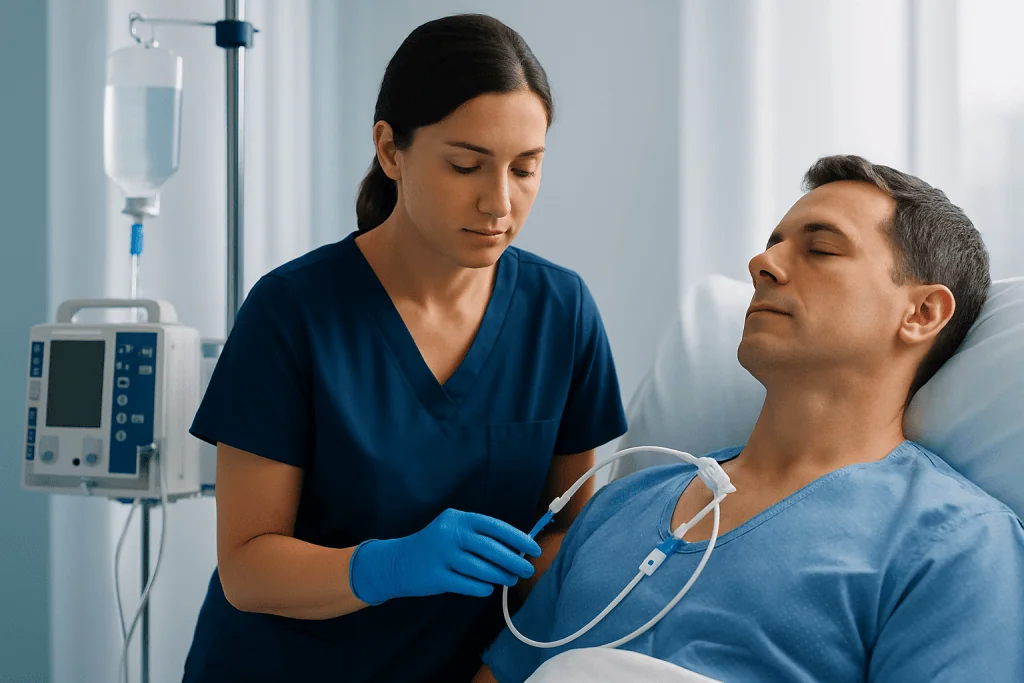
A central venous catheter delivers treatment through a large vein, where blood flow is high. This can be useful for medicines or fluids that may irritate smaller veins, as well as for treatments that need to be given repeatedly or continuously. Depending on the catheter type, the line may also be used to draw blood samples.
A clinician may recommend central venous catheter placement for a person who needs chemotherapy, prolonged intravenous antibiotics, total parenteral nutrition, frequent blood tests, intensive care treatment, certain blood products or dialysis. A central line can also be used when peripheral IV placement has repeatedly been difficult.
There are several main types. A non-tunnelled catheter is often used for short-term hospital care. A peripherally inserted central catheter, or PICC, is inserted through a vein in the upper arm and may be appropriate for treatments lasting weeks to months. Tunnelled catheters and implanted ports are designed for longer-term access and may be selected for people receiving ongoing treatments such as chemotherapy.
Not everyone needs a central line. The decision is individualized, considering the treatment plan, expected duration of therapy, infection or bleeding risk, clotting history, kidney function and the condition of the available veins.
Preparing for central venous catheter placement

Before the procedure, the clinical team reviews the reason for the catheter, medical conditions, allergies and current medicines. It is particularly important to mention blood-thinning medicines, a bleeding disorder, previous blood clots, kidney disease, skin infections near a possible insertion site, or a history of reactions to local anesthetic or contrast material.
Some patients need blood tests to assess blood counts and clotting. Imaging or ultrasound may be used to identify suitable veins and plan the safest route. Instructions about eating, drinking and regular medicines vary according to the type of line, the planned sedation and the setting, so patients should follow the instructions provided by their team.
Many central lines are placed with local anesthetic, which numbs the skin and deeper tissues while the patient remains awake. Some people may receive medicine to help them relax, while implanted ports or more complex placements may be performed with deeper sedation or anesthesia. Patients who receive sedation usually need someone to take them home and should avoid driving or important decisions until the effects have worn off.
Step by step: what happens during the procedure
Central venous catheter placement is commonly performed by an interventional radiologist, anesthesiologist, surgeon, intensivist or another clinician trained in vascular access. The patient lies in a position that gives the team safe access to the selected vein, often in the neck, upper chest, groin or upper arm.
The skin is cleaned carefully with antiseptic and covered with sterile drapes. The clinician wears sterile protective equipment and injects local anesthetic. Ultrasound is often used in real time to locate the vein and guide the needle, which improves accuracy and can reduce certain complications.
After entering the vein, the clinician advances a guidewire and then places the catheter over it. The catheter is secured with stitches, a securement device or a small dressing, depending on its type. For a tunnelled catheter or implanted port, a small incision may be made under the skin before the device is positioned.
The catheter is flushed and checked before use. For lines placed in the chest or neck, a chest X-ray, electrocardiographic tip-confirmation method or other imaging technique may be used to confirm that the catheter tip is in the correct position and to look for uncommon early complications. Patients can learn more about specialized interventional radiology procedures when image-guided placement is recommended.
Recovery timeline and everyday catheter care
After placement, mild tenderness, bruising or discomfort at the insertion site is common for a short period. The dressing should remain clean, dry and securely attached. The care team provides specific instructions about bathing, activity, dressing changes and when the catheter can be used.
Many people can return to light daily activities within a day or two, depending on the catheter type and their underlying condition. Heavy lifting, vigorous arm movement and swimming may need to be limited temporarily, especially after a chest port, tunnelled catheter or PICC insertion. The treating team can advise when usual activity is appropriate.
Central line care is a shared responsibility between trained healthcare professionals and, in some cases, the patient or caregiver. Care commonly includes hand hygiene, sterile dressing changes, disinfecting access points before use and flushing the line according to the prescribed plan. Patients should not adjust, repair or use a catheter unless they have been taught how to do so.
If the line is intended for long-term treatment, regular review is important. A catheter should be removed as soon as it is no longer needed, because avoiding unnecessary line days is an important way to lower the chance of infection and other complications.
Benefits, risks and possible complications
The main benefit of central venous catheter placement is dependable access for treatments that would be difficult, uncomfortable or unsafe through small peripheral veins. It can reduce repeated needle sticks and allow complex care to be delivered more consistently. For some patients, it makes long-term treatment more practical at home or in an outpatient setting.
Like all invasive procedures, central line placement has risks. These include pain or bruising, bleeding, accidental arterial puncture, catheter blockage, catheter movement, blood clots and infection. The likelihood and type of risk vary with the catheter design, insertion location, medical condition and how long the line remains in place.
Rarely, placement in the neck or chest can cause injury to nearby structures, an abnormal heart rhythm during guidewire placement, or a collapsed lung. Sterile technique, ultrasound guidance, experienced clinicians and confirmation of catheter position are important safety measures. A clinician will explain the relevant risks in the individual situation.
People receiving cancer care, those with weakened immune systems, and those requiring intensive treatment may have additional considerations. Related conditions such as deep vein thrombosis may affect catheter planning or prompt further evaluation if symptoms suggest a clot.
When to seek medical care
Patients should contact their healthcare team promptly if they develop fever, chills, new redness, warmth, swelling, tenderness, drainage or bleeding around the catheter site. They should also seek advice if the dressing becomes loose or wet, the catheter appears to have moved, the line will not flush as instructed, or fluid leaks from the device.
Urgent medical assessment is needed for sudden shortness of breath, chest pain, fainting, coughing up blood, severe swelling of the neck, face or arm, or uncontrolled bleeding. These symptoms can have several causes, but they should not be managed at home when a central line is present.
Patients should not remove a central line themselves unless a qualified healthcare professional has specifically instructed them to do so. If a catheter becomes damaged, clamp the line if trained and able, avoid using it, and contact the care team immediately for guidance.
Acibadem International’s multidisciplinary specialists and JCI-accredited hospitals support diagnosis and treatment planning for international patients who need central venous access as part of their medical care.
Frequently asked questions
Is central venous catheter placement painful?
Local anesthetic is usually used to numb the insertion area, so patients commonly feel pressure or brief discomfort rather than sharp pain during placement. Mild soreness or bruising can occur afterward and usually improves over the following days. The care team can discuss pain relief options if needed.
How long does a central venous catheter stay in place?
The duration depends on the catheter type and why it was inserted. A short-term line may be used for days, while a PICC, tunnelled catheter or implanted port may remain for weeks, months or longer. It should be removed when it is no longer medically necessary.
Can a person shower with a central line?
Showering instructions depend on the catheter type, dressing and stage of healing. In many cases, the dressing and external catheter components must be protected from water with an approved cover. Swimming and soaking in baths are often restricted because they can increase infection risk.
What are signs of a central line infection?
Possible signs include fever, chills, redness, pain, warmth, swelling or drainage at the insertion site. Feeling generally unwell during or shortly after an infusion can also require assessment. These symptoms should be reported promptly to the healthcare team.
Is a PICC line the same as a central venous catheter?
A PICC line is one type of central venous catheter. It enters through a vein in the upper arm, but its tip is advanced to a central vein near the heart. Other central lines may enter through the neck, chest or groin, or be placed as an implanted port.
Can central venous catheter placement cause a blood clot?
A catheter can contribute to clot formation in the vein, although not everyone develops this complication. New swelling, pain, skin color changes or prominent veins in the arm, neck or chest should be assessed by a clinician. The care team considers clotting risk when choosing and managing a catheter.
References
- Centers for Disease Control and Prevention
- Infusion Nurses Society
- Society of Interventional Radiology
- National Institute for Health and Care Excellence
- World Health Organization
This article is for general information only and is not a substitute for professional medical advice. Please consult a qualified doctor about your individual situation.
Explore treatments in Turkey — costs, top hospitals & a free quote
JCI-accredited · board-certified surgeons · reply within 24h

More from the Health Library



Related Specialists

Prof. Dr. Altay Bedük
Neurosurgery
Assoc. Prof. Dr. Ali Özer
Liver Transplant Center
Prof. Dr. Tülin Tuğlular
Hematology
Prof. Dr. Barış Kocaoğlu
Orthopedic Surgery & Traumatology