Dermatologist Skin Cancer Screening: How It Works, Results and What to Expect

A full-body skin examination can identify suspicious spots before they cause symptoms. Dermatologists assess lesions by appearance, pattern, location and changes over time, sometimes using a dermatoscope.
Key Takeaways
- A full-body skin examination can identify suspicious spots before they cause symptoms.
- Dermatologists assess lesions by appearance, pattern, location and changes over time, sometimes using a dermatoscope.
- A suspicious spot may require a skin biopsy, which is the only way to confirm or rule out skin cancer.
- People with changing lesions, a personal or family history of skin cancer, many moles or substantial ultraviolet exposure may benefit from regular professional checks.
- Sun protection and prompt assessment of new, changing or non-healing skin lesions remain important between screenings.
A dermatologist skin cancer screening is a focused examination of the skin, scalp, nails and visible mucous membranes to look for changes that may need monitoring or testing. Most appointments are quick, noninvasive and do not confirm cancer on their own; a biopsy is needed to make a diagnosis.
Overview: What Is a Dermatologist Skin Cancer Screening?
A dermatologist skin cancer screening is a clinical examination in which a dermatologist checks the skin for signs that could be linked with skin cancer or precancerous change. The examination may include the scalp, face, trunk, arms, legs, hands, feet, nails and other areas that are difficult to inspect at home. It is usually painless and does not involve radiation, blood tests or imaging.
The purpose is to identify lesions that look unusual, have changed, or do not fit a person’s usual pattern of moles and marks. Screening can help detect melanoma, basal cell carcinoma and squamous cell carcinoma at an earlier stage, when treatment is often simpler. However, an examination is not a diagnosis: if a lesion is concerning, the dermatologist may recommend close observation, photographs, dermoscopy or a biopsy.
Screening intervals are individualized. Some people may only need an examination when they notice a concerning change, while others may be advised to have regular reviews because of their skin type, sun exposure, number of moles, immune status or personal history of skin cancer.
Who May Benefit From Skin Cancer Screening?
Anyone can develop skin cancer, including people with darker skin tones and people who have not had obvious sunburn. A dermatologist may recommend a skin check for people who notice a new or changing spot, a sore that does not heal, a persistently scaly area, or a mole that looks different from the rest.
Regular professional review may be particularly useful for people with a previous melanoma or other skin cancer, a close relative with melanoma, numerous or atypical moles, a history of intense intermittent sun exposure or indoor tanning, or a weakened immune system. People who work outdoors or have received certain medical treatments that increase skin sensitivity may also have a higher need for monitoring.
Risk is assessed as a whole rather than by one feature alone. A dermatologist can suggest an appropriate follow-up schedule and explain which changes should prompt an earlier appointment. Screening complements, rather than replaces, regular self-awareness of the skin.
- New spots that appear after adulthood
- Moles that change in size, shape, colour or sensation
- Persistent rough, crusted, bleeding or non-healing areas
- A personal or family history of melanoma or other skin cancers
What Should I Expect During a Skin Cancer Screening?

Before the examination, the dermatologist will usually ask about personal and family history of skin cancer, past sunburns, tanning-bed use, medications, immune conditions and any specific spots of concern. It can be helpful to make a note of lesions that have changed, bled, itched, hurt or failed to heal. Patients should mention any prior biopsies or treatment for suspicious skin lesions.
For a full-body examination, the patient is normally asked to undress to underwear or wear a gown. The dermatologist examines the skin in a systematic way, often including the scalp, behind the ears, between the fingers and toes, palms, soles, and nails. Patients should avoid nail polish where possible if nail changes are a concern, as it can conceal pigmentation or other details.
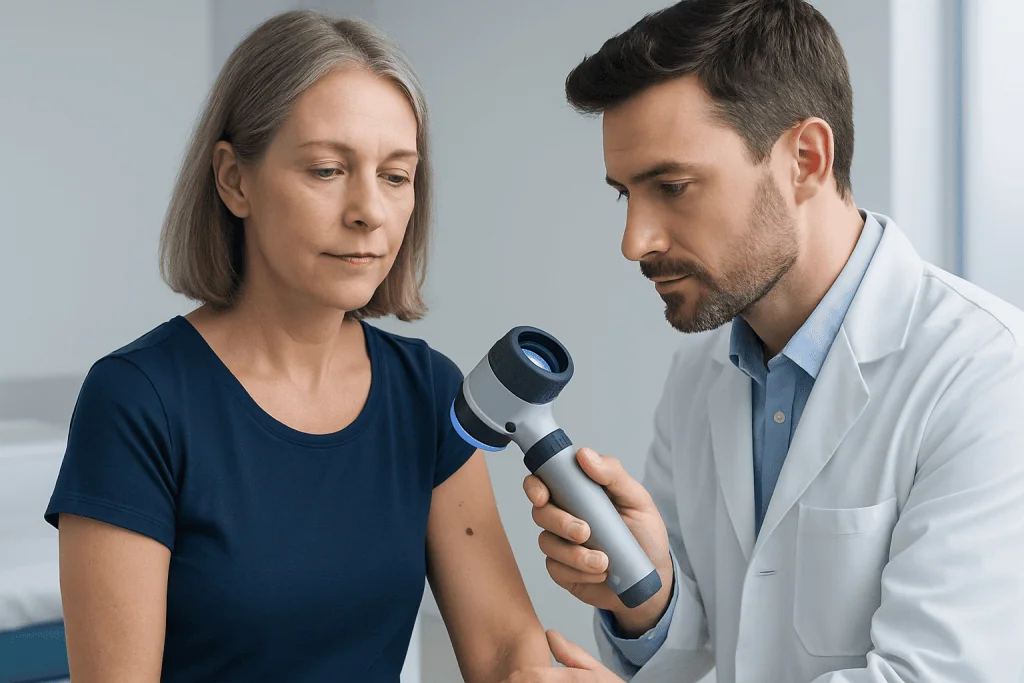
A handheld magnifying device with a light, called a dermatoscope, may be used to view patterns beneath the surface of a mole or pigmented lesion. This is painless and does not break the skin. The clinician may also measure a lesion, document it in the record or take clinical photographs for future comparison with consent.
The visit is also an opportunity to discuss sun protection, self-checks and follow-up. A dermatologist can explain the difference between common benign lesions and marks that may need closer review, but visual assessment alone cannot always determine the exact nature of a lesion.
Can a Dermatologist Tell If You Have Skin Cancer Just by Looking?
A dermatologist can often recognize features that make a lesion more or less suspicious, especially when using dermoscopy and comparing it with other marks on the skin. Features such as asymmetry, irregular borders, uneven colour, a changing appearance, unusual blood vessels, ulceration or a lesion that differs from a person’s other moles may guide clinical decisions.
However, even experienced dermatologists generally cannot confirm skin cancer by looking alone. Some harmless conditions can resemble cancer, while some cancers can look subtle or atypical. A biopsy, in which a small sample or the whole lesion is removed and examined in a laboratory by a pathologist, is the standard way to establish a diagnosis.
If a biopsy is recommended, this does not mean cancer is certain. It means the lesion has features that need clarification. Depending on the area and the suspected condition, the dermatologist may use a shave, punch or excisional biopsy under local anaesthetic. Further care is planned according to the pathology result and the type of lesion involved.
The Procedure, Results and Recovery Timeline
A routine screening appointment generally has no recovery time. After the examination, the dermatologist may reassure the patient that a lesion appears benign, recommend a review after a defined period, or advise a biopsy or removal. When a lesion is photographed or monitored, comparing images over time can help identify meaningful changes.
If a biopsy is performed, local anaesthetic is used to numb the area. The sample is sent for laboratory analysis, and the site may be covered with a dressing. Mild tenderness, bruising or a small amount of bleeding can occur afterward. Instructions commonly include keeping the area clean, changing the dressing as advised, avoiding friction and contacting the clinic if there is increasing redness, swelling, discharge, fever or bleeding that does not stop with firm pressure.
Results are usually discussed once pathology analysis is complete. If skin cancer is confirmed, treatment depends on the cancer type, size, depth, body site and a person’s overall health. Options may include surgical removal, local treatments, radiation therapy or systemic treatment in selected situations. Skin cancer treatment is planned individually and may involve dermatology, pathology, surgical oncology, medical oncology and radiation oncology.
The main benefit of screening is earlier assessment of suspicious changes. Possible downsides include anxiety while awaiting results, a biopsy scar, temporary discomfort and the possibility of testing lesions that ultimately prove benign. These considerations are balanced against the value of accurately assessing a lesion that could require treatment.
What Is the 2 Week Rule for Skin Cancer?
The “2 week rule” is not a formal diagnostic test for skin cancer, and it should not be used to delay assessment of a concerning lesion. In everyday practice, it is often used as a reminder that a new sore, crusted patch, bleeding area or skin change that does not begin to improve within around two weeks deserves medical attention, particularly if there is no clear explanation such as a recent injury.
Some skin cancers grow slowly and may not change noticeably within two weeks, while benign rashes or wounds can take longer than two weeks to settle. For this reason, the more useful guidance is to seek assessment promptly for a lesion that is new, changing, recurrently bleeding, painful, persistently itchy, ulcerated or unlike other marks on the skin.
People should not wait for a particular time period if a mole is rapidly changing or if a dark streak develops in or around a nail. A dermatologist can examine the area and decide whether monitoring, treatment or biopsy is appropriate.
Do Female Dermatologists Examine the Groin Area?
Yes. Female dermatologists, like all appropriately trained dermatologists, may examine the groin, genital skin and buttock area when a full-body skin cancer screening is being performed or when there is a specific concern in that region. Skin cancers and other important skin conditions can occur in areas with little or no sun exposure, so a complete examination may include these sites.
Examinations should always be conducted respectfully, professionally and with clear communication. The dermatologist should explain why the examination is recommended, ask for consent and protect privacy with appropriate draping. A patient can ask questions, request a chaperone where available, ask to have a support person present in line with clinic policy, or decline examination of any area.
If there is a lesion in the genital area, it is important to mention it even if a full-body examination is not planned. Dermatologists can assess many conditions affecting this sensitive area and may coordinate care with gynecology, urology or other specialists when needed.
When to Seek Medical Care
Medical assessment is advisable for a new or changing mole, a spot that becomes darker or develops several colours, a lesion with an irregular outline, or a mark that looks distinctly different from surrounding moles. A sore that repeatedly bleeds, crusts, ulcerates or does not heal should also be examined. These signs do not necessarily mean cancer, but they warrant an informed evaluation.
People with a history of melanoma, non-melanoma skin cancer or significant immune suppression should follow the review plan given by their clinician and arrange an earlier appointment if they notice changes between scheduled visits. Urgent medical attention may be needed for uncontrolled bleeding, signs of significant wound infection after a biopsy, or rapidly worsening symptoms.
Between appointments, sun-protective clothing, shade, broad-spectrum sunscreen used as directed, and avoiding indoor tanning can reduce ultraviolet exposure. Regular self-checks in good light, including hard-to-see areas with a mirror or help from another person, can make it easier to recognize changes. Acibadem International’s multidisciplinary specialists and JCI-accredited hospitals assess suspicious skin lesions and coordinate care for international patients when further investigation or treatment is needed.
Frequently asked questions
How long does a dermatologist skin cancer screening take?
The length varies according to the number of lesions, the need for dermoscopy and whether a biopsy is required. A straightforward full-body examination is often completed during a standard dermatology appointment, while additional testing can make the visit longer.
Should a person wear makeup to a skin cancer screening?
It is usually helpful to arrive with little or no makeup, particularly if there are concerns on the face or lips. Removing nail polish may also be useful when examining nails, although patients should follow any instructions provided by their clinic.
Does a skin cancer screening hurt?
The visual examination and dermoscopy are painless. If a biopsy is needed, local anaesthetic is used, and a person may feel a brief sting from the injection followed by pressure or mild soreness afterward.
How often should someone have a skin cancer check?
There is no single schedule that fits everyone. A dermatologist can recommend timing based on personal risk factors, previous skin cancers, family history, number and type of moles, immune status and any new symptoms.
Can skin cancer occur in places that do not get much sun?
Yes. Although ultraviolet exposure is an important risk factor for many skin cancers, suspicious lesions can occur on the scalp, soles, under nails, genitals and other less-exposed areas. This is one reason a complete examination may include areas beyond the face, arms and legs.
What happens if a skin biopsy finds cancer?
The dermatologist will explain the pathology result, the cancer type and the treatment options appropriate for the lesion. Many skin cancers can be treated with procedures that remove the cancer, while some cases need care from additional specialists depending on the diagnosis and extent.
References
- American Academy of Dermatology
- American Cancer Society
- National Cancer Institute
- World Health Organization
- British Association of Dermatologists
This article is for general information only and is not a substitute for professional medical advice. Please consult a qualified doctor about your individual situation.
Skin Cancer in Turkey — costs, top hospitals & a free quote
JCI-accredited · board-certified surgeons · reply within 24h

More from the Health Library



Related Specialists

Dr. Hülya Yüksel
Physical Medicine & Rehabilitation
Dr. Tevfik Ertürk
Gynecology & Obstetrics
Assoc. Prof. Dr. Sabri Berkem Ökten
Gynecology & Obstetrics
Dr. Zeki Yenidünya
Internal Medicine