E. Coli Meat UTI Study — Explained by Medical Evidence, Not Myths

Most UTIs are caused by E. coli, but the bacteria usually reach the urinary tract through several possible routes, not one single source. Research has found genetic overlap between some E. coli strains in people and strains found in retail meat, suggesting a possible pathway in selected cases.
Key Takeaways
- Most UTIs are caused by E. coli, but the bacteria usually reach the urinary tract through several possible routes, not one single source.
- Research has found genetic overlap between some E. coli strains in people and strains found in retail meat, suggesting a possible pathway in selected cases.
- The study evidence is important, but it does not prove that eating meat directly causes every UTI.
- Good food safety, hand hygiene, hydration, and timely treatment all help lower complications from UTIs.
- People with fever, flank pain, pregnancy, recurrent UTIs, or symptoms that do not improve should seek medical care.
The e. coli meat uti study refers to research exploring whether some urinary tract infections may be linked to E. coli strains found in retail meat. Current evidence suggests a possible connection in some cases, but it does not mean that all UTIs come from meat or that diet alone explains infection risk.
What the e. coli meat uti study means
The phrase e. coli meat uti study usually refers to medical and public health research asking whether some urinary tract infections may be caused by strains of Escherichia coli that are also found in retail meat. The short answer is that some studies have found genetic similarities between E. coli from meat and E. coli that cause human infections, which makes a food-related route biologically plausible. However, the evidence does not show that meat is the only source of UTI-causing E. coli, and it does not mean that every person with a UTI got it from food.
This topic can sound more dramatic than the science supports. UTIs are common, and E. coli normally lives in the intestines of healthy people and animals. For a UTI to happen, bacteria usually need to move from the bowel area into the urinary tract, then multiply there. Studies looking at meat are trying to understand one possible upstream source of certain strains, not replace the well-established explanation of how UTIs develop in the body.
That distinction matters. A study may show an association, shared bacterial fingerprints, or a possible transmission pathway, but that is not the same as proving direct cause in an individual patient. Medical evidence is strongest when many different studies point in the same direction, and even then, researchers usually describe risk, probability, and uncertainty rather than simple yes-or-no answers.
How E. coli causes urinary tract infections
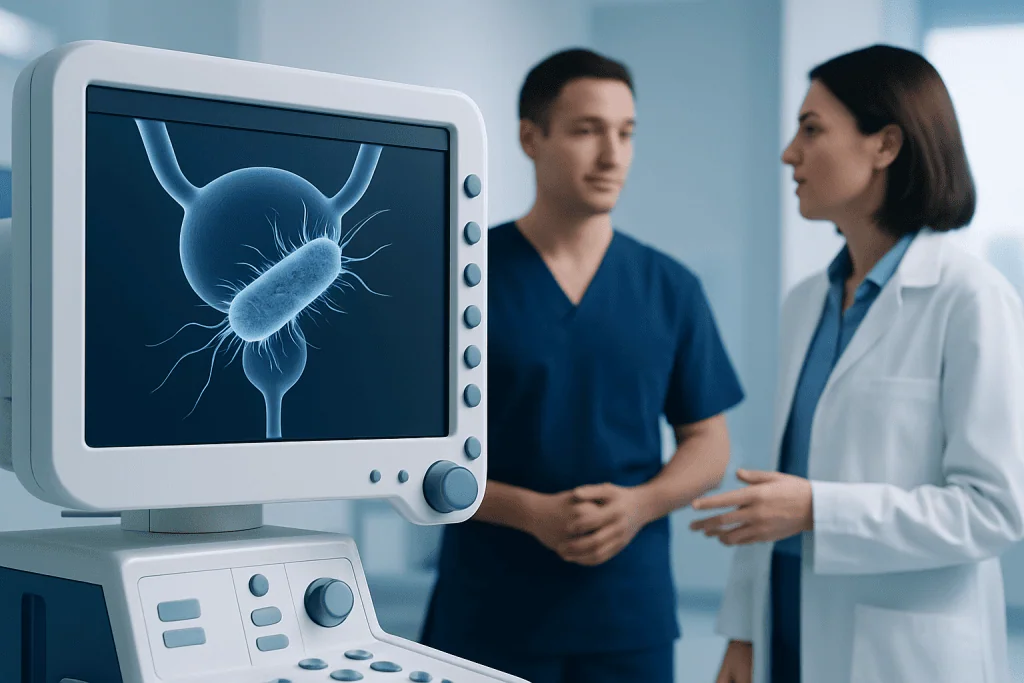
E. coli is the most common cause of urinary tract infections, especially bladder infections. In many cases, the bacteria that cause a UTI come from the person’s own intestinal tract. They can move from the area around the anus to the urethra, enter the bladder, and sometimes travel upward to the kidneys.
This process helps explain why UTIs are influenced by anatomy and daily habits. A shorter urethra, sexual activity, urinary retention, menopause-related changes, catheter use, pregnancy, kidney stones, and some chronic illnesses can all make it easier for bacteria to reach or remain in the urinary tract. These are well-established risk factors and are often more directly relevant to an individual than a possible food-source question.
Not all E. coli are identical. Some strains carry traits that make them better able to stick to the lining of the urinary tract and trigger infection. Researchers sometimes call these strains uropathogenic E. coli. Understanding where such strains circulate, including in people, animals, and food systems, is part of why the meat-related studies have attracted attention.
For readers wanting background on urinary infections more broadly, a clinician may evaluate symptoms in the context of urinary tract infection patterns, risk factors, and recurrence history.
What researchers have found in meat-related studies

Several studies have compared E. coli from human urine, blood, stool, and retail meat samples. In some of this work, investigators found overlapping strains or closely related genetic patterns, particularly in poultry and other meat products. These findings support the possibility that some E. coli capable of causing infections in humans may circulate through the food chain.
Still, important limits remain. Finding a similar strain in meat and in a human sample does not by itself prove that a specific patient acquired the bacteria from a specific meal. E. coli can spread through many pathways, including person-to-person contact, environmental contamination, animal contact, and shared reservoirs in the community. In addition, food can become contaminated during processing or preparation, and a strain found on raw meat may never reach the urinary tract if proper handling and cooking prevent exposure.
Another challenge is that studies differ in design. Some are laboratory-based genetic analyses, while others are epidemiologic studies that look at populations and risk patterns. Laboratory similarity is useful, but it does not always translate into a clear clinical message for day-to-day care. That is why specialists tend to describe the evidence carefully: the meat route is possible and worth studying, but it is only one piece of a larger picture.
From a patient perspective, the practical conclusion is balanced. The evidence does not justify panic about meat, yet it does reinforce routine food safety. It also reminds clinicians and public health experts that antibiotic resistance and bacterial transmission can be connected across human, animal, and food environments.
Myths and misunderstandings to avoid
One common myth is that a meat-related study proves eating meat directly causes UTIs. That overstates the science. Even if a UTI-causing strain originally circulated through food production systems, the infection itself still depends on the bacteria reaching the urinary tract and overcoming the body’s defenses.
Another misunderstanding is that only people who eat meat can get E. coli UTIs. This is not true. E. coli is part of normal intestinal flora in humans, and many UTIs arise from a person’s own gut bacteria without any identifiable food trigger. Many people with UTIs also have other contributing factors such as dehydration, urinary obstruction, hormonal changes, or incomplete bladder emptying.
A third myth is that a UTI can be managed safely without proper evaluation if symptoms seem mild. Some bladder infections stay uncomplicated, but others can spread to the kidneys or become more serious, especially in pregnancy, older age, diabetes, or people with weakened immune systems. Symptoms such as burning with urination, urinary frequency, urgency, blood in the urine, pelvic discomfort, or fever should not be ignored.
Finally, a food-source study does not change the need for evidence-based treatment. If a UTI is suspected, diagnosis often depends on symptoms and may include urine testing or culture. When infection is confirmed or strongly suspected, clinicians may recommend antibiotic treatment based on likely bacteria, local resistance patterns, and the patient’s history.
How UTIs are diagnosed and treated
Doctors usually diagnose a UTI by combining symptoms with medical history and, when appropriate, a urine test. A urine dipstick can suggest infection, while a urine culture can identify the bacteria and show which antibiotics are more likely to work. Cultures are especially helpful in recurrent infections, treatment failure, complicated cases, pregnancy, or when symptoms are unusual.
Treatment depends on where the infection is, how severe it is, and whether the person has risk factors for complications. Many straightforward bladder infections improve with the right antibiotic, fluids, and symptom-guided supportive care. More serious infections, such as kidney infection, may require closer monitoring, imaging, or intravenous treatment.
Further evaluation may be needed if infections keep returning or if there is concern about an underlying urinary problem. In those cases, clinicians may use urinalysis and sometimes imaging or specialist assessment to look for blockage, stones, incomplete emptying, or structural issues. In selected patients with recurrent or complicated infections, imaging of the urinary tract may help guide care, especially if kidney involvement is suspected.
If symptoms suggest upper urinary tract disease, a doctor may consider conditions such as pyelonephritis and decide whether urgent treatment is needed. Near the end of a care pathway, multidisciplinary specialists at Acibadem International’s JCI-accredited hospitals also diagnose and treat urinary infections for international patients when specialist input is required.
Prevention: practical steps that matter most
Because the evidence on meat and UTIs is still being clarified, prevention should focus on measures known to reduce infection risk. Drinking enough fluids, urinating when needed rather than holding urine for long periods, and emptying the bladder after sexual activity can be helpful for some people. Personal hygiene practices can also lower the chance of bacteria moving toward the urethra.
Food safety is still sensible and relevant. Raw meat should be stored separately from ready-to-eat foods, handled with clean hands and utensils, and cooked thoroughly. Kitchen surfaces should be cleaned after contact with raw meat, and cross-contamination should be avoided. These steps reduce exposure to many harmful bacteria, not only E. coli.
People who have repeated infections may benefit from a medical review rather than relying only on home strategies. Recurrent UTIs can be linked to menopause, stones, urinary retention, diabetes, anatomical factors, or resistant bacteria. If symptoms come back often, a clinician may recommend targeted prevention and, in some cases, additional testing such as MR urography or other imaging when clinically appropriate.
- Stay well hydrated unless a doctor has advised fluid restriction.
- Do not delay urination for long periods.
- Follow safe food handling and cooking practices.
- Seek review for recurrent symptoms rather than self-treating repeatedly.
- Use antibiotics only as prescribed to help limit resistance.
When to seek medical care
Medical care is appropriate if symptoms suggest a UTI and do not improve promptly, if they are severe, or if the diagnosis is uncertain. Burning during urination, urgency, frequent small urinations, pelvic pain, cloudy urine, or visible blood in the urine can all justify professional assessment, especially if they are new or worsening.
Urgent evaluation is important when symptoms are accompanied by fever, chills, nausea, vomiting, flank or back pain, or marked weakness. These features can suggest kidney involvement or a more complicated infection. The same is true for infants, older adults with confusion, pregnant patients, and people with diabetes, kidney disease, urinary catheters, or weakened immunity.
Recurrent infections also deserve medical attention. Repeated antibiotic courses without testing can miss resistant bacteria or an underlying cause. A qualified doctor can decide whether urine culture, imaging, specialist referral, or prevention planning is needed.
Frequently asked questions
Does the e. coli meat uti study prove that meat causes UTIs?
No. The research suggests that some UTI-causing E. coli strains may overlap with strains found in retail meat, but that does not prove meat is the direct cause of every UTI. UTIs usually result from bacteria entering the urinary tract, and several different sources and risk factors may be involved.
If a person stops eating meat, will that prevent UTIs?
Not necessarily. Many UTIs are caused by E. coli that already live in a person's own intestines, and factors such as anatomy, hydration, bladder emptying, sexual activity, menopause, or urinary tract problems can be more important. Prevention usually depends on overall hygiene, food safety, and medical assessment when infections recur.
Why is E. coli such a common cause of urinary tract infection?
E. coli normally lives in the bowel, so it is often present near the urinary opening. Some strains also have special features that help them attach to the urinary tract lining and multiply there. This makes E. coli the leading cause of bladder infections.
What symptoms suggest a UTI rather than a food poisoning illness?
A UTI more often causes burning with urination, urgency, frequent urination, pelvic discomfort, or blood in the urine. Food poisoning more commonly causes diarrhea, stomach cramps, nausea, or vomiting. In some cases, symptoms can overlap, so a doctor may need to evaluate the situation.
Can cooking meat properly reduce the risk discussed in these studies?
Proper cooking and safe kitchen handling reduce exposure to harmful bacteria from raw meat and are sensible precautions. They do not eliminate all possible sources of E. coli, because bacteria can also come from a person's own gut or other environmental routes. Still, food safety remains an important and practical step.
When should a person worry that a UTI is becoming serious?
A UTI may need urgent care if there is fever, chills, vomiting, flank pain, severe weakness, confusion, or symptoms during pregnancy. These can suggest a kidney infection or a complicated infection. People with diabetes, immune suppression, catheters, or repeated UTIs should also seek medical advice early.
References
- Centers for Disease Control and Prevention
- National Institute of Diabetes and Digestive and Kidney Diseases
- World Health Organization
- Infectious Diseases Society of America
- European Association of Urology
This article is for general information only and is not a substitute for professional medical advice. Please consult a qualified doctor about your individual situation.
Explore treatments in Turkey — costs, top hospitals & a free quote
JCI-accredited · board-certified surgeons · reply within 24h

More from the Health Library



Related Specialists

Dr. Ezgi Gülüm
Oral Dental and Maxillofacial Surgery
Prof. Dr. Alp Demireller
Otorhinolaryngology
Dr. Hakan Çakır
Urology
Prof. Dr. Nazan Bengüdeniz Erda
Ophthalmology