Moles on Face — Explained by Medical Evidence, Not Myths

Most moles on face are benign and do not require treatment. A new or changing facial mole should be assessed, especially if it looks different from other moles.
Key Takeaways
- Most moles on face are benign and do not require treatment.
- A new or changing facial mole should be assessed, especially if it looks different from other moles.
- Warning signs include asymmetry, irregular borders, color variation, growth, bleeding, itching, or pain.
- Dermatologists diagnose concerning moles through skin examination and sometimes biopsy.
- Sun protection helps reduce skin damage and may lower the risk of some skin cancers.
Moles on face are common and are often harmless clusters of pigment-producing skin cells. The important medical question is not whether a facial mole exists, but whether it is new, changing, unusual in appearance, or causing symptoms that need professional evaluation.
What moles on face usually mean
Moles on face are usually benign skin growths made up of melanocytes, the cells that produce pigment. They may be flat or raised, light brown to dark brown, skin-colored, or sometimes pinkish or black depending on a person’s skin tone and the type of mole. Many people develop facial moles during childhood, adolescence, or early adulthood, and having them does not automatically mean disease.
Medical evidence focuses less on myths about personality, beauty marks, or future health and more on how a mole behaves over time. A stable mole that has looked the same for years is often less concerning than one that is new, enlarging, changing color, or becoming symptomatic. Because the face is sun-exposed and highly visible, people tend to notice even small changes there sooner than on other body areas.
Not every pigmented spot on the face is a mole. Freckles, sun spots, seborrheic keratoses, birthmarks, and other lesions can look similar. That is why a visual check by a qualified clinician, especially a dermatologist, is useful when there is uncertainty about what a spot is.
How to recognize normal and suspicious facial moles
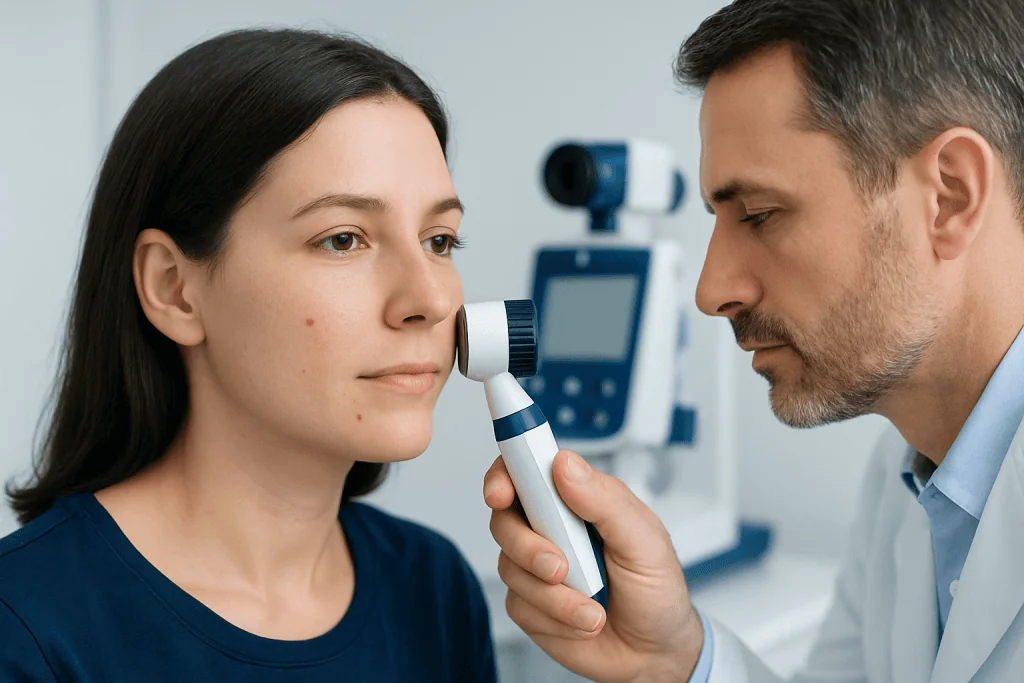
A typical benign mole is often symmetrical, evenly colored, and round or oval with a clear border. It may be flat like a small spot or raised like a soft bump. Some moles have hair growing from them, which is not by itself a sign of cancer. People can have just a few moles or many, and both patterns can be normal.
Doctors often use the ABCDE rule to help identify features that deserve closer attention:
- A – Asymmetry: one half does not match the other.
- B – Border: edges are irregular, blurred, or jagged.
- C – Color: more than one color is present, or the color is changing.
- D – Diameter: a lesion is growing, especially if it becomes larger than about 6 mm, though smaller lesions can also be important.
- E – Evolving: any change in size, shape, color, texture, or symptoms.
Another useful clue is the “ugly duckling” sign. This means one mole looks clearly different from a person’s other spots. A single dark, rapidly changing, uneven, or unusual lesion on the face should not be ignored even if it does not meet every ABCDE point. Some serious lesions, including skin cancer, can begin subtly.
Symptoms also matter. Bleeding without injury, crusting, itching, tenderness, or a sore that does not heal can signal that a mole or mole-like lesion needs medical review. While these symptoms are not always due to cancer, they are important reasons to arrange an examination.
Why moles develop and what raises the risk of problems

Moles develop when melanocytes grow in clusters rather than being spread evenly through the skin. Some are congenital, meaning they are present at birth, while many are acquired over time. Genetics plays a strong role, so people often notice similar mole patterns in close family members. Hormonal changes during puberty or pregnancy can also affect the appearance of some moles.
Sun exposure is a major factor in skin aging and can contribute to the development and change of pigmented lesions, especially on the face. Ultraviolet radiation from sunlight or tanning devices can damage skin cells over time. People with fair skin, light eyes, light hair, a history of sunburns, or many moles generally have a higher risk of abnormal moles and certain skin cancers.
Risk is also higher in those with a personal or family history of melanoma, a weakened immune system, or previous atypical moles. However, people with darker skin tones can also develop concerning facial lesions, and skin cancer may be diagnosed later if symptoms are overlooked. That is why mole awareness is important for everyone, regardless of skin color.
How doctors evaluate moles on face
Evaluation starts with a history and physical examination. A doctor may ask when the mole first appeared, whether it has changed, whether it bleeds or itches, and whether there is a personal or family history of skin cancer. They will also look at the rest of the skin because a single facial lesion is often easier to interpret in the context of a person’s overall mole pattern.
Dermatologists may use dermoscopy, a handheld tool with magnification and special lighting that helps them examine pigment patterns beneath the skin surface. This can improve accuracy compared with the naked eye alone. In some clinics, total body photography or digital mole monitoring is used for people who have many moles or lesions that are difficult to track over time.
If a lesion looks suspicious, the doctor may recommend a biopsy. This means removing all or part of the spot so it can be studied under a microscope. A biopsy is the only reliable way to confirm whether a mole is benign, atypical, or cancerous. For diagnosis and planning, specialists may also coordinate care through dermatology and dermatology evaluation services.
Treatment options and when removal is appropriate
Not all moles on face need treatment. If a mole is clearly benign and not bothersome, observation is often enough. Removal may be considered if the lesion is suspicious, repeatedly irritated by shaving or skincare routines, or cosmetically unwanted. The best approach depends on the size, depth, location, and reason for treatment.
When cancer or precancer is suspected, the priority is complete and accurate diagnosis. A dermatologist or surgeon may remove the mole with an excisional biopsy or another appropriate technique so the tissue can be examined. If pathology shows melanoma or another skin cancer, further treatment may be needed, sometimes involving specialists in oncology or surgical care.
For benign lesions, removal options may include shave excision or full-thickness surgical excision, depending on the type of mole and the need for pathology. Because the face is cosmetically sensitive, treatment planning also considers scarring, natural skin lines, and healing. In carefully selected cases, consultation with plastic and reconstructive surgery may help optimize cosmetic and functional results after removal.
People should avoid trying to remove facial moles at home with acids, cutting tools, or unproven remedies. Home removal can cause infection, scarring, incomplete treatment, and delayed diagnosis of a serious condition.
Prevention, self-checks, and daily skin care habits
It is not possible to prevent every mole, but it is possible to reduce avoidable skin damage. Daily sun protection is one of the most practical steps. This includes using a broad-spectrum sunscreen, wearing a wide-brimmed hat, seeking shade during strong midday sun, and avoiding tanning beds. Consistent protection is especially important for the face because it receives frequent ultraviolet exposure year-round.
Regular self-checks help people notice change early. A simple method is to look at the face in good light once a month and compare visible moles over time. Some people find it helpful to take clear photographs every few months for comparison, especially if they have several similar spots. Any noticeable evolution should prompt medical review.
Skin care products do not remove true moles safely, but gentle skincare can reduce irritation around them. Friction from picking, squeezing, or aggressive exfoliation should be avoided. If a mole is often nicked while shaving or becomes irritated by cosmetics, it is reasonable to ask a doctor whether removal would be appropriate.
Near the end of the care pathway, some patients may benefit from multidisciplinary review. Acibadem International’s specialists in dermatology, oncology, and surgery at JCI-accredited hospitals diagnose and treat skin lesions for international patients when further evaluation is needed.
When to seek medical care
Medical attention is advisable if a facial mole is new in adulthood, changes in size, shape, color, or height, or looks distinctly different from nearby spots. A prompt appointment is also sensible if the lesion bleeds without obvious injury, develops persistent crusting, becomes painful, or repeatedly itches. These signs do not confirm cancer, but they do justify professional assessment.
People at higher risk should be especially careful. This includes those with a personal or family history of melanoma, many moles, atypical moles, significant past sunburns, or immune suppression. In these situations, a clinician may recommend regular skin checks even when no urgent symptom is present.
Urgent evaluation is important for a rapidly growing dark lesion, a non-healing sore, or a spot that begins to ulcerate. If there is concern about possible melanoma, early diagnosis offers the best chance for effective treatment and a clearer management plan.
Frequently asked questions
Are moles on face usually harmless?
Yes, most facial moles are benign and remain stable for years. The main concern is not the presence of a mole itself, but whether it is new, changing, unusual, or causing symptoms such as bleeding or itching.
Can a mole on the face turn into cancer?
Some skin cancers can arise in or resemble a mole, but many moles never become cancerous. A changing mole, especially one with irregular shape or color, should be checked by a doctor to rule out melanoma or another skin cancer.
Is it normal for facial moles to grow hair?
Yes, hair growth from a mole can be normal and does not by itself mean the mole is dangerous. Still, if the mole is changing in other ways, a professional examination is recommended.
Should a new mole on the face in adulthood be examined?
A new mole in adulthood is worth assessing, especially if it appears after age 30 or changes quickly. Not every new spot is serious, but a doctor can determine whether it is a benign mole, sun-related lesion, or something that needs biopsy.
Can facial moles be removed for cosmetic reasons?
Yes, benign facial moles can sometimes be removed for cosmetic or comfort reasons. Because the face is sensitive and visible, removal should be done by a qualified doctor who can choose the safest technique and minimize scarring.
How often should someone check their facial moles?
A monthly self-check in good lighting is a practical routine for many people. Anyone with many moles, atypical moles, or a history of skin cancer may need regular dermatologist visits based on individual risk.
References
- American Academy of Dermatology
- National Cancer Institute
- National Health Service
- Mayo Clinic
- World Health Organization
This article is for general information only and is not a substitute for professional medical advice. Please consult a qualified doctor about your individual situation.
Explore treatments in Turkey — costs, top hospitals & a free quote
JCI-accredited · board-certified surgeons · reply within 24h
Add us as a Preferred Source to see more of our trusted health content across Google Search, AI Overviews and Discover.