

Quick answer
Robotic orthopedic surgery combines computer-assisted planning with robotic guidance to support surgeons during selected joint and bone procedures. At Acibadem in Turkey, orthopedic specialists use this technology to plan and perform procedures with tailored guidance, following an individual evaluation of the patient’s condition and treatment needs.
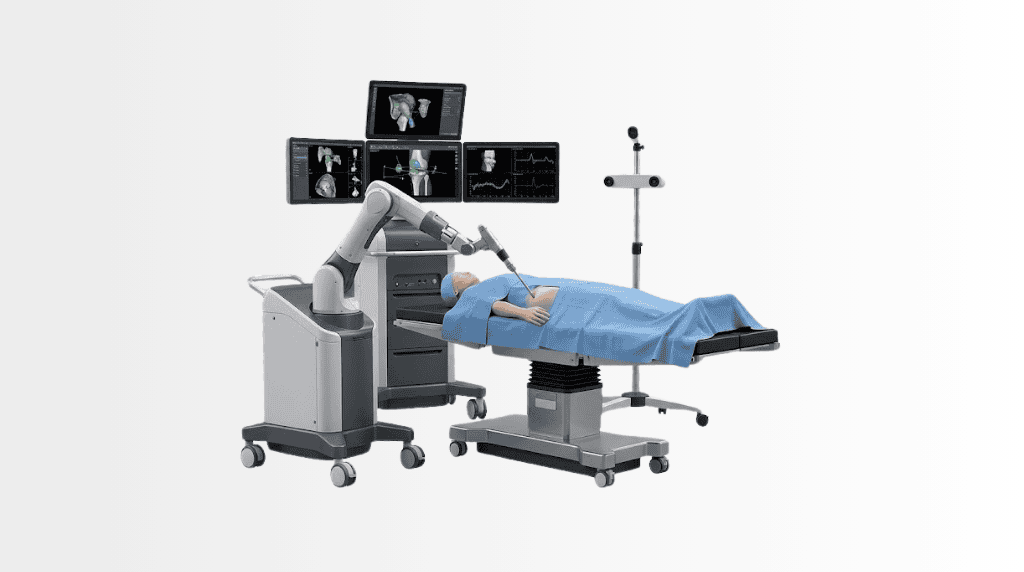
Robotic knee replacement, and its hip counterpart, changes the part of joint surgery patients never see: the plan. Instead of sizing and aligning an implant chiefly by instruments and experience, robotic systems build a three-dimensional model of your joint, let the surgeon plan the implant’s position to the degree and millimetre against your own anatomy, and then enforce that plan in the theatre: the robotic arm or handpiece simply will not cut outside it. The surgeon still operates; the robot guarantees the geometry. Across the Acibadem network, robotic platforms including Mako, NAVIO and ROSA serve exactly that promise.
How robotic joint replacement works
The sequence, whichever platform: a 3D model of your joint, from a pre-operative CT (Mako’s method) or built during surgery by mapping the bone surfaces (imageless systems such as NAVIO); a virtual plan placing the implant against your alignment, ligament balance and bone quality; and haptic execution, as the surgeon prepares the bone, the system tracks instruments in real time and constrains cutting to the planned envelope. Ligament tension can be measured through the range of motion and the plan adjusted before a single definitive cut, which is the step conventional instrumentation simply cannot offer.
Robotic knee replacement
In total knee replacement the difference concentrates on balance: a knee that is aligned but tight, or loose in mid-flexion, is the classic source of the dissatisfied-but-normal-X-ray patient. Robotic workflow quantifies gaps and tension across flexion before committing, so component positions are tuned to your ligaments rather than averages. In partial (unicompartmental) knee replacement, resurfacing only the worn compartment, robotic precision has its strongest published case, because the margin for error in a partial is smaller and accurate placement is what makes partials last.
Robotic hip replacement
In the hip, the robot’s value is the cup: acetabular component orientation drives dislocation risk, leg-length accuracy and wear. Robotic planning positions the cup against your pelvis’s actual, often-tilted geometry rather than an assumed one, and intra-operative tracking verifies leg length and offset before closure, replacing the tape measure and the trained eye’s estimate with numbers.
Benefits, and the honest frame
What the evidence supports: more accurate, more reproducible implant positioning; fewer alignment outliers; less soft-tissue disruption in several series, with less early pain and faster early recovery; and in partial knees, improved survivorship in registry data. What honesty requires saying: a well-performed conventional replacement by an experienced surgeon remains an excellent operation, long-term superiority data for total joints are still maturing, and the robot does not choose your implant, your surgeon or, most importantly, whether you need surgery at all. The scan and the examination decide that; the unit guide’s rule applies in full: the operation not needed is the one not performed.
Who is a candidate?
The candidacy question is the same as for any joint replacement: advanced osteoarthritis or joint damage with pain and function loss that conservative care, weight management, physiotherapy, medication, injections, no longer controls. Robotic assistance then applies to almost any primary knee or hip replacement, and is particularly rational where anatomy is unusual, deformity complicates alignment, or a partial knee is on the table. Complex revisions are planned individually, sometimes robotically, sometimes conventionally; the plan serves the case.
Surgery, stay and recovery
The operation itself takes roughly as long as conventional replacement; hospital stays typically run a few days, with walking beginning the same or next day under physiotherapy guidance. Recovery follows the standard arc, weeks to independent daily life, months to full strength, with early rehabilitation the true determinant of outcome. Discharge notes carry your implant record and rehabilitation protocol, written for the physiotherapist and doctor continuing your care anywhere.
Robotic orthopedics at Acibadem
The group’s orthopedics practice operates robotic joint platforms across the network, including the corporate-verified Mako programme for robotic knee and hip replacement at Bayındır Söğütözü Hospital in Ankara, alongside NAVIO and ROSA workflows, with rehabilitation teams carrying the half of joint replacement that happens after the theatre. For international patients, candidacy usually settles from X-rays and MRI before travel: a written surgical opinion, an estimate, and a one-trip plan.
The rehabilitation arc: where outcomes are earned
Implant position is set in an hour; outcome is built over twelve weeks. The arc, roughly: days one to three, standing and walking with support, circulation exercises, pain managed by multimodal protocols that keep you mobile rather than sedated; weeks one to three, progressive walking, knee-bend or hip-precaution work per protocol, stairs, sleep normalising as swelling recedes; weeks three to six, independence in daily life, driving when reaction and strength allow (your team, not the calendar, clears it); weeks six to twelve, strength and endurance building toward the joint you actually wanted: walks, swimming, cycling, golf. What the robot contributed silently: components aligned to your anatomy tend to feel “quiet” earlier, and several series report less early pain, but adherence to the protocol remains the strongest predictor a patient controls. The rehabilitation team’s staged plan travels home in your discharge notes, measurable milestones included.
Choosing wisely: the questions worth asking any surgeon
Robotic marketing is loud; good decisions are quiet. Questions that sort substance from shine: Do I need a replacement at all yet, and what would waiting cost? (An honest surgeon sometimes answers “not yet.”) Partial or total, and does my imaging genuinely support a partial? Which platform do you use, and how many robotic cases has this team done, because the learning curve is the team’s, not the machine’s? Which implant, and why that one for my bone and age? What are my personal risk numbers, infection, clot, stiffness, not the brochure’s? And what does my rehabilitation plan look like, week by week, wherever I live? A centre comfortable with every one of those questions, and willing to recommend the conventional operation where it serves you equally, is the centre the technology deserves.
Frequently Asked Questions
When can I drive after robotic knee or hip replacement?
When reaction, strength and confidence allow, commonly a few to several weeks, cleared by your team rather than a fixed date, and sooner for left-side surgery with automatic cars.
What sports can I return to?
Low-impact life, walking, swimming, cycling, golf, doubles tennis, is the design goal; repetitive high-impact sport is discussed honestly per implant and patient.
What questions should I ask before agreeing to surgery?
Whether you need it yet, partial versus total, the team’s robotic case volume, implant choice reasoning, your personal risk numbers and the week-by-week rehabilitation plan, good centres welcome all six.
Does the robot perform the surgery?
No: the surgeon operates throughout; the system enforces the plan by constraining cuts to the planned envelope and feeding back live measurements.
Is robotic knee replacement better than conventional?
It is measurably more accurate and reproducible, with less early pain and faster early recovery in several series; a well-performed conventional replacement remains excellent, and long-term superiority data for total knees are still maturing: your surgeon frames it honestly.
What is the difference between Mako, NAVIO and ROSA?
Different engineering routes to the same goal: Mako plans from a pre-operative CT with a haptic arm; NAVIO builds the model during surgery without CT; ROSA assists planning and execution across knee and other applications. The surgeon chooses the platform that fits the case.
Am I a candidate for a partial knee replacement?
If your arthritis is confined to one compartment with intact ligaments, a scan-and-examination decision, a robotic partial is among the strongest indications for the technology.
Does robotic surgery take longer?
Operating times are broadly comparable to conventional replacement once the team is experienced; planning happens before or during surgery without adding meaningful patient burden.
Is the incision smaller?
Incisions are similar; the difference is beneath, less collateral soft-tissue disruption and no intramedullary alignment rods in most workflows.
How long is the hospital stay?
Typically a few days, with walking starting the same or next day under physiotherapy guidance.
How long until I am back to normal life?
Independent daily life commonly within weeks; full strength and endurance build over months, early rehabilitation adherence is the honest predictor.
How long do robotic implants last?
The implants are the same proven prostheses used conventionally; positioning accuracy is what robotics adds, and registry data associate accurate placement, especially in partials, with better survivorship.
Do I need a CT scan first?
For CT-based platforms such as Mako, yes; imageless systems such as NAVIO map your joint during surgery instead. Your pathway states which applies.
Can robotic surgery fix a failed previous replacement?
Revisions are planned case by case, some benefit from robotic workflows, others are best served conventionally; the plan follows the problem.
Can I be assessed from abroad?
Largely yes, joint replacement candidacy reads from X-rays, MRI and your story, so a written opinion and estimate usually precede any flight.
Will my physiotherapist at home get a protocol?
Always, discharge notes carry the implant record and a staged rehabilitation protocol written for the team continuing your care.
Related Medical Units
Related Treatments
Speak with our medical team
Find out how this technology could support your diagnosis or treatment.