

Arriving in Turkey for Surgery: Your First 48 Hours Explained

Your first 48 hours in Turkey are mostly logistics, not treatment: passport control, your arranged transfer, hotel or hospital check-in, registration paperwork, and pre-operative checks such as blood tests and an anaesthesia consultation. The practical priorities are rest, hydration, keeping documents and medicines in hand luggage, and confirming fasting and timing instructions with your care team before the evening ends.
Who meets you at the airport, and where do you go first: the hotel or the hospital? Most patients turn these questions over somewhere above the Balkans. They are easier to settle before you land, and this guide settles them.
Arriving in Turkey for surgery is a logistics exercise before it is a medical one. Your first two days are about getting from the aircraft door to a hospital bed with the right documents, the right medicines and enough rest in between. Here is what those 48 hours usually contain, in the order they happen.
At a glance
- Best for: International patients arriving in Turkey for planned surgery
- Covers: Airport arrival, transfers, hotel and hospital check-in, registration, pre-operative assessment
- Time frame: The first 48 hours after landing
- What it is not: Medical advice about your medicines, fasting times or fitness for surgery: those instructions come from your treating team
- Helpful support: Interpreter services, arranged transfers, and an international patient coordinator
What your first 48 hours usually look like
Arriving in Turkey for surgery tends to feel like a mixture of relief, tiredness and last-minute questions. In most cases the first 48 hours contain very little treatment. They contain arrival, transfer, rest, registration and final checks, in roughly that order. Knowing this in advance takes some pressure off: you are not expected to perform on day one. You are expected to turn up, hand over documents and answer questions honestly.
If your operation is scheduled soon after arrival, the second day usually holds the pre-operative work: blood tests, sometimes imaging, a consultation with your surgeon, and a separate conversation with the anaesthesiology team. None of this is a formality. It is how the team confirms that the plan made from your records at a distance still fits the person standing in front of them.
Many patients find the medical side more organised than expected and the practical side more tiring than expected. Jet lag, an unfamiliar city and a phone that may or may not connect are the real obstacles of the first day. Structured hospital groups, Acibadem among them, run international patient departments precisely because a jet-lagged patient should not be coordinating transfers, interpreters and admission paperwork alone. Some patients also deliberately build in extra days before their operation; there is a separate guide on arriving early for surgery in Turkey and why timing matters if you are still deciding on your dates.
At the airport: the first practical steps after landing
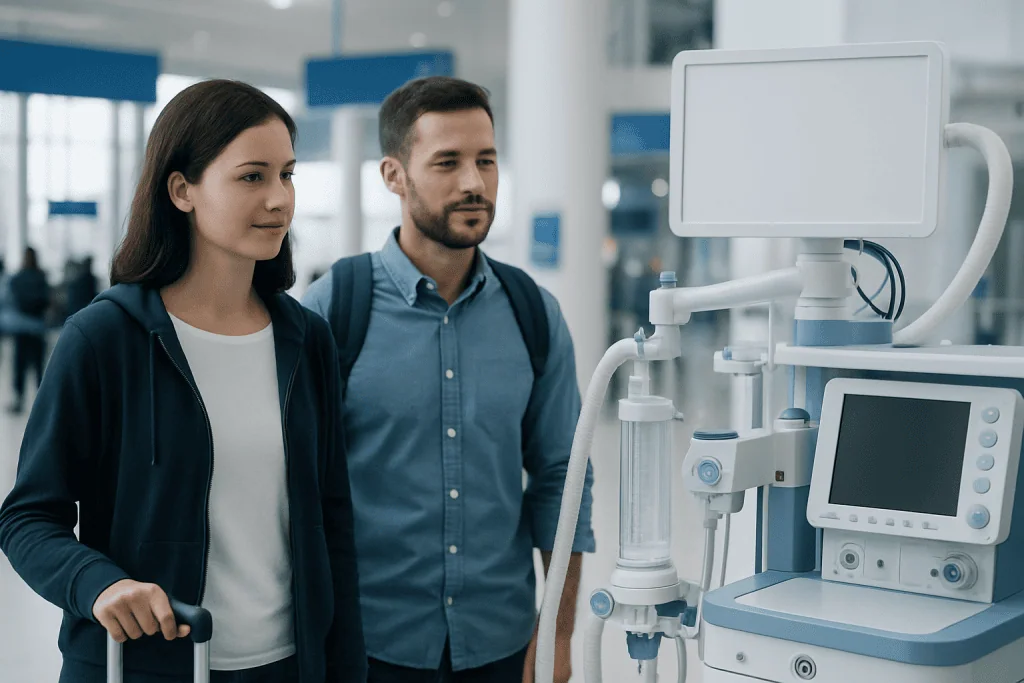
Once you land, the sequence is fixed: passport control, baggage collection, communication, transport. Work through it in that order and nothing important gets missed.
Keep your passport, entry documents, hospital correspondence, phone charger and a printed copy of your accommodation details in your hand luggage, never in a checked bag. Checked bags arrive late often enough that this rule alone prevents most first-day problems. The same applies to prescribed medicines: carry them with you, in their original packaging, with a written list of doses and timings.
Expect the airport to be busy, particularly in Istanbul. Give yourself extra time, walk at a steady pace, and do not put your paperwork away until you are through every checkpoint. If your operation is close, avoid hauling heavy bags yourself; that is what trolleys and companions are for.
If a driver has been arranged, confirm before you fly exactly where they will stand and what sign or identifier they will hold, international arrivals halls at large Turkish airports have several exits, and “outside arrivals” is not a meeting point. If you are organising your own transport, make sure your phone works the moment you land, whether through roaming, airport Wi-Fi or a Turkish SIM or eSIM. Being reachable matters: your transfer driver or coordinator may need to find you, not the other way round.
- Save your hospital’s contact number where you can find it without scrolling.
- Save the hospital address in both English and Turkish if you have it, taxi drivers read the Turkish version faster.
- Keep prescribed medicines and the written medication list in your hand luggage.
- Carry a small bottle of water and, if you are not yet under fasting instructions, a light snack.
Hotel, hospital, or both: where you go first

Some patients go straight from the airport to a hotel to rest. Others go directly to the hospital for tests or admission. Neither route is better in general; the right one depends on your arrival time, your surgery date, how long the journey was, and what your surgical team scheduled when your dates were fixed. You should know which route applies to you before you board the flight: it will be written in your travel plan or admission letter.
If the hotel comes first, use the time deliberately. Drink water, eat lightly if you are permitted to eat, charge your phone, and lay out your documents for the next day. Resist the pull of the city. The evening before pre-operative checks is not the time for sightseeing, long walks, heavy meals or late nights, however tempting Istanbul is from a taxi window. The city will still be there when you are recovering.
If the hospital comes first, expect administrative steps before medical ones: registration, identity checks, and being directed between departments. At Acibadem hospitals, international patient services typically handle registration support and language assistance so you are not deciphering signage alone. Even in a well-organised hospital there will be waiting periods between appointments, so dress comfortably, keep a light extra layer with you, and keep your phone and charger in your day bag rather than your suitcase.
Hospital check-in and pre-operative assessment
Hospital check-in usually includes identity verification, consent paperwork, confirmation of payment or insurance arrangements where relevant, and a review of your medical file. Have your passport, prior reports, imaging discs or download links, prescription list, allergy history and emergency contact details together in one folder. A single pouch that holds everything saves you from repeating the same rummage at every desk.
The medical part of the first 48 hours commonly includes blood work, vital signs, and consultations linked to your specific procedure. Depending on your case, you will meet the anaesthesiology team, who will ask about your medical history, previous operations, smoking, alcohol use, recent illnesses and any past reactions to anaesthesia or other medicines. Answer completely, even when something feels trivial or slightly embarrassing. The anaesthesiologist is not judging your habits; they are calculating around them.
This is also when practical details get fixed. Before the day ends, you should know four things with certainty: when to stop eating and drinking, what time to present yourself on surgery day if you are not already admitted, whether your companion can stay with you and where, and what happens to your valuables during the operation. If any of the four is unclear, say so on the spot: these questions are expected, and asking them the evening before is far easier than resolving confusion at six in the morning. Interpreter support makes these conversations straightforward if you do not speak Turkish.
Why people travel to Turkey for surgery, and what it means for your arrival
It helps to understand the landscape you are arriving into. Turkey receives large numbers of international patients each year, from Europe, the Middle East, Central Asia, Africa and North America, including Americans, who most often travel for aesthetic procedures and dentistry. The range of surgery people travel for is wide: plastic, reconstructive and aesthetic surgery is the most visible category, but patients also come for bariatric and metabolic surgery, cardiovascular surgery, orthopaedics, eye surgery, transplant medicine and general surgery. That volume is why the arrival infrastructure described in this guide, airport pickups, coordinators, interpreters, exists at all.
Is it safe? The honest answer is that safety is not a property of a country; it is a property of a specific hospital, a specific surgeon, a specific procedure and a specific patient. Turkey has large, modern hospital groups with experienced surgical teams, and it also has operators whose standards you cannot verify. Any operation carries risk anywhere in the world, and travelling adds its own considerations: long flights close to surgery, being away from your home doctor during early recovery, and follow-up at a distance. Government travel-health services such as the CDC and the UK Foreign Office publish general guidance for people considering treatment abroad, and reading it before you commit is time well spent. The most useful thing you can do is ask specific, verifiable questions of any provider, who operates, where, with what pre-operative assessment and what follow-up plan, and treat vague answers as information in themselves.
On cost, this guide will not quote figures, because honest figures cannot be quoted in general. What a written quote depends on is knowable: the procedure itself and its complexity, the type of anaesthesia, the expected length of hospital stay, any implants or materials used, pre-operative tests, and whether accommodation and transfers are bundled in. A serious quote itemises these; a suspicious one names a single number before anyone has reviewed your records. Note that revision procedures are usually assessed differently from first-time operations: there is a dedicated guide on why revision surgery costs are structured differently.
Jet lag, food, medication and nerves
The first 48 hours are physically demanding because travel and pre-operative preparation are both tiring, and they land on the same two days. Keep the basics in view: hydration, rest, comfortable clothes, a quiet evening, and precise adherence to whatever fasting instructions you have been given. Fighting jet lag by staying busy rarely works before surgery; conserving energy is more useful than pretending to operate on home time.
Medication deserves particular care. Some regular medicines, blood thinners, diabetes medication, certain supplements and pain relievers, have specific pre-operative instructions. Those instructions belong to your treating doctor, and only your treating doctor. Do not take guidance on your medicines from this guide, from forums, or from other patients in the hotel lobby, and do not improvise if something is unclear; get the instruction stated plainly and, ideally, written down.
Feeling emotional in these two days is normal, not a warning sign. Anxiety, impatience, homesickness and the low-grade disorientation of an unfamiliar language all tend to peak the evening before surgery. The tactic that helps most patients is to keep the world small: focus on the next step only, keep one point of contact for questions rather than three, and let your coordinator or companion carry the logistics. You do not need to be calm; you only need to be organised, and much of the organising can be delegated.
Companions, solo travellers, and staying organised
If you are travelling with a companion, give them a defined job rather than a vague supporting role. They can carry copies of your documents, track appointment times, stay reachable by phone while you are in consultations, and handle updates to family at home. Decide in advance who holds the essentials, passport, wallet, test results, medicines, chargers, so that nothing is “in the other bag” at the wrong moment. If surgery is early the next morning, pack the hospital bag the night before, not on the way out of the door.
If you are travelling alone, structure matters even more, and this is where international patient departments earn their keep: appointment timing, navigation inside the hospital, interpretation, and practical guidance about your stay. Accepting that help is not a weakness. The first 48 hours are not a test of self-sufficiency; they are a handover, from you managing your treatment plan to a team managing it with you.
Communication in the first 48 hours
One theme runs through everything above: pre-operative teams work from information, and the information comes from you. That is why the admission process asks about recent illness, why the anaesthesiology consultation revisits your history in detail, and why hospitals encourage patients to raise changes in how they feel after a long journey, travel fatigue, dehydration and illness picked up en route are all relevant to surgical planning, and teams would always rather hear about them than not.
The same principle applies to practicalities. Misunderstandings about fasting times, medication instructions or appointment locations are common among tired travellers and are trivially easy to fix when raised early, and genuinely stressful when discovered at dawn on surgery day. Interpreters, coordinators and admission staff exist to absorb exactly these questions. The goal of your first 48 hours is not to do everything perfectly. It is to arrive, rest, prepare, and make sure the right people have the right information before anyone picks up an instrument.
Step by step
- Confirm your arrival plan before you fly. Know who is meeting you, where you go first, and which documents you need on landing. Save the hospital contact, hotel address, transfer details and coordinator’s number in your phone and on paper.
- Move through the airport in sequence. Immigration, baggage, communication, transport, in that order. Keep medicines, passport, medical letters and chargers in hand luggage so a delayed suitcase costs you nothing important.
- Settle in and prioritise rest. Whether you reach a hotel or the hospital first, drink water, sit down and reset. Do not over-schedule day one; jet lag makes simple tasks harder than they look.
- Complete registration and give a full history. Present all requested documents and mention allergies, previous operations, current medicines and any recent illness. Details that seem minor to you may matter to anaesthesia planning.
- Fix the four certainties before evening. When to stop eating and drinking, what time to arrive on surgery day, whether your companion can stay, and what happens to valuables. Repeat the instructions back so nothing is ambiguous overnight.
- Pack the next-day bag the night before. ID, phone, charger, glasses, basic toiletries, and anything your team asked you to bring. Leave valuables behind where possible and choose loose clothing that is easy to change in and out of.
- Delegate. Let your companion, coordinator or the international patient team handle navigation, interpretation and family updates. Conserve your energy for the part only you can do.
Your checklist
- Passport and visa or entry documents
- Printed and digital hospital confirmation details
- Medication list with doses and timing
- Prescribed medicines in original packaging
- Recent test results, reports and imaging if requested
- Emergency contact information
- Phone charger, plug adapter, and a working internet plan
- Comfortable clothes and slip-on shoes
- One folder or pouch for all paperwork
Key takeaways
- The first 48 hours after arriving in Turkey for surgery are about arrival, rest, registration and final pre-operative checks, not treatment.
- Documents, medicines and contact details travel in your hand luggage, always.
- Fasting and medication instructions come only from your treating team, stated plainly and confirmed before the evening ends.
- Interpreter, transfer and coordination services exist to be used; delegating logistics is part of preparing well.
- A written, itemised quote and specific answers about who operates and how follow-up works are the marks of a serious provider anywhere.
Frequently asked questions
Is it safe to go to Turkey for surgery?
Safety depends on the specific hospital, surgeon, procedure and patient, not on the country as a whole. Turkey has large, modern hospital groups alongside providers whose standards are harder to verify. All surgery carries risk anywhere, and travel adds considerations such as flights close to the operation and follow-up at a distance. Government resources such as the CDC’s medical tourism guidance are worth reading before committing.
How much does it cost to go to Turkey for surgery?
There is no honest single figure. A written quote depends on the procedure and its complexity, anaesthesia type, expected length of stay, any implants or materials, pre-operative tests, and whether accommodation and transfers are included. A serious quote itemises these elements after reviewing your records; be cautious of a single number offered before anyone has seen your case.
What surgeries do people travel to Turkey for?
The range is broad: aesthetic and reconstructive surgery is the most visible category, but international patients also travel for bariatric surgery, cardiovascular and cardiothoracic procedures, orthopaedics, eye surgery, dentistry, and general surgery. The scale of this travel is why arrival infrastructure, transfers, interpreters, patient coordinators, is well developed at the larger hospital groups.
Do Americans go to Turkey for plastic surgery?
Yes. Americans are among the international patients who travel to Turkey, most commonly for aesthetic procedures and dentistry. The U.S. State Department and CDC both publish general guidance for citizens considering medical care abroad, covering documentation, travel timing around procedures, and questions to ask providers.
Should you arrive a day or two before surgery?
Often, yes. Arriving early gives time to recover from travel, complete final tests and handle paperwork without rushing. The right margin depends on your procedure, your health and your surgeon’s plan, so follow the schedule set for your case rather than a general rule.
What documents should you keep with you when arriving in Turkey for surgery?
Your passport and entry paperwork, hospital correspondence, accommodation details, a medication list with doses, and any requested medical reports or imaging, all in hand luggage, with printed copies in case your phone battery dies or connectivity fails on arrival.
Can you eat after landing if surgery is soon?
Only if your fasting period has not yet started. Fasting rules vary with the operation and anaesthesia plan, so the timing that applies to you comes from your own team’s written instructions, not from general advice or from other patients.
What if you do not speak Turkish?
Most international patients manage comfortably with interpreter and coordination support arranged through the hospital. English is widely used in international patient departments, and interpreters can sit in on consultations so that consent, fasting and medication instructions are understood exactly.
Add us as a Preferred Source to see more of our trusted health content across Google Search, AI Overviews and Discover.

Update history
- PublishedAugust 14, 2026
- Medical review approvedSeptember 1, 2026
- Last content updateSeptember 1, 2026
References2
- Medical Tourism: CDC Travelers' Health wwwnc.cdc.gov
- Foreign travel advice: Turkey: GOV.UK gov.uk
More Patient Guides

GHIC and EHIC in Turkey: Why They Do Not Cover You
The blue card that quietly covers you across Europe stops working at the Turkish border, and every summer, travelers discover this…

Do You Need Vaccinations for Turkey?
Here is the answer travel clinics give every day: no vaccinations are required to enter Turkey from anywhere in the normal course…

Flying With a Broken Leg or Cast: Airline Rules and Comfort
A broken leg does not cancel a flight, airlines carry passengers in casts every single day. What surprises travelers is that…
Travel Insurance After Cancer: What Patients Should Know
A cancer diagnosis changes how insurers read your name, but it does not end your traveling life. Thousands of people with…