

At Acibadem, What We Mean by Quality and Patient Safety in Daily Care

Quality and patient safety in daily care mean hundreds of small, structured routines rather than one dramatic step: confirming your identity before every test or medicine, reviewing your records and allergies, keeping the environment clean, checking medicines carefully, and coordinating teams so information follows you. You take part by giving accurate information, keeping documents organised, and asking questions whenever something is unclear.
Wondering what actually keeps you safe once you land, register, and start moving between consultations, tests, and treatment? It is rarely one dramatic thing. It is the practical systems that protect you every day: identity checks, clear communication, clean environments, careful medication processes, and teams that pass information on properly.
If you are travelling for care, this guide explains what those systems look like in real life. It does not promise perfection, no hospital can, but it does show you what safe daily care is built from, why some routines feel repetitive on purpose, and where your own actions genuinely make a difference.
At a glance
- Best for: Patients and families who want to understand how safety works day to day, not just on paper
- What it covers: Identity checks, infection prevention, medication safety, handovers, teamwork, accreditation, and discharge planning
- Setting: Acibadem hospitals and outpatient services in Turkey
- Why it matters: Knowing what to expect helps you notice that the system is working, and helps you take part in it
- Your role: Bring accurate information, keep documents organised, follow preparation instructions, and speak up when anything is unclear
- Honest limit: Structured safety systems reduce avoidable risk; they cannot remove risk entirely or guarantee outcomes
What we mean by quality and patient safety in daily care
When hospitals talk about quality, it can sound abstract. So it helps to define what we mean by quality and patient safety in daily care in plain terms. Quality is care that is delivered the same reliable way every time, the right test, the right preparation, the right documentation, regardless of which nurse is on shift or which day of the week you arrive. Patient safety is the part of quality that focuses on preventing avoidable harm: mix-ups, infections, medication errors, missed information.
Neither of these lives in a certificate on a wall. In daily care they show up as hundreds of small actions: staff confirming your identity before a blood draw, a pharmacist checking a prescription against your allergy record, a cleaner following a defined routine in your room, two nurses reviewing a medicine together before it is given, a team meeting where your imaging is discussed before a plan is set.
At Acibadem, the aim is to make care reliable as well as compassionate. That means structured processes, trained teams, and recognised standards that reduce avoidable risk and support consistency. For international patients, it also means explanation: interpreters where needed, coordinators who keep your schedule coherent, and staff who expect questions rather than merely tolerating them.
You may hear terms such as accreditation, protocols, or multidisciplinary care. In everyday language, these mean the hospital follows established systems, reviews how care is actually delivered, and brings different specialists together when your case needs more than one point of view. Good safety is usually quiet. The table below shows how the formal language translates into things you will actually see.
| Formal term | What you notice in daily care |
|---|---|
| Patient identification | Being asked your name and date of birth repeatedly; checks against your wristband before medicines, samples, and procedures |
| Medication reconciliation | Staff going through your full medicine, supplement, and allergy list at admission and again before key steps |
| Infection prevention | Hand sanitiser points, staff hand hygiene between patients, defined cleaning routines, protective equipment where appropriate |
| Clinical handover | Structured shift changes and transfer notes so the next team knows your history, plan, and pending results |
| Multidisciplinary review | Specialists from different fields discussing your case together before or during treatment planning |
| Accreditation | An external body periodically reviewing whether all of the above is defined, trained, documented, and actually followed |
How your identity, information, and treatment are checked
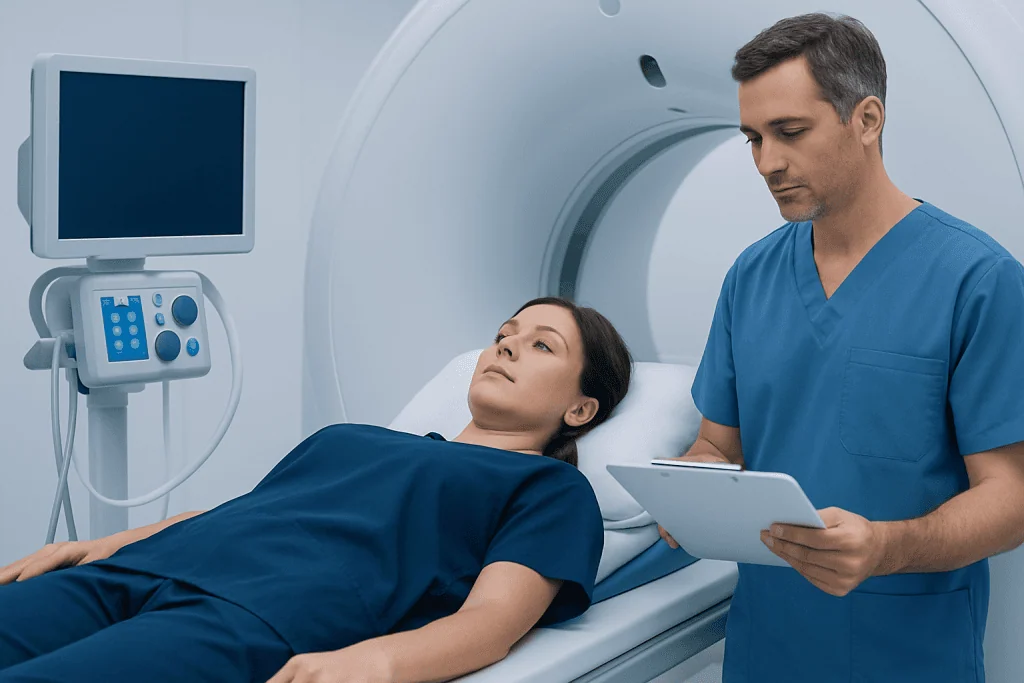
One of the simplest and most important safety practices is confirming that you are the right patient for the right test, medicine, or procedure. You will be asked your full name, date of birth, or another identifier more than once, sometimes several times in a single hour. This is deliberate. Identification checks are repeated at each point where an error could occur, not just once at registration, because each new step is a new opportunity for a mix-up. Repetition is the system working, not the system failing.
Your medical information is checked in parallel. Teams review your symptoms, previous diagnoses, allergies, current medicines, and test results before decisions are made. When several departments are involved, records and updates are shared so your care stays coordinated rather than fragmented. Before surgery, these checks intensify: site marking, pre-procedure verification, and a final team pause are standard elements, which we explain in more detail in our guide to the safety checks that support surgery and inpatient care.
You strengthen this process by giving complete and accurate information from the start. Bring a written list of your medicines, mention supplements and herbal products, and tell your team about allergies, past reactions to anaesthesia, chronic conditions, implants, and recent illnesses. Small details matter more than most people expect: a supplement you consider harmless may interact with a procedure plan, and an old implant may affect which scans are suitable.
- Expect repeat identity checks before tests, medication administration, and procedures, and expect them to match your wristband.
- Point it out if your name, date of birth, or allergy details are recorded incorrectly anywhere, even on a minor form.
- Keep copies of reports, scans, and prescriptions with you during your trip rather than packed in checked luggage.
Infection prevention and a safe hospital environment

Many patients think of safety only in relation to surgery, but the environment matters just as much. Clean rooms, hand hygiene, sterilisation of equipment, careful waste handling, and isolation measures when appropriate all reduce infection risk. These routines are a core part of daily hospital life, defined, trained, and audited rather than left to individual habit.
You will see visible traces of this system: hand sanitiser points at entrances and bedsides, staff cleaning their hands between patients, protective equipment used where the situation calls for it, and clear cleaning procedures in patient areas. Less visible parts matter too, such as how sterile instruments are tracked, how air is handled in operating theatres, and how staff movement between areas is managed.
Your part is simpler but real. Clean or sanitise your hands regularly, especially before eating and after touching shared surfaces. Standard pre-admission questions cover recent fever, cough, stomach symptoms, and other signs of illness, because a new infection can change the safest timing for a procedure, answer them fully rather than minimising anything. During recovery, teams monitor wounds and dressings on a schedule; how dressings are managed after you leave the hospital is covered in our guide to wound care and dressings after discharge in Turkey.
Medication safety and clear communication
Medication safety depends on detail. Your team needs to know what you take regularly, what you have stopped recently, and whether you have ever reacted badly to a drug. The hospital then applies its own layer of checks: what is prescribed, at what dose, at what time, and whether it fits your condition, your other medicines, your kidney and liver function where relevant, and your procedure plan.
If you are travelling from abroad, medicine names and packaging often differ from what local teams see daily. The same active ingredient can carry different brand names in different countries. This is why a written list is so useful. For each medicine, note the name (ideally the generic name), the dose, how often you take it, and why, if you know. Do the same for vitamins, herbal products, and blood thinners in particular, since these can affect procedures and recovery. Any decision to pause, adjust, or restart a medicine belongs to your treating doctor: the safe habit for you is to report everything and change nothing on your own initiative.
Communication is part of medication safety, not an accessory to it. At Acibadem, interpreter and international patient support services help reduce confusion for patients who are not comfortable in Turkish or English. It is entirely reasonable to ask what a medicine is for, when to take it, how it relates to food, and what side effects your team wants to hear about. If an answer is too fast or too technical, ask for it again in simpler words. That is not an imposition; it is how the system is supposed to work.
Handovers: how information follows you between teams
Some of the highest-risk moments in any hospital are not procedures but transitions: shift changes, transfers between departments, moves from theatre to recovery to ward. If information is lost at these points, a pending test result, an allergy, a change in the plan, errors become possible even when every individual clinician is careful.
This is why handovers are structured rather than casual. Outgoing staff pass on your history, current status, active medicines, pending results, and plan in a defined format, and incoming staff are expected to confirm they have understood. Documentation supports this: what is written in your record is what the next team relies on, which is one more reason accuracy at registration matters.
You will sometimes notice a new nurse or doctor asking questions you have already answered. Occasionally that is a gap being closed; more often it is verification, checking that what is in the record matches what you say. Answer patiently and mention anything that seems to be missing. You are a legitimate part of the handover chain, not a bystander to it.
Why multidisciplinary teamwork matters
Some conditions are straightforward. Others involve decisions across imaging, surgery, internal medicine, oncology, rehabilitation, or follow-up care. In those cases, quality is strengthened when specialists review your case together rather than in sequence, each seeing only a fragment. Joint review helps align the diagnosis, the timing, and the order of treatment steps. If your case involves several fields, our guide on how multidisciplinary care is coordinated in Turkey explains the process in more depth.
Multidisciplinary work also matters for logistics. If you are visiting Turkey for a limited time, coordinated scheduling reduces unnecessary gaps between consultation, testing, and treatment. Good coordination does not mean rushing. It means each step happens in the right order, with the right information available to each team, and with enough time built in for results to be reviewed properly before the next decision.
Acibadem supports this by connecting clinical teams with international patient coordinators, interpreters, and practical travel support. For you, this typically means fewer communication gaps, a single point of contact for scheduling questions, and a clearer sense of who holds the overall plan while you move between departments.
What accreditation means for you as a patient
Accreditation sounds technical, but the patient-side meaning is straightforward: an external body reviews the hospital against recognised standards for quality and safety. JCI accreditation, for example, is associated with structured processes around patient identification, infection prevention, medication management, staff training, documentation, and continuous improvement. We explain the framework in detail in what our JCI accreditation means for your safety.
It is worth being precise about what accreditation does not mean. It does not mean perfection, and it does not guarantee any specific medical outcome, no honest hospital will claim otherwise. What it does mean is that safety is treated as a system rather than an individual habit: policies are written down, staff are trained against them, key processes are measured, and shortfalls are reviewed and corrected. That creates a stronger foundation for consistent care, day after day, across shifts and departments.
If you are weighing hospitals in different countries, accreditation is one useful signal among several, alongside how openly a hospital discusses risks, how it handles your records, and how its teams communicate. Our guide on how to compare hospital quality and safety standards in Turkey sets out a practical way to read these signals together rather than relying on any single badge.
Safety does not stop at discharge
Quality and patient safety in daily care extend past the hospital doors. A safe discharge is a planned event, not an administrative moment: before you leave, your team walks through your medication schedule, wound or dressing care where relevant, activity limits, follow-up appointments, and the specific changes they want to hear about while you recover.
For international patients this stage carries extra weight, because part of your recovery may happen in a hotel room or back home. Written discharge summaries, translated where needed, help your local doctor continue care without gaps. Many patients also find it useful to keep a daily recovery log during treatment: a simple record of temperature, pain, medicines taken, and how a wound looks, which makes follow-up conversations far more precise than memory alone.
Treat the discharge conversation as the last safety check of your stay. Repeat the plan back in your own words, ask for anything unclear to be written down, and make sure the documents you leave with match what you were told. Ambiguity at this stage is fixable in five minutes; ambiguity discovered at home is much harder to resolve.
How you can take part in your own safety
You do not need medical knowledge to contribute meaningfully to safe care. Some of the most protective actions are simple: answer questions carefully, keep your documents organised, follow fasting and preparation instructions exactly, and ask for clarification whenever something is unclear. If you think a step has been missed, a hand not cleaned, a wristband not checked, it is appropriate to say so politely. Well-run teams treat that as help, not criticism.
Bring a trusted companion if it helps, especially if you expect to be anxious, tired, or medicated. A companion can listen, take notes, and help you keep track of instructions. If you are travelling alone, use written notes and your discharge documents as your memory, and keep everything in one folder or phone album so nothing is lost between appointments.
Above all, understand the plan at each stage: what happens next, why, and what you need to do to prepare. The pre-travel stage is a good place to start: our guide on how we explain surgical risks and safety checks before you travel shows what a thorough risk conversation should cover, so you can recognise one when you have it.
Step by step
- Gather your medical history early. Collect reports, scan results, your medication list, allergy details, and notes from previous procedures well before you travel. Complete records let teams review your case accurately and prepare consultations and tests without last-minute gaps.
- Expect repeated safety checks. Staff will ask your name, date of birth, or other identifiers many times during your visit. These checks are intentional and are one of the simplest ways hospitals reduce the risk of mix-ups.
- Use interpreter or coordinator support if needed. If you are not fully comfortable discussing medical details in English or Turkish, ask for language support. Clear communication lowers stress and helps you follow consent discussions, medicines, and follow-up plans.
- Review your medicines and allergies at every key point. Before tests, admission, procedures, and discharge, go through your current medicines and allergies with the team again, especially if brand names differ in your home country or anything changed during your trip.
- Follow preparation and hygiene instructions exactly. Fasting rules, skin preparation guidance, and any medicine instructions from your treating doctor exist for safety and timing reasons. Follow them as given, and raise questions rather than improvising.
- Confirm the plan before you leave. At discharge or transfer, make sure you know your next appointment, medication schedule, activity limits, and what your team wants to hear about during recovery, and that it is all written down.
Your checklist
- Passport or ID and hospital registration details
- Copies of recent reports, test results, and imaging
- A written list of all medicines, vitamins, and supplements, with doses
- A note of any allergies or previous reactions to medicines or anaesthesia
- Contact details for your companion or emergency contact
- Questions you want to ask during consultations, written in advance
- Comfortable clothes and personal aids such as glasses or hearing devices
- One folder (paper or digital) where every document from the trip is kept together
Key takeaways
- Quality and patient safety are built from daily routines, identity checks, medication review, hand hygiene, structured handovers, not one-time inspections.
- Repeated questions and checks are the system working as designed, not a sign of disorganisation.
- Accreditation means safety is treated as a measured, reviewed system; it does not and cannot guarantee outcomes.
- Handovers and discharge are transition points where structure matters most, and where your own attention helps.
- You contribute by sharing accurate information, keeping documents organised, and asking questions until the plan is clear.
Frequently asked questions
Why am I asked to confirm my identity so many times?
Repeated identity checks are a standard safety measure applied before medicines, tests, samples, and procedures. Each new step is a fresh opportunity for a mix-up, so the check is repeated at each one rather than relying on registration alone.
Does accreditation guarantee a successful outcome?
No. No accreditation can guarantee a medical result, and any hospital claiming otherwise should be treated with caution. Accreditation means the hospital follows recognised standards for quality and safety and has its systems reviewed regularly by an external body.
What is the difference between quality and patient safety?
Quality is the broader idea: care delivered reliably and consistently to a defined standard. Patient safety is the part of quality focused specifically on preventing avoidable harm, such as identification errors, infections, and medication mistakes. In daily care the two overlap constantly.
What should I bring to help the team care for me safely?
Bring your reports, imaging, prescriptions, allergy information, and a complete written list of medicines and supplements with doses. Translated summaries are helpful where available. Keep everything with you in one folder rather than in checked luggage.
How does language support fit into patient safety?
Misunderstood instructions are a genuine safety risk, so interpretation is treated as part of care rather than a courtesy. Interpreter and coordinator support helps patients follow consent discussions, medication explanations, and discharge instructions accurately.
What happens during a clinical handover, and why does it matter to me?
At shift changes and transfers, staff pass on your history, current status, medicines, pending results, and plan in a structured format. It matters because transitions are where information is most easily lost; structure and documentation close that gap.
Is it acceptable to question staff or point out something that seems missed?
Yes. Speaking up politely, about an unchecked wristband, an unclear instruction, or a detail recorded incorrectly, is a recognised part of patient safety, and well-run teams treat it as useful information rather than a complaint.
How can my family or companion support patient safety?
A companion can listen during consultations, take notes, keep documents organised, and notice when something needs clarification. That second set of ears is especially valuable when you are tired, anxious, or recovering from anaesthesia.
Add us as a Preferred Source to see more of our trusted health content across Google Search, AI Overviews and Discover.

Update history
- PublishedJune 22, 2026
- Medical review approvedSeptember 13, 2026
- Last content updateSeptember 12, 2026
References2
- Patient safety: World Health Organization fact sheet who.int
- Patient safety: MedlinePlus medlineplus.gov
More Patient Guides

When to Delay Travel for Treatment in Turkey Because of Cold, Flu, or Fever
Delay travel for treatment in Turkey if you have fever, worsening flu symptoms, or breathing difficulty; contact your care team before flying.

Traveling to Turkey for Treatment While Pregnant: Safety Questions to Ask First
Traveling to Turkey while pregnant can be safe with medical clearance, airline checks and a tailored care plan. Ask these key safety…

When to Seek Urgent Help After Leaving the Hospital in Turkey
When to seek urgent help after leaving the hospital in Turkey: act fast for breathing trouble, chest pain, heavy bleeding, high fever,…

At Acibadem, How We Handle Consent, Privacy, and Patient Decision-Making
Consent, privacy, and patient decision-making at Acibadem in Turkey are handled with clear information, confidentiality, interpreters, and respect for your choices.