

Need a Blood Transfusion in Turkey? What International Patients Should Know

If you need a blood transfusion in Turkey, expect the same core safeguards used internationally: identity checks, blood grouping, compatibility testing, screened donor blood and monitoring throughout. Bring your passport, medical records and details of any past transfusions or reactions. When you can travel afterwards depends on the condition that made the transfusion necessary, not on the transfusion itself.
You may have been told you need a blood transfusion in Turkey — as part of planned treatment, or unexpectedly, far from home. Either way, it helps to know exactly what happens, what is checked and what is expected of you.
The short version: a transfusion in a Turkish hospital follows the same core safeguards used internationally. Your identity is verified, your blood group is confirmed, the donor unit is matched against your sample, and staff monitor you throughout. This guide walks through the process step by step, explains what international patients should know before they arrive, and covers the practical questions — documents, timing, alternatives and travel — that the clinical team will not always think to answer unprompted.
At a glance
- Before transfusion: clinical assessment, blood grouping and compatibility testing are always required — documents alone are not enough.
- What to bring: passport, medical records, medication and allergy list, details of past transfusions or pregnancies, insurance information.
- Typical setting: inpatient ward, day-care unit, emergency department or outpatient infusion area, depending on why you need blood.
- During transfusion: your identity and the blood unit are cross-checked at the bedside; vital signs are monitored, especially at the start.
- Timing standard: a unit of red cells is completed within four hours of leaving temperature-controlled storage.
- Travel afterwards: fitness to fly depends on the underlying condition, not the transfusion itself — your treating doctor advises on timing.
When you may need a blood transfusion in Turkey
A transfusion is recommended when a doctor concludes that replacing blood, or a specific component of it, is the safest option for you. Common reasons include significant blood loss during or after surgery, anaemia that has not responded to other treatment, bleeding disorders, complications of childbirth, cancer treatment that suppresses blood production, and some long-term conditions such as inherited blood disorders. The decision is never made from a diagnosis alone: your symptoms, laboratory results, medical history and the treatment you are having all shape it.
For international patients, this need arises in two quite different ways. The first is planned: a transfusion is anticipated as part of surgery or ongoing treatment at a hospital in Turkey, and it can be prepared for in advance — records reviewed, blood group confirmed, compatible units reserved. The second is unplanned: an illness or injury during travel leads to emergency assessment, and a transfusion becomes part of the treatment that follows. In both cases the same testing and verification steps apply; what differs is how much can be organised before the day itself.
It is worth saying plainly that a transfusion is a medical treatment given after clinical evaluation, not something arranged on request. A hospital cannot confirm from documents sent from abroad that you will receive blood; a treating clinician must assess you in person, and current blood tests are almost always repeated on site.
Can foreign nationals be treated in Turkish hospitals?
Yes. Foreign nationals can receive care in Turkey’s public and private hospitals, whether the need is planned or urgent. You will need your passport for registration — accurate identification is itself a transfusion safety step — and payment or insurance arrangements are agreed with the hospital. Private hospitals that regularly treat international patients, including Acibadem hospitals, provide interpreter support and English-language documentation as part of routine service. If you are travelling specifically for treatment, it is sensible to review what your travel insurance actually covers before you fly, since policies treat planned and emergency care differently.
How blood safety checks work
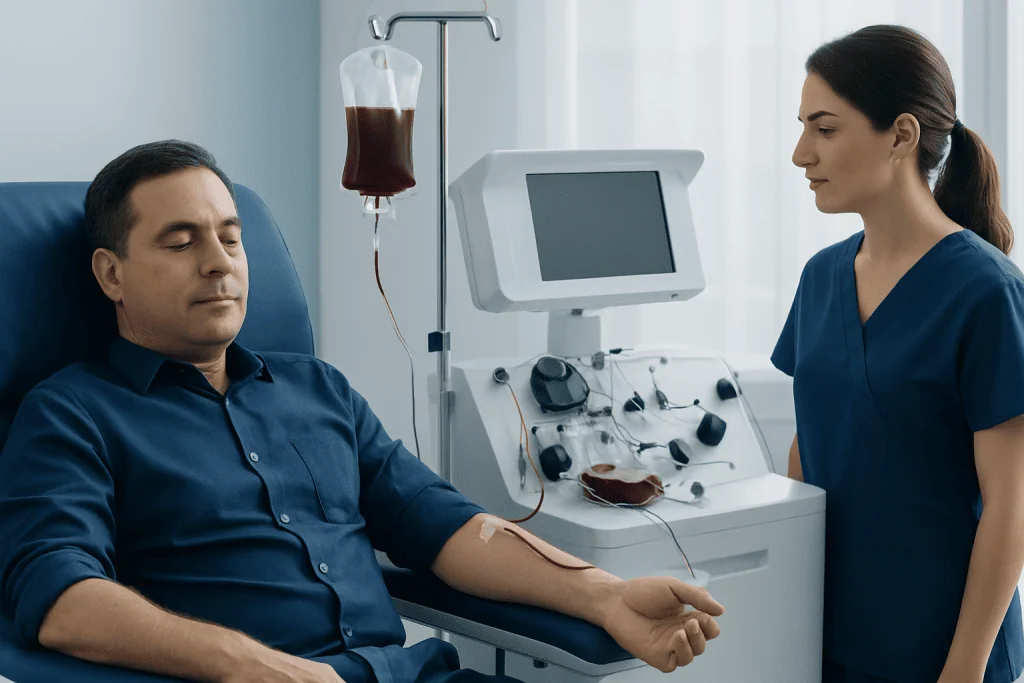
Transfusion safety rests on a chain of checks, not a single test. It begins with the donated blood: units used in Turkish hospitals come from screened voluntary donors and are tested for transfusion-transmissible infections in line with national regulation before release. It continues with you: before any transfusion, the team confirms your identity, takes a fresh blood sample, establishes your blood group and performs compatibility testing — cross-matching — between your sample and the specific unit intended for you.
Your history matters here more than many patients expect. Previous transfusions and pregnancies can create antibodies that make some units unsuitable for you even when the blood group matches. Staff will ask about these, along with allergies, current medicines and any past transfusion reactions. Depending on your condition, you may receive red blood cells, platelets, plasma or another specific component rather than whole blood — modern practice separates blood into components so that each patient receives only what they actually need.
The final safeguard happens at the bedside, immediately before the drip starts: two trained staff verify your identifying details against the label on the blood unit and against your documentation. This bedside check is repeated for every single unit, even if you receive several in one day. During the transfusion you are observed, most closely in the first minutes, and your vital signs are recorded at intervals.
- Bring any blood group card or previous transfusion records you have — they help, even though testing is repeated.
- Mention past reactions even if they happened decades ago or in another country.
- Ask which component you are receiving and why it has been recommended. A good team expects the question.
The four-hour rule and how transfusions are timed
You may come across references to a “four-hour rule”. It is a genuine, widely applied safety standard: once a unit of red blood cells leaves temperature-controlled storage, the transfusion of that unit should be completed within four hours. The limit exists because blood held at room temperature for longer both deteriorates and carries a growing risk of bacterial growth. In practice, most red cell units are transfused over one and a half to three hours, well inside the limit; the four hours is a ceiling, not a target.
Other components run to different clocks. Platelets and plasma are typically given faster, over shorter periods, because of how they are stored and how they behave once issued. What this means for you as a patient is mainly about planning your day: a single unit is not a quick visit, and if more than one unit is prescribed, each one restarts the process of bedside checks and monitored infusion. Allow a full morning or afternoon at minimum, plus observation time afterwards, and do not book anything tight against the appointment.
Alternatives to transfusion and patient blood management
Not every anaemic patient needs donor blood, and international guidance has moved steadily in that direction. The approach is called patient blood management: identify and treat the cause of anaemia where possible, minimise blood loss during procedures, and transfuse only when the expected benefit is clear. Turkey has an active national patient blood management programme, and Turkish hospitals apply these principles alongside international guidance.
What the alternatives look like depends entirely on why transfusion was suggested. For iron-deficiency anaemia, the treating team may consider iron therapy instead of, or before, blood. Around surgery, options can include correcting anaemia in advance, surgical and anaesthetic techniques that reduce bleeding, medicines that limit blood loss, and cell salvage — collecting and returning your own blood during the operation. None of these is universally suitable, and whether one is safe in your situation is a judgement your treating doctor makes with your full picture in front of them.
If you decline blood products for personal or religious reasons, say so early — ideally when treatment is first being planned. Turkish consent practice allows you to accept or refuse specific interventions, and your preferences should be recorded before treatment begins. The guide to medical consent forms in Turkey explains how these discussions are documented.
Preparing as an international patient

Preparation is mostly paperwork, and it pays off. Bring your passport — it is required at registration and used in the identity checks that anchor transfusion safety. Bring recent laboratory reports, discharge summaries, specialist letters and imaging if relevant, plus a written list of your medicines, doses, supplements and allergies. Digital copies work, but keep them accessible offline; hospital Wi-Fi and a dead phone battery are a poor combination. The separate guide on documents to bring for hospital admission in Turkey covers the full set.
Tell the team about anything that could affect how a transfusion is planned or monitored: heart, kidney, liver or lung conditions; clotting problems; pregnancy, current or past; previous surgery; and any prior transfusion, anywhere, ever. These details influence which component is chosen, how quickly it is given and how closely you are watched. If your transfusion sits within a larger course of treatment, expect additional workup — the guide to pre-op tests in Turkey outlines what is commonly repeated on arrival even when you have recent results from home.
Language should not be left to chance. Acibadem International’s patient services coordinate interpretation for consultations, consent discussions and practical questions. An interpreter supports understanding, but the standard remains the same as anywhere: if something is unclear, ask again before you sign. Your records are handled under Turkish data protection law; the guide on medical records privacy in Turkey explains how sharing and consent work.
What happens on the day
On arrival you register, your identity is confirmed and you meet the team responsible for your care. Blood tests are usually repeated or updated — always if your samples were taken elsewhere, and often even if they were taken locally, because compatibility testing must reflect your current state. Before anything starts, a clinician explains why the transfusion is recommended, what it involves, the recognised risks and any alternatives relevant to you, and asks for your consent.
The transfusion itself is given through an intravenous line, usually in your arm or hand. You can read, use your phone and, in most settings, eat and drink normally unless told otherwise. A nurse checks your vital signs before starting, again shortly after the unit begins, and at intervals until it finishes — the first fifteen minutes or so get the closest attention, because that is when most reactions declare themselves. After the final unit, you typically stay for a period of observation before the line is removed and you are discharged with paperwork.
Practicalities: wear clothing that gives easy access to your arm, bring a charger and something to read, and arrange transport rather than planning to drive yourself. Do not leave the unit or disconnect anything unless a member of staff confirms it is safe. If you are having a transfusion around surgery, the anaesthetic team will also have their own requirements — the guide to preparing for general anaesthesia in Turkey covers those separately.
How reactions are monitored and managed
Most transfusions finish without incident, but reactions can happen, which is precisely why the monitoring exists. The signs teams watch for include fever, chills, itching, rash, flushing, nausea, dizziness, new pain — particularly in the back — dark urine, swelling and changes in breathing. Nurses will ask you to mention any change in how you feel, however minor it seems; standard practice on any change is to pause the transfusion, assess, and only continue once the team is satisfied it is safe. Pausing is routine caution, not a sign that something has gone seriously wrong.
Some reactions appear hours or days after a transfusion rather than during it, which is why discharge paperwork matters. Before you leave, the team explains what to watch for in the days that follow and gives you contact details for out-of-hours questions. If a reaction is suspected or confirmed, it is documented; make sure it goes into your own copy of your records too, because any clinician who transfuses you in future needs to know about it, in any country, for the rest of your life.
Planning your stay, travel and follow-up
Whether you can fly soon after a transfusion has surprisingly little to do with the transfusion and almost everything to do with why you needed it. Blood loss from surgery, anaemia from an ongoing condition, a bleeding disorder — each carries its own follow-up needs, and some require repeat blood tests or a period of observation before travel is medically reasonable. Ask your treating doctor for a specific answer for your situation, and do not confirm flights before you have one.
If your care is planned, build slack into the itinerary. Cross-matching, record translation, medical review and possible repeat visits can stretch a schedule, particularly in complex cases. Accommodation near the hospital is worth the modest inconvenience if more than one visit is likely. Before you leave Turkey, request a discharge summary in English, copies of the relevant laboratory results and written instructions for your doctor at home — continuity of care depends on those documents travelling with you.
Step by step
- Share your medical information before travelling, if care is planned. Recent test results, diagnosis, discharge summaries and a current medication list let the hospital prepare — and details of prior transfusions, pregnancies and reactions feed directly into compatibility planning.
- Complete clinical review and testing on site. A clinician assesses whether transfusion is appropriate for you now, and blood grouping and cross-matching are performed against a fresh sample before any unit is issued.
- Go through the consent discussion. Understand why transfusion is recommended, which component you will receive, what the alternatives are and what the observation plan looks like. Sign only when your questions are answered.
- Attend with identification and time to spare. Registration, bedside checks, the transfusion itself and observation add up; a single unit alone can occupy several hours.
- Mention any change in how you feel during treatment. Monitoring works best when patients report early; pausing a transfusion to assess is normal practice.
- Collect your paperwork before discharge. Discharge summary, laboratory results, details of the components given and out-of-hours contact information — in English where you need it.
- Hand the records to your doctor at home. Especially important if you need further testing, ongoing treatment for the underlying cause, or ever need blood products again.
Your checklist
- Passport or official photo identification
- Recent blood test results and medical reports
- List of medicines, supplements, doses and allergies
- Details of previous transfusions or transfusion reactions
- Information about pregnancies, if relevant to your medical history
- Travel insurance policy and insurer contact details, if applicable
- Emergency contact and companion details
- Comfortable clothing with easy access to your arm
- Phone charger and any approved personal comfort items
- Plan for transport and accommodation after your appointment
Key takeaways
- A blood transfusion in Turkey follows clinical assessment, identity verification, blood grouping and compatibility testing — the same safeguards used internationally.
- Donor blood is screened before release, and every unit is cross-checked against you at the bedside before it starts.
- The four-hour rule means each red cell unit is completed within four hours of leaving controlled storage; plan a long visit, not a quick one.
- Alternatives to transfusion exist under patient blood management, but whether one suits you is your treating doctor’s call.
- Travel timing depends on the underlying condition, not the transfusion — and your English-language discharge records are what keep care continuous at home.
Frequently asked questions
Can foreigners go to hospital in Turkey?
Yes. Foreign nationals can be treated in Turkish hospitals, public and private, for both planned and urgent care. You need your passport for registration, and payment or insurance arrangements are agreed with the hospital. Private hospitals that regularly treat international patients provide interpreter support and English-language documentation.
What is the 4-hour rule for blood transfusions?
Once a unit of red blood cells leaves temperature-controlled storage, the transfusion of that unit should be completed within four hours. The limit protects against deterioration of the blood and bacterial growth at room temperature. Most units are actually given over one and a half to three hours; four hours is the ceiling, not the norm.
What can I do instead of getting a blood transfusion?
It depends entirely on why transfusion was recommended. Under patient blood management, teams may consider treating the cause of anaemia — iron therapy for iron deficiency, for example — reducing blood loss during procedures, using medicines that limit bleeding, or cell salvage during surgery. None of these is universally suitable; whether an alternative is safe in your case is a decision for your treating doctor.
What are the new blood transfusion guidelines for 2026?
There is no single global rulebook; national and international bodies revise transfusion guidance periodically. Recent revisions have consistently reinforced patient blood management: transfusing only when clearly indicated, using single units where appropriate and treating the underlying cause of anaemia. Your treating team applies the guidance in force at the time of your care, and can explain how it shapes your plan.
How long does a blood transfusion take?
A single unit of red cells usually runs over one and a half to three hours, and each additional unit restarts bedside checks and monitored infusion. Add registration, pre-transfusion testing and observation afterwards, and a realistic plan is at least half a day rather than a short visit.
Can a family member donate blood directly for me?
Directed donation policies vary and direct donation is often neither necessary nor faster, because every donor must still be screened and every unit tested and cross-matched. If this matters to you, raise it with the hospital’s transfusion service well in advance so that eligibility, timing and compatibility requirements can be checked.
Will I need to stay overnight in hospital?
Not always. Some patients receive transfusions in day-care or outpatient units and go home the same day; others are admitted because of the condition causing the anaemia or bleeding, or because they need further treatment. Your clinician advises based on your results and overall health, not on the transfusion alone.
Can I fly home soon after a blood transfusion in Turkey?
There is no universal answer. Fitness to fly depends on the underlying reason for the transfusion, how you have responded and whether you need further tests or monitoring. Ask your treating doctor for individual travel advice before confirming or changing flights, and carry your discharge summary when you travel.
Add us as a Preferred Source to see more of our trusted health content across Google Search, AI Overviews and Discover.

Update history
- PublishedAugust 21, 2026
- Medical review approvedSeptember 2, 2026
- Last content updateSeptember 2, 2026
References3
- Blood transfusion — NHS — nhs.uk
- Blood safety and availability — World Health Organization — who.int
- Blood Transfusion and Donation — MedlinePlus — medlineplus.gov
More Patient Guides

When You May Need ICU Care After Surgery in Turkey
ICU care after surgery in Turkey may be planned for close monitoring or needed if recovery requires extra support. Learn what to…
8 min read
Medical Records Privacy in Turkey: Consent, Sharing, and Patient Rights
Medical records privacy in Turkey gives you rights to informed consent, confidential care, record access and controlled sharing during treatment in Istanbul.
8 min read
When to Delay Travel for Treatment in Turkey Because of Cold, Flu, or Fever
Delay travel for treatment in Turkey if you have fever, worsening flu symptoms, or breathing difficulty; contact your care team before flying.
8 min read
Traveling to Turkey for Treatment While Pregnant: Safety Questions to Ask First
Traveling to Turkey while pregnant can be safe with medical clearance, airline checks and a tailored care plan. Ask these key safety…
8 min read