

Blood Transfusion Safety in Turkey: Patient Guide

Blood transfusion safety in Turkey rests on a chain of checks: regulated donor screening, laboratory typing and crossmatching, bedside identity verification, consent in a language you understand, and close monitoring during the infusion. Your role is simple, share your medical history early, confirm your name matches your wristband, and report any new symptom immediately. No transfusion is entirely without risk, but each check exists to catch problems early.
If a blood transfusion might be part of your treatment in Turkey, during surgery, cancer care, childbirth or intensive care, you probably have two questions. Is it safe? And what, exactly, will happen? This guide answers both, without glossing over the limits.
Blood transfusion safety in Turkey is not one test or one signature. It is a chain: donor screening, laboratory matching, bedside identity checks, consent, monitoring and documentation. When you understand each link, you can take part in it, and speaking up is genuinely useful, not a nuisance. Here is what to expect, what to ask, and what to bring with you.
At a glance
- Best for: Patients planning surgery, cancer care, childbirth or any treatment in Turkey where a transfusion is possible
- How blood is supplied: Blood services in Turkey are nationally regulated; donations are screened for defined transfusion-transmissible infections before release
- Main safety layers: Blood typing, antibody screening, crossmatching, bedside identity verification, monitored infusion, documented traceability
- Your part: Share previous reactions, antibodies, rare blood group information, allergies and current medicines before admission
- Language support: Interpreters help with consent, symptom reporting and discharge instructions, ask for one early
- Where to confirm details: Your treating doctor, anaesthesiology team, nursing team and international patient coordinator
Blood transfusion safety in Turkey: how the system works
Blood services in Turkey are regulated at national level. Donations are collected largely through the Turkish Red Crescent under Ministry of Health oversight, and every unit is tested for a defined set of transfusion-transmissible infections, including HIV, hepatitis B, hepatitis C and syphilis, before it can be released to hospitals. Hospitals then add their own layer: their transfusion committees, laboratory procedures and bedside protocols determine how a unit reaches an individual patient safely.
It helps to be honest about what this means. No transfusion anywhere in the world is entirely without risk. Screening and matching dramatically reduce preventable harm, but reactions can still occur, which is why monitoring during the infusion matters as much as the laboratory work before it. Blood transfusion safety in Turkey, as elsewhere, is best understood as risk managed through repeated checks rather than risk eliminated.
There is also a broader shift you may hear about called patient blood management. Turkish hospitals, in line with international practice, increasingly focus on avoiding unnecessary transfusion in the first place: treating anaemia before planned surgery, limiting blood loss during procedures, and transfusing only when laboratory results and your clinical condition justify it. A transfusion is a deliberate medical decision, not a routine add-on. If you want the fuller clinical picture of when and why transfusions are used, our guide on blood transfusion in Turkey for international patients covers the treatment side in more depth.
How hospitals reduce transfusion risks
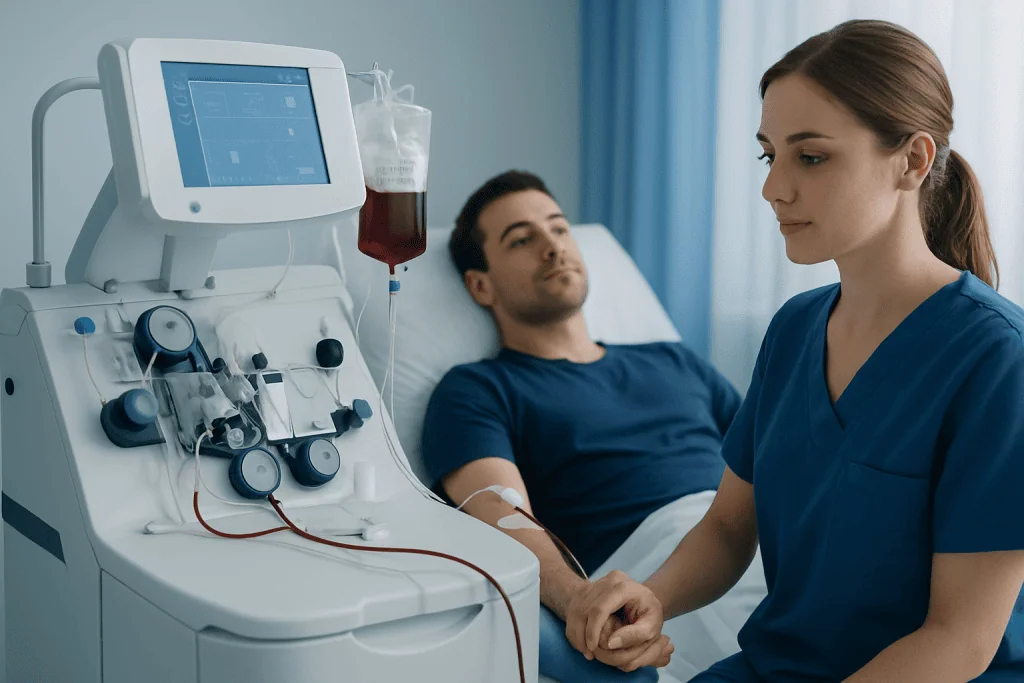
Before any blood reaches you, several things happen in sequence. A blood sample is taken from you and labelled at your bedside. The laboratory determines your ABO group and Rh type, then screens your plasma for unexpected antibodies that could react against donor blood. If a transfusion is planned, a crossmatch tests your blood against the specific donor unit. Many hospitals also require a second, separately drawn sample before releasing group-specific blood: a deliberate safeguard against the rare but serious error of a mislabelled tube.
Storage and handling follow strict rules too. Blood components are kept in controlled, monitored conditions, transported in a documented cold chain, and labelled so that every unit can be traced from donor to recipient. One practical rule you may hear is the four-hour rule: once a unit of red cells leaves controlled storage, the transfusion should begin promptly and finish within four hours. Beyond that window, the risk of bacterial growth and loss of quality rises, so the unit is not used.
Depending on your condition, the team may consider different components, red cells for oxygen-carrying capacity, platelets for clotting support, plasma or cryoprecipitate for clotting factors. Each has a specific purpose, and the choice depends on your laboratory results, bleeding risk and overall plan. If the reasoning is not clear to you, ask for a plain-language explanation. Terms like typing, screening and crossmatching are part of a safety culture, and any good team can translate them into ordinary words.
Consent, communication and your right to ask questions
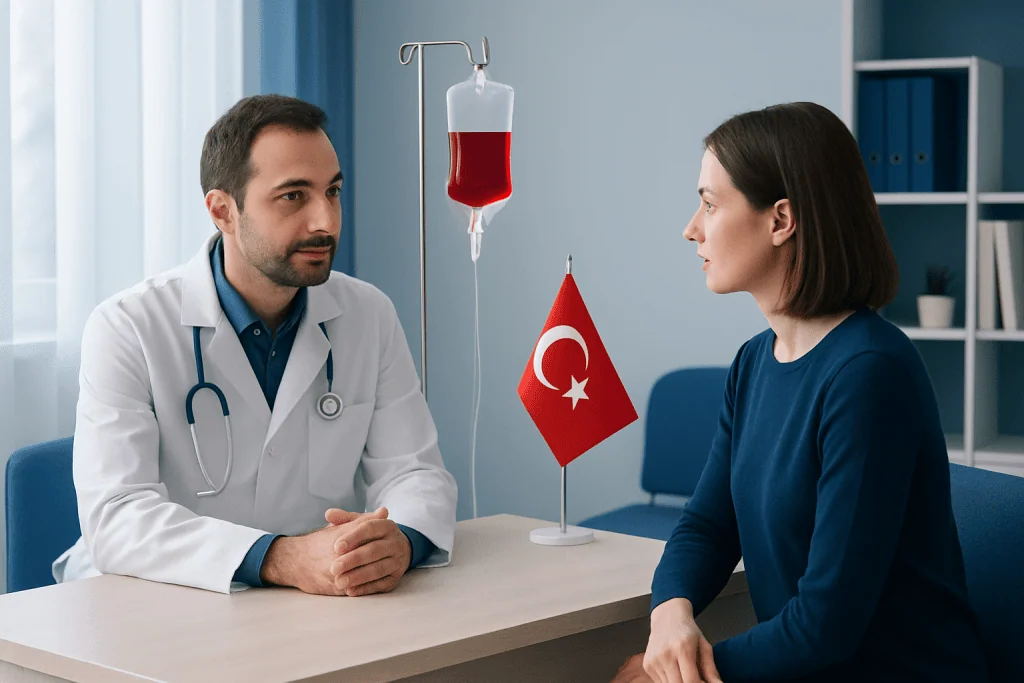
For a planned transfusion, your doctor should explain why it may be needed, what benefit is expected, what risks exist and whether alternatives are realistic in your case. In an emergency the sequence changes, because stabilising you comes first, but the team should still inform you or your authorised representative as soon as circumstances allow.
For international patients, language support is a safety tool, not a courtesy. An interpreter helps you understand the consent form, ask precise questions and report symptoms accurately. If you are treated through Acibadem International, your patient coordinator can arrange interpretation and keep communication moving between departments. Do not sign anything you have not fully understood; asking for the form to be explained again is normal and expected.
Useful questions include: Why might I need a transfusion? Which component is being considered? Are there non-transfusion options for me? How will I be monitored? Which symptoms should I report at once? If you have religious, personal or medical concerns, including questions about faith and transfusion, which we address in the FAQ below, raise them during planning, not on the morning of surgery. Early conversation gives your team time to discuss safe, realistic options. Our safety and consent checklist for surgery in Turkey pairs well with this guide if an operation is part of your plan.
Patient identification and bedside checks
The most error-sensitive moment in transfusion is not in the laboratory: it is at the bedside. Before blood is started, staff verify your identity against the blood product according to hospital policy. Expect to state your full name and date of birth more than once, and expect staff to compare your wristband, your medical record and the label on the unit. In many hospitals two qualified staff members check together, or an electronic scanning system supports the verification. The repetition is intentional. It is the check working, not failing.
International patients add one specific risk that is easy to fix early: name mismatches. If your passport name differs from the name you commonly use, if you have multiple surnames, or if spellings vary across your documents, tell the admissions team on day one so your hospital registration matches your passport exactly. A wristband that matches your official identity is a genuine safety asset.
You can support the process directly. Keep your wristband on, never remove identification labels, and correct any mismatch immediately and politely. If someone approaches with blood, medication or a procedure without confirming who you are, it is entirely reasonable to say: “Please check my name and date of birth first.” Safe teams welcome that sentence. If something ever feels wrong and you are not being heard, you can also read how to report a safety concern in a Turkish hospital.
What monitoring feels like during and after a transfusion
Before the infusion starts, your nurse records baseline observations, temperature, pulse, blood pressure, breathing. The first fifteen to thirty minutes are watched most closely, because many reactions announce themselves early, and the infusion often begins slowly for that reason. You will be checked at intervals throughout, and you can call the nurse at any point in between.
Report these symptoms immediately, even if they seem mild: fever, chills, itching, rash, back pain, chest tightness, shortness of breath, dizziness, nausea, dark urine, pain at the infusion site, or simply a sudden feeling that something is wrong. That last one matters, patients often sense a reaction before the numbers change. Pausing the transfusion for assessment is a standard, well-rehearsed response, and many reactions are manageable precisely because they were reported early. You are never inconveniencing anyone by speaking up.
Afterwards, the team may repeat blood tests or continue observation, depending on why you needed the transfusion and how you are recovering. Before you leave the ward, ask two things: which symptoms should prompt you to contact the hospital, and how to reach the team after hours from your hotel.
Special considerations for international patients
Preparation from home makes decisions in Turkey faster and safer. Bring recent blood test results, surgical and cancer treatment summaries, a complete medication list, allergy details and any record of previous transfusions. Three things deserve to be flagged before you even book flights: a previous transfusion reaction, known antibodies or “difficult crossmatch” history, and a rare blood group. Any of these can affect how far in advance the hospital needs your sample, so earlier is genuinely better.
Expect the Turkish hospital to repeat blood typing and compatibility testing even if you carry documents from home. Current, locally verified results are a safety requirement, not a distrust of your paperwork: our guide on why blood tests and scans may be repeated in Turkey explains the reasoning.
Medicines matter too. If you take anticoagulants, antiplatelet drugs, iron, chemotherapy or anything that affects bleeding, do not stop or change them yourself. How they are handled before travel and before surgery is a decision for your treating doctor; see managing blood thinners before treatment in Turkey for the questions worth asking. Your international patient coordinator can help with the practical layer, appointments, admission, interpreter booking and keeping your companion informed, so your attention stays on the medical decisions.
Aftercare, records and returning home
Before discharge, ask directly whether you received a transfusion and, if so, which component and how many units. You do not need to memorise the details: you need them written into your discharge summary. That record can matter years later, for future surgery, pregnancy care, cancer treatment or emergencies, because prior transfusion can influence antibody development and future matching.
Your discharge instructions should cover follow-up tests, medicines, activity guidance and warning signs. If you plan to fly soon after treatment, ask whether your haemoglobin level, your underlying condition or your procedure affects safe travel timing: this is an individual judgement, not a fixed rule.
After returning home, give your local doctor a copy of your Turkish records, including the transfusion note. If you notice fever, jaundice, dark urine, worsening fatigue or unusual bruising in the days or weeks afterwards, contact a doctor promptly and mention the date and place of the transfusion. If you develop severe breathing difficulty, chest pain or another rapidly worsening symptom, call your local emergency number or go to the nearest emergency department now. Most patients need no such care, but clear records and a low threshold for asking make the rare problem easier to handle.
Step by step
- Send your records before you travel. Share recent blood tests, diagnosis reports, medication lists, allergy history and any previous transfusion reaction details with your care coordinator. Flag rare blood groups or known antibodies explicitly, do not assume they will be noticed in a stack of documents.
- Discuss transfusion possibility during planning. Ask whether your procedure commonly involves transfusion, whether blood will be prepared as a precaution, and what would trigger the decision. This is also the moment to raise religious, personal or medical preferences.
- Confirm language support for consent. Request an interpreter if you are not fully comfortable in medical English or Turkish. Understanding the reason, risks, benefits and alternatives is part of valid consent, not a formality.
- Check your identity details at admission. Make sure your wristband matches your passport exactly. Report spelling differences, multiple surnames or name changes on day one.
- Ask what to watch for before the infusion starts. Have the nurse list the symptoms worth reporting, and report them the moment they appear rather than waiting to see if they pass.
- Keep your companion in the loop. Ask them to listen to key instructions and help you remember questions, especially after anaesthesia, when your own recall will be unreliable.
- Collect your discharge documentation. Request a summary noting your diagnosis, treatment, test results, medicines and any blood products given. Keep a digital and a paper copy.
Your checklist
- Passport and hospital registration details match your wristband exactly
- Recent blood tests and medical reports shared before admission
- Medication list includes blood thinners, supplements, chemotherapy and allergies
- Previous transfusion reactions, antibodies or rare blood group clearly reported
- Interpreter arranged for consent and discharge conversations if needed
- You understand why transfusion may be needed and what alternatives exist in your case
- You know which symptoms to report during and after transfusion
- Your companion knows whom to contact in the hospital if concerns arise
- Discharge summary saved, including any transfusion details, before you fly home
Key takeaways
- Transfusion safety is a chain: regulated donor screening, typing and crossmatching, bedside identity verification, consent, monitoring and traceable documentation.
- Share prior reactions, known antibodies, rare blood group information, medicines and allergies before you travel, earlier disclosure means better planning.
- The Turkish hospital will repeat its own compatibility testing; documents from home inform the team but never replace current checks.
- During a transfusion, report fever, chills, rash, breathing difficulty, chest or back pain, dark urine or any sudden discomfort immediately.
- Take home a discharge summary that records whether blood products were given: it protects your care for years.
Frequently asked questions
Will I automatically receive a transfusion during surgery in Turkey?
No. Transfusion depends on your clinical condition, blood loss, laboratory results and your team’s judgement. For many procedures, blood is prepared only as a precaution and never used. Ask your surgeon or anaesthesiology team how the decision would be made in your specific case.
Can I refuse a blood transfusion?
You can discuss refusal, and you should do so as early as possible if you have religious, personal or medical objections. Your team will explain the risks of refusing, which alternatives are realistic for you, and how emergencies would be handled. In urgent situations, local law, consent rules and the severity of your condition can affect decision-making, so put your wishes in writing during planning.
Are Muslims allowed to give and receive blood transfusions?
Mainstream Islamic scholarship widely regards both blood donation and transfusion as permissible, particularly when health or life is at risk, and transfusion is routine medical practice in Turkey and across the Muslim world. Interpretations can vary between communities, so if this concerns you, raise it with your care team and, if you wish, your own religious adviser before treatment.
What is the 4-hour rule for blood transfusions?
Once a unit of red cells leaves controlled cold storage, the transfusion should start promptly and be completed within four hours. Beyond that window, the risk of bacterial growth and deterioration of the blood rises, so the unit is discarded rather than used. It is one of several handling rules that protect you between the blood bank and the bedside.
What is the most common blood type in Turkey?
A Rh-positive is generally reported as the most common blood group in Turkey, with O positive close behind. For you as a patient, this matters little in practice: the hospital tests your blood individually, matches you to compatible units, and flags rare groups or antibodies for advance planning. Tell the team early if you know your group is uncommon.
Can I give blood at home if I have been to Turkey?
That depends on your home country’s blood service, not on Turkish rules. Some services apply temporary deferrals after travel to particular regions, sometimes varying by season and infection risk. Check directly with your national blood service, for example NHS Give Blood in the UK, before booking a donation, and tell them exactly where and when you travelled.
What are possible signs of a transfusion reaction?
Fever, chills, rash, itching, shortness of breath, chest tightness, back pain, dizziness, nausea, dark urine, or a sudden sense that something is wrong. Report any of these immediately, even if mild. The nurse can pause the transfusion and assess you according to hospital protocol, early reporting is what makes most reactions manageable.
Do I need to know my blood type before travelling to Turkey?
It is helpful but not essential, because the hospital performs its own typing and compatibility testing before any transfusion. Old documents never replace current checks. What genuinely helps is bringing records of rare blood groups, known antibodies or previous transfusion reactions, and sharing them before admission.
Add us as a Preferred Source to see more of our trusted health content across Google Search, AI Overviews and Discover.

Update history
- PublishedJune 8, 2026
- Medical review approvedSeptember 13, 2026
- Last content updateSeptember 13, 2026
References3
- NHS: Blood transfusion nhs.uk
- World Health Organization: Blood transfusion safety who.int
- MedlinePlus: Blood Transfusion and Donation medlineplus.gov
More Patient Guides

When to Delay Travel for Treatment in Turkey Because of Cold, Flu, or Fever
Delay travel for treatment in Turkey if you have fever, worsening flu symptoms, or breathing difficulty; contact your care team before flying.

Traveling to Turkey for Treatment While Pregnant: Safety Questions to Ask First
Traveling to Turkey while pregnant can be safe with medical clearance, airline checks and a tailored care plan. Ask these key safety…

When to Seek Urgent Help After Leaving the Hospital in Turkey
When to seek urgent help after leaving the hospital in Turkey: act fast for breathing trouble, chest pain, heavy bleeding, high fever,…

At Acibadem, How We Handle Consent, Privacy, and Patient Decision-Making
Consent, privacy, and patient decision-making at Acibadem in Turkey are handled with clear information, confidentiality, interpreters, and respect for your choices.