

Blood Type and Crossmatch Before Surgery in Turkey

Hospitals in Turkey confirm your ABO and Rh blood group in their own laboratory before most significant operations and run an antibody screen. A crossmatch, testing your sample against specific donor units, is added when blood may need to be reserved. Being tested does not mean you will be transfused. It means compatible blood can be prepared quickly if the surgical team decides it is needed.
You have a surgery date, your flights are booked, and then the pre-operative list mentions a blood type and crossmatch. Does that mean a transfusion is coming? Usually not. It means the hospital wants compatible blood identified and, in some cases, reserved, so that if blood is needed during or after your operation, nobody is searching for it under pressure.
This guide explains what blood type and crossmatch before surgery in Turkey actually involves, why hospitals repeat the test even when you know your group, how timing windows work, and what to have ready as an international patient.
At a glance
- Main purpose: To confirm your ABO and Rh blood group, screen for unexpected antibodies, and check donor compatibility if blood may be reserved
- Typical timing: During the pre-operative assessment after arrival; often repeated within a set window close to surgery
- Sample needed: A standard blood draw at the hospital; some blood banks require a second confirming sample
- Bring with you: Passport, any previous blood group records, transfusion history, and a full medication list
- Key point: Being typed and crossmatched does not mean you will receive a transfusion: it is preparation, not prediction
Why blood type and crossmatch matter before surgery in Turkey
Blood is not interchangeable between people. If a patient receives blood of an incompatible group, the immune system can attack the transfused cells, and that reaction can be serious. This is why hospitals treat pre-transfusion testing as a strict, rule-bound process rather than a formality, and why the blood type and crossmatch before surgery in Turkey is done in the treating hospital’s own laboratory, on a sample they drew themselves, from a patient whose identity they verified themselves.
The testing serves two purposes. First, it establishes your ABO group (A, B, AB or O) and your Rh status (positive or negative). Second, it checks whether your plasma contains antibodies, beyond the expected ones, that could react with donor blood. Only when both of these are known can a blood bank say with confidence which units are compatible with you.
Not every operation needs the full process. For procedures with a low likelihood of blood loss, many hospitals order a type and screen only: your group and antibody status are recorded, and no specific units are set aside. For operations where transfusion is more plausible, major abdominal work, some cardiovascular surgery, revision procedures, or surgery in patients with existing anaemia: the blood bank may go further and crossmatch specific donor units against your sample. Which approach applies to you is a clinical decision made by your surgical and anaesthesia teams, based on the procedure and your history.
What is usually checked
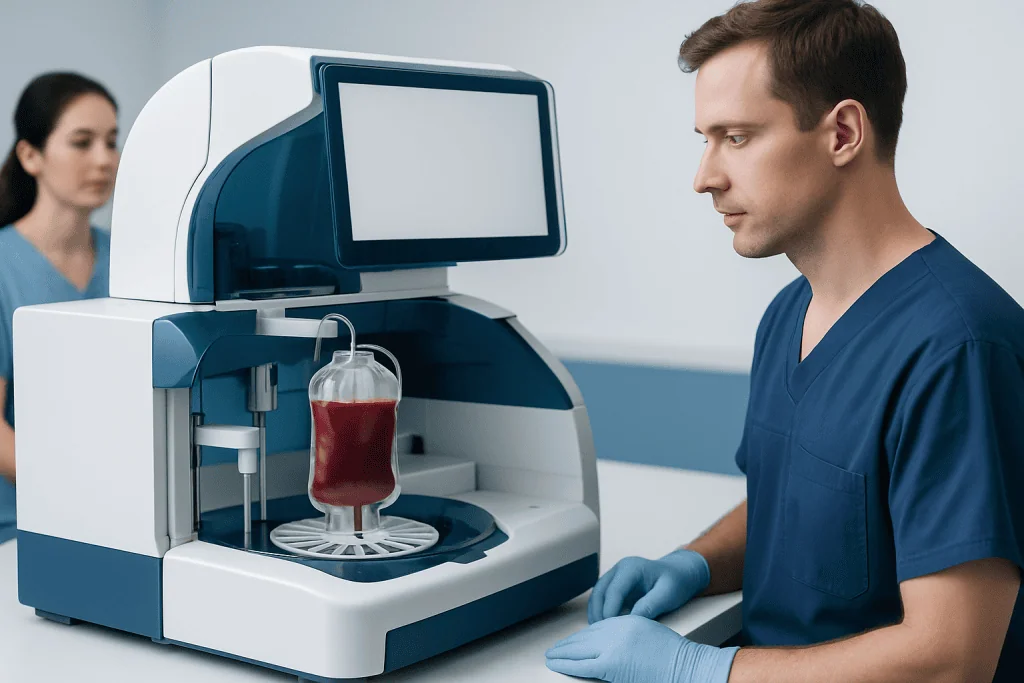
Blood grouping
The laboratory determines your ABO group and Rh status by testing your red cells against known reagents and, in parallel, testing your plasma against known red cells. The two methods must agree. Because a mislabelled tube is one of the most dangerous errors in transfusion medicine, some blood banks also require a second sample, drawn at a different time, before they will issue blood to a patient with no previous record in their system. If you are asked for a second blood draw, this is why: it is a deliberate double-check, not a mistake.
Antibody screen
Beyond the ABO system, red cells carry many other surface markers. People who have been transfused before, or who have been pregnant, can develop antibodies against markers their own cells lack. The antibody screen looks for these. A negative screen keeps the process simple. A positive screen means the laboratory must identify the antibody and find donor units that lack the corresponding marker, which takes more time and is one of the main reasons pre-operative testing is done days, not hours, before surgery.
The crossmatch itself
A crossmatch is the final compatibility check between your sample and a specific donor unit. There are different techniques. A full serological crossmatch physically mixes your plasma with donor red cells and watches for a reaction. Where the patient has a clean antibody history and the laboratory systems support it, an electronic crossmatch may be used instead: the computer verifies compatibility from validated group and screen results without a physical test. Both are established practice internationally. You do not choose the method: the blood bank does, according to your antibody status and its own protocols.
You do not need to memorise any of this. What genuinely helps is sharing your history: previous transfusions and any reactions to them, pregnancies, known antibodies, a rare blood group if one has ever been mentioned, and any haematology reports you hold. These details tell the laboratory whether your case is routine or needs extra lead time. There is more on how pre-arrival records are used in our guide to why blood tests and scans are often repeated before treatment in Turkey.
When the test is done and why it may be repeated

For most international patients, the sample is taken during the pre-operative assessment after arrival, alongside other blood work and the anaesthesia consultation. If you sent laboratory reports from home, they help the team plan, but they do not replace the hospital’s own test. A blood bank issues blood only against a sample it processed itself, under its own labelling and identity checks. A card from another country stating your group is useful background, never a substitute.
Crossmatch samples also expire. Antibody status can change, particularly after a recent transfusion or pregnancy, so blood banks set a validity window for the sample used to reserve blood. For patients transfused or pregnant within the previous few months, that window is commonly around three days. If your operation is postponed beyond the window, the draw is repeated. This is routine and does not signal a problem with your earlier result.
The practical consequence: build laboratory time into your itinerary. Registration, the blood draw, processing, and any follow-up questions all take longer than the needle itself, and a positive antibody screen can add a day or more while suitable units are sourced. If your surgery is scheduled soon after you land, the buffer matters: our guide on when to arrive before surgery in Turkey covers how much margin different procedures usually need. Acibadem International patient services coordinate the appointment sequence and interpreter support so the pre-operative days run in a sensible order.
Blood types in Turkey: a note on compatibility
Patients sometimes ask whether their blood type is common in Turkey and whether that affects planning. In Turkey, as in much of Europe and the Middle East, A Rh-positive and O Rh-positive are the most common groups, and Rh-negative groups are considerably less common. Turkish blood banks supply all ABO and Rh combinations through the national donation system, so a standard group does not need special arrangements.
Compatibility follows the same rules everywhere: group O red cells can be given to a wider range of recipients, which is why O-negative units are held for emergencies, while people with group AB can receive red cells from more donor groups. What genuinely changes planning is not a common group but a rare one, or a known antibody, either can mean the blood bank needs extra time to locate suitable units, which is why that history belongs in the pre-operative conversation as early as possible.
Why a transfusion might be needed around surgery
Transfusion around an operation generally happens for one of three reasons. During surgery, blood loss can exceed what the body comfortably tolerates, and red cells are replaced to keep oxygen delivery stable. Before surgery, some patients arrive with significant anaemia, from chronic disease, bleeding, or iron deficiency, and the team may judge that correcting it first makes the operation safer; how that is done, and whether transfusion is part of it, is an individual clinical decision. After surgery, slow ongoing losses or drain output occasionally make transfusion appropriate in the recovery period.
None of this is decided in advance by the crossmatch. The crossmatch only makes compatible blood available. Whether any of it is used depends on what happens in theatre, your laboratory values, and your team’s judgement at the time. Many patients who are fully typed and crossmatched receive no blood at all.
Medication is part of the same picture. Anticoagulants, antiplatelet drugs, and some supplements affect bleeding, and how they are managed before an operation is decided by the treating doctors, never on your own initiative. If you take any of these, read our guide on blood thinners before surgery in Turkey for the questions worth raising early in planning.
Documents and personal information to prepare
Gather your records into one digital folder before travel and, ideally, carry printed copies in hand luggage. The hospital will repeat the blood test regardless, but your history shapes how the blood bank prepares. Useful items include:
- Your passport or official ID, matching the name on your medical file exactly
- A previous blood group card or laboratory report, if you have one
- Records of past transfusions, any reactions, or documented antibodies
- A recent full blood count or any anaemia-related reports
- A complete medication list, including anticoagulants, antiplatelets, supplements, and iron treatment
- Allergy details and a summary of major previous surgeries
- Notes on pregnancies, transplant history, or any “special requirements” letter from another hospital’s blood bank
Reports in other languages can usually be reviewed with interpreter support, but clear dates, units of measurement, and hospital letterheads make them far easier to use.
What to expect at the hospital
On the day of testing, you register with your passport or hospital file number and go to the blood collection area. A staff member confirms your identity, usually name and date of birth, checked against the tube label at the bedside, before drawing the sample. Expect this check to be repeated word for word at every draw. Pre-transfusion safety depends on exact identity matching, so the repetition is deliberate.
The draw itself takes a few minutes. Allow considerably longer for the visit overall: hospital navigation, queues, consent forms, and any other tests ordered for the same session. Blood grouping does not itself require fasting, but it is often bundled with tests that do, so follow the instructions you were given rather than assuming: the details are covered in our guide to fasting rules before surgery in Turkey. If nobody has told you to fast, it is reasonable to ask before the appointment rather than skip breakfast unnecessarily.
If needles make you anxious, or you have fainted during blood draws before, mentioning it at the collection point is normal and staff are used to it. You can be seated or lying down for the draw.
Special situations that need extra lead time
Most patients pass through typing and screening without complication. A few histories genuinely change the timeline, and hospitals ask about them during pre-operative assessment precisely because they take longer to prepare for:
- Known antibodies or a positive screen in the past. The blood bank must find antigen-negative units, which can take days for uncommon combinations.
- A rare blood group. Suitable units may need to be sourced from beyond the hospital’s immediate stock.
- Previous transfusion reactions. Documentation of what happened, and when, helps the laboratory choose components and precautions.
- Bleeding disorders or complex anaemia. These may need haematology input alongside the standard surgical work-up.
- Personal or religious refusal of transfusion. Hospitals can plan around documented wishes, but doing so responsibly takes time: the feasibility of the operation without blood, the alternatives, and the consent wording all have to be worked through before the surgery date, not on the ward the night before. This is exactly the sort of topic covered in our safety and consent checklist for surgery in Turkey.
The common thread: none of these automatically rules out surgery in Turkey, but all of them reward early disclosure. A blood bank told about an antibody two weeks before the operation has options; one told on the morning of surgery has a delay.
Keeping the process smooth as an international patient
Treat blood bank testing as part of your travel plan rather than a detail. Leave a genuine buffer between landing and the operation, avoid non-refundable commitments in the day or two before surgery, and know the morning-traffic travel time from your accommodation to the hospital. Keep your phone reachable on the channel the hospital uses for appointment messages, because laboratory results occasionally prompt an added consultation at short notice.
Acibadem International’s patient services support the practical layer, interpreters, appointment sequencing, and in-hospital orientation, while all medical instructions come from your treating doctors. The division of labour is worth understanding: the concierge side reduces uncertainty about where to be and when; the clinical side decides what is tested and why.
Step by step
- Assemble your history before travel. Blood group reports, transfusion history and reactions, antibody findings, pregnancy history, allergy details, and a full medication list. If a rare group or antibody has ever been mentioned to you, put it at the top of the file.
- Confirm the pre-operative schedule. Find out when the blood sample will be taken and whether the blood bank requires a second confirming draw. Leave laboratory processing time between the draw and the operation date.
- Bring identification that matches your records. Use the same passport details for registration and testing. Identity will be checked repeatedly; this is a blood bank safety requirement, not bureaucracy.
- Follow fasting and medication instructions exactly as given. The grouping test itself may not need fasting, but adjacent tests might. Do not stop anticoagulants, diabetes medicines, or any regular medication unless your treating doctor instructs it.
- Allow real time on the day. Registration, consent forms, interpreter handover, the draw itself, and possible follow-up questions add up. Arriving early costs little; arriving tight can push results past the day’s laboratory run.
- Understand how the results will be used. It is reasonable to ask whether you are being typed and screened only, or whether units will be reserved. The answer tells you how likely a repeat sample is if dates shift.
- Expect a repeat if dates change. Crossmatch samples have validity windows, so a postponed operation usually means a fresh draw. It is routine, quick, and does not restart the whole work-up.
Your checklist
- Passport or official ID used for hospital registration
- Previous blood group report or donor card, if available
- Records of past transfusions or transfusion reactions
- Known antibody reports or rare blood group documentation
- Current medication list, including blood thinners and supplements
- Recent blood count, anaemia, or haematology reports
- Allergy list and major surgery history
- Pregnancy and transplant history, where relevant
- Interpreter arrangement confirmed, if needed
- Appointment times, hospital location, and morning travel time saved
Key takeaways
- A blood type and crossmatch before surgery in Turkey confirms your group, screens for antibodies, and checks donor compatibility if units may be reserved.
- Hospitals test in their own laboratory even when your group is documented elsewhere; a home-country card informs planning but never replaces the test.
- Crossmatch samples have validity windows, commonly around three days after recent transfusion or pregnancy, so repeats near the operation date are routine.
- Antibodies, rare groups, past reactions, and transfusion refusal all deserve early disclosure because they extend blood bank preparation time.
- Being crossmatched is preparation, not prediction: many fully crossmatched patients receive no blood at all.
Frequently asked questions
Do hospitals check your blood type before surgery?
Before most significant operations, yes. Hospitals in Turkey confirm the ABO and Rh group in their own laboratory as part of pre-operative assessment, usually with an antibody screen. For minor procedures with very low bleeding risk, the surgical and anaesthesia teams may decide it is not required.
What is the most common blood type in Turkey?
A Rh-positive and O Rh-positive are the most common groups in Turkey, and Rh-negative groups are markedly less common. For patients, the practical point is small: Turkish blood banks stock all groups, and it is rare types and antibodies, not common groups, that need extra planning time.
What are the procedures for blood typing and crossmatching?
Typing tests your red cells and plasma against known reagents to establish ABO and Rh group. An antibody screen then checks your plasma for unexpected antibodies. If blood may be reserved, a crossmatch tests your sample against specific donor units, either serologically or, for straightforward cases, electronically through validated laboratory records.
Why would someone need a blood transfusion before surgery?
Occasionally a patient arrives with significant anaemia, and the treating team judges that correcting it first makes the operation safer. Whether that involves transfusion, iron treatment, or another approach is an individual clinical decision made by the doctors after reviewing the laboratory results.
If I already know my blood type, can I skip the test?
No. Blood banks issue blood only against a sample they processed themselves, under their own identity checks, and they also need a current antibody screen. A previous report is useful background for planning, but it never substitutes for the hospital’s own test.
How long does crossmatching take?
A routine sample with a negative antibody screen usually fits within the normal pre-operative schedule. A positive screen changes this: the antibody must be identified and matching units found, which can add a day or more. This is the main reason testing is planned days before surgery rather than hours.
Will I definitely receive a transfusion if blood is crossmatched?
No. Crossmatching means compatible blood can be issued quickly if needed. The decision to transfuse depends on blood loss, your laboratory values, and clinical judgement during and after the operation. Many crossmatched patients receive no blood.
Should I stop blood thinners before my blood test?
No, never stop or change prescribed medication on your own. Blood thinners are often adjusted before surgery, but the plan depends on your diagnosis, the procedure, and your individual risks, and it comes from your treating doctors. The blood draw for typing itself does not require stopping them.
Add us as a Preferred Source to see more of our trusted health content across Google Search, AI Overviews and Discover.

Update history
- PublishedJune 16, 2026
- Medical review approvedSeptember 13, 2026
- Last content updateSeptember 13, 2026
References2
- Blood groups: NHS nhs.uk
- Blood transfusion: NHS nhs.uk
More Patient Guides

How Long Does Anesthesia Last? Wear-Off Times by Type
Coming round from an operation, almost everyone asks the same two questions: when will my head feel normal, and how long is…

Flying to Turkey After a Recent Illness: When Is It Safe to Travel?
Flying to Turkey after a recent illness may be safe once you are medically stable and cleared to travel; plan airline support…

Braces, Retainers, and Dental Work Before Surgery in Turkey: What to Tell Your Team
Braces, retainers and dental work before surgery in Turkey should be shared with your care team early to plan safe anaesthesia and…

When to Stop Eating, Drinking, or Smoking Before a Procedure in Turkey
When to stop eating before a procedure in Turkey depends on your anesthesia plan; follow your care team’s exact fasting instructions for…