

Can Your Treatment Quote Change After New Test Results in Turkey?

Yes. A treatment quote in Turkey can change after new test results if the findings alter your diagnosis, the recommended procedure, the length of your stay, or the level of monitoring you need. An initial quote reflects the records available at the time; blood work, imaging, pathology or anaesthesia assessment can refine that picture. Ask for any revision in writing, itemised, with the medical reasons explained.
You have a figure in your inbox, your flights are half-booked, and one question keeps circling: can your treatment quote change after new test results in Turkey? The honest answer is yes. If tests, imaging or a specialist examination change your diagnosis, your treatment plan, your timing or the level of support you need, the quote can change with them. It can move in either direction. This guide explains why that happens, what an initial quote usually covers, how revised quotes should be presented to you, and how to plan so that a change feels manageable rather than alarming.
At a glance
- Short answer: Yes — quotes can change after new blood work, imaging, pathology or anaesthesia assessment, and the change can go up or down.
- Why it happens: The first quote is built on the records available before travel; in-person assessment can refine or correct that picture.
- When it happens: Most often after pre-treatment tests, repeat imaging, or the pre-anaesthesia evaluation.
- What to ask for: A written, itemised revision that separates medically necessary changes from logistics and optional extras.
- How to prepare: Share complete, dated records early, ask whether the quote is provisional or confirmed, and keep a contingency budget.
Can your treatment quote change after new test results in Turkey?
It can, and understanding why makes the whole process less unsettling. An initial treatment quote is usually built from the medical information available when you first enquire: your reported symptoms, previous reports, imaging, pathology results, current medications, and a preliminary specialist opinion given at a distance. If that information is incomplete, out of date, or interpreted differently once a doctor examines you in person, the treatment plan may need to be adjusted — and the quote follows the plan, not the other way round.
In Turkey, the usual pattern for international patients is a provisional estimate before travel, followed by a more precise plan after consultations and any on-site tests. A revised quote at that stage does not automatically mean something has gone wrong. Often it reflects careful medical practice: your team is using newer or clearer information to confirm what treatment is appropriate and safe for you, rather than proceeding on assumptions made from a scanned report.
At Acibadem, international patient teams typically coordinate your records, appointments and communication between departments, so you should be able to find out clearly whether a given figure is provisional or confirmed. Whatever hospital you choose, the same principle applies: if the plan changes after new test results, a straightforward written explanation should come with the new number. If you want the broader context first, the guide on what can change after you receive a medical quote in Turkey covers the full range of moving parts, not just test results.
What new test results can affect your quote
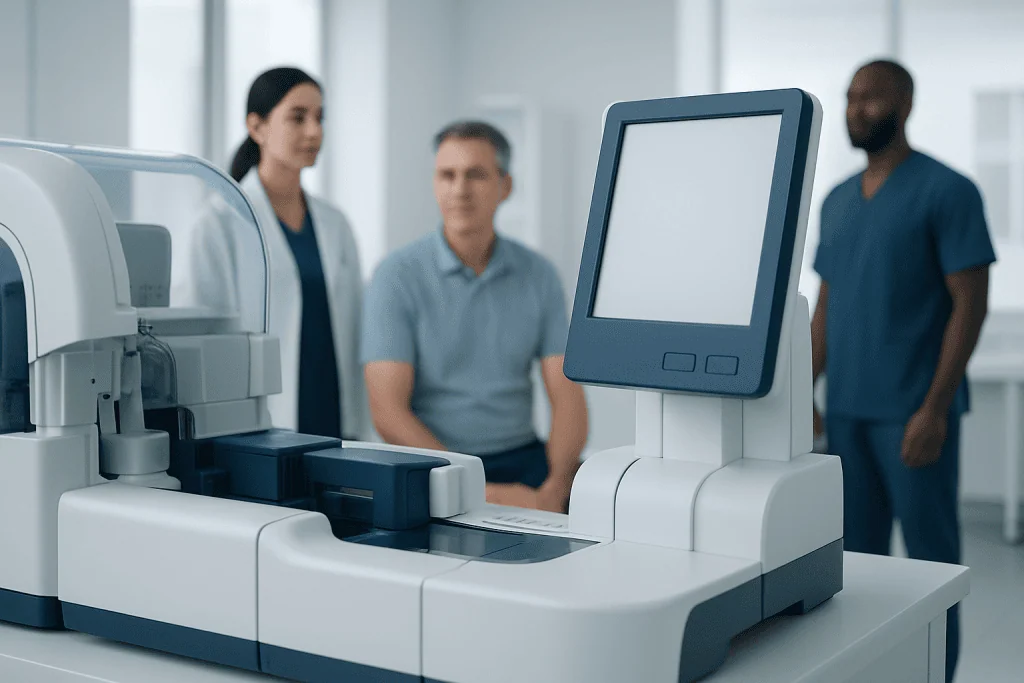
Several categories of findings can change the expected scope of care. Blood tests may reveal anaemia, signs of infection, clotting issues, kidney or liver concerns, or poorly controlled blood sugar — any of which may need attention before a procedure can go ahead safely. Imaging such as MRI, CT, ultrasound, PET-CT, mammography or X-ray can show that a condition is more extensive, more complex, or simply different from what was suspected when the first quote was written.
Pathology can matter just as much. A biopsy, or a second pathology opinion on existing slides, may refine the diagnosis in a way that alters the recommended surgery, the oncology plan, or the specialists who need to be involved. This cuts both ways. Sometimes a condition that looked significant on remote review turns out to suit a less invasive approach; sometimes the opposite is true and a broader plan is safer.
The pre-anaesthesia evaluation is another common trigger, and one many patients do not anticipate. If you have heart or lung conditions, sleep apnoea, medication interactions, allergies or airway-related risks, the anaesthesia team may recommend extra monitoring, a different length of hospital stay, or input from cardiology or another department before the procedure. These additions exist to support safer care — they are clinical decisions, not administrative padding.
In summary, the most common findings behind a revised quote are:
- An updated diagnosis after in-person specialist review
- More imaging or laboratory work than the original plan anticipated
- Additional procedures identified as necessary during planning
- Involvement of another specialist, such as cardiology or endocrinology
- A longer hospital stay or more intensive post-treatment monitoring
Some of these tests only become apparent after you land. The guide on what happens if you need extra tests after arriving in Turkey explains how that scenario typically unfolds day by day.
What an initial quote usually covers — and what it may not

Many patients assume a quote is fixed from the beginning, but that depends entirely on its wording. Some quotes are package-based, with defined inclusions and exclusions. Others are estimates built around the likely course of treatment, expressly subject to final physician assessment. Neither format is wrong; the problem arises when you do not know which one you are holding.
An initial quote typically includes the main hospital services expected for the planned treatment: the procedure itself, a standard ward stay, routine nursing care, and the tests commonly anticipated for that pathway. What it may not include are items that only become necessary if new results change the picture — extra imaging, repeat laboratory work, consultations outside the original pathway, intensive care if unexpectedly required, treatment of an unrelated condition discovered during evaluation, an upgraded room, companion expenses, or hospitalisation beyond the standard plan.
Before you book anything non-refundable, ask three plain questions. Is this a preliminary estimate, a package with defined inclusions, or a figure conditional on final physician assessment? What is explicitly excluded? And are practical items — airport transfers, interpreter services, hotel arrangements, prescription medicines after discharge, follow-up tests — inside the figure or separate? Coordinators handling international patients deal with these questions daily, and precise answers now prevent confusion later.
Medical, practical or optional: how to read a revised quote
Not every quote change signals a medical problem. Some changes are clearly clinical: a different procedure is now recommended, a biopsy has been added, or an extra day of monitoring is advised because tests point to a higher-risk situation. Others are practical: a procedure date moves to allow a medication washout period the treating doctor has set, or the stay lengthens so all consultations can be completed in the right order. A schedule shift often costs you more in hotel nights than in medical fees, which is why the guide on treatment delays in Turkey is worth reading alongside this one.
Then there are optional, preference-based changes: a private room category, additional comfort services, companion arrangements, or convenience upgrades. These are your choices, not requirements, and a well-presented revision keeps them visibly separate from the medically necessary items.
A practical technique: ask for any revised quote to be grouped under three headings — medically necessary additions, logistics-related adjustments, and patient-choice extras. This single request makes an updated document far easier to understand, particularly if you are reading paperwork in a language that is not your first. Interpreters can go through the groupings with you line by line.
What a treatment quote in Turkey actually depends on
People searching for treatment abroad often want a single number for “treatment in Turkey” or a “full body check-up”, and no honest guide can give one. Costs are not standardised across hospitals, cities or specialties, and this page deliberately quotes no figures. What can be explained is the structure — the variables that any legitimate quote is built from:
- The diagnosis and its complexity. The same procedure name can describe very different operations depending on the findings.
- The scope of the plan. Which tests, consultations and procedures the pathway includes, and whether more than one department is involved.
- Length and level of stay. Ward versus intensive monitoring, and the number of nights anticipated.
- Your individual risk profile. Existing conditions and medications can add pre-procedure work-up or monitoring.
- Non-clinical services. Transfers, interpretation, accommodation support and companion arrangements may sit inside or outside the medical figure.
The same logic applies to comprehensive health checks: the figure depends on which laboratory panels, imaging studies and specialist reviews the programme includes, and programmes vary widely in scope. When you compare quotes from different providers, compare the inclusions, not just the totals. Turkey’s hospitals treat international patients across a wide range of fields — cardiology, oncology, orthopaedics, ophthalmology, transplant medicine, fertility treatment, dental care and comprehensive check-up programmes among them — and the quoting logic above applies across all of them.
Before you travel: reducing the chance of surprises
The single most effective step is sharing complete, recent medical records as early as possible: scanned reports, imaging discs or cloud links, pathology reports, a full medication list, allergy information, previous operation notes if you have them, and a clear summary of your current symptoms. Date everything. If a scan is a year old, say so — the team can then tell you in advance whether it is likely to be repeated, rather than surprising you on arrival. There is a practical walkthrough in how to organise your test results before travelling to Turkey.
Before booking flights, ask three forward-looking questions. Which tests are likely to be repeated on arrival? Does the doctor need to examine you before the final plan is confirmed? And for your specific treatment, what most commonly leads to a revised quote? None of this eliminates uncertainty — medicine sometimes requires step-by-step confirmation — but it lets you budget realistically instead of optimistically.
Experienced international patients also keep a contingency fund for possible extra tests, an added consultation or a slightly longer stay, and they book accommodation and flights with some flexibility. Even at large, well-coordinated multispecialty hospitals in Istanbul or elsewhere in Turkey, a plan built on remote records is a starting point, not a contract with biology.
On the broader question of safety: choosing treatment abroad is a personal decision that depends on the institution, the treatment and your own health. It is sensible to research how a hospital is regulated and how it handles international patients, and to check your own government’s current travel advice for Turkey before you commit to dates. Guidance on medical travel in general is published by public health bodies such as the CDC, and it applies to any destination, not only Turkey.
If your quote changes after you arrive
When a revised quote lands, pause before reacting to the number. Ask for the explanation in everyday language: what the new findings are, how they affect the diagnosis or plan, which added items are medically necessary, and whether alternatives exist. If any part of the plan is time-sensitive, the team should say so plainly and explain why.
Then ask for the update in writing, itemised against the original estimate. This matters if you are managing family finances, insurer correspondence or payment planning from abroad — a verbal explanation in a hospital corridor is not something you can forward to anyone. If language is a barrier, ask your coordinator or an interpreter to sit with you while the revision is explained, so nothing is lost in translation.
It is also entirely reasonable to ask whether the change can be reviewed by the relevant specialist team. Complex cases at multidisciplinary hospitals may draw on surgery, radiology, oncology, anaesthesia and internal medicine together, and that coordinated review is part of how a revised plan earns your confidence. If the findings alter more than the price — if the diagnosis itself has shifted — the guides on what happens if your diagnosis changes after arriving in Turkey and how plan changes after in-person evaluation are handled at Acibadem cover that situation in detail.
Payment timing, insurance and your schedule
If you are self-paying, ask when a revised amount needs to be settled and whether payments are staged — tied to testing, admission or treatment day. Timing has knock-on effects: if new findings delay treatment, hotel nights, flights, local transport and companion arrangements may all need adjusting alongside the medical figure itself.
If an international insurer, embassy or sponsoring organisation is involved, request every revised document promptly. Insurers typically want the updated diagnosis, the medical justification and the new financial estimate before authorising changes, and incomplete paperwork is the most common cause of delay. Ask your coordinator for an exact list of what your insurer will need, then send it in one batch rather than piecemeal.
Finally, keep the direction of change in perspective. Yes, your treatment quote can change after new test results in Turkey — but new results sometimes show that a simpler or different approach suits you better than the one originally assumed. What matters is not whether the number moved, but whether you received a transparent explanation, a plan grounded in your current findings, and enough practical support to make informed decisions during your stay.
Step by step
- Share your full records before travel. Send recent reports, scans, pathology, medication lists and major health history as early as you can, with dates. The more complete the picture, the more realistic the initial quote.
- Ask whether the quote is provisional or confirmed. Use plain wording: is this an estimate based on current records, or a package with defined inclusions? Know which document you are holding before you spend money around it.
- Clarify what could trigger a revision. Ask which test results or clinical findings most commonly alter the plan for your specific treatment. Named triggers make a later change feel expected rather than sudden.
- Request written inclusions and exclusions. Ask what is included, what is excluded, and what is added only if medically required. This is the document your budget and your insurer both depend on.
- Keep a contingency budget and flexible travel plans. Allow room for extra tests, an added consultation or a longer stay. Flexible hotel and flight bookings absorb schedule changes far better than fixed ones.
- Review any revision line by line. Ask your coordinator or interpreter to walk through the itemised changes with you, separating medical necessities from logistics and optional extras.
- Confirm timing before you approve. Ask how the revised plan affects your treatment date, discharge estimate and return travel. A small medical change can move your schedule more than your bill.
Your checklist
- Passport and travel dates ready for scheduling
- Recent medical reports and imaging shared in advance, with dates noted
- Medication list, allergies and chronic conditions documented
- Written confirmation of whether the quote is provisional or final
- Clear list of inclusions, exclusions and conditional add-ons
- Contingency budget for extra tests or a longer stay
- Insurance or sponsor contact details, if relevant
- Interpreter or coordinator contact saved on your phone
Key takeaways
- Initial quotes for treatment in Turkey are built on the information available before you arrive; in-person assessment can change the plan and therefore the figure.
- Blood work, imaging, pathology and the pre-anaesthesia evaluation are the most common sources of new findings.
- A revised quote can move in either direction — the plan drives the price, not the reverse.
- Always ask for revisions in writing, itemised, with medical necessities separated from logistics and optional extras.
- Budget for possible extra tests, added consultations or a longer stay, and keep travel arrangements flexible.
- Interpreters and international patient coordinators exist to help you understand updates line by line.
Frequently asked questions
Is it normal for a treatment quote to change after tests in Turkey?
Yes, it can be entirely normal, especially when the original quote was based on records sent before travel. Once doctors review you in person and see updated results, they may refine the diagnosis or adjust the plan, and the quote follows the plan.
Does a changed quote mean the hospital made a mistake the first time?
Not necessarily. The first figure is often an estimate built from limited remote information, while the revision reflects what the team knows after examining you. In many cases a change shows the hospital adjusting responsibly rather than proceeding on assumptions.
Can the quote go down after new test results?
Yes. If updated findings show that a less extensive treatment is appropriate, or that certain planned services are not needed, the final quote may be lower than the initial estimate. Changes run in both directions.
How can I tell whether a quote is fixed or only an estimate?
Ask directly: is this a package with defined inclusions, or a provisional estimate subject to final physician review? Ask what is excluded and which circumstances would lead to changes after testing. Get the answer in writing.
How much does medical treatment cost in Turkey?
There is no single answer, and reliable providers will not give one before reviewing your case. Any genuine quote depends on the diagnosis, the complexity and scope of the plan, the length and level of hospital stay, your individual risk profile, and which non-clinical services are included. Compare inclusions between quotes, not just totals.
How much does a full body check-up cost in Turkey?
It depends on the programme’s scope: which laboratory panels, imaging studies and specialist consultations are included. Check-up programmes vary widely between hospitals, so ask for the full list of included tests before comparing anything.
What medical treatment is Turkey famous for?
Turkey receives international patients across many fields, including cardiology, oncology, orthopaedics, ophthalmology, transplant medicine, fertility treatment, dental care, hair restoration and comprehensive health check-up programmes. Large multispecialty hospitals typically coordinate several departments around a single patient’s plan.
Is it safe to go to Turkey for medical procedures?
That depends on the institution, the treatment and your own health, so it deserves research rather than a blanket answer. Look at how a hospital is regulated and how it manages international patients, review general medical-travel guidance from public health bodies, and check your government’s current travel advice for Turkey before fixing dates.
Add us as a Preferred Source to see more of our trusted health content across Google Search, AI Overviews and Discover.

Update history
- PublishedJuly 8, 2026
- Medical review approvedSeptember 1, 2026
- Last content updateSeptember 1, 2026
References2
More Patient Guides

Private MRI, CT and Check-Up Costs in Turkey: How Scans Are Priced
How private MRI, CT, PET-CT and full check-up packages are priced in Turkey — modality, region, contrast, reporting — and what a…

Cataract Surgery Cost in Turkey: Per-Eye Prices and Lens Options
Cataract surgery in Turkey is priced per eye and the lens decides the quote. Biometry, both eyes on one trip, and what…

Lip Filler Cost in Turkey: Per-ml Prices Explained
Lip filler in Turkey is priced per millilitre with licensed hyaluronic acid brands and physician injectors. Volume, product, dissolving, safety and what…

Botox Cost in Turkey: Per-Area and Per-Unit Prices
How Botox is priced in Turkey — per area or per unit, brand, physician injectors, medical indications — and what a serious…