

ECG and Echocardiogram in Turkey: Heart Test Guide
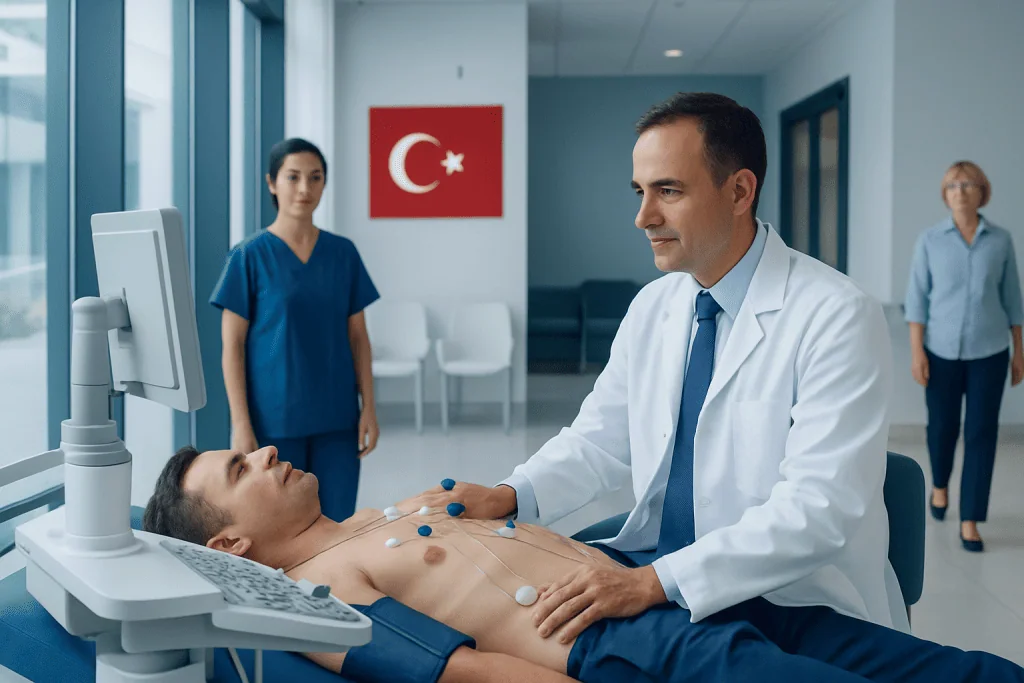
An ECG records the heart's electrical rhythm; an echocardiogram is an ultrasound showing chambers, valves and pumping strength. Both are routine, non-invasive outpatient tests, and an ECG and echocardiogram in Turkey are usually arranged within one cardiology visit, often on the same day. Preparation is mostly informational: previous reports and a complete medication list matter more than anything physical.
An ECG and echocardiogram in Turkey are usually two of the first tests a cardiologist arranges, and both are routine outpatient procedures rather than hospital admissions. If you are travelling for a heart assessment, the practical questions matter as much as the medical ones: how long each test takes, what preparation is genuinely needed, how the two tests differ, and how results and reports reach you before you fly home.
This guide explains what each test does, how appointments are typically organised for international patients, what the tests can and cannot show, and what to have ready before you travel. It also covers the Turkish terms you will see on reports and signage, the tests a cardiologist may add afterwards, and how pricing for cardiac check-ups is usually structured, without pretending any of this replaces the judgement of the cardiologist who examines you.
At a glance
- Best for: Assessing heart rhythm, chamber structure, valve function and pumping strength
- Typical visit: Outpatient; ECG and echocardiogram are often completed on the same day as the consultation
- Time on site: The ECG takes minutes; the echocardiogram usually takes longer, plus consultation and registration time
- Preparation: Minimal for resting tests; bring previous reports, imaging files and a full medication list
- Language: On Turkish paperwork, ECG appears as EKG and echocardiogram as ekokardiyografi or EKO; interpreter support is arranged through international patient services
- Results: Interpreted by the cardiology team in context with your history; written reports can be prepared for your doctor at home
What an ECG and echocardiogram are used for
The two tests answer different questions, which is why cardiologists frequently order them together. An ECG (electrocardiogram) records the heart’s electrical activity through electrodes placed on the skin. It shows heart rate, rhythm and electrical patterns that may point to strain, previous heart injury or conduction problems. It is the standard first test when someone reports palpitations or a suspected irregular heartbeat, and it sits at the centre of the assessment of heart rhythm disorders.
An echocardiogram is an ultrasound scan of the heart. Instead of electrical signals, it produces moving images: the size of the chambers, the thickness of the muscle, how the valves open and close, and how strongly the heart pumps. Doppler measurements add information about the direction and speed of blood flow through the heart. This makes it the core test for suspected heart valve diseases, for assessing pumping strength when heart failure is a possibility, and for examining structural questions present from birth, as in congenital heart diseases.
A simple way to hold the distinction: the ECG listens to the heart’s wiring; the echocardiogram looks at its plumbing and mechanics. Neither replaces the other, and neither alone gives a complete picture. A person can have a normal ECG and a significant valve problem, or a normal echocardiogram and a rhythm disturbance that only appears intermittently. That is also why a cardiologist may add further tests depending on what the first results show.
| ECG | Echocardiogram | |
|---|---|---|
| What it measures | Electrical activity: rate, rhythm, conduction | Structure and mechanics: chambers, valves, pumping, blood flow |
| How it works | Electrodes on the skin record signals; nothing enters the body | Ultrasound probe on the chest produces moving images |
| Typical duration | Minutes, including electrode placement | Noticeably longer; multiple views take time |
| Best at finding | Rhythm disturbances, conduction problems, signs of strain or past injury | Valve disease, weakened pumping, chamber enlargement, structural abnormalities |
| Main limitation | Only captures the rhythm during the recording | Cannot record electrical rhythm over time |
For international patients, the practical point is that an ECG and echocardiogram in Turkey sit inside a standard cardiology pathway. They are not specialist procedures needing long lead times, and in most cases both can be scheduled around a single consultation.
How your appointment is usually arranged in Turkey
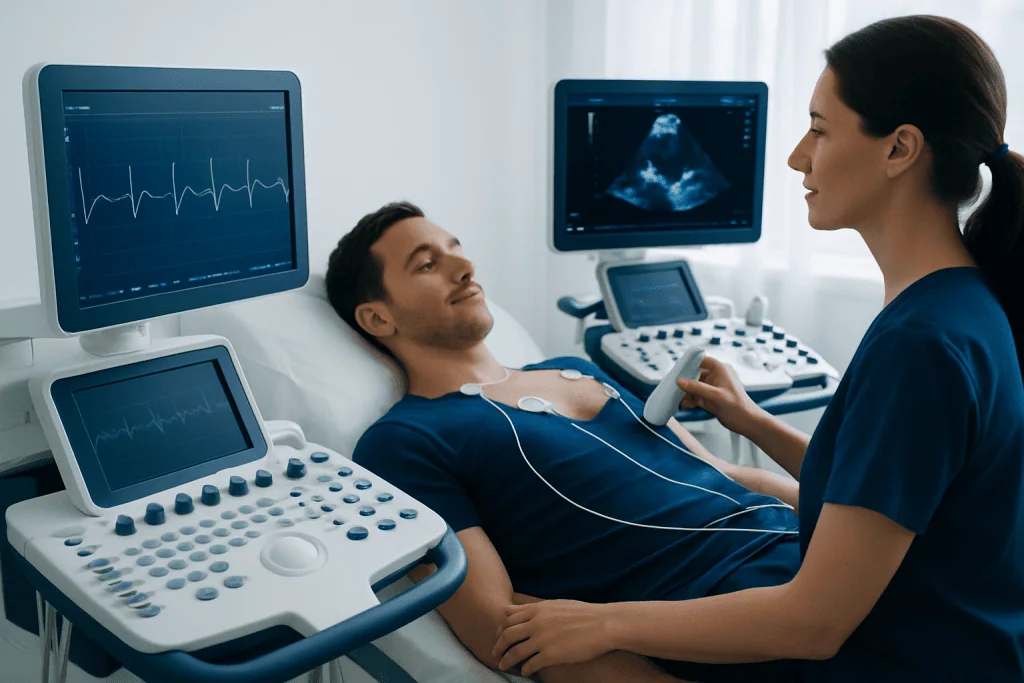
Most international cardiology visits follow a similar shape. Before travel, the hospital’s international patient team reviews the medical background a patient provides, recent reports, a medication list, a short description of the reason for the visit, and a schedule is built around it. A referral letter from a home doctor is useful but not required; a cardiology consultation can establish which tests are appropriate.
On the day, the usual sequence is a consultation with a cardiologist, followed by the ECG and echocardiogram either the same day or on a nearby date, depending on availability and what the consultation reveals. If the cardiologist wants additional information, blood tests, 24-hour Holter monitoring, a stress test, or cardiac CT, these are explained at that point and fitted into the schedule rather than sprung on you at the end.
The most common planning mistake is booking a return flight too close to the appointment. The tests themselves are quick, but a cardiologist may want a second conversation once results are ready, or may recommend one further test that needs another slot. Building a day or two of flexibility into your itinerary costs little and removes most of the pressure. Interpreter support and hospital wayfinding are normally handled by the international patient department, so the day itself tends to be less complicated than first-time visitors expect.
What to expect during the ECG
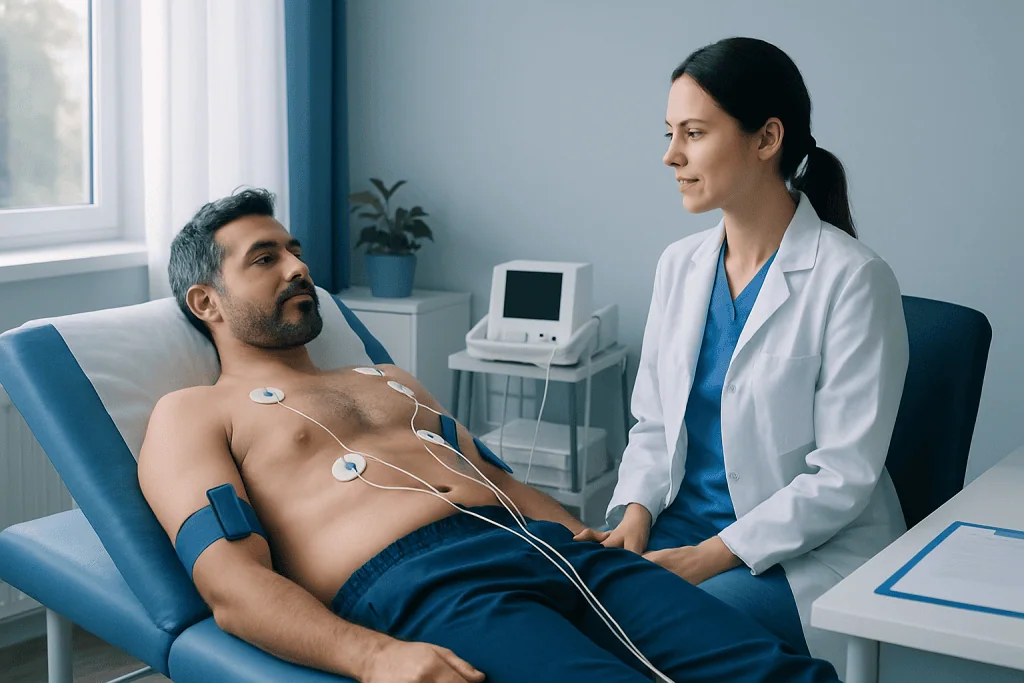
The ECG is the shorter of the two tests. You lie on a couch while small adhesive electrodes are placed on your chest, arms and legs. The machine records your heart’s electrical signals for a matter of seconds to minutes. No electricity enters your body: the electrodes only listen. Removing them afterwards feels roughly like peeling off a plaster.
A few practical details improve both comfort and recording quality. Wear clothing that opens at the front or is easy to remove from the upper body. Skip heavy body lotion or oil on the chest that day, because electrodes need clean, dry skin to stick. If you have significant chest hair, staff may need to prepare small patches of skin so the electrodes attach properly: a routine step, not a problem. Lying still and breathing normally matters more than most people expect: muscle movement, shivering and talking all show up as noise on the trace, and a noisy trace sometimes has to be repeated.
Tell the team about anything that affects positioning or the recording: a pacemaker or implantable defibrillator, adhesive allergies, difficulty lying flat, or mobility limitations. If you tend to feel anxious during medical tests, say so; the staff or your interpreter can talk you through each step before it happens, which for most people is enough.
What to expect during the echocardiogram
The standard test is a transthoracic echocardiogram, ultrasound performed from outside the chest. You lie mostly on your left side while gel is applied and a probe is moved across the chest wall to capture the heart from several angles. You may hear whooshing sounds during Doppler measurements; that is blood flow being converted to audio, and it is normal. You may be asked to shift position, hold your breath briefly or stay still while measurements are taken. Some pressure from the probe between the ribs is common; say something if it is uncomfortable, because the operator can usually adjust.
Expect this scan to take noticeably longer than the ECG. Good images from multiple views take time, and rushing them defeats the purpose. Also expect that the person performing the scan may not give you a full interpretation at the bedside. Images and measurements go to the cardiology team, and the cardiologist explains the findings in the context of your symptoms, ECG and history, which is where the findings actually mean something.
Other forms of echocardiography
Depending on the question being asked, a cardiologist may recommend a variant of the standard scan. A transoesophageal echocardiogram uses a probe passed into the food pipe under sedation to obtain closer, sharper images of certain structures, often relevant when structural heart problems or specific valve details are being assessed. A stress echocardiogram images the heart before and after exercise, or after medication that raises the heart rate, to see how it performs under load. These have their own preparation rules, including fasting for transoesophageal studies, and they are only added when the resting tests leave a specific question open.
Tests that are sometimes added afterwards
Resting tests are a starting point, not always an endpoint. If the ECG suggests an intermittent rhythm problem, a Holter monitora small portable recorder worn for 24 hours or longer, captures the rhythm across a full day and night, including whatever provokes your symptoms. If the question is how the heart behaves under effort, a stress test on a treadmill or bicycle records the ECG during exercise. Blood tests add information about cholesterol, kidney function, thyroid activity and markers of heart strain. Cardiac CT looks at the coronary arteries themselves, which neither a resting ECG nor a standard echocardiogram can image directly.
None of these is routine for every patient. They are added when the first results raise a specific question, which is precisely why itinerary flexibility is worth building in. If a cardiologist finds significant coronary disease, conversations about treatment options, from medication through procedures such as heart bypass surgeryhappen on a separate timeline and are never rushed into a diagnostic visit.
Turkish terms you will see on reports and signs
Turkish medical vocabulary is close enough to international usage that most paperwork is decipherable, but a short glossary helps:
- EKG (elektrokardiyogram): ECG
- Ekokardiyografi, often shortened to EKOechocardiogram
- Bilgisayarlı tomografi, abbreviated BTCT scan; if a cardiac CT is added to your work-up, this is the term on the request form
- MR (manyetik rezonans): MRI
- Kan tahliliblood test
- Efor testiexercise stress test
- Kardiyolojicardiology, the department sign you will follow
Reports for international patients are commonly issued or translated into English, but department stamps, headers and appointment slips often stay in Turkish, so recognising these terms saves confusion on the day.
How costs and quotes are structured
This guide gives no figures, because a single number for an ECG and echocardiogram in Turkey would be misleading. What a quote actually depends on is worth understanding, so you can compare offers sensibly:
- Scope: a resting ECG plus standard echocardiogram is the simplest configuration; stress testing, Holter monitoring, cardiac CT or transoesophageal studies each change the picture
- Consultation: whether one or two cardiology consultations are included, and whether the results review is a separate item
- Packaging: many hospitals offer cardiac or general check-up packages that bundle blood tests and imaging; a package is only good value if you need what is in it
- Documentation: whether English-language reports, imaging files and a summary letter for your home doctor are included or billed separately
- Payment route: self-pay, travel insurance or an international health policy each work differently, and insurers usually want itemised invoices
The same logic applies to full health check-ups, which is why quoted figures for those vary so widely: the honest answer to what a check-up costs is that it depends on which tests are inside it. The practical habit that protects you is asking for a written, itemised quote and confirming exactly what it covers before travel, particularly the reports and files you need to take home, which are easy to overlook and awkward to chase afterwards.
Can foreigners use hospitals in Turkey?
Yes. Turkey has a mixed public and private healthcare system, and private hospital groups routinely register international patients: a passport is the standard identification, and international patient departments handle scheduling, interpreting and paperwork in languages other than Turkish. Emergency departments treat anyone who arrives, resident or not.
As for how good the system is: the honest answer is that quality varies between institutions, as it does in every country. Large private hospitals in cities such as Istanbul are experienced with international patients and equipped for full cardiology work-ups, from resting tests through advanced imaging. Rather than relying on general reputation, it is reasonable to check the specific hospital’s cardiology services, the tests it can perform on site, and how it handles English documentation. An ECG and echocardiogram in Turkey are routine tests at any established cardiology department; the differences you will actually notice are in coordination, language support and how results are communicated.
Documents, medications and practical preparation
Preparation for resting heart tests is mostly about information, not about your body. Fasting is not usually required for a basic ECG and standard transthoracic echocardiogram, though other tests on the same schedule may have their own rules, which the hospital confirms in advance.
What genuinely improves the quality of your assessment is comparison material. Previous ECGs, echocardiogram reports, angiography results, discharge summaries, blood tests and imaging discs let the cardiologist see change over time rather than a single snapshot. A complete medication list, names, doses, timing, including over-the-counter products and supplements, matters just as much, because several common medicines influence heart rate, rhythm and blood pressure readings.
Do not change any medication on your own account before the tests. If a specific test requires an adjustment, that decision belongs to the treating doctor, who will explain it directly. Women should mention pregnancy or the possibility of it, and anyone with a pattern of symptoms, palpitations at night, breathlessness on stairs, swelling by evening, will get more from the consultation by writing the pattern down beforehand. Symptom patterns matter in cardiology, and they can differ between men and women, a point covered in more depth under women’s heart health.
Understanding results and planning the next step
Results from these tests only mean something in context. A finding that reads alarmingly on paper, mild valve regurgitation is a common example, may be insignificant in your situation, while entirely normal results do not rule out every problem, particularly rhythm disturbances that come and go. The cardiologist’s job is to weigh the ECG, the echocardiogram, your history and your symptoms together, and to say plainly what the tests show, what they cannot show, and whether anything further is worth doing.
Before leaving the hospital, make sure you hold everything your home doctor will need: written reports, imaging files where available, any medication notes and a summary of recommendations. Ask about repeat-testing intervals if monitoring was advised, and ask the treating doctor about fitness to fly if your diagnosis or medication changed during the visit: that conversation belongs before you confirm the return leg, not at the airport.
Step by step
- Records are reviewed before travel. Most international pathways begin with the hospital reviewing recent reports, a medication list and a short symptom history. Having these ready in digital form is what allows a realistic schedule to be built in advance.
- The schedule is confirmed. This sets out whether the cardiology consultation comes before the tests, whether both tests fall on the same day, expected time in the hospital, interpreter arrangements and any preparation rules for added tests.
- Arrive with time to spare. Registration, document checks and finding the right department all take longer on a first visit. Arriving early keeps the day calm.
- The ECG is performed. Electrodes on the skin, a brief recording while you lie still. Mention implanted cardiac devices, adhesive sensitivity or difficulty lying flat before it starts.
- The echocardiogram is performed. Ultrasound gel, a probe on the chest, several viewing angles. Position changes and brief breath-holds are normal parts of getting clear measurements.
- The cardiologist reviews the results with you. Ask for plain-language explanations: what is normal, what needs monitoring, what needs action. Use interpreter support if you need it: this conversation is the point of the whole visit.
- Reports and follow-up instructions are collected. Confirm how you receive written reports and imaging files, keep copies for your home doctor, and note any monitoring intervals or medication guidance from the treating team.
Your checklist
- Passport or official ID
- Appointment confirmation and hospital contact details
- Current medication list with doses and timing, including supplements
- Previous ECGs, echocardiograms and cardiology reports
- Recent blood tests, imaging reports, discs or discharge summaries
- Referral letter or note from your doctor, if available
- Clothing that opens at the front or allows chest access
- Written list of symptoms, triggers and questions for the cardiologist
- Insurance documents, if a policy is paying
- Interpreter request confirmed in advance if you need language support
Key takeaways
- An ECG records the heart’s electrical rhythm; an echocardiogram uses ultrasound to show structure, valves and pumping function. They answer different questions and are commonly ordered together.
- Both are non-invasive outpatient tests, and an ECG and echocardiogram in Turkey are usually arranged within a single cardiology pathway, often on the same day.
- Preparation is mostly informational: prior reports and a complete medication list do more for the quality of your assessment than any physical preparation.
- Further tests, Holter monitoring, stress testing, cardiac CT, are added only when the first results raise a specific question, which is why itinerary flexibility matters.
- Quotes vary with scope, packaging and documentation; ask for an itemised written quote and confirm what reports and files are included.
- Leave with written results, imaging where available, and a clear follow-up plan for your doctor at home.
Frequently asked questions
Can I have an ECG and echocardiogram on the same day in Turkey?
Often, yes. Both are outpatient tests and are commonly scheduled together with a cardiology consultation, subject to availability. It is sensible to avoid a tight travel itinerary until the schedule is confirmed, because a cardiologist may want a follow-up conversation or one additional test once results are in.
Do I need to fast before an ECG or echocardiogram?
Not for a resting ECG or a standard transthoracic echocardiogram. Fasting and other preparation rules apply to some related tests, transoesophageal echocardiography, certain blood tests, some stress protocols, so follow the specific instructions issued for your schedule rather than a general rule.
Can I take my usual heart medicines before the appointment?
Decisions about starting, stopping or adjusting medication belong to the treating doctor, so do not change anything on your own before the tests. Bring a complete list of everything you take, including blood thinners, blood pressure and rhythm medicines, and supplements, because several of these influence what the tests show.
Can I get my reports in English?
English reports and summary letters are commonly available for international patients, though they are sometimes prepared separately from the standard Turkish report. Confirm in advance that English documentation, imaging files and a letter for your home doctor are part of what you will receive, and keep both digital and printed copies.
Can foreigners go to hospital in Turkey?
Yes. Private hospitals routinely register international patients using a passport, and international patient departments handle scheduling, interpreting and paperwork. Payment is typically by self-pay, travel insurance or an international health policy, and emergency departments treat anyone who arrives regardless of residency.
How good is Turkey’s healthcare system?
Turkey runs a mixed public and private system, and quality varies between institutions, as it does everywhere. Established private hospitals in major cities are experienced with international patients and perform full cardiology work-ups on site. The useful approach is to assess the specific hospital, its cardiology services, available tests and documentation practices, rather than relying on generalisations.
What is a CT scan called in Turkish?
A CT scan is called bilgisayarlı tomografi, abbreviated BT on request forms and signage. Relatedly, an ECG appears as EKG and an echocardiogram as ekokardiyografi or simply EKO. Reports for international patients are often issued in English, but appointment slips and department signs usually remain in Turkish.
How much does a full health check cost in Turkey?
There is no single figure, because check-up pricing depends on scope: which tests are bundled, how many consultations are included, whether advanced imaging is part of the package, and whether English reports and files are covered or billed separately. Ask for a written, itemised quote before travel and compare offers on what they actually include, not on the headline alone.
Add us as a Preferred Source to see more of our trusted health content across Google Search, AI Overviews and Discover.

Update history
- PublishedJune 16, 2026
- Medical review approvedSeptember 13, 2026
- Last content updateSeptember 12, 2026
References2
- Electrocardiogram (ECG): NHS nhs.uk
- Echocardiogram: NHS nhs.uk
More Patient Guides
Sleep Apnea Testing in Turkey: What Happens During Your Evaluation
Sleep apnea testing in Turkey may include a consultation, overnight sleep study or home test, and a clear review of your results…

How to Organize Your Test Results Before Traveling to Turkey
Organize your test results before traveling to Turkey by sorting records, images, medicines and timelines so your Istanbul care team can review…

When Extra Tests Are Needed Before Treatment in Turkey
Extra tests before treatment in Turkey may be needed to confirm diagnosis, timing, and safety. Here is what you can expect in…

At Acibadem, How to Prepare for Blood Tests, Scans, and Pre-Op Checks
Blood tests, scans, and pre-op checks at Acibadem in Turkey help confirm you are ready for treatment and avoid delays on the…