

Hotel Check-In Guide for Patients Arriving in Turkey

Turkish hotels register every guest, so have your passport and booking confirmation ready at reception. Keep medication, medical reports and appointment details in your hand luggage. Ask reception about hospital travel time, taxis and breakfast hours, check the room before unpacking, then organise tomorrow's documents in one folder and rest. Arriving a day before your first appointment makes all of this far easier.
Will you have the energy to sort out a room, a taxi and tomorrow’s appointment after a long flight? Most patients don’t, and they don’t need to. This hotel check-in guide for patients arriving in Turkey walks you through what reception will ask for, what belongs in your hand luggage, and how to set up your first evening so the next morning at the hospital runs smoothly.
A few decisions make most of the difference. Where possible, arrive at least one day before your first appointment. Keep your passport, appointment details, insurance or payment documents, medication and medical records with you rather than in checked bags. At reception, ask about Wi-Fi, breakfast hours, taxi options, accessibility support and how long the journey to the hospital takes at the time of day you will actually travel.
Once you are in the room, the priority is simple: rest, hydrate, avoid strenuous activity and follow any pre-appointment instructions your care team has given you. You are not doing this alone. International patient teams can help with interpreters, transfers and local coordination, so contact your patient coordinator or the hotel team whenever something is unclear.
At a glance
- Best time to arrive: at least one day before your first appointment, where your schedule allows.
- Keep with you: passport, appointment details, insurance or payment documents, medication and medical records, in hand luggage, never checked bags.
- Typical hotel hours: check-in usually opens mid-afternoon and check-out falls late morning; confirm exact times when you book.
- Ask at reception: Wi-Fi, breakfast hours, taxi options, accessibility support and hospital travel time.
- Health priority: rest, hydrate, avoid strenuous activity and follow your care team’s pre-appointment instructions.
- Support: international patient teams can assist with interpreters, transfers and local coordination.
Before You Reach the Hotel
The useful part of any hotel check-in guide for patients arriving in Turkey starts before the plane lands. Pack your most important items in your hand luggage rather than checked bags: passport, visa or entry documents if applicable, hotel booking confirmation, appointment schedule, medical reports, current medication in its original packaging, glasses or hearing aids, a phone charger and any mobility aid you need immediately. If a suitcase is delayed, you should still be able to attend your appointment safely.
If you are travelling for care with Acibadem, confirm your arrival plan with your international patient coordinator before you fly or as soon as you land. Depending on your arrangements, this may cover airport transfer details, appointment timing, interpreter support and the address of your hotel or serviced residence. Save these details offline, as screenshots or on paper, in case mobile data does not work straight away. Our arrival day checklist for international patients covers the airport-to-hotel leg in more detail.
Try not to schedule your first hospital visit too close to your flight unless your care team has specifically arranged it. Long-haul travel commonly causes fatigue, dehydration, leg swelling, disrupted sleep and stress. A calmer check-in gives you time to rest, shower, organise your papers and prepare for the next day with a clear head.
Documents and Details You May Need at Check-In

Hotels in Turkey are required to register their guests, so reception will ask for your passport or official identification. They may also confirm the reservation name, length of stay, a contact number and your payment method. If a coordinator, agency, hospital assistance team or family member made the booking, check before you travel that the reservation name matches the passport of the person who will actually check in. A mismatch is fixable, but not something you want to negotiate at midnight after a nine-hour flight.
Keep your medical documents private but accessible. Hotel staff do not need to see your diagnosis or treatment plan. If you need support, describe the practical need instead: “I need a quiet room near the lift”, “I cannot climb stairs”, or “I may need help booking a taxi to the hospital”. That gets you the right help without sharing anything personal.
Hold digital and paper copies of key documents in separate places, one set with your companion, one in a folder in your cabin bag. Useful items include:
- Passport and entry stamp or visa information, if relevant
- Hotel booking confirmation and hospital appointment schedule
- Emergency contacts in Turkey and at home
- A medication list with generic names and doses
- Recent medical reports, imaging discs or links, and lab results
- Insurance, guarantee letter or payment-related documents, if applicable
The hospital will ask for a different, more formal set of paperwork than the hotel does. See hospital check-in in Turkey: documents international patients should bring so you can prepare both folders at once.
Check-In and Check-Out Times at Turkish Hotels
Most hotels in Turkey open check-in from mid-afternoon, often around 14:00, and expect check-out by late morning, typically between 11:00 and 12:00. These are conventions, not rules, individual hotels set their own times, so confirm when you book rather than assuming.
Timing matters more for patients than for tourists, which is why a hotel check-in guide for patients arriving in Turkey has to treat it seriously. Three situations come up often:
- Early morning arrival. If you land at dawn, your room may not be ready for hours. The reliable fix is to book the previous night as well, so the room is yours the moment you arrive. The cheaper alternative is to ask the hotel to store your luggage and rest in the lobby, workable for a healthy companion, harder for a tired patient.
- Late night arrival. Tell the hotel your expected arrival time in advance so the booking is held. Most receptions in medical travel districts operate around the clock, but confirming removes the doubt.
- Check-out on discharge day. If you leave hospital in the afternoon but your flight departs at night, ask about late check-out or luggage storage early in your stay, not on the final morning.
Choosing the Right Room for a Medical Stay
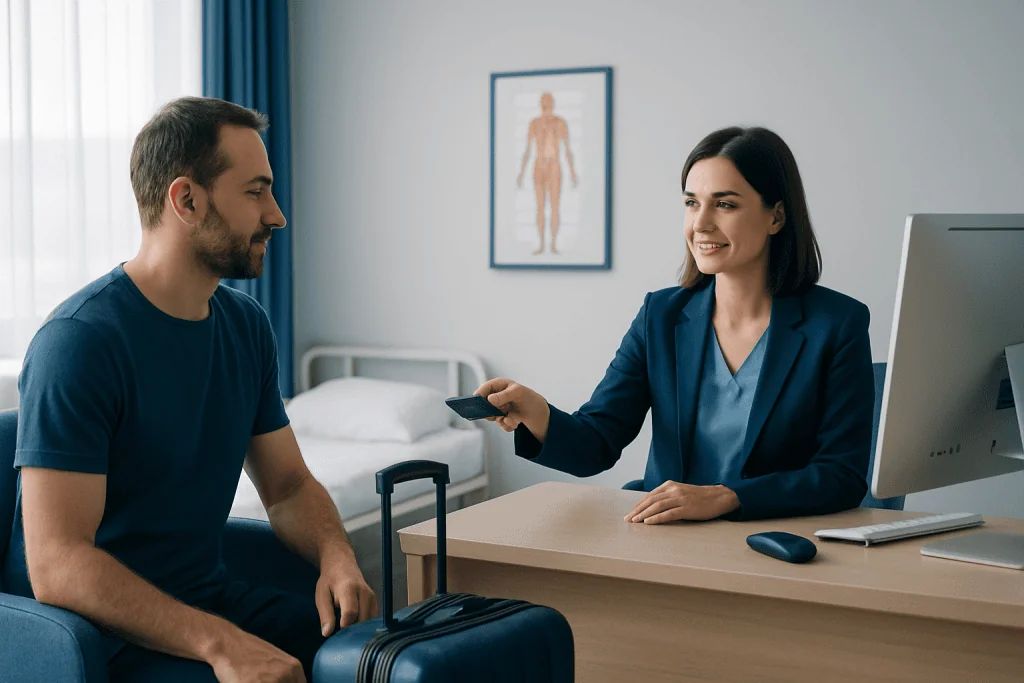
A room that suits a holiday may not suit a patient. Before your luggage is fully brought up, weigh up the distance from the lift, bathroom safety, bed height, noise, heating and cooling, and whether there is enough space for a companion, wheelchair, walker or medical supplies.
If you have limited mobility, recent surgery, breathing difficulty, pain, dizziness or fatigue, ask for a room that cuts unnecessary walking: a lower floor or a room near the lift can help, provided it is still quiet enough to sleep. If noise bothers you, ask to avoid rooms beside lifts, service areas, breakfast rooms, busy roads or nightlife.
The bathroom deserves the closest look. Ask whether the shower is walk-in or has a high step, whether grab bars exist, and whether a non-slip mat can be provided. If you are unsure you can manage safely, ask reception to show you the room first. A room change on arrival takes ten minutes; coping with an unsafe bathroom takes your whole stay. If you will spend recovery days in the room after a procedure, work through our hotel recovery room setup checklist before you settle in.
Communication, Language and Local Support
Many hotels in Turkey’s main medical travel destinations have English-speaking staff, but the level varies by shift and by hotel. Keep essential phrases written down in English and, if you can, translated into Turkish: your name, room number, hospital name, coordinator contact, allergies and an emergency contact. A translation app helps; a card in your pocket works when your phone battery does not.
If you are under the care of Acibadem, ask your patient coordinator how to reach the international patient services team during your stay. Depending on your arrangements, coordination can include interpreter support, appointment guidance, transfer assistance and practical information for companions. Save the number in your phone and write it on paper.
At the hotel, clarify three things: how to reach reception from your room, how to request a taxi, and what to do if you feel unwell. You do not need to share medical detail, but it is reasonable to say you may need extra time, a wheelchair, luggage help or assistance reaching transport.
Food, Medication and Daily Routine
Once checked in, compare your meal options with any instructions from your care team. Before some blood tests, imaging, anaesthesia assessments or procedures, you may be asked to fast or avoid certain foods. Do not rely on hotel staff for medical fasting rules: the hospital’s written instructions are the only ones that count.
Ask reception about breakfast hours, room service, the nearest pharmacy (look for “eczane” signs), drinking water and whether the room has a kettle or mini-fridge. A mini-fridge matters if you carry temperature-sensitive medication, but hotel fridges are not built for medical-grade temperature control. If storage is critical, discuss it with your pharmacist or care team before you travel, not after.
Jet lag makes medication timing genuinely confusing. Set phone alarms and keep a written list, and if you are unsure how to handle doses across time zones, ask your treating doctor before you fly rather than guessing. Timing and dose decisions belong to the doctor who prescribed the medication, not to a hotel guide.
How Healthcare and Costs Work for Visitors in Turkey
Two questions come up constantly, so here are honest answers. First: tourists do not get free healthcare in Turkey. The public system covers residents enrolled in Turkish social insurance; visitors are generally expected to pay for treatment, whether at public or private facilities. Emergency services will respond to anyone, but the care that follows is normally chargeable. This is exactly why travel insurance for treatment in Turkey deserves attention before you book flights.
Second: what a doctor’s visit costs depends on the type of facility, the specialty involved, whether tests or imaging are added, and whether interpreter support is included. Rather than relying on figures you find online, ask for a written quote from the hospital’s international patient office before you travel, and ask what the quote does and does not include. If your treatment was arranged as a package, check the inclusions line by line: our guide to treatment package inclusions in Turkey lists the questions worth asking.
Practical Dos and Don’ts for Patients in Turkey
- Do carry prescription medication in original packaging, with a doctor’s letter for anything unusual or injectable.
- Do keep the hotel address written in both Turkish and English so any driver can find it.
- Do leave extra travel time for hospital appointments, traffic in Istanbul and other large cities is unpredictable, especially at rush hour.
- Do ask reception before drinking tap water; many visitors and locals prefer bottled water, which hotels stock routinely.
- Don’t pack medication, medical reports or your passport in checked luggage.
- Don’t plan sightseeing, long walks or heavy meals the evening before a procedure or fasting test.
- Don’t hand your only copy of a medical document to anyone, share copies, keep originals.
- Don’t rely on general travel advice for medical questions; your hospital team’s instructions override everything in this guide.
Safety, Comfort and When to Ask for Help
Your first evening in Turkey should be low-pressure. Avoid heavy luggage, long walks and rushed plans, especially if you have travelled for surgery, cancer care, cardiology assessment, fertility treatment or another demanding reason. Even if you feel well, your body needs time to recover from the flight.
Walk the room once before bed: check the phone, the door lock, the bathroom lighting and the path from bed to bathroom. Keep slippers or shoes within reach, particularly if you are at risk of falls. If you use a CPAP device, a mobility aid, wound care supplies or other equipment, set it up while you still have energy, patients travelling with sleep apnoea equipment can follow our CPAP checklist for hospital patients.
Know the red flags. If you develop chest pain, severe shortness of breath, fainting, sudden weakness, heavy bleeding, confusion or a severe allergic reaction, call your local emergency number or go to the nearest emergency department now. In Turkey, 112 is the national emergency number, and reception can place the call if that is faster. Inform your patient coordinator or hospital contact as soon as it is safe to do so.
Step by step
- Confirm your reservation and arrival time. Check that the reservation name matches your passport and the dates match your treatment schedule. For early morning or late night arrivals, arrange early check-in, a held booking or luggage storage in advance.
- Keep essential items in your hand luggage. Medication, passport, medical reports, appointment details and chargers stay with you. A delayed suitcase should never mean a missed appointment or a missed dose.
- Use planned transport where possible. If a transfer has been arranged by your hotel, hospital support team or coordinator, follow the agreed meeting point instructions. Keep the hotel address written in Turkish and English.
- Tell reception about practical needs. Skip the medical history. Ask for what helps you function safely: a room near the lift, a quiet floor, wheelchair access, luggage help or a reliable taxi to the hospital.
- Check the room before fully unpacking. Look at the bathroom, bed height, temperature control, noise, lighting and the walk from the lift. If something is unsuitable, ask for a change immediately, while the hotel can still help easily.
- Organise tomorrow’s hospital visit. Put your appointment details, passport, medical documents and payment or insurance papers in one folder. Confirm travel time, interpreter arrangements and any fasting or preparation instructions from your care team.
- Rest and monitor how you feel. Hydrate, eat lightly if permitted, keep to your prescribed medication plan and sleep. For anything worrying, contact reception, your coordinator or emergency services depending on urgency.
Your checklist
- Passport, visa or entry documents, and hotel booking confirmation
- Hospital appointment schedule and patient coordinator contact details
- Medical reports, imaging, test results and a medication list with generic names
- Prescription medication in original packaging, kept in hand luggage
- Phone charger, plug adapter for Turkey and offline copies of key addresses
- Comfortable clothing, slip-resistant footwear and any mobility aids
- Insurance, guarantee letter or payment documents, if applicable
- Written allergy information and emergency contacts in Turkey and at home
- Snacks or special dietary items, if permitted by your care team
Key takeaways
- A good hotel check-in guide for patients arriving in Turkey really begins at packing: documents, medication and appointment details travel in your hand luggage.
- Hotels will ask for your passport; share practical needs with staff, not private medical details.
- Standard check-in is mid-afternoon and check-out late morning, plan early arrivals and discharge-day departures around this, and confirm exact times with your hotel.
- Choose a room that supports recovery: quiet, close to the lift if needed, with a safe bathroom.
- Follow your hospital team’s instructions on fasting, medication and preparation, never general travel advice.
- Acibadem international patient services can help with interpreters, transfers and local guidance when arranged as part of your care.
Frequently asked questions
What time do hotels in Turkey typically check in and check out?
Check-in usually opens mid-afternoon, often around 14:00, and check-out is expected by late morning, commonly between 11:00 and 12:00. Every hotel sets its own times, so confirm when booking. If you land early, booking the previous night guarantees an immediate room; otherwise ask about luggage storage.
Do tourists get free healthcare in Turkey?
No. Turkey’s public healthcare system covers residents enrolled in the national social insurance scheme. Visitors are generally expected to pay for care at both public and private facilities. Emergency services respond to anyone, but treatment afterwards is normally chargeable, which is why appropriate travel or medical insurance matters before you fly.
How much does it cost to see a doctor in Turkey?
It depends on the type of facility, the specialty, whether tests or imaging are added and what support services are included. Rather than trusting figures found online, request a written quote from the hospital’s international patient office before you travel, and ask exactly what it covers and what would be billed separately.
Do hotels in Turkey need my passport at check-in?
Yes. Hotels in Turkey register their guests, so reception will ask for your passport or official identification. Keep it accessible on arrival rather than packed in a suitcase. A companion staying with you may also be asked for identification.
Should I tell the hotel that I am a medical patient?
Only share what helps your comfort and safety. You can ask for an accessible room, a quiet floor, luggage help or reliable taxi arrangements without discussing any diagnosis. If you might need urgent support during your stay, it is sensible to make sure reception knows who to contact.
What should I do if my room is not suitable for my condition?
Tell reception as soon as possible and describe the practical problem: the shower step is too high, the room is too far from the lift, the noise prevents rest before treatment. If your stay is coordinated through an international patient team, inform them too so they can advise or assist.
What if I need medication refrigerated at the hotel?
Ask in advance whether the room has a refrigerator, but remember that hotel mini-fridges may not hold a reliable temperature for all medicines. For temperature-sensitive medication, discuss storage with your doctor, pharmacist or patient coordinator before travel, and never place critical medication in checked luggage.
What should I do if I feel unwell after checking in?
For ordinary travel fatigue, rest, hydrate and follow your care team’s instructions. For serious symptoms such as chest pain, severe breathing difficulty, fainting, sudden weakness, heavy bleeding or confusion, call your local emergency number or go to the nearest emergency department now. Then notify your hospital contact or coordinator when it is safe to do so.
Add us as a Preferred Source to see more of our trusted health content across Google Search, AI Overviews and Discover.

Update history
- PublishedJune 8, 2026
- Medical review approvedSeptember 13, 2026
- Last content updateSeptember 12, 2026
References2
- CDC Travelers' Health: Medical Tourism wwwnc.cdc.gov
- UK Government: Foreign Travel Advice: Turkey gov.uk
More Patient Guides

GHIC and EHIC in Turkey: Why They Do Not Cover You
The blue card that quietly covers you across Europe stops working at the Turkish border, and every summer, travelers discover this…

Do You Need Vaccinations for Turkey?
Here is the answer travel clinics give every day: no vaccinations are required to enter Turkey from anywhere in the normal course…

Flying With a Broken Leg or Cast: Airline Rules and Comfort
A broken leg does not cancel a flight, airlines carry passengers in casts every single day. What surprises travelers is that…
Travel Insurance After Cancer: What Patients Should Know
A cancer diagnosis changes how insurers read your name, but it does not end your traveling life. Thousands of people with…