

How to Sleep After a Hair Transplant: Positions and Timeline

For roughly the first 7 to 10 nights after a hair transplant, sleep on your back with your head and upper body raised at about 30 to 45 degrees, keeping the grafted area clear of the pillow. Side sleeping often returns around days 7 to 10, and most familiar positions after 10 to 14 days, but your own surgeon's written instructions always take priority.
Worried you will roll over in the night and undo your surgeon’s work? It is the single most common fear before the first night, and the answer is more manageable than most people expect. To sleep after a hair transplant safely, you lie on your back with your head elevated for roughly the first 7 to 10 nights, keeping all pressure and friction away from the grafted area. That is the whole principle. Everything else in this guide is detail on how to make it comfortable and when the restriction ends.
One caveat before anything else. Timelines vary with the technique used, the number and position of grafts, how much swelling you develop and your general health. The written instructions from your own surgeon override anything you read online, including this guide.
At a glance
- First nights: Back sleeping with your head elevated at roughly 30–45 degrees, usually for 7–10 nights.
- Main goal: No rubbing, pressure or accidental scratching on the recipient area while grafts settle.
- Useful setup: A recliner, or two to three firm pillows behind the shoulders plus a U-shaped travel pillow.
- Side sleeping: Often possible from around days 7–10, provided the grafts stay clear of the pillow and your surgeon agrees.
- Normal sleeping: Most people return gradually to familiar positions after 10–14 days, subject to their own aftercare plan.
- The deciding voice: Your surgeon’s discharge instructions, not a fixed calendar date.
How to sleep after a hair transplant: position and setup
The safest general approach for the first week is to sleep on your back with your head and upper body raised at roughly 30 to 45 degrees. Elevation does two jobs at once. It limits the swelling that tends to gather around the forehead in the first few days, and it keeps the newly transplanted area away from the pillow, the headboard and your own hands while you are unconscious and cannot supervise yourself.
A recliner is the simplest solution if you have access to one, because it holds the angle for you and makes rolling onto your side physically awkward. In a bed, build the incline from your upper back rather than bending your neck sharply: stack two or three firm pillows behind your shoulders and head so the slope is gradual. A single pillow wedged under the neck is the common mistake: it tips your head back, strains your neck and collapses during the night.
A U-shaped travel pillow around the neck earns its place here. It keeps your head centred, cushions you against sideways drift and does not touch the top of the scalp where most recipient areas sit. Pillows placed along each side of your body add a second line of defence against rolling.
Prepare all of this before your procedure day, or before you return to your hotel. Once you are tired, sore and slightly disoriented from a long day, you do not want to be improvising a pillow fort. Practical points that help:
- Keep the recipient area clear of the pillow whenever possible; the donor area at the back is generally more tolerant of contact, but confirm this for your own case.
- Sleep slightly upright rather than flat for the early recovery period.
- Do not wear tight hats, headbands or anything that compresses the grafts at night unless your surgeon has specifically approved it: the question of head coverings has its own timeline, covered in our guide on when you can wear a hat after a hair transplant.
- Wear a loose, front-opening top so nothing has to be pulled over your head.
- Ask a companion to check your setup before you fall asleep if you are anxious about rolling.
Why the first nights matter
In the first days after surgery, transplanted grafts are held in place by clotting and early tissue healing rather than by anything mechanically strong. They have not yet re-established a blood supply or anchored firmly into the surrounding scalp. During this window, sustained pressure or repeated friction: a pillow grinding against the scalp for eight hours, or a fingernail dragged across an itch, is the kind of contact the sleeping rules exist to prevent.
This is also why the guidance is broadly the same whichever technique you had. Whether your procedure was FUE or DHI, the recipient area needs the same protection from contact in the early nights. What changes between techniques and between patients is the fine detail, how long elevation is advised, when washing starts, when coverings are allowed, which is exactly why the discharge plan you receive is personal rather than generic.
By around day 7, grafts are considerably more settled, but they should not yet be treated as fully secure. Healing speed differs between people, and picking, scratching or firm rubbing can still disturb crusts, irritate the scalp or cause bleeding. Most surgeons therefore keep the protective sleeping routine in place through roughly days 7 to 10, and sometimes longer for larger sessions or grafts placed low on the hairline or into the crown.
Sleeping timeline after a hair transplant: night by night
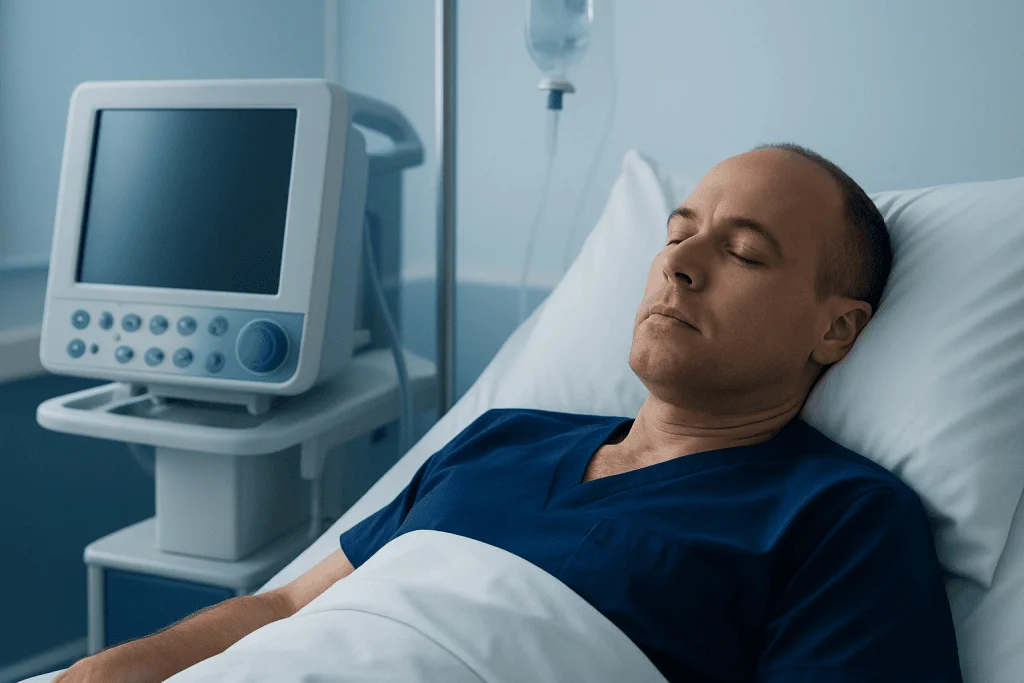
The first 10 to 14 nights are when how you sleep after a hair transplant matters most. The table below is a practical general guide to how the restrictions typically loosen. Treat it as a map, not a contract: extensive grafting, work in more than one area, marked swelling or additional procedures can all shift these dates. Sleep sits inside a much wider recovery arc, washing, exercise, sun exposure, shedding, which we cover in the full hair transplant recovery timeline.
| Recovery period | Typical sleeping guidance |
|---|---|
| Procedure night to day 3 | Back sleeping only, elevated at around 30–45 degrees. No pressure on the recipient area, no face-down sleeping. Swelling risk is highest in this window, so elevation matters most now. |
| Days 4–7 | Continue elevated back sleeping unless your surgeon says otherwise. Swelling is usually settling, but grafts still need protection from friction and accidental contact. |
| Days 7–10 | Some people can cautiously reduce the elevation or begin side sleeping, provided the grafted area does not touch the pillow. This is a surgeon’s call, not a self-assessment. |
| Days 10–14 | Many patients gradually return to more familiar positions. Avoid vigorous rubbing, scratching or sustained direct pressure while any scabs remain. |
| After 2 weeks | Usual sleeping positions are commonly acceptable. Stay gentle with any remaining sensitivity or crusting and keep following your individual plan. |
Do not judge readiness by the calendar alone. If you still have substantial tenderness, swelling, crusting or genuine uncertainty about where grafts were placed, staying in the more protective position for a few extra nights costs you almost nothing. Moving on too early is the only direction in which the trade-off is unfavourable.
When can I sleep in bed after a hair transplant?

From the first night. The bed itself was never the problem, position and support are. A bed is entirely fine as long as you can stay on your back, hold the incline and keep the recipient area off the bedding. If you know you move a great deal in your sleep, a recliner or an adjustable hotel bed may feel more secure for the first few nights, but neither is compulsory.
If you use a standard bed, arrange it like this: firm pillows stacked behind your upper back to create the slope, a pillow along each side of your torso to discourage rolling, and optionally the travel pillow around your neck. Some patients lay a clean towel or a disposable cover over the pillow area in case of minor spotting or fluid in the first nights, sensible, provided nothing is placed directly against the grafts themselves.
Expect the arrangement to feel strange. Sleeping semi-upright on your back is genuinely uncomfortable for habitual side and stomach sleepers, and the first two or three nights are usually the worst of it. It helps to think of it as a short, defined project, seven to ten nights of imperfect sleep protecting a result you intend to keep for decades. Take any prescribed medicines exactly as your treating doctor directed; decisions about adding anything for sleep, changing a dose or combining products belong to that doctor, not to a guide.
When can I sleep on my side or stomach again?
Side sleeping usually returns first, often around days 7 to 10, and only on one condition: the grafted area must stay clear of the pillow. Whether that is achievable depends on where your grafts sit. A transplant confined to the frontal hairline may tolerate careful side sleeping earlier than one extending across the temples or into the crown, where almost any side position brings grafts into contact with bedding. This is precisely the kind of judgement your surgeon makes for you at follow-up, because they know the exact distribution of your grafts.
Stomach sleeping comes back last. Face-down positions press the forehead and frontal scalp, the most common recipient zones, directly into the pillow, and they concentrate friction where you can least afford it. Most people are advised to wait until the two-week mark or until their surgeon confirms that normal positions are acceptable, whichever comes later.
When you do transition back, do it gradually. Lower the elevation over a night or two before flattening out completely. Try side sleeping for part of a night rather than committing to it for eight hours. If a position causes tenderness in the grafted area, that is useful information: the scalp is telling you it is not ready, whatever the calendar says.
Pain, itching and swelling at night
Discomfort follows a fairly recognisable pattern, though it is never identical between patients. Most people find that tenderness and tightness are most noticeable in the first one to three days, once the local anaesthetic has fully worn off. The donor area at the back of the head often feels tight or sore; the recipient area tends to feel tender and sensitive to contact rather than sharply painful. For most people this eases steadily over the first week, with the donor tightness sometimes lingering a little longer.
Swelling behaves differently: it often appears around day two or three and can migrate down the forehead towards the brows before it settles. Sleeping elevated is one of the few things you can actively do about it, which is another reason the incline earns its keep beyond graft protection.
Itching typically arrives as scabs form and the scalp heals, often within the first week, and it usually settles as the crusts clear, commonly over the following two to three weeks. It is one of the more maddening parts of recovery precisely because the one thing you must not do is scratch. Keeping fingernails short, keeping the bedroom cool and following your approved moisturising routine all take the edge off; many aftercare plans use a soothing spray for exactly this purpose, which we explain in our guide to panthenol spray after a hair transplant.
Making the first nights more comfortable
A calm, prepared environment does real work here. Before bed, complete your approved scalp-care routine, take prescribed medication at the scheduled time and arrange the pillows while you are still fully alert. Keep the room cool, dim and quiet, overheating makes itching worse, and a restless sleeper is a rolling sleeper. The full washing, medication and activity routine sits in our complete post-op care instructions; the night-time habits below are the sleep-specific layer on top of it.
- Set a phone alarm for medication timings if your schedule includes doses near bedtime.
- Keep fingernails short to limit damage if you touch your scalp while asleep.
- Skip hot showers, strenuous activity and any other triggers your surgeon has restricted in the hours before bed.
- Do not share the bed with pets or young children in the early nights: an affectionate headbutt at 3 a.m. is exactly the contact you are engineering against.
- If you wake and find you have shifted, simply reposition yourself gently. Do not rub the area or repeatedly inspect the grafts; checking is its own form of contact.
International patients have one extra variable: travel. Jet lag, an early procedure day and an unfamiliar hotel bed can all disrupt sleep just when you need to control your position. If you are staying in Istanbul for the early recovery period, it is worth setting up the hotel bed properly on the first evening rather than the first exhausted night: our guide to sleep positions and hotel recovery in Turkey covers the practical detail, from pillow requests to flight-day planning. Wherever you are treated, keep the written sleeping and washing plan from your discharge paperwork with you: it is the reference for every question this guide answers in general terms.
Step by step
- Set up your sleeping space before the procedure. Prepare a recliner or a stable pillow arrangement in advance, with clean bedding, so your first recovery night requires no improvisation.
- Sleep on your back with your head elevated. For the first 7 to 10 nights, back sleeping at roughly 30 to 45 degrees limits swelling and keeps the recipient area off the pillow.
- Use supports to prevent rolling. Pillows along each side of your body and a U-shaped travel pillow around the neck make side and stomach positions far less likely without pressing on the grafts.
- Protect the graft area from all friction. No scratching, no picking at scabs, no tight coverings unless your surgeon has approved them, and no contact between grafts and bedding.
- Follow your prescribed medicine and washing plan exactly. Take what your treating doctor has prescribed, on schedule, and leave any changes or additions, including sleep aids, to that doctor.
- Return to side sleeping gradually. From around days 7 to 10, and only with your surgeon’s confirmation, trial side sleeping with the grafted area clear of the pillow before committing to it for a full night.
- Keep your written aftercare plan beside the bed. It is the document that resolves every 2 a.m. doubt about what is and is not allowed for your specific case.
Your checklist
- A recliner or firm pillows that hold a stable 30–45 degree incline
- A U-shaped travel neck pillow, if you find it comfortable
- Clean pillowcases and an optional clean towel for the surrounding bedding
- Prescribed medicines with written dosing instructions
- Water and tissues within arm’s reach of the bed
- Loose, front-opening sleepwear that never passes over your scalp
- A plan to keep pets and young children out of the bed for the first nights
- Short, clean fingernails
- Your surgeon’s personalised washing and sleeping instructions, kept beside the bed
Key takeaways
- Sleep on your back with your head elevated for the early recovery period, commonly 7 to 10 nights.
- You can sleep in a bed from the first night: the position and supports matter, not the furniture.
- Grafts are far more settled by day 7 but still deserve protection from rubbing, pressure and scratching through days 7 to 10 or beyond.
- Discomfort is usually most noticeable in the first one to three days; itching typically arrives with the scabs and settles as they clear.
- Side sleeping often returns around days 7 to 10, stomach sleeping later, and both only with your surgeon’s agreement.
- The calendar is a guide; your own healing and your surgeon’s plan are the deciders.
Frequently asked questions
How long after a hair transplant can I sleep normally?
Most people can gradually return to their usual sleeping positions after 10 to 14 days, once grafts have settled and any scabs are clearing. Larger sessions, grafts in exposed positions or lingering tenderness can extend this. Treat 10 to 14 days as the common range and your surgeon’s confirmation as the actual green light.
When can I sleep in bed after a hair transplant?
From the first night. A bed is fine as long as you sleep on your back with your head elevated at roughly 30 to 45 degrees and keep the recipient area off the bedding. A recliner is a convenient alternative for restless sleepers, not a requirement.
Can I sleep on my side after a hair transplant?
Not in the first week, because side positions tend to bring the grafted area into contact with the pillow. Many people can resume careful side sleeping around days 7 to 10, provided the grafts stay clear of the bedding and their surgeon agrees. Grafts extending into the temples or crown usually mean a longer wait.
How long does the head hurt after a hair transplant?
Discomfort is usually most noticeable in the first one to three days, once the anaesthetic has worn off, and eases steadily over the first week for most people. The donor area can feel tight or sore for somewhat longer than the recipient area feels tender. Prescribed pain relief is normally planned around exactly this pattern.
When does itching stop after a hair transplant?
Itching typically begins as scabs form in the first week and settles as they clear, commonly over the following two to three weeks. Sensations vary widely between people. The rule that does not vary: do not scratch. Short fingernails, a cool bedroom and your approved scalp-care routine make the itch far easier to sit out.
What happens if I roll over in my sleep after a hair transplant?
Shifting position does not automatically mean grafts have been damaged. A brief brush against the pillow without bleeding or new pain is very unlikely to have disturbed anything. Gently return to your back, resist the urge to rub or repeatedly inspect the area, and improve the pillow barriers for the next night.
Can I use a travel pillow after a hair transplant?
Yes: a U-shaped travel pillow is one of the most useful items for the first week, because it supports the neck and discourages rolling without touching the top of the scalp. Check that it does not press on or rub any grafted area; if your transplant extends low or wide, ask your surgeon about the safest arrangement.
Can I take a sleeping pill after a hair transplant?
Only if your treating doctor has approved it. Some sleep aids interact with the medicines prescribed after surgery, and anything that deepens sleep can also make you less likely to notice and correct an unsafe position. The decision belongs to the doctor who knows your prescription list, not to general guidance.
Add us as a Preferred Source to see more of our trusted health content across Google Search, AI Overviews and Discover.

Update history
- PublishedAugust 15, 2026
- Medical review approvedSeptember 2, 2026
- Last content updateSeptember 2, 2026
References2
- Hair transplant: MedlinePlus Medical Encyclopedia medlineplus.gov
- Hair transplant: NHS nhs.uk
More Patient Guides

Septoplasty Recovery: Week by Week
Learn what to expect after deviated septum surgery: a week-by-week septoplasty recovery timeline, when it is usually safe to fly home, and…

Gallbladder Surgery Recovery: Week by Week
Learn what to expect after gallbladder surgery: a week-by-week recovery timeline, pain, diet, wound care, when it is safe to fly home…
Robotic Hysterectomy Recovery: Week by Week
Recovery from robotic hysterectomy week by week: pain, lifting, wounds, driving, flying home safely, warning signs and questions to ask before you…

Breast Reconstruction Recovery: Week by Week
DIEP flap recovery week by week: hospital stay, drains, pain, walking, showering, driving, when it is usually safe to fly home, and…