

Panthenol Spray After a Hair Transplant: When to Start and How to Use It
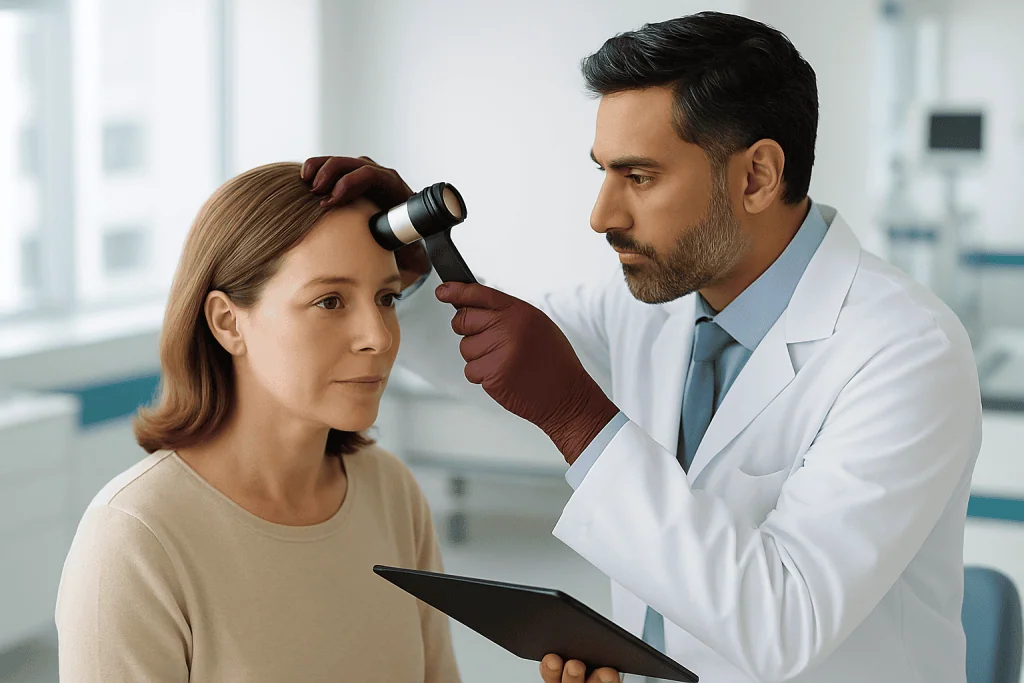
Start panthenol spray only when your surgeon confirms the timing. Many clinics introduce it after the first week, once scabs are lifting and grafts are settled, but protocols differ. In the earliest days, saline misting and the prescribed washing routine matter more. Choose a fragrance-free, alcohol-free formulation, apply it without rubbing, and stop any product that stings or provokes a rash.
You have flown home with a healing scalp, and the pharmacy shelf is full of sprays promising to soothe it. Should panthenol be one of them? Not yet, in most cases. Panthenol spray after a hair transplant can ease dryness, tightness and the itch that arrives as scabs lift, but the right start date and the right product depend on your surgeon’s protocol, not on the label.
In the first days after surgery, what matters far more than adding any over-the-counter product is protecting newly placed grafts and following your clinic’s washing and saline instructions. Panthenol has a place in recovery. It simply is not first in the queue.
At a glance
- Best first step: Read your surgeon’s written aftercare plan before adding panthenol or any other product.
- Early graft-care period: No rubbing, pressing or unapproved products on the recipient area during the first week.
- Saline spray: Often the only spray used in the first days; duration varies by clinic and technique.
- Panthenol products: Usually introduced later, and only as a gentle, fragrance-free, alcohol-free formulation.
- Graft security: Follicles are generally well anchored by around days 10 to 14, though your surgeon confirms this for your case.
- Styling products: Delayed until scabs have shed and the scalp is calm, tender-free and unbroken.
When can you start panthenol spray after a hair transplant?
The honest answer: when your own surgeon or aftercare team says so. There is no universal start date for panthenol spray after a hair transplant, because clinics differ in technique, washing schedules and the condition they expect the scalp to reach before extra products are added. Many teams prioritise saline misting, careful cleansing and strict graft protection during the first several days, then permit a soothing product such as panthenol once scabs have begun to lift naturally, often somewhere after the first week. Some clinics include a panthenol foam in their own aftercare kit from an earlier point. Both approaches exist, which is exactly why a general article cannot set your date.
If your clinic has given you a post-transplant kit, use it exactly as directed rather than combining it with a pharmacy spray on your own initiative. A product labelled “panthenol” can still contain fragrance, denatured alcohol, propellants, menthol or preservatives that sting an irritated scalp. The active ingredient is not the whole formulation, and a freshly transplanted scalp does not behave like ordinary skin.
One more distinction worth holding onto: your recipient area and your donor area heal differently and may carry different instructions. The donor zone often tolerates products sooner, but it can still have small healing wounds. The reliable way to settle any product question is to show your treating team the full ingredient list before you apply anything, most surgical teams review labels for their patients routinely, and it takes them seconds. The complete washing, sleeping and product rules are covered in our hair transplant aftercare instructions guide.
What panthenol is, and what it can and cannot do
Panthenol is a form of provitamin B5 (dexpanthenol) used widely in skincare. On skin, it acts as a humectant and emollient: it draws in moisture, softens dry surface layers and is generally well tolerated. Dermatology literature supports its use for dry, irritated skin, which is why it appears so often in post-procedure products. After a transplant, that translates into practical comfort, less tightness, less flaking, and scabs that soften rather than crack.
What panthenol does not do is grow hair. It is not a growth stimulant, and no spray or foam will make transplanted follicles produce hair sooner than the normal biological cycle allows. If a product marketed at transplant patients implies otherwise, treat the claim with caution. The question of whether medical treatments such as finasteride or minoxidil belong in your plan is a separate one, decided with your surgeon: our guide on finasteride and minoxidil after a hair transplant explains how that conversation usually goes.
So the honest framing is this: panthenol supports the skin the follicles sit in. Comfortable, well-moisturised skin is easier to care for, less tempting to scratch, and more pleasant to live with while you wait for growth. That is a real benefit. It is also the whole benefit.
A practical hair transplant aftercare timeline
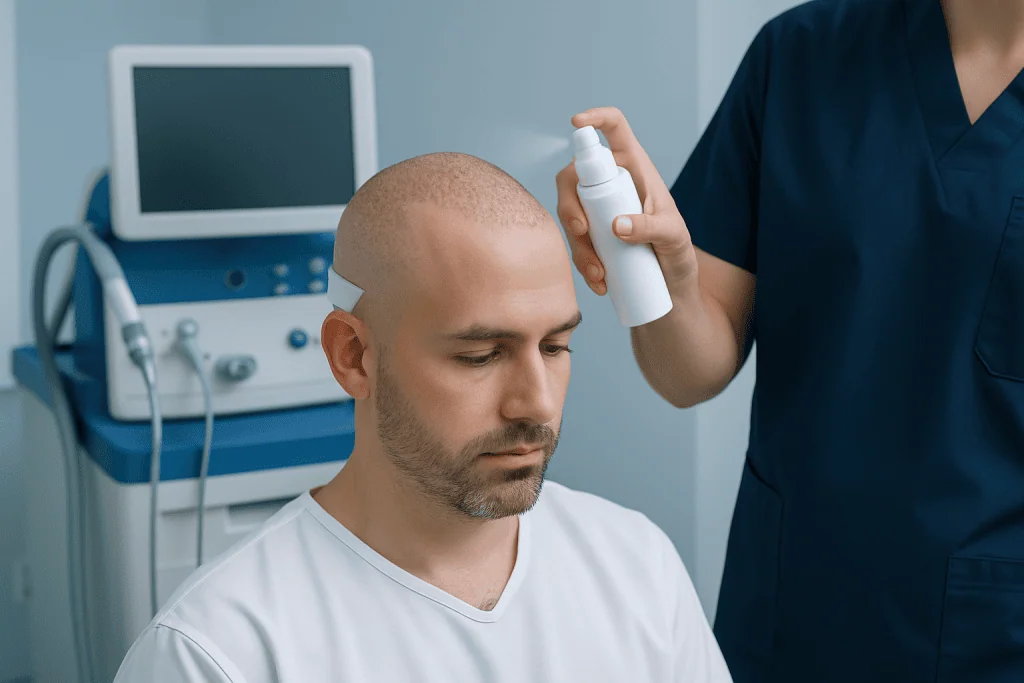
The timeline below is orientation, not instruction. Some teams ask for saline more frequently than others; some approve a moisturising product only after scabs have started shedding on their own. Never read a general timeline as permission to change a prescribed routine. For a fuller picture of what each stage feels like, see the hair transplant recovery timeline.
| Time after transplant | Usual priority | Panthenol and product considerations |
|---|---|---|
| Day 0 | Rest, manage swelling as instructed, avoid touching grafts entirely. | Only products applied by, or expressly approved by, the surgical team. |
| Days 1–3 | Protect grafts from friction, pressure, sweat and accidental rubbing. Saline misting may be advised. | No panthenol foam or spray unless your surgeon has specifically included it in your plan. |
| Days 4–7 | Gentle cleansing begins on the clinic’s schedule. Scabbing forms. | Some teams permit a soothing product now; if so, mist lightly, never rub, never wipe. |
| Days 8–14 | Scabs soften and shed with approved washing. No picking. | The common window for introducing panthenol against dryness and itch. Styling products still off the table. |
| Weeks 3–4 | Temporary shedding of transplanted shafts can occur and is often expected. | Selected everyday products may return after clearance, provided the scalp is calm and unbroken. |
| Months 2–6+ | New growth appears gradually; the pace is individual. | Routine hair care resumes as advised; anything that irritates the scalp gets stopped. |
Redness, dermatitis, a sensitive scalp, a larger procedure or an unexpected healing concern can all shift these windows. Your surgeon’s dates override every row of this table.
Panthenol spray versus saline spray: two different jobs
These two sprays get confused because both come in similar bottles and both touch the same scalp. They are not interchangeable. Saline, sterile salt water, is used in the earliest days to keep the recipient area comfortably moist, reduce crust hardening and support gentle scab care. It contains nothing that nourishes or moisturises skin in a lasting way; its job is short-term surface moisture during the most fragile phase. How long you use it varies considerably between clinics: some advise frequent misting for several days, others take a shorter or different approach.
Panthenol takes over a different job later: conditioning skin that is dry, tight and flaky once the critical graft-anchoring phase has passed. Using panthenol early does not substitute for saline, and continuing saline late does not deliver what panthenol does. If you were given a saline schedule, follow it to the letter, aim the mist as instructed, avoid a strong direct jet, never let the nozzle touch the scalp, and stop on the date your team set rather than extending it on your own. Misting beyond the advised period can leave the scalp overly damp and interfere with the washing routine.
Before leaving your clinic, it is worth having three dates written down: when saline stops, when normal washing begins, and when a moisturising product may start if dryness persists. Patients who fly home with those three dates rarely end up guessing at a pharmacy shelf.
Can I use panthenol foam spray after a hair transplant?
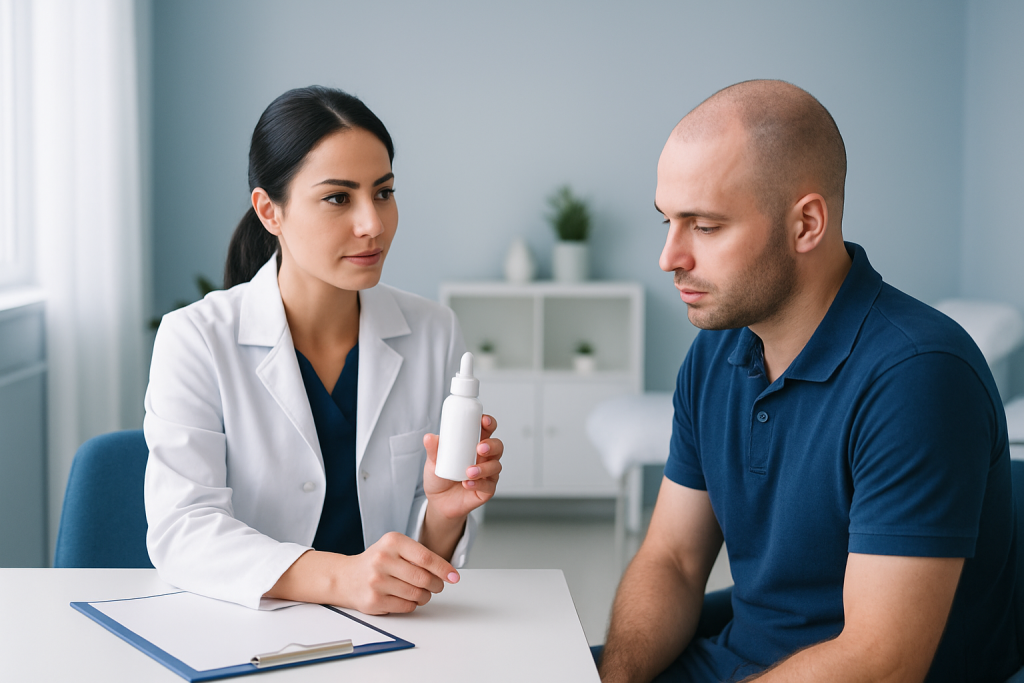
Usually yes, at the right stage, with the right product, applied the right way. Foam has a practical advantage over a liquid spray: it sits where you put it instead of dripping, which makes gentle application easier. But foam still needs to be placed, not worked in. In the early healing phase, even light massage or wiping can disturb grafts.
Before using any panthenol foam or spray, check three things. First, whether your team intends it for the recipient area, the donor area, or both: the answer is often “donor first, recipient later”. Second, the ingredient list: fragrance, denatured alcohol, menthol, strong preservatives and any active ingredient not already in your plan are all reasons to pause. Third, the start date your surgeon has set, which outranks anything printed on the packaging, including “post-procedure” and “repair” labels.
When you are cleared, the application itself is simple. Wash your hands. Hold the container at the distance stated on the product or by your clinic. Apply the smallest amount that covers the dry area. Let it absorb, no rubbing, no scratching, no towel to remove excess. A product that stings, provokes hives, or makes redness and weeping worse is a product to stop; comfort is the entire point, so discomfort is a clear signal the formulation is wrong for your scalp at this stage.
Can you dislodge grafts after 10 days?
By around day 10, transplanted follicles are generally well anchored in the scalp, and the research on graft security suggests that everyday contact, normal washing, light touch, a soft pillow, is very unlikely to displace them at that point. The genuinely fragile window is the first several days, which is why the early rules are so strict. This is also why most clinics relax their product restrictions somewhere in the second week rather than earlier.
Two caveats keep this honest. First, “around day 10” is a population statement, not a promise about your own healing pace; your surgeon confirms when your grafts are secure, taking into account the technique usedFUE and DHI procedures can carry slightly different early-care details. Second, “secure” does not mean “finished healing”. Aggressive scratching, picking scabs, harsh chemical exposure and vigorous friction can still irritate the skin and set comfort back, even when the follicles themselves are safe. Seeing transplanted shafts fall out in weeks two to four is a separate matter entirely: that shedding is a normal part of the follicle cycle and does not mean grafts were dislodged.
How to support healing after a hair transplant
There is no safe way to force a scalp to heal, or transplanted hair to grow, faster than the body’s own timetable. Products marketed as rapid-growth solutions cannot shortcut biology, and some actively irritate healing skin. What you can do is remove obstacles, which in practice means a short list of unglamorous habits.
- Protect the grafts physically. No touching, rubbing or pressure in the early days, and a sleeping position that keeps the recipient area off the pillow: our guide on how to sleep after a hair transplant covers the positions and how long they matter.
- Follow the washing and saline schedule exactly. Gentle, scheduled cleansing helps scabs shed on time; skipping washes or scrubbing both work against you.
- Take prescribed medication as directed. Any change to what you take is a decision for your treating doctor, not a forum or a product label.
- Avoid smoking, heavy alcohol and strenuous exercise for the period your clinic sets. All three affect circulation, sweating and swelling in ways a healing scalp does not need.
- Protect the scalp from sun according to your clinician’s advice, including when and what kind of head covering is acceptable, which is a more nuanced question than it sounds; see when you can wear a hat after a hair transplant.
- Eat and hydrate normally. Adequate nutrition supports skin repair; exotic supplements do not need to be part of the picture unless your clinician has reviewed them.
Adjuncts such as medical therapy or low-level light therapy exist, but they suit some patterns of hair loss and health histories and not others. They belong in a personalised plan discussed with your surgeon, not in the early healing period on your own initiative.
What hair products should you use after a hair transplant?
Fewer than you expect, for longer than you expect. The early weeks favour a short roster: the clinic-approved shampoo, saline if prescribed, and, once cleared, a gentle panthenol product for dryness. Everything else waits.
Hair spray, gels, waxes, fibres, pomades and dry shampoo are best postponed until the grafts are securely healed and your surgeon confirms styling products are back on the menu. The problem is not only the ingredients, alcohol, fragrance, strong hold polymers, but the removal: styling residue demands rubbing to wash out, and rubbing is exactly what a healing scalp should not get. Many patients need to wait at least until scabs have shed and the scalp is no longer tender, red or broken; your surgeon may advise longer if irritation persists.
When you do restart, ask about the specific product you want to use rather than assuming all styling products are equivalent, apply it away from the scalp where possible, and remove it with the approved shampoo and a light touch. Residue, itch or inflammation is your cue to shelve that product again. Your usual everyday shampoo raises the same question: ask when you can return to it and whether a milder alternative makes more sense in the meantime.
Step by step
- Read your surgeon’s discharge instructions first. Find the rules for saline, washing, sleeping position, sun protection and medication before considering any new scalp product. Your individual protocol outranks every general timeline, including this one.
- Confirm the exact panthenol product. Have your treating team see the product name and full ingredient list before you buy or apply a foam or spray, and confirm whether it is meant for the recipient area, the donor area or neither at your current stage.
- Protect grafts during the first days. No touching, rubbing, scratching or pressing the transplanted area. Only approved sprays, applied at the distance and frequency your team specified.
- Follow the saline and washing schedule as written. Sterile saline only, if recommended; do not substitute extra misting for the washing routine, and keep the nozzle clean and away from the scalp.
- Introduce panthenol gently once cleared. Clean hands, a small amount, no massage, no towelling off. Stop any product that stings, provokes a rash or worsens redness.
- Delay styling products until your surgeon clears them. Then choose mild formulations, keep them off the scalp where you can, and remove them with the approved shampoo and gentle technique.
- Keep a simple recovery record. Dated photos in similar lighting, plus brief notes on itch, dryness or swelling, give your treating team something concrete to work with at follow-up, especially once you are back home.
Your checklist
- Your written hair transplant aftercare instructions
- Your clinic’s follow-up contact details, saved before you fly
- Sterile saline, only if your surgeon has prescribed or approved it
- The approved shampoo and the washing schedule
- The full ingredient list of any panthenol product you plan to use
- The three key dates: saline stops, normal washing starts, moisturising products may begin
- Clean hands before anything goes near the scalp
- Sun protection guidance from your clinic
- A plan to avoid smoking, strenuous exercise and scalp friction for the advised period
Key takeaways
- Use panthenol spray after a hair transplant only once your surgeon approves the product and the timing, for many clinics that means after the first week.
- In the earliest days, graft protection, prescribed saline and careful washing are the priorities; panthenol is a later comfort measure, not an early treatment.
- Panthenol moisturises and soothes skin. It does not make hair grow, and no spray does.
- Grafts are generally well anchored by around days 10 to 14, but healing pace is individual and your surgeon confirms it.
- Styling products wait until scabs have shed and the scalp is calm; removal-by-rubbing is as much of a problem as the ingredients.
- Any product that stings, itches or worsens redness gets stopped, comfort is the point, so discomfort is the signal.
Frequently asked questions
Is panthenol good for hair growth?
No, not in the sense of stimulating growth. Panthenol (provitamin B5) is a well-tolerated skin moisturiser that softens dryness, eases tightness and can add slip and apparent thickness to hair shafts cosmetically. It does not act on follicles and will not make transplanted hair grow sooner or thicker. Its value after a transplant is comfort while the normal growth cycle runs its course.
Can you dislodge grafts after 10 days?
It becomes very unlikely. By around day 10, grafts are generally well anchored, and normal washing or light touch should not displace them. That is a general finding rather than a certainty for every patient, so your surgeon’s confirmation for your own scalp still matters. Shedding of transplanted shafts in weeks two to four is a normal part of the follicle cycle, not a sign of dislodged grafts.
Can panthenol spray damage newly transplanted grafts?
The panthenol ingredient itself is not the risk. The risks are timing, technique and formulation: applying any product too early, pressing or rubbing it in, or using a version with fragrance, alcohol or menthol on irritated skin. Used at the stage your surgeon sets, applied without pressure, a gentle panthenol product is generally well tolerated.
Is panthenol better than saline spray after a hair transplant?
Neither is better; they do different jobs at different times. Saline keeps the recipient area moist and supports scab care in the first days. Panthenol conditions dry, tight skin later, once the fragile phase has passed. The sequence and durations in your clinic’s plan are the ones to follow, not a swap you improvise.
Can I apply panthenol to the donor area before the recipient area?
Often, yes: the donor area frequently tolerates products sooner than the recipient zone, which is why some protocols stage the two areas separately. But the donor area can still carry small healing wounds and its own sensitivities, so the location, product and start date all come from your surgeon’s plan rather than a general rule.
When will the transplanted hairs start growing?
Transplanted shafts commonly shed in the first weeks while the follicles stay in place beneath the skin. New growth then develops gradually over the following months, at a pace that varies between individuals, hair types and procedures. Panthenol does not change that timetable; consistent aftercare and patience are what the waiting period actually asks of you.
Can I use normal shampoo after a hair transplant?
During early recovery, use the shampoo and washing method your clinic specified. Ordinary shampoos may contain fragrance or strong cleansers that are uncomfortable on healing skin, and washing technique matters as much as the product. The return date for your usual shampoo, and whether a milder alternative is worth keeping, are questions your treating team answers for your specific stage.
Add us as a Preferred Source to see more of our trusted health content across Google Search, AI Overviews and Discover.

Update history
- PublishedAugust 18, 2026
- Medical review approvedSeptember 2, 2026
- Last content updateSeptember 2, 2026
References3
- Topical use of dexpanthenol in skin disorders (PubMed) pubmed.ncbi.nlm.nih.gov
- Topical use of dexpanthenol: a 70th anniversary article (PubMed) pubmed.ncbi.nlm.nih.gov
- NHS: Hair transplant nhs.uk
More Patient Guides

Septoplasty Recovery: Week by Week
Learn what to expect after deviated septum surgery: a week-by-week septoplasty recovery timeline, when it is usually safe to fly home, and…

Gallbladder Surgery Recovery: Week by Week
Learn what to expect after gallbladder surgery: a week-by-week recovery timeline, pain, diet, wound care, when it is safe to fly home…

Robotic Hysterectomy Recovery: Week by Week
Recovery from robotic hysterectomy week by week: pain, lifting, wounds, driving, flying home safely, warning signs and questions to ask before you…

Breast Reconstruction Recovery: Week by Week
DIEP flap recovery week by week: hospital stay, drains, pain, walking, showering, driving, when it is usually safe to fly home, and…