

Managing High Blood Pressure Before Treatment in Turkey

High blood pressure rarely rules out planned treatment in Turkey, but it does shape how your case is prepared. Hospitals want your usual readings, a complete medication list and recent test results before dates are confirmed. Decisions about medication timing around fasting or anaesthesia belong to the treating team, not the patient. On arrival, expect readings to be repeated after rest.
If you take tablets for blood pressure and are planning a procedure abroad, you probably have the same question most patients do: will this get in the way? Usually it does not, provided it is known about early. Managing high blood pressure before treatment in Turkey is mostly a matter of preparation, gathering the right records, keeping your medication routine steady and understanding how hospitals assess fitness for treatment.
This guide explains why blood pressure matters to the team planning your care, what information is worth gathering before travel, how home readings are used, how medication decisions are made around anaesthesia and fasting, and what typically happens at the hospital once you arrive.
One principle runs through everything here: hypertension is not something to downplay or leave off a medical history form because it feels routine. The more your treating team knows before your dates are confirmed, the fewer surprises there are once you land.
At a glance
- When to share your history: Before treatment dates are confirmed, not after you arrive
- Medication changes: Made only on the instruction of a doctor, blood pressure medicines are never stopped or re-timed independently
- What to bring: A medication list with generic names, a home readings log, recent test reports and your prescriptions
- On arrival: Readings are usually repeated after rest; travel and anxiety are taken into account
- Possible extra checks: Blood tests, ECG or specialist review, depending on your history and the planned procedure
Why blood pressure matters before treatment
Managing high blood pressure before treatment in Turkey starts with understanding why anyone asks about it in the first place. Blood pressure affects how anaesthesia is planned, how bleeding risk is weighed, which monitoring is used during and after a procedure, and sometimes which tests are ordered beforehand. Hypertension is one of the most common chronic conditions worldwide, and hospitals that treat international patients see it every day. It is rarely a barrier. It is, however, always relevant.
Travel itself tends to push readings around. Long flights, broken sleep, dehydration, unfamiliar food, anxiety about the procedure and a shifted time zone can all nudge blood pressure upward for a few days. None of this means treatment cannot go ahead. It does mean that a single number taken in an airport or a hotel room tells the team very little, which is why your usual pattern, recorded calmly at home over days or weeks, carries more weight than any one reading.
Depending on the procedure, planning for a patient with hypertension may involve more than one specialty: the treating doctor, an anaesthetist, and sometimes cardiology or internal medicine. That coordination works best when the relevant history arrives before the travel dates are fixed, not on admission day.
What to send before you travel
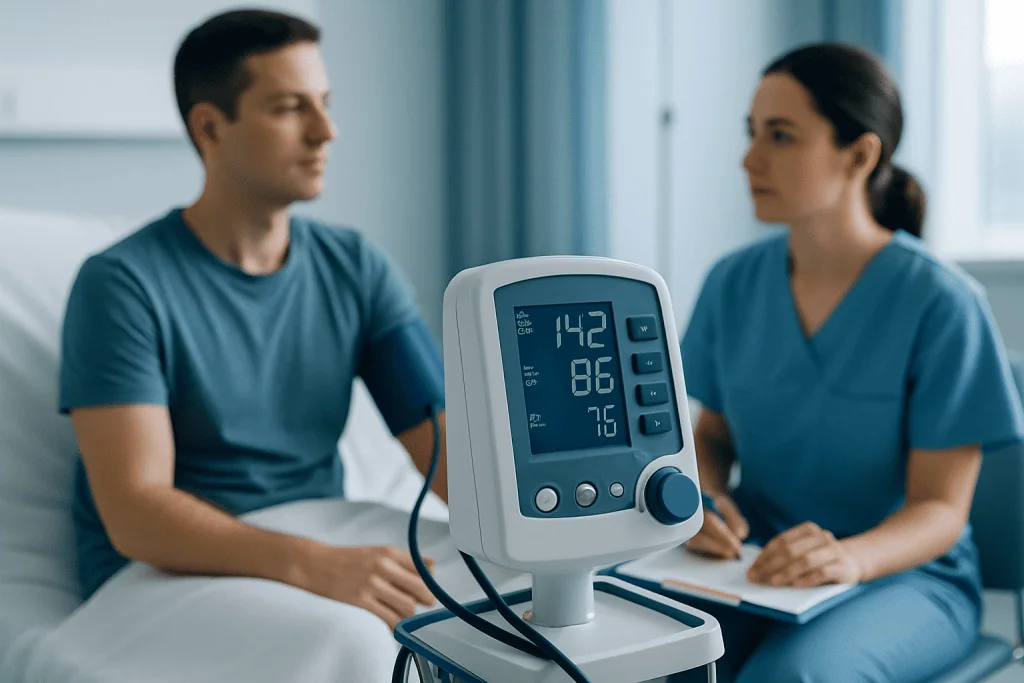
Treatment planning for international patients begins with a review of medical records, and blood pressure history belongs in that file from the start. A clear picture at this stage means the reviewing doctors can decide early whether additional evaluation is needed, rather than discovering the question after you have booked flights. There is a separate guide on how medical records are reviewed before a treatment plan is given if you want the full picture of that process.
For hypertension specifically, the most useful documents are:
- A recent home blood pressure log, dates, times, readings and pulse
- A complete list of medicines with doses and the time of day each is taken
- Recent blood tests, particularly kidney function if you have had it checked
- Any ECG, echocardiogram or other cardiac reports
- Letters or notes from a cardiologist or family doctor, if you see one
History matters as much as numbers. A past heart attack, stroke, heart failure, kidney disease, diabetes, blood clots or a previous problem with anaesthesia all change how a case is planned, and each belongs in the record even if it happened years ago. The same is true if your blood pressure has recently been unusually high, unstable or difficult to control, even if you currently feel well. Reports in languages other than English or Turkish can generally be worked with, though a short English summary from your own doctor tends to speed the review.
Checking your readings at home

A short, honest home log is more useful than a single reading taken under stress. If your own doctor has advised home monitoring and you have a monitor, the standard approach is simple: sit quietly for a few minutes first, rest your arm at heart level, measure at roughly the same times each day, and write down both numbers along with your pulse. A week or two of readings taken this way gives a far truer baseline than sporadic checks.
Two habits make logs less useful. The first is measuring repeatedly in a panic after one high number, anxiety raises blood pressure, so each anxious re-check tends to confirm the worry rather than clarify anything. The second is editing the log, leaving out readings that look bad. The point of the record is your genuine range, including the outliers, so the team can see what is normal for you and what is not.
If your device is old, damaged or gives wildly inconsistent results, mention that to your doctor; a clinic check or a validated monitor may be more reliable. And if home monitoring has never been part of your care, there is no need to invent a regime before travel: the hospital will measure on arrival regardless. Whatever you have is worth bringing; whatever you do not have is not worth improvising.
Medication before and during travel
The single most important rule is also the simplest: blood pressure medicines are not stopped, started or re-timed on a patient’s own initiative before a procedure. Some classes of medication interact with anaesthesia and need specific instructions about the morning of treatment; others should not be interrupted abruptly at all because sudden withdrawal can cause a rebound rise. Which category your tablets fall into is a decision for the prescribing doctor and the treating team: it is not something to work out from a search engine or a forum.
The same discipline applies to everything else you take. Blood thinners, diabetes medicines, painkillers, supplements and herbal products can all affect planning, and some interact with blood pressure treatment. If you take anticoagulants alongside your blood pressure tablets, the guide on what to tell your care team about blood thinners covers that ground in detail. When in doubt about whether something counts as a medicine, include it on your list anyway.
Practical packing points for the journey itself:
- Carry all medicines in hand luggage, never in checked baggage
- Keep original packaging where possible, so names and doses are verifiable
- Bring prescriptions or a doctor’s letter, particularly if you take several medicines
- Pack more than your planned stay requires, in case your return is delayed
- Write a list using generic names as well as brand names, brand names often differ in Turkey, and the generic name is what a pharmacist or doctor will recognise
Time zones deserve a thought too. From much of Europe the shift to Turkey is small; from the Americas or East Asia it is not, and a once-daily tablet’s timing can drift by many hours. How to handle dose timing across a large time change is a question for whoever prescribes the medicine, ideally raised before departure rather than mid-flight.
What happens at the hospital in Turkey
Expect your blood pressure to be measured on arrival, at admission, in consultation and again during the pre-anaesthesia evaluation if your treatment involves anaesthesia. A single raised reading after a long journey does not, by itself, decide anything. Clinicians know that travel, pain and unfamiliar surroundings inflate numbers, and the usual response is rest and a repeat measurement, compared against your home log if you have one.
Depending on your history and the planned procedure, the team may also request blood work, an ECG, kidney function tests or a cardiology review. These requests are routine risk assessment, not a sign that something has gone wrong. The guides on pre-op tests for international patients and why tests are sometimes repeated in Turkey even when you bring results from home explain what to expect and why fresh results are often preferred.
If readings remain persistently high or the evaluation raises a concern, the options include adjusting the plan, adding monitoring, or postponing until the picture is clearer. A postponement is frustrating when you have travelled for treatment, but it is a clinical judgement about timing, not a rejection, and the reasoning, the next steps and the implications for your schedule should be explained to you, with an interpreter if needed. This is also one of the strongest arguments for sharing your history early: most of what would surface on arrival can be identified, and dealt with, before you ever book a flight.
The days before treatment
The final days before a procedure are for steadiness, not transformation. Extreme dieting, an intense new exercise plan or an untested supplement bought for the occasion can all move your blood pressure in unpredictable directions. What helps instead is ordinary consistency: medication taken as prescribed, reasonable sleep, adequate water, limited alcohol and, if your doctor has recommended a low-salt diet, continuing it while travelling.
Salt is the quiet variable abroad. Restaurant and hotel food is often saltier than home cooking, and it is entirely reasonable to ask for grilled, steamed or baked dishes with sauces on the side. If your treatment requires fasting, the hospital’s written instructions take precedence over habit, including the question of what to do with morning tablets, which the team will answer specifically rather than leaving you to guess.
Sleep disruption is the other common culprit behind odd readings in the first days abroad. Arriving a day or more before your first appointment, when the schedule allows it, gives your body time to settle; the guide on managing jet lag before treatment in Turkey covers this in more depth. Many patients also find that travelling with a companion takes real pressure off, someone to take notes in consultations, keep track of medication times and share the administrative load.
Planning the logistics around hypertension
Good logistics lower stress, and lower stress shows up in your readings. Where the choice exists, favour flights that leave time to rest before hospital visits rather than tight same-day transfers. If you tire easily or have mobility needs, airport assistance can be arranged in advance through the airline. Keep water and, where your condition allows, light snacks within reach on the journey, along with the medicines you would need if a leg of the trip runs long.
Managing high blood pressure before treatment in Turkey also means planning for the small failures: a lost bag, a delayed return, a tablet strip left in a hotel room. The mitigations are the ones already mentioned, medicines in hand luggage, extra supply, prescriptions and a generic-name list, plus one more: keep your medication list, key medical documents and hospital contact details both on your phone and on paper, so no single dead battery or lost device strands you without them.
Finally, build slack into the itinerary. A schedule with no buffer between landing, consultation and procedure leaves nothing to absorb a repeated test or an extra review. A day of margin costs little and removes a great deal of pressure: the kind that shows up on a monitor as well as in your mood.
Step by step
- Get your history into the file early. Your diagnosis, usual readings, medication list and relevant reports belong in the record review before treatment dates are confirmed, so any need for cardiology input or extra testing surfaces while you are still at home.
- Build a home reading log, if you already monitor. Consistent times, a rested measurement, both numbers plus pulse, nothing edited out. Bring it in written or digital form so hospital readings can be compared against your genuine baseline.
- Settle medication questions before departure. Whether any tablet needs special timing around flights, fasting or anaesthesia is a question for the prescribing doctor and the treating team. No blood pressure medicine is stopped or re-timed on a patient’s own judgement.
- Pack medicines defensively. Hand luggage only, original packaging where possible, prescriptions or a doctor’s letter, extra supply beyond the planned stay, and a written list with generic names.
- Plan a low-stress arrival. Rest time before the first appointment, no needlessly tight transfers, and airport assistance requested in advance if it would help.
- Go through the pre-treatment checks. Expect repeated blood pressure measurements and possibly blood tests, an ECG or a specialist review. These determine the safest timing and monitoring plan for your procedure.
- Keep your home doctor in the loop. They know your baseline better than anyone. A short note from them summarising your control and treatment history strengthens the file, and they remain part of your care after you return.
Your checklist
- Home blood pressure log with dates, times, readings and pulse
- Full medication list, generic names, doses, timing, including supplements and over-the-counter medicines
- Original prescriptions or a doctor’s letter for all regular medicines
- Recent ECG, blood tests, cardiology notes or kidney function results, if available
- Medication supply exceeding the planned length of stay
- Medicines packed in hand luggage, in original packaging where possible
- Medical documents and contact details saved on your phone and carried on paper
- An itinerary with rest time before appointments and buffer days for extra checks
- Written questions about fasting, anaesthesia and morning medication timing for your consultations
Key takeaways
- High blood pressure does not automatically prevent treatment in Turkey, but it must be in the file before dates are confirmed.
- A calm home reading log outweighs any single measurement taken under travel stress.
- Medication decisions, including morning-of-treatment timing, belong to the prescribing doctor and the treating team, never to guesswork.
- Expect readings to be repeated after rest on arrival, with extra tests possible depending on your history and procedure.
- Medicines travel in hand luggage, with prescriptions, extra supply and a generic-name list, because brand names differ in Turkey.
Frequently asked questions
Can I travel to Turkey for treatment if I have high blood pressure?
Hypertension is common among international patients and rarely prevents planned treatment. What matters is that the treating team knows about it early, your usual readings, your medicines and any related conditions, so that anaesthesia, testing and monitoring can be planned around it. Whether your control is currently stable enough for travel is a judgement for the doctor who manages your blood pressure.
Will my procedure be cancelled if my blood pressure is high on arrival?
Not on the basis of one reading. Travel, tiredness, pain and anxiety all raise blood pressure temporarily, and the usual response to a high arrival number is rest and a repeat measurement, compared with your home log. If readings stay persistently high or the evaluation raises other concerns, the team may adjust the plan, add tests or monitoring, or postpone, and the reasoning should be explained to you at each step.
Should I take my blood pressure medicine on the morning of treatment?
It depends on the specific medicine, the procedure and whether anaesthesia or fasting is involved, some tablets are usually continued, others held, and the answer differs between drug classes. This is decided by the treating team and given to you as an explicit instruction before the treatment day. It is never something to guess at, and bringing your medicines with you lets the team verify exact names and doses.
What records are most useful for planning treatment when I have hypertension?
A recent home blood pressure log, a complete medication list with doses and timing, recent blood tests, any ECG or cardiac reports, and notes from a cardiologist or family doctor if you have them. History of heart attack, stroke, kidney disease, diabetes, blood clots or previous anaesthesia problems belongs in the file too, however long ago it happened.
What happens if I lose or run out of my medication while in Turkey?
Turkish pharmacies stock most common blood pressure medicine classes, but often under different brand names, which is why a generic-name list and a prescription or doctor’s letter matter so much. Any replacement or substitution is confirmed by a doctor rather than improvised at a pharmacy counter, and the sooner a missing medicine is flagged to the people treating you, the simpler the fix.
Can anxiety make my readings look worse at the hospital?
Yes. The so-called white-coat effect, readings that run higher in clinical settings than at home, is well recognised, and it is amplified by travel fatigue and an unfamiliar environment. Hospitals account for it by allowing rest and repeating measurements. Your home log is the counterweight: it shows the team what is genuinely usual for you.
Does flying affect blood pressure?
For most people with treated hypertension, commercial flights are uneventful, but long journeys bring dehydration, disrupted sleep, immobility and stress, all of which can nudge readings upward for a day or two. Practical countermeasures are ordinary ones, water, movement when permitted, rest after landing. Whether a long-haul flight is advisable in your particular circumstances is a question for your own doctor before booking.
Do time-zone changes affect when I should take my tablets?
They can, particularly on once-daily medicines after a large time shift, where dose timing can drift by many hours. How to bridge the change is agreed with the doctor who prescribes the medicine, ideally before departure. Keeping a written schedule and setting phone reminders in the new time zone helps you follow whatever plan is agreed.
Add us as a Preferred Source to see more of our trusted health content across Google Search, AI Overviews and Discover.

Update history
- PublishedJune 16, 2026
- Medical review approvedSeptember 13, 2026
- Last content updateSeptember 12, 2026
References2
- High blood pressure (hypertension): NHS nhs.uk
- High Blood Pressure: MedlinePlus medlineplus.gov
More Patient Guides

How Long Does Anesthesia Last? Wear-Off Times by Type
Coming round from an operation, almost everyone asks the same two questions: when will my head feel normal, and how long is…

Flying to Turkey After a Recent Illness: When Is It Safe to Travel?
Flying to Turkey after a recent illness may be safe once you are medically stable and cleared to travel; plan airline support…

Braces, Retainers, and Dental Work Before Surgery in Turkey: What to Tell Your Team
Braces, retainers and dental work before surgery in Turkey should be shared with your care team early to plan safe anaesthesia and…

When to Stop Eating, Drinking, or Smoking Before a Procedure in Turkey
When to stop eating before a procedure in Turkey depends on your anesthesia plan; follow your care team’s exact fasting instructions for…