

Medical Travel to Turkey with Visual Impairment

You can travel to Turkey for treatment with visual impairment, but the trip works best when support is arranged before you fly. Share an accessibility profile with the international patient team, book airline assistance for every flight segment, confirm who meets you on arrival, request interpreter support for medical conversations, and agree on how you will receive discharge instructions in a format you can actually use.
Will you be able to find your way through an unfamiliar airport, a busy hospital corridor and a hotel room you have never seen? That is usually the first worry when you are blind or have low vision and your treatment is in another country. The honest answer: yes, with preparation. Almost every difficult moment in this kind of trip can be anticipated, and most of them can be arranged away before you leave home.
This guide takes you through each stage of medical travel to Turkey with visual impairment: what to prepare, what to ask for, what to expect at airports and in hospital, and how to make sure aftercare instructions reach you in a format you can use.
At a glance
- Best planned: 2–4 weeks or more before travel, so assistance can be booked and confirmed
- Useful support: Airline and airport assistance, interpreter, hospital escort, pre-arranged transfers
- Documents to prepare: Medical records, medication list, accessibility profile, emergency contacts, in accessible digital and printed form
- Companion: Recommended for surgery, anaesthesia, first international trips, or unfamiliar mobility situations; sometimes required at discharge
- Hospital support: International patient coordination, guidance between departments, verbal orientation on request
Is medical travel to Turkey a good idea when you have visual impairment?
It can be, provided two things are true: your treating doctor at home agrees you are medically fit to travel, and the hospital receiving you knows about your visual impairment before your first appointment rather than on the day. Medical travel to Turkey with visual impairment is not fundamentally different from any other patient’s journey: the medicine is the same. What changes is the amount of information you need in advance, because you cannot rely on reading signs, spotting your driver, or scanning a consent form at a glance.
Start with how you actually move through unfamiliar places. Do you use a white cane, a guide dog, a magnifier, a screen reader, large print, or a trusted companion’s elbow? Do you want verbal orientation when you enter a new room? Write this down as a short accessibility profile, a few lines is enough, and send it to your care coordinator before you book flights. At Acibadem, international patient teams can build practical support around your appointments: interpreters, guidance within the hospital, help with registration and administrative steps. None of this replaces your own mobility skills. It removes the parts of the trip that would otherwise cost you energy you need for treatment.
One planning point that patients often miss: decide early whether you are travelling alone. Many appointments can be completed independently, but some treatment plans require an adult companion at discharge, after anaesthesia or day procedures, for example, regardless of visual impairment. Ask this question before booking, not after.
Before you travel: documents, communication and consent
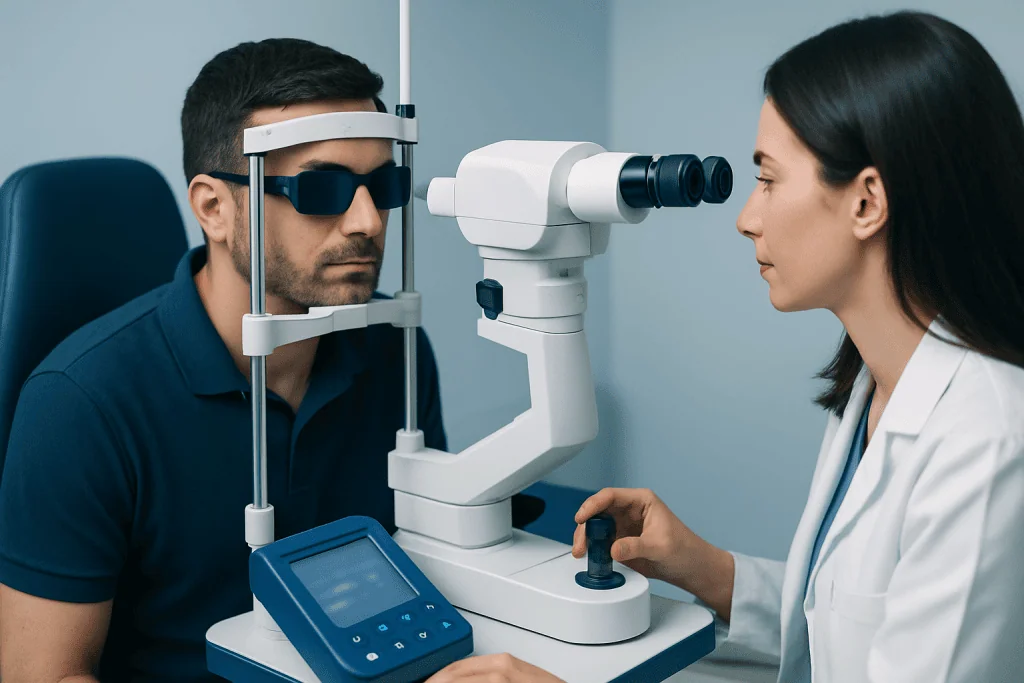
Your medical documents need to exist in two forms: one you can access and one the hospital can review. That usually means accessible digital copies on your phone or in cloud storage, files that work with your screen reader or can be enlarged, plus a printed set for the medical team. Include recent reports, imaging, test results, prescriptions, allergies, previous surgery notes and a summary from your current doctor. If organising this feels daunting, our guide on how to share your medical history clearly when you travel for treatment breaks the task into manageable steps.
Consent deserves a separate conversation before you fly, especially if you are travelling with a companion. You decide who may receive information about you, who may help you read forms, and whether you want private conversations with your doctor or interpreter. Visual impairment does not reduce your right to understand, question and decide. A professional interpreter and a companion do different jobs: the interpreter handles medical meaning; the companion knows your preferences and history. Both are useful, and you can use both without either one speaking for you.
Tell your coordinator in advance if you need documents read aloud, explained verbally, enlarged or sent digitally. Not every document will be available in every format immediately, and a hospital that admits this plainly is being honest with you. Requesting formats early gives the team time to prepare rather than improvise.
Two more pre-travel checks matter. First, insurance: confirm what your policy covers for the treatment itself and for complications, and read our guide to travel insurance for medical treatment in Turkey before you buy a policy. Second, medicines: bring your full supply in original packaging with a clear schedule, and never change doses or timing on your own initiative, any adjustment belongs to your treating doctor. Our guide on keeping your regular medicines on schedule during medical travel covers time zones, storage and backups.
Flights, airport assistance and arrival in Turkey
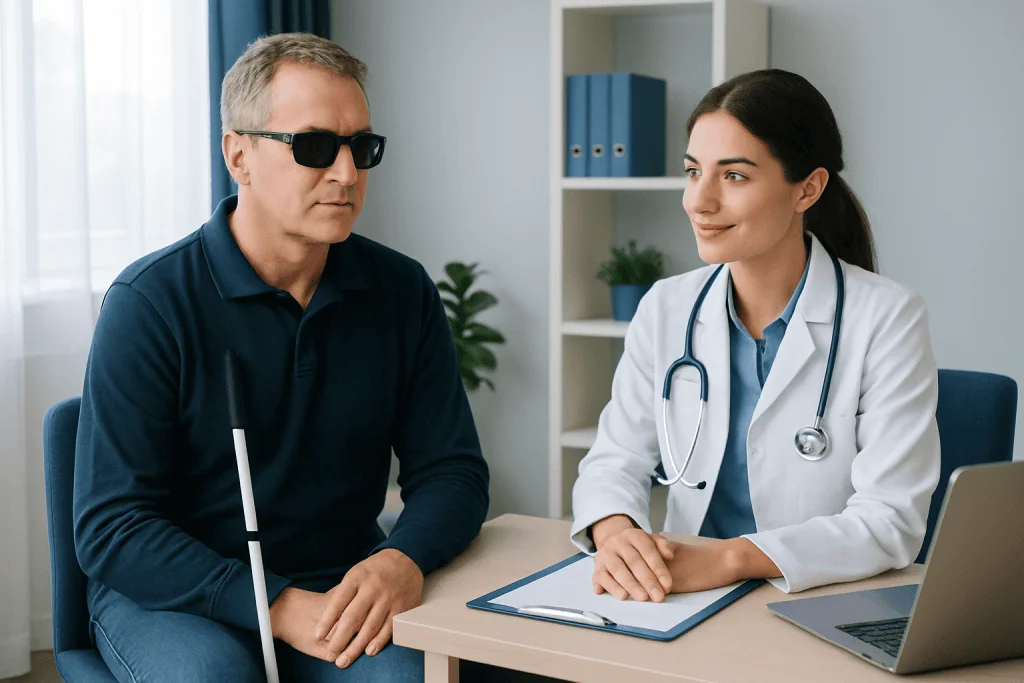
Airports are usually the hardest part of the journey, queues, security checks, visual signage, announcements you may not hear clearly over noise, and long walking routes you have never taken. The solution is booked assistance, not improvisation. When you buy your ticket, request assistance from the airline for both departure and arrival, and again for any connection. Be specific: do you need meet-and-assist from check-in, escort through security, help locating the gate, support at baggage claim, guidance to the arrivals meeting point? Confirm the booking a few days before you fly. Assistance requested at the airport on the day is far less reliable than assistance booked in advance.
Pack strategically. Essential items go in your cabin bag, never in checked luggage: medications, glasses or low-vision aids, spare cane tips, chargers and adapters, medical documents, insurance details and your hospital contact information. If any of your equipment counts as a medical device, our guide on how to pack medical devices and supplies for treatment travel to Turkey explains what airlines and security staff typically expect.
If you travel with a guide dog, start the paperwork early, weeks, not days. Airline approval, veterinary documentation and Turkey’s entry requirements each have their own timelines, and hotel and hospital access rules vary. Confirm in writing where the dog can accompany you, and plan backup mobility support for clinical areas where animal access may be restricted, such as operating suites or sterile zones.
Arrival is where vague plans fail. Before you land, agree a precise identification process with whoever is meeting you: the driver’s name, the vehicle description, and a simple call or message routine that does not depend on you reading a name board. Save the phone numbers of your coordinator, driver, hotel and companion in a format you can use quickly: a labelled contact list your screen reader handles well, plus a printed card as backup.
Choosing a hospital: what “best” actually means
People often search for the single best hospital in Turkey for medical tourism. There is no honest answer to that question, because “best” depends on your condition, the specific procedure, and, in your case, how well the hospital handles accessibility. A hospital that is excellent for one treatment may not be the right choice for another. What you can assess is reliability: does the hospital answer specific questions with specific answers, explain who will treat you, describe its international patient process clearly, and respond directly when you describe your visual impairment?
A useful test: send your accessibility profile before committing, and see what comes back. A vague reassurance is a warning sign. A concrete reply, who meets you, where, what escort support looks like, how consent will be handled, tells you the team has done this before. For a fuller set of criteria, read how to recognise a reliable hospital in Turkey for medical travel.
Getting around the hospital with low vision or blindness
Large hospitals feel complex on the first day even for sighted patients. For you, the difference between a stressful day and a manageable one is a clear arrival plan: which entrance to use, where you meet the international patient representative, and whether someone accompanies you to registration, consultation rooms, testing areas and administrative desks. Ask for all of this before your first appointment. It is a routine request, and making it early means nobody has to improvise while you wait.
Inside the hospital, practical safety is mostly about communication. Ask staff to identify themselves when they approach you, to explain before they touch your arm, shoulder or face, and to tell you before any equipment is moved near you. None of this is demanding; it is how good clinical care should work for every patient with visual impairment.
Requests worth making explicitly:
- Verbal orientation when entering a room, where the chair, examination couch and exit are located.
- Help reading queue numbers, door signs, forms and medication labels.
- Time to store your cane, bag or assistive devices safely during examinations, and their return before you stand up.
- A description of any procedure before it starts, including what you will feel and how long it takes.
- Guidance back to your companion, transport point or waiting area after each appointment.
- Your preferred guiding method stated once at the start, taking an elbow, verbal directions, or walking slightly behind a guide, so every staff member does the same thing.
Accommodation, daily routines and mobility outside the hospital
Choose accommodation for predictability and proximity, not sightseeing value. Useful questions before booking: is entry step-free, is there a lift, how is the room lit, what is the bathroom layout, are floor surfaces even, and can staff help with taxis and directions? If you have low vision, ask for photos or a short verbal description of the room so you can build a mental map before arrival. Once you are there, spend ten minutes learning the route from bed to bathroom to door before you need it in the dark or half-asleep after a procedure.
Keep your daily routine deliberately simple during treatment. Use the same transport route, save key locations in your phone, and resist changing meeting points. Ride-hailing apps vary in screen-reader accessibility, so pre-arranged hospital transfers or a companion are usually easier for the first days. Turkish cities are lively: traffic is assertive, some pavements are uneven, construction is common and public spaces can be crowded. None of this means staying indoors: it means pacing yourself, choosing familiar routes, and accepting more support than usual immediately after tests, sedation or any procedure, even if you are fully independent at home.
If low vision is relatively new for you, be honest with yourself about the difference between adapting at home and adapting abroad. At home you know the light switches, the kerb heights, the pharmacy layout. Abroad, everything must be learned at once, while you are also managing treatment. Techniques that help include consistent lighting in your room, high-contrast markers on items you use daily, keeping possessions in fixed positions, and asking companions to describe spaces systematically, clockwise, or from the door inward, rather than in fragments. A low-vision specialist at home can advise on aids and strategies before you travel; that conversation is worth having early rather than after a difficult first day.
Working with interpreters, companions and care teams
If you do not speak Turkish, request interpreter support for every conversation where meaning matters: diagnosis, consent, risks, medication instructions, discharge planning. A professional interpreter reduces misunderstanding in ways an informal helper cannot, because medical vocabulary is precise and the consequences of a mistranslation are real. Your companion still has a role, remembering your preferences, describing symptoms you have tracked together, supporting your mobility, but important medical decisions should not rest on informal translation.
Agree on communication channels with your coordinator. You may prefer phone calls over printed notes, voice messages over text, or email attachments that work with your screen reader. Say so plainly. Then adopt one habit that catches most errors: before leaving any appointment, explain the plan back to the team in your own words. If you can say it, you have understood it. If you cannot, ask again: that is what the appointment is for.
If you are travelling alone, tell the international patient team at the planning stage. They can tell you which parts of your treatment genuinely require a companion and which do not, based on the treatment plan rather than assumptions about your visual impairment.
Costs: how quotes work and what to check
There is no single answer to what a check-up or treatment in Turkey costs, and you should be wary of anyone who gives you one before seeing your medical records. A serious quote depends on your diagnosis, the scope of the procedure, the tests included, the length of any hospital stay, and follow-up needs. Ask for the quote in writing, ask what it includes and excludes, anaesthesia, implants or materials, medications, transfers, extra nights, and ask what happens financially if plans change mid-treatment. Then budget separately for the costs that sit outside any hospital quote: flights, accommodation, a companion’s expenses, and contingency time. Our budget checklist beyond the treatment quote lists the items patients most often forget.
Aftercare, medications and returning home
Discharge is the moment when the most information arrives in the least accessible way. Slow it down. Ask the team to go through medication names, timing, dosage, restrictions, wound care if relevant, and follow-up dates verbally, and to provide a written or digital summary you can use later. Any change to your medicines is decided by your treating doctor, not improvised at the pharmacy or the airport. If labels are hard to read, ask someone to help you organise medicines safely; tactile markers, phone reminders and accessible medication apps can help, but confirm your system with the care team before you rely on it.
Before discharge, ask one question explicitly and get a specific answer: which warning signs mean I need urgent help? Every procedure has its own list: it may include heavy bleeding, worsening pain, fever, breathing difficulty or signs of infection. If any warning sign your team described appears, whether you are still in Turkey or already home, call your local emergency number or go to the nearest emergency department now. Do not wait to reach your coordinator first, and do not treat a message to the hospital as a substitute for emergency care.
The same applies to your eyes. Sudden loss of vision, a sudden shower of new floaters or flashes, a dark curtain or shadow moving across your vision, or sudden severe eye pain can signal conditions that worsen within hours. If any of these occur, call your local emergency number or go to the nearest emergency department now.
For everything non-urgent, the route home is straightforward: share your discharge documents with your local doctor, keep your Acibadem contact details available, and route follow-up questions through the international patient team, who can pass them to the appropriate department. If you are flying soon after treatment, confirm any travel restrictions or precautions with your doctor before booking the return flight.
Step by step
- Share your accessibility needs early. Send your coordinator a brief written profile: your level of vision, mobility aids, assistive technology and preferred communication style. Include what helps most in unfamiliar buildings, verbal orientation, escort support, large-print or digital documents.
- Prepare medical and travel documents in two formats. Collect reports, prescriptions, allergies, imaging, passport details, insurance documents and emergency contacts. Keep accessible digital copies plus a printed backup folder in case your phone or internet fails.
- Book airline and airport assistance for every segment. Request it when buying the ticket, specify exactly what you need, and confirm it a few days before departure. Include connections, not just the first and last airports.
- Fix the arrival plan precisely. Before flying, save your coordinator, driver, hotel and companion contacts accessibly, and agree how you will identify your driver without reading a sign, name, vehicle details, and a call or message routine.
- Plan the first hospital visit in detail. Confirm which entrance to use, what time to arrive, and where you meet the international patient representative. Request help with registration, forms and movement between departments.
- Use professional interpreters for medical conversations. Request interpreter support for diagnosis, consent, risks, medications and discharge. Keep asking until you can explain the plan back in your own words.
- Organise aftercare before leaving Turkey. Get medication instructions, restrictions, follow-up dates and warning signs in a format you can access later, and know exactly which symptoms require emergency care rather than a call to the hospital.
Your checklist
- Passport, visa information if required, and travel insurance details
- Medical records, imaging, prescriptions, allergies and doctor summaries
- Accessible digital copies of all important documents on your phone or cloud storage
- White cane, spare cane tips, low-vision aids, glasses, chargers and power adapters
- Full medication supply in original packaging, plus a clear medication schedule
- Airline and airport assistance confirmed in writing for all flight segments
- Guide dog paperwork started early, with written confirmation of access rules, if applicable
- Hospital coordinator, driver, hotel, companion and emergency contacts saved accessibly and printed
- Preferred communication notes: screen reader use, large print, verbal instructions
- A support plan for after treatment, especially if sedation or reduced mobility is expected
Key takeaways
- Medical travel to Turkey with visual impairment is manageable when accessibility needs are shared before flights are booked, not after arrival.
- Booked airport assistance, pre-arranged transfers, professional interpreters and hospital escorts remove most of the trip’s stress points.
- You have the right to clear explanations, accessible documents where possible, and direct involvement in consent and treatment decisions.
- A companion is often helpful and sometimes required after certain treatments, but the team should base that on the treatment plan, not on assumptions about your independence.
- Before leaving Turkey, get aftercare, medications and warning signs in an accessible format, and if a warning sign appears, call your local emergency number or go to the nearest emergency department now.
Frequently asked questions
Is it a good idea to travel to Turkey for medical reasons if I am blind or have low vision?
It can be, provided your treating doctor confirms you are fit to travel and the receiving hospital knows about your visual impairment in advance. The treatment itself is no different for you than for any other patient; what changes is the planning. Share your accessibility needs early, book assistance for every stage, and judge hospitals by how specifically they respond to your questions.
Should I bring a companion?
A companion is strongly recommended for complex treatment, anaesthesia, surgery, or a first international medical trip. Some discharge plans require an adult companion regardless of visual impairment. If you prefer to travel alone, tell your coordinator at the planning stage so the team can say which parts of your plan genuinely need support and which do not.
Will hospital staff help me move between departments?
International patient teams can often coordinate guidance within the hospital for registration, consultations, tests and administrative steps. Request this before your appointment rather than on arrival, and state your preferred guiding method once, taking an elbow or receiving verbal directions, so everyone assists you the same way.
Can I get medical information in an accessible format?
You can ask for information to be read aloud, explained verbally, enlarged or shared digitally where available. Not every document is available in every format immediately, so request formats in advance. For safety, repeat key instructions back to the team before leaving any appointment to confirm you have understood them.
What if I do not speak Turkish?
Request interpreter support for consultations, consent, discharge instructions and medication explanations. Acibadem’s international patient teams can help coordinate language support according to availability and need. Avoid relying on informal translation for important medical decisions: the interpreter’s job and a companion’s job are different, and both matter.
Can I bring my guide dog when travelling for treatment?
Often yes, but it requires early planning because airline, airport, hotel, hospital and country-entry rules all differ. You may need veterinary documents, airline approval and written confirmation of where the dog can accompany you within the hospital. Start weeks in advance and arrange backup mobility support for clinical areas where animal access may be restricted.
How should I manage medications if I cannot read labels easily?
Bring medicines in original packaging with a clear, accessible medication list. Before discharge, ask staff to review each medicine’s name, timing, dose and purpose with you, and with your companion if you choose. Tactile markers, phone reminders and accessible medication apps can help, but confirm any system with your care team, and leave all dose decisions to your treating doctor.
How much does treatment or a check-up in Turkey cost?
There is no single figure, and a quote given before anyone has seen your medical records is not a serious quote. Costs depend on the diagnosis, the scope of the procedure or check-up, included tests, hospital stay and follow-up. Ask for a written quote, ask exactly what it includes and excludes, and budget separately for flights, accommodation, a companion and contingency days.
Add us as a Preferred Source to see more of our trusted health content across Google Search, AI Overviews and Discover.

Update history
- PublishedJune 8, 2026
- Medical review approvedSeptember 13, 2026
- Last content updateSeptember 12, 2026
References3
- CDC Yellow Book: Travelers with Disabilities wwwnc.cdc.gov
- NHS: Blindness and vision loss nhs.uk
- MedlinePlus: Vision Impairment and Blindness medlineplus.gov
More Patient Guides

Airport Wheelchair Assistance: How to Book It for a Medical Trip
Airport wheelchair assistance is free, it exists at every commercial airport, and airlines are legally required to provide it, yet half…

Travelling With a Stoma: Flights, Supplies and Airport Screening
Traveling to Turkey with a stoma is manageable with the right supplies, airport screening plan, and recovery support in Istanbul or Turkey.
Mobility Aids in Turkey: Renting a Wheelchair, Walker, or Crutches
Mobility aids in Turkey can be rented through medical suppliers, pharmacies, and hospital-linked services in Istanbul and other cities.
Traveling to Turkey with Food Allergies or Special Diet Needs
Traveling to Turkey with food allergies or special diet needs is manageable with planning, translated allergy cards, and hotel and hospital support…